
Reports
The Global Camera Module Testing Equipment Market was valued at USD 1,008.2 Million in 2025 and is anticipated to reach a value of USD 2,136.1 Million by 2033 expanding at a CAGR of 9.84% between 2026 and 2033. Growth is driven by rising smartphone camera complexity, multi-camera integration, automotive vision systems, and automated optical inspection adoption across semiconductor and electronics manufacturing.
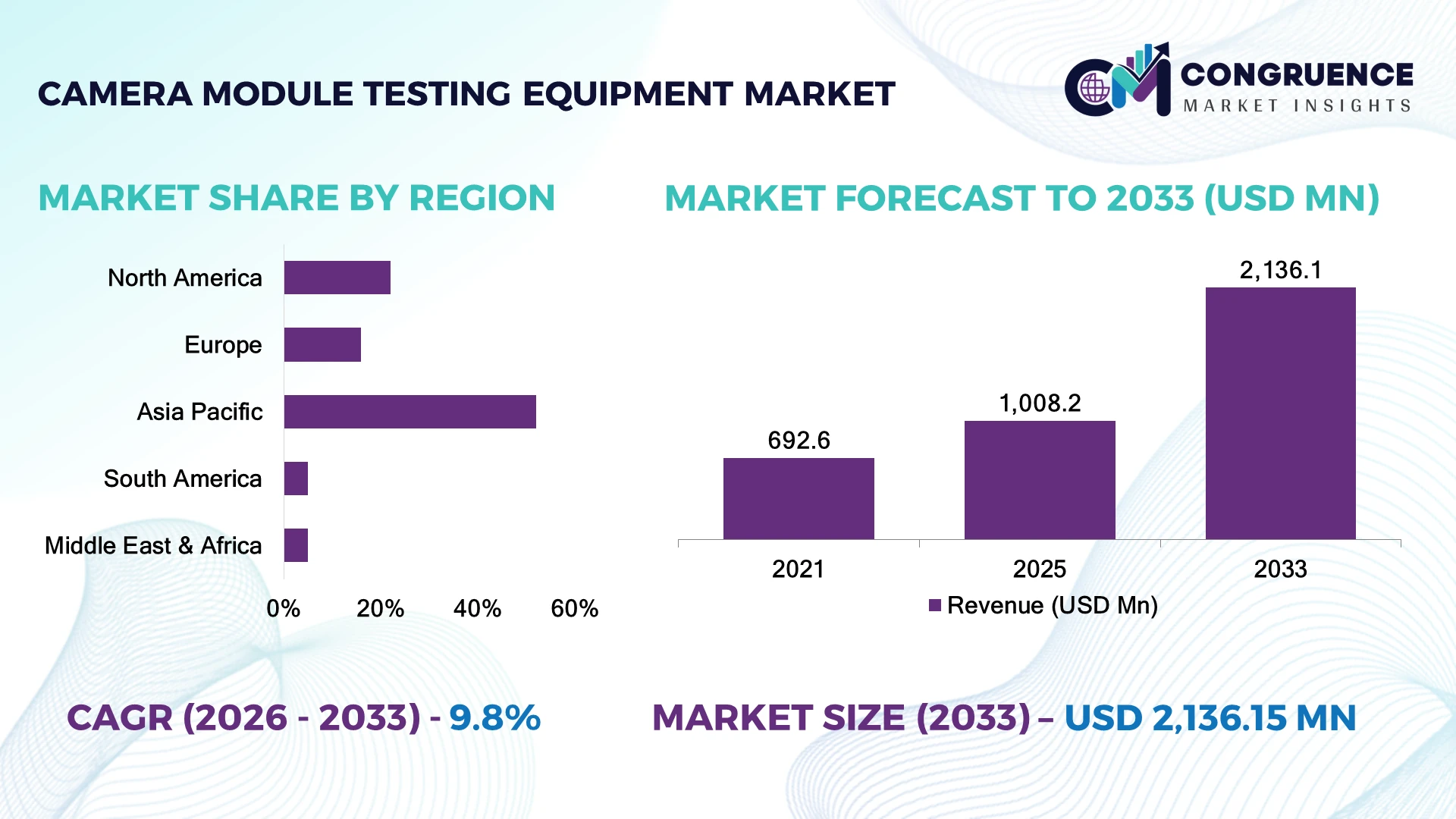
China dominates the market with nearly 38% share due to its extensive smartphone manufacturing base, more than USD 40 billion semiconductor ecosystem investments, and rapid deployment of automated camera inspection systems. Japan and South Korea follow with advanced imaging technology capabilities, while India is expanding through electronics manufacturing initiatives with camera module production growth exceeding 20% annually. Compared with Japan’s precision-led testing ecosystem, China focuses on high-volume manufacturing scalability.
Strategic investment in AI-based testing platforms and localized supply chains will determine future competitive positioning.
Market Size & Growth: USD 1,008.2 Million in 2025 to USD 2,136.1 Million by 2033 at 9.84% CAGR, supported by AI-enabled inspection and advanced camera module complexity.
Top Growth Drivers: Smartphone camera upgrades (35%), automotive ADAS adoption (28%), and factory automation expansion (22%) are accelerating equipment deployment.
Short-Term Forecast: By 2028, automated testing adoption is projected to reduce inspection cycle time by 30% and improve defect detection efficiency by 25%.
Emerging Technologies: AI vision analytics, robotic testing platforms, and high-resolution optical measurement systems are reshaping quality control operations.
Regional Leaders: Asia-Pacific is projected at USD 1.35 Billion by 2033 with electronics expansion; North America at USD 420 Million with automotive imaging adoption; Europe at USD 300 Million with industrial automation demand.
Consumer/End-User Trends: More than 60% of premium smartphones use multi-camera configurations, increasing demand for precision testing equipment.
Pilot/Case Example: In 2024, automated optical inspection deployment in electronics factories improved testing throughput by 35% and reduced manual inspection dependency.
Competitive Landscape: Key players include Advantest, Teradyne, Keysight Technologies, Viavi Solutions, and Chroma ATE, with leading suppliers controlling approximately 40% of the market.
Regulatory & ESG Impact: Energy-efficient automated testing systems reduce manufacturing waste by nearly 20% while supporting global electronics sustainability targets.
Investment & Funding: Over USD 5 billion invested globally in semiconductor and electronics manufacturing expansion, driving testing equipment partnerships and facility upgrades.
Innovation & Future Outlook: Next-generation systems integrating AI, machine learning, and digital twins are shifting the market toward predictive quality management.
Camera Module Testing Equipment solutions are becoming essential across smartphone, automotive, security, and industrial imaging applications as manufacturers prioritize higher accuracy and faster production validation. Recent innovations include AI-powered defect classification and automated calibration systems, with advanced inspection platforms improving testing accuracy by around 25%. Supply-chain localization efforts in China, India, and Southeast Asia are also strengthening regional equipment deployment strategies.
The Camera Module Testing Equipment Market is becoming strategically important as imaging technologies move from consumer electronics into automotive safety, robotics, and industrial automation. The restructuring of semiconductor supply chains and expansion of localized electronics manufacturing in countries such as India and Vietnam are increasing demand for advanced testing infrastructure.
AI-based testing platforms are replacing traditional manual inspection methods by improving defect identification accuracy by nearly 30% while reducing testing time by approximately 35%. Compared with legacy optical inspection systems, automated solutions provide higher throughput, real-time analytics, and lower operational dependency. China maintains scale advantages through large electronics manufacturing clusters, while Japan and South Korea lead in precision imaging technologies.
Over the next 2–3 years, companies are prioritizing partnerships with semiconductor manufacturers, automotive camera suppliers, and automation providers to strengthen testing capabilities. For example, smartphone module producers are deploying automated calibration lines to manage increasing camera complexity. Strategic investment in intelligent testing platforms will define competitive advantage by improving production reliability, reducing quality losses, and supporting next-generation imaging applications.
The increasing complexity of camera modules is accelerating demand for advanced testing equipment across electronics manufacturing. Multi-camera smartphones, automotive cameras, and machine vision systems are driving adoption, with AI-based inspection improving defect recognition rates by nearly 30% and reducing manual testing requirements by over 25%. China’s electronics manufacturing ecosystem and South Korea’s semiconductor industry are expanding automated testing capacity to support higher precision requirements. Companies are responding through investments in AI-enabled optical testing, robotic calibration systems, and strategic partnerships with module manufacturers. The shift toward autonomous quality control is creating operational advantages through faster validation cycles and improved production consistency.
High initial investment requirements and dependence on specialized optical components remain key barriers for smaller manufacturers. Advanced camera testing systems can increase production setup costs by 20–30% compared with conventional inspection approaches. Global supply-chain disruptions affecting precision sensors and semiconductor components have increased equipment delivery challenges, particularly across Southeast Asian manufacturing hubs. Companies are reducing exposure through supplier diversification, localized production agreements, and long-term component contracts. The strategic challenge is balancing advanced testing capabilities with cost efficiency while maintaining competitiveness in price-sensitive electronics manufacturing markets.
Growing adoption of automotive cameras and industrial vision systems is creating new opportunities beyond smartphones. Advanced driver assistance systems require high-precision camera validation, with automotive imaging applications expanding by more than 25% annually in major manufacturing markets. Germany, Japan, and China are increasing investments in vehicle automation and smart factory infrastructure. Companies are positioning through R&D partnerships, AI software integration, and customized testing solutions for automotive-grade modules. The emerging opportunity lies in predictive testing platforms that combine hardware validation with real-time analytics to improve reliability and reduce manufacturing losses.
Rapid changes in camera resolution, sensor architecture, and AI algorithms create continuous integration challenges for testing equipment providers. Manufacturers upgrading from conventional systems face compatibility issues, with nearly 30% of production facilities requiring workflow modifications during automation transitions. Cybersecurity requirements for connected testing platforms are also increasing as factories adopt Industry 4.0 technologies. Companies must invest in flexible architectures, software upgrades, workforce training, and ecosystem partnerships to maintain deployment consistency. Long-term competitiveness depends on developing adaptable testing platforms capable of supporting evolving imaging technologies and global manufacturing standards.
AI Vision Integration Growth AI-driven inspection systems are reshaping camera module testing workflows, with automated defect recognition improving accuracy by 25–35% and reducing manual inspection dependency by nearly 30%. Electronics manufacturers in China and South Korea are integrating machine learning algorithms into optical testing lines to manage higher-resolution sensors. Companies are scaling AI-enabled platforms to improve throughput, reduce rework costs, and support increasingly complex camera architectures.
Automated Production Expansion Automated calibration and robotic testing systems are gaining adoption as manufacturers address labor constraints and production consistency requirements. Advanced factories report testing cycle reductions of 20–40% after automation deployment, while smart manufacturing investments have increased across India’s electronics clusters. Companies are restructuring production lines through robotics partnerships and modular testing equipment to improve speed, flexibility, and operational efficiency.
Automotive Testing Transition Automotive camera validation is becoming a major workflow shift as ADAS regulations and vehicle automation requirements expand. Camera testing demand from automotive suppliers is increasing with more than 25% annual growth in vision-based system deployment. Manufacturers are adapting equipment designs for high-reliability testing, thermal validation, and multi-camera synchronization to support connected vehicle platforms.
Localized Supply Chain Shift Supply-chain restructuring is encouraging localized camera module testing equipment production and component sourcing. India, Vietnam, and Mexico are expanding electronics manufacturing capacity, reducing dependence on concentrated supplier networks. Nearly 20% improvement in equipment delivery efficiency has been targeted through regional sourcing strategies. Companies are establishing local partnerships and service networks to improve deployment speed and long-term equipment support.
Automated Optical Inspection (AOI) systems represent the leading type segment, accounting for approximately 42% of the market, driven by high-speed defect detection, repeatable measurement accuracy, and integration with smart manufacturing lines. Functional testing equipment follows with around 30% share due to its importance in validating camera performance, image quality, and module reliability. Companies are prioritizing AOI upgrades as production facilities require faster inspection cycles and reduced manual intervention. Image quality testing systems are emerging as the fastest-growing segment, supported by rising demand for high-resolution smartphone cameras, automotive vision modules, and AI-based imaging applications. Adoption of advanced image analysis tools is increasing by nearly 25% as manufacturers focus on calibration accuracy and performance consistency. Traditional electrical testing systems remain relevant for module validation, while companies are expanding partnerships to develop integrated platforms combining optical, functional, and AI-based testing capabilities.
Smartphone camera module testing remains the leading application segment with approximately 55% market share, supported by continuous upgrades in multi-camera systems, computational photography, and premium device specifications. Smartphone manufacturers require high-volume testing solutions capable of processing millions of modules annually, encouraging suppliers to develop faster automated inspection platforms. Companies are expanding testing capacity near major electronics manufacturing hubs to reduce production delays. Automotive camera testing is the fastest-growing application, supported by increasing ADAS adoption and vehicle safety requirements. Deployment of automotive vision systems is expanding by more than 30% in major vehicle manufacturing markets, increasing demand for reliability testing and environmental validation. Security cameras, industrial imaging, and medical imaging applications are also gaining importance as organizations adopt intelligent vision systems. Companies are developing customized testing solutions to address application-specific accuracy and compliance requirements.
Electronics manufacturers represent the leading end-user segment with approximately 50% market share due to large-scale smartphone, consumer device, and semiconductor production requirements. These companies rely on automated testing equipment to maintain quality standards while improving manufacturing efficiency. Major manufacturers in China, South Korea, and Taiwan are investing in advanced testing infrastructure, with automation reducing production inspection workloads by nearly 30%. Automotive component manufacturers are the fastest-growing end-user group as vehicle cameras become essential for ADAS and autonomous driving systems. Adoption among automotive suppliers is increasing by over 25% as testing requirements become more stringent for safety-critical components. Semiconductor companies, research institutes, and third-party testing service providers continue to support innovation through specialized validation capabilities. Equipment providers are responding with modular solutions, service partnerships, and customized platforms designed for different production environments.
Asia-Pacific accounted for the largest market share at 52% in 2025 however, North America is expected to register the fastest growth, expanding at a CAGR of 10.6% between 2026 and 2033.
North America is strengthening its position through advanced imaging, semiconductor, and automotive testing capabilities, accounting for approximately 22% of the global market. The United States represents the primary demand center due to investments in semiconductor manufacturing, automotive automation, and defense imaging systems. More than 60 new semiconductor and electronics manufacturing projects announced under domestic production initiatives are increasing demand for precision testing equipment. Companies are deploying AI-powered inspection platforms and automated calibration systems to improve production accuracy, reduce manual testing dependency, and support localized supply chains. Strategic partnerships between equipment providers and semiconductor manufacturers are accelerating adoption across high-value applications.
United States Market Outlook: The United States leads North America through semiconductor ecosystem expansion, automotive camera innovation, and advanced manufacturing adoption. Over 40% of regional testing equipment demand is concentrated among electronics, automotive, and semiconductor manufacturers. Companies are increasing investments in automated optical testing solutions to support domestic chip production, vehicle automation programs, and next-generation imaging technologies.
Europe holds nearly 16% market share, supported by automotive manufacturing, industrial automation, and advanced engineering capabilities. Germany remains the largest contributor due to its automotive supply chain and Industry 4.0 manufacturing ecosystem. Increasing demand for vehicle cameras, machine vision systems, and quality validation processes is encouraging manufacturers to modernize testing infrastructure. More than 35% of European automotive production facilities have adopted advanced automation technologies, improving manufacturing consistency. Companies are focusing on energy-efficient testing platforms, software-driven inspection systems, and partnerships with automotive suppliers to meet higher reliability standards and strengthen regional production competitiveness.
Germany Market Outlook: Germany remains the strategic hub for Europe’s camera module testing equipment demand due to its automotive engineering base and smart factory deployment. The country contributes nearly 40% of European automotive camera system production activity. Manufacturers are integrating automated testing solutions to support electric vehicles, ADAS technologies, and precision manufacturing requirements.
Asia-Pacific dominates the global market with approximately 52% share due to large-scale smartphone production, semiconductor manufacturing, and electronics assembly networks. China, South Korea, Japan, and Taiwan represent the primary deployment centers, supported by extensive camera module production capacity. China accounts for more than 35% of global smartphone manufacturing output, driving strong demand for automated testing systems. Companies are expanding production facilities, integrating AI inspection technologies, and establishing localized supply chains to improve manufacturing efficiency. Rising adoption of multi-camera smartphones and automotive vision systems is increasing demand for high-speed, high-precision testing equipment across electronics clusters.
China Market Outlook: China maintains the strongest position due to its electronics manufacturing scale, semiconductor investments, and camera module production ecosystem. The country produces more than half of the world’s smartphones, creating continuous demand for advanced testing solutions. Manufacturers are prioritizing automated inspection, AI-based analysis, and localized equipment partnerships to improve production quality and reduce supply-chain dependency.
South America represents an emerging market with approximately 5% global share, supported by electronics assembly growth, automotive manufacturing, and security imaging demand. Brazil is the key contributor due to its industrial base and expanding technology adoption across automotive and consumer electronics sectors. Regional manufacturers are increasing automation investments as they address production efficiency challenges and quality requirements. Electronics facilities adopting automated testing solutions have reported inspection efficiency improvements of nearly 20%. Companies are focusing on localized service networks, equipment leasing models, and partnerships to overcome infrastructure limitations and improve accessibility of advanced testing technologies.
Brazil Market Outlook: Brazil leads South America through automotive production capacity, electronics assembly activity, and industrial modernization programs. The country accounts for more than 50% of regional electronics manufacturing activity. Companies are gradually adopting automated camera testing equipment to improve production reliability and support growing demand for automotive and security imaging applications.
Middle East & Africa accounts for approximately 5% of the global market, with growth supported by smart city projects, surveillance infrastructure, and technology manufacturing investments. The United Arab Emirates and Saudi Arabia are increasing adoption of advanced imaging systems across security, transportation, and industrial applications. Smart infrastructure programs are driving demand for reliable camera module validation, with technology investments exceeding billions of dollars across digital transformation initiatives. Companies are expanding regional partnerships, service capabilities, and customized testing solutions to support new deployment environments. The region’s transition toward automated infrastructure creates opportunities for advanced imaging quality-control systems.
United Arab Emirates Market Outlook: The UAE is emerging as the regional technology hub due to smart city development, security infrastructure modernization, and advanced automation adoption. More than 70% of major urban technology projects incorporate intelligent imaging systems. Companies are strengthening partnerships and deploying automated testing platforms to support surveillance, mobility, and industrial applications.
The Camera Module Testing Equipment Market features competition between global automation leaders such as Advantest, Teradyne, Keysight Technologies, and regional equipment specialists focused on customized optical inspection solutions. Leading suppliers compete against Asian manufacturers through technology depth, pricing flexibility, and faster deployment support. The top five players collectively account for approximately 45% of market share, creating a moderately consolidated structure. Competition is driven by AI-based inspection accuracy, with automated platforms improving defect detection by 30%, while advanced systems reduce testing cycles by 25%. Players are expanding through semiconductor partnerships, software integration, and localized service networks. Global companies emphasize high-performance platforms, while regional suppliers compete through cost advantages and customization. The competitive landscape is shifting toward intelligent testing ecosystems, vertical integration, and supply-chain localization. High capital requirements, engineering expertise, and customer qualification cycles create entry barriers. Winning requires combining automation capability, precision performance, flexible solutions, and strong manufacturing partnerships.
Teradyne Inc.
Keysight Technologies Inc.
Chroma ATE Inc.
Viavi Solutions Inc.
Yokogawa Test & Measurement Corporation
National Instruments Corporation
Jabil Inc.
AIXTRON SE
Cohu Inc.
TRIOPTICS GmbH
EOL IT Services GmbH
Artificial intelligence-based inspection is becoming a core technology in camera module testing, replacing manual analysis with automated defect classification and predictive quality monitoring. AI-enabled systems improve inspection accuracy by 25–35% and reduce testing time by nearly 30%. Manufacturers in China, South Korea, and Taiwan are increasing deployment of machine learning platforms to manage complex multi-camera modules and high-resolution sensors.
Advanced optical testing, robotic automation, and high-speed calibration systems are improving production efficiency across electronics and automotive applications. Compared with traditional inspection methods, automated optical platforms deliver approximately 40% faster validation cycles while reducing operator dependency. More than 60% of large electronics manufacturers are integrating automated quality-control workflows, creating advantages for suppliers offering flexible and scalable systems.
Between 2026 and 2028, digital twins, edge analytics, and connected testing platforms will influence competitive positioning. Companies investing in software-driven testing ecosystems will gain stronger operational visibility, lower production losses, and faster product qualification. Technology leaders benefit through premium solutions, while cost-focused suppliers must accelerate automation partnerships to remain competitive.
October 2025 Teradyne introduced the ETS-800 Dual Sector Automated Test System, expanding its automated testing portfolio for advanced semiconductor and electronics applications. The platform enhanced parallel testing capability and improved manufacturing throughput for complex devices. This development strengthens Teradyne’s position in high-volume automated validation environments supporting next-generation imaging components. Source: www.teradyne.com
September 2025 Teradyne received recognition as a TSMC Open Innovation Platform Partner of the Year, highlighting its collaboration in advanced semiconductor testing solutions. The partnership supports improved test efficiency and ecosystem integration for emerging semiconductor applications, including components used in advanced consumer electronics and imaging systems. Source: www.teradyne.com
January 2025 Teradyne announced a strategic partnership with Infineon Technologies to advance automated test capabilities for power semiconductor applications. The collaboration strengthened semiconductor validation infrastructure and supported higher-performance electronic testing workflows required for automotive and industrial imaging systems. Source: www.teradyne.com
April 2025 Teradyne highlighted the evolution of automated test equipment driven by AI, high-performance computing, silicon photonics, and automotive electronics complexity. The company emphasized increasing demand for advanced testing methodologies as semiconductor designs become more complex, creating opportunities for intelligent testing platforms.
The Camera Module Testing Equipment Market Report covers comprehensive analysis across equipment types, including automated optical testing, functional testing, image quality testing, and electrical validation systems. The report evaluates applications across smartphones, automotive cameras, industrial imaging, security systems, and medical imaging sectors. End-user analysis includes electronics manufacturers, automotive suppliers, semiconductor companies, and testing service providers across major global markets.
The report provides regional insights across North America, Europe, Asia-Pacific, South America, and Middle East & Africa, highlighting manufacturing concentration, technology adoption, and deployment trends. It analyzes AI inspection, automation, robotics, digital testing platforms, and emerging validation technologies. Covering strategic developments from 2026 to 2033, the study supports investment decisions, expansion planning, competitive benchmarking, partnership strategies, and identification of high-potential opportunities in advanced imaging quality-control ecosystems.
| Report Attribute / Metric | Details |
|---|---|
| Market Revenue (2025) | USD 1,008.2 Million |
| Market Revenue (2033) | USD 2,136.1 Million |
| CAGR (2026–2033) | 9.84% |
| Base Year | 2025 |
| Forecast Period | 2026–2033 |
| Historic Period | 2021–2025 |
| Segments Covered |
By Type
By Application
By End-User
|
| Key Deliverables | Revenue Forecast; Market Trends; Growth Drivers & Restraints; Technology Insights; Segmentation Analysis; Regional Insights; Competitive Landscape; Regulatory & ESG Overview; Recent Developments |
| Regions Covered | North America; Europe; Asia-Pacific; South America; Middle East & Africa |
| Companies Profiled | Advantest Corporation; Teradyne Inc.; Keysight Technologies Inc.; Chroma ATE Inc.; Viavi Solutions Inc.; Yokogawa Test & Measurement Corporation; National Instruments Corporation; Jabil Inc.; Cohu Inc.; TRIOPTICS GmbH; AIXTRON SE; EOL IT Services GmbH |
| Customization & Pricing | Available on Request (10% Customization Free) |




