
Reports
The Global Camera Module Manufacturing Systems Market was valued at USD 3,054.7 Million in 2025 and is anticipated to reach a value of USD 6,222.0 Million by 2033 expanding at a CAGR of 9.3% between 2026 and 2033. Growth is driven by rising deployment of automated optical alignment, wafer-level packaging, and AI-enabled inspection systems supporting high-resolution camera module production across consumer electronics and automotive sectors.
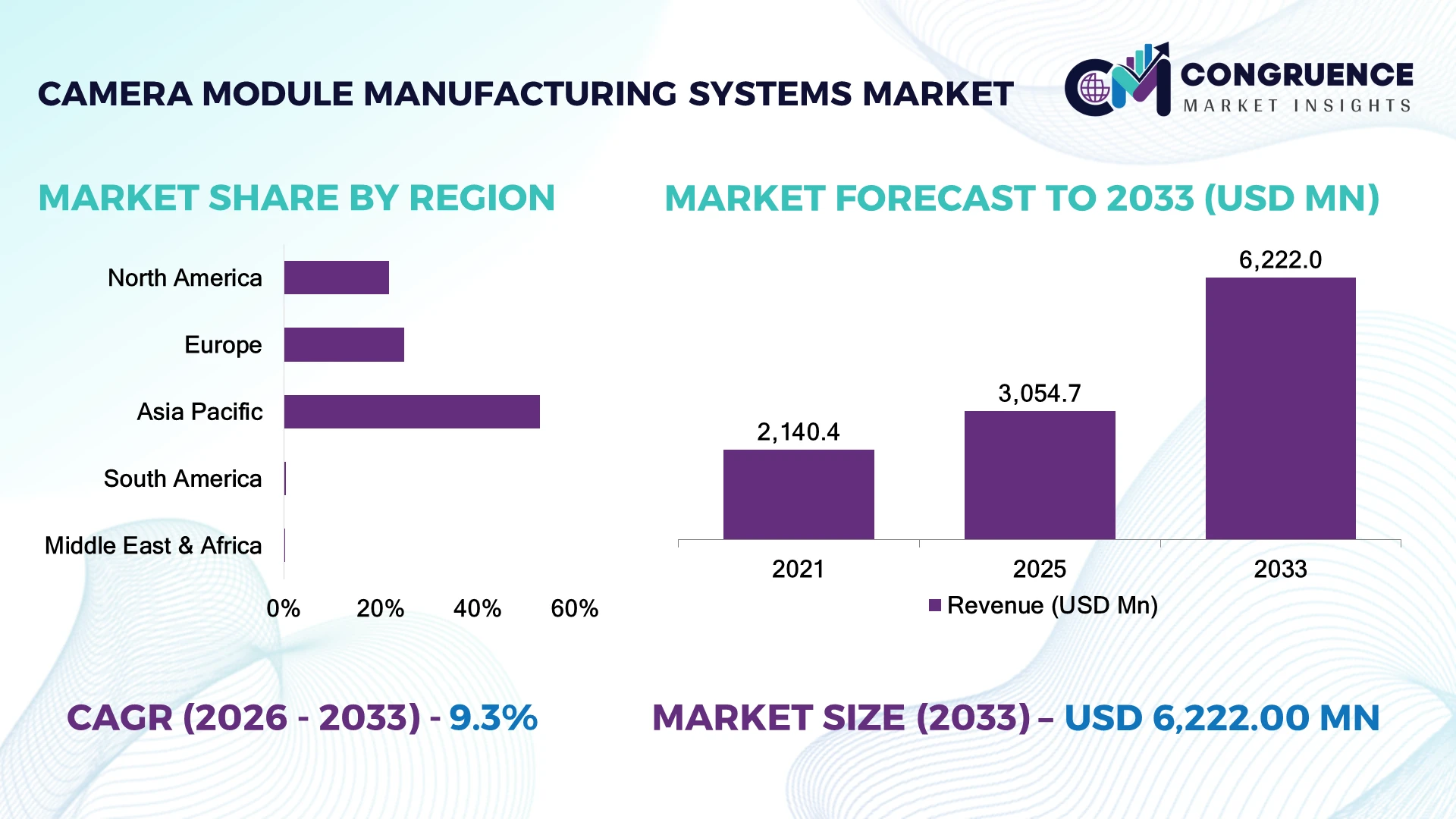
China accounts for approximately 46% of global camera module manufacturing capacity, supported by large-scale investments in smartphone, automotive electronics, and semiconductor packaging facilities. More than 71% of newly commissioned production lines incorporate AI-driven vision inspection and precision active alignment technologies, compared with approximately 39% in Vietnam, where manufacturing expansion is accelerating through supply-chain diversification following geopolitical trade realignments. Precision automation continues strengthening production consistency while reducing assembly defects.
Manufacturers investing in intelligent manufacturing platforms and vertically integrated production systems are securing long-term competitiveness across high-value imaging applications.
Market Size & Growth: USD 3,054.7 Million in 2025, reaching USD 6,222.0 Million by 2033 at 9.3% CAGR, driven by AI-enabled manufacturing and advanced camera integration.
Top Growth Drivers: Active alignment adoption 34%, automotive imaging demand 29%, factory automation 26%.
Short-Term Forecast: By 2028, assembly efficiency improves 24% while defect rates decline 18%.
Emerging Technologies: AI vision inspection, robotic active alignment, wafer-level optics, and digital twin manufacturing accelerate productivity.
Regional Leaders: Asia-Pacific exceeds USD 3.2 Billion, Europe approaches USD 1.3 Billion, North America surpasses USD 1.1 Billion with advanced automation investments.
Consumer/End-User Trends: Around 68% of premium smartphone camera modules now require automated precision alignment during production.
Pilot/Case Example: A 2026 smart production upgrade increased alignment accuracy by 32% and reduced inspection time by 21%.
Competitive Landscape: Leading manufacturers control approximately 47% market share, led by ASMPT, Canon Machinery, Hanmi Semiconductor, Musashi Engineering, and Kulicke & Soffa.
Regulatory & ESG Impact: Automated process optimization lowers material waste by approximately 16% across advanced production facilities.
Investment & Funding: More than USD 2.6 Billion supports intelligent electronics manufacturing expansion and precision automation.
Innovation & Future Outlook: High-speed AI inspection, micro-optics integration, and flexible manufacturing platforms are redefining camera module production.
Camera Module Manufacturing Systems are increasingly deployed across smartphone, automotive ADAS, industrial vision, and medical imaging production where micron-level precision directly determines optical performance. AI-enabled inspection improves manufacturing yield by approximately 27%, while advanced robotic alignment reduces calibration time. Supply-chain localization and semiconductor packaging investments continue accelerating factory modernization, creating a strong foundation for the market's strategic transformation.
Camera Module Manufacturing Systems have become strategically important as imaging performance increasingly differentiates smartphones, intelligent vehicles, industrial automation, and healthcare devices. Manufacturers are restructuring production networks through supply-chain diversification, greater automation, and digital factory investments to improve production resilience and shorten product development cycles. Precision manufacturing capability has become a critical competitive advantage rather than simply a production requirement.
Modern AI-enabled active alignment systems improve positioning accuracy by approximately 31% while reducing assembly cycle time by nearly 22% compared with conventional manual calibration platforms. China continues leading manufacturing scale and equipment deployment, while Japan and South Korea maintain technological leadership in precision optics and advanced automation. Over the next two to three years, more than 65% of newly commissioned camera module production lines are expected to incorporate intelligent inspection and real-time process analytics.
Leading equipment suppliers are deploying integrated manufacturing cells combining dispensing, alignment, bonding, inspection, and traceability into unified production platforms. Companies are expanding engineering partnerships, investing in semiconductor-compatible automation, and strengthening regional manufacturing capabilities to support automotive and premium imaging applications. Long-term competitiveness will depend on production precision, digital integration, manufacturing flexibility, and the ability to rapidly scale next-generation camera technologies across multiple end-use industries.
The rapid transition toward high-resolution smartphone cameras, automotive vision systems, and AI-powered imaging devices is accelerating investment in precision camera module manufacturing systems. Approximately 69% of newly commissioned production lines now integrate automated active alignment and AI-driven optical inspection, while robotic assembly improves first-pass production yield by nearly 26%. China's continued investment in advanced electronics manufacturing and semiconductor packaging, combined with supply-chain diversification across Southeast Asia, is driving deployment of next-generation assembly platforms. Equipment manufacturers are expanding smart factory portfolios, strengthening robotics partnerships, and investing in software-defined production systems. A significant strategic advantage now comes from reducing micron-level alignment errors while increasing throughput across multiple camera module configurations within a single manufacturing platform.
Camera module manufacturing systems depend on ultra-precision motion platforms, optical alignment equipment, industrial vision sensors, and semiconductor-grade components, creating substantial capital and sourcing challenges. Approximately 44% of total equipment value is concentrated in precision automation and optical positioning technologies, while specialised component costs have increased lifecycle operating expenditure by nearly 18%. Japan remains a major supplier of high-precision optics and motion control technologies, exposing manufacturers to procurement risks during semiconductor and electronics supply-chain fluctuations. These constraints delay production expansion and reduce investment flexibility for mid-sized manufacturers. Companies are addressing these pressures through supplier diversification, localized precision component manufacturing, and modular equipment architectures that simplify maintenance while improving operational resilience.
Advanced AI vision analytics, digital twins, and adaptive robotic calibration are creating new opportunities beyond traditional assembly automation. AI-driven defect classification improves inspection accuracy by approximately 33%, while predictive process optimisation reduces production scrap by nearly 19%. India's electronics manufacturing expansion and Vietnam's increasing investment in smartphone assembly are generating demand for scalable camera module manufacturing platforms. Equipment providers are expanding R&D in closed-loop alignment algorithms, collaborative robotics, and cloud-based manufacturing intelligence while establishing ecosystem partnerships with semiconductor packaging specialists. A distinctive opportunity lies in unified production platforms capable of assembling smartphone, automotive, and industrial camera modules with minimal equipment reconfiguration, significantly improving factory asset utilisation.
Modern camera module manufacturing requires seamless integration of dispensing, bonding, active alignment, autofocus calibration, optical inspection, and traceability within a synchronized production environment. Approximately 48% of brownfield electronics factories require customised software integration before achieving stable high-volume production, while system commissioning extends implementation timelines by nearly 21%. Increasing cybersecurity requirements for connected industrial equipment add complexity as manufacturers deploy cloud-based production monitoring. These challenges affect deployment consistency and factory scalability rather than equipment availability. Equipment suppliers must strengthen open automation standards, digital engineering capabilities, workforce training, and collaborative integration partnerships to deliver flexible manufacturing systems capable of supporting rapidly evolving imaging technologies.
Active Alignment Becomes Standard: Automated active alignment is now integrated into approximately 72% of newly installed premium camera module production lines, improving optical alignment accuracy by nearly 29% while reducing manual calibration time by 24%. Smartphone camera complexity and automotive imaging requirements are prompting manufacturers to scale robotic alignment technologies across high-volume manufacturing facilities.
Inline AI Inspection Expands: AI-powered visual inspection platforms improve defect detection by approximately 31% while reducing false rejection rates by nearly 18%. Growing quality requirements for multi-camera smartphones and ADAS sensors are encouraging manufacturers to replace offline inspection workflows with continuous inline quality verification integrated directly into automated production systems.
Flexible Production Cells Increase: Modular manufacturing cells now account for approximately 37% of new camera module equipment deployments, reducing product changeover time by nearly 26%. Electronics manufacturers responding to shorter product lifecycles are restructuring production with reconfigurable automation capable of supporting multiple sensor sizes and optical architectures using shared manufacturing infrastructure.
Traceability Integration Strengthens: Digital traceability systems are deployed across approximately 58% of advanced camera module manufacturing facilities, reducing quality investigation time by nearly 23% while improving process transparency. Tightening automotive qualification standards and semiconductor supply-chain accountability are encouraging equipment suppliers to integrate manufacturing execution systems, real-time analytics, and lifecycle data management into complete production platforms.
Fully automated camera module manufacturing systems account for approximately 69% of the market because they deliver superior throughput, micron-level positioning accuracy, and seamless integration with active alignment, dispensing, bonding, and AI-based inspection processes. These systems have become the preferred choice for high-volume smartphone and automotive camera production where precision, repeatability, and low defect rates directly influence profitability. Semi-automated manufacturing systems continue serving small and mid-volume electronics manufacturers, pilot production, and specialised imaging applications that require greater operational flexibility with lower initial investment.
Fully automated intelligent production lines represent the fastest-growing segment as manufacturers accelerate digital factory deployment and reduce manual intervention. Adoption has increased by approximately 30%, while AI-assisted process optimisation improves production yield by nearly 25%. Around 62% of newly commissioned camera module assembly facilities now specify integrated automation platforms with closed-loop quality control and traceability. Equipment suppliers are strengthening robotics capabilities, expanding software integration, and developing modular production architectures to address diversified camera module formats and evolving customer requirements.
A 2026 enterprise assessment by an international electronics manufacturing association indicated that fully automated optical assembly lines have become the preferred investment for large-scale camera module production due to superior consistency, productivity, and process traceability.
Smartphone camera module manufacturing accounts for approximately 58% of equipment demand because premium mobile devices require multiple high-resolution camera modules assembled with micron-level precision and high production throughput. Continuous upgrades in image sensors, optical stabilisation, and multi-camera architectures sustain investment in advanced manufacturing systems. Automotive camera modules have emerged as the fastest-expanding application, while industrial vision equipment, security cameras, and medical imaging systems continue creating specialised opportunities requiring flexible and high-precision assembly platforms.
Automotive imaging represents the fastest-growing application as ADAS deployment and intelligent vehicle platforms increase demand for highly reliable camera modules. Adoption has expanded by approximately 33%, while automated calibration improves manufacturing consistency by nearly 22%. Around 54% of new automotive camera production facilities now integrate AI-based optical inspection and digital traceability. Equipment manufacturers are responding through dedicated automotive production platforms, expanded cleanroom automation, and integrated quality assurance technologies that strengthen production efficiency across safety-critical imaging applications.
According to a 2025 institutional survey from a leading electronics manufacturing authority, automated active alignment and digital inspection have become standard specifications for new smartphone and automotive camera module production facilities.
Consumer electronics manufacturers account for approximately 63% of camera module manufacturing system procurement due to large-scale smartphone, tablet, notebook, and wearable device production. Frequent product launches, higher imaging performance expectations, and continuous manufacturing upgrades sustain demand for intelligent automation and precision assembly equipment. Automotive component manufacturers remain another major buyer group, while medical device companies, industrial vision suppliers, and contract electronics manufacturers continue investing in specialised production capabilities supporting high-value imaging applications.
Automotive electronics manufacturers represent the fastest-growing end-user segment as vehicle electrification and advanced driver assistance technologies increase camera integration. Procurement has expanded by approximately 29%, while automated optical calibration improves production reliability by nearly 24%. Approximately 51% of newly installed automotive camera assembly systems include integrated traceability and AI-assisted inspection capabilities. Equipment suppliers are strengthening industry-specific engineering support, customised production platforms, collaborative development programmes, and long-term service agreements to secure strategic customer relationships in rapidly evolving imaging markets.
A 2026 industry study published by a global automotive electronics organization reported that manufacturers continue increasing investment in automated camera module production systems to support expanding ADAS deployment and stringent quality validation requirements.
Asia-Pacific accounted for the largest market share at 52.8% in 2025 however, North America is expected to register the fastest growth, expanding at a CAGR of 10.1% between 2026 and 2033.
Advanced Imaging Automation Drives Manufacturing Modernization
North America continues strengthening its position through investments in semiconductor packaging, automotive imaging, and advanced electronics manufacturing. The region accounts for approximately 21.7% of global demand, supported by increasing deployment of AI-enabled inspection systems, robotic active alignment, and automated optical testing. More than 58% of newly commissioned camera module production facilities incorporate digital manufacturing execution systems integrated with precision assembly equipment. Expanding investments in automotive vision systems and domestic semiconductor production are accelerating adoption of intelligent manufacturing platforms. Equipment suppliers are strengthening partnerships with semiconductor manufacturers and automotive technology providers to improve production flexibility and shorten product qualification cycles.
United States Market Outlook: The United States leads the regional market through advanced semiconductor infrastructure, strong automotive technology investment, and expanding AI hardware manufacturing. Electronics manufacturers continue integrating automated camera module assembly with advanced packaging facilities to support premium smartphones, autonomous driving technologies, and industrial vision applications. Approximately 61% of newly deployed precision optical assembly systems feature AI-assisted quality inspection and real-time manufacturing analytics, reinforcing operational efficiency and product consistency.
Precision Engineering Strengthens Smart Manufacturing
Europe maintains a strong market position through expertise in industrial automation, precision machinery, and automotive electronics manufacturing. The region contributes approximately 24.8% of global demand, supported by advanced optical manufacturing and increasing integration of intelligent robotics into electronics production. Nearly 54% of newly installed precision assembly systems feature automated metrology and closed-loop calibration capabilities. Manufacturers continue modernising production facilities with energy-efficient automation, high-accuracy dispensing technologies, and digital quality management systems to support premium imaging applications.
Germany Market Outlook: Germany remains Europe's technology leader through its strong industrial automation ecosystem, advanced machinery manufacturing, and premium automotive electronics industry. Domestic manufacturers continue investing in precision motion systems, industrial robotics, and optical alignment technologies to strengthen high-value camera module production. Approximately 57% of advanced electronics manufacturing facilities now deploy digitally integrated camera module assembly platforms supporting industrial imaging and automotive vision applications.
Large-Scale Electronics Manufacturing Sustains Market Leadership
Asia-Pacific dominates the Camera Module Manufacturing Systems market through its unmatched electronics manufacturing ecosystem, semiconductor packaging capacity, and vertically integrated supply chains. The region accounts for approximately 52.8% of global demand, with smartphone manufacturers, image sensor producers, and contract electronics companies continuously expanding production capabilities. Around 68% of newly established camera module production lines deploy AI-driven alignment and automated optical inspection technologies. Ongoing investment in advanced manufacturing infrastructure and export-oriented electronics production continues strengthening the region's competitive position across consumer and automotive imaging markets.
China Market Outlook: China represents the world's largest manufacturing base for camera modules, supported by extensive smartphone production, semiconductor packaging facilities, and integrated electronics supply chains. Domestic manufacturers continue expanding smart factory investments while accelerating adoption of AI-enabled inspection and robotic assembly systems. Approximately 72% of premium smartphone camera module production capacity is supported by highly automated manufacturing lines, enabling high-volume production with consistent optical precision.
Electronics Localization Encourages Production Investment
South America is gradually expanding its camera module manufacturing capability through electronics localisation initiatives, consumer device assembly, and industrial automation investments. Production remains concentrated around established electronics manufacturing hubs, while imported precision equipment continues supporting advanced assembly requirements. Approximately 34% of new electronics manufacturing projects incorporate automated optical inspection and precision assembly technologies. Although dependence on imported components and specialised engineering expertise limits rapid scaling, manufacturers continue improving operational capability through strategic technology partnerships and regional service expansion.
Brazil Market Outlook: Brazil remains the region's leading electronics manufacturing market due to its established consumer electronics industry and supportive industrial ecosystem. Manufacturers continue modernising production lines with automated inspection, dispensing, and precision alignment technologies to improve competitiveness in domestic device assembly. Nearly 49% of advanced electronics manufacturing investments within South America are concentrated in Brazil, strengthening its position as the region's primary deployment hub for camera module manufacturing systems.
Industrial Diversification Supports Electronics Manufacturing
The Middle East & Africa market is steadily developing as industrial diversification programmes encourage electronics manufacturing, semiconductor assembly, and smart technology investment. Governments are expanding industrial infrastructure while attracting foreign investment into advanced manufacturing and digital production facilities. Approximately 31% of recently announced electronics manufacturing projects include precision automation and intelligent inspection capabilities. Equipment suppliers are strengthening technical partnerships, workforce development programmes, and regional engineering support to establish sustainable manufacturing capabilities across emerging industrial economies.
Saudi Arabia Market Outlook: Saudi Arabia is emerging as the region's most strategically important market through industrial diversification, technology manufacturing initiatives, and investment in advanced production infrastructure. Electronics manufacturers are increasingly adopting automated assembly platforms supporting high-value electronic components and imaging technologies. Approximately 43% of announced advanced electronics manufacturing investments across the Gulf region are concentrated in Saudi Arabia, positioning the country as a future centre for precision manufacturing and industrial automation deployment.
Global automation specialists ASMPT, Canon Machinery, Hanmi Semiconductor, Musashi Engineering, and Kulicke & Soffa compete through precision alignment, while regional equipment suppliers challenge on delivery speed and manufacturing cost. The top five participants collectively account for approximately 46% of the market. Competition increasingly depends on micron-level positioning accuracy, AI-enabled inspection, and production throughput, with automated active alignment improving assembly precision by nearly 31%, AI inspection increasing first-pass yield by approximately 24%, and modular production cells reducing changeover time by almost 20%. Companies are expanding manufacturing capacity, forming semiconductor ecosystem partnerships, integrating software with factory automation platforms, and pursuing vertical integration across dispensing, bonding, alignment, and inspection processes. Competitive momentum is shifting toward intelligent, fully integrated production systems supporting automotive vision and advanced smartphone imaging. Precision motion control expertise and optical process validation remain major entry barriers. Market leadership demands superior automation, scalable integration, digital intelligence, and dependable global engineering support.
ASMPT Ltd.
Canon Machinery Inc.
Hanmi Semiconductor Co., Ltd.
Musashi Engineering, Inc.
Kulicke & Soffa Industries, Inc.
Besi (BE Semiconductor Industries N.V.)
Mycronic AB
Viscom AG
Fuji Corporation
Yamaha Motor Co., Ltd.
Shibaura Machine Co., Ltd.
Toray Engineering Co., Ltd.
DISCO Corporation
AI-driven active alignment, robotic dispensing, high-speed optical inspection, and precision motion control define current camera module manufacturing technology. Automated active alignment improves lens positioning accuracy by approximately 30%, while AI-based inspection reduces defect escape rates by nearly 25%. Around 68% of newly deployed premium production lines now combine alignment, bonding, calibration, and inspection into fully automated manufacturing cells. This integration improves production consistency, shortens cycle times, and enables manufacturers to handle increasingly compact, multi-camera architectures across consumer electronics and automotive applications.
Emerging technologies include digital twins, adaptive robotics, machine learning-based defect classification, and cloud-connected manufacturing analytics. Compared with conventional vision-guided assembly, intelligent closed-loop alignment systems improve production throughput by approximately 28% while reducing calibration errors by nearly 22%. Smartphone camera manufacturers and automotive imaging suppliers gain the greatest competitive advantage because these technologies accelerate product introduction, improve traceability, and reduce quality-related production losses across high-volume manufacturing.
Between 2026 and 2028, software-defined manufacturing, autonomous process optimisation, and integrated metrology will reshape precision camera module production. Adoption of AI-assisted manufacturing analytics is expected to exceed 65% across new intelligent factories. Equipment providers investing in interoperable automation platforms, advanced optical calibration, cybersecurity, and predictive maintenance will strengthen competitive differentiation while supporting next-generation imaging sensors, autonomous vehicle cameras, and industrial vision applications.
March 2025 ASMPT introduced its new high-resolution stationary camera for SIPLACE platforms, delivering six-times more pixels per ball for complex BGA inspection and improving processing flexibility for advanced electronics manufacturing. Source: ASMPT
March 2025 ASMPT showcased its DALA fully automated camera module assembly platform with ±7 µm placement precision, strengthening flexible inline production for smart electronics and automotive imaging applications. Source: ASMPT
November 2024 ASMPT highlighted advanced active alignment technology for high-volume LWIR camera manufacturing, supporting automated optical assembly for pedestrian safety systems with improved precision and scalable production capability. Source: Semi ASMPT
May 2025 Canon Machinery expanded its semiconductor and advanced packaging equipment strategy by advancing high-precision die bonding platforms with a 42% smaller equipment footprint, strengthening manufacturing efficiency for imaging and semiconductor applications. Source: Canon corporate strategy presentation.
The Camera Module Manufacturing Systems Market Report provides comprehensive analysis across fully automated and semi-automated manufacturing systems, covering smartphone, automotive, industrial vision, medical imaging, security, and consumer electronics applications. The assessment evaluates deployment across consumer electronics manufacturers, automotive component suppliers, contract manufacturers, and specialised imaging producers throughout Asia-Pacific, Europe, North America, South America, and the Middle East & Africa. More than 65% of new production facilities now deploy intelligent automation incorporating active alignment, AI inspection, and digital traceability.
The report further examines active alignment, robotic dispensing, precision bonding, optical inspection, AI-enabled quality analytics, digital twins, and factory automation integration shaping industry competitiveness between 2026 and 2033. Strategic insights cover technology adoption, production localisation, supply-chain transformation, equipment innovation, and competitive positioning across leading manufacturers. The analysis supports investment prioritisation, manufacturing expansion, partnership evaluation, product strategy, and long-term operational planning in the rapidly evolving precision imaging equipment industry.
| Report Attribute/Metric | Report Details |
|---|---|
|
Market Revenue in 2025 |
USD 3,054.7 Million |
|
Market Revenue in 2033 |
USD 6,222.0 Million |
|
CAGR (2026 - 2033) |
9.3% |
|
Base Year |
2025 |
|
Forecast Period |
2026 - 2033 |
|
Historic Period |
2021 - 2025 |
|
Segments Covered |
By Type
By Application
By End-User
|
|
Key Report Deliverable |
Revenue Forecast, Growth Trends, Market Dynamics, Segmental Overview, Regional and Country-wise Analysis, Competition Landscape |
|
Region Covered |
North America, Europe, Asia-Pacific, South America, Middle East, Africa |
|
Key Players Analyzed |
ASMPT Ltd., Canon Machinery Inc., Hanmi Semiconductor Co., Ltd., Musashi Engineering, Inc., Kulicke & Soffa Industries, Inc., Besi (BE Semiconductor Industries N.V.), Mycronic AB, Viscom AG, Fuji Corporation, Yamaha Motor Co., Ltd., Shibaura Machine Co., Ltd., Toray Engineering Co., Ltd., DISCO Corporation |
|
Customization & Pricing |
Available on Request (10% Customization is Free) |




