
Reports
The Global Calcium Carbonate Market was valued at USD 3,710.0 Million in 2025 and is anticipated to reach a value of USD 7,021.0 Million by 2033 expanding at a CAGR of 8.3% between 2026 and 2033. Growth is being driven by the shift toward high-purity PCC, ultrafine GCC, and surface-modified grades in paper, plastics, coatings, pharmaceuticals, and advanced composites, where particle-size engineering improves filler performance and reduces reliance on higher-cost additives.
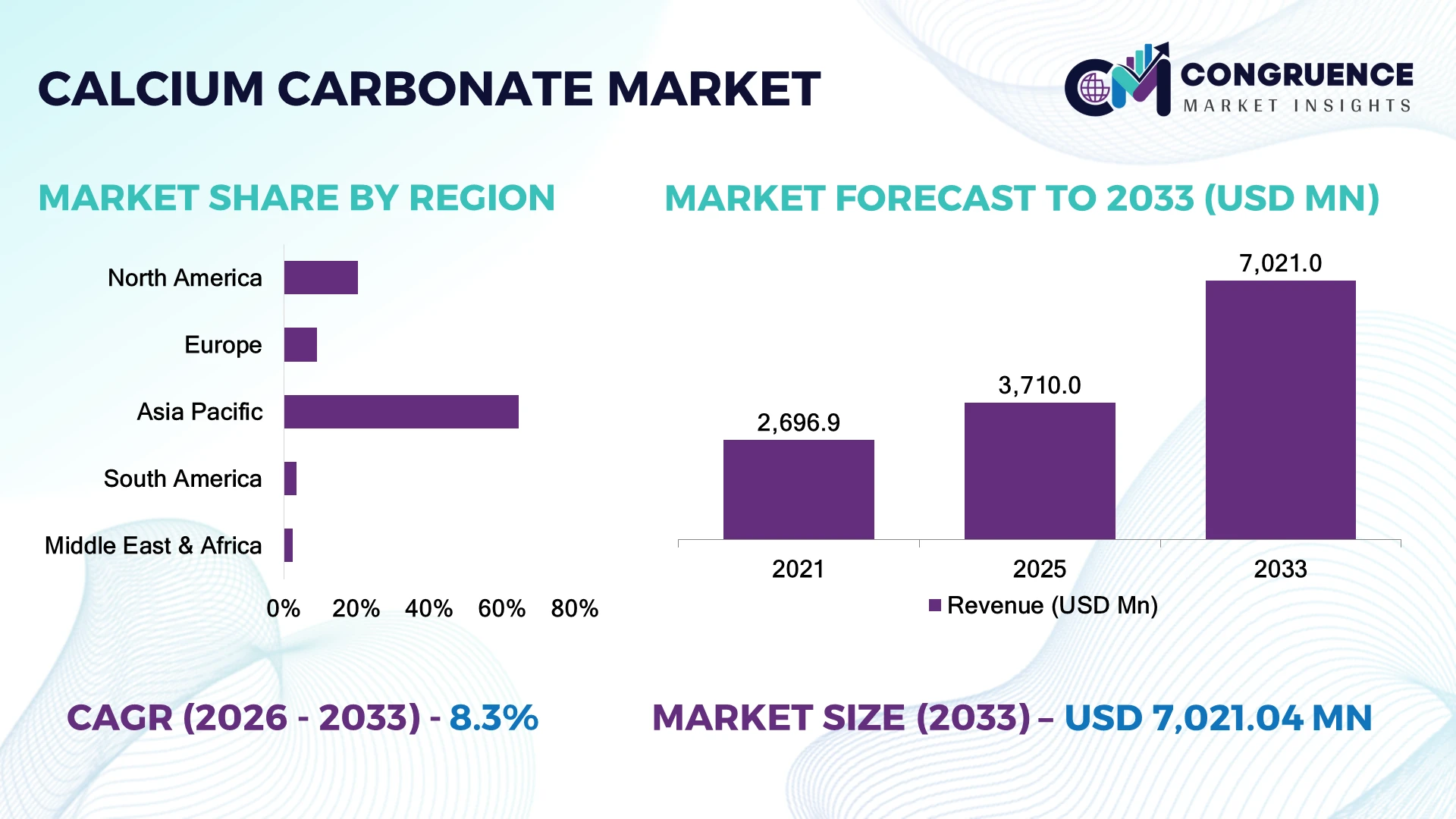
China dominates the supply base, producing about 10 million tons in 2024, versus 3.7 million tons in India, with China, the U.S., and India together representing 48% of global production. Asia Pacific accounted for 64.5% of global market value in 2025, supported by paper, packaging, plastics, and construction manufacturing. India is strengthening domestic capacity, including facilities reaching 150,000 tons/year. The EU's tightening carbon-emissions monitoring further reinforces investment in efficient processing.
Strategic implication Investors and suppliers should prioritize localized GCC/PCC capacity, ultrafine processing, and lower-emission production platforms in China, India, and other high-volume manufacturing hubs.
Market Size & Growth: USD 3.71 billion in 2025 and USD 7.021 billion by 2033, supported by advanced PCC/GCC adoption in paper, plastics, coatings, and construction.
Top Growth Drivers: Paper and packaging ~28%, plastics ~20%, and construction-related applications ~18% represent major demand pools, with formulation optimization accelerating premium-grade adoption.
Short-Term Forecast: By 2028, finer particle-size processing and automated milling are positioned to deliver approximately 10–15% higher process efficiency in modern plants versus conventional configurations.
Emerging Technologies: AI-assisted process control, automated ultrafine milling, nano-calcium carbonate, and surface modification are shifting competition toward engineered performance rather than commodity volume.
Regional Leaders: Asia Pacific represents 64.5% of 2025 market value; North America and Europe remain major specialty markets, while China and India strengthen localized production and paper-integrated PCC capacity.
Consumer/End-User Trends: Paper, plastics, paints, coatings, and construction remain core users, while specialty PCC and nano-grade adoption is increasing in applications requiring controlled particle size and purity.
Pilot/Case Example: In 2023, Kuantum Papers reported a 40% increase in output efficiency following operational debottlenecking, alongside its onsite PCC plant, demonstrating the value of integrated mineral supply.
Competitive Landscape: Omya leads at approximately 11%, followed by Imerys, Minerals Technologies, Huber Engineered Materials, and Sibelco; competition centers on mineral access, particle-size control, technical service, and regional supply.
Regulatory & ESG Impact: EU emissions-monitoring rules explicitly account for carbonate-related process emissions, strengthening the business case for energy-efficient kilns, renewable power, and lower-carbon mineral processing.
Investment & Funding: Omya's China and Indonesia expansion involves 7 onsite plants, while Minerals Technologies' China and India agreements add more than 180,000 metric tons/year of PCC capacity.
Innovation & Future Outlook: Next-generation PCC, nano-calcium carbonate, coated GCC, carbon-efficient processing, and onsite production will increasingly determine competitive positioning across high-growth industrial applications.
The Calcium Carbonate Market is moving beyond commodity filler supply toward engineered mineral solutions for high-performance formulations. Paper and packaging remain major demand anchors, while nano-grade and surface-treated products are expanding into plastics, coatings, pharmaceuticals, and composites. With 64.5% of global market value concentrated in Asia Pacific, suppliers are increasingly localizing production near manufacturing customers to reduce logistics exposure and improve formulation responsiveness.
Calcium carbonate is becoming strategically important because it simultaneously influences material cost, product performance, formulation flexibility, and supply-chain resilience across paper, plastics, coatings, construction, and pharmaceutical manufacturing. The market is shifting from bulk mineral supply toward controlled particle morphology, ultrafine grades, and application-specific PCC. This shift gives producers with mineral reserves, processing technology, and technical service capabilities a clear competitive advantage.
Supply-chain restructuring is particularly visible in Asia. Omya invested in 7 onsite GCC/PCC plants across China and Indonesia, while Minerals Technologies established long-term PCC partnerships in China and India exceeding 180,000 metric tons/year of additional capacity. Onsite production reduces transportation exposure and integrates mineral supply directly into paper-mill operations.
Technology differentiation is also becoming measurable: advanced ultrafine milling can achieve 90–98% below 2 microns in specialized GCC processing, compared with substantially coarser conventional grades. India is building localized capacity, while China remains the larger production base. Over the next 2–3 years, automated grinding, surface treatment, and integrated PCC facilities will gain priority. Companies that combine local capacity with low-emission processing and application-specific R&D will secure stronger margins and customer retention.
The primary growth driver is the transition from commodity calcium carbonate toward engineered GCC and PCC grades. Asia Pacific already represents 64.5% of global market value, while China produced approximately 10 million tons in 2024 and India about 3.7 million tons, demonstrating the concentration of manufacturing capability. Paper and packaging producers increasingly require controlled particle size, brightness, opacity, and coating performance. Companies are responding with ultrafine milling, coated grades, and onsite PCC facilities. Omya's 7-plant China/Indonesia expansion and Minerals Technologies' 180,000+ tons/year PCC commitments demonstrate the strategic shift toward customer-integrated production. The non-obvious advantage is reduced logistics exposure: production located directly beside paper mills converts mineral availability into a supply-chain differentiator.
Energy intensity and carbonate-process emissions remain structural constraints, particularly for producers operating calcination and high-temperature processing assets. EU rules require carbonate-related process emissions to be monitored, increasing compliance requirements for mineral processors and downstream industries. International calcium carbonate trade also remains relatively limited: global imports were approximately 3.9 million tons in 2024, down 5.7%, highlighting the importance of regional production economics and freight costs. Producers therefore face pressure to maintain competitive delivered costs while upgrading environmental controls. Indian manufacturers are responding through renewable-energy integration; Bharat Carbonates installed 2.1 MW of wind and 1.35 MW of solar in 2025 while expanding production capacity to 150,000 tons/year.
The strongest opportunity lies in specialty PCC, nano-calcium carbonate, coated GCC, and application-specific surface treatments. Specialty PCC can command substantially higher value than commodity GCC, while ultrafine processing enables 90–98% of particles to reach below 2 microns in advanced systems. India offers a particularly attractive localization opportunity: its calcium carbonate market reached approximately 335.8 thousand tons in 2025, with nano-calcium carbonate gaining adoption in high-performance applications. Companies are positioning through R&D, onsite plants, and partnerships with paper and polymer manufacturers. The non-obvious opportunity is to combine mineral processing with formulation support, turning calcium carbonate suppliers into strategic material-development partners rather than interchangeable bulk vendors.
Scaling engineered calcium carbonate production without compromising particle-size distribution, purity, brightness, and dispersion remains a major execution challenge. Advanced GCC systems can deliver 90–98% below 2 microns, but maintaining such specifications consistently across high-volume production requires sophisticated milling, classification, testing, and automation. Customer requirements also differ sharply between paper, plastics, coatings, pharmaceuticals, and construction, increasing formulation complexity and quality-control demands. India illustrates the transition: producers are expanding from conventional GCC/PCC into coated and specialty grades while investing in analytical infrastructure. Companies must therefore integrate automated process control, real-time particle-size monitoring, specialized technical teams, and customer co-development. The strategic pressure is clear: scale alone is insufficient; reproducible performance and application-specific customization increasingly determine long-term competitiveness.
Packaging-Grade Paper Is Reshaping Demand: Packaging now represents 63.9% of paper and board production in Cepi countries, while containerboard output increased 1.7% in 2025. Calcium carbonate suppliers are redirecting PCC capacity toward packaging mills, with Minerals Technologies dedicating 50% of its 2025–2026 Asian expansions to packaging applications.
Onsite PCC Is Scaling Faster: Producers are shifting from transported mineral supply to mill-integrated PCC satellites to reduce freight exposure and improve formulation consistency. Minerals Technologies added three Asian satellite plants in 2025 and doubled capacity at another Indian site; its satellite model recycles approximately 85% of water obtained from host paper mills, creating an operational and ESG advantage.
Crystal Engineering Gains Importance: Calcium carbonate suppliers are increasingly tailoring crystal morphology, particle size, and surface characteristics rather than competing solely on tonnage. Advanced PCC products use narrow particle-size distributions for controlled opacity, dispersion, and reinforcement, while surface-treated ultrafine grades target polymer systems. This shifts purchasing toward specification-based contracts and technical collaboration.
Specialty Paper Offsets Print Declines: European graphic-paper production fell 7.3% in 2025, but specialty paper and board production increased 1.2%, signaling a shift toward higher-value formulations. Producers are responding by prioritizing engineered fillers for specialty packaging and functional papers rather than relying on declining printing-paper volumes, making application-specific calcium carbonate a more defensible growth niche.
Ground Calcium Carbonate (GCC) remains the dominant type, accounting for approximately 76.9% of the global market in 2025 because limestone availability, established grinding infrastructure, and lower processing complexity support high-volume paper, plastics, coatings, and construction applications. Precipitated Calcium Carbonate (PCC), at roughly 23.1%, commands stronger positioning where controlled morphology, brightness, and narrow particle-size distribution are essential.
PCC is the faster-moving type within value-added applications as manufacturers seek tighter functional specifications and improved material efficiency. Advanced PCC can deliver controlled particle shapes and narrow distributions, supporting premium paper, polymer, pharmaceutical, and specialty applications. Companies are therefore maintaining GCC capacity for cost-sensitive bulk demand while expanding PCC partnerships and onsite production. Minerals Technologies' 2025 expansion added three satellite plants in Asia and doubled capacity at another Indian facility, reinforcing the shift toward localized PCC supply.
Paper is the leading application, representing approximately 34.7% of Asia-Pacific calcium carbonate demand in 2025, as PCC and GCC function as fillers and coating pigments that improve brightness, opacity, smoothness, and material economics. Plastics, paints and coatings, and adhesives and sealants remain important secondary applications, with plastics increasingly using engineered calcium carbonate to improve stiffness, dimensional stability, and filler economics.
The fastest-moving shift is toward packaging and performance-oriented formulations. In Europe, packaging grades represented 63.9% of total paper and board production in 2025, while containerboard production increased 1.7%, strengthening demand for functional fillers even as graphic-paper output contracted. Companies are consequently reallocating technical resources toward packaging, specialty paper, polymer compounding, and coating formulations, reducing dependence on traditional printing-paper demand.
Paper and packaging represent the leading end-user group, accounting for approximately 36.0% of global calcium carbonate demand in 2025. Their dominance reflects high-volume filler consumption, continuous production cycles, and the direct impact of calcium carbonate on brightness, opacity, bulk, and fiber economics. Plastics, construction, paints and coatings, adhesives and sealants, and other specialty industries diversify demand and reduce dependence on a single industrial cycle.
Packaging is the most important emerging buying priority within established paper demand. European packaging grades reached 63.9% of total paper and board production in 2025, while containerboard output grew 1.7%, encouraging suppliers to customize PCC/GCC grades for high-speed converting and lightweight packaging applications. Pharmaceuticals, food, and specialty polymer producers are also increasing requirements for purity and particle-size consistency. Companies are responding with application-specific formulations, onsite partnerships, technical service, and localized production rather than relying solely on standardized bulk grades.
Asia Pacific accounted for the largest market share at 64.5% in 2025 however, North America is expected to register the fastest growth, expanding at a CAGR of9.0% between 2026 and 2033.
North America represented approximately 20.4% of the global calcium carbonate market in 2025, with the U.S. accounting for most regional consumption. Demand is concentrated across construction materials, plastics, pharmaceuticals, coatings, and established pulp-and-paper operations, where high-purity and specification-controlled grades command greater strategic importance than commodity volumes. Recent investments in Alabama and Georgia are reinforcing localized supply and reducing freight exposure, while technical-grade producers increasingly support customers through application engineering and shorter delivery cycles. The region's mature manufacturing base also favors PCC and specialty GCC where particle-size consistency and formulation performance are critical. U.S. tariff measures introduced in 2025 have further encouraged procurement teams to reassess imported mineral supply chains and strengthen domestic sourcing.
U.S. Market Outlook: The U.S. remains North America's principal demand center, with a 2025 market value of USD 9.38 billion. Its competitive advantage comes from diversified plastics, pharmaceutical, construction, and paper manufacturing, supported by sophisticated quality-control infrastructure. The country's technical-grade ecosystem gives suppliers room to shift from bulk calcium carbonate toward higher-specification products for lightweight composites, coatings, and pharmaceutical formulations.
Europe maintains 9.1% a mature calcium carbonate ecosystem supported by paper, automotive, construction, plastics, and coatings manufacturing. Environmental regulation is increasingly influencing quarrying, processing, energy consumption, and product selection, pushing suppliers toward efficient precipitation, lower-emission processing, and optimized logistics. Packaging is gaining importance as European paper producers restructure away from declining graphic-paper volumes. In 2025, European packaging grades represented 63.9% of paper and board production, while containerboard output increased 1.7%, strengthening demand for functional mineral fillers. Germany, Italy, France, and the Nordic manufacturing corridor remain important industrial centers. Companies are prioritizing resource efficiency, recycled inputs, automated processing, and application-specific grades to protect margins under tighter environmental requirements.
Germany Market Outlook: Germany is Europe's most strategically significant calcium carbonate market, reaching approximately USD 2.61 billion in 2025 and representing about 6.6% of global demand. Its advanced automotive, construction, plastics, and industrial manufacturing base supports technically demanding grades. Strict environmental standards also accelerate investment in efficient mineral processing and lower-impact formulations, giving suppliers with strong compliance capabilities an advantage in industrial procurement.
Asia Pacific accounted for 64.5% of the global calcium carbonate market in 2025, making it the clear production and consumption center. China, India, Japan, South Korea, and Southeast Asian manufacturing hubs combine substantial limestone availability with paper, plastics, construction, coatings, and consumer-goods production. China remains the principal demand engine, while India is expanding domestic processing and downstream manufacturing. The region's cost advantage is reinforced by large industrial clusters and shorter mineral-to-customer logistics. Minerals Technologies' 2025–2026 Asian expansion included three new satellite plants and capacity doubling at another Indian facility, illustrating the move toward customer-integrated PCC supply. Companies are also shifting investment toward packaging, specialty paper, polymers, and higher-performance grades rather than relying exclusively on commodity mineral volumes.
China Market Outlook: China is the region's dominant calcium carbonate market because of its extensive paper, plastics, coatings, construction, and manufacturing base. Major suppliers are expanding local processing around downstream customers, including facilities in Wuhu, Qingyang, and Yueyang. This integrated manufacturing structure improves supply responsiveness and supports both high-volume GCC consumption and increasingly sophisticated PCC requirements for packaging and specialty materials.
South America represents a smaller but strategically relevant calcium carbonate market, supported primarily by Brazil and Argentina. Construction materials, paints and coatings, plastics, agriculture, and paper manufacturing create a diversified demand base, while domestic mineral resources provide an advantage for localized GCC production. Brazil accounted for approximately USD 1.9 billion of market value in 2025 and represented around 3.5% of Latin American demand. Construction and industrial activity are encouraging suppliers to strengthen distribution networks and regional processing rather than relying exclusively on imports. However, logistics infrastructure, currency volatility, and uneven industrial investment remain important operational considerations. Producers with local quarry access and established distributor relationships have a stronger cost position because they can reduce exposure to international freight and imported filler pricing.
Brazil Market Outlook: Brazil leads South America's calcium carbonate demand through its large construction, agricultural, paper, plastics, and industrial manufacturing base. Its USD 1.9 billion market in 2025 demonstrates substantial regional scale. Local limestone availability and established downstream industries support domestic GCC utilization, while infrastructure expansion creates additional requirements for coatings, construction materials, sealants, and polymer formulations.
The Middle East & Africa market remains smaller than the major industrial regions but is gaining strategic importance through construction, plastics, coatings, pharmaceuticals, and manufacturing localization. The Middle East & Africa represented approximately 2.5% of the global PCC market in 2025, with Saudi Arabia, the UAE, Qatar, and South Africa serving as important industrial centers. Saudi Carbonate announced its largest PCC expansion in the Middle East and Africa in September 2025, targeting stronger domestic and international supply capabilities. Saudi Arabia's industrial-diversification agenda is encouraging investment in mineral processing and downstream compounding, while Gulf infrastructure projects create sustained requirements for coatings, sealants, plastics, and construction materials. Companies are increasingly building regional production rather than depending on imported specialty grades, improving lead times and strengthening supply-chain control.
Saudi Arabia Market Outlook: Saudi Arabia is emerging as the region's most strategically significant production hub because industrial diversification is encouraging domestic manufacturing of specialty mineral products. Saudi Carbonate's 2025 PCC expansion strengthens local capacity for plastics, paints, pharmaceuticals, and paper. Separately, a Jeddah II Industrial Area facility is designed for 130,000 tons/year of micronization and 100,000 tons/year of compounding in its first phase, positioning the country as an export-oriented calcium carbonate processing base.
The market pits global integrated leaders Omya, Imerys, Minerals Technologies, Huber Engineered Materials, and Sibelco against regional GCC/PCC specialists and cost-focused Asian producers. The top five collectively hold approximately 48.2%, indicating moderate concentration rather than dominance. Competition centers on price, particle-size control, purity, technical service, logistics, and customization: specialty ultrafine grades command 20–30% premiums, while proximity can reduce transportation costs 15–25%. Leaders are expanding onsite PCC satellites, acquiring regional producers, developing surface-treated grades, and integrating quarrying, processing, laboratories, and distribution. Minerals Technologies added four Asian satellite projects; Imerys strengthened Brazil through SB Mineração; Omya is commercializing engineered fillers for polymers and fibers. The competitive shift is toward application-specific performance, circular inputs, and supply-chain localization rather than commodity tonnage alone. Entry barriers include mineral reserves, permitting, processing know-how, customer qualification, and established mill relationships at scale. Winning requires reliable supply, measurable formulation performance, rapid technical support, and continuous processing innovation.
Imerys S.A.
Minerals Technologies Inc.
Huber Engineered Materials
Sibelco
Carmeuse
Graymont Limited
Nordkalk Corporation
Mississippi Lime Company
Calcinor S.A.
Gulshan Polyols Ltd.
Maruo Calcium Co., Ltd.
Shiraishi Kogyo Kaisha, Ltd.
Calcium carbonate technology is shifting from conventional quarrying-and-milling toward precision classification, crystal engineering, surface treatment, and application-specific formulation. Advanced PCC controls morphology and particle size more tightly than conventional GCC, improving opacity, rheology, reinforcement, and dispersion. Minerals Technologies operates or is constructing 56 paper satellites globally, showing that onsite production is becoming a scalable architecture. Omya’s functional filler technology can replace up to 50 phr of conventional carbon black while maintaining mechanical properties, giving polymer compounders a formulation advantage.
Digital process control is becoming the operational layer. Automated milling, particle-size monitoring, predictive maintenance, and data-driven formulation reduce batch variability and improve line responsiveness. Closed-loop water systems are also gaining importance: Minerals Technologies reports recycling approximately 85% of water obtained from host paper mills in satellite operations. Compared with standalone supply, onsite production shortens material movement and synchronizes mineral supply with customer production schedules, benefiting paper and packaging manufacturers.
From 2026–2028, competitive impact will come from engineered grades combined with automation, circular inputs, and customer-site integration. Omya’s 2025 portfolio includes recycled calcium carbonate and technologies for engineering materials and biopolymers. Technology leaders gain specification control, faster qualification, and stronger customer retention; commodity suppliers face pressure to upgrade processing and technical-service capabilities.
January 2026 Minerals Technologies announced four Asian paper-packaging satellite expansions, including three plants launched in 2025, one planned for early 2026, and doubled Indian capacity. The move significantly strengthens localized PCC supply and packaging exposure across Asia immediately. Source: mineralstech.com
October 2025 Imerys signed an agreement to acquire SB Mineração, a Brazilian ground calcium carbonate producer serving polymers, thermosets, paints, and coatings. The transaction expands Imerys’s industrial footprint and strengthens regional GCC supply for performance applications across Brazil. Source: euronext.com
October 2025 Omya showcased calcium-carbonate innovations at K 2025, including Omyafiber and Omyafilm for nonwovens and breathable films, plus recycled grades. The portfolio broadens calcium carbonate beyond conventional fillers and supports lower-cost, lower-impact polymer processing worldwide for manufacturers. Source: omya.com
June 2024 Sibelco completed its acquisition of Strategic Materials, adding 42 North American recycling sites processing about 2 million tonnes of cullet annually. The transaction strengthens circular-minerals capabilities and broadens Sibelco’s platform regionally, improving resilience. Source: sibelco.com
The Calcium Carbonate Market Report covers Ground Calcium Carbonate (GCC) and Precipitated Calcium Carbonate (PCC), with application analysis spanning paper, plastics, paints and coatings, adhesives and sealants, construction, pharmaceuticals, agriculture, and specialty uses. End-user assessment examines paper and packaging, plastics and rubber, construction, paints and coatings, adhesives and sealants, and other industrial consumers, emphasizing specification, volume, and adoption differences.
Geographic coverage includes North America, Europe, Asia Pacific, South America, and the Middle East & Africa, with country-level focus on major production and consumption centers. The report evaluates ultrafine processing, crystal engineering, surface modification, onsite PCC, automation, recycling, and lower-impact production. With Asia Pacific representing 64.5% of the market in 2025, the analysis supports capacity planning, localization, technology investment, competitive positioning, partnership decisions, and expansion strategy through 2026–2033.
| Report Attribute / Metric | Details |
|---|---|
| Market Revenue (2025) | USD 3,710.0 Million |
| Market Revenue (2033) | USD 7,021.0 Million |
| CAGR (2026–2033) | 8.3% |
| Base Year | 2025 |
| Forecast Period | 2026–2033 |
| Historic Period | 2021–2025 |
| Segments Covered |
By Type
By Application
By End-User
|
| Key Deliverables | Revenue Forecast; Market Trends; Growth Drivers & Restraints; Technology Insights; Segmentation Analysis; Regional Insights; Competitive Landscape; Regulatory & ESG Overview; Recent Developments |
| Regions Covered | North America; Europe; Asia-Pacific; South America; Middle East & Africa |
| Companies Profiled | Omya AG; Imerys S.A.; Minerals Technologies Inc.; Huber Engineered Materials; Sibelco; Carmeuse; Graymont Limited; Nordkalk Corporation; Mississippi Lime Company; Calcinor S.A.; Gulshan Polyols Ltd.; Maruo Calcium Co., Ltd.; Shiraishi Kogyo Kaisha, Ltd. |
| Customization & Pricing | Available on Request (10% Customization Free) |




