
Reports
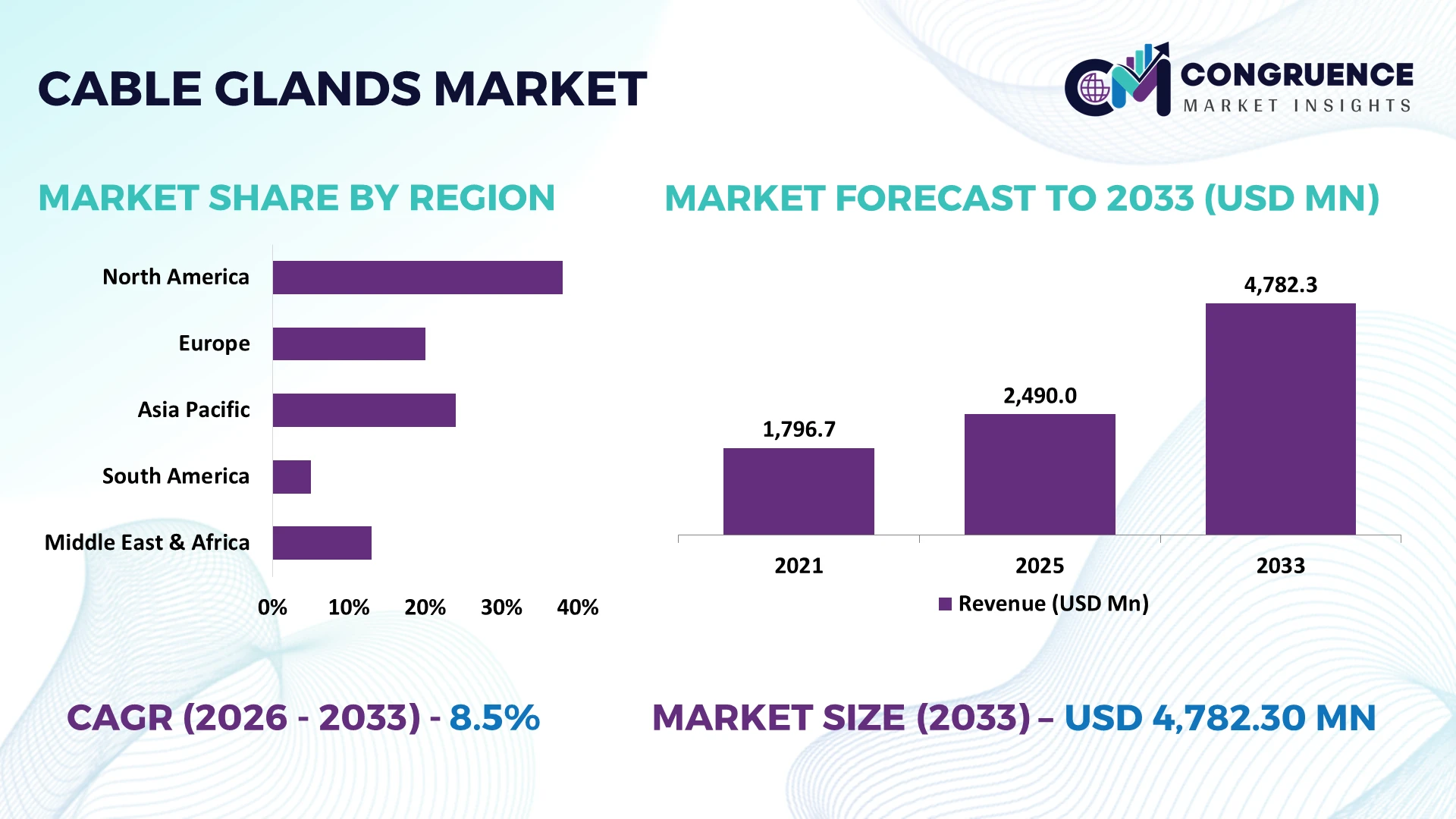
The Global Cable Glands Market was valued at USD 2490 Million in 2025 and is anticipated to reach a value of USD 4782.3 Million by 2033 expanding at a CAGR of 8.5% between 2026 and 2033. Growth is driven by industrial automation, hazardous-area electrification, renewable-power installations, and tighter IECEx, ATEX, and ingress-protection requirements.
China dominates industrial cable gland demand with a 21.4% share, supported by manufacturing, power equipment, chemicals, and automation; its industrial robot exports reached USD 8.03 billion in 2025, representing 11% of global robot export value. A USD 100 million intelligent manufacturing facility investment further strengthens advanced automation adoption. India recorded 12.3% cable gland import growth from 2020–2024, reflecting expanding industrial supply chains. U.S.-China trade frictions are accelerating supplier diversification and regional manufacturing strategies.
Strategically, manufacturers should prioritize certified, corrosion-resistant, automation-ready glands while expanding localized production in high-growth industrial corridors.
Market Size & Growth: USD 2.49 billion in 2025 to USD 4.78 billion by 2033 at 8.5% CAGR, driven by industrial electrification.
Top Growth Drivers: Industrial applications 69.8%, Asia Pacific 35%, and oil & gas 31% highlight the strongest demand pools.
Short-Term Forecast: By 2028, advanced installation designs target 30–40% lower installation time through integrated gland kits and simplified sealing.
Emerging Technologies: AI-enabled manufacturing, automated inspection, advanced polymers, and corrosion-resistant alloys are reshaping high-performance gland production.
Regional Leaders: Asia Pacific reached USD 1.06 billion, Europe USD 737 million, and North America USD 627.8 million in 2025, led by IECEx, retrofit, and UL adoption.
Consumer/End-User Trends: Industrial applications captured 69.8%, with buyers increasingly specifying hazardous-area, IP-rated, EMC, and low-maintenance products.
Pilot/Case Example: A 2026 automotive automation deployment cut wiring time from 45 to 8 minutes, improving changeover efficiency by 82%.
Competitive Landscape: Amphenol holds an estimated 16% share in one industry assessment; CMP Products, ABB, Eaton, Hubbell, and TE Connectivity remain key global players.
Regulatory & ESG Impact: IEC 60079-14 updates and ATEX compliance increase certification requirements, while recyclable polymer designs address tightening environmental standards.
Investment & Funding: Bimed secured strategic investment from a fund allocating up to USD 50 million per deal, supporting international expansion and product scaling.
Innovation & Future Outlook: Multi-cable sealing, lead-free brass, IP68 designs, EMC protection, and modular entry systems are shifting competition toward installation efficiency and lifecycle performance.
The Cable Glands Market is increasingly specification-driven across industrial automation, power distribution, oil and gas, renewable energy, data centers, and transportation infrastructure. Industrial applications accounted for 69.8% of the market in 2025, reinforcing demand for vibration-resistant, IP-rated, EMC, and hazardous-area products. Recent innovations include lead-free brass, advanced nylon compounds, integrated grounding, modular sealing, and faster installation designs. IECEx and ATEX compliance is becoming a procurement differentiator, while supply-chain diversification is increasing regional sourcing across India and Southeast Asia. This shift creates stronger opportunities for certified, high-performance gland suppliers.
Cable glands are becoming strategically important as industrial electrification, automation, and hazardous-area installations raise requirements for sealing reliability, EMC protection, and certified connectivity. The shift toward localized supply chains is also changing procurement, with manufacturers prioritizing suppliers capable of supporting regional production and shorter lead times. Over the next 2–3 years, adoption of modular and pre-assembled gland systems is expected to reduce installation labor by 20–30% compared with conventional multi-step assembly.
China remains the largest manufacturing and deployment base, while Germany emphasizes engineered hazardous-area and automation solutions and India is expanding industrial electrical infrastructure. This contrast is increasing demand for both high-volume standardized products and application-specific certified systems. By 2028, automated inspection and digital quality controls are positioned to increase production consistency by approximately 10–15%.
In practical deployments, automotive plants and process facilities are replacing conventional brass and basic polymer glands with IP68, EMC, and vibration-resistant designs. Companies are responding through localized molding, alloy sourcing, distributor partnerships, and expanded certification portfolios. Competitive positioning will increasingly depend on combining installation efficiency, compliance capability, material performance, and supply continuity rather than competing on unit price alone.
Industrial automation and electrification are strengthening cable gland demand as factories increase cable density, motion systems, and control-panel connectivity. Industrial applications account for approximately 69.8% of demand, while hazardous-area specifications represent a significant premium segment requiring IECEx or ATEX-certified designs. India's manufacturing expansion and China's automation-intensive production are increasing requirements for IP-rated and vibration-resistant sealing. The shift from manual wiring toward modular control architectures can reduce installation time by 20–30%, improving commissioning efficiency. Manufacturers are responding through localized production, broader certification portfolios, and partnerships with electrical distributors. The non-obvious advantage is specification lock-in: suppliers meeting plant-wide engineering standards can secure recurring replacement and expansion orders.
Material volatility and certification requirements constrain margins, particularly for brass, stainless steel, and engineered polymer glands. Metal input costs can fluctuate by more than 10% across procurement cycles, while certified hazardous-area products require additional testing and documentation compared with standard glands. European manufacturers also face stricter material and environmental-compliance requirements, increasing qualification costs. These pressures can raise procurement complexity and extend product validation timelines by 10–20%. Companies are reducing exposure through dual-source contracts, localized machining, recycled-material integration, and standardized component platforms. A key operational constraint is that replacing a certified gland with a lower-cost alternative can trigger panel revalidation, making total installed cost more important than purchase price.
The strongest untapped opportunity lies in modular glands designed for faster installation, high-density cable routing, and integrated EMC or grounding functions. Pre-assembled systems can reduce field installation labor by 20–30%, while automated production and inspection can improve manufacturing consistency by roughly 10–15%. India's data-center, renewable-power, and industrial automation expansion creates additional demand for compact IP68-rated systems. Emerging designs using advanced polymers, multi-hole sealing, and integrated strain relief can reduce component count while improving enclosure protection. Manufacturers are positioning through application-specific R&D, distributor partnerships, and localized assembly. A differentiated opportunity is supplying standardized modular platforms that serve multiple enclosure configurations without requiring separate tooling for every cable diameter.
Increasing cable density and mixed electrical architectures are creating integration challenges across automated factories, energy facilities, and process plants. Incorrect gland sizing can compromise enclosure protection, while EMC-sensitive installations require coordinated grounding and shielding practices. Advanced industrial systems can contain 15–25% more interconnected cabling than conventional installations, increasing routing and sealing complexity. Skilled electrical labor shortages can further affect commissioning consistency, particularly across rapidly expanding industrial facilities in India and Southeast Asia. Manufacturers must invest in application engineering, digital configuration tools, installer training, and standardized installation procedures. The strategic challenge is maintaining identical sealing and EMC performance across diverse cable diameters, materials, and installation environments while meeting evolving certification requirements.
Modular Sealing Gains Ground Modular multi-cable systems are reducing installation steps by 20–30%, particularly in dense control panels and machinery. German and Indian manufacturers are expanding pre-assembled sealing systems to address skilled-labor shortages and shorten commissioning cycles.
EMC Protection Expands EMC cable gland adoption is increasing by approximately 8–12% across automation-heavy installations as variable-frequency drives and high-density control networks raise interference exposure. Manufacturers are integrating grounding, shielding, and strain relief into single assemblies to reduce rework and component handling.
Localized Sourcing Accelerates Procurement teams are shifting an estimated 15–20% of cable-gland sourcing toward domestic and nearshore suppliers as freight disruption, tariff exposure, and longer qualification cycles affect electrical-component supply chains. Indian and Southeast Asian producers are expanding machining and molding capacity.
Compliance Upgrades Reshape Products ATEX and IECEx requirements are driving approximately 10–15% more hazardous-area specifications toward certified stainless-steel, brass, and explosion-resistant designs. Oil and gas operators are tightening approved-vendor requirements, prompting manufacturers to broaden certification portfolios and standardize tested configurations.
Metal Glands account for approximately 65% of cable-gland demand, supported by mechanical strength, thermal resistance, durability, and suitability for demanding industrial environments. Plastic Glands remain important in cost-sensitive automation and enclosure applications, while Armored Cable Glands retain strong relevance where cable armor requires secure termination. EMC Cable Glands are gaining specification traction as electrical systems become denser. Explosion-Proof Glands command premium positioning in hazardous installations, while Strain-Relief Glands remain widely deployed across machinery and standard enclosures.
EMC Cable Glands represent the fastest-shifting category, with adoption increasing approximately 10–15% in automation-intensive equipment. Manufacturers are reallocating R&D toward multifunctional designs combining sealing, grounding, EMC protection, and strain relief. The investment shift favors engineered products over basic commodity fittings, particularly where OEM specifications create repeat purchasing.
Power Distribution represents approximately 30% of application demand, supported by switchgear, substations, industrial electrical networks, and renewable-power infrastructure. Industrial Automation follows as factories increase robotics, drives, sensors, and distributed control systems. Instrumentation and Electrical Enclosures remain established applications, while Cable Entry is increasingly integrated into enclosure designs. Hazardous Area Installations represent a smaller but higher-value segment because certification and environmental requirements increase specification intensity.
Industrial Automation is experiencing the strongest adoption shift, with demand for compact glands increasing approximately 12–15% as machinery becomes more cable-dense. Companies are responding through standardized thread systems, compact sealing configurations, and OEM partnerships. Power Distribution remains volume-oriented, whereas automation increasingly rewards installation speed, EMC performance, and space efficiency. This divergence is shifting product development toward application-specific cable-entry platforms.
Oil & Gas represents approximately 30% of cable-gland demand, reflecting extensive deployment across refineries, offshore platforms, pipelines, and hazardous processing facilities. Manufacturing remains a major volume opportunity as automation increases equipment-level cable density. Power Generation requires durable products across switchgear and generation assets, while Chemicals and Mining prioritize corrosion resistance and hazardous-area certification. Telecommunications emphasizes compact weather-resistant designs, and Marine applications require sealing performance against vibration and saltwater exposure.
Manufacturing is showing the strongest adoption shift, with automation-driven cable-gland requirements increasing approximately 12–16% across machinery and control systems. Companies are targeting this demand through OEM partnerships, customized cable-entry kits, and standardized product families. Oil & Gas buyers continue prioritizing certified premium products, while manufacturers increasingly emphasize faster installation and lifecycle maintenance. The strategic opportunity lies in tailoring product portfolios to different purchasing criteria rather than applying a single specification across end-users.
Asia-Pacific accounted for the largest market share at 35.2% in 2025 however, Middle East & Africa is expected to register the fastest growth, expanding at a CAGR of 9.7% between 2026 and 2033.
Industrial modernization strengthens engineered cable-entry demand
North America represents approximately 25% of global cable-gland demand, supported by oil and gas, power distribution, data infrastructure, manufacturing, and industrial automation. The United States concentrates most regional demand because of its extensive installed electrical infrastructure and large industrial base. Hazardous-area applications increasingly favor IECEx- and UL-compatible designs, while automation projects are increasing requirements for EMC and IP68-rated glands. Replacement activity across aging electrical assets is creating recurring demand alongside new installations. Manufacturers are strengthening local inventory, distributor coverage, and application engineering to reduce delivery cycles by approximately 10–15%. The market is shifting from commodity fittings toward engineered cable-entry systems where certification, enclosure protection, and installation reliability influence purchasing decisions.
United States Market Outlook: The United States remains the region's principal demand center, supported by petrochemical facilities, utilities, manufacturing plants, and large-scale infrastructure modernization. Rising automation intensity is increasing cable density inside control systems, strengthening demand for compact EMC, strain-relief, and hazardous-area configurations.
Certification and industrial modernization reshape specifications
Europe accounts for approximately 23% of global cable-gland demand, with Germany, the United Kingdom, Italy, and France representing major industrial consumption centers. Stringent electrical safety requirements and established hazardous-area standards sustain demand for certified products across chemicals, energy, manufacturing, and transportation. Germany remains particularly important because of its machinery and automation ecosystem. Sustainability requirements are also encouraging manufacturers to reduce material waste and increase recyclable polymer content. European suppliers are responding with modular sealing systems, stainless-steel designs, and integrated EMC protection. Automated production and inspection are improving manufacturing consistency by approximately 10–15%, while distributor consolidation is shortening procurement cycles. Competition increasingly centers on certification depth, engineering support, lifecycle performance, and compliance responsiveness rather than unit price alone.
Germany Market Outlook: Germany provides a strong industrial base for advanced cable-gland adoption through machinery manufacturing, automation, chemicals, and process engineering. High-density electrical systems are increasing demand for EMC protection and compact sealing solutions, while established engineering standards favor suppliers with broad certification portfolios and application-specific technical support.
Manufacturing scale accelerates localized cable-entry production
Asia-Pacific holds approximately 35.2% of global cable-gland demand, supported by China's manufacturing scale, India's industrial expansion, Japan's automation base, and Southeast Asia's growing electronics and electrical-equipment production. China remains the largest regional production and consumption center, while India is strengthening its position through manufacturing, infrastructure, power, and automation investment. Localized production is increasing as buyers seek shorter lead times and reduced exposure to international logistics disruptions. Regional manufacturers are expanding brass machining, polymer molding, and automated inspection capabilities, with selected facilities targeting 15–20% higher production throughput. The competitive structure is increasingly split between high-volume standardized products and certified engineered systems. This creates opportunities for suppliers that combine cost efficiency with IECEx, ATEX, EMC, and IP-rated product capabilities.
China Market Outlook: China combines extensive manufacturing capacity with large-scale industrial automation and electrical-equipment production. High factory density supports substantial cable-gland consumption across machinery, power systems, chemicals, and infrastructure. Domestic suppliers benefit from integrated metalworking and polymer-processing capabilities, enabling faster customization and competitive pricing for large industrial orders.
Mining and power infrastructure anchor specialized demand
South America represents approximately 7% of global cable-gland demand, with Brazil accounting for the largest share through mining, oil and gas, power generation, manufacturing, and infrastructure projects. Chile and Peru add significant mining-related demand where corrosion resistance, mechanical protection, and hazardous-area specifications are important. Industrial projects increasingly require IP-rated and ruggedized cable-entry products, while imported components remain important for specialized applications. Local distributors are expanding inventory coverage to reduce project delays caused by extended international lead times. Demand for mining-specific glands is estimated to represent more than 20% of regional industrial applications. Manufacturers are therefore emphasizing corrosion-resistant materials, customized cable-entry configurations, and partnerships with engineering contractors. Logistics complexity remains a key operational constraint, making local stock availability a competitive differentiator.
Brazil Market Outlook: Brazil is the region's largest industrial demand center, supported by mining, offshore energy, utilities, manufacturing, and electrical infrastructure. Large industrial facilities require durable cable-entry systems capable of handling vibration, moisture, and corrosive environments. Local distribution partnerships are becoming increasingly important for maintaining project availability and reducing procurement delays.
Energy investment drives hazardous-area specialization
Middle East & Africa represents approximately 9% of global cable-gland demand, with Saudi Arabia, the United Arab Emirates, South Africa, and Qatar generating substantial requirements across oil and gas, power generation, chemicals, mining, and infrastructure. Hazardous-area installations account for a significant portion of premium demand because refineries, petrochemical facilities, and processing plants require certified explosion-resistant and corrosion-resistant cable-entry systems. Saudi Arabia's industrial diversification programs are expanding non-oil manufacturing and infrastructure activity alongside established energy projects. Suppliers are increasing local inventories and partnering with EPC contractors to improve project responsiveness. Premium certified products can command approximately 15–25% higher pricing than standard configurations. Competitive advantage increasingly depends on certification, environmental durability, contractor relationships, and rapid project fulfillment.
Saudi Arabia Market Outlook: Saudi Arabia represents a strategically important market because of its concentration of energy infrastructure, petrochemical facilities, utilities, and industrial-development projects. Large EPC programs require certified cable glands across hazardous and non-hazardous installations. Suppliers with local distribution, technical support, and approved-vendor credentials are positioned to capture specification-driven project demand.
Global cable glands competition is led by ABB, Eaton, Hubbell, CMP Products, and Amphenol, with established European and North American suppliers competing against Indian, Chinese, and Southeast Asian manufacturers on certification, price, customization, and delivery speed. The top five players collectively account for approximately 38% of sales, leaving substantial room for regional specialists. Price-focused suppliers typically compete on 8–15% lower unit costs, while engineered suppliers command premiums through IECEx, ATEX, EMC, and IP68-certified designs. Manufacturers are expanding localized machining, distributor networks, and application engineering to shorten lead times by 10–20%. Strategic partnerships with enclosure, switchgear, automation, and hazardous-area equipment OEMs are strengthening specification-based sales. The competitive shift is moving toward integrated glands combining sealing, grounding, strain relief, and EMC protection, increasing product differentiation. Entry barriers remain high for hazardous-area products because certification, testing, and approved-vendor qualification require time and technical investment. Winning requires certified performance, responsive supply, and application-specific customization.
ABB
Amphenol Corporation
Eaton Corporation
Hubbell Incorporated
CMP Products
TE Connectivity
Emerson Electric
Schneider Electric
Hawke International
Jacob GmbH
LAPP Group
HellermannTyton
BARTEC
KOPEX-EX
Current cable-gland technology is shifting from conventional threaded fittings toward IP68/IP69 sealing, EMC shielding, strain relief, and advanced elastomer systems. LAPP’s threadless CLICK design can cut installation time by up to 70% versus threaded assembly, while integrated sealing reduces component handling. Adoption is strongest across automated machinery, control cabinets, and electrical enclosures, where faster installation lowers labor exposure and commissioning time. This favors standardized, tool-efficient gland architectures.
Emerging systems combine modular multi-entry sealing, lead-free brass, advanced polyamide, and application-specific ventilation membranes. Multi-entry designs can reduce gland count by 20–30% in dense cable-routing environments, while automated inspection can improve manufacturing consistency by roughly 10–15%. Manufacturers benefiting most are those pairing materials engineering with OEM design-in programs, because standardized platforms increase customization speed without multiplying tooling and inventory requirements. Sustainability specifications reinforce this material transition.
By 2026–2028, disruptive integration will center on digitally configured cable-entry systems, sensor-compatible enclosures, and automated product selection linked to installation databases. These workflows can reduce selection errors by 5–10% and shorten engineering cycles by 10–15%. Competitive advantage will favor suppliers combining certified hazardous-area performance with faster configuration and localized production, making technology investment relevant to margin protection, specification retention, and deployment speed. Early adopters gain OEM integration.
December 2024 ABB acquired Solutions Industry & Building (SIB), adding premium cable glands and accessories and nearly 100 employees. The transaction broadened ABB’s hazardous-environment portfolio across rail, mining, OEM, and industrial markets, strengthening cross-selling through its electrification platform. Source: abb.com
February 2025 Amphenol Industrial Operations launched GuardXcel cable glands, vents, and accessories with UL certification, EMC compatibility, UV resistance, and UL94 V0 flammability performance. The portfolio expands protection for renewable energy, railway, automotive, instrumentation, transformers, and automation applications. Source: amphenol-industrial.com
June 2025 CMP Products partnered with TEC Sales to expand cable-management support across key Southern U.S. states. The partnership added dedicated representation to CMP’s team and warehousing, strengthening customer access and technical support across industrial and infrastructure projects. Source: cmp-products.com
July 2025 DNV issued LAPP type approval for SKINTOP MS-M ATEX, MS-M-XL ATEX, MS-M ATEX BRUSH, MSR-M ATEX, and MSR-M-XL ATEX cable glands. Approval covers vessels, offshore units, and high-speed craft, strengthening LAPP’s certified marine and hazardous-area offering. Source: dnv.com
The Cable Glands Market Report covers six major product types: Metal Glands, Plastic Glands, Armored Cable Glands, EMC Cable Glands, Explosion-Proof Glands, and Strain-Relief Glands. Application analysis includes Power Distribution, Industrial Automation, Instrumentation, Cable Entry, Electrical Enclosures, and Hazardous Area Installations, while end-user coverage spans Oil & Gas, Power Generation, Mining, Chemicals, Manufacturing, Telecommunications, and Marine. The report evaluates technology adoption, material shifts, certification requirements, installation efficiency, and emerging modular cable-entry systems.
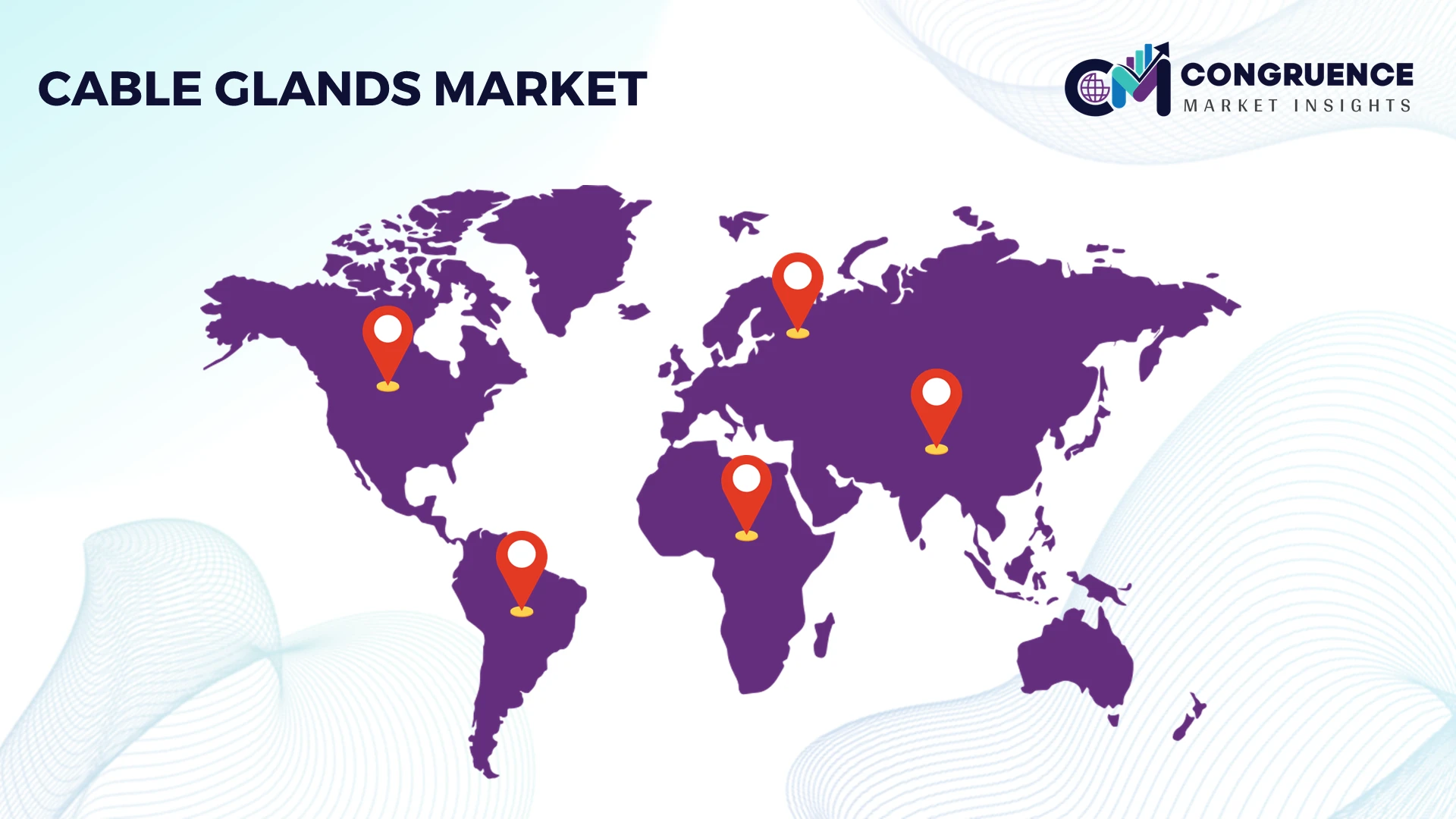
Geographic coverage includes North America, Europe, Asia-Pacific, South America, and Middle East & Africa, with country-level analysis of major industrial markets. Approximately 35% of global demand is concentrated in Asia-Pacific, highlighting manufacturing and infrastructure importance. The report supports investment planning, regional expansion, product portfolio prioritization, competitive positioning, supply-chain localization, and technology deployment decisions across 2026–2033.
| Report Attribute/Metric | Report Details |
|---|---|
Market Revenue in 2025 | USD 2490 Million |
Market Revenue in 2033 | USD 4782.3 Million |
CAGR (2026 - 2033) | 8.5% |
Base Year | 2025 |
Forecast Period | 2026 - 2033 |
Historic Period | 2021 - 2025 |
Segments Covered | By Type
By Application
By End-User
|
Key Report Deliverable | Revenue Forecast, Growth Trends, Market Dynamics, Segmental Overview, Regional and Country-wise Analysis, Competition Landscape |
Region Covered | North America, Europe, Asia-Pacific, South America, Middle East, Africa |
Key Players Analyzed | ABB, Amphenol Corporation, Eaton Corporation, Hubbell Incorporated, CMP Products, TE Connectivity, Emerson Electric, Schneider Electric, Hawke International, Jacob GmbH, LAPP Group, HellermannTyton, BARTEC, KOPEX-EX |
Customization & Pricing | Available on Request (10% Customization is Free) |




