Global C5ISR Market Report Overview
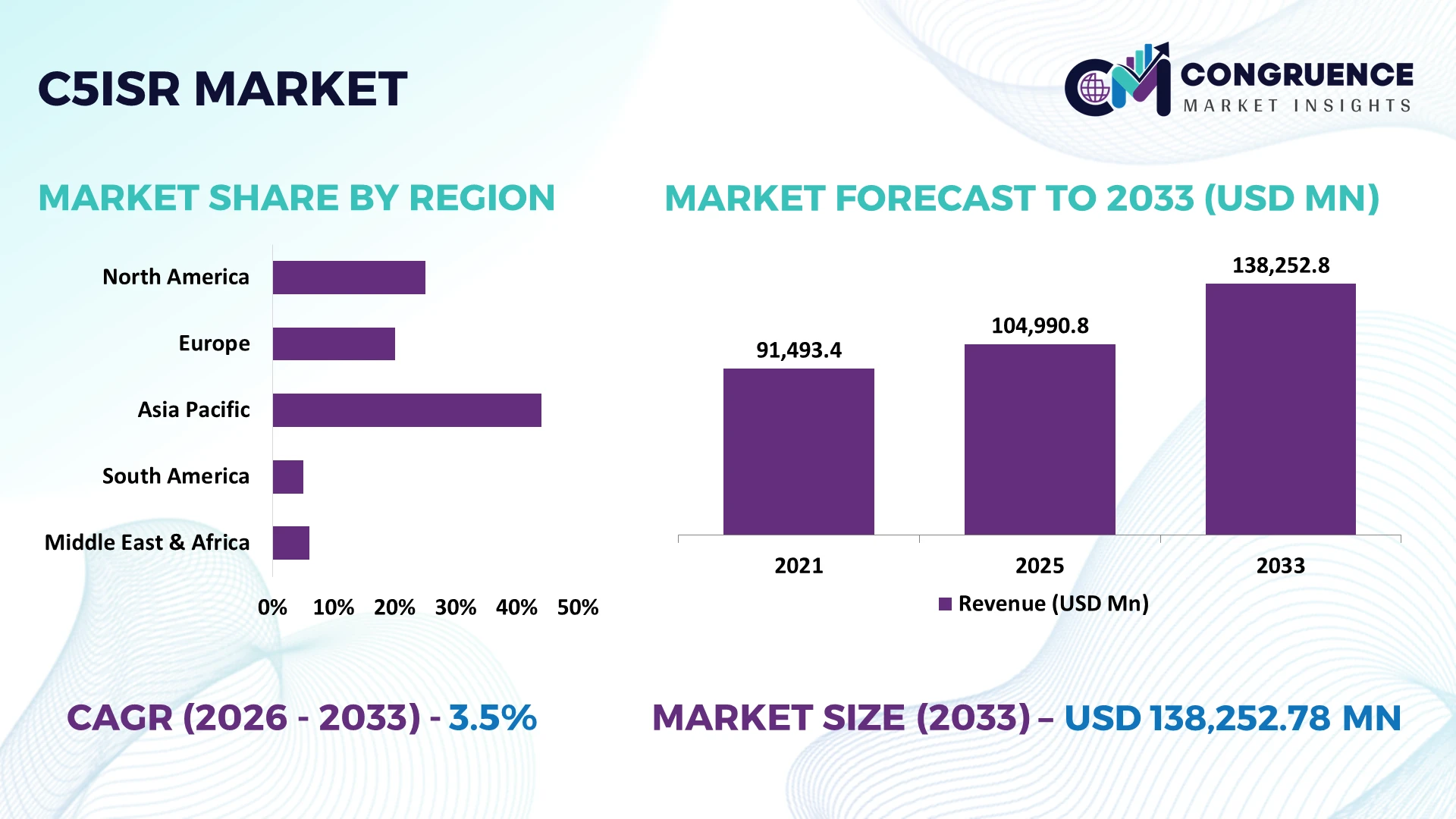
The Global C5ISR Market was valued at USD 104990.76 Million in 2025 and is anticipated to reach a value of USD 138252.78 Million by 2033 expanding at a CAGR of 3.5% between 2026 and 2033. Growth is driven by multi-domain command integration, AI-enabled intelligence processing, resilient military communications, space-based surveillance, and modernization of electronic warfare and battlefield networking systems.
The United States dominates global C5ISR capabilities, supported by extensive defense infrastructure, satellite intelligence networks, and advanced military electronics manufacturing. Its FY2025 defense budget request included approximately USD 28.4 billion for command, control, communications, computers, and intelligence capabilities. NATO's European members are accelerating network modernization following Russia's invasion of Ukraine. The United States accounted for approximately 37% of global military expenditure in 2024, compared with China's estimated 12%. Investments in Joint All-Domain Command and Control strengthen interoperability across air, land, maritime, space, and cyber operations.
Defense contractors integrating secure communications, AI-assisted intelligence, and interoperable sensor networks are positioned to capture high-value military modernization contracts.
Key Highlights of the Global C5ISR Market
-
Market Size & Growth: USD 104,990.76 million in 2025, reaching USD 138,252.78 million by 2033 at 3.5% CAGR, driven by multi-domain command integration.
-
Top Growth Drivers: Global military expenditure increased 9.4% in 2024; European spending rose 17%, while China's military spending increased 7%.
-
Short-Term Forecast: By 2028, defense modernization prioritizes 3 operational improvements: reduced decision latency, faster sensor fusion, and resilient communications.
-
Emerging Technologies: AI-enabled intelligence fusion, software-defined tactical radios, and edge computing support 3 critical C5ISR modernization pathways.
-
Regional Leaders: North America, Europe, and Asia-Pacific dominate procurement, supported by NATO's 5% GDP defense investment commitment and expanding Indo-Pacific surveillance networks.
-
Consumer/End-User Trends: Defense forces increasingly prioritize 5 interconnected operational domains: land, maritime, air, space, and cyber.
-
Pilot/Case Example: The US Combined Joint All-Domain Command and Control initiative integrates 3 military service departments through interoperable information-sharing architectures.
-
Competitive Landscape: Lockheed Martin, RTX, Northrop Grumman, L3Harris, and BAE Systems compete across 5 critical defense electronics and integration capabilities.
-
Regulatory & ESG Impact: NATO's 2025 agreement allocates at least 3.5% of GDP toward core defense requirements by 2035, strengthening procurement planning.
-
Investment & Funding: The US FY2025 defense budget requested USD 28.4 billion for missile defense capabilities, reinforcing integrated sensor and command-system investment.
-
Innovation & Future Outlook: Autonomous intelligence processing, zero-trust military networks, and space-based ISR integration reshape 3 priority areas of defense digital transformation.
The global C5ISR market is undergoing structural modernization as defense organizations replace fragmented command systems with integrated, software-defined operational networks. Demand is concentrated in tactical communications, airborne surveillance, electronic warfare, battlefield intelligence, and secure satellite connectivity. AI-assisted sensor fusion, distributed edge computing, and interoperable data architectures are improving situational awareness across contested environments. NATO members committed in 2025 to allocating 5% of GDP toward defense and security-related requirements by 2035, reinforcing long-term procurement priorities. The transition toward resilient, multi-domain military networks establishes the foundation for evaluating strategic investment pathways and competitive positioning.
What Is the Strategic Relevance and Future Pathways of the C5ISR Market?
C5ISR capabilities are becoming central to military competitiveness as defense organizations prioritize integrated command networks, intelligence automation, and secure information exchange across contested operational environments. Global military expenditure increased 9.4% in 2024, reflecting accelerated modernization and geopolitical instability. The United States is restructuring battlefield communications through Combined Joint All-Domain Command and Control, while NATO strengthens multinational interoperability following Russia's invasion of Ukraine. Defense contractors are shifting investment toward software-defined architectures, resilient satellite communications, and distributed intelligence processing.
Technological differentiation increasingly determines operational effectiveness. Modern tactical data links such as Link 16 support data rates up to 115.2 kbps in enhanced configurations, compared with 16 kbps for conventional low-rate tactical communication channels, representing substantially greater information-transfer capacity. North America leads advanced systems integration, while Europe emphasizes interoperable military communications and electronic warfare modernization. India's defense ecosystem increasingly prioritizes indigenous command systems and secure tactical networking.
Between 2026 and 2028, procurement will increasingly emphasize edge-based intelligence processing, zero-trust cybersecurity, and interoperable sensor fusion. The US Army's Project Convergence demonstrates practical integration of autonomous platforms, battlefield sensors, and command networks. Lockheed Martin, Northrop Grumman, and L3Harris are strengthening modular architectures and communications capabilities. Competitive advantage will depend on faster information exploitation, secure cross-domain connectivity, and scalable integration with existing military infrastructure.
C5ISR Market Dynamics
DRIVER:
Multi-Domain Defense Modernization and Network Integration
Military modernization programs are accelerating procurement of integrated C5ISR architectures capable of coordinating distributed sensors, command centers, and operational platforms. Global defense expenditure increased 9.4% in 2024, while European military spending rose 17%, reflecting heightened security requirements. Poland allocated approximately 4.1% of GDP to defense in 2024, reinforcing investment in battlefield communications and intelligence infrastructure. NATO's interoperability initiatives are encouraging adoption of standardized tactical data exchange and resilient military networking. Lockheed Martin and L3Harris are expanding software-defined communications and integrated battle-management capabilities. Defense agencies increasingly prioritize architectures that reduce information fragmentation and support cross-service coordination. Suppliers offering modular integration and secure connectivity gain procurement advantages over proprietary, platform-specific systems.
RESTRAINT:
Semiconductor Dependencies and Procurement Constraints
C5ISR manufacturing remains constrained by specialized semiconductor availability, export restrictions, and extended defense procurement cycles. Taiwan accounts for more than 90% of global advanced semiconductor manufacturing capacity, creating concentration risks for sophisticated military electronics supply chains. The United States' CHIPS and Science Act establishes investment incentives equivalent to 25% of qualified semiconductor manufacturing expenditures, supporting domestic production localization. However, defense-grade components require stringent reliability testing, secure sourcing, and long-term configuration management. US export controls on advanced computing technologies further complicate international component procurement and technology transfer. RTX, Northrop Grumman, and L3Harris are strengthening supplier qualification, domestic sourcing, and lifecycle inventory planning. Securing trusted electronic components is essential for protecting production schedules and maintaining military system availability.
OPPORTUNITY:
Autonomous Intelligence Fusion and Sovereign Defense Networks
AI-enabled intelligence processing and sovereign military communications infrastructure are creating opportunities for next-generation C5ISR deployment. India's defense modernization strategy emphasizes domestic electronics production, secure networking, and indigenous intelligence capabilities. The country's defense procurement framework targets approximately 75% of capital acquisition expenditure for domestic industry in FY2025–26, encouraging local technology development. NATO's 2025 investment framework establishes a 3.5% GDP benchmark for core defense requirements by 2035, strengthening long-term planning for digital command infrastructure. Edge-based AI can process intelligence near deployed sensors, reducing dependence on centralized communication links. Bharat Electronics, Thales, and L3Harris are advancing tactical communications, secure networking, and integrated surveillance technologies. Suppliers combining indigenous production with interoperable software architectures gain access to strategically sensitive procurement programs.
CHALLENGE:
Cyber Resilience and Cross-Domain Systems Integration
Integrating legacy military platforms with cloud-enabled intelligence systems introduces complex cybersecurity, certification, and operational reliability challenges. NATO's 32 member countries operate diverse communications architectures, requiring standardized security controls and interoperable data exchange. The US Department of Defense's zero-trust strategy targets implementation of foundational capabilities by FY2027, increasing requirements for identity verification, network segmentation, and continuous monitoring. Modern military networks must maintain availability during electronic interference, cyber intrusion, and satellite communication disruption. Australia's defense modernization programs also require secure integration across geographically distributed maritime and air surveillance assets. Lockheed Martin, BAE Systems, and Northrop Grumman are strengthening cyber-hardened architectures and systems engineering capabilities. Long-term competitiveness depends on validated interoperability, resilient software updates, and dependable performance across contested operational environments.
C5ISR Market Latest Trends
-
Commercial Satellite Networks Enter Military Operations: Defense organizations increasingly integrate low-Earth-orbit satellite connectivity with conventional military communications. Starlink operates more than 8,000 satellites, while military users evaluate multi-orbit connectivity for resilient command links. Ukraine's operational experience demonstrates the importance of distributed satellite infrastructure. Viasat and Eutelsat are strengthening secure connectivity portfolios, allowing defense customers to diversify communications pathways and reduce dependence on individual satellite systems.
-
Open Architecture Standards Reshape Defense Procurement: Military acquisition programs increasingly emphasize modular hardware interfaces and standardized software integration. The US Department of Defense's Modular Open Systems Approach encourages reusable components across 3 major service departments. Sensor Open Systems Architecture specifications support interoperable electronic modules, reducing dependence on proprietary platform designs. Collins Aerospace and Mercury Systems are expanding open architecture capabilities, improving subsystem replacement flexibility and reducing long-term integration complexity.
-
Electronic Spectrum Monitoring Becomes Operational Priority: Military forces are expanding passive radio-frequency sensing and electromagnetic spectrum monitoring following extensive electronic interference during the Ukraine conflict. Modern electronic support systems integrate wideband receivers, digital signal processing, and automated emitter classification across multiple frequency bands. Saab and BAE Systems are developing adaptable spectrum management technologies. Continuous signal monitoring strengthens threat identification and enables commanders to adjust communications procedures during contested operations.
-
Deployable Command Infrastructure Gains Procurement Attention: Defense organizations are shifting toward mobile command posts and rapidly configurable tactical networks. The US Army's Integrated Tactical Network modernization supports incremental fielding across 2 operational echelons: tactical formations and command headquarters. Software-configurable radios and transportable networking equipment reduce dependence on fixed communications infrastructure. General Dynamics Mission Systems and L3Harris are developing expeditionary networking solutions, improving deployment flexibility and distributed command continuity.
Segmentation Analysis
By Type
Communications Systems Anchor Integrated Defense Connectivity
Communications Systems represent a leading segment of the global C5ISR market, supported by continuous requirements for secure tactical radios, satellite connectivity, military data links, and interoperable battlefield networks. Their operational importance extends across all military service branches, making communications infrastructure essential to distributed command execution. NATO's 32 member countries maintain interoperability requirements that reinforce investment in standardized communication architectures. Command and Control Systems remain closely integrated with communications platforms, supporting operational planning, information distribution, and mission coordination. Intelligence, Surveillance and Reconnaissance Systems provide sensor-derived information through airborne, maritime, terrestrial, and space-based platforms.
Cybersecurity Systems are positioned for accelerated adoption as military organizations strengthen network authentication, continuous monitoring, and protection against advanced cyber threats. The US Department of Defense targets foundational zero-trust implementation by FY2027, reinforcing procurement of secure network infrastructure. Electronic Warfare Systems support electromagnetic threat detection and countermeasure operations, while Navigation and Positioning Systems provide mission-critical location and timing information. L3Harris, Northrop Grumman, and Thales are advancing software-defined communications, integrated intelligence processing, and secure system architectures.
- The US Department of Defense's FY2026 budget documentation identifies continued investment in command, control, communications, and intelligence modernization, reinforcing the strategic importance of interoperable communications infrastructure and resilient operational information systems.
By Application
Military Operations Lead Integrated C5ISR Deployment
Military Operations represent the dominant application category in the global C5ISR market, reflecting extensive deployment of command networks, tactical surveillance, operational intelligence, and integrated battlefield management platforms. The United States maintains one of the world's largest defense technology infrastructures, supporting multi-domain operational coordination across land, maritime, air, space, and cyber environments. Tactical Communications remains a critical application, enabling secure information exchange between deployed units and operational headquarters. Intelligence Gathering supports threat assessment and mission planning through sensor fusion and advanced analytical systems. Border and Coastal Surveillance increasingly incorporates persistent radar coverage, unmanned platforms, and integrated maritime monitoring networks.
Electronic Warfare is positioned for accelerated adoption as military organizations respond to sophisticated electromagnetic interference and contested communications environments. NATO's 32 members are strengthening interoperability and coordinated spectrum operations, reinforcing requirements for adaptable electronic protection technologies. Disaster Response and Emergency Management applications utilize deployable communications and surveillance systems to support coordination during infrastructure disruptions. RTX, Saab, and BAE Systems are expanding specialized sensing, electronic warfare, and operational networking capabilities.
- NATO's 2025 Hague Summit established a commitment to allocate 5% of GDP toward defense and security-related requirements by 2035, strengthening long-term procurement planning for military communications, intelligence infrastructure, and operational surveillance capabilities.
By End-User
Army Modernization Anchors Defense Network Procurement
Army organizations represent a major end-user category in the global C5ISR market, supported by extensive requirements for battlefield communications, mobile command infrastructure, tactical intelligence, and distributed surveillance. Land forces operate complex networks connecting armored platforms, infantry formations, unmanned systems, and operational headquarters. The US Army's modernization initiatives emphasize resilient tactical networking and integrated battlefield information management. Navy organizations require maritime surveillance, shipborne command systems, and secure communications across dispersed fleets. Air Force procurement emphasizes airborne intelligence, mission data integration, and networked command capabilities, reflecting the importance of coordinated air operations.
Homeland Security Agencies are positioned for accelerated adoption as governments strengthen border monitoring, critical infrastructure protection, and integrated emergency communications. Intelligence Agencies increasingly prioritize secure analytical platforms and classified information processing, while Defense Contractors invest in reusable integration technologies and specialized systems engineering. India's defense modernization framework prioritizes approximately 75% of capital acquisition expenditure for domestic procurement in FY2025–26, encouraging collaboration with indigenous technology suppliers. Bharat Electronics, L3Harris, and General Dynamics Mission Systems are strengthening customer-specific integration, secure networking, and lifecycle support capabilities.
- The Indian Ministry of Defence's FY2025–26 procurement allocation reserved approximately three-quarters of capital acquisition expenditure for domestic industry, reinforcing opportunities for indigenous tactical communications, surveillance electronics, and military systems integration across defense end-user categories.
Region-Wise Market Insights
North America accounted for the largest market share at approximately 39% in 2025 however, Asia-Pacific is expected to register the fastest growth, expanding at a CAGR of approximately 4.8% between 2026 and 2033.

North America C5ISR Market
Multi-Domain Command Integration and Advanced Defense Networking
North America dominates the global C5ISR market, supported by extensive military technology infrastructure, integrated defense manufacturing, and advanced intelligence capabilities. The United States drives regional procurement through modernization of command networks, space-based surveillance, electronic warfare, and secure tactical communications. Canada's defense modernization initiatives emphasize Arctic surveillance, maritime domain awareness, and interoperable military networking. The US Department of Defense's Combined Joint All-Domain Command and Control initiative strengthens information exchange across military services, while the US Space Force expands space-domain monitoring capabilities. Lockheed Martin, Northrop Grumman, RTX, and L3Harris maintain significant regional systems integration and defense electronics operations. Canada's NORAD modernization program includes approximately CAD 38.6 billion in planned investments over 20 years, reinforcing continental surveillance infrastructure. Regional procurement increasingly prioritizes secure data integration, resilient communications, and rapid operational decision-making across distributed military platforms.
United States Market Outlook: The United States maintains a leading position through advanced defense electronics manufacturing, military satellite infrastructure, and established systems integration capabilities. The Department of Defense's FY2025 budget request included approximately USD 28.4 billion for command, control, communications, computers, and intelligence capabilities. Lockheed Martin and Northrop Grumman are advancing integrated battle-management technologies, while L3Harris develops tactical communications and electronic warfare solutions. Military acquisition priorities increasingly emphasize modular architectures, AI-enabled intelligence processing, and secure information exchange across geographically dispersed operational formations.
Europe C5ISR Market
Defense Interoperability and Electronic Warfare Modernization
Europe represents an important C5ISR procurement center, supported by expanding military modernization programs and heightened security requirements following Russia's invasion of Ukraine. Germany, France, the United Kingdom, and Poland are strengthening battlefield communications, intelligence infrastructure, and electronic warfare capabilities. NATO's 2025 defense investment framework establishes a target of 5% of GDP for defense and security-related expenditure by 2035, encouraging long-term capability planning. European defense contractors including BAE Systems, Thales, Saab, and Leonardo are developing integrated surveillance platforms, secure military networks, and advanced electronic protection technologies. The European Union's European Defence Industrial Strategy emphasizes collaborative procurement and industrial readiness, reinforcing cross-border technology integration. Regional suppliers increasingly prioritize interoperable command architectures, sovereign cryptographic capabilities, and modular sensor systems. These requirements favor manufacturers capable of integrating equipment across multinational operational environments while maintaining national security controls.
Germany Market Outlook: Germany is strengthening its defense electronics ecosystem through military communications modernization and investment in integrated command infrastructure. The country's 2025 defense expenditure was estimated at approximately 2.4% of GDP under NATO reporting, reflecting increased procurement commitments. Rohde & Schwarz supports secure military communications and electronic intelligence capabilities, while HENSOLDT develops radar and electronic warfare technologies. German procurement priorities emphasize digital battlefield networking, deployable surveillance, and interoperability with allied military systems, strengthening opportunities for domestic defense technology suppliers.
Asia-Pacific C5ISR Market
Indigenous Defense Electronics and Distributed Surveillance Expansion
Asia-Pacific is emerging as a major center for C5ISR modernization, supported by strategic competition, maritime security requirements, and expanding indigenous defense manufacturing. China, India, Japan, South Korea, and Australia are strengthening tactical communications, space-based intelligence, integrated surveillance, and electronic warfare capabilities. China's military modernization emphasizes networked operational command and advanced sensing technologies, while Japan invests in integrated air and missile defense systems. Australia's defense transformation prioritizes long-range surveillance and secure military communications under its National Defence Strategy. India's domestic procurement policies are encouraging indigenous military electronics manufacturing and technology partnerships. The country allocated approximately 75% of its FY2025–26 defense capital acquisition budget to domestic procurement, reinforcing local supplier participation. Bharat Electronics, Mitsubishi Electric, Hanwha Systems, and regional defense technology firms are advancing secure networking and sensor integration capabilities. Distributed maritime surveillance remains a significant procurement priority.
India Market Outlook: India is expanding its C5ISR manufacturing and integration capabilities through domestic defense electronics production, military digitization, and indigenous surveillance programs. Bharat Electronics manufactures military communication equipment, electronic warfare systems, and integrated command platforms. India's FY2025–26 defense budget allocated approximately INR 1.8 trillion toward capital expenditure, supporting military modernization. The country's strategic focus on border surveillance, naval domain awareness, and secure tactical communications strengthens opportunities for domestic manufacturers and international technology partners.
South America C5ISR Market
Border Surveillance and Sovereign Defense Electronics Development
South America's C5ISR market is shaped by territorial monitoring, border security, maritime surveillance, and military communications modernization. Brazil leads regional defense technology development through established aerospace manufacturing, military electronics integration, and extensive territorial surveillance requirements. Colombia prioritizes intelligence coordination and border monitoring, while Chile maintains demand for naval surveillance and secure military communications. Brazil's Integrated Border Monitoring System, SISFRON, is designed to support surveillance across approximately 16,886 kilometers of land borders, reinforcing demand for radar, communications, and command infrastructure. Embraer and Atech support integrated defense systems and operational information management. Regional procurement remains influenced by fiscal constraints, imported electronics dependencies, and uneven communications infrastructure. Defense organizations are increasingly prioritizing modular surveillance architectures and domestic maintenance capabilities to improve operational continuity while controlling lifecycle costs.
Brazil Market Outlook: Brazil maintains the region's strongest defense aerospace and electronics manufacturing ecosystem, supported by Embraer, Atech, and established military technology institutions. The Brazilian Air Force operates the E-99 airborne early warning platform, integrating radar surveillance with airborne command capabilities. Brazil's approximately 7.4 million square kilometers of maritime jurisdictional waters, including its extended continental shelf claims, reinforces requirements for persistent maritime domain awareness. Domestic technology integration and long-term maintenance capabilities remain central to procurement decisions.
Middle East & Africa C5ISR Market
Integrated Air Defense and Sovereign Surveillance Infrastructure
The Middle East & Africa C5ISR market is influenced by air defense modernization, maritime security, border monitoring, and investment in domestic military technology capabilities. Saudi Arabia, the United Arab Emirates, Israel, and South Africa maintain distinct procurement priorities covering integrated command systems, intelligence processing, and electronic warfare. Saudi Arabia's Vision 2030 defense localization strategy targets 50% domestic military spending by 2030, encouraging industrial partnerships and technology transfer. The UAE's EDGE Group is expanding advanced defense electronics, autonomous systems, and secure communications capabilities. Israel maintains specialized expertise in radar, intelligence systems, and electronic warfare technologies through established domestic defense manufacturers. African defense organizations increasingly emphasize affordable surveillance networks and deployable communications infrastructure. Suppliers offering integrated system support, localization partnerships, and adaptable equipment configurations gain advantages in procurement programs requiring long-term operational independence.
Saudi Arabia Market Outlook: Saudi Arabia is strengthening indigenous C5ISR capabilities through military industrial development and partnerships with international defense technology suppliers. Saudi Arabian Military Industries supports domestic defense electronics integration, while the General Authority for Military Industries oversees localization initiatives. The country's military expenditure localization rate reached approximately 24.89% by the end of 2024, demonstrating progress toward national industrial objectives. Investments in integrated air defense, secure communications, and intelligence infrastructure are expanding opportunities for domestic systems engineering and specialized electronics manufacturing.
Market Competition Landscape
The global C5ISR market features competition between integrated defense contractors Lockheed Martin, RTX, Northrop Grumman, L3Harris, and BAE Systems, alongside specialized electronics suppliers Thales and Saab. The leading five account for an estimated 35–40% of integrated C5ISR contracting, while regional manufacturers compete through localization and customized integration. Technology differentiation centers on secure communications, sensor fusion, electronic warfare, and interoperable command architectures. NATO's 3.5% core defense investment target reinforces procurement opportunities, while India's 75% domestic capital acquisition allocation favors localized partnerships. Lockheed Martin advances integrated battle management, RTX develops radar and command systems, and L3Harris expands tactical communications capabilities. Software-defined architectures increasingly challenge proprietary hardware integration, shifting competitive advantage toward modular upgrades and accelerated deployment. Classified system certification, export controls, and established military procurement relationships restrict new entrants. Winning requires validated interoperability, trusted component sourcing, cybersecurity assurance, and reliable lifecycle support across operational environments and evolving defense mission requirements.
Companies Profiled in the C5ISR Market Report
-
Lockheed Martin Corporation
-
RTX Corporation
-
Northrop Grumman Corporation
-
L3Harris Technologies, Inc.
-
BAE Systems plc
-
Thales Group
-
General Dynamics Corporation
-
Leonardo S.p.A.
-
Saab AB
-
Elbit Systems Ltd.
-
Israel Aerospace Industries Ltd.
-
HENSOLDT AG
-
Bharat Electronics Limited
-
Hanwha Systems Co., Ltd.
Technology Insights for the C5ISR Market
Modern C5ISR architectures integrate software-defined tactical radios, distributed command platforms, and networked surveillance sensors to improve operational coordination. Link 16 supports enhanced tactical data rates up to 115.2 kbps, compared with 16 kbps for conventional low-rate channels, providing approximately 620% greater transmission capacity. Advanced radar systems combine active electronically scanned arrays with digital beamforming, improving target tracking and electronic resilience. Defense organizations increasingly prioritize interoperable communications across five operational domains, enabling faster intelligence distribution and coordinated mission execution.
Emerging technologies emphasize AI-assisted intelligence fusion, edge computing, and zero-trust cybersecurity. Automated sensor correlation reduces manual information processing, while edge-based analytics enables intelligence exploitation without continuous centralized connectivity. The US Department of Defense targets foundational zero-trust implementation by FY2027, accelerating secure identity management and network segmentation. Northrop Grumman, L3Harris, and Thales are integrating modular software architectures with advanced sensing and encrypted communications, strengthening upgrade flexibility and operational reliability.
Between 2026 and 2028, autonomous intelligence processing, resilient satellite networks, and open mission systems will influence procurement decisions. NATO's 32 member countries require interoperable operational communications, creating opportunities for standardized integration technologies. Suppliers offering validated cybersecurity, rapid software updates, and dependable cross-platform connectivity gain competitive advantages over hardware-dependent legacy architectures in contested environments.
Recent Developments in the Global C5ISR Market
-
April 2024: Lockheed Martin secured a $4.0999 billion ceiling contract from the Missile Defense Agency for C2BMC-Next modernization. The program advances integrated battle management, improves multi-domain interoperability, and strengthens command coordination across geographically distributed missile defense networks. Source: lockheedmartin.com
-
January 2025: L3Harris Technologies received nearly $300 million in US Army production orders for Manpack and Leader tactical radios. The program expands resilient battlefield communications, strengthens interoperability between deployed formations, and supports secure connectivity under electronic warfare conditions. Source: l3harris.com
-
June 2025: BAE Systems secured support for the United Kingdom's £204.6 million ECRS Mk2 radar investment alongside Leonardo. The program advances Eurofighter Typhoon electronic warfare capabilities, enabling simultaneous target detection, identification, and tracking while sustaining domestic defense engineering expertise. Source: baesystems.com
-
February 2025: Northrop Grumman was identified as principal contractor for Egypt's proposed $304 million AN/TPS-78 radar acquisition. The US authorization supports enhanced air threat detection and surveillance modernization, expanding opportunities for interoperable radar infrastructure and defense integration. Source: defense.gov
Scope of the C5ISR Market Report
The C5ISR Market Report examines defense technology development, procurement priorities, and operational modernization across 2026–2033. Segmentation covers six system categories: Command and Control Systems, Communications Systems, Intelligence, Surveillance and Reconnaissance Systems, Electronic Warfare Systems, Navigation and Positioning Systems, and Cybersecurity Systems. Application coverage includes Military Operations, Border and Coastal Surveillance, Intelligence Gathering, Tactical Communications, Electronic Warfare, and Disaster Response and Emergency Management. End-user analysis evaluates Army, Navy, Air Force, Homeland Security Agencies, Intelligence Agencies, and Defense Contractors.
Regional assessment spans North America, Europe, Asia-Pacific, South America, and the Middle East & Africa, emphasizing procurement concentration, indigenous manufacturing, and interoperability requirements. Technology evaluation addresses AI-enabled intelligence fusion, software-defined radios, satellite communications, and cyber-resilient architectures. Competitive benchmarking covers 14 defense technology companies, supporting investment planning, market entry, localization partnerships, and strategic positioning.
C5ISR Market Report Summary
| Report Attribute/Metric | Report Details |
|---|
Market Revenue in 2025 | USD 104990.76 Million |
Market Revenue in 2033 | USD 138252.78 Million |
CAGR (2026 - 2033) | 3.5% |
Base Year | 2025 |
Forecast Period | 2026 - 2033 |
Historic Period | 2021 - 2025 |
Segments Covered | By TypeCommand and Control Systems Intelligence, Surveillance and Reconnaissance Systems Electronic Warfare Systems Navigation and Positioning Systems
By ApplicationBorder and Coastal Surveillance Disaster Response and Emergency Management
By End-UserHomeland Security Agencies
|
Key Report Deliverable | Revenue Forecast, Growth Trends, Market Dynamics, Segmental Overview, Regional and Country-wise Analysis, Competition Landscape |
Region Covered | North America, Europe, Asia-Pacific, South America, Middle East, Africa |
Key Players Analyzed | Lockheed Martin Corporation, RTX Corporation, Northrop Grumman Corporation, L3Harris Technologies, Inc., BAE Systems plc, Thales Group, General Dynamics Corporation, Leonardo S.p.A., Saab AB, Elbit Systems Ltd., Israel Aerospace Industries Ltd., HENSOLDT AG, Bharat Electronics Limited, Hanwha Systems Co., Ltd. |
Customization & Pricing | Available on Request (10% Customization is Free) |





