
Reports
The Global Buttermilk Powder Market was valued at USD 3434.69 Million in 2025 and is anticipated to reach a value of USD 5176.01 Million by 2033 expanding at a CAGR of 5.26% between 2026 and 2033. Growth is driven by rising utilization of spray-dried buttermilk powder in bakery, confectionery, processed foods, and functional dairy formulations, supported by improved milk-solid recovery and longer shelf-life requirements.
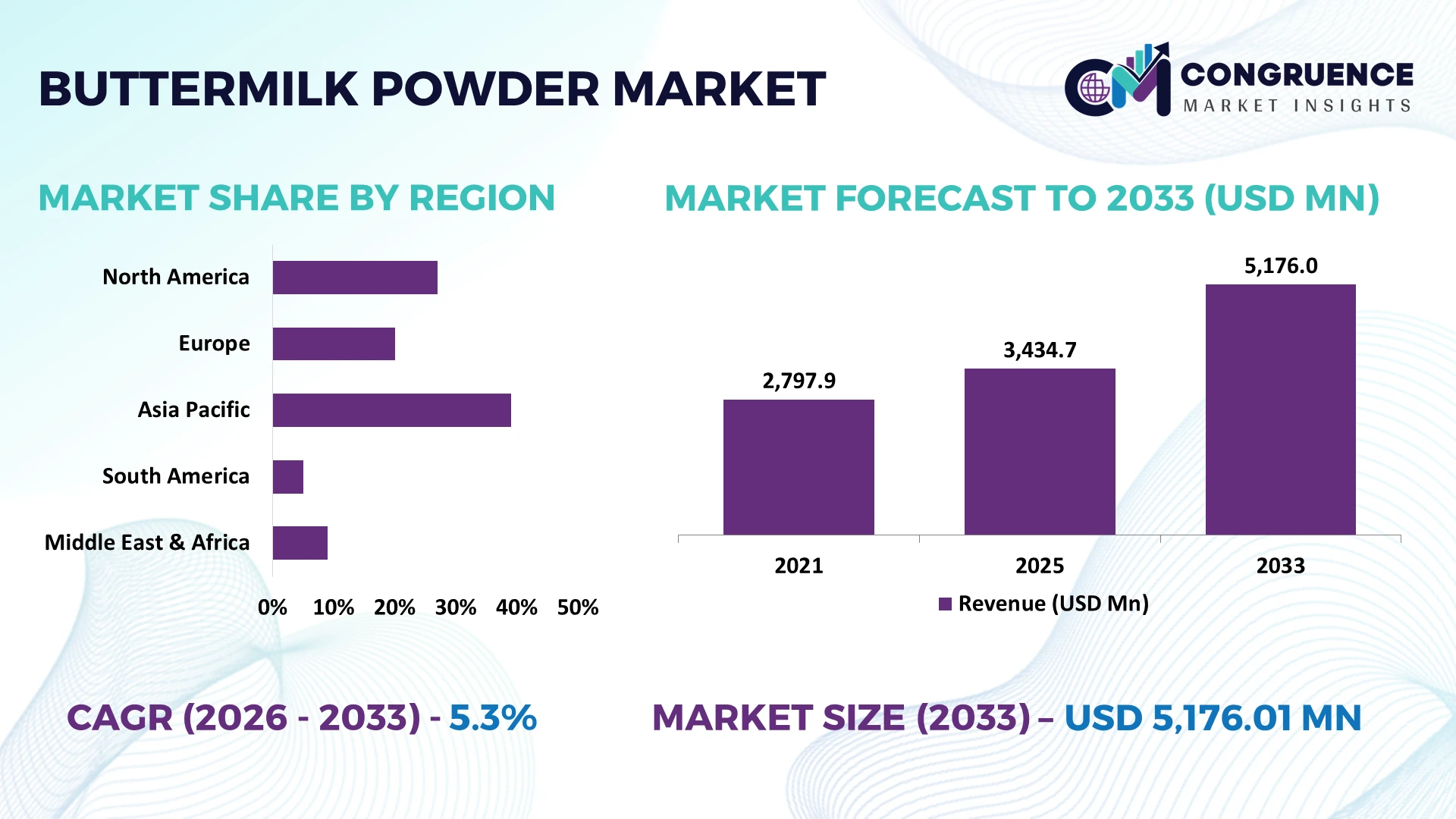
The United States holds an estimated 28% market share, supported by large-scale dairy processing capacity, strong bakery and prepared-food industries, and continued investment in spray-drying and automated powder handling. U.S. processors operate at roughly 80%+ utilization in major dairy clusters, compared with about 65% in several emerging Asian markets. EU dairy reforms and shifting global milk-powder trade flows are strengthening regional supply-chain competitiveness.
Strategic decisions should prioritize high-capacity processing hubs, formulation innovation, and resilient sourcing partnerships across North America and Europe.
Market Size & Growth: USD 3.43 billion in 2025 to USD 5.18 billion by 2033 at 5.26% CAGR, driven by spray-drying and bakery applications.
Top Growth Drivers: Bakery use 32%, processed foods 24%, nutritional formulations 18%.
Short-Term Forecast: By 2028, automated drying and handling systems are positioned to reduce processing costs 6% and improve throughput 9%.
Emerging Technologies: AI-assisted drying control, automated packaging, and precision moisture monitoring are advancing high-efficiency powder production.
Regional Leaders: North America is projected at about USD 1.55 billion, Europe USD 1.32 billion, and Asia-Pacific USD 1.15 billion, with automation adoption accelerating across regional plants.
Consumer/End-User Trends: Clean-label and high-protein formulations are increasing specialized ingredient adoption by approximately 12%.
Pilot/Case Example: A 2025 dairy-processing automation deployment demonstrated approximately 8% lower powder losses through automated moisture and temperature control.
Competitive Landscape: North American producers lead with approximately 28% share; major competitors include Lactalis, Fonterra, Dairy Farmers of America, FrieslandCampina, and Glanbia.
Regulatory & ESG Impact: Energy-efficient drying and waste-reduction programs are targeting 10%–15% lower processing emissions across upgraded facilities.
Investment & Funding: More than USD 400 million in recent dairy-processing capacity expansion and modernization is supporting automation, drying efficiency, and regional supply resilience.
Innovation & Future Outlook: Next-generation formulations, intelligent processing, and low-waste powder recovery will shift competition toward higher-value applications and integrated dairy supply chains.
The global buttermilk powder market is gaining traction across bakery premixes, confectionery, sauces, dairy beverages, and convenience foods, where approximately 20% of new formulation activity increasingly emphasizes functional dairy ingredients and improved texture. Recent spray-drying optimization, automated moisture control, and packaging upgrades are improving consistency while supporting longer-distance distribution. Global dairy trade disruptions and evolving EU supply-chain strategies are reinforcing regional sourcing diversification, creating a stronger strategic focus on processing capacity, product differentiation, and resilient ingredient networks.
Buttermilk powder is becoming strategically important because dairy processors are shifting toward shelf-stable, transport-efficient ingredients that improve formulation consistency and reduce dependence on liquid dairy logistics. Spray-drying can lower moisture-related handling losses by roughly 5–8%, while automated process controls improve production efficiency by about 6–10% versus conventional monitoring. This advantage is strengthening investment in modernized powder-processing facilities.
The United States and Germany maintain stronger industrial-scale processing capabilities, while India is expanding dairy-processing infrastructure and ingredient manufacturing. Over the next 2–3 years, automated drying, moisture sensing, and digital batch monitoring are positioned to reach roughly 30–40% deployment across newly upgraded large-scale facilities. Supply-chain restructuring is also encouraging producers to diversify sourcing contracts and establish localized powder-processing capacity.
A practical deployment model combines continuous spray drying with automated packaging and real-time quality monitoring, enabling processors to reduce powder losses and improve batch consistency. Companies are increasingly directing capital toward energy-efficient dryers, strategic dairy partnerships, and higher-value bakery and functional-food formulations. Competitive advantage will increasingly depend on processing efficiency, reliable milk-solid sourcing, formulation capability, and the ability to scale standardized powder production across multiple industrial hubs.
The primary growth driver is the modernization of dairy ingredient production, particularly in the United States, Germany, and India. Automated drying and moisture-control systems can improve throughput by 6–10% while reducing powder losses by approximately 5–8%. Rising bakery and processed-food utilization is reinforcing demand for consistent dairy solids, with industrial formulations accounting for an estimated 25–30% of specialized ingredient consumption. As European and Asian processors upgrade facilities, companies are investing in spray dryers, automated conveying, and quality-control systems. The non-obvious advantage is improved batch standardization, allowing manufacturers to serve multinational food producers with tighter formulation specifications and fewer quality-related production interruptions.
Volatility in milkfat and milk-solid availability remains a structural restraint, particularly for processors dependent on concentrated dairy supply chains. Input-cost fluctuations of approximately 8–12% can materially affect powder-processing margins, while transportation and energy expenses can add another 5–7% to delivered production costs. India and parts of Europe face different procurement pressures because seasonal milk availability influences processing utilization. Companies are responding through multi-year procurement agreements, supplier diversification, and greater inventory buffers. A key operational constraint is that powder producers cannot fully offset raw-material volatility without risking price competitiveness, making localized sourcing and integrated dairy-processing capacity increasingly important for margin protection.
Advanced processing creates opportunities beyond conventional ingredient supply, particularly through precision drying, automated quality control, and specialized buttermilk formulations. Digital monitoring can improve process consistency by approximately 8–12%, while energy-optimized drying systems can reduce thermal consumption by around 7–10%. India offers an emerging opportunity as dairy infrastructure expands and food manufacturers increase adoption of standardized powdered ingredients. Companies are positioning through R&D partnerships, modular processing upgrades, and customized formulations for bakery, confectionery, sports nutrition, and functional foods. A less-developed opportunity lies in converting production variability into premium-grade differentiated powders, enabling processors to command stronger margins through texture, solubility, and functionality rather than competing primarily on volume.
Long-term competitiveness depends on integrating automated processing, quality analytics, and workforce capabilities without disrupting established dairy operations. Approximately 15–20% of older processing infrastructure can require significant modernization before advanced monitoring systems achieve full integration, while inconsistent operator skills can reduce automation benefits by 5–8%. U.S. processors generally have stronger digital infrastructure, whereas smaller Indian facilities face greater equipment and technical-service constraints. Companies must therefore invest in interoperable sensors, workforce training, preventive maintenance, and technology partnerships. The strategic challenge is not simply installing advanced equipment; it is maintaining consistent powder moisture, particle characteristics, and microbiological quality across multiple production batches as facilities scale and sustainability requirements become more demanding.
Spray-Drying Automation Accelerates: Large U.S. and European dairy plants are increasing automated spray-drying, moisture sensing, and process-control deployment, delivering roughly 6%–10% higher throughput and 5%–8% lower powder losses. Energy-cost pressure is accelerating modernization, while processors are integrating quality analytics directly into continuous production workflows.
Application-Specific Grades Expand: Food manufacturers are moving from standardized commodity powder toward grades optimized for solubility, acidity, flavor, and emulsification. Approximately 20%–25% of formulation programs now emphasize differentiated ingredient functionality, encouraging suppliers to develop tailored specifications. The non-obvious shift is that tighter customer specifications are becoming a competitive barrier, not merely a quality requirement.
Procurement Networks Restructure: Dairy buyers are increasing multi-supplier qualification and inventory buffering by approximately 10%–15% as milk availability, energy pricing, and international logistics remain volatile. EU milk production is forecast at 149.4 million metric tons in 2025, down marginally from 149.6 million in 2024, forcing processors to prioritize higher-value dairy outputs and strengthen supply planning.
Functional Dairy Integration Rises: Cultured and specialty buttermilk powder is gaining traction in functional beverages, premium bakery, and prepared-food formulations, with specialized adoption increasing around 8%–12%. India and Southeast Asia are expanding localized dairy processing, while U.S. and European producers are improving culture stability and powder functionality through controlled processing and application partnerships.
Sweet Cream Buttermilk Powder remains the leading type, accounting for approximately 58% of the segment in 2025, supported by broad bakery integration, mild flavor, emulsification performance, and established industrial scalability. Cultured Buttermilk Powder is the fastest-growing type, with adoption expanding around 8%–10% as manufacturers seek stronger flavor profiles and differentiated fermented-food formulations. Low-Fat captures roughly 15%–18%, supported by reduced-fat product development, while Full-Fat retains approximately 20%–24% share because of superior mouthfeel and formulation performance.
The competitive implication is a widening split between volume-oriented Sweet Cream production and value-oriented Cultured formulations. U.S. manufacturers continue prioritizing high-throughput Sweet Cream capacity, whereas Indian processors are increasingly evaluating cultured products for specialized applications. Companies are responding through fermentation-control investments, application testing, customized powder specifications, and partnerships with bakery and dairy formulators. Cultured adoption is therefore shifting investment toward higher-functionality products rather than simply increasing processing volume.
Bakery Products represent the leading application, capturing approximately 40%–42% of market usage, because buttermilk powder improves browning, crumb structure, moisture retention, flavor, and dough performance. Dairy Products account for roughly 20%–25%, while Sauces & Dressings represent about 12%–14%. Bakery manufacturers increasingly favor powdered ingredients because they simplify dry-mix handling and reduce refrigeration dependency. Companies are responding with application-specific grades and automated dosing systems that improve formulation consistency by approximately 6%–9%.
Beverages are emerging as the fastest-expanding application, with specialized adoption increasing around 10%–13% as manufacturers develop protein-enriched and functional dairy formulations. Prepared Foods maintain strategic relevance where stable flavor and controlled ingredient dosing are required. U.S. bakery manufacturers remain scale-driven, while Indian and Asian producers are expanding beverage applications alongside localized dairy innovation. This shift is encouraging suppliers to invest in customized solubility, flavor, and dispersion characteristics rather than relying on one standardized powder grade.
Food Manufacturers lead the end-user structure with an estimated 40%–45% share, reflecting large procurement volumes, standardized formulations, and extensive use across bakery, dairy products, beverages, sauces, and prepared foods. Dairy Processors represent approximately 20%–25%, supported by integrated milk collection and drying infrastructure. Bakery Manufacturers contribute around 17%–20%, with purchasing increasingly linked to automated premix systems and high-throughput production. Companies are responding through volume contracts, customized specifications, and technical formulation partnerships to secure consistent powder quality.
Beverage Companies are the fastest-growing end-user group, with adoption increasing approximately 10%–14% as functional and protein-oriented dairy beverages expand. Foodservice Operators remain a smaller but strategically important buyer group, using shelf-stable powder to simplify storage and reduce cold-chain requirements. U.S. manufacturers emphasize scale and specification consistency, while Indian processors increasingly target customized dairy ingredients for emerging food and beverage formats. Suppliers are consequently shifting toward segmented pricing, direct technical support, and co-development programs that lock in large industrial customers.
North America accounted for the largest market share at 31.2% in 2025 however, Asia-Pacific is expected to register the fastest growth, expanding at a CAGR of 6.1% between 2026 and 2033.

Automated processing strengthens supply-chain efficiency
North America holds the leading position in the Buttermilk Powder Market, supported by large dairy-processing facilities, established bakery manufacturing, and sophisticated ingredient distribution. The region represents approximately 31% of global demand, with the United States serving as the principal production and consumption hub. Automated spray drying and powder handling systems are increasingly deployed across major facilities, improving throughput by 7%–10%. Companies are also integrating moisture monitoring and automated packaging to improve batch consistency. Strong domestic dairy supply reduces import exposure, while long-term procurement contracts support production planning. Food manufacturers are increasingly demanding application-specific powder specifications, encouraging suppliers to invest in formulation support and processing upgrades. The competitive advantage is shifting toward vertically integrated processors capable of combining reliable milk sourcing, efficient drying, and customized ingredient supply.
United States Market Outlook: The United States dominates North American buttermilk powder activity because of its extensive dairy-processing infrastructure and large bakery and prepared-food industries. Large facilities increasingly use automated drying and quality-control systems, with productivity improvements of approximately 8%. Established cold-chain logistics and nationwide ingredient distribution further strengthen domestic supply reliability.
Energy optimization reshapes mature dairy infrastructure
Europe maintains a strong position through sophisticated dairy-processing infrastructure, established food manufacturing, and stringent quality requirements. Germany, France, the Netherlands, and Ireland represent major processing centers, collectively supporting approximately 27% of global market activity. Energy-intensive spray drying is undergoing modernization as processors prioritize heat recovery, efficient drying, and lower plant energy consumption. Advanced systems can reduce thermal requirements by approximately 7%–12%, strengthening the investment case for facility upgrades. Sustainability requirements are also encouraging improved water management and by-product utilization. Companies are expanding application-specific production and strengthening partnerships with bakery and prepared-food manufacturers. The region’s competitive structure is increasingly shaped by processing efficiency, environmental performance, and consistent cross-border supply rather than production volume alone. Producers with modern facilities are gaining stronger positioning with multinational food manufacturers requiring standardized ingredient specifications.
Germany Market Outlook: Germany benefits from advanced dairy-processing infrastructure, strong bakery manufacturing, and sophisticated industrial food production. Modern plants increasingly integrate automated monitoring and energy-management systems, with targeted upgrades delivering approximately 10% operational efficiency improvement. Manufacturers are prioritizing drying optimization, heat recovery, and consistent powder specifications to strengthen industrial customer relationships.
Dairy-processing expansion accelerates industrial adoption
Asia-Pacific represents the fastest-developing market, supported by expanding dairy-processing capacity, urban food manufacturing, and rising use of powdered ingredients. India, China, Japan, and Australia anchor regional activity, while India is strengthening domestic value-added dairy production. Modernized facilities are increasingly adopting automated drying, packaging, and quality-control technologies, targeting approximately 8%–12% higher operational efficiency. Demand is also shifting toward cultured and functional formulations as manufacturers expand premium bakery, beverage, and convenience-food production. Local processing reduces import dependence and improves response times for food manufacturers. Companies are investing in spray-drying capacity, regional distribution, and technical partnerships with formulation specialists. The strongest strategic opportunity is combining large-scale dairy infrastructure with application-specific ingredient development, allowing suppliers to capture higher-value demand while improving supply-chain responsiveness.
India Market Outlook: India offers the strongest expansion platform because of its extensive dairy-processing ecosystem and rapidly growing packaged-food industry. Government-supported infrastructure modernization is encouraging value-added dairy production. Automated drying and quality-control upgrades can improve processing efficiency by approximately 8%–10%, strengthening domestic supply and reducing dependence on imported specialized dairy ingredients.
Integrated dairy processing improves regional supply
South America is strengthening its buttermilk powder position through expanding dairy processing and food manufacturing, with Brazil and Argentina representing major industrial centers. The region accounts for approximately 9% of global market activity, supported by bakery, prepared-food, and dairy applications. Brazilian processors are increasingly integrating powder production into broader dairy operations to improve milk-solid utilization and reduce logistics exposure. Automated drying and packaging upgrades can raise plant productivity by approximately 6%–9%. Currency volatility and uneven infrastructure remain constraints for smaller manufacturers, particularly those dependent on imported equipment. Companies are responding through localized sourcing, longer-term milk procurement contracts, and selective capacity expansion. Integrated processors hold the strongest advantage because they can connect domestic milk collection, efficient powder production, quality control, and established food-manufacturing distribution networks while reducing exposure to external ingredient supply disruptions.
Brazil Market Outlook: Brazil leads South American market development through its extensive dairy industry, large food-processing base, and expanding bakery sector. Domestic processors are prioritizing higher-value dairy ingredients to improve milk-solid utilization. Facility modernization targeting approximately 7%–9% productivity improvement is strengthening localized production economics and reducing exposure to imported ingredient supply.
Food-processing modernization strengthens localization
Middle East & Africa is developing through investments in dairy processing, food manufacturing, and shelf-stable ingredient infrastructure. Saudi Arabia, the UAE, South Africa, and Egypt represent important demand and processing centers, with the region contributing approximately 6% of global market activity. Gulf countries remain dependent on imported dairy inputs because of limited domestic milk availability, encouraging investments in local formulation, blending, warehousing, and distribution. Automated powder handling can reduce manual processing requirements by approximately 10%–15%, supporting modernization at larger facilities. Food manufacturers are expanding bakery, beverage, and prepared-food capacity, increasing demand for stable dairy ingredients. Companies are responding through international sourcing partnerships, local processing ventures, and regional inventory hubs. Supply reliability, import flexibility, and proximity to major food-manufacturing clusters are becoming more important competitive factors than processing scale alone.
Saudi Arabia Market Outlook: Saudi Arabia holds strong strategic importance because of its established dairy industry, large food-manufacturing base, and food-security investments. Major processors increasingly deploy automated production and packaging technologies, while regional distribution networks support neighboring markets. Modernization programs targeting approximately 10% operational efficiency improvement are strengthening domestic ingredient-processing capabilities.
The Buttermilk Powder Market features Fonterra, Lactalis, FrieslandCampina, Glanbia, and Dairy Farmers of America competing with specialized regional dairy-ingredient suppliers. The top five players collectively hold approximately 35%–40% of organized supply, leaving meaningful space for regional manufacturers. Competition centers on pricing, powder functionality, supply reliability, customization, and processing efficiency. Automated facilities can improve throughput by 6%–10%, while integrated sourcing can reduce procurement volatility by roughly 5%–8%. Global leaders leverage broad dairy networks and international distribution, whereas regional producers compete through shorter delivery cycles, localized sourcing, and application-specific formulations. Companies are expanding drying capacity, forming partnerships with bakery and food manufacturers, and strengthening vertical integration from milk sourcing to finished powder. The competitive shift favors producers controlling supply consistency and specialized functionality. High capital requirements for spray-drying infrastructure and stringent quality standards create entry barriers. Winning requires scalable processing, dependable sourcing, differentiated formulations, and strong industrial customer relationships.
Fonterra Co-operative Group Limited
Lactalis Group
Royal FrieslandCampina N.V.
Glanbia plc
Dairy Farmers of America, Inc.
Arla Foods amba
Saputo Inc.
Amul
Kerry Group plc
Hoogwegt Group
Uelzena eG
Valley Milk Products
Grassland Dairy Products
Mokate Ingredients
Spray drying remains the core technology, with automated atomization, moisture sensors, and closed-loop controls improving drying efficiency by 6%–9% and reducing powder losses 3%–5%. Around 45% of large industrial dairy facilities use some digital process monitoring. Compared with legacy batch monitoring, continuous control delivers approximately 8% better consistency and faster corrective action, benefiting high-volume processors.
Emerging systems integrate artificial intelligence, predictive maintenance, and advanced fluid-bed agglomeration. AI-assisted process optimization can reduce unplanned downtime 2%–4%, while automated agglomeration improves solubility performance 4%–6%. Adoption is concentrated in modern facilities in the United States, Germany, Denmark, and India, where processors are integrating sensors, SCADA platforms, and laboratory analytics. This integration strengthens quality compliance and lowers operator dependency.
Disruptive progress is centered on low-energy evaporation, heat recovery, and precision fermentation for cultured buttermilk grades. Thermal optimization can reduce energy consumption 5%–8%, while fermentation monitoring improves batch uniformity 3%–5%. Between 2026 and 2028, deployment will shift toward integrated digital plants, particularly among multinational dairy processors and export-oriented Indian manufacturers. Companies acting now gain lower operating costs, stronger specification control, and faster product customization, making intelligent processing the key competitive differentiator for global ingredient suppliers seeking premium industrial contracts.
November 2024 MilkyMist, SIG, and AnaBio launched long-life probiotic buttermilk using encapsulation and aseptic filling. The breakthrough enabled shelf-stable probiotic beverages without refrigeration, expanding distribution flexibility and opening functional-dairy applications beyond conventional chilled buttermilk and commercial beverage development. Source: sig.biz
March 2025 King Arthur Baking launched Buttermilk Biscuit Flour Blend containing real powdered buttermilk. More than 90% of millennial bakers planned biscuit baking within six months, supporting premium convenience positioning and broader retail utilization of powdered buttermilk ingredients. Source: kingarthurbaking.com
August 2025 Aavin reported 80% completion of its ₹60-crore Salem milk-powder plant, expanding capacity from 10 to 30 metric tonnes daily. SCADA and thermal-vapour-recompression technology strengthen automation and energy efficiency, improving regional dairy processing capability and supply resilience. Source: newindianexpress.com
February 2024 Aavin received a Tamil Nadu government modernization commitment for automated dairy machinery across Tiruchirapalli, Madurai, and Salem, valued at ₹60 crore. The program targets operational efficiency and quality consistency, strengthening processing infrastructure for value-added dairy ingredients. Source: tnbudget.tn.gov.in
The Buttermilk Powder Market Report covers Sweet Cream, Cultured, Low-Fat, and Full-Fat types across Bakery Products, Dairy Products, Beverages, Sauces & Dressings, and Prepared Foods. End-user analysis includes Food Manufacturers, Dairy Processors, Bakery Manufacturers, Beverage Companies, and Foodservice Operators. Regional coverage spans North America, Europe, Asia-Pacific, South America, and Middle East & Africa, with country-level assessment of production capacity, processing infrastructure, trade exposure, and adoption patterns.
The report evaluates spray drying, automated moisture control, SCADA integration, fluid-bed agglomeration, energy-efficient evaporation, and emerging precision-processing technologies. Approximately 40%–45% of demand is concentrated among large food manufacturers, while beverage applications are gaining adoption through functional formulations. Competitive analysis covers major global and regional participants, investment priorities, supply-chain positioning, and product customization. The 2026–2033 assessment supports capacity planning, market-entry decisions, partnership development, expansion strategy, technology investment, and competitive positioning.
| Report Attribute/Metric | Report Details |
|---|---|
Market Revenue in 2025 | USD 3434.69 Million |
Market Revenue in 2033 | USD 5176.01 Million |
CAGR (2026 - 2033) | 5.26% |
Base Year | 2025 |
Forecast Period | 2026 - 2033 |
Historic Period | 2021 - 2025 |
Segments Covered | By Type
By Application
By End-User
|
Key Report Deliverable | Revenue Forecast, Growth Trends, Market Dynamics, Segmental Overview, Regional and Country-wise Analysis, Competition Landscape |
Region Covered | North America, Europe, Asia-Pacific, South America, Middle East, Africa |
Key Players Analyzed | Fonterra Co-operative Group Limited, Lactalis Group, Royal FrieslandCampina N.V., Glanbia plc, Dairy Farmers of America, Inc., Arla Foods amba, Saputo Inc., Amul, Kerry Group plc, Hoogwegt Group, Uelzena eG, Valley Milk Products, Grassland Dairy Products, Mokate Ingredients |
Customization & Pricing | Available on Request (10% Customization is Free) |




