
Reports
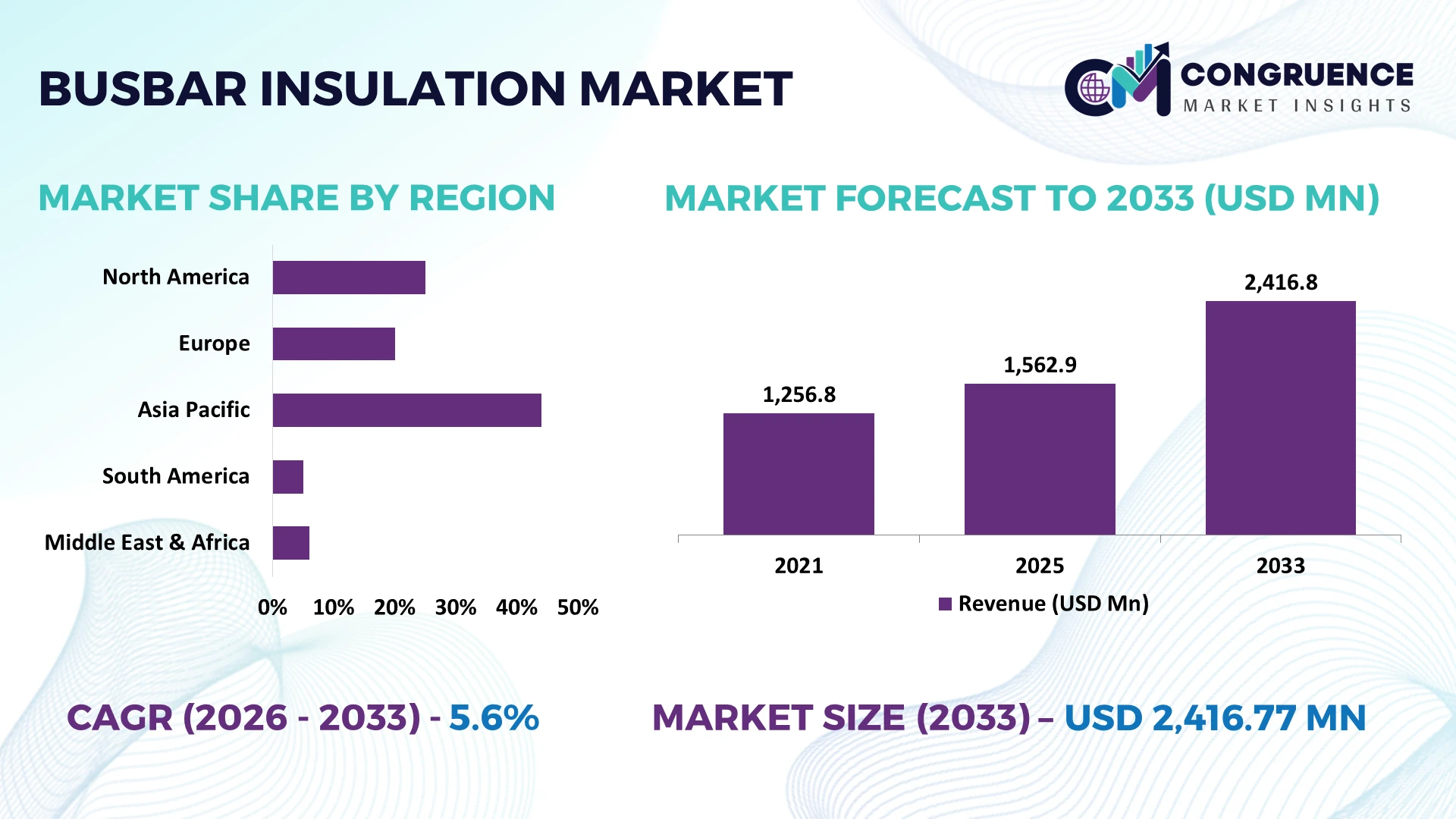
The Global Busbar Insulation Market was valued at USD 1562.88 Million in 2025 and is anticipated to reach a value of USD 2416.77 Million by 2033 expanding at a CAGR of 5.6% between 2026 and 2033. Growth is driven by expansion of high voltage transmission networks, electrification of industrial facilities, renewable energy grid connections, and increasing adoption of insulated busbar systems in compact switchgear and power distribution equipment.
China maintains a dominant position in the global busbar insulation industry through extensive electrical equipment manufacturing and transmission infrastructure development. The country installed approximately 277 GW of solar capacity in 2024, compared with India's approximately 24.5 GW, creating substantial requirements for insulated electrical distribution components. China's State Grid announced investment exceeding CNY 650 billion for 2025, supporting transmission modernization and equipment procurement. Domestic manufacturers are expanding epoxy insulation, heat shrink tubing, and composite coating production for industrial switchgear, renewable energy substations, and high voltage electrical networks.
Strategically, manufacturers should prioritize China's expanding transmission infrastructure and India's renewable energy grid modernization, targeting insulation systems supporting 35 kV distribution equipment and advanced thermal performance requirements.
Market Size & Growth: USD 1,562.88 million in 2025, reaching USD 2,416.77 million by 2033 at 5.6% CAGR, supported by grid electrification.
Top Growth Drivers: Indicative demand contributions include grid modernization at 38%, renewable energy integration at 32%, and industrial electrification at 30%.
Short Term Forecast: By 2028, automated insulation processing targets approximately 15% lower production cycle times through precision coating and curing systems.
Emerging Technologies: Three innovations include nanocomposite epoxy insulation, automated powder coating, and digitally monitored dielectric testing for advanced electrical equipment.
Regional Leaders: Indicative 2033 allocations place Asia Pacific at USD 1,063.38 million, Europe at USD 555.86 million, and North America at USD 507.52 million, reflecting grid expansion, efficiency upgrades, and infrastructure replacement.
Consumer/End User Trends: Renewable energy developers increasingly specify insulated busbars for 1,500 V DC solar infrastructure, strengthening demand for dielectric reliability.
Pilot/Case Example: In 2024, China's solar installations reached approximately 277 GW, demonstrating the scale of electrical infrastructure requiring insulated distribution components.
Competitive Landscape: 3M, ABB, Schneider Electric, TE Connectivity, and Eaton compete across insulation materials, switchgear integration, and engineered electrical components.
Regulatory & ESG Impact: The EU Ecodesign framework requires qualifying power transformers to meet efficiency requirements, encouraging lower loss electrical infrastructure.
Investment & Funding: China's State Grid announced more than CNY 650 billion in 2025 investment, supporting transmission expansion and electrical equipment procurement.
Innovation & Future Outlook: Advanced insulation platforms target 35 kV applications, improved thermal endurance, and automated quality verification for compact electrical distribution systems.
The Busbar Insulation Market is undergoing significant technological transformation as utilities, renewable energy developers, and industrial manufacturers prioritize electrical safety, compact equipment design, and dependable power distribution. Advanced epoxy coatings, polyolefin heat shrink sleeves, and silicone insulation systems are increasingly integrated into medium voltage switchgear, battery energy storage systems, and industrial busduct installations. Insulation materials supporting temperatures of 125°C and above are particularly relevant for demanding electrical environments. India's transmission expansion and domestic electrical equipment manufacturing initiatives are strengthening localized procurement opportunities. These developments establish the foundation for evaluating competitive positioning, material innovation, and strategic investment priorities.
Busbar insulation is becoming strategically important as utilities, electrical equipment manufacturers, and industrial operators modernize power distribution networks to accommodate renewable generation and higher electrical loads. China's installation of approximately 277 GW of solar capacity in 2024 demonstrates the scale of infrastructure requiring dependable dielectric protection. The transition toward compact switchgear, prefabricated busduct systems, and high voltage transmission equipment is reshaping material specifications. Manufacturers are expanding epoxy coatings, silicone insulation, and engineered polymer production to address stricter electrical safety and thermal endurance requirements.
Advanced automated powder coating offers more consistent insulation thickness than conventional manual application, with process improvement targets of 10% to 15% in material utilization under controlled manufacturing conditions. Asia Pacific emphasizes production scale and grid expansion, while Europe prioritizes dielectric reliability, material compliance, and compact electrical equipment. Between 2026 and 2028, manufacturers are expected to prioritize automated coating lines, higher temperature insulation materials, and standardized testing for 35 kV distribution applications.
A practical deployment involves applying epoxy insulation to copper busbars within medium voltage switchgear to reduce exposed conductive surfaces and improve electrical clearance management. ABB, Schneider Electric, and TE Connectivity are strengthening engineered insulation portfolios and manufacturing integration. Competitive positioning increasingly depends on dielectric performance, production consistency, and qualification speed.
Expansion of renewable energy infrastructure and electrical transmission networks is increasing demand for advanced busbar insulation materials. China accounted for approximately 60% of global renewable capacity additions in 2023, while renewable electricity generation represented approximately 32% of global electricity production in 2024. India's renewable energy expansion and transmission modernization are strengthening requirements for insulated busbars in substations, switchgear, and solar power distribution equipment. Advanced epoxy coatings and heat shrink insulation support higher dielectric reliability in compact electrical assemblies. ABB, Schneider Electric, and TE Connectivity are expanding electrical protection technologies and integrated power distribution solutions. Manufacturers prioritizing standardized insulation systems can reduce equipment qualification complexity and strengthen procurement relationships with utilities and industrial equipment producers.
Busbar insulation manufacturers face procurement pressure from copper price fluctuations, specialty polymer availability, and energy intensive coating operations. Copper represents approximately 60% to 70% of the material cost in certain busbar assemblies, making conductor price movements important for integrated equipment manufacturers. Epoxy powder coating operations commonly require curing temperatures of approximately 160°C to 200°C, increasing energy requirements and processing complexity. In India, dependence on imported specialty resins and engineered insulation compounds creates additional exposure to currency movements and supply disruptions. Manufacturers are responding through localized material sourcing, longer procurement contracts, and process automation. The operational priority is reducing coating waste and production variability without compromising dielectric strength, adhesion, or thermal endurance.
Increasing deployment of compact switchgear, battery energy storage systems, and high capacity electrical distribution creates opportunities for advanced insulation technologies. Modern solar installations increasingly operate at 1,500 V DC, compared with conventional 1,000 V DC architectures, representing a 50% increase in nominal system voltage. This transition strengthens requirements for insulation coordination, thermal resistance, and reliable electrical clearance management. India's battery storage infrastructure expansion creates additional opportunities for silicone elastomers, engineered epoxy compounds, and flame resistant polymer insulation. Manufacturers are investing in nanocomposite formulations, automated coating technologies, and modular insulation components. The strongest differentiation opportunity lies in application specific insulation systems that simplify equipment assembly while meeting increasingly demanding dielectric and thermal performance requirements.
Scaling busbar insulation production while maintaining consistent dielectric performance creates substantial engineering and quality assurance challenges. Medium voltage equipment operating at 11 kV and 33 kV requires carefully controlled insulation thickness, surface preparation, and electrical clearance design. Thermal cycling across operating conditions approaching 125°C can accelerate material degradation when polymer selection and processing are inadequate. China's expanding electrical equipment manufacturing sector faces increasing pressure to standardize insulation performance across domestic and export applications. Partial discharge, coating defects, and inconsistent adhesion create long term reliability risks in compact switchgear assemblies. Manufacturers must strengthen automated inspection, dielectric testing, material traceability, and accelerated aging validation. Competitive advantage depends on achieving repeatable insulation quality while supporting higher production volumes and increasingly complex equipment geometries.
Automated Dielectric Inspection Gains Industrial Adoption: Electrical equipment manufacturers are integrating automated optical inspection and high voltage testing into insulation production workflows. Coating lines operating at 160°C to 200°C require precise curing verification, while industrial dielectric testing increasingly incorporates 100% component inspection. ABB and Schneider Electric are strengthening manufacturing quality controls to improve insulation consistency, reduce rejected components, and accelerate equipment qualification.
Flame Retardant Material Specifications Tighten: European electrical equipment manufacturers are strengthening insulation material selection under evolving chemical compliance and fire safety requirements. UL 94 V0 classifications require specimens to extinguish within 10 seconds after each flame application, subject to additional testing conditions. TE Connectivity and specialized polymer suppliers are expanding halogen free insulation options, improving material qualification and supporting procurement requirements for enclosed electrical installations.
Prefabricated Insulation Assemblies Streamline Installation: Manufacturers are shifting toward factory prepared busbar insulation components to reduce manual fitting and installation variability. Standardized molded covers support common 90° busbar connections, while prefabricated sleeves accommodate 11 kV and 33 kV equipment configurations. Eaton and electrical component suppliers are expanding modular insulation portfolios, enabling faster replacement, more consistent assembly, and simplified maintenance across industrial electrical distribution networks.
Thermal Classification Shapes Material Procurement: Industrial buyers increasingly specify insulation materials according to continuous operating temperature and thermal aging performance. Class B insulation corresponds to 130°C, while Class F supports 155°C under applicable insulation system classifications. Japanese electrical equipment manufacturers are refining thermal qualification procedures, and material suppliers are improving polymer formulation consistency. This transition strengthens product differentiation through verified service temperature performance rather than insulation thickness alone.
Heat-Shrink Insulation Tubing represents the leading product category, with an indicative 32% market share, supported by installation flexibility, standardized manufacturing, and broad compatibility with electrical distribution assemblies. Its ability to conform around busbar geometries supports insulation consistency across switchgear, electrical panels, and industrial equipment. Insulation Sleeves remain important for straightforward conductor protection, while Insulation Tapes serve localized repairs and irregular component configurations. Heat shrink products commonly offer shrink ratios of 2:1 or 3:1, allowing manufacturers to accommodate different conductor dimensions using standardized product families. TE Connectivity and specialized insulation manufacturers are strengthening material formulations and product availability to serve electrical equipment producers.
Epoxy Powder Coatings represent the fastest expanding category, supported by increasing demand for uniform dielectric protection on complex busbar surfaces. Insulation Coatings provide application flexibility, while Molded Insulation Covers support repeatable protection around joints and exposed connections. Advanced epoxy processing typically involves curing temperatures between 160°C and 200°C, making production control important for coating reliability. Manufacturers are investing in automated application equipment, material qualification, and specialized coating formulations to improve manufacturing consistency and strengthen supplier differentiation.
Medium-Voltage Busbars represent the leading application, accounting for an indicative 30% market share, supported by extensive use in industrial switchgear, substations, and electrical distribution networks. Equipment operating at 11 kV and 33 kV requires carefully specified dielectric insulation, surface protection, and electrical clearance management. Low-Voltage Busbars remain important in industrial distribution equipment and commercial electrical installations, where standardized insulation products support cost effective assembly. Electrical Panel Insulation addresses exposed conductive surfaces within compact electrical enclosures, while Busbar Joint Insulation protects connection points exposed to mechanical movement and thermal cycling. Manufacturers are expanding application specific insulation portfolios to improve component compatibility and installation consistency.
High-Voltage Busbars represent the fastest expanding application, supported by transmission infrastructure modernization and increasing requirements for reliable electrical insulation. Switchgear Insulation remains strategically important as utilities replace aging equipment and specify compact electrical assemblies. Advanced coating technologies and engineered polymer components support improved dielectric protection across demanding operating conditions. ABB, Schneider Electric, and TE Connectivity are strengthening integrated insulation capabilities through material innovation, automated manufacturing, and electrical equipment partnerships, positioning suppliers to capture higher specification procurement opportunities.
Power Transmission and Distribution represents the leading end user category, with an indicative 36% market share, reflecting extensive requirements for insulated conductors across substations, switchgear, and electrical distribution networks. Utility procurement emphasizes dielectric reliability, standardized product qualification, and long equipment service life. Power Generation maintains substantial demand through generator connections and auxiliary electrical systems, while Industrial Manufacturing requires insulation compatible with demanding operating temperatures and continuous electrical loads. Commercial Buildings prioritize compact electrical panels and dependable conductor protection. Manufacturers are expanding utility focused insulation portfolios and strengthening technical partnerships to support large infrastructure procurement programs.
Renewable Energy represents the fastest expanding end user category, supported by solar power installations, energy storage deployment, and grid connection infrastructure. Modern utility scale solar installations increasingly use 1,500 V DC architectures, strengthening requirements for compatible insulation materials and electrical safety components. Data Centers are emerging as important buyers of insulated busbar assemblies for high capacity power distribution, while Transportation and Railways require durable insulation systems resistant to vibration and thermal cycling. Suppliers are developing specialized polymer compounds, modular insulation products, and customized electrical protection solutions to address increasingly differentiated procurement requirements.
Asia Pacific accounted for the largest market share at an estimated 44% in 2025 however, Asia Pacific is expected to register the fastest growth, expanding at a CAGR of approximately 6.8% between 2026 and 2033.
Grid Infrastructure Replacement Strengthens Advanced Insulation Procurement
North America represents an estimated 21% of the global busbar insulation market, supported by aging electrical infrastructure replacement, industrial electrification, and expanding data center power distribution requirements. The United States dominates regional consumption through utility modernization, electrical equipment manufacturing, and high capacity commercial installations. Canada contributes through renewable electricity infrastructure, industrial processing facilities, and transmission network development. Demand concentrates on epoxy powder coatings, heat shrink insulation tubing, and molded protection components for medium voltage switchgear. The United States Department of Energy's Grid Resilience and Innovation Partnerships program supports approximately USD 10.5 billion in federal funding for grid resilience and modernization projects. Eaton, 3M, and TE Connectivity maintain established electrical component supply networks, strengthening regional procurement capabilities. Manufacturers are prioritizing dielectric reliability, standardized product qualification, and localized technical support to secure utility and industrial equipment contracts.
United States Market Outlook: The United States maintains strong competitive advantages through advanced electrical equipment manufacturing, established insulation material suppliers, and extensive utility infrastructure. Data center construction in Virginia, Texas, and Arizona strengthens demand for insulated busbar assemblies and compact power distribution equipment. Eaton and other domestic equipment manufacturers are expanding production capabilities, while electrical contractors increasingly prioritize prefabricated insulation components to improve installation consistency and reduce maintenance requirements.
Electrical Safety Standards Accelerate Material Qualification Upgrades
Europe accounts for an estimated 23% of the global market, supported by established electrical equipment manufacturing, transmission infrastructure modernization, and stringent dielectric safety requirements. Germany, France, Italy, and the United Kingdom concentrate demand for engineered insulation materials across industrial switchgear, substations, and electrical distribution assemblies. European manufacturers emphasize material traceability, thermal endurance, and compliance with IEC electrical equipment standards. The European Commission's electricity grid action plan identifies approximately EUR 584 billion in required grid investment by 2030, reinforcing long term equipment modernization priorities. Schneider Electric, ABB, and specialized insulation suppliers are strengthening polymer formulations and manufacturing integration. Regional procurement increasingly favors halogen free insulation materials, automated coating quality verification, and standardized components compatible with compact electrical assemblies. These requirements support premium insulation products while increasing qualification complexity for manufacturers entering regulated electrical equipment supply chains.
Germany Market Outlook: Germany benefits from advanced industrial manufacturing, precision materials engineering, and established electrical automation capabilities. Its Energiewende energy transition requires extensive transmission and distribution infrastructure upgrades. German manufacturers are developing insulation systems for industrial switchgear and high capacity electrical installations, emphasizing dielectric testing, thermal performance, and production consistency. Domestic engineering expertise supports adoption of advanced epoxy coatings and customized molded insulation components.
Manufacturing Scale and Grid Expansion Reinforce Regional Leadership
Asia Pacific dominates the global busbar insulation market with an estimated 44% share, supported by extensive electrical equipment production, renewable energy deployment, and transmission infrastructure development. China leads manufacturing and consumption through established switchgear production networks, polymer processing capabilities, and large scale utility investment. India contributes through expanding electricity transmission networks, industrial electrification, and domestic electrical equipment manufacturing. Japan and South Korea maintain strong positions in advanced insulation materials and precision electrical components. China's State Grid announced investment exceeding CNY 650 billion for 2025, reinforcing procurement requirements across transmission and distribution equipment. Manufacturers are expanding epoxy coating production, heat shrink tubing capacity, and engineered polymer processing. Competitive advantages include established component supply chains, manufacturing specialization, and proximity to electrical equipment assembly operations, enabling faster delivery and customized insulation solutions.
China Market Outlook: China maintains a substantial manufacturing advantage through integrated electrical equipment supply chains and large scale infrastructure investment. The country installed approximately 277 GW of solar capacity during 2024, strengthening requirements for insulated electrical connections and distribution equipment. Domestic manufacturers are advancing automated powder coating, polymer extrusion, and dielectric testing capabilities. Local production supports competitive pricing and rapid fulfillment for switchgear manufacturers, renewable energy developers, and utility procurement programs.
Utility Modernization and Industrial Electrification Shape Demand
South America represents an estimated 6% of global busbar insulation demand, supported by electricity distribution modernization, renewable energy installations, and industrial infrastructure development. Brazil dominates regional procurement through its extensive electricity network, manufacturing sector, and expanding solar power infrastructure. Chile contributes through renewable energy development and mining electrification, while Argentina maintains demand from industrial power distribution and utility equipment replacement. Regional buyers prioritize heat shrink insulation tubing, epoxy coatings, and molded protection components for substations and electrical panels. Brazil added approximately 10.9 GW of solar capacity during 2024, illustrating increasing electrical infrastructure requirements. Imported specialty polymers and currency volatility create procurement challenges, encouraging manufacturers to strengthen local distribution partnerships and inventory management. Equipment suppliers increasingly emphasize standardized insulation products, installation flexibility, and dependable technical support.
Brazil Market Outlook: Brazil benefits from established electrical equipment manufacturing clusters around São Paulo and substantial renewable electricity infrastructure. Hydropower, solar generation, and industrial processing facilities create recurring requirements for busbar insulation and electrical protection components. Domestic suppliers are strengthening partnerships with international materials manufacturers to improve product availability. Utility modernization programs encourage adoption of standardized dielectric insulation, automated electrical testing, and durable components suitable for demanding operating environments.
Infrastructure Diversification Accelerates Electrical Equipment Modernization
The Middle East and Africa account for an estimated 6% of global busbar insulation demand, supported by electricity infrastructure expansion, industrial diversification, and large scale construction programs. Saudi Arabia and the United Arab Emirates lead investment in advanced electrical distribution equipment, while South Africa maintains substantial requirements for network rehabilitation and industrial electrical protection. Regional procurement emphasizes heat resistant insulation materials, reliable dielectric performance, and equipment compatibility with demanding environmental conditions. Saudi Arabia's National Renewable Energy Program targets approximately 50% renewable electricity generation by 2030, strengthening requirements for grid connections and electrical distribution components. Schneider Electric, ABB, and Eaton support regional projects through equipment integration and distribution partnerships. Manufacturers are expanding technical support networks and emphasizing insulation products resistant to elevated temperatures, dust exposure, and prolonged industrial operation.
Saudi Arabia Market Outlook: Saudi Arabia is strengthening its electrical equipment market through Vision 2030 industrial diversification, renewable energy deployment, and infrastructure construction. Large developments such as NEOM require extensive medium voltage distribution networks and insulated electrical assemblies. Domestic manufacturing initiatives encourage supplier localization and technical partnerships. Equipment manufacturers are prioritizing thermal endurance, reliable dielectric protection, and standardized insulation components for industrial facilities, substations, and large commercial infrastructure.
The global busbar insulation market features competition between diversified electrical technology leaders ABB, Schneider Electric, and Eaton and specialized material suppliers 3M, TE Connectivity, and HellermannTyton. The five largest participants collectively hold an indicative 42% market share, reflecting fragmented purchasing across insulation materials and integrated electrical equipment. Diversified manufacturers compete through bundled switchgear solutions, while specialists differentiate through dielectric performance, customization, and installation efficiency. Advanced heat shrink products offering 3:1 shrink ratios provide greater dimensional flexibility than conventional 2:1 alternatives, strengthening product differentiation. Automated coating processes targeting 10% to 15% lower material waste create manufacturing cost advantages. Companies are expanding localized production, developing flame resistant polymers, and strengthening utility partnerships. Competition increasingly emphasizes qualified material availability, manufacturing consistency, and integrated component supply. Certification expenses, specialized processing equipment, and lengthy customer approval cycles restrict market entry. Winning requires dependable dielectric performance, competitive production economics, and responsive technical support across industrial applications.
3M Company
ABB Ltd.
Schneider Electric SE
Eaton Corporation plc
TE Connectivity plc
HellermannTyton Group
Nitto Denko Corporation
Sumitomo Electric Industries, Ltd.
Rogers Corporation
Saint Gobain S.A.
Elantas GmbH
Raychem RPG Private Limited
KREMPEL GmbH
ISOVOLTA AG
Current busbar insulation technologies include heat shrink polyolefin tubing, epoxy powder coatings, silicone sleeves, and molded dielectric covers. Advanced automated coating systems improve insulation thickness consistency, while controlled curing at 160°C to 200°C supports reliable adhesion and dielectric performance. Heat shrink products offering 3:1 shrink ratios accommodate 50% greater dimensional variation than conventional 2:1 alternatives when comparing maximum expansion ratios. Manufacturers benefit from standardized assembly, reduced installation complexity, and improved electrical protection across medium voltage switchgear.
Emerging technologies include ceramic reinforced epoxy composites, halogen free flame retardant polymers, and automated dielectric inspection. Nanocomposite formulations target approximately 10% improvement in thermal conductivity under optimized laboratory conditions, while precision powder application targets 15% lower material waste than conventional spraying. Automated inspection enables 100% component screening within configured production lines. Specialized material suppliers gain competitive advantages through verified thermal endurance, reduced coating defects, and faster equipment qualification.
Between 2026 and 2028, digital process monitoring, robotic coating, and advanced polymer compounding will reshape manufacturing priorities. Insulation systems rated for 155°C thermal classes support demanding industrial applications. ABB, TE Connectivity, and specialized manufacturers are strengthening material engineering and automation capabilities. Suppliers combining dielectric reliability, repeatable production, and customized insulation geometries will secure stronger positions across electrical infrastructure procurement.
September 2024: Shin Etsu Chemical introduced ST OR silicone rubber tubing for busbar insulation, delivering dielectric strength of 28 kV/mm. The innovation improves electrical protection and thermal reliability while simplifying insulation installation for high voltage electric vehicle applications. Source: shinetsusilicone-global.com.
May 2025: Schneider Electric launched Canalis for EV in the United Kingdom and Ireland, introducing modular busbar distribution for charging infrastructure. The system addresses transport electrification, with domestic transport representing 29% of UK emissions, supporting flexible charging installations. Source: se.com.
August 2025: Wacker introduced ELASTOSIL R 531/60 silicone rubber for electric vehicle busbar insulation, supporting continuous temperatures up to 205°C. Its fire resistant ceramic layer strengthens short circuit protection, while extrusion compatibility supports scalable manufacturing of insulated conductors. Source: chargedevs.com.
August 2026: Dexco expanded United States busbar manufacturing with a fluidized bed epoxy insulation line supporting electrical components rated up to 38 kV. The expansion consolidates fabrication and coating operations, reducing external processing dependencies for utility customers. Source: wboc.com.
The Busbar Insulation Market Report examines six product categories: Heat Shrink Insulation Tubing, Insulation Sleeves, Insulation Coatings, Epoxy Powder Coatings, Insulation Tapes, and Molded Insulation Covers. Application analysis covers Low Voltage Busbars, Medium Voltage Busbars, High Voltage Busbars, Electrical Panel Insulation, Switchgear Insulation, and Busbar Joint Insulation. End user coverage includes Power Generation, Power Transmission and Distribution, Industrial Manufacturing, Commercial Buildings, Data Centers, Transportation and Railways, and Renewable Energy.
Regional assessment spans North America, Europe, Asia Pacific, South America, and the Middle East and Africa, examining manufacturing concentration, procurement requirements, and infrastructure modernization. Technology evaluation covers advanced polymers, dielectric coatings, automated processing, and thermal endurance. Competitive profiling assesses 14 manufacturers, supporting supplier selection, capacity investment, geographic expansion, and strategic positioning between 2026 and 2033.
| Report Attribute/Metric | Report Details |
|---|---|
Market Revenue in 2025 | USD 1562.88 Million |
Market Revenue in 2033 | USD 2416.77 Million |
CAGR (2026 - 2033) | 5.6% |
Base Year | 2025 |
Forecast Period | 2026 - 2033 |
Historic Period | 2021 - 2025 |
Segments Covered | By Type
By Application
By End-User
|
Key Report Deliverable | Revenue Forecast, Growth Trends, Market Dynamics, Segmental Overview, Regional and Country-wise Analysis, Competition Landscape |
Region Covered | North America, Europe, Asia-Pacific, South America, Middle East, Africa |
Key Players Analyzed | 3M Company, ABB Ltd., Schneider Electric SE, Eaton Corporation plc, TE Connectivity plc, HellermannTyton Group, Nitto Denko Corporation, Sumitomo Electric Industries, Ltd., Rogers Corporation, Saint Gobain S.A., Elantas GmbH, Raychem RPG Private Limited, KREMPEL GmbH, ISOVOLTA AG |
Customization & Pricing | Available on Request (10% Customization is Free) |




