
Reports
The Global Busbar for EV Market was valued at USD 2,230.5 Million in 2025 and is anticipated to reach a value of USD 6,589.4 Million by 2033 expanding at a CAGR of 14.5% between 2026 and 2033. Growth is driven by higher-voltage EV architectures, battery-pack electrification, fast-charging infrastructure, and the replacement of conventional cable-heavy power-distribution systems with compact laminated busbars.
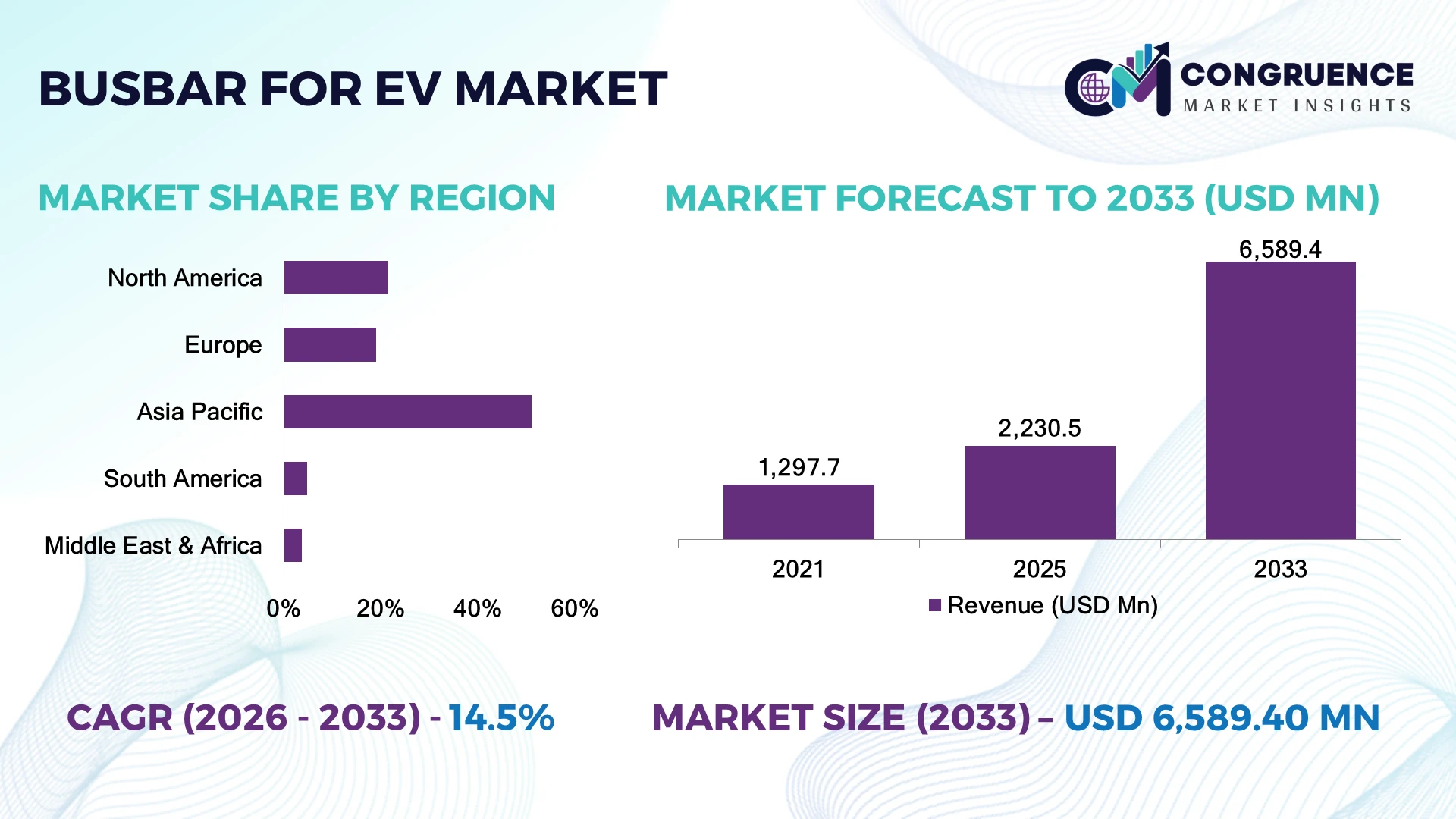
China accounts for approximately 38–42% of global Busbar for EV demand, supported by its dominant EV, battery, and charging-equipment manufacturing base, while the U.S. represents roughly 18–21%. Chinese battery and EV factories continue expanding high-voltage platforms in 2026, while U.S. localization programs are increasing domestic component sourcing. Advanced laminated busbars can reduce electrical interconnection losses by approximately 5–10% versus conventional wiring architectures in suitable applications.
Strategic implication: suppliers with high-voltage insulation, lightweight aluminum/copper designs, automated fabrication, and localized production are positioned to secure EV platform contracts.
Market Size & Growth: USD 2,230.5 million in 2025 to USD 6,589.4 million by 2033 at 14.5% CAGR, driven by high-voltage EV architectures and battery-pack integration.
Top Growth Drivers: EV battery packs 38%, fast charging 24%, vehicle electrification 21%.
Short-Term Forecast: By 2028, automated busbar fabrication can reduce assembly labor requirements by 15–25% and improve dimensional consistency by 5–10%.
Emerging Technologies: Laminated copper busbars, aluminum busbars, laser welding, integrated cooling channels, and high-voltage insulation systems are reshaping EV power distribution.
Regional Leaders: Asia-Pacific is projected near USD 3.2 billion by 2033, Europe around USD 1.5 billion, and North America approximately USD 1.3 billion, supported by localized EV and battery manufacturing.
Consumer/End-User Trends: Battery-electric vehicles represent the core demand base, with high-voltage platforms increasingly moving toward 400–800V architectures for faster charging and lower current requirements.
Pilot/Case Example: 2026 battery-platform deployments increasingly combine laminated busbars with automated laser welding, targeting approximately 10–15% reductions in interconnection assembly time.
Competitive Landscape: Leading integrated busbar and electrical-component suppliers collectively represent an estimated 25–30% share, competing across automotive OEM programs, battery manufacturers, and charging applications.
Regulatory & ESG Impact: Lightweight aluminum busbars can reduce conductor mass by approximately 30–50% versus equivalent copper configurations in selected applications, supporting vehicle weight and material-efficiency objectives.
Investment & Funding: EV and battery manufacturers continue directing multi-billion-dollar capital programs toward localized production, increasing demand for regional busbar fabrication, stamping, insulation, and assembly capacity.
Innovation & Future Outlook: Next-generation busbars will integrate sensing, cooling, high-voltage insulation, and structural functions, shifting procurement toward complete power-distribution modules rather than standalone conductors.
The Busbar for EV Market is increasingly concentrated around battery packs, power electronics, electric drive units, charging systems, and high-voltage distribution architectures. Laminated designs can reduce interconnection complexity by approximately 15–25% while improving packaging efficiency. In 2026, localized EV supply chains and 800V vehicle platforms are accelerating demand for lightweight aluminum, precision laser welding, integrated insulation, and thermally managed busbar assemblies.
The Busbar for EV Market is becoming strategically important because electrical architecture is moving from simple current distribution toward compact, thermally managed, high-voltage power systems. EV manufacturers increasingly require components that combine conductivity, insulation, weight reduction, manufacturability, and dimensional precision within constrained battery-pack spaces. This makes busbar engineering directly relevant to vehicle range, charging performance, safety, and assembly economics.
Compared with conventional cable-heavy interconnections, laminated busbar architectures can reduce interconnection complexity by approximately 15–25% and deliver more consistent routing within battery modules. Copper remains dominant in high-current applications, while aluminum is gaining traction where weight and material cost are prioritized. China leads on manufacturing scale, whereas Germany, Japan, South Korea, and the U.S. emphasize high-precision battery and power-electronics integration.
During 2026–2028, 800V platforms, fast charging, automated laser welding, embedded sensing, and integrated thermal-management features will increasingly influence busbar specifications. Battery plants are expanding automated stamping, forming, insulation, and inspection processes to support higher production volumes. Suppliers are consequently investing in regional fabrication capacity, co-development with OEMs, and direct partnerships with battery-pack manufacturers. Competitive advantage will increasingly depend on delivering validated, lightweight, thermally efficient busbar assemblies at production scale while maintaining high-voltage safety and manufacturing consistency.
The shift toward 800V EV architectures is increasing demand for compact, high-current busbars capable of handling greater electrical loads with controlled thermal performance. High-voltage platforms can reduce charging current requirements by approximately 50% versus comparable 400V systems, while advanced laminated busbars can reduce interconnection complexity by 15–25%. China is rapidly scaling 800V vehicle platforms across premium and mass-market models, while European and Korean manufacturers are accelerating high-voltage programs. Busbar suppliers are responding through copper-aluminum optimization, improved insulation, laser-welded joints, and integrated cooling structures. The strategic shift is significant: busbars are moving from passive conductors toward engineered power-distribution assemblies that influence charging performance, battery packaging, and manufacturing efficiency.
Copper remains a major cost driver for EV busbars, with conductive material typically representing approximately 45–60% of manufacturing cost depending on architecture and design. Copper price volatility can translate into 8–15% fluctuations in material-related component costs, while aluminum alternatives require additional engineering for conductivity, joining, and corrosion management. China-based manufacturers benefit from extensive copper processing and EV supply ecosystems, whereas suppliers dependent on imported materials face greater procurement exposure. Complex laminated constructions can also increase tooling and insulation-processing requirements by approximately 10–20% compared with simpler stamped conductors. Manufacturers are reducing exposure through aluminum substitution, optimized conductor geometry, recycled copper inputs, and multi-source procurement. The critical restraint is balancing weight reduction against thermal and electrical performance without compromising high-voltage safety.
Next-generation EV busbars are evolving into multifunctional assemblies incorporating sensing, insulation, thermal management, and structural interfaces. Integrated designs can reduce component count by approximately 10–20% and shorten battery-pack assembly steps by 15–25%. China, South Korea, and Germany are particularly active in high-voltage battery-platform development, creating opportunities for suppliers that co-engineer busbars directly with battery-pack manufacturers. Embedded temperature and current sensing can additionally improve fault detection and thermal monitoring by approximately 10–20%. Suppliers are investing in laser welding, automated forming, precision insulation, and digital inspection to meet these requirements. The non-obvious opportunity lies in moving upstream into battery-pack engineering, where suppliers can secure platform-level contracts rather than competing solely on conductor pricing.
Busbars operating in 400–800V architectures must maintain electrical isolation, dimensional accuracy, thermal stability, and mechanical integrity under vibration and temperature cycling. Manufacturing tolerances can fall below 1% for critical formed dimensions, while insulation defects can create disproportionately high safety and warranty exposure. Battery-pack designs also vary significantly across vehicle platforms, increasing engineering and validation requirements by approximately 15–25% for customized assemblies. U.S., German, and Japanese OEMs are demanding tighter traceability and automated inspection as battery safety requirements intensify. Suppliers must therefore invest in high-voltage testing, automated optical inspection, digital traceability, and application-specific tooling. Long-term competitiveness will depend on scaling customized production without allowing engineering complexity to erode manufacturing yield or delivery reliability.
800V Platforms Reshape Specifications: EV manufacturers are increasingly moving beyond 400V architectures, with 800V systems reducing charging current requirements by approximately 50% at equivalent power. This is driving demand for thinner, thermally optimized conductors and higher-performance insulation. Chinese and Korean OEMs are accelerating high-voltage platform deployment, while busbar manufacturers are redesigning terminals, joints, and insulation systems for higher electrical loads.
Aluminum Gains Design Attention: Aluminum busbars are gaining traction where vehicle weight and material economics outweigh copper's conductivity advantage. Optimized aluminum designs can reduce conductor mass by approximately 30–50%, although larger cross-sections and specialized joining remain necessary. Suppliers are developing aluminum-compatible laser welding, surface treatments, and hybrid copper-aluminum architectures, particularly for battery packs where weight reduction directly supports vehicle efficiency.
Laser Welding Expands Assembly: Automated laser welding is increasingly replacing selected mechanical joining processes in battery busbar production, improving joint consistency and reducing manual assembly requirements by approximately 15–25%. Automated inspection can further improve dimensional and weld-quality consistency by 5–10%. Battery manufacturers in China and Europe are expanding automated pack lines, encouraging suppliers to deliver busbars engineered specifically for high-speed welding and inline inspection.
Busbars Become Data Interfaces: Advanced battery-pack architectures increasingly integrate temperature, current, and voltage sensing directly into busbar assemblies. Embedded sensing can improve localized fault detection by approximately 10–20% and reduce separate wiring requirements by 10–15%. The non-obvious shift is that busbars are becoming part of the battery's monitoring architecture. Suppliers are consequently developing sensor-ready laminates, insulated stamped structures, and direct battery-management-system interfaces.
Laminated busbars represent the leading type, accounting for approximately 42–47% of the global Busbar for EV Market, supported by compact geometry, lower interconnection complexity, controlled insulation, and compatibility with high-voltage battery architectures. Stamped busbars contribute around 28–33%, retaining strong adoption where simpler construction and high-volume production favor cost efficiency, while flexible busbars account for approximately 12–16% and remain relevant where packaging requires greater routing freedom. Laminated designs are particularly suited to 400–800V battery packs and power-electronics assemblies.
Aluminum busbars represent the fastest-shifting material configuration, with adoption increasing as OEMs prioritize weight and material-cost optimization. Aluminum designs can reduce conductor mass by approximately 30–50% versus comparable copper configurations, although larger cross-sections and specialized joining are required. Suppliers are responding through hybrid copper-aluminum architectures, laser welding, precision insulation, and automated inspection. Investment is increasingly moving toward multifunctional busbars incorporating sensing, cooling, and structural interfaces rather than standalone conductors.
The IEA reported that nearly 22 million electric cars were produced globally in 2025, with China accounting for nearly 75% of global EV production, reinforcing the scale advantage of high-volume busbar manufacturing and battery-pack integration in the Chinese supply chain.
Battery packs represent the leading application, accounting for approximately 50–55% of global Busbar for EV demand because high-voltage energy storage requires compact, insulated, low-resistance current distribution between cells, modules, contactors, and power electronics. Power distribution and inverter assemblies contribute roughly 18–22%, while electric-drive and charging applications account for approximately 15–20%. Battery-pack architectures therefore generate the strongest recurring demand for precision forming, insulation, joining, and dimensional control.
Fast-charging and high-voltage power-distribution applications represent the fastest-growing use case as 800V architectures expand. These systems can reduce charging current requirements by approximately 50% at equivalent power, increasing the importance of low-resistance joints and thermal management. Suppliers are developing laminated structures, integrated cooling paths, laser-welded connections, and sensor-ready assemblies. Traditional battery busbars remain volume-intensive, while charging and inverter applications increasingly demand higher thermal and electrical performance. The business implication is a shift toward application-specific engineering, with suppliers increasingly co-developing busbar assemblies directly with battery and vehicle manufacturers.
The IEA reported that electric-car sales exceeded 20 million units in 2025, representing one-quarter of global new-car sales, while battery-electric vehicles accounted for 65% of electric-car sales, strengthening demand for high-voltage battery-pack interconnection systems.
Automotive OEMs represent the leading end-user group, accounting for approximately 48–53% of global Busbar for EV demand because they determine vehicle electrical architecture, battery-pack specifications, safety validation, and platform-level component sourcing. Battery manufacturers and pack integrators contribute approximately 25–30%, while charging-equipment and power-electronics manufacturers account for roughly 12–17%. OEM procurement increasingly emphasizes electrical performance, thermal behavior, weight, dimensional repeatability, and multi-year supply assurance rather than conductor pricing alone.
Battery manufacturers and pack integrators represent the fastest-growing buyer group as cell-to-pack architectures and higher-voltage platforms reduce the separation between battery and vehicle electrical engineering. Their demand is increasingly tied to automated stamping, forming, insulation, welding, and inline inspection, with automation reducing assembly labor requirements by approximately 15–25%. Suppliers are responding through co-development agreements, dedicated production lines, localized fabrication, and platform-specific tooling. China has the strongest scale advantage, while European, Japanese, Korean, and U.S. buyers place greater emphasis on qualification, traceability, and regional supply resilience. Competitive positioning is therefore shifting toward integrated design-and-manufacturing partnerships.
The IEA reported that Chinese automakers supplied 60% of global electric-car sales in 2025, while China produced nearly 75% of global electric cars, reinforcing the purchasing influence of Chinese automotive and battery manufacturers across the EV component supply chain.
Asia-Pacific accounted for the largest market share at 51.0% in 2025 however, Middle East & Africa is expected to register the fastest growth, expanding at a CAGR of 16.2% between 2026 and 2033.

Battery localization shifts busbar sourcing toward regional production
North America accounted for approximately 21.5% of the global Busbar for EV Market in 2025, supported by battery-cell plants, EV assembly, power-electronics manufacturing, and charging infrastructure. The U.S. dominates regional demand, while Mexico is becoming increasingly important as an automotive component manufacturing hub. Approximately 45–50% of regional busbar consumption is linked to battery-pack and high-voltage power-distribution applications. The expansion of localized battery production is increasing demand for stamped, laminated, and insulated busbars manufactured closer to vehicle assembly plants. Suppliers are establishing regional fabrication and forming capacity to reduce logistics exposure and support just-in-time deliveries. The shift toward 800V architectures is also increasing requirements for higher-performance insulation, low-resistance joints, and integrated thermal management.
United States Market Outlook: The United States represents the region's largest busbar market, supported by major automotive manufacturing clusters and expanding battery production. Battery-pack applications account for approximately half of domestic demand. New battery plants are increasing requirements for automated stamping, laser welding, insulation, and electrical testing, encouraging suppliers to establish localized production and engineering capabilities close to OEM and battery-manufacturing facilities.
Battery localization strengthens high-voltage component manufacturing
Europe represented approximately 19.0% of global Busbar for EV Market demand in 2025, supported by Germany, France, Italy, Spain, and Central European automotive manufacturing hubs. Battery localization and increasing adoption of high-voltage vehicle platforms are strengthening demand for precision busbars with controlled insulation and thermal performance. Approximately 40–45% of regional consumption is associated with battery packs and high-voltage distribution. European manufacturers are emphasizing lightweight aluminum, laminated architectures, automated inspection, and traceable production. Suppliers are responding through OEM co-development and localized manufacturing. The region's stringent vehicle safety and sustainability requirements are also encouraging greater material efficiency and process control across busbar production.
Germany Market Outlook: Germany is Europe's most strategically significant market because of its concentration of automotive OEMs, Tier-1 suppliers, battery projects, and power-electronics manufacturing. Battery and vehicle platforms increasingly require 400–800V electrical architectures, creating demand for precision-formed copper and aluminum busbars. German suppliers and manufacturing partners are emphasizing automated inspection, high-voltage validation, and platform-specific engineering to meet stringent OEM qualification requirements.
China's EV scale drives integrated busbar manufacturing
Asia-Pacific accounted for approximately 51.0% of global Busbar for EV Market demand in 2025, with China representing the dominant manufacturing and consumption base. China produces nearly three-quarters of global electric cars, creating substantial demand for battery busbars, laminated conductors, and high-voltage distribution assemblies. Japan and South Korea contribute through advanced battery and automotive electronics manufacturing, while India is expanding localized EV and battery production. Suppliers are scaling stamping, forming, insulation, laser welding, and automated inspection capacity alongside battery plants. The region increasingly favors vertically integrated production, where busbar manufacturers collaborate directly with cell, pack, and vehicle companies. High-volume Chinese manufacturing is also accelerating cost optimization and faster qualification of new busbar architectures.
China Market Outlook: China is the global center of EV and battery manufacturing, accounting for approximately 75% of global electric-car production. Its extensive battery-cell, pack, and vehicle ecosystem creates strong demand for high-volume busbar production. Domestic suppliers benefit from proximity to major battery clusters, integrated copper and aluminum processing, and rapidly expanding 800V vehicle programs, supporting competitive cost and short production lead times.
Brazil anchors emerging EV component localization
South America accounted for approximately 4.8% of global Busbar for EV Market demand in 2025, with Brazil representing the primary opportunity through automotive assembly, commercial vehicles, battery projects, and charging infrastructure. Regional demand remains smaller than established EV manufacturing centers, but vehicle electrification is increasing requirements for battery interconnections and high-voltage distribution. Approximately 45–50% of regional busbar demand is concentrated in automotive and battery-related applications. Brazil's established automotive supply base provides an initial platform for localized busbar fabrication, while imported advanced components continue serving specialized applications. Suppliers are prioritizing distributor partnerships, local forming and assembly, and flexible production to address lower volumes without excessive inventory exposure.
Brazil Market Outlook: Brazil is the region's largest automotive manufacturing market and provides the strongest foundation for EV busbar localization. Automotive production creates an established supplier ecosystem for stamped and formed electrical components, while expanding electrification increases demand for battery and power-distribution assemblies. Local production can reduce import dependence and shorten component replenishment cycles, particularly for standardized copper and aluminum busbars.
EV infrastructure investment creates new component demand
Middle East & Africa accounted for approximately 4.2% of global Busbar for EV Market demand in 2025, with Saudi Arabia, the United Arab Emirates, South Africa, and selected North African economies driving regional activity. Demand is concentrated around EV assembly initiatives, charging infrastructure, battery projects, and industrial electrification. Approximately 30–35% of regional demand is linked to charging and high-voltage electrical infrastructure rather than vehicle manufacturing alone. Saudi Arabia and the UAE are investing heavily in advanced mobility and charging ecosystems, creating opportunities for busbars used in high-current charging equipment and vehicle power systems. Suppliers are responding through project partnerships, regional distribution, and localized assembly, while high-performance laminated designs gain relevance in fast-charging applications.
Saudi Arabia Market Outlook: Saudi Arabia offers the region's strongest emerging opportunity because EV manufacturing, charging infrastructure, and industrial localization programs are developing simultaneously. The country's EV ecosystem is creating demand for high-current electrical distribution components, while fast-charging deployments increase requirements for thermally stable busbars. Suppliers with regional engineering, assembly, and after-sales capabilities can position themselves across vehicle, battery, and charging-infrastructure projects.
Mersen, Rogers, TE Connectivity, Yazaki, and Tata AutoComp compete with regional specialists such as RHI Electric and EMS, with global engineered-material suppliers targeting premium OEM programs while Asian manufacturers compete on cost and delivery speed. The top five players are estimated to hold approximately 25–30% combined share, reflecting a fragmented supply base. Competition centers on electrical performance, packaging, localization, and qualification: laminated architectures can reduce assembly complexity 15–25%, lightweight aluminum designs can cut conductor mass 30–50%, and regional production can shorten replenishment cycles 20–30%. Mersen and Rogers emphasize co-engineering and integrated sensing, while Tata AutoComp and Chinese suppliers expand localized production and customized fabrication. The competitive shift is toward multifunctional busbars combining power distribution, sensing, insulation, and thermal management. Entry barriers include automotive validation, high-voltage testing, precision forming, and long OEM qualification cycles. Winning requires co-development, automated quality control, regional manufacturing, and demonstrable lifecycle advantages rather than commodity pricing alone.
Mersen SA
Rogers Corporation
TE Connectivity
Yazaki Corporation
Tata AutoComp Systems
Amphenol Corporation
Methode Electronics
EAE Group
Brar Elettromeccanica
RHI Electric
EMS Group
Legrand SA
Current EV busbar technology is moving toward laminated copper structures, precision-stamped conductors, laser-welded joints, and integrated insulation. Laminated designs reduce interconnection complexity by roughly 15–25% versus cable-heavy architectures, while automated laser welding can improve joint consistency by 5–10%. Adoption is strongest in high-volume battery-pack production, where dimensional repeatability and high-voltage isolation directly affect pack yield and safety.
Emerging architectures combine busbars with cell-contacting systems, temperature sensing, voltage monitoring, and battery-management interfaces. Integrated designs can reduce separate sensing connections by approximately 10–15% and lower insulation material use by up to 30% in optimized assemblies. Aluminum busbars are gaining traction where conductor mass reduction matters, with potential weight savings of 30–50% versus equivalent copper configurations. These developments favor suppliers with materials expertise, automated forming, and validated joining processes.
During 2026–2028, 800V platforms, embedded sensing, thermal management, and automated optical inspection will increasingly shape procurement. Compared with conventional manual assembly and separate wiring, integrated busbar systems can reduce assembly steps by approximately 15–25%. Mersen, Rogers, Tata AutoComp, and specialized Asian suppliers benefit when they combine co-engineering with localized manufacturing. The competitive advantage will shift toward multifunctional assemblies that improve packaging, traceability, thermal performance, and production speed simultaneously across next-generation EV battery platforms worldwide.
February 2024 Rogers Corporation announced a Monterrey, Mexico factory for advanced busbar manufacturing and engineering. The first phase was scheduled for late 2024, strengthening North American EV supply localization and shortening customer lead times, manufacturing resilience. Source: Rogers Corporation
January 2025 Yazaki Innovations unveiled a new EV busbar line at CES, targeting lightweight construction and improved electrical efficiency. The launch expanded power-distribution capabilities and strengthened positioning in EV mobility, where packaging and conductor mass influence architecture. Source: Yazaki Innovations
April 2025 Sensata Technologies announced its high-voltage distribution units entered serial production for heavy electric trucks, supporting charging up to 3 MW. Integrated optimized busbars, cooling, sensors, and protection components strengthened demand for multifunctional high-voltage distribution assemblies. Source: Sensata Technologies
January 2026 Mahindra Research Valley researchers presented EV busbar optimization work focused on thermal and electrical behavior under loads. The study evaluated a 96V battery system, emphasizing sizing to avoid material weight and cost while improving reliability. Source: SAE International
The Busbar for EV Market Report evaluates copper, aluminum, copper-alloy, laminated, stamped, flexible, and hybrid busbar configurations used across battery-electric, hybrid, and plug-in hybrid vehicles. Application coverage includes battery packs, power distribution units, inverters, electric drive systems, charging equipment, and high-voltage interconnections. End-user analysis covers automotive OEMs, battery manufacturers, Tier-1 suppliers, charging-equipment producers, and specialized component integrators.
Regional analysis spans North America, Europe, Asia-Pacific, South America, and Middle East & Africa, with detailed country assessment for China, the United States, Germany, Japan, South Korea, India, Brazil, and Saudi Arabia. The report evaluates 400–800V architectures, laser welding, automated forming, integrated sensing, thermal management, and high-voltage insulation. With battery-pack applications representing approximately 50–55% of demand, the study supports investment planning, supplier selection, localization, OEM partnerships, technology prioritization, and competitive positioning through 2026–2033.
| Report Attribute/Metric | Report Details |
|---|---|
|
Market Revenue in 2025 |
USD 2,230.5 Million |
|
Market Revenue in 2033 |
USD 6,589.4 Million |
|
CAGR (2026 - 2033) |
14.5% |
|
Base Year |
2025 |
|
Forecast Period |
2026 - 2033 |
|
Historic Period |
2021 - 2025 |
|
Segments Covered |
By Type
By Application
By End-User
|
|
Key Report Deliverable |
Revenue Forecast, Growth Trends, Market Dynamics, Segmental Overview, Regional and Country-wise Analysis, Competition Landscape |
|
Region Covered |
North America, Europe, Asia-Pacific, South America, Middle East, Africa |
|
Key Players Analyzed |
Mersen SA, Rogers Corporation, TE Connectivity, Yazaki Corporation, Tata AutoComp Systems, Amphenol Corporation, Methode Electronics, EAE Group, Brar Elettromeccanica, RHI Electric, EMS Group, Legrand SA |
|
Customization & Pricing |
Available on Request (10% Customization is Free) |




