
Reports
The Global Bulk Material Handling Equipment Market was valued at USD 16817.24 Million in 2025 and is anticipated to reach a value of USD 21805.06 Million by 2033 expanding at a CAGR of 3.3% between 2026 and 2033.
Rising deployment of automated conveyor systems, AI-enabled predictive maintenance, and energy-efficient material transport solutions across mining, cement, ports, and food processing facilities is accelerating equipment replacement cycles, with automated systems improving operational throughput by over 22% compared to conventional handling infrastructure. Between 2024 and 2026, geopolitical trade realignments, Red Sea shipping disruptions, and stricter industrial emission regulations across Europe and Asia pushed manufacturers to localize bulk handling operations and invest in digitally monitored high-capacity equipment to reduce downtime and logistics exposure by nearly 18%.
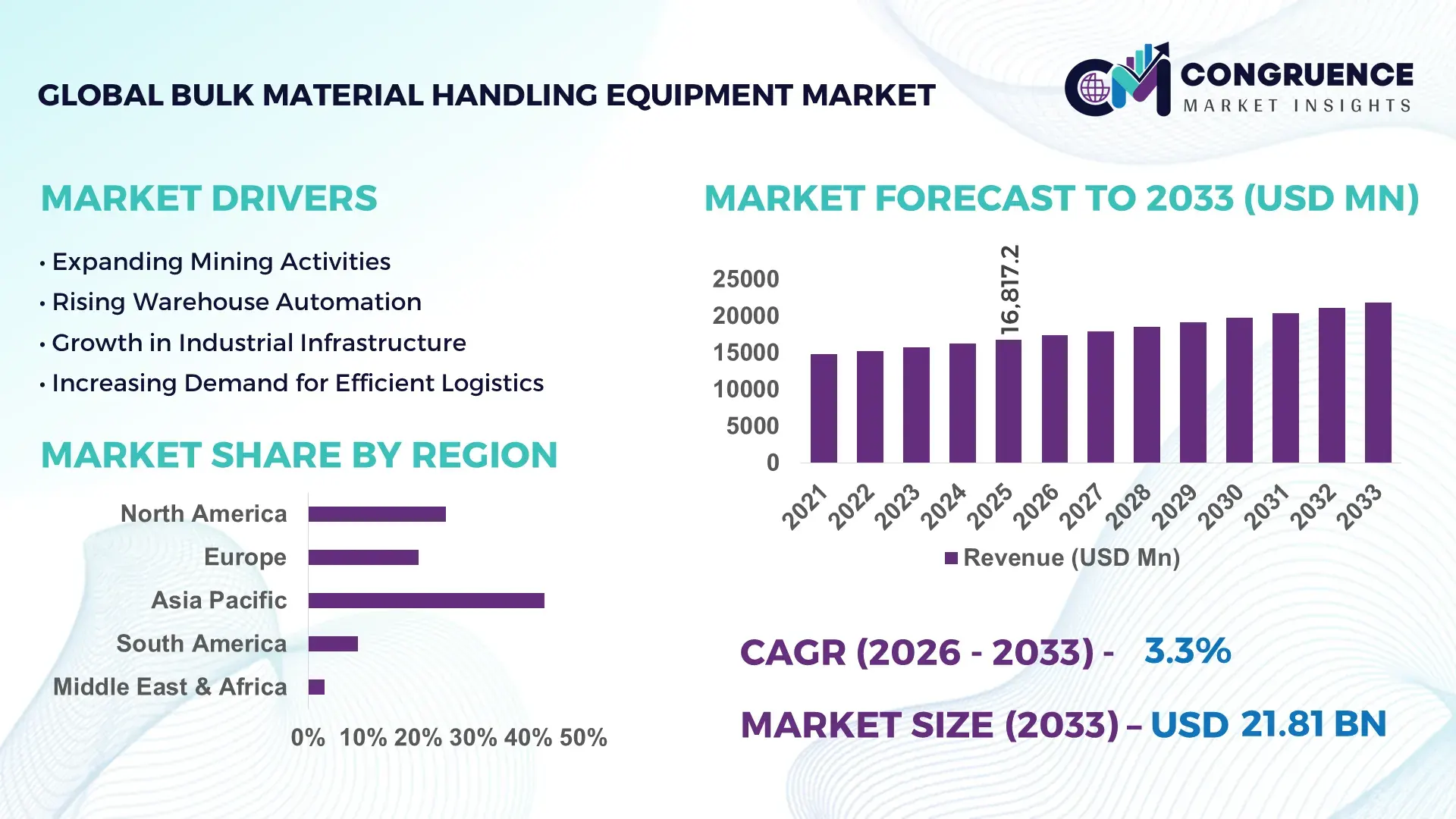
China remains the dominant country in the global bulk material handling equipment market, accounting for nearly 34% of global manufacturing capacity in 2026, supported by large-scale steel, mining, cement, and port infrastructure investments exceeding USD 95 billion. More than 48% of newly commissioned industrial logistics facilities in eastern China integrated smart conveyor automation and sensor-based loading systems, compared to under 30% adoption in 2021. India and Southeast Asia are emerging as high-volume deployment hubs due to rapid expansion in thermal power, fertilizer, and aggregate processing industries, while the United States continues leading in advanced robotic bulk handling integration for high-throughput warehousing and mining applications.
Manufacturers prioritizing automation-led retrofitting, regional production expansion, and energy-optimized equipment portfolios are positioned to secure stronger long-term industrial contracts and operational margins in the evolving global bulk material handling equipment market.
Market Size & Growth: USD 16.8 billion market in 2025 advances toward USD 21.8 billion by 2033, driven by automated mining logistics and smart industrial material flow systems at 3.3% CAGR.
Top Growth Drivers: Automation adoption rose 26%, mining infrastructure investments increased 18%, and port material throughput demand expanded 14% globally.
Short-Term Forecast: By 2028, AI-enabled handling systems reduce unplanned downtime by 21% and improve operational efficiency by 19%.
Emerging Technologies: Autonomous conveyors, IoT-enabled predictive monitoring, and lightweight wear-resistant materials improve energy efficiency by 15%–20%.
Regional Leaders: Asia-Pacific exceeds USD 9.4 billion with smart port expansion, North America surpasses USD 4.8 billion through mining automation, and Europe crosses USD 3.9 billion via low-emission industrial upgrades.
Consumer/End-User Trends: Over 52% of mining and cement operators prioritize automated bulk handling systems to reduce labor dependency and material loss.
Pilot/Case Example: In 2025, an automated port conveyor modernization project improved bulk loading speed by 28% and reduced maintenance costs by 17%.
Competitive Landscape: Top manufacturers control nearly 38% market share, led by advanced industrial automation specialists and heavy equipment providers.
Regulatory & ESG Impact: Energy-efficient systems lowered industrial material transfer emissions by 13% amid stricter European and Asian compliance standards.
Investment & Funding: Global industrial expansion and strategic partnerships surpassed USD 7 billion between 2024 and 2026, supported by supply chain localization programs.
Innovation & Future Outlook: Next-generation AI-driven handling platforms and modular equipment designs accelerate high-capacity, low-energy industrial logistics transformation.
Mining and minerals processing contribute nearly 32% of global bulk material handling equipment demand, followed by cement and construction materials at 24% and food processing industries at 14%. Advanced dust-control systems, autonomous stacker reclaimers, and digital twin-enabled conveyor monitoring are improving plant efficiency by over 20% across high-throughput industrial sites. Asia-Pacific continues leading deployment volumes due to rapid infrastructure and port expansion, while North America strengthens demand for retrofitted smart handling systems amid supply chain resilience strategies and tightening industrial sustainability regulations. Increasing integration of electrified and sensor-based material transport systems is shaping the next phase of competitive industrial modernization.
Bulk material handling equipment is transforming into a strategic industrial infrastructure segment as mining, ports, cement, energy, and large-scale manufacturing operations prioritize throughput optimization, labor efficiency, and automated logistics resilience. Global operators are accelerating investments in intelligent conveyor systems, robotic loaders, and digitally connected storage equipment to reduce material loss and improve plant productivity by over 20%. The market is becoming increasingly competitive as industrial operators shift from standalone machinery procurement toward integrated automation ecosystems capable of delivering predictive maintenance, real-time operational analytics, and lower lifecycle operating costs.
Between 2024 and 2026, supply chain regionalization, stricter industrial emission mandates, and rising energy costs forced manufacturers to redesign material flow operations for higher efficiency and reduced dependency on manual handling. AI-enabled conveyor monitoring improves efficiency by 27% while reducing maintenance costs by 18% compared to legacy electromechanical systems. Asia-Pacific leads in deployment volume due to mining and infrastructure expansion, while Europe leads in smart automation adoption with over 46% integration across advanced industrial facilities. Over the next three years, automated bulk handling facilities are expected to lower operational downtime by nearly 23%, while electrified systems reduce industrial energy consumption by 14%, strengthening ESG-linked procurement advantages and export compliance access.
In 2025, a large-scale automated port handling upgrade in Southeast Asia improved cargo throughput by 31% and reduced turnaround time by 19%, reinforcing the commercial value of intelligent material movement systems. Major equipment manufacturers are shifting capital allocation toward modular automation platforms, digital retrofit services, and regional manufacturing expansion to secure long-duration industrial contracts. Companies optimizing AI integration, energy-efficient operations, and high-capacity material transport infrastructure are positioning themselves to dominate the next phase of industrial logistics transformation.
Rapid industrial automation and infrastructure modernization are accelerating demand for advanced bulk material handling equipment across mining, cement, ports, and power generation sectors. Automated conveyor deployment increased by 24% between 2024 and 2026 as operators prioritized continuous material flow and lower labor dependency. Simultaneously, global port expansion investments rose 18%, driven by trade route restructuring and higher bulk commodity movement after Red Sea shipping disruptions. Smart handling systems reduce operational downtime by nearly 21%, forcing industrial operators to replace aging mechanical infrastructure. Companies are responding through regional manufacturing expansion, AI-enabled predictive maintenance integration, and strategic partnerships with industrial automation providers, while high-capacity electrified handling systems are reshaping procurement priorities across large-scale processing facilities worldwide.
Raw material cost volatility and infrastructure limitations are constraining large-scale deployment of bulk material handling equipment, particularly in emerging industrial economies. Steel and industrial component prices fluctuated by over 17% between 2024 and 2026, directly increasing equipment manufacturing and installation costs. More than 35% of mid-sized industrial facilities still operate on outdated mechanical systems due to limited grid stability, weak automation infrastructure, and high retrofit expenses. Stricter environmental compliance regulations are also forcing costly redesigns of dust-control and emission management systems. Companies are mitigating exposure through long-term supplier contracts, regional component diversification, and modular equipment architectures that reduce installation complexity by nearly 14%, while alternative lightweight materials are gaining strategic attention for cost optimization.
Emerging economies and intelligent automation platforms are redefining growth opportunities across the bulk material handling equipment market. Automated material transport systems improve throughput efficiency by over 26% while reducing energy consumption by nearly 15%, creating strong operational advantages for mining, fertilizer, and cement producers. Southeast Asia, India, and Africa are accelerating industrial corridor and port infrastructure investments, with bulk commodity logistics demand rising above 20% across strategic trade zones. AI-driven digital twins, sensor-based maintenance systems, and autonomous stacking equipment are transforming maintenance planning and reducing equipment failure rates by 18%. Leading manufacturers are increasing R&D spending, expanding localized production hubs, and building industrial automation ecosystems to secure long-term contracts and future dominance in high-volume processing industries.
Operational complexity, energy infrastructure pressure, and regulatory tightening are challenging long-term competitiveness in the bulk material handling equipment market. Nearly 29% of industrial operators report integration delays caused by incompatible legacy systems and limited digital workforce capabilities. High-capacity automated facilities also increase electricity consumption significantly, while unstable power infrastructure in developing regions constrains scalable deployment. Environmental compliance requirements related to dust emissions, noise reduction, and energy efficiency are increasing equipment redesign costs by approximately 12%. Supply chain fragmentation following geopolitical trade disruptions continues extending component lead times across heavy industrial projects. To remain competitive, manufacturers are prioritizing electrified equipment platforms, advanced system interoperability, strategic technology alliances, and predictive analytics capabilities that improve operational reliability and reduce lifecycle maintenance risks.
34% rise in AI-enabled conveyor monitoring is reshaping industrial material flow operations. Mining, cement, and port operators are deploying sensor-based predictive maintenance systems that reduce equipment downtime by 22% and maintenance intervention frequency by 17%. Companies are integrating centralized control platforms to optimize conveyor throughput and loading precision across multi-site operations. Labor shortages in heavy industrial environments are forcing faster automation adoption, while manufacturers are restructuring service portfolios around remote diagnostics and performance analytics contracts.
28% increase in electrified handling equipment deployment is redefining operational efficiency standards. Industrial operators are replacing diesel-driven stackers and reclaimers with electric systems that lower energy consumption by 14% and reduce emission-control compliance costs by 11%. Europe and Japan are accelerating low-emission equipment upgrades following stricter industrial sustainability mandates. Equipment manufacturers are scaling modular electrification platforms and battery-assisted handling systems to capture long-duration infrastructure and port modernization projects.
31% expansion in regional manufacturing localization is shifting procurement and supply chain execution models. After persistent shipping disruptions and component delays, bulk handling equipment suppliers are increasing localized production capacity and dual-sourcing strategies to reduce lead times by nearly 19%. Southeast Asia and India are emerging as assembly and customization hubs for conveyors and bucket elevators. This shift is also redefining aftermarket service models, with faster spare-part delivery becoming a competitive differentiator rather than purely a support function.
26% growth in integrated warehouse-material handling convergence is optimizing industrial logistics networks. Companies are combining warehouse management systems with automated loading, unloading, and storage handling infrastructure to improve bulk inventory accuracy by 21% and internal transfer speed by 24%. Food processing and chemical industries are rapidly adopting synchronized handling ecosystems to manage fluctuating raw material movement. Equipment providers are responding through software partnerships, integrated automation packages, and scalable retrofit solutions that strengthen long-term client retention.
The bulk material handling equipment market is segmented by type, application, and end-user industries, with conveyors and material transportation systems collectively accounting for over 40% of deployment demand due to their scalability and continuous operational efficiency. Mining and cement industries remain the largest end-user segments, contributing nearly 38% of equipment utilization because of high-volume material movement requirements. Demand is increasingly shifting toward automated loading, storage handling, and warehouse-integrated systems as industrial operators prioritize labor optimization and predictive maintenance capabilities. Companies are expanding smart equipment portfolios and modular system integration strategies to capture rising demand from energy-efficient industrial processing and digitally connected logistics operations.
Conveyors dominate the bulk material handling equipment market with nearly 39% share due to their continuous transport capability, lower operational interruption rates, and strong integration advantage across mining, ports, cement plants, and warehouse-linked industrial facilities. Their ability to improve material throughput by over 25% compared to intermittent handling systems continues reinforcing structural dominance. Bucket elevators represent the fastest-growing type segment, with adoption increasing by approximately 18% as food processing, chemicals, and fertilizer industries prioritize vertical material movement optimization and reduced floor-space utilization. Compared with traditional hoppers, bucket elevators improve enclosed transport efficiency while lowering product contamination risk significantly.
Stackers and reclaimers collectively account for around 34% of deployment demand, driven by large-scale stockyard automation and high-capacity bulk storage management requirements. Hoppers maintain niche relevance in controlled material discharge operations, especially across cement and aggregate facilities requiring dust-controlled handling precision. Equipment manufacturers are accelerating investments in automated conveyors, energy-efficient bucket elevators, and digitally monitored stacker systems to capture infrastructure modernization projects and industrial retrofit demand. Companies prioritizing modular conveyor expansion and smart material flow integration are securing stronger competitive positioning in high-throughput industrial operations.
Material transportation remains the leading application segment, accounting for approximately 36% of global equipment deployment due to continuous demand from mining, power generation, cement, and industrial logistics operations. Usage concentration exists because uninterrupted bulk movement directly influences throughput efficiency, plant utilization rates, and operational cost control. Warehouse management is emerging as the fastest-growing application, with adoption expanding by nearly 21% as industrial operators integrate automated storage, loading, and digital inventory synchronization systems to optimize internal logistics efficiency. Compared with traditional loading and unloading operations, warehouse-integrated handling systems improve material traceability and reduce transfer delays by over 18%.
Mining operations, storage handling, and processing operations collectively contribute nearly 44% of application demand, supported by increasing automation requirements across high-volume industrial facilities. Companies are repositioning equipment portfolios toward AI-enabled transportation systems, modular warehouse-linked handling infrastructure, and sensor-based unloading automation to improve asset productivity. Demand is shifting toward integrated operational ecosystems where transportation, storage, and processing functions operate through centralized digital monitoring platforms. Businesses investing in synchronized material handling networks are gaining measurable advantages in operational speed, labor optimization, and supply chain responsiveness.
Mining remains the dominant end-user segment, accounting for nearly 29% of global bulk material handling equipment demand due to continuous large-volume material extraction, stockyard movement, and long-distance transport requirements. Demand concentration is strongest in iron ore, coal, and mineral processing operations where automated handling infrastructure directly improves throughput consistency and reduces operational downtime. Food and beverage is the fastest-growing end-user segment, with equipment deployment increasing by approximately 17% as manufacturers prioritize contamination-controlled transport, automated storage systems, and high-speed processing logistics. Compared with mining operations focused on heavy-capacity durability, food and beverage buyers prioritize precision handling, enclosed transport efficiency, and energy-optimized automation.
Construction, chemicals, power generation, and cement industries collectively represent around 51% of equipment utilization, supported by rising infrastructure activity and industrial process automation. Companies are increasingly targeting these sectors through customized conveyor systems, modular bucket elevators, and low-emission handling equipment aligned with operational compliance requirements. Buying behavior is shifting toward long-term automation partnerships and predictive maintenance service contracts rather than standalone equipment procurement. Manufacturers expanding localized support networks and digitally integrated product portfolios are capturing stronger industrial procurement opportunities across high-throughput sectors.
Asia-Pacific accounted for the largest market share at 43% in 2025 however, Middle East & Africa is expected to register the fastest growth, expanding at a CAGR of 4.8% between 2026 and 2033.
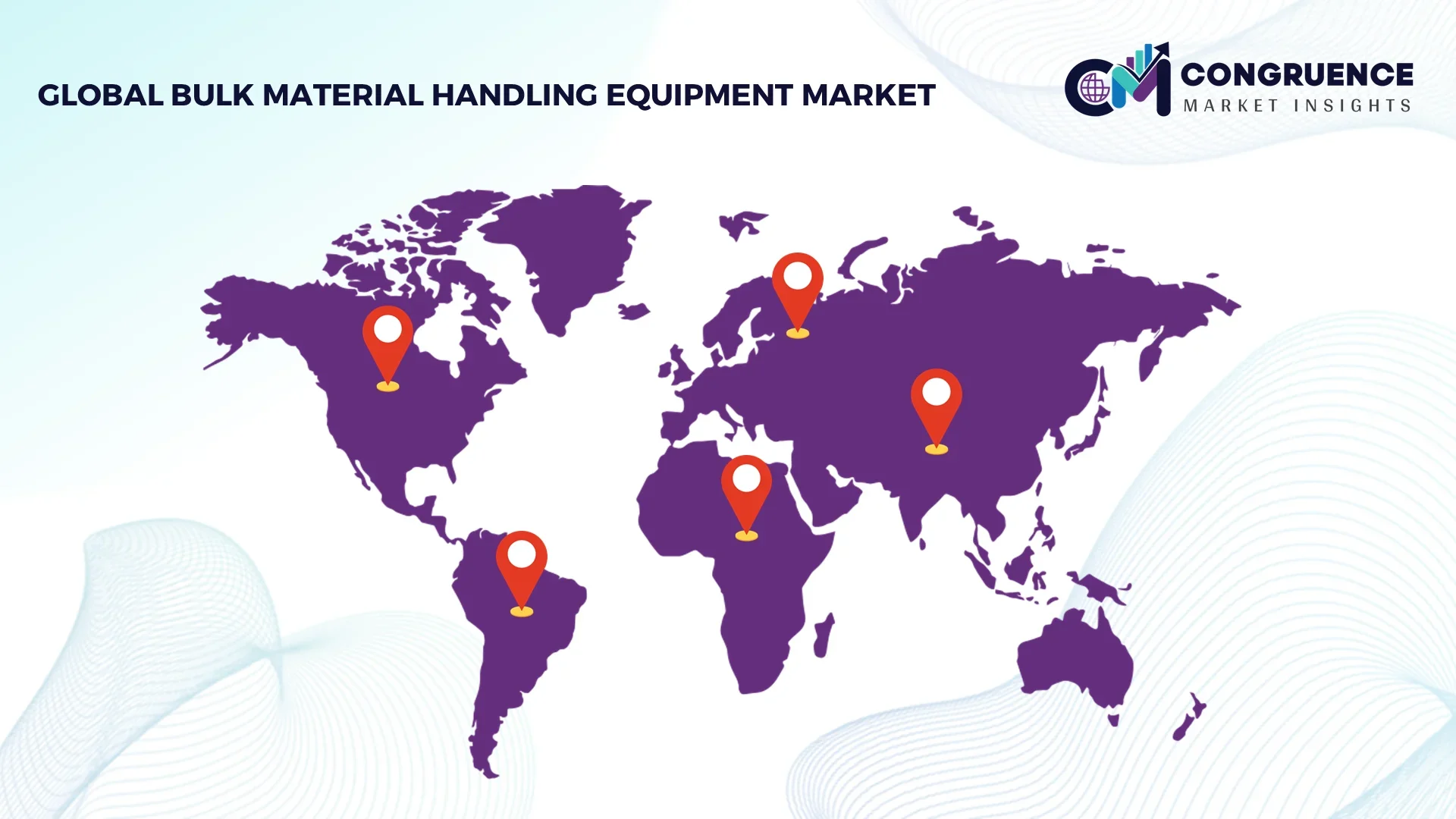
Asia-Pacific dominates bulk material handling equipment demand due to large-scale mining, cement production, port expansion, and industrial automation deployment across China, India, and Southeast Asia. North America holds nearly 24% share, leading in AI-enabled conveyor automation and predictive maintenance adoption, with over 47% of large industrial facilities integrating digitally monitored handling systems. Europe contributes around 21% of global demand, driven by low-emission industrial upgrades and stricter operational efficiency mandates. Meanwhile, Middle East & Africa is accelerating infrastructure-linked equipment deployment through mining diversification and logistics corridor investments. Supply chain regionalization and energy-efficiency regulations are reshaping procurement priorities globally, forcing manufacturers to localize production, expand aftermarket support networks, and accelerate smart handling system integration across high-growth industrial hubs.
North America accounts for approximately 24% of global bulk material handling equipment demand, supported by strong mining, warehousing, aggregates, and industrial processing activity across the United States and Canada. Automated conveyor adoption increased by nearly 29% between 2024 and 2026 as industrial operators prioritized predictive maintenance and lower labor dependency. Supply chain resilience initiatives and nearshoring strategies are forcing companies to modernize high-capacity material flow infrastructure and regional distribution facilities. More than 46% of large industrial plants now operate digitally monitored handling systems integrated with AI-based performance analytics. Equipment manufacturers are expanding localized production and retrofit capabilities to reduce installation timelines and strengthen aftermarket support. Enterprise buyers increasingly favor scalable, energy-efficient automation platforms that improve operational continuity and long-term asset utilization.
Europe represents nearly 21% of global bulk material handling equipment deployment, led by Germany, France, and the Netherlands through advanced industrial automation and port modernization initiatives. Stricter emission-control regulations and industrial energy-efficiency targets are accelerating replacement of legacy diesel-powered handling systems with electrified and low-noise equipment platforms. More than 41% of newly installed industrial material transport systems in Western Europe now include energy-monitoring and predictive maintenance capabilities. Industrial operators are prioritizing enclosed conveyors and automated dust-control systems to meet environmental compliance requirements while reducing operational losses by approximately 16%. Equipment suppliers are strengthening partnerships with automation software providers and expanding modular electrification portfolios. The region is forcing manufacturers globally to accelerate innovation, sustainability integration, and compliance-focused product engineering.
Asia-Pacific leads the global bulk material handling equipment market with nearly 43% demand concentration, driven by rapid industrialization, mining expansion, cement production growth, and port infrastructure development across China, India, Indonesia, and Vietnam. China alone contributes over 34% of global production capacity for industrial handling equipment and components. Regional manufacturers are accelerating localized conveyor, stacker, and bucket elevator production to reduce procurement lead times by nearly 18%. More than 52% of newly commissioned industrial facilities across major manufacturing corridors now integrate automated handling systems for throughput optimization and labor efficiency. Enterprise buyers prioritize scale, speed, and cost-efficient deployment, while manufacturers continue expanding regional assembly operations and integrated automation capabilities to capture infrastructure-linked industrial growth opportunities.
South America contributes approximately 7% of global bulk material handling equipment demand, supported primarily by mining, agriculture, and bulk commodity export operations across Brazil, Chile, and Peru. Copper, iron ore, and grain logistics modernization projects are increasing demand for automated conveyors and loading systems capable of improving throughput efficiency by nearly 20%. However, inconsistent infrastructure investment and high import dependency continue constraining large-scale deployment timelines and raising equipment acquisition costs by approximately 13%. Industrial operators are increasingly adopting modular and localized handling solutions to reduce maintenance complexity and installation delays. Equipment suppliers are expanding regional service partnerships and aftermarket support networks to strengthen operational reliability. The region presents strong industrial expansion potential but requires strategic localization and cost-optimized deployment models to remain commercially competitive.
Middle East & Africa accounts for nearly 5% of global bulk material handling equipment deployment, with demand concentrated across Saudi Arabia, the United Arab Emirates, and South Africa through mining, cement, port, and large-scale infrastructure projects. Industrial diversification programs and logistics corridor investments are accelerating adoption of automated conveyors, reclaimers, and bulk loading systems. More than 27% of newly approved industrial infrastructure projects in the Gulf region now include digitally integrated handling technologies to improve material movement efficiency and reduce operational downtime. Mining operators across Africa are increasing investments in high-capacity electrified equipment to optimize extraction logistics and lower maintenance interruptions by approximately 15%. Enterprise buyers prioritize durable, scalable systems capable of operating under harsh environmental conditions, positioning the region as a strategic long-term infrastructure expansion market.
China – Holds approximately 34% share of the global Bulk Material Handling Equipment market due to massive mining output, industrial manufacturing scale, and aggressive port and infrastructure expansion projects.
United States – Accounts for nearly 19% share of the Bulk Material Handling Equipment market, supported by advanced industrial automation adoption, large-scale warehousing infrastructure, and strong mining and logistics modernization demand.
The bulk material handling equipment market is dominated by global industrial automation leaders competing against regional cost-focused manufacturers and specialized engineering providers. Companies such as Siemens AG, FLSmidth, Metso, BEUMER Group, and Thyssenkrupp collectively control nearly 38% of market activity through integrated automation, conveyor engineering, and high-capacity mining solutions. Competition is increasingly shifting from standalone equipment pricing toward operational efficiency, predictive maintenance integration, and lifecycle service contracts. AI-enabled monitoring systems improve operational uptime by over 21%, while modular conveyor architectures reduce installation timelines by approximately 17%, forcing suppliers to accelerate technology integration. Global players are expanding localized manufacturing, strengthening automation partnerships, and vertically integrating digital monitoring platforms to secure infrastructure modernization contracts. Regional manufacturers remain competitive through lower-cost customization and faster aftermarket responsiveness. High capital requirements, engineering complexity, and long industrial procurement cycles continue creating strong entry barriers. Winning requires scalable automation capabilities, regional execution strength, and long-term operational reliability.
Siemens AG
FLSmidth
Metso Corporation
BEUMER Group
Thyssenkrupp AG
Sandvik AB
Hitachi Construction Machinery
Komatsu Ltd.
Honeywell International Inc.
Daifuku Co., Ltd.
Schenck Process Holding GmbH
TAKRAF GmbH
Liebherr Group
Caterpillar Inc.
Bulk material handling equipment is rapidly transitioning toward AI-enabled automation, predictive diagnostics, and digitally synchronized material flow systems. More than 48% of newly deployed conveyor networks in mining and cement operations now integrate IoT sensors and centralized analytics platforms to reduce unplanned downtime by nearly 22%. Automated stacker reclaimers and smart bucket elevators are also improving throughput efficiency by over 19% while lowering maintenance intervention frequency. Companies deploying digitally monitored systems are gaining operational advantages through faster material tracking, reduced labor dependency, and optimized energy consumption across high-volume industrial facilities.
Emerging technologies between 2026 and 2028 are reshaping execution-level performance through electrified handling equipment, digital twins, and modular conveyor engineering. AI-powered predictive maintenance platforms improve efficiency by 27% while reducing maintenance costs by 18% compared to legacy electromechanical systems. More than 41% of advanced industrial facilities in Europe and North America are integrating digital twin simulations to optimize conveyor routing, storage handling, and loading precision before physical deployment. Equipment manufacturers are scaling partnerships with industrial software providers to accelerate integrated warehouse-material handling ecosystems and remote operational control capabilities.
Disruptive technologies including AI-driven industrial copilots, magnetic levitation conveyors, and adaptive autonomous logistics systems are redefining competitive positioning. New AI-assisted engineering systems are delivering up to 50% workflow efficiency improvements compared to conventional manual configuration processes. Early adopters in mining, ports, and food processing are prioritizing scalable automation ecosystems capable of supporting real-time operational adaptation and lower lifecycle costs. Companies investing aggressively in electrification, AI integration, and modular automation platforms are positioning themselves ahead of slower legacy equipment suppliers as industrial procurement increasingly shifts toward intelligent, energy-optimized handling infrastructure.
April 2024 – Metso launched modular FIT™ and Foresight™ conveyor systems for mining applications, reducing delivery time by up to 25% and installation time by 15% through standardized modular engineering. The launch strengthened rapid-deployment conveyor adoption across high-capacity mining projects and accelerated electrified bulk transport modernization. [Modular Conveyor Shift] Source: Metso
September 2025 – BEUMER Group introduced BEUMER Guardian digital monitoring solutions for conveying technology, bucket elevators, and packaging systems, enhancing plant availability through advanced diagnostics and process optimization. The platform improved maintenance visibility and operational efficiency for industrial bulk handling operators focused on predictive asset management. [Predictive Monitoring Expansion] Source: BEUMER Group
March 2026 – Siemens launched Drivetrain Analyzer Onsite, an AI-powered industrial drive analytics solution enabling real-time condition monitoring within local infrastructure environments. The platform strengthened secure predictive maintenance adoption across industrial material handling operations requiring strict data sovereignty and faster anomaly detection capabilities. [Industrial AI Integration] Source: Siemens Press
January 2026 – Siemens and NVIDIA expanded their industrial AI partnership to build adaptive AI-driven manufacturing and logistics systems integrating digital twins and autonomous operational intelligence. The initiative accelerated deployment of AI-native industrial infrastructure and reinforced large-scale automation optimization across material flow and warehouse operations. [AI Logistics Transformation] Source: Siemens CES 2026 Announcement
The Bulk Material Handling Equipment Market Report delivers comprehensive analysis across core equipment types including conveyors, stackers, reclaimers, hoppers, and bucket elevators, alongside detailed application coverage spanning material transportation, warehouse management, loading and unloading, storage handling, and mining operations. The report evaluates demand patterns across key end-user industries such as mining, cement, construction, chemicals, food and beverage, and power generation. Geographic assessment covers North America, Europe, Asia-Pacific, South America, and Middle East & Africa, with execution-level insights into industrial automation, electrified handling systems, predictive maintenance platforms, and AI-integrated logistics technologies shaping industrial operations between 2026 and 2033.
The report analyzes more than 20 strategic market indicators including automation adoption rates, operational efficiency improvements, deployment concentration by industry, and regional infrastructure expansion patterns. Over 48% of newly commissioned industrial facilities now integrate automated material handling technologies, while digitally monitored conveyor systems reduce maintenance interruptions by approximately 22%. Competitive benchmarking profiles major global equipment manufacturers, automation providers, and regional engineering companies to evaluate product positioning, expansion strategies, and innovation intensity. The report supports investment planning, supply chain localization strategies, industrial capacity expansion, and technology adoption decisions by identifying where demand is accelerating, which technologies are scaling fastest, and how competitive differentiation is evolving across industrial material movement ecosystems.
| Report Attribute/Metric | Report Details |
|---|---|
|
Market Revenue in 2025 |
USD 16817.24 Million |
|
Market Revenue in 2033 |
USD 21805.06 Million |
|
CAGR (2026 - 2033) |
3.3% |
|
Base Year |
2025 |
|
Forecast Period |
2026 - 2033 |
|
Historic Period |
2021 - 2025 |
|
Segments Covered |
By Type
By Application
By End-User
|
|
Key Report Deliverable |
Revenue Forecast, Growth Trends, Market Dynamics, Segmental Overview, Regional and Country-wise Analysis, Competition Landscape |
|
Region Covered |
North America, Europe, Asia-Pacific, South America, Middle East, Africa |
|
Key Players Analyzed |
Siemens AG, FLSmidth, Metso Corporation, BEUMER Group, Thyssenkrupp AG, Sandvik AB, Hitachi Construction Machinery, Komatsu Ltd., Honeywell International Inc., Daifuku Co., Ltd., Schenck Process Holding GmbH, TAKRAF GmbH, Liebherr Group, Caterpillar Inc. |
|
Customization & Pricing |
Available on Request (10% Customization is Free) |




