
Reports
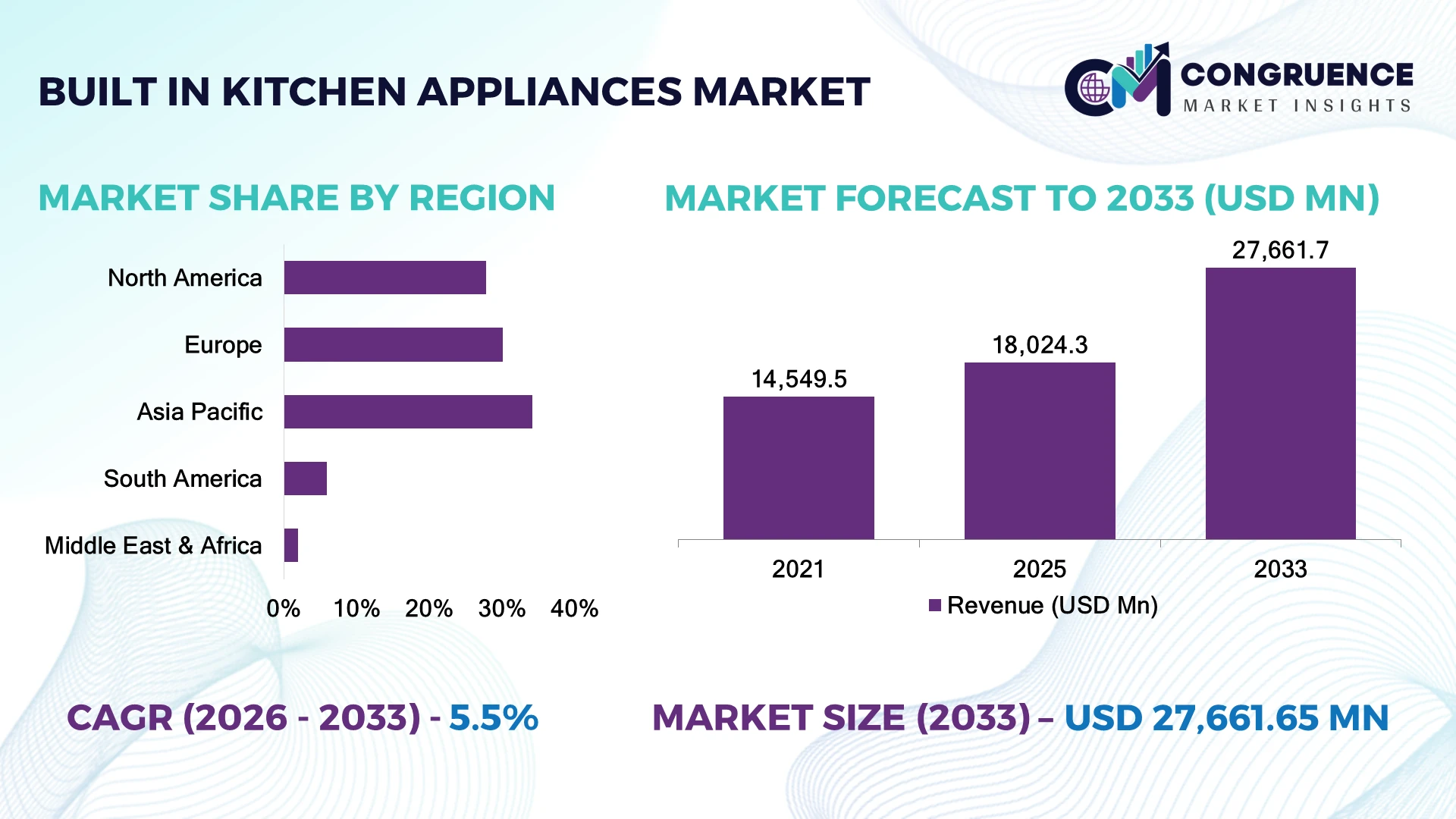
The Global Built-in Kitchen Appliances Market was valued at USD 18,024.3 Million in 2025 and is anticipated to reach a value of USD 27,661.7 Million by 2033 expanding at a CAGR of 5.5% between 2026 and 2033. Growth is driven by integrated kitchen renovation, premium induction and connected cooking systems, energy-efficiency requirements, and replacement of freestanding appliances with space-optimized built-in configurations.
China remains the dominant manufacturing hub, accounting for roughly 30% of global major-appliance production capacity, while the U.S. represents a substantially larger premium built-in demand base than most individual Asian markets. European built-in penetration exceeds 60% in several mature kitchen-renovation channels, supported by induction, steam cooking, and connected appliance adoption. Ongoing supply-chain diversification is shifting component sourcing toward Southeast Asia and Eastern Europe.
Manufacturers that combine localized production, energy-efficient platforms, and connected appliance ecosystems are best positioned to capture premium built-in kitchen demand.
The built-in kitchen appliances market is strongest across premium residential kitchens, urban apartments, hospitality projects, and renovation-led housing. Demand centers on induction hobs, built-in ovens, integrated refrigerators, dishwashers, and connected cooking systems. Smart connectivity is expanding, with premium models increasingly incorporating Wi-Fi and automated controls. Supply-chain localization and energy-efficiency standards are also accelerating product redesign, setting the stage for deeper strategic differentiation.
Built-in kitchen appliances are becoming strategically important because appliance manufacturers are competing increasingly on complete kitchen ecosystems rather than individual products. Integrated ovens, induction hobs, refrigerators, dishwashers, and smart controls enable higher-value product configurations and strengthen brand retention through connected platforms. In 2026, manufacturers are also restructuring sourcing around regional production and shorter component supply chains to reduce exposure to freight disruption and geopolitical trade friction.
Technology is widening the performance gap. Modern induction systems can deliver roughly 10–20% better cooking-energy efficiency than conventional electric resistance cooking, while connected appliances enable automated scheduling, remote diagnostics, and usage optimization. Europe remains the most mature built-in market, whereas Asia-Pacific is expanding rapidly through urban housing, premium residential development, and kitchen modernization.
Over the next 2–3 years, connected appliance penetration is positioned to rise by approximately 12–15%, while energy-efficient models increasingly become the default premium configuration. A practical deployment is the integrated induction-and-oven kitchen, where synchronized controls optimize cooking sequences and standby consumption. Manufacturers are responding through regional assembly, software partnerships, modular platforms, and semiconductor investments. Competitive advantage will increasingly depend on ecosystem integration, energy performance, design consistency, and dependable localized supply.
Premium kitchen renovation and compact urban housing are shifting demand toward coordinated built-in appliance configurations. Induction hobs, multifunction ovens, and integrated dishwashers now represent an estimated 35–40% of premium kitchen installations in mature markets, while connected appliance adoption is approaching 25% among higher-income households. In Germany and the U.S., energy-efficiency requirements are accelerating replacement of older cooking equipment. Manufacturers are responding with modular platforms, synchronized controls, and appliance bundles that improve installation efficiency by approximately 10–15%. A non-obvious advantage is higher ecosystem attachment: once several appliances share one control platform, replacement decisions increasingly favor the same manufacturer, strengthening recurring premium sales and reducing customer switching.
Built-in appliances carry higher component and installation costs because integrated cabinetry, specialized compressors, electronic controls, and precision fittings require tighter manufacturing tolerances. Semiconductor-enabled models can carry 15–25% higher component complexity than conventional appliances, while installation costs can increase 10–20% where kitchen dimensions require customized integration. European manufacturers also face elevated compliance and redesign costs from evolving energy-efficiency requirements. Supply disruptions affecting motors, power electronics, and control boards can extend procurement cycles by 8–12%. Companies are mitigating exposure through dual sourcing, localized assembly in Poland, Turkey, Mexico, and Southeast Asia, and longer component contracts. The operational challenge is maintaining standardized platforms while accommodating country-specific cabinetry and electrical specifications.
AI-enabled cooking assistance is creating a higher-value product layer beyond conventional connectivity. Sensor-driven ovens can automate temperature and cooking-stage adjustments, while food-recognition systems increasingly target 10–15% lower energy use through optimized heating cycles. In Japan and South Korea, compact smart kitchens provide an important deployment model for urban households with limited floor space. Manufacturers are investing in computer vision, recipe intelligence, edge processing, and interoperable smart-home platforms. Partnerships between appliance brands and technology providers can shorten software development cycles by 15–20%. The less obvious opportunity is monetizing appliance data for predictive maintenance and personalized service, transforming built-in equipment from durable hardware into a longer-term connected customer relationship.
Connected built-in kitchens increasingly combine appliances, mobile applications, voice interfaces, home-energy systems, and third-party platforms, creating integration requirements that conventional appliance engineering was not designed to manage. Software-related service incidents can account for 10–15% of connected-appliance support interactions, while cybersecurity testing adds development workloads of roughly 8–12%. Germany, Japan, and the U.S. also operate under differing data, electrical, and interoperability expectations. Manufacturers must therefore invest in secure firmware architecture, over-the-air update infrastructure, standardized communication protocols, and specialized software teams. The strategic risk is fragmented ecosystems: inconsistent connectivity can undermine the premium value proposition even when individual appliances deliver strong energy and cooking performance.
Smart Controls Move Beyond Connectivity: Built-in ovens and induction systems are shifting from basic Wi-Fi functions toward automated cooking, energy monitoring, and remote diagnostics, with premium connected adoption approaching 25–30%. Manufacturers are integrating edge processing and app-based controls to reduce service visits and strengthen ecosystem retention.
Induction Platforms Become More Efficient: Energy-focused product redesign is accelerating as European efficiency requirements tighten. New induction systems can deliver roughly 10–20% better cooking efficiency than conventional electric resistance technologies, while improved power electronics reduce heat losses. Manufacturers are expanding induction portfolios and standardizing modular control platforms.
Modular Production Gains Importance: Supply-chain volatility is encouraging manufacturers to standardize common control boards, motors, displays, and electronic modules across multiple appliance families. Platform reuse can reduce component complexity by 10–15% and shorten product-development cycles. Production hubs in Poland, Turkey, Mexico, and Southeast Asia are gaining strategic importance.
Quiet Appliances Become Premium Differentiator: Noise performance is emerging as a measurable selling point for integrated dishwashers, refrigeration systems, and ventilation appliances, particularly in open-plan urban kitchens. Premium models increasingly target noise reductions of 10–20% versus older platforms, prompting manufacturers to redesign compressors, insulation, airflow paths, and vibration-control systems.
Built-in ovens represent the leading type, accounting for approximately 29–32% of the global built-in kitchen appliances market, supported by broad residential installation, standardized cabinetry integration, and multifunction cooking capability. Built-in refrigerators and integrated dishwashers follow at roughly 22–25% and 18–21%, respectively, with mature demand concentrated in Germany, France, the U.S., and the U.K. Manufacturers are increasingly standardizing modular dimensions and control platforms, reducing installation complexity by around 10–15%.
Induction hobs are the fastest-growing type, supported by electrification, precise temperature control, and increasingly stringent energy-efficiency requirements. Their share is estimated near 14–17%, with adoption accelerating in Japan, South Korea, Germany, and France. Steam ovens, integrated microwaves, and combination cooking systems remain smaller but strategically important premium categories, generally commanding 15–25% higher selling prices. Companies are prioritizing induction-plus-oven product bundles and connected cooking ecosystems rather than isolated appliance launches.
Residential kitchens account for approximately 72–76% of built-in kitchen appliance demand, reflecting high installation volumes across new housing, apartment developments, and renovation projects. Germany, the U.S., the U.K., and France remain important premium markets, where integrated ovens, hobs, refrigerators, and dishwashers are commonly specified as coordinated kitchen packages. Renovation projects increasingly favor appliance replacement without complete kitchen reconstruction, creating demand for standardized 60-cm configurations and modular installation systems. Manufacturers are responding with broader product families that share platforms and connectivity architecture.
Hospitality and commercial kitchens represent the fastest-growing application, currently accounting for roughly 16–20% of demand. Hotel developments, serviced apartments, premium restaurants, and compact food-service environments are prioritizing space utilization, energy monitoring, and low-noise equipment. Commercial deployment can require 10–20% higher durability specifications than residential installations, while connected diagnostics can reduce service-response requirements by 10–15%. Remaining applications, including institutional housing and property developments, increasingly use centralized procurement and appliance packages, strengthening manufacturers' opportunities for project-based contracts.
Individual homeowners represent approximately 58–62% of global built-in kitchen appliance demand, supported by renovation, replacement, and premium kitchen upgrades. Their purchasing decisions increasingly combine design consistency with energy efficiency, connectivity, noise performance, and appliance interoperability. Premium homeowners in Germany, the U.S., Japan, and South Korea show stronger adoption of multi-appliance connected ecosystems, with bundled purchases typically increasing average appliance value by 15–25%. Manufacturers are responding through coordinated appliance families, financing programs, retailer partnerships, and app-based ecosystem integration.
Property developers and hospitality operators form the fastest-growing institutional buyer group, representing approximately 23–27% of demand. Large residential projects and hotels increasingly specify standardized appliance packages to simplify procurement, installation, maintenance, and replacement. Developer-led deployments can reduce installation and procurement complexity by 10–15% through common appliance dimensions and centralized contracts. Kitchen designers, contractors, and institutional buyers account for the remaining demand and exert disproportionate influence over brand selection. Companies are therefore expanding B2B specification teams, project partnerships, and dedicated configuration tools to secure appliance volumes before construction completion.
Asia-Pacific accounted for the largest market share at 34.2% in 2025 however, Middle East & Africa is expected to register the fastest growth, expanding at a CAGR of 6.4% between 2026 and 2033.
Premium renovation and connected-kitchen integration strengthen replacement demand
North America accounted for approximately 27.8% of the global built-in kitchen appliances market in 2025, with the U.S. generating the majority of regional demand through residential remodeling, premium housing, and hospitality projects. Built-in ovens, induction cooktops, integrated refrigerators, and dishwashers are increasingly specified as coordinated packages rather than standalone replacements. Connected appliance penetration in premium households is estimated at 30–35%, strengthening demand for app-based controls and energy monitoring. Mexico is also gaining importance as an appliance manufacturing and export base, supporting shorter North American supply chains. Manufacturers are expanding regional assembly, retailer partnerships, and smart-home compatibility to manage logistics exposure and improve product availability.
U.S. Market Outlook:
The U.S. remains the region's principal demand center because of its large remodeling market, high appliance replacement volumes, and extensive premium-kitchen installation network. California, Texas, Florida, and New York represent important high-value markets. Induction adoption is accelerating, while ENERGY STAR-oriented purchasing increasingly influences premium appliance specifications. Major manufacturers are expanding connected product portfolios and retailer integration, with bundled kitchen installations improving cross-selling opportunities by approximately 15–20%.
Energy efficiency and integrated kitchen design reshape appliance specifications
Europe represented approximately 30.1% of global built-in kitchen appliance demand in 2025, supported by high built-in penetration in Germany, France, Italy, the U.K., and the Netherlands. Energy labeling, eco-design requirements, and electrification are accelerating replacement toward induction cooking, efficient dishwashers, heat-pump-enabled systems, and intelligent ovens. Built-in configurations account for more than 60% of appliance installations in several mature Western European kitchen channels. Manufacturers are redesigning platforms around lower standby consumption, recyclable materials, and standardized electronic modules, while European production hubs maintain strong capabilities in premium appliance engineering and automation.
Germany Market Outlook:
Germany is the region's most strategically important market for premium built-in appliances, combining strong domestic manufacturing capabilities with sophisticated kitchen-furniture integration. Bosch, Siemens, Miele, and other established brands benefit from extensive dealer and kitchen-studio networks. Energy-efficient appliances increasingly influence specification decisions, while induction and connected cooking systems are expanding across new-build and renovation projects. Automated manufacturing and modular electronics enable German producers to maintain premium positioning while improving production flexibility.
Manufacturing scale increasingly converges with premium kitchen adoption
Asia-Pacific held approximately 34.2% of global built-in kitchen appliance demand in 2025 and also represents the industry's most important manufacturing base. China, Japan, South Korea, and India are driving different layers of the value chain, from high-volume component production to premium smart-kitchen deployment. China remains a major appliance manufacturing center, while Southeast Asia is attracting additional production diversification as manufacturers rebalance sourcing. Urban apartment construction and premium residential projects are increasing demand for integrated cooking and refrigeration systems. Companies are combining local production with connected platforms and region-specific product dimensions to reduce logistics costs and installation complexity.
China Market Outlook:
China combines extensive appliance manufacturing capacity with a rapidly expanding premium urban kitchen segment. Major production clusters in Guangdong, Zhejiang, Jiangsu, and Shandong support refrigerators, ovens, induction systems, compressors, motors, and electronic controls. Smart-home integration is particularly relevant, with leading manufacturers linking kitchen appliances to broader connected-home ecosystems. Domestic manufacturers are increasingly using locally developed control electronics and AI-enabled cooking functions, helping reduce dependence on imported technology and shorten product-development cycles.
Premium housing and hospitality projects expand integrated appliance adoption
South America accounted for approximately 5.9% of global built-in kitchen appliance demand in 2025, with Brazil representing the region's principal market. Demand is concentrated in higher-income urban households, residential developments, hotels, and premium apartment projects in São Paulo, Rio de Janeiro, Curitiba, and Brasília. Built-in appliances remain less penetrated than in Europe and North America, creating room for replacement-led expansion. Imported premium products face currency and logistics pressures, encouraging manufacturers and distributors to strengthen local inventory and regional assembly. Integrated appliance packages are gaining traction because developers can standardize kitchens across large residential projects, reducing installation variability by approximately 10–15%.
Brazil Market Outlook:
Brazil represents the strongest commercial opportunity because of its population scale, established appliance manufacturing base, and concentrated premium housing activity. São Paulo is particularly important for kitchen renovation, property development, and hospitality procurement. Local manufacturers benefit from domestic distribution networks, while international brands increasingly use partnerships with kitchen designers and specialist retailers to reach affluent consumers. Built-in induction and multifunction ovens are gaining visibility, although price sensitivity keeps conventional cooking technologies relevant across the broader household market.
Luxury development and hospitality investment accelerate premium integration
Middle East & Africa represented approximately 7.0% of global built-in kitchen appliance demand in 2025, with Saudi Arabia, the UAE, Turkey, and South Africa forming the principal commercial centers. Large hospitality, residential, and mixed-use developments are increasing demand for integrated ovens, refrigerators, dishwashers, and induction systems. Saudi Arabia and the UAE are particularly important for premium projects where coordinated kitchen design and smart-home integration are increasingly specified. High temperatures also increase the importance of compressor efficiency and thermal management. Manufacturers and distributors are strengthening project-sales teams, regional warehousing, and developer partnerships to support large-volume installations and reduce equipment lead times.
Saudi Arabia Market Outlook:
Saudi Arabia is emerging as the region's strongest growth market because large-scale residential, hospitality, and mixed-use construction is creating substantial demand for premium kitchen packages. Riyadh, Jeddah, and major tourism-development zones are becoming important specification centers. New hotels and serviced residences increasingly require integrated appliances aligned with high-end interior design standards. Manufacturers are responding through distributor partnerships, local service networks, and project-based procurement, while energy-efficient refrigeration and cooking systems gain relevance under the country's broader efficiency and resource-management priorities.
BSH Home Appliances, Miele, Electrolux, Samsung, and LG compete as global premium and technology leaders, while Smeg and other regional specialists compete through design and customization. The top five players command an estimated 32% combined share. Competition centers on smart connectivity, energy efficiency, design, price, and supply reliability: connected platforms can lift premium positioning 15–20%, modular manufacturing reduces component complexity 10–15%, and localized sourcing can shorten replenishment cycles 10–20%. BSH and Miele deepen premium kitchen ecosystems, Samsung and LG integrate AI and smart-home platforms, while Electrolux emphasizes energy-efficient product architectures. Competitive pressure is shifting from standalone appliances toward interoperable kitchen ecosystems, software-enabled features, and coordinated appliance packages. Entry barriers remain significant because certification, kitchen-channel relationships, embedded electronics, service infrastructure, and brand trust require sustained investment. Winning requires differentiated technology, reliable supply, strong kitchen-designer partnerships, seamless integration across appliances, and increasingly localized production capabilities across major markets.
Built-in appliance technology is shifting from electronic controls toward AI-assisted cooking, sensor fusion, induction power management, and connected diagnostics. AI-enabled ovens use cameras and food recognition to automate settings, while induction systems improve cooking efficiency by roughly 10–20% versus conventional electric resistance. Connected premium models now represent an estimated 25–30% of installations, giving manufacturers recurring software engagement and differentiated service capabilities.
Modular electronics and platform engineering are reducing component variety by approximately 10–15%, improving procurement flexibility and simplifying repairs. Heat-pump and inverter technologies are expanding in refrigeration and ventilation, reducing energy consumption by roughly 15–25% in applicable configurations. Samsung benefits from combining AI, displays, SmartThings, and security across appliances, while BSH and Miele leverage premium engineering and established kitchen-channel integration. The competitive advantage increasingly comes from ecosystem depth rather than individual appliance specifications.
Between 2026 and 2028, edge AI, predictive diagnostics, interoperable controls, and automated energy optimization will move deeper into mainstream built-in kitchens. Compared with legacy appliances, connected platforms can reduce service interventions by around 10–15% through fault alerts and remote diagnostics. Manufacturers investing now in software architectures, secure firmware, and standardized interfaces will gain faster product updates, lower lifecycle costs, and stronger customer retention.
June 2025 Samsung launched its 2025 Bespoke AI appliance range in India, expanding AI Home across connected appliances. The lineup added a 9-inch refrigerator interface and AI features, strengthening ecosystem control and positioning Samsung for premium smart-kitchen adoption. Source: news.samsung.com
February 2026 Whirlpool India acquired the remaining 3.18% stake in Elica PB Whirlpool Kitchen Appliances, reaching 100% ownership. The move strengthened control over cooking-appliance manufacturing and distribution while supporting Whirlpool’s broader built-in kitchen strategy in India directly. Source: economictimes.indiatimes.com
May 2025 Siemens opened a new brand store in Coimbatore, highlighting built-in ovens, hobs and hoods as a fast-expanding premium category. Cooking appliances reached 72% of store sales year-to-date, strengthening southern India distribution and customer engagement further. Source: bosch-home.in
September 2025 Miele introduced XXL built-in refrigeration with 45% more storage volume than comparable standard models. The launch targeted larger households and premium kitchens, demonstrating how manufacturers are using capacity innovation and differentiated formats to defend premium positioning. Source: miele.de
The Built-in Kitchen Appliances Market Report covers built-in ovens, induction and electric hobs, integrated refrigerators, dishwashers, microwaves, ventilation systems, and emerging multifunction cooking platforms. Analysis spans residential and commercial applications, homeowners, property developers, hospitality operators, kitchen designers, and institutional buyers. Regional coverage includes North America, Europe, Asia-Pacific, South America, and Middle East & Africa, with country-level assessment of demand, manufacturing, distribution, and premium adoption.
The report evaluates AI-assisted cooking, connected appliances, induction technology, inverter systems, modular electronics, energy management, and smart-home interoperability. Built-in ovens and related cooking equipment represent the largest application cluster, while connected premium installations are approaching 25–30% in selected high-end markets. Competitive analysis covers major global manufacturers, regional specialists, product positioning, supply-chain strategies, and technology differentiation. The findings support investment planning, market-entry decisions, product portfolio expansion, partnership development, competitive positioning, and strategic planning through 2026–2033.
| Report Attribute/Metric | Report Details |
|---|---|
|
Market Revenue in 2025 |
USD 18,024.3 Million |
|
Market Revenue in 2033 |
USD 27,661.7 Million |
|
CAGR (2026 - 2033) |
5.5% |
|
Base Year |
2025 |
|
Forecast Period |
2026 - 2033 |
|
Historic Period |
2021 - 2025 |
|
Segments Covered |
By Type
By Application
By End-User
|
|
Key Report Deliverable |
Revenue Forecast, Growth Trends, Market Dynamics, Segmental Overview, Regional and Country-wise Analysis, Competition Landscape |
|
Region Covered |
North America, Europe, Asia-Pacific, South America, Middle East, Africa |
|
Key Players Analyzed |
BSH Home Appliances Group, Miele & Cie. KG, Electrolux AB, Samsung Electronics Co., Ltd., LG Electronics Inc., Haier Smart Home Co., Ltd., Panasonic Holdings Corporation, Fisher & Paykel Appliances Holdings Ltd., Sub-Zero Group, Inc., Smeg S.p.A., Elica S.p.A., Franke Holding AG, Arçelik A.Ş. |
|
Customization & Pricing |
Available on Request (10% Customization is Free) |




