
Reports
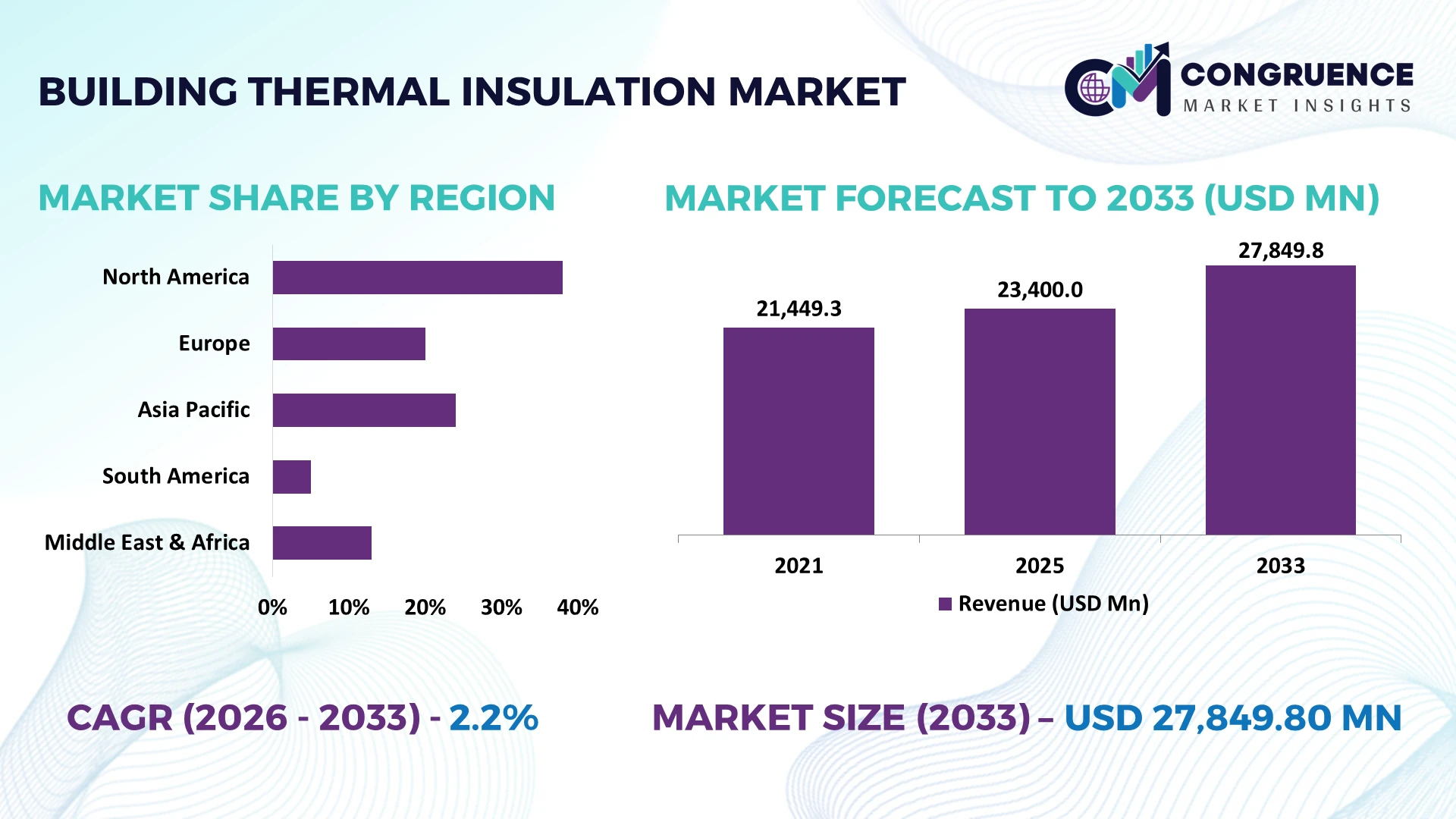
The Global Building Thermal Insulation Market was valued at USD 23400 Million in 2025 and is anticipated to reach a value of USD 27849.8 Million by 2033 expanding at a CAGR of 2.2% between 2026 and 2033. Growth is being driven by stricter building energy-efficiency regulations, large-scale retrofit programs, wider adoption of low-carbon insulation materials, and accelerated investments in sustainable residential and commercial construction.
China remains the dominant country, accounting for approximately 31% of global insulation material production, supported by continued investments exceeding USD 18 billion in energy-efficient buildings and advanced manufacturing. More than 68% of newly constructed urban commercial projects integrate high-performance insulation systems, compared with about 54% in the United States, reflecting stronger manufacturing scale and deployment. Ongoing global energy security priorities following regional geopolitical disruptions continue to reinforce domestic production and material diversification across major economies.
Manufacturers prioritizing high-performance, regulation-compliant insulation portfolios and regional production capacity are positioned to strengthen long-term competitiveness and supply resilience.
Market Size & Growth: USD 23400 Million in 2025, projected to reach USD 27849.8 Million by 2033 at a CAGR of 2.2%, supported by advanced energy-efficient building standards and retrofit investments.
Top Growth Drivers: Building energy regulations contribute approximately 34% of demand growth, retrofitting projects 29%, and sustainable construction materials 24%.
Short-Term Forecast: By 2027, advanced insulation systems reduce building energy consumption by nearly 15% while installation productivity improves by 10%.
Emerging Technologies: AI-enabled building performance modeling, automated insulation manufacturing, and advanced aerogel composites improve thermal efficiency by up to 20%.
Regional Leaders: Asia Pacific exceeds USD 11.8 Billion, Europe reaches about USD 7.2 Billion, and North America approaches USD 6.4 Billion, driven by green building adoption and regional manufacturing expansion.
Consumer/End-User Trends: More than 61% of commercial developments specify high-performance insulation to meet energy-efficiency and sustainability targets.
Pilot/Case Example: A 2026 public-building renovation program achieved approximately 18% lower annual heating demand through upgraded thermal insulation systems.
Competitive Landscape: The top manufacturer holds approximately 12% market share, with Owens Corning, Saint-Gobain, ROCKWOOL, Knauf Insulation, and Kingspan maintaining strong global positions.
Regulatory & ESG Impact: Updated building-efficiency policies lower operational carbon emissions by approximately 22% while accelerating adoption of recyclable insulation materials.
Investment & Funding: More than USD 5.5 Billion supports manufacturing expansion, strategic partnerships, and regional supply-chain diversification across high-growth markets.
Innovation & Future Outlook: Bio-based insulation, digital quality monitoring, and circular-material technologies improve lifecycle performance by over 16%, strengthening long-term strategic differentiation.
The Building Thermal Insulation Market is expanding through rising demand from residential retrofits, commercial green buildings, industrial facilities, and cold-storage infrastructure. Manufacturers are introducing advanced aerogel composites, bio-based insulation materials, and digitally monitored production systems that improve thermal performance by nearly 20%. Tightened energy-efficiency regulations and regional supply-chain localization continue to reshape procurement strategies, creating a stronger foundation for the strategic market assessment that follows.
Building thermal insulation has become a strategic priority as governments, developers, and manufacturers align investment with energy-efficiency targets, resilient construction, and lower operating costs. Supply-chain restructuring is encouraging localized production of mineral wool, expanded polystyrene, and advanced insulation materials, reducing procurement risk while improving delivery reliability. Competitive advantage increasingly depends on high-performance products that satisfy evolving building standards and accelerate retrofit programs across residential, commercial, and industrial infrastructure.
Advanced aerogel-based insulation delivers approximately 25% higher thermal performance than conventional fiberglass while reducing installation thickness by nearly 35%, making it suitable for space-constrained projects. China leads large-scale deployment through integrated manufacturing capacity, whereas Germany emphasizes premium low-carbon insulation technologies and circular material innovation. Over the next two to three years, digital design platforms and automated production are expected to exceed 45% adoption among major manufacturers, improving quality consistency and reducing production waste.
A 2026 commercial retrofit program incorporating digitally optimized insulation systems achieved nearly 18% lower annual heating demand and shortened installation schedules by approximately 12%. Companies are strengthening market positions through manufacturing expansion, technology partnerships, and recycled-material investments to improve product differentiation and supply resilience. Organizations that combine advanced material innovation with localized production and digital manufacturing capabilities will secure stronger competitive positioning and long-term operational advantages.
Mandatory energy-performance standards and expanding building renovation programs continue to reshape insulation demand across developed and emerging construction markets. Nearly 62% of new commercial developments now specify high-performance insulation systems, while deep-retrofit activity has increased by approximately 19% across major urban projects. China continues expanding green-building capacity, and Germany is strengthening building-efficiency compliance through stricter construction standards. These structural changes improve long-term operating efficiency while increasing demand for advanced insulation materials. Manufacturers are responding by expanding production facilities, investing in recycled-content insulation, and forming technology partnerships to improve thermal performance. Companies integrating advanced manufacturing with localized supply networks achieve faster project delivery, stronger regulatory compliance, and improved competitiveness in institutional and commercial construction.
Persistent volatility in petrochemical derivatives and mineral-based raw materials continues to pressure insulation manufacturers. Input costs fluctuate by nearly 14%, while logistics expenses remain approximately 11% above pre-disruption levels in several international supply corridors. Dependence on imported specialty additives creates procurement uncertainty, particularly for manufacturers in India and Southeast Asia. These structural constraints reduce pricing flexibility, compress margins, and delay project execution for large construction contracts. Companies are minimizing exposure through supplier diversification, localized sourcing strategies, and long-term procurement agreements while increasing the use of recycled feedstocks. Businesses establishing regional manufacturing clusters gain stronger inventory control, improved production continuity, and greater resilience against external supply disruptions.
Advanced insulation materials combined with digital manufacturing present a high-value opportunity beyond conventional building applications. Bio-based insulation and recyclable composite systems reduce lifecycle emissions by approximately 28%, while AI-enabled production monitoring improves manufacturing efficiency by nearly 16%. Japan and South Korea are accelerating commercialization of lightweight, high-performance insulation for compact residential and industrial facilities. Companies are increasing R&D investment, expanding partnerships with material science specialists, and integrating automated quality inspection into production lines. An emerging competitive advantage lies in circular manufacturing ecosystems that recover insulation waste for reuse, lowering production costs while supporting sustainability targets and strengthening long-term product differentiation.
Maintaining consistent insulation performance across diverse construction environments remains a long-term execution challenge. Installation-related efficiency losses can reach approximately 17% when skilled labor availability is limited, while quality inconsistencies increase project rework by nearly 9%. The United States continues facing shortages of certified installation professionals as advanced insulation materials become more technically demanding. Inconsistent installation reduces building energy performance, weakens customer confidence, and limits realization of expected efficiency gains. Companies are addressing these issues through installer certification programs, digital installation guidance, prefabricated insulation solutions, and collaboration with construction technology providers. Organizations that standardize installation quality and workforce capability will strengthen operational reliability and sustain competitive differentiation in increasingly performance-driven markets.
Advanced Material Portfolio Expansion High-performance aerogel composites, graphite-enhanced EPS, and bio-based insulation materials are reshaping product portfolios. Adoption of premium insulation solutions has increased by approximately 21%, while lightweight material usage has grown by nearly 17% in commercial construction. Stricter building-performance regulations and demand for lower lifecycle emissions are accelerating product substitution. Manufacturers are expanding specialty production lines, forming material technology partnerships, and integrating recycled content to improve thermal performance while reducing installation complexity and logistics costs.
Localized Manufacturing Networks Companies are restructuring supply chains by increasing domestic production and regional distribution capacity. Local sourcing of insulation inputs has risen by approximately 24%, reducing average delivery times by nearly 16% across major construction projects. Continued logistics uncertainty and import dependency have encouraged production expansion in China, India, and the United States. Manufacturers are investing in regional facilities, supplier diversification, and inventory digitization, creating faster fulfillment, improved procurement resilience, and more stable project execution.
Digital Factory Optimization Automated production monitoring, AI-driven quality inspection, and predictive maintenance are becoming standard across modern insulation manufacturing. Smart manufacturing deployment has exceeded 43% among large producers, while production defects have declined by approximately 13%. Labor shortages and higher quality expectations are driving automation investments. Companies are integrating industrial analytics with production workflows, improving consistency, reducing waste, and strengthening operational efficiency without significantly increasing manufacturing footprints.
Performance-Based Procurement Models Large developers increasingly evaluate insulation products through verified thermal efficiency, lifecycle performance, and carbon impact rather than material cost alone. Performance-based specifications have expanded by approximately 19%, while digital product documentation adoption has reached nearly 38%. This shift encourages suppliers to provide certified performance data and digital compliance records. Companies are strengthening engineering support, expanding technical partnerships, and offering integrated building-performance solutions that improve customer retention and competitive differentiation.
Glass Wool remains the leading product category, accounting for approximately 37% of global demand due to its favorable cost-performance ratio, lightweight characteristics, and broad compatibility with residential and commercial construction. Its established manufacturing ecosystem and efficient installation process continue to support large-scale deployment. Stone Wool follows with strong adoption in industrial facilities and high-rise buildings requiring superior fire resistance and acoustic performance. EPS remains a preferred option for external insulation systems because of its affordability, while XPS continues serving moisture-sensitive applications such as foundations and below-grade construction.
Polyurethane Foam represents the fastest-growing segment as demand increases for higher thermal efficiency in compact building designs. Adoption has expanded by nearly 18%, while advanced formulations improve insulation effectiveness by approximately 23% compared with conventional alternatives in space-constrained applications. Manufacturers are increasing investment in low-emission polyurethane technologies, expanding premium product portfolios, and strengthening partnerships with building system providers. The competitive focus is steadily shifting from standard insulation materials toward high-performance solutions that combine energy efficiency, durability, and regulatory compliance.
Walls represent the dominant application, accounting for approximately 41% of total demand because they deliver the largest improvement in building energy performance and support compliance with increasingly stringent building codes. Continuous insulation systems and prefabricated wall assemblies are accelerating adoption across residential and commercial developments. Roof applications remain a mature segment with growing emphasis on heat-reflective insulation, while floor insulation maintains stable deployment in cold-climate construction and industrial facilities requiring thermal stability.
HVAC Systems are the fastest-growing application as energy optimization becomes an operational priority for commercial buildings and manufacturing facilities. HVAC insulation deployment has increased by nearly 20%, while advanced duct insulation reduces thermal losses by approximately 15%. Companies are expanding integrated insulation offerings, combining smart building technologies with high-performance materials to improve operational efficiency. Demand is increasingly shifting toward complete building thermal management rather than isolated insulation components, encouraging manufacturers to deliver application-specific solutions with enhanced lifecycle performance.
Residential construction remains the largest end-user segment with approximately 48% market share, supported by extensive housing renovation programs, energy-efficiency upgrades, and stricter residential building standards. Large-scale retrofit initiatives and demand for lower household energy consumption continue strengthening insulation deployment. Commercial buildings remain a substantial market driven by office, healthcare, education, and retail developments requiring enhanced thermal performance. Industrial facilities prioritize specialized insulation for process stability and energy management, while infrastructure projects increasingly integrate insulation into transport and public buildings.
Infrastructure represents the fastest-growing end-user segment as governments modernize public assets and climate-resilient construction practices. Deployment in infrastructure projects has expanded by approximately 16%, while demand for high-performance insulation in transport facilities has increased by nearly 14%. Companies are developing customized product portfolios, expanding contractor partnerships, and offering project-specific engineering support. Investment priorities are gradually shifting toward long-life insulation systems capable of supporting public infrastructure resilience, operational efficiency, and lower maintenance requirements over extended service cycles.
Asia-Pacific accounted for the largest market share at 42% in 2025 however, Middle East & Africa is expected to register the fastest growth, expanding at a 3.4% CAGR between 2026 and 2033.
Advanced Retrofit Programs Strengthen Market Leadership
North America represents approximately 24% of global market demand, supported by extensive residential retrofits, commercial modernization, and industrial energy-efficiency investments. The United States and Canada continue expanding high-performance building envelopes through stricter energy codes and increasing adoption of advanced insulation systems. Digital building design platforms and prefabricated construction methods are improving installation accuracy while reducing project timelines. More than 59% of large commercial developments now specify high-performance insulation as a standard requirement. Manufacturers continue expanding regional production facilities and distribution networks to reduce procurement lead times by approximately 15%. Enterprise partnerships between insulation suppliers and modular construction companies are improving project execution while strengthening supply-chain resilience across institutional and infrastructure developments.
United States Market Outlook: The United States remains the regional leader through its extensive commercial construction pipeline, large renovation market, and advanced manufacturing ecosystem. More than 63% of large-scale energy retrofit projects incorporate premium insulation systems, supported by updated building performance standards and digital design integration. Manufacturers continue investing in automated production, recycled insulation materials, and localized logistics networks, improving delivery efficiency and supporting stronger long-term competitiveness across residential, healthcare, education, and industrial construction.
Sustainability Standards Accelerate Material Innovation
Europe accounts for approximately 27% of global deployment, supported by stringent building-efficiency regulations, renovation initiatives, and widespread adoption of low-carbon construction materials. Fire-resistant mineral wool and recyclable insulation products continue gaining preference across residential and commercial projects. More than 61% of major renovation programs specify high-performance insulation to improve building energy efficiency. Manufacturers are expanding recycled-content production, strengthening circular manufacturing processes, and forming technology collaborations to meet increasingly demanding environmental requirements. Modernization of aging building stock remains a major operational driver while advanced manufacturing improves product consistency and compliance with evolving technical standards.
Germany Market Outlook: Germany leads the European market through advanced manufacturing capacity, engineering expertise, and strict building-efficiency regulations. Approximately 68% of newly upgraded commercial buildings incorporate premium insulation systems designed for energy optimization and lifecycle performance. Companies continue expanding mineral wool production, investing in recyclable insulation technologies, and strengthening research partnerships to maintain leadership in sustainable construction materials while supporting industrial and residential modernization.
Manufacturing Scale Drives Regional Leadership
Asia-Pacific contributes approximately 42% of global market demand through its unmatched construction activity, manufacturing capacity, and infrastructure expansion. Rapid urban development, industrial investment, and large-scale residential projects continue supporting consistent insulation deployment. More than 70% of regional production capacity is concentrated within major manufacturing economies, improving supply availability and export competitiveness. Companies are expanding automated production lines, increasing domestic raw material sourcing, and strengthening regional distribution networks. Infrastructure modernization, industrial expansion, and energy-efficiency requirements continue reinforcing long-term operational demand across both mature and emerging construction sectors.
China Market Outlook: China dominates the regional market through integrated manufacturing, extensive building activity, and large-scale industrial capacity. The country contributes approximately 31% of global insulation production and continues investing in advanced manufacturing technologies that improve production efficiency by nearly 18%. Domestic manufacturers are expanding premium insulation portfolios, increasing automation, and strengthening export capabilities while supporting high-volume residential, commercial, and infrastructure developments.
Infrastructure Modernization Expands Deployment
South America represents approximately 5% of global demand, supported by urban housing development, logistics infrastructure, and commercial construction modernization. Demand continues shifting toward higher-performance insulation products as governments emphasize energy-efficient buildings and industrial modernization. Construction material localization has improved procurement efficiency by approximately 12%, helping reduce project delays despite periodic supply-chain constraints. Manufacturers are expanding regional partnerships with distributors and contractors while introducing cost-effective insulation systems suited to local climate conditions. Operational performance and lifecycle savings increasingly influence procurement decisions across institutional and commercial developments.
Brazil Market Outlook: Brazil leads the regional market through its broad construction sector, expanding industrial facilities, and ongoing residential development. Approximately 46% of regional insulation deployment is concentrated in the country, supported by commercial construction and infrastructure investment. Companies continue strengthening local manufacturing capacity, improving contractor training, and expanding product availability for energy-efficient building projects while increasing adoption of advanced insulation technologies.
Mega Infrastructure Investments Transform Demand
Middle East & Africa continues strengthening its position through large-scale urban development, industrial diversification, and smart city construction. The region accounts for approximately 6% of global deployment while recording the strongest expansion outlook supported by premium commercial developments and climate-responsive construction practices. High-performance insulation adoption has increased by nearly 20% across major infrastructure projects, improving operational energy efficiency in demanding environmental conditions. Companies are establishing regional production facilities, expanding engineering partnerships, and increasing project-specific insulation solutions for transport, healthcare, and hospitality infrastructure. Investment in sustainable construction continues strengthening long-term market positioning.
Saudi Arabia Market Outlook: Saudi Arabia leads regional deployment through ambitious infrastructure development, industrial diversification, and large-scale urban transformation projects. Approximately 52% of premium insulation demand within the Gulf is linked to commercial and mixed-use developments requiring advanced thermal performance. Manufacturers are expanding local partnerships, supporting domestic production initiatives, and introducing high-performance insulation systems that align with modern building standards and long-term operational efficiency objectives.
The market is led by Owens Corning, Saint-Gobain, ROCKWOOL, Kingspan Group, and Knauf Insulation, competing directly against strong regional manufacturers specializing in cost-efficient insulation products and localized supply. The top five companies collectively control approximately 46% of the global market. Competition is centered on thermal performance, product innovation, manufacturing scale, delivery reliability, and lifecycle sustainability rather than price alone. Premium manufacturers improve thermal efficiency by nearly 20%, while localized production reduces delivery lead times by approximately 15% and logistics costs by around 10%. Companies are expanding manufacturing capacity, forming technology partnerships, integrating recycled materials, and strengthening vertical supply chains to improve resilience. The competitive landscape is shifting toward advanced low-carbon insulation products supported by digital manufacturing and performance certification. High capital investment, regulatory compliance, and advanced material expertise remain major entry barriers. Success depends on combining manufacturing efficiency, innovation, localized production, and strong contractor relationships to outperform established global competitors.
Owens Corning
Saint-Gobain
ROCKWOOL Group
Kingspan Group
Knauf Insulation
BASF SE
Huntsman Corporation
Armacell International S.A.
Johns Manville
Recticel NV
GAF Materials Corporation
Carlisle Companies Inc.
SOPREMA Group
NICHIAS Corporation
Building thermal insulation technology is rapidly shifting from conventional fiberglass and mineral wool toward engineered materials with higher thermal efficiency and digital manufacturing integration. Automated production systems are now deployed across approximately 46% of large manufacturing facilities, improving production consistency by nearly 12% while reducing material waste by around 9%. AI-assisted process monitoring and inline quality inspection are strengthening operational control, enabling manufacturers to maintain tighter product specifications and faster order fulfillment across commercial and residential construction markets.
Emerging technologies include aerogel composites, vacuum insulation panels (VIPs), graphite-enhanced EPS, and bio-based insulation materials. Aerogel insulation delivers approximately 25% higher thermal performance than traditional fiberglass while requiring nearly 35% less installation thickness, making it attractive for premium retrofit projects. Digital Building Information Modeling (BIM) integration has exceeded 41% among large commercial developments, allowing insulation systems to be optimized during project design. Manufacturers combining advanced materials with automated production gain stronger product differentiation, lower defect rates, and improved compliance with evolving building-efficiency standards.
Between 2026 and 2028, recyclable insulation materials, AI-enabled manufacturing, and smart performance monitoring are expected to reshape competitive positioning. More than 30% of premium construction projects are projected to specify next-generation insulation systems. Companies investing early in advanced material science, localized automated production, and circular manufacturing will outperform cost-focused competitors through superior product performance, operational resilience, and faster response to increasingly stringent building regulations.
February 2026 Owens Corning reported construction of a state-of-the-art fiberglass insulation production line in Kansas City, designed to strengthen its North American supply network with production beginning in 2027, improving product quality and manufacturing efficiency through advanced process technology. Source: owenscorning.com
December 2025 Owens Corning appointed José Méndez-Andino as Chief Innovation Officer to accelerate product leadership and innovation across its building products portfolio, strengthening technology commercialization and long-term product development capabilities across insulation operations.
April 2025 Owens Corning published its 2024 Sustainability Report, highlighting continued progress in manufacturing efficiency and environmental performance, reinforcing operational priorities around lower-carbon production and responsible material management across insulation manufacturing.
May 2026 Owens Corning confirmed approximately USD 800 million in planned capital additions for 2026 while continuing operational investments across its insulation business, reinforcing manufacturing modernization and long-term capacity optimization despite softer construction markets. Source: investor.owenscorning.com press release
This report provides a comprehensive assessment of the Building Thermal Insulation Market across Glass Wool, Stone Wool, EPS, XPS, and Polyurethane Foam, covering applications in Walls, Roofs, Floors, and HVAC Systems alongside Residential, Commercial, Industrial, and Infrastructure end-users. The analysis evaluates market positioning across North America, Europe, Asia-Pacific, South America, and the Middle East & Africa, while examining deployment trends, technology adoption, manufacturing developments, and competitive strategies. More than 45% of the assessment focuses on operational performance, product innovation, and enterprise expansion trends shaping market evolution.
The report further analyzes advanced insulation materials, automated manufacturing, digital quality control, circular production models, and emerging high-performance thermal technologies expected to influence market direction between 2026 and 2033. Strategic insights include competitive benchmarking, regional investment priorities, supply-chain developments, adoption patterns, and company positioning, enabling manufacturers, investors, distributors, and construction stakeholders to identify expansion opportunities, optimize product portfolios, strengthen operational resilience, and support long-term business decision-making in an increasingly performance-driven insulation industry.
| Report Attribute/Metric | Report Details |
|---|---|
Market Revenue in 2025 | USD 23400 Million |
Market Revenue in 2033 | USD 27849.8 Million |
CAGR (2026 - 2033) | 2.2% |
Base Year | 2025 |
Forecast Period | 2026 - 2033 |
Historic Period | 2021 - 2025 |
Segments Covered | By Type
By Application
By End-User
|
Key Report Deliverable | Revenue Forecast, Growth Trends, Market Dynamics, Segmental Overview, Regional and Country-wise Analysis, Competition Landscape |
Region Covered | North America, Europe, Asia-Pacific, South America, Middle East, Africa |
Key Players Analyzed | Owens Corning, Saint-Gobain, ROCKWOOL Group, Kingspan Group, Knauf Insulation, BASF SE, Huntsman Corporation, Armacell International S.A., Johns Manville, Recticel NV, GAF Materials Corporation, Carlisle Companies Inc., SOPREMA Group, NICHIAS Corporation |
Customization & Pricing | Available on Request (10% Customization is Free) |




