
Reports
The Global Building Information Modeling Solution Market was valued at USD 970.0 Million in 2025 and is anticipated to reach a value of USD 2,367.6 Million by 2033 expanding at a CAGR of 11.8% between 2026 and 2033. Growth is being driven by mandatory digital construction standards, accelerating infrastructure modernization programs, and the integration of AI-enabled design coordination across commercial, industrial, and public-sector projects.
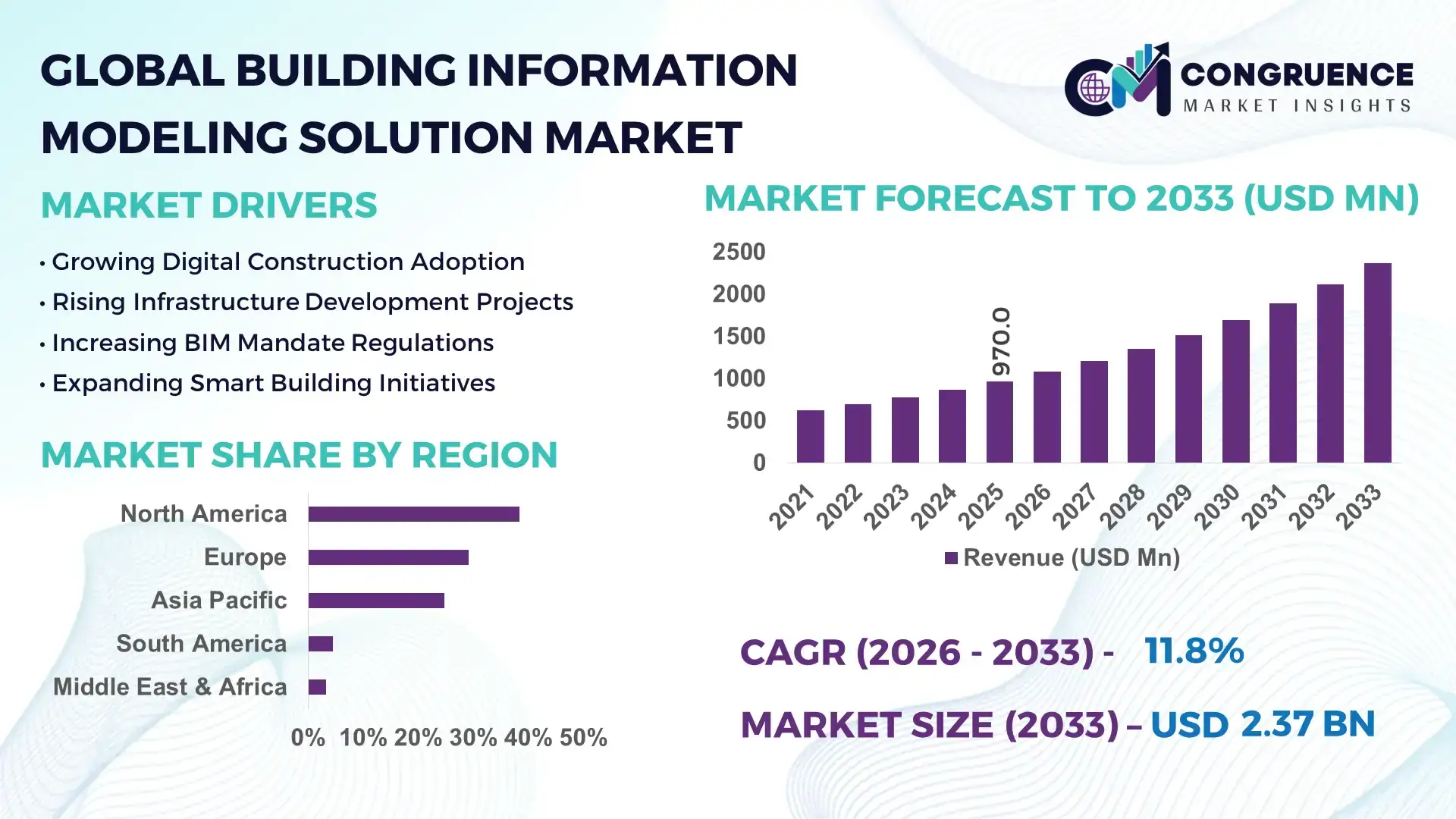
The United States dominates the market with approximately 32% share of global BIM software deployment, supported by over USD 1.2 trillion in infrastructure modernization initiatives and widespread adoption across architecture, engineering, and construction firms. More than 68% of large construction contractors utilize BIM-integrated workflows, compared with nearly 52% in Germany, where adoption is concentrated in transportation and industrial facilities. The continued implementation of digital project delivery frameworks following major infrastructure legislation has further strengthened U.S. leadership in advanced construction technology deployment.
Strategically, vendors that align BIM platforms with infrastructure digitization, lifecycle asset management, and AI-driven project intelligence are positioned to secure higher-value enterprise contracts and long-term ecosystem influence.
Market Size & Growth: USD 970.0 Million in 2025 reaching USD 2,367.6 Million by 2033, supported by digital construction mandates and AI-enabled project collaboration.
Top Growth Drivers: Government-led digital construction adoption (+28%), cloud BIM deployment (+35%), and infrastructure modernization programs (+22%).
Short-Term Forecast: By 2028, project rework rates are expected to decline by 18% while design coordination efficiency improves by 25%.
Emerging Technologies: AI-assisted modeling, digital twins, and cloud-based collaboration platforms are reducing design conflicts by over 30%.
Regional Leaders: North America (USD 780 Million), Europe (USD 640 Million), and Asia-Pacific (USD 510 Million) lead through smart infrastructure and digital engineering adoption.
Consumer/End-User Trends: Nearly 64% of large engineering firms now integrate BIM with project lifecycle management systems.
Pilot/Case Example: A 2024 transportation infrastructure project achieved a 21% reduction in design revisions through integrated BIM workflows.
Competitive Landscape: Autodesk leads with approximately 24% market share, alongside Bentley Systems, Nemetschek Group, Trimble, and Dassault Systèmes.
Regulatory & ESG Impact: BIM-enabled planning reduces material waste by up to 15%, supporting carbon reduction and green-building compliance targets.
Investment & Funding: More than USD 3.5 Billion has been directed toward construction digitization, strategic partnerships, and cloud engineering platforms.
Innovation & Future Outlook: AI-powered predictive design, real-time asset intelligence, and digital twin ecosystems are reshaping high-growth construction technology strategies.
Building Information Modeling solutions are becoming central to complex infrastructure delivery, smart-city development, and industrial facility planning. Demand is expanding across transportation, healthcare, and commercial construction where integrated digital workflows improve project visibility and execution quality. Recent innovations combine AI-driven clash detection, cloud collaboration, and digital twins, helping reduce design conflicts by over 30%. Growing regulatory emphasis on digital project documentation and resilient supply-chain planning is accelerating enterprise-wide BIM deployment, creating a strong foundation for strategic market evolution.
Building Information Modeling solutions have become strategically important as construction firms, infrastructure developers, and asset owners pursue greater operational control, project transparency, and lifecycle efficiency. Digital construction adoption is increasingly influencing competitive positioning, particularly as governments introduce digital procurement requirements and infrastructure modernization programs. The market is also benefiting from broader industry shifts toward connected project delivery, integrated asset management, and data-driven decision-making.
Compared with conventional 2D design processes, BIM-enabled workflows can reduce design conflicts by more than 30% and shorten project coordination cycles by approximately 20%. The United States continues to lead large-scale deployment through infrastructure investments and enterprise software integration, while countries such as Singapore and the United Kingdom demonstrate strong adoption through national digital construction frameworks. Over 60% of large engineering organizations now integrate BIM into multidisciplinary project environments to improve collaboration and execution consistency.
Construction technology providers are expanding cloud capabilities, digital twin partnerships, and AI-enhanced analytics to strengthen platform value. For example, infrastructure operators increasingly deploy BIM-linked asset management systems to improve maintenance planning and operational visibility. Over the next two to three years, adoption is expected to accelerate across transportation, utilities, and industrial facilities, reinforcing BIM as a critical enabler of competitive differentiation, project efficiency, and long-term infrastructure intelligence.
Mandatory digital construction standards and infrastructure digitization initiatives are accelerating BIM implementation across public and private projects. More than 68% of large construction contractors now utilize BIM-enabled workflows, while digital project delivery requirements have increased by approximately 25% across major infrastructure programs. The United Kingdom's BIM framework and expanding U.S. infrastructure modernization initiatives continue to influence procurement standards and project execution models. This regulatory shift improves project coordination, reduces design conflicts, and strengthens lifecycle asset visibility. In response, software vendors are expanding cloud-based BIM ecosystems, investing in AI-assisted design automation, and forming strategic partnerships with engineering consultancies. A notable operational impact is the growing preference for integrated project delivery models, where BIM functions as the central collaboration platform linking design, construction, and asset management stakeholders.
Despite strong adoption momentum, interoperability limitations remain a significant structural constraint. Approximately 42% of engineering firms report challenges integrating BIM platforms with legacy enterprise systems, while software migration costs can represent 10–15% of project technology budgets. Fragmented data standards across contractors, consultants, and asset owners create workflow inefficiencies that reduce deployment scalability. In Germany and Japan, many infrastructure operators continue to rely on mixed digital environments, increasing coordination complexity. These limitations can delay implementation timelines and reduce expected productivity gains. To mitigate risk, organizations are investing in open-data architectures, vendor-neutral collaboration frameworks, and standardized digital asset requirements. A key strategic insight is that firms achieving seamless interoperability often realize stronger project execution consistency than competitors relying on disconnected software environments.
The convergence of BIM, artificial intelligence, and digital twin technology is creating substantial new value opportunities. AI-enabled model analysis can improve design coordination efficiency by more than 25%, while predictive asset management applications reduce maintenance planning effort by approximately 20%. Singapore and South Korea are advancing smart infrastructure initiatives that increasingly require integrated digital asset intelligence platforms. Beyond design applications, BIM is evolving into a continuous operational decision-support environment throughout asset lifecycles. Software providers are expanding R&D investments, forming cloud technology alliances, and developing real-time analytics capabilities to capture emerging demand. One non-obvious opportunity lies in industrial facilities, where BIM-linked operational intelligence can enhance energy performance, maintenance scheduling, and workforce planning within a unified digital ecosystem.
Long-term market expansion depends on overcoming execution complexity associated with skilled workforce availability and digital security requirements. Nearly 35% of construction organizations report shortages of advanced BIM specialists, while cyber incidents targeting connected engineering systems have increased by more than 20% in recent years. As BIM platforms become integrated with cloud environments, digital twins, and operational technology systems, data governance requirements become increasingly stringent. In the United States and the United Kingdom, infrastructure operators are strengthening cybersecurity protocols to protect project and asset information. Companies must invest in workforce training, certification programs, secure cloud architecture, and cross-functional digital engineering capabilities. Organizations that successfully address both talent and cybersecurity challenges will establish stronger deployment consistency, operational resilience, and long-term competitive advantage.
AI-Powered Design Automation Expansion BIM platforms are rapidly integrating generative design and AI-assisted clash detection capabilities, with automated model validation adoption increasing by nearly 35% and design conflict resolution times declining by 28%. Labor shortages across engineering and construction teams are accelerating deployment, particularly in the United States and the United Kingdom. Companies are scaling AI-enabled workflows through software partnerships and cloud-based engineering platforms, improving project delivery speed while reducing manual coordination effort across multidisciplinary environments.
Digital Twin Integration Accelerates BIM deployment is increasingly extending beyond design into operational asset intelligence. More than 40% of large infrastructure projects now incorporate digital twin functionality, while lifecycle data utilization has improved by approximately 30% compared with traditional asset management practices. Transportation operators and utility providers are integrating BIM-connected monitoring systems to support predictive maintenance. Vendors are responding through acquisitions, platform consolidation, and real-time analytics deployment to strengthen long-term customer engagement and recurring service value.
Cloud Collaboration Becomes Standard Cloud-hosted BIM environments have surpassed 60% adoption among enterprise-scale engineering organizations, reducing document processing cycles by nearly 25% and improving remote project coordination efficiency by 32%. Growing project complexity and distributed supply chains are driving demand for centralized digital workspaces. Software providers are expanding secure collaboration ecosystems, enhancing interoperability features, and introducing subscription-based deployment models that improve scalability across geographically dispersed project teams.
Infrastructure-Focused BIM Standardization Governments and public infrastructure authorities are strengthening digital project delivery requirements, resulting in a 20% increase in BIM-based procurement specifications across major transportation and civic construction programs. Standardized data environments are improving contractor coordination and reducing information handover delays by approximately 18%. A notable emerging shift is the use of BIM for infrastructure resilience planning, prompting companies to align product development, compliance capabilities, and implementation services with evolving digital construction standards.
Cloud-based BIM solutions represent the leading segment, accounting for approximately 58% of deployments due to superior scalability, centralized collaboration, and lower infrastructure requirements. Large engineering firms increasingly favor cloud architectures because they enable real-time model access across distributed teams while reducing IT maintenance burdens by nearly 30%. Integration with digital twins, AI-assisted design tools, and project management ecosystems further strengthens adoption. Vendors continue expanding cloud-native functionality through platform enhancements, strategic alliances, and subscription-based delivery models, reinforcing long-term customer retention and operational flexibility. On-premise BIM solutions remain strategically relevant among government agencies, defense projects, and highly regulated infrastructure environments where data sovereignty requirements remain critical. However, hybrid BIM environments are emerging as the fastest-growing segment, supported by organizations seeking enhanced security alongside cloud-enabled collaboration. Hybrid deployments have increased by approximately 22% over the past two years as enterprises modernize legacy environments without disrupting existing workflows. Investment priorities are increasingly shifting toward interoperable platforms capable of supporting mixed deployment models, driving innovation in security architecture, data management, and enterprise integration capabilities.
Design and planning continue to dominate BIM application demand, representing roughly 45% of total platform utilization. Engineering consultancies, architects, and project developers rely on BIM to improve design visualization, clash detection, and multidisciplinary coordination. Organizations deploying BIM during planning stages have reported reductions of up to 30% in design conflicts and approximately 20% faster approval cycles. Software providers are expanding simulation capabilities, AI-assisted modeling, and collaborative design environments to strengthen value creation within early project phases. Construction management is emerging as the fastest-growing application area as contractors increasingly connect BIM workflows with scheduling, procurement, and field execution processes. Adoption within construction operations has expanded by nearly 25% as organizations seek greater visibility across complex project ecosystems. Facility management and asset lifecycle optimization are also gaining traction, particularly among transportation and utility operators focused on operational efficiency. Vendors are responding through integrated asset intelligence platforms, predictive maintenance functionality, and workflow automation tools that extend BIM value beyond project completion and into long-term infrastructure operations.
Construction companies represent the largest end-user segment, accounting for approximately 42% of BIM platform demand due to extensive project portfolios, contractor coordination requirements, and increasing digital project delivery expectations. Large contractors use BIM to streamline scheduling, procurement, and stakeholder communication while reducing rework rates by nearly 20%. Growing infrastructure investments and stricter project documentation requirements continue reinforcing adoption. Technology providers are tailoring solutions through modular deployments, industry-specific workflows, and strategic implementation partnerships to strengthen engagement with large construction organizations. Infrastructure owners and operators constitute the fastest-growing end-user group as asset lifecycle optimization becomes a strategic priority. Adoption within transportation, utilities, and public infrastructure organizations has increased by approximately 24%, driven by demand for predictive maintenance, operational visibility, and digital asset management. Architectural and engineering firms remain critical users due to their role in design coordination and project specification development. Meanwhile, industrial facility operators are increasingly investing in BIM-integrated operational intelligence. Companies are responding through customized asset management modules, ecosystem partnerships, and industry-focused service offerings that align with evolving infrastructure digitization priorities.
North America accounted for the largest market share at 38.4% in 2025 however, Asia-Pacific is expected to register the fastest growth, expanding at a CAGR of 13.4% between 2026 and 2033.

North America maintains its leadership position through advanced digital construction practices, large-scale infrastructure investments, and widespread enterprise software integration. The region accounts for approximately 38.4% of global BIM deployment activity, supported by strong adoption across commercial construction, transportation infrastructure, healthcare facilities, and industrial developments. More than 68% of large engineering and construction organizations utilize BIM-enabled project delivery workflows. The increasing convergence of BIM, digital twins, and cloud-based collaboration platforms is reshaping project execution standards. A notable market development is the expansion of AI-enabled design automation capabilities across major engineering firms, improving coordination efficiency and reducing project redesign cycles. Vendors continue strengthening cloud ecosystems and strategic implementation partnerships to support complex infrastructure programs.
United States Market Outlook: The United States represents the largest BIM market globally due to its extensive infrastructure modernization initiatives, mature engineering software ecosystem, and strong enterprise digitization priorities. Public infrastructure programs, transportation upgrades, and commercial redevelopment projects continue driving deployment activity. More than 70% of large architecture, engineering, and construction firms utilize BIM-integrated workflows, while growing adoption of digital twin technology is expanding lifecycle asset management applications. Enterprise demand increasingly focuses on interoperability, cloud collaboration, and AI-assisted design intelligence, positioning the country as a key innovation center for advanced construction technology solutions.
Europe remains a highly developed BIM market, supported by stringent digital construction frameworks, sustainability objectives, and infrastructure modernization initiatives. The region contributes approximately 29.1% of global market activity and demonstrates strong deployment concentration across transportation, public infrastructure, and energy projects. Digital procurement requirements and standardized project delivery frameworks continue strengthening adoption across both public and private sectors. Approximately 60% of large infrastructure developments now incorporate BIM-based collaboration environments during planning and execution stages. Organizations increasingly integrate BIM with carbon assessment and lifecycle management tools to improve project transparency and operational performance. Technology providers are expanding compliance-focused solutions and interoperability capabilities to address evolving regulatory requirements.
Germany Market Outlook: Germany serves as the region’s most strategically significant market due to its industrial engineering strength, transportation infrastructure investments, and advanced digital construction initiatives. The country has accelerated BIM adoption across rail, logistics, and industrial facility projects, supported by government-backed digital infrastructure programs. Nearly 55% of major engineering organizations have integrated BIM into multidisciplinary project workflows. Demand is also increasing for BIM-enabled asset lifecycle management and industrial facility modernization, creating opportunities for software vendors specializing in enterprise-scale deployment, digital integration, and operational intelligence solutions.
Asia-Pacific is emerging as the fastest-expanding BIM market due to large-scale infrastructure programs, rapid urbanization, and accelerating digital construction adoption. The region accounts for approximately 24.8% of global BIM activity and benefits from substantial deployment across transportation networks, smart-city projects, industrial facilities, and commercial developments. Public-sector digitization initiatives are strengthening BIM implementation requirements, while enterprise demand for project efficiency continues increasing. Infrastructure project digitization has expanded by more than 25% across key economies during recent years. Technology providers are increasing regional investments, establishing implementation partnerships, and localizing cloud-based solutions to address growing demand from construction and infrastructure stakeholders.
China Market Outlook: China dominates the regional market through its unparalleled construction scale, smart-city investments, and infrastructure development pipeline. Government-supported digital construction initiatives continue expanding BIM utilization across rail networks, airports, industrial zones, and urban development projects. More than 65% of large state-owned engineering enterprises have incorporated BIM into project planning and execution environments. The country is also advancing BIM integration with digital twins and intelligent infrastructure management platforms, creating a competitive advantage in large-scale project coordination and operational efficiency.
South America is experiencing steady BIM adoption as governments and private developers pursue greater project transparency, infrastructure modernization, and construction efficiency. The region contributes approximately 4.5% of global market activity, with deployment concentrated in transportation, commercial construction, utilities, and public infrastructure projects. While implementation remains uneven due to varying digital maturity levels, demand for integrated project delivery platforms continues strengthening. Infrastructure investment programs have increased digital engineering requirements by nearly 18% across several major projects. Software providers are expanding local partnerships, implementation services, and workforce training initiatives to address operational capability gaps and improve deployment outcomes.
Brazil Market Outlook: Brazil represents the largest BIM market in South America due to its extensive construction sector, infrastructure modernization initiatives, and growing emphasis on digital engineering practices. National efforts to improve project efficiency and public-sector transparency have encouraged wider BIM implementation across transportation and civic infrastructure projects. Adoption among large engineering consultancies and contractors has increased steadily, with approximately 40% of major firms utilizing BIM-supported workflows. Continued investments in digital construction capabilities and workforce development are strengthening the country's long-term market position.
The Middle East & Africa market is benefiting from ambitious infrastructure development programs, smart-city initiatives, and large-scale commercial construction activity. The region accounts for approximately 3.2% of global market demand but demonstrates strong deployment intensity within strategically significant projects. BIM adoption is increasingly embedded within project planning and execution frameworks to improve coordination, cost control, and asset lifecycle management. More than 30% of major regional mega-projects now utilize advanced BIM environments integrated with digital project management systems. Technology vendors are expanding implementation partnerships and specialized consulting services to support increasingly complex construction ecosystems.
Saudi Arabia Market Outlook: Saudi Arabia serves as the leading regional market due to extensive infrastructure investment, urban development programs, and large-scale digital construction initiatives. National transformation projects are accelerating demand for BIM-enabled project delivery, digital engineering coordination, and lifecycle asset management solutions. Large infrastructure and mixed-use development projects increasingly require integrated BIM workflows, with deployment rates exceeding 50% among major government-backed developments. The country's focus on smart infrastructure, operational efficiency, and advanced project management continues attracting technology providers and implementation specialists seeking long-term growth opportunities.
The market is led by Autodesk, Bentley Systems, Nemetschek Group, Trimble, and Dassault Systèmes, which collectively control approximately 67% of global market activity. Competition is primarily between global platform leaders and specialized engineering software providers, while regional vendors compete through customization and lower deployment costs. Autodesk and Bentley compete aggressively in infrastructure-scale digital workflows, whereas Nemetschek and Trimble focus on design collaboration and construction execution integration. Technology capability remains the key battleground, with AI-enabled coordination improving workflow efficiency by 25–30% and cloud-based BIM environments reducing project cycle times by nearly 20%. Companies are expanding through strategic partnerships, digital twin integration, cloud ecosystem development, and industry-specific solutions. The competitive shift is moving from standalone modeling software toward connected digital construction platforms combining BIM, analytics, and lifecycle asset intelligence. High switching costs, enterprise integration complexity, and interoperability requirements create significant entry barriers. Winning requires scalable cloud architecture, strong ecosystem partnerships, advanced automation, and seamless lifecycle integration capabilities.
Trimble Inc.
Dassault Systèmes SE
Hexagon AB
Procore Technologies, Inc.
RIB Software GmbH
AVEVA Group plc
Oracle Corporation
Siemens Digital Industries Software
Asite Solutions Ltd.
Bricsys NV
Graphisoft SE
Building Information Modeling technology is rapidly evolving from design-centric software into integrated digital construction ecosystems. Cloud-native BIM platforms now support over 60% of enterprise deployments, enabling real-time collaboration and reducing document management effort by nearly 25%. AI-powered clash detection, automated model validation, and predictive design optimization are becoming standard capabilities. Organizations deploying AI-assisted BIM workflows report coordination efficiency improvements exceeding 30%, creating measurable advantages in project delivery speed and resource utilization.
Emerging technologies are centered on digital twins, IoT-connected asset intelligence, and generative design engines. Digital twin integration has expanded across more than 40% of major infrastructure projects, enabling continuous lifecycle monitoring and operational optimization. Compared with conventional 2D design workflows, advanced BIM environments reduce design conflicts by over 30% and improve multidisciplinary coordination by approximately 20%. Large infrastructure operators, engineering consultancies, and transportation authorities benefit most because these technologies enhance asset visibility, maintenance planning, and project governance.
Between 2026 and 2028, BIM platforms are expected to increasingly integrate robotics, spatial AI, and automated reality-capture technologies. Automated model generation from laser scanning can reduce modeling effort by up to 50%, while next-generation digital twin environments support near real-time decision-making. Companies investing early in AI-driven BIM ecosystems, interoperability frameworks, and connected asset intelligence platforms will gain stronger operational control, higher project predictability, and sustainable competitive differentiation.
March 2024 – Trimble Inc. launched Tekla 2024 structural BIM software with expanded open-standards connectivity and workflow integration capabilities. The release improved stakeholder collaboration across design and fabrication environments while supporting more efficient project execution and schedule control. Business impact: stronger interoperability across construction ecosystems. Source: www.investor.trimble.com
November 2025 – Autodesk, Inc. entered a three-year strategic partnership with Adani Group to deploy Autodesk Construction Cloud and BIM advisory services across infrastructure projects. The agreement covers a unified digital delivery framework across multiple business units. Business impact: accelerated enterprise-scale BIM standardization and project coordination.
November 2025 – Bentley Systems formed a strategic partnership with EARTHBRAIN to integrate AI-powered digital twin technologies into smart construction workflows. The initiative expands connected construction capabilities from design through earthworks execution. Business impact: enhanced lifecycle data integration and infrastructure project intelligence.
January 2026 – Bentley Systems acquired Talon Aerolytics and Pointivo technologies to strengthen digital twin and AI-based asset analytics capabilities. The acquisitions enhance infrastructure inspection and resilience management applications. Business impact: expanded digital asset intelligence portfolio supporting infrastructure owner-operators.
The report provides comprehensive coverage of the Building Information Modeling Solution market across major deployment types, applications, and end-user industries. Analysis includes cloud-based, on-premise, and hybrid solution environments, along with applications spanning design and planning, construction management, facility operations, and asset lifecycle optimization. The study evaluates adoption patterns across construction enterprises, engineering firms, infrastructure operators, industrial facilities, and public-sector organizations. Regional assessment covers North America, Europe, Asia-Pacific, South America, and the Middle East & Africa, representing more than 95% of global deployment activity.
The report further examines emerging technologies including artificial intelligence, digital twins, cloud collaboration platforms, reality capture systems, and advanced interoperability frameworks. Competitive benchmarking covers leading software providers and strategic ecosystem participants influencing technology adoption. More than 60% of enterprise deployments now involve cloud-enabled collaboration environments, while digital twin integration continues expanding across infrastructure-intensive sectors. The analysis supports investment planning, market entry evaluation, expansion prioritization, partnership development, and competitive positioning decisions through 2033.
| Report Attribute / Metric | Details |
|---|---|
| Market Revenue (2025) | USD 970.0 Million |
| Market Revenue (2033) | USD 2,367.6 Million |
| CAGR (2026–2033) | 11.8% |
| Base Year | 2025 |
| Forecast Period | 2026–2033 |
| Historic Period | 2021–2025 |
| Segments Covered |
By Type
By Application
By End-User Insights
|
| Key Report Deliverables | Revenue Forecast; Market Trends; Growth Drivers & Restraints; Technology Insights; Segmentation Analysis; Regional Insights; Competitive Landscape; Regulatory & ESG Overview; Recent Developments |
| Regions Covered | North America; Europe; Asia-Pacific; South America; Middle East & Africa |
| Key Players Analyzed | Autodesk; Bentley Systems; Nemetschek; Trimble; Dassault Systèmes; Hexagon; Procore Technologies; RIB Software; AVEVA; Oracle; Siemens Digital Industries Software; Asite; Bricsys; Graphisoft |
| Customization & Pricing | Available on Request (10% Customization Free) |




