
Reports
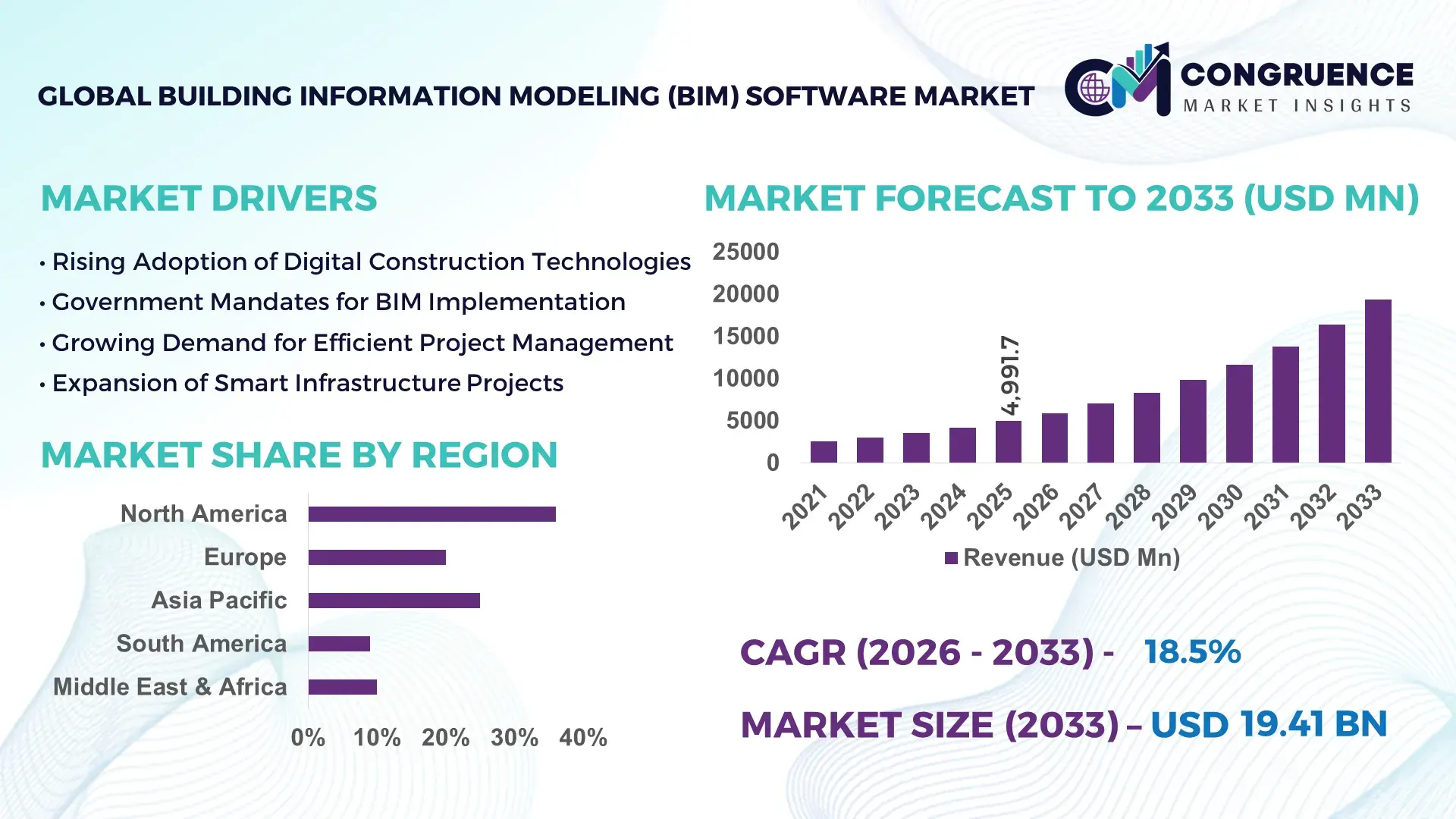
The Global Building Information Modeling (BIM) Software Market was valued at USD 4991.73 Million in 2025 and is anticipated to reach a value of USD 19408.79 Million by 2033 expanding at a CAGR of 18.5% between 2026 and 2033. The market expansion is primarily driven by rapid digital transformation across the architecture, engineering, and construction (AEC) industry combined with rising demand for cost-efficient infrastructure delivery.
The United States remains the most influential country in the Building Information Modeling (BIM) Software market, supported by advanced construction digitization and high-value infrastructure investments exceeding USD 1.2 trillion under federal programs. Over 70% of large-scale commercial and public infrastructure projects in the country integrate BIM-based design workflows. The U.S. hosts more than 35% of global BIM software R&D centers, with strong adoption across transportation, healthcare, and smart city development projects. Cloud-based BIM deployment penetration in major metropolitan construction firms has surpassed 60%, reflecting rapid enterprise-level digital adoption and integration with AI-driven project lifecycle management platforms.
Market Size & Growth: Valued at USD 4,991.73 Million in 2025, projected to reach USD 19,408.79 Million by 2033 at a CAGR of 18.5%, driven by accelerating digital construction and integrated project delivery models.
Top Growth Drivers: 65% enterprise BIM adoption in large infrastructure projects, 30% improvement in project cost efficiency, 40% reduction in design rework through 3D collaborative modeling.
Short-Term Forecast (2028): By 2028, BIM-enabled projects are expected to achieve up to 25% construction cost savings and 20% faster project completion timelines across commercial developments.
Emerging Technologies: AI-powered generative design, cloud-based collaborative BIM platforms, digital twin integration for real-time asset monitoring, and 5D cost modeling analytics.
Regional Leaders: North America projected to exceed USD 7.8 Billion by 2033 with strong public infrastructure digitization; Asia-Pacific expected to surpass USD 6.5 Billion driven by rapid urbanization; Europe forecast to cross USD 4.9 Billion supported by regulatory BIM mandates.
Consumer/End-User Trends: AEC firms account for over 55% of total adoption, followed by contractors and real estate developers increasingly using cloud-based BIM for lifecycle asset management.
Pilot Case Example (2024): A large-scale smart transit corridor project implemented BIM-based 5D modeling, achieving 18% reduction in material waste and 22% improvement in schedule adherence.
Competitive Landscape: Autodesk holds approximately 28% share, followed by Bentley Systems, Trimble Inc., Nemetschek Group, and Dassault Systèmes.
Regulatory & ESG Impact: Government-mandated BIM compliance in public projects across developed economies has increased digital adoption by over 35%, while carbon footprint tracking through BIM supports ESG-aligned green building initiatives.
Investment & Funding Patterns: Over USD 2.4 Billion invested globally in construction technology and BIM-focused startups between 2023 and 2025, with rising venture capital participation in AI-integrated modeling platforms.
Innovation & Future Outlook: Integration of BIM with IoT sensors, predictive analytics, and blockchain-based documentation is reshaping digital construction ecosystems and enabling fully interoperable smart infrastructure management.
Building Information Modeling (BIM) Software adoption is strongly concentrated in commercial construction (approximately 38%), infrastructure and transportation (27%), residential development (20%), and industrial projects (15%). Recent innovations include AI-driven clash detection, automated quantity take-offs, and real-time cloud collaboration tools enhancing productivity across distributed project teams. Regulatory mandates for digital construction documentation in advanced economies, combined with sustainability-driven green building standards, continue to stimulate market penetration. Rapid urbanization in China, Germany, and the United Kingdom is accelerating regional BIM consumption, while emerging markets are investing in smart city frameworks supported by digital twin technologies. Future growth will be shaped by deeper integration with enterprise resource planning systems, advanced analytics dashboards, and lifecycle asset optimization platforms targeting long-term operational efficiency.
Cloud-Based BIM Collaboration Surpasses 60% Enterprise Adoption: More than 62% of large architecture and engineering firms have transitioned to cloud-enabled BIM platforms to enable real-time collaboration across multi-location teams. Cloud deployment has reduced design coordination time by 28% and improved document version control accuracy by 35%. Over 48% of contractors now integrate cloud-based BIM with project management software, enabling centralized data environments and reducing communication delays by approximately 22% on complex infrastructure projects.
AI-Driven Generative Design Improves Project Efficiency by 30%: Artificial intelligence integration within BIM software has accelerated conceptual design cycles by nearly 30%, allowing automated layout optimization and predictive performance modeling. Approximately 44% of advanced construction firms now use AI-powered clash detection tools, resulting in 32% fewer design conflicts during pre-construction phases. Automated quantity take-offs and cost simulations have improved estimation accuracy by 25%, enabling data-driven decision-making for high-value commercial and transportation projects.
Rise in Modular and Prefabricated Construction Enhances Cost Efficiency by 55%: The adoption of modular and prefabricated construction is reshaping demand dynamics in the Building Information Modeling (BIM) Software market. Around 55% of newly executed projects report measurable cost advantages through modular workflows. BIM-enabled prefabrication reduces on-site labor requirements by 20% and shortens project timelines by up to 35%. Automated off-site manufacturing, particularly in Europe and North America, is increasing demand for high-precision digital modeling and 4D scheduling tools.
Digital Twin Integration Expands Across 40% of Smart Infrastructure Projects: Nearly 40% of newly initiated smart infrastructure developments incorporate BIM-based digital twin technology for lifecycle asset monitoring. Real-time sensor integration has improved maintenance response efficiency by 26% and reduced unplanned downtime by 18%. In transportation and healthcare facilities, BIM-linked digital twins support predictive maintenance strategies, enabling 24% improvement in operational asset performance and enhanced long-term infrastructure resilience.
The Building Information Modeling (BIM) Software market is strategically segmented by type, application, and end-user, reflecting the evolving digital maturity of the global construction ecosystem. By type, the market spans 3D modeling software, 4D scheduling tools, 5D cost estimation platforms, and integrated cloud-based BIM solutions, each addressing specific project lifecycle requirements. Application segmentation covers commercial construction, residential development, infrastructure and transportation, and industrial facilities, with infrastructure projects increasingly demanding advanced 4D and digital twin integration. From an end-user perspective, architecture and engineering firms dominate adoption, followed by contractors, real estate developers, and government agencies. Over 68% of large-scale urban projects now deploy multi-dimensional BIM capabilities to improve project transparency, compliance tracking, and cross-functional coordination. This segmentation structure highlights the shift from basic visualization tools toward comprehensive lifecycle asset management platforms.
3D BIM modeling software currently accounts for approximately 46% of total adoption, remaining the leading type due to its foundational role in architectural visualization, clash detection, and design coordination. In comparison, 4D BIM solutions hold about 24% share, while 5D cost estimation platforms represent nearly 18%. However, adoption of cloud-integrated BIM ecosystems is rising fastest, expected to exceed 28% penetration by 2033, driven by remote collaboration demand and centralized data management. Cloud-based BIM platforms are the fastest-growing segment, expanding at an estimated CAGR of 21%, supported by increasing enterprise digitization and integration with AI-driven analytics. These platforms reduce project delays by 23% and improve stakeholder communication efficiency by 30% in large infrastructure programs. Meanwhile, niche tools such as sustainability-focused BIM modules and facility management extensions collectively account for the remaining 12%, serving specialized energy optimization and lifecycle monitoring requirements.
Commercial construction leads the Building Information Modeling (BIM) Software market with nearly 38% share, supported by high-value office complexes, healthcare facilities, and mixed-use developments requiring complex digital coordination. Infrastructure and transportation applications account for approximately 29%, while residential construction contributes 21%. Industrial facility projects make up the remaining 12%. However, infrastructure and transportation represent the fastest-growing application segment, expanding at a CAGR of 20% due to large-scale smart mobility and urban transit investments. Infrastructure projects increasingly integrate 4D scheduling and digital twin capabilities, improving project timeline adherence by 26% and reducing material waste by 19%. Commercial developments leverage BIM for energy-efficient building design, resulting in up to 22% operational energy savings. Residential builders are adopting standardized BIM templates, cutting design turnaround time by 18%.
Architecture and engineering (A&E) firms represent the leading end-user segment, accounting for nearly 42% of total BIM software adoption due to their central role in design conceptualization and technical documentation. Contractors hold around 31%, while real estate developers represent 15%. Government agencies and facility managers collectively contribute approximately 12%. Although A&E firms dominate usage, government agencies are the fastest-growing end-user group, expanding at a CAGR of 19% driven by mandatory digital construction standards and public infrastructure modernization. Large contractors report 28% improvement in on-site coordination efficiency through integrated BIM dashboards, while developers use predictive modeling tools to reduce cost overruns by 17%. Government-led smart city initiatives have increased BIM deployment in urban planning projects by 33% over the past two years.
North America accounted for the largest market share at 36% in 2025 however, Asia-Pacific is expected to register the fastest growth, expanding at a CAGR of 20% between 2026 and 2033.
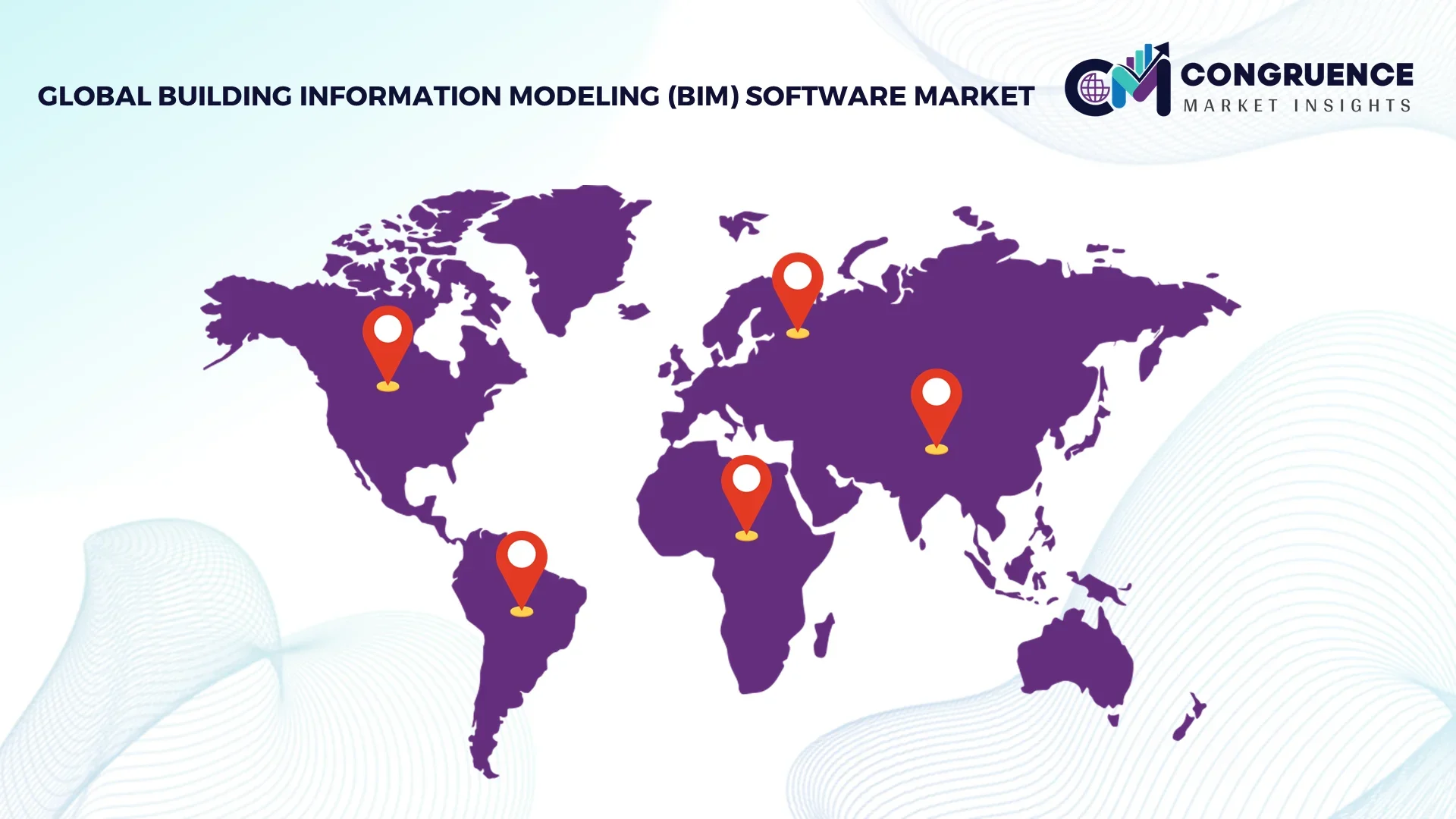
North America’s dominance is supported by over 70% BIM penetration in large-scale commercial projects and more than 65% adoption among top-tier engineering firms. Europe follows with 28% share, driven by mandatory BIM compliance across public infrastructure programs in over 15 countries. Asia-Pacific holds nearly 24% share, with China, India, and Japan contributing more than 60% of regional demand through rapid urbanization and smart city investments exceeding 500 major projects. South America accounts for 7%, while the Middle East & Africa represent 5%, primarily led by high-value transport corridors and energy infrastructure developments. Across all regions, more than 58% of infrastructure megaprojects initiated in 2025 integrated 4D or 5D BIM functionalities, reflecting accelerating digital construction transformation globally.
How Is Advanced Digital Construction Reshaping Project Delivery Standards?
North America represents 36% of the global Building Information Modeling (BIM) Software market share, supported by mature digital construction ecosystems and large-scale infrastructure modernization programs. Key industries driving demand include commercial real estate, healthcare infrastructure, transportation, and defense projects, with over 68% of public infrastructure contracts requiring BIM-based documentation. Federal infrastructure allocations exceeding USD 1 trillion have accelerated digital engineering compliance standards. Technological advancements such as AI-based clash detection, 5D cost modeling, and cloud collaboration platforms are adopted by more than 60% of top contractors. Autodesk continues expanding cloud-integrated BIM tools, enhancing cross-platform data exchange and improving project visualization accuracy by 30%. Consumer behavior in this region shows higher enterprise adoption in healthcare and finance-linked real estate projects, where lifecycle asset management and regulatory transparency are critical procurement requirements.
Why Are Regulatory Mandates Accelerating Digital Engineering Adoption?
Europe accounts for approximately 28% of the global Building Information Modeling (BIM) Software market share, with Germany, the United Kingdom, and France representing over 55% of regional demand. More than 14 European countries mandate BIM usage for publicly funded projects, increasing digital compliance across rail, energy-efficient housing, and urban redevelopment programs. Sustainability directives aligned with carbon neutrality targets have pushed nearly 48% of large-scale developers to integrate BIM-based energy simulation modules. Advanced digital twin adoption is visible in smart infrastructure upgrades across Germany and the UK. Nemetschek Group, headquartered in Germany, continues enhancing open BIM standards to support cross-border interoperability and improve modeling precision by 25%. Consumer behavior reflects strong regulatory-driven demand, with project stakeholders prioritizing transparent documentation and sustainability performance validation through structured BIM workflows.
What Is Driving Large-Scale Digital Infrastructure Modernization?
Asia-Pacific holds nearly 24% of the Building Information Modeling (BIM) Software market and ranks as the fastest-growing region by adoption volume. China, India, and Japan collectively account for more than 62% of regional implementation across urban rail, residential complexes, and industrial corridors. Over 400 smart city initiatives across Asia integrate BIM for digital planning and lifecycle asset monitoring. Infrastructure expansion, including high-speed rail networks and commercial skyscraper projects, is accelerating 4D and digital twin integration. Japan’s construction automation programs have increased BIM-based prefabrication adoption by 34% in metropolitan redevelopment projects. Trimble has expanded its regional partnerships to deliver advanced construction analytics platforms, improving site productivity by 22%. Regional consumer behavior shows strong adoption among government-backed infrastructure projects and technology-driven urban development authorities.
How Are Infrastructure and Energy Investments Supporting Digital Construction?
South America represents approximately 7% of the global Building Information Modeling (BIM) Software market, led by Brazil and Argentina, which together contribute over 60% of regional demand. Infrastructure modernization in transportation and renewable energy sectors is driving adoption, with nearly 45% of newly approved public works projects integrating digital design frameworks. Government-backed housing programs and energy corridor expansions are increasing BIM penetration in urban planning. Trade agreements facilitating technology imports have reduced software deployment costs by 12% over the past two years. Local engineering firms are incorporating BIM-enabled 4D scheduling to reduce project overruns by 18%. Regional consumer behavior highlights demand tied to multilingual interfaces and localized compliance standards to support diverse regulatory environments.
Can Mega Infrastructure Projects Accelerate Digital Engineering Transformation?
The Middle East & Africa region accounts for roughly 5% of the global Building Information Modeling (BIM) Software market, with the United Arab Emirates and South Africa contributing more than 55% of regional activity. Large-scale urban megaprojects and oil & gas infrastructure developments are primary demand drivers, with over 50% of new commercial developments in the UAE incorporating BIM-based 3D modeling. Technological modernization programs across Gulf economies emphasize smart city frameworks and digital twin integration for long-term asset management. Public-private partnerships in transport corridors and energy hubs have increased BIM utilization in high-value engineering projects. Regional consumer behavior reflects strong demand for high-precision visualization tools in luxury real estate and tourism infrastructure, alongside increasing government mandates for digital documentation compliance.
United States – 34% market share: The Building Information Modeling (BIM) Software market in the United States is driven by extensive federal infrastructure programs and over 70% enterprise-level adoption in commercial and transportation projects.
China – 18% market share: China’s Building Information Modeling (BIM) Software market leadership is supported by large-scale urbanization, with more than 300 smart city and high-speed rail projects integrating digital construction platforms.
The Building Information Modeling (BIM) Software market demonstrates a moderately consolidated structure, with more than 150 active global and regional competitors offering design, scheduling, cost estimation, and lifecycle asset management platforms. The top five companies collectively account for approximately 65% of total market share, reflecting strong brand positioning, advanced product ecosystems, and extensive enterprise customer bases.
Industry leaders such as Autodesk, Bentley Systems, Trimble Inc., Nemetschek Group, and Dassault Systèmes dominate through integrated BIM suites that combine 3D modeling, 4D scheduling, 5D cost analytics, and cloud-based collaboration tools. More than 70% of large-scale infrastructure projects globally utilize software platforms from these leading vendors. Strategic initiatives shaping competition include over 25 notable product upgrades in 2024–2025 focused on AI-driven clash detection and digital twin integration. Partnerships between BIM providers and construction technology startups have increased by 30% over the past two years, accelerating interoperability with IoT-enabled asset monitoring systems.
The competitive landscape is also influenced by rising demand for open-standard interoperability, with nearly 48% of enterprise buyers prioritizing vendor-neutral data exchange formats. Innovation intensity remains high, as more than 40% of leading vendors allocate significant R&D resources toward cloud-native BIM ecosystems and predictive analytics modules, reinforcing technological differentiation and long-term contract retention.
Autodesk
Bentley Systems
Trimble Inc.
Nemetschek Group
Dassault Systèmes
Hexagon AB
Procore Technologies
Asite Solutions
RIB Software
AVEVA Group
The Building Information Modeling (BIM) Software market is undergoing significant technological evolution as digital construction requirements expand beyond traditional 3D visualization. One of the most impactful current technologies is cloud-native BIM platforms, which are now deployed by over 60% of large construction and engineering enterprises. Cloud-based models enable centralized data access for distributed project teams, reducing coordination errors by more than 30% and accelerating design iteration cycles by nearly 25% on complex infrastructure developments. These platforms also facilitate enhanced version control, real-time clash detection, and multi-stakeholder collaboration across geographies. AI and machine learning integration is transforming design automation and quality assurance workflows. AI-assisted generative design tools are used on approximately 45% of advanced commercial projects, enabling automatic generation of optimized structural layouts based on predefined performance metrics. Machine learning algorithms also enhance predictive analytics in BIM, identifying potential construction conflicts up to 22% earlier than traditional review processes. This predictive capability extends to automated quantity take-offs, reducing manual estimation efforts by nearly 40%.
Emerging technologies such as digital twin integration are expanding BIM use cases into operational and asset management phases. Nearly 38% of newly initiated smart city and industrial mega-projects now embed digital twin models that synchronize real-time sensor data with as-built BIM models, improving maintenance forecasting accuracy by 28% and reducing unplanned downtime by roughly 18%. IoT connectivity within BIM ecosystems supports condition monitoring and lifecycle cost analysis for infrastructure assets valued at hundreds of billions in aggregate global construction portfolios. Mobile and augmented reality (AR) tools are enhancing field-level BIM adoption, with over 50% of contractors and on-site engineers using AR overlays for real-time design validation, risk assessment, and safety planning. These AR applications improve on-site decision accuracy by approximately 24% and accelerate issue resolution by 19%. Furthermore, interoperability advancements, including standardized data exchange formats and open BIM protocols, are now prioritized by more than 55% of enterprise buyers to improve integration with enterprise resource planning (ERP), facility management (FM), and procurement systems, ensuring seamless downstream workflows across the construction lifecycle.
• In March 2025, Autodesk announced enhanced AI-powered automation features within its BIM portfolio, introducing generative design updates and improved cloud collaboration tools that enable automated clash detection and workflow optimization for multi-disciplinary teams. The upgrade supports real-time data synchronization across distributed project environments. Source: www.autodesk.com
• In May 2024, Bentley Systems expanded its digital twin capabilities by integrating advanced infrastructure asset analytics into its BIM environment, enabling predictive maintenance modeling and lifecycle performance tracking for transportation and utilities projects across more than 40 countries. Source: www.bentley.com
• In October 2024, Trimble introduced new interoperability enhancements across its construction software ecosystem, improving 3D model data exchange between design and field teams and increasing on-site coordination efficiency for contractors working on large-scale infrastructure programs. Source: www.trimble.com
• In February 2025, Nemetschek Group strengthened its open BIM strategy by advancing cloud-based collaboration standards across multiple software brands, improving cross-platform compatibility and enabling structured data workflows for public infrastructure projects complying with European digital construction mandates. Source: www.nemetschek.com
The Building Information Modeling (BIM) Software Market Report provides a comprehensive assessment of digital construction technologies across core segments, including 3D modeling, 4D scheduling, 5D cost estimation, cloud-based collaboration platforms, and digital twin integration modules. The report evaluates adoption patterns across commercial construction (approximately 38% of demand), infrastructure and transportation (29%), residential development (21%), and industrial facilities (12%), offering quantitative insights into deployment intensity and workflow optimization outcomes. Geographically, the report analyzes five major regions—North America (36% share), Europe (28%), Asia-Pacific (24%), South America (7%), and Middle East & Africa (5%)—with country-level insights covering over 20 leading construction economies. It examines infrastructure modernization initiatives exceeding 1,000 major public projects globally that integrate BIM-based digital documentation and lifecycle asset management systems.
Technology coverage includes AI-driven generative design tools implemented by nearly 45% of advanced enterprises, cloud-native BIM platforms adopted by more than 60% of large firms, and digital twin solutions embedded in 38% of new smart infrastructure projects. The scope further extends to regulatory mandates in over 15 countries requiring BIM compliance for public works, sustainability-linked modeling for carbon tracking, and interoperability standards shaping procurement decisions. The report also addresses emerging niches such as modular construction modeling, augmented reality-based field visualization adopted by over 50% of contractors, and integration with IoT-enabled facility management systems. This structured market evaluation supports strategic planning, competitive benchmarking, technology investment decisions, and long-term digital transformation roadmaps for construction and infrastructure stakeholders.
| Report Attribute/Metric | Report Details |
|---|---|
|
Market Revenue in 2025 |
USD V2025 Million |
|
Market Revenue in 2033 |
USD V2033 Million |
|
CAGR (2026 - 2033) |
18.5% |
|
Base Year |
2025 |
|
Forecast Period |
2026 - 2033 |
|
Historic Period |
2021 - 2025 |
|
Segments Covered |
By Types
By Application
By End-User
|
|
Key Report Deliverable |
Revenue Forecast, Growth Trends, Market Dynamics, Segmental Overview, Regional and Country-wise Analysis, Competition Landscape |
|
Region Covered |
North America, Europe, Asia-Pacific, South America, Middle East, Africa |
|
Key Players Analyzed |
Autodesk , Bentley Systems , Trimble Inc. , Nemetschek Group, Dassault Systèmes, Hexagon AB, Procore Technologies, Asite Solutions, RIB Software, AVEVA Group |
|
Customization & Pricing |
Available on Request (10% Customization is Free) |




