
Reports
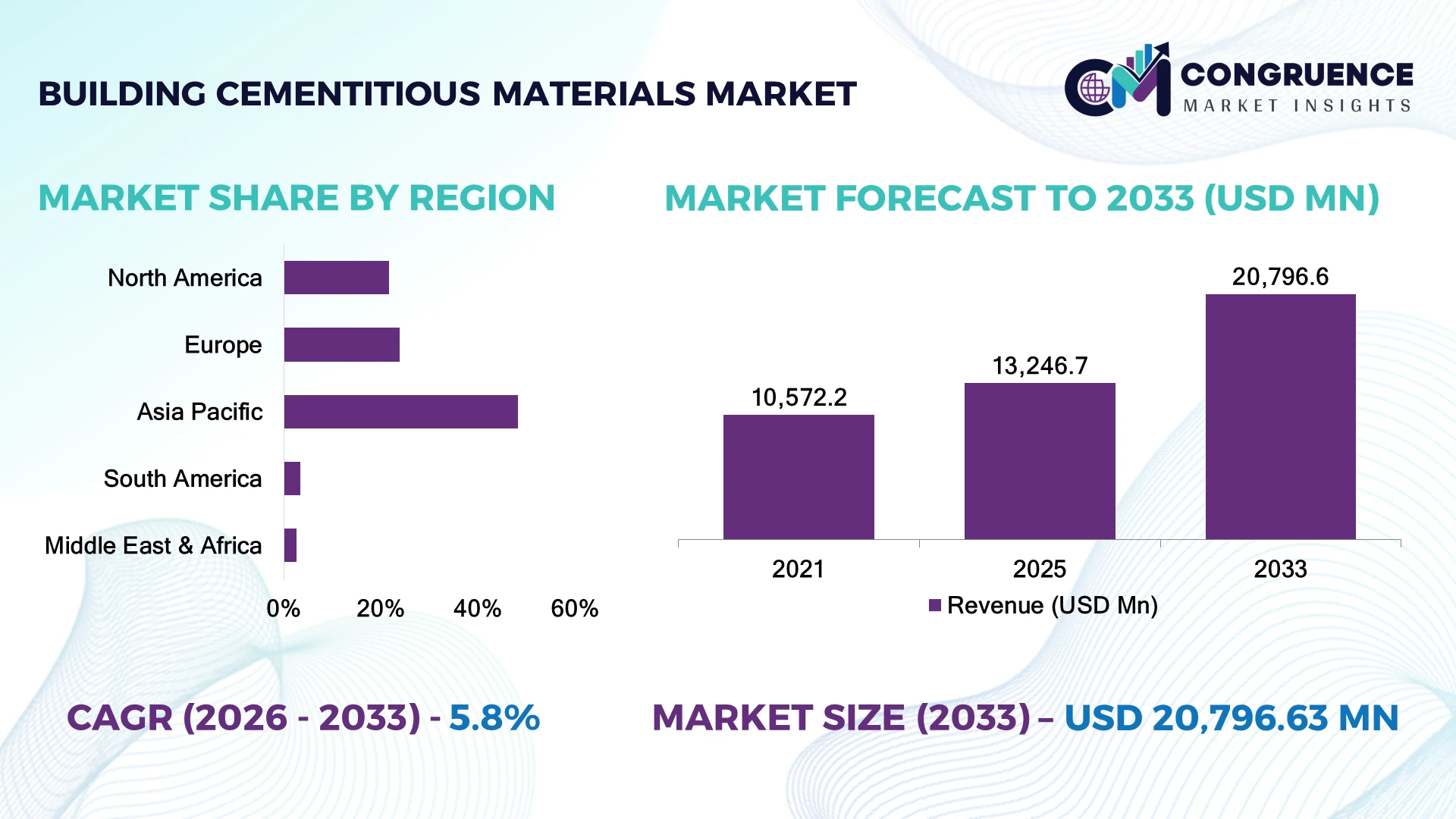
The Global Building Cementitious Materials Market was valued at USD 13,246.7 Million in 2025 and is anticipated to reach a value of USD 20,796.6 Million by 2033 expanding at a CAGR of 5.8% between 2026 and 2033. Growth is driven by rapid adoption of low-carbon cementitious formulations, accelerated infrastructure modernization, and increasing utilization of supplementary cementitious materials across commercial and residential construction.
China leads the Building Cementitious Materials market with approximately 46% of global production capacity, supported by large-scale infrastructure investment, integrated cement manufacturing, and widespread deployment of blended cement technologies. Compared with India, China produces nearly 3.2 times more cementitious materials, while approximately 41% of new infrastructure projects utilize low-clinker or blended cement formulations. Global trade realignments and carbon reduction policies are encouraging localized raw material sourcing and energy-efficient manufacturing upgrades across major producing countries.
Manufacturers prioritizing low-carbon innovation, supply-chain resilience, and advanced production technologies are strengthening long-term competitiveness in the global building materials industry.
Market Size & Growth: USD 13,246.7 million in 2025 to USD 20,796.6 million by 2033 at 5.8% CAGR, driven by low-carbon construction materials.
Top Growth Drivers: Infrastructure investment (+34%), blended cement adoption (+29%), sustainable construction (+25%).
Short-Term Forecast: By 2028, production energy intensity declines approximately 16% through process optimization.
Emerging Technologies: Carbon capture, AI-enabled process control, and alternative binders improve manufacturing efficiency.
Regional Leaders: Asia-Pacific, Europe, and North America lead demand through infrastructure renewal and green building initiatives.
Consumer/End-User Trends: Around 59% of large contractors increasingly specify blended cementitious materials for sustainable projects.
Pilot/Case Example: A 2026 infrastructure project reduced clinker usage by approximately 21% through advanced supplementary materials.
Competitive Landscape: Leading manufacturers collectively account for nearly 44% of global market activity.
Regulatory & ESG Impact: Low-carbon cement adoption reduces embodied emissions by approximately 18% in major projects.
Investment & Funding: More than USD 5.6 billion supports capacity expansion, decarbonization, and alternative binder technologies.
Innovation & Future Outlook: Digital manufacturing and next-generation cement chemistries strengthen competitive differentiation.
The Building Cementitious Materials market is evolving through clinker substitution, carbon capture integration, and AI-enabled production optimization that improve manufacturing efficiency and environmental performance. Approximately 43% of newly commissioned production upgrades now incorporate digital process monitoring and energy management systems. Increasing carbon compliance requirements and localized raw material sourcing are reshaping investment priorities, providing a strong foundation for the strategic market assessment that follows.
The Building Cementitious Materials market has become strategically significant as construction companies, infrastructure developers, and manufacturers transition toward lower-carbon building materials without compromising structural performance. Competitive differentiation increasingly depends on sustainable formulations, manufacturing efficiency, and resilient supply chains rather than production scale alone. Carbon reduction regulations, infrastructure modernization programs, and localized sourcing strategies are reshaping procurement decisions and accelerating investment in advanced cementitious technologies.
Modern blended cementitious materials incorporating supplementary cementitious components improve embodied carbon performance by approximately 22% while reducing energy consumption during production by nearly 15% compared with conventional Portland cement systems. China continues expanding high-volume manufacturing and industrial modernization, whereas Germany emphasizes advanced low-carbon formulations and precision production technologies. During the next two to three years, approximately 48% of newly commissioned production upgrades are expected to incorporate digital process automation and intelligent energy management systems.
Major producers are deploying AI-driven process optimization, alternative raw material processing, and strategic partnerships with infrastructure developers to improve production consistency and supply resilience. Investment is increasingly directed toward calcined clay technologies, carbon capture integration, and regional manufacturing expansion to address evolving construction requirements. Companies combining sustainable material innovation, operational efficiency, digital manufacturing, and reliable raw material sourcing will secure stronger competitive positioning as low-carbon construction standards become integral to future infrastructure development.
Government-backed infrastructure modernization and stricter carbon reduction targets are accelerating adoption of advanced building cementitious materials with lower clinker content and improved durability. Approximately 47% of newly specified public infrastructure projects now include blended cement formulations, while supplementary cementitious materials reduce embodied carbon by nearly 23% and improve long-term durability by approximately 17%. India's expansion of transport and urban development programs is increasing demand for high-performance cementitious products optimized for large-scale construction. The shift toward performance-based construction standards is encouraging producers to expand low-carbon product portfolios. Companies are investing in calcined clay technologies, strategic raw material partnerships, and digital manufacturing platforms to improve production efficiency and strengthen competitive positioning in sustainable construction.
Volatility in energy prices, limestone availability, and supplementary cementitious material supply continues challenging production economics across the building cementitious materials industry. Energy accounts for approximately 34% of manufacturing costs, while fluctuations in fly ash and slag availability have increased procurement variability by nearly 19%. Germany's industrial producers continue adapting to higher energy costs and changing by-product availability resulting from power sector decarbonization. These structural pressures affect production planning, pricing stability, and operating margins across manufacturers. Companies are mitigating risk through localized raw material sourcing, alternative binder development, long-term supply agreements, and investment in energy-efficient kiln technologies that improve cost resilience and operational continuity.
Next-generation cement chemistries, digital manufacturing, and industrial by-product utilization are creating significant opportunities beyond conventional cement formulations. Approximately 39% of advanced manufacturing projects now evaluate calcined clay and alkali-activated binders, while AI-driven production optimization improves process efficiency by nearly 16% and reduces material waste by approximately 14%. France continues promoting lower-carbon construction materials through updated public procurement priorities that encourage innovative cementitious solutions. Manufacturers are expanding research partnerships, investing in pilot production facilities, and integrating digital quality control platforms. A major strategic opportunity lies in converting industrial waste streams into value-added supplementary cementitious materials that reduce production costs while strengthening circular construction ecosystems.
Achieving large-scale decarbonization while maintaining production efficiency remains a complex execution challenge for cementitious material manufacturers. Approximately 44% of existing production facilities continue operating with legacy kiln systems, while carbon capture integration increases project complexity by nearly 22% during plant modernization. China faces growing pressure to modernize older production assets while maintaining supply continuity for major infrastructure projects. Delayed technology integration affects competitiveness, operational consistency, and compliance with evolving environmental standards. Companies must accelerate investment in carbon capture systems, digital plant automation, renewable energy integration, and collaborative technology partnerships to modernize production without disrupting large-scale construction supply chains.
Blended Cement Gains Momentum: Approximately 46% of newly specified commercial construction projects now utilize blended cementitious materials, reducing clinker consumption by nearly 21% while improving durability. Tightening carbon regulations are influencing procurement decisions, prompting manufacturers to expand low-carbon product portfolios and optimize regional raw material sourcing.
Digital Plants Improve Efficiency: Around 42% of production facility upgrades now incorporate AI-based process control and predictive maintenance, improving kiln efficiency by approximately 15% while reducing unplanned downtime. Companies are accelerating factory automation and integrating real-time production analytics to strengthen manufacturing consistency and operating performance.
Alternative Materials Expand Usage: Calcined clay, recycled mineral additives, and industrial by-products now contribute to nearly 37% of advanced cement formulation development programs. Supply-chain diversification and reduced dependence on conventional clinker are encouraging producers to establish strategic partnerships with mining and industrial processing companies for stable feedstock availability.
Modular Construction Influences Demand: Approximately 33% of precast and modular construction projects increasingly specify high-performance cementitious materials with faster strength development, reducing project timelines by nearly 18%. Manufacturers are redesigning formulations for automated production lines while expanding technical collaboration with prefabrication companies to support industrialized construction practices.
Portland cement accounts for approximately 48% of the Building Cementitious Materials market due to its proven structural performance, extensive manufacturing base, standardized specifications, and compatibility with large-scale residential, commercial, and infrastructure projects. Its dominance is reinforced by mature supply chains, consistent compressive strength, and cost-efficient production. Blended cement has become a strategically important segment as contractors increasingly prioritize lower-carbon construction materials, while masonry cement and specialty cement continue serving niche applications requiring enhanced workability, rapid strength development, or chemical resistance.
Blended cement is the fastest-growing type as infrastructure developers accelerate clinker substitution and sustainable construction practices. Approximately 44% of newly commissioned public infrastructure projects now specify blended cement formulations, while supplementary cementitious materials reduce clinker usage by nearly 22% and improve durability by approximately 18%. Manufacturers are expanding calcined clay production, strengthening industrial by-product partnerships, and introducing performance-enhanced blended formulations. Investment priorities are steadily shifting toward advanced low-carbon cement technologies that combine environmental compliance with long-term structural performance and production efficiency.
A 2026 technical assessment released by the Global Cement and Concrete Association highlighted that blended cement continues expanding across major infrastructure programs as producers increase supplementary cementitious material utilization to improve sustainability and operational efficiency.
Infrastructure construction represents approximately 46% of Building Cementitious Materials demand owing to extensive utilization across highways, bridges, railways, ports, airports, and public utility projects. Governments increasingly specify high-performance cementitious materials capable of supporting longer service life and reduced maintenance requirements. Residential construction remains a major application supported by urban housing expansion, while commercial buildings and industrial facilities continue adopting specialized cementitious formulations designed for high-load structural performance and faster project execution.
Green building construction is the fastest-growing application as developers increasingly integrate low-carbon materials into certified construction projects. Nearly 39% of large commercial developments now specify advanced blended cement systems, while optimized formulations improve construction productivity by approximately 17% and reduce embodied carbon by nearly 21%. Manufacturers are strengthening contractor partnerships, expanding technical support services, and integrating digital quality assurance into project delivery. Demand is shifting toward engineered cementitious solutions that deliver structural reliability alongside sustainability and lifecycle cost advantages.
According to a 2025 industry survey conducted by the World Green Building Council, construction companies increasingly prioritize lower-carbon cementitious materials within major infrastructure and commercial building developments to meet evolving sustainability objectives.
Construction companies account for approximately 51% of Building Cementitious Materials procurement due to continuous demand from large infrastructure developments, commercial buildings, residential projects, and industrial facilities. Their purchasing decisions increasingly emphasize product consistency, supply reliability, and compliance with evolving environmental standards. Real estate developers remain significant buyers focused on cost optimization and project timelines, while infrastructure contractors continue specifying advanced cementitious formulations for complex engineering projects requiring higher durability and structural performance.
Infrastructure developers represent the fastest-growing end-user segment as governments expand transportation, energy, and urban development investments requiring specialized cementitious materials. Approximately 43% of newly awarded public infrastructure contracts now include performance-based material specifications, while digital construction planning improves material utilization efficiency by nearly 15%. Manufacturers are strengthening contractor partnerships, offering customized technical support, and expanding regional distribution networks to improve project responsiveness. Competitive positioning increasingly depends on product innovation, logistics efficiency, and long-term collaboration with major engineering and construction firms.
A 2026 enterprise assessment by the International Federation of Consulting Engineers found that major infrastructure developers are increasingly specifying advanced cementitious materials with improved durability, lower carbon intensity, and predictable lifecycle performance for large-scale engineering projects.
Asia-Pacific accounted for the largest market share at 48.3% in 2025 however, Middle East & Africa is expected to register the fastest growth, expanding at a CAGR of 6.4% between 2026 and 2033.
Infrastructure Renewal Drives Low-Carbon Material Adoption
North America accounts for approximately 21.7% of the Building Cementitious Materials market, supported by extensive infrastructure rehabilitation, commercial construction upgrades, and increasing adoption of low-carbon cement formulations. Public infrastructure investments are encouraging manufacturers to expand blended cement production while integrating digital manufacturing technologies to improve operational efficiency. Approximately 45% of newly commissioned cement plant modernization projects now incorporate advanced process automation and energy optimization systems. Producers are strengthening regional supply chains, increasing alternative binder utilization, and forming long-term partnerships with engineering and construction firms to improve product availability and project execution. The market continues shifting toward performance-based cementitious materials designed for longer asset life and reduced environmental impact.
United States Market Outlook: The United States leads the regional market through extensive transportation infrastructure investment, advanced cement manufacturing capacity, and accelerating adoption of sustainable construction materials. Manufacturers continue upgrading production facilities with intelligent process control systems while expanding blended cement portfolios for public infrastructure projects. Approximately 52% of newly specified large-scale transportation developments now include lower-carbon cementitious materials to improve durability and meet evolving procurement standards.
Decarbonization Reshapes Manufacturing Priorities
Europe represents approximately 23.9% of the global Building Cementitious Materials market through strong environmental regulations, advanced production technologies, and widespread implementation of low-carbon construction practices. Cement producers continue reducing clinker intensity while investing in carbon capture, digital process optimization, and alternative binder technologies. Nearly 41% of production modernization projects now integrate advanced emissions reduction systems alongside automated quality control. Manufacturers are strengthening industrial partnerships and expanding sustainable product portfolios to meet increasingly stringent construction specifications.
Germany Market Outlook: Germany remains Europe's leading market due to its advanced cement manufacturing industry, engineering expertise, and strong investment in low-emission production technologies. Producers continue integrating carbon capture readiness, waste-derived fuels, and intelligent manufacturing systems into plant modernization programs. Approximately 38% of recently upgraded production facilities now utilize advanced digital process optimization technologies that improve operational efficiency while supporting lower-emission cement production.
Manufacturing Scale Supports Global Leadership
Asia-Pacific contributes approximately 48.3% of the global Building Cementitious Materials market through unmatched production capacity, rapid urbanization, and extensive infrastructure investment. Manufacturers continue expanding integrated cement facilities while increasing utilization of supplementary cementitious materials and digital production technologies. Approximately 58% of recently commissioned cement production capacity incorporates automated process monitoring and energy management systems. Strong domestic demand, export competitiveness, and localized raw material availability continue reinforcing the region's leadership across both conventional and sustainable cementitious material production.
China Market Outlook: China dominates the regional market through its large-scale cement manufacturing base, integrated industrial supply chains, and sustained infrastructure development. Producers continue investing in intelligent manufacturing, low-clinker formulations, and alternative fuel technologies to improve production efficiency and environmental performance. Approximately 46% of newly modernized production lines now incorporate advanced digital process control and energy optimization systems, strengthening both domestic supply and export competitiveness.
Infrastructure Recovery Stimulates Construction Materials Demand
South America is experiencing steady demand for building cementitious materials through transportation infrastructure improvements, residential construction activity, and industrial development projects. Producers are modernizing manufacturing operations while strengthening regional distribution networks to improve product availability and logistics efficiency. Approximately 32% of recently upgraded cement plants now include energy-efficient production technologies designed to improve operational performance. Infrastructure investment continues supporting market expansion despite periodic volatility in construction activity and raw material costs across several national markets.
Brazil Market Outlook: Brazil remains the largest market in South America due to its extensive cement manufacturing capacity, diversified construction sector, and large infrastructure development pipeline. Domestic producers continue investing in production modernization, alternative raw materials, and logistics optimization to improve competitiveness. Approximately 49% of the region's integrated cement production capacity is concentrated in Brazil, supporting both domestic construction demand and regional supply stability.
Mega Projects Accelerate Capacity Expansion
The Middle East & Africa market is strengthening through major infrastructure investments, urban development initiatives, and industrial diversification programs that require high-performance building cementitious materials. Cement manufacturers continue expanding production capacity while integrating energy-efficient technologies and lower-carbon production methods. Approximately 36% of recently announced production expansion projects incorporate advanced process automation and alternative fuel systems. Companies are increasing regional manufacturing investments, strengthening construction partnerships, and improving logistics infrastructure to support large-scale development programs.
Saudi Arabia Market Outlook: Saudi Arabia leads regional market development through extensive infrastructure investments, large-scale urban development projects, and sustained expansion of domestic cement manufacturing. Producers continue modernizing production facilities while introducing advanced sustainability technologies to improve operational efficiency and reduce emissions intensity. Approximately 44% of newly commissioned strategic construction projects specify advanced blended cementitious materials, reflecting the country's transition toward more sustainable and durable infrastructure development.
Holcim, Heidelberg Materials, CRH, CEMEX, and Buzzi compete aggressively against regional cement producers and specialist low-carbon material innovators, while integrated manufacturers challenge independent grinding companies through supply-chain control. The top five companies collectively command approximately 49% of global market activity. Competition is driven by production efficiency, clinker substitution, logistics reach, and sustainable product portfolios rather than price alone. Alternative fuel utilization improves operating efficiency by nearly 18%, digital plant automation reduces production downtime by approximately 15%, and blended cement lowers clinker intensity by around 22%. Companies are expanding calcined clay capacity, acquiring recycling businesses, integrating aggregates with cement operations, and forming infrastructure partnerships to secure long-term contracts. The competitive shift favors vertically integrated, low-carbon producers with localized supply networks. High capital investment, environmental compliance, and raw material access remain key entry barriers. Winning requires decarbonized production, digital manufacturing, resilient logistics, and differentiated sustainable cement solutions.
Holcim Ltd.
Heidelberg Materials AG
CRH plc
CEMEX S.A.B. de C.V.
Buzzi S.p.A.
Votorantim Cimentos
Taiheiyo Cement Corporation
Cementir Holding N.V.
UltraTech Cement Ltd.
Anhui Conch Cement Company Limited
China National Building Material (CNBM)
Shree Cement Ltd.
JSW Cement Ltd.
Titan Cement Group
Digital kiln optimization, blended cement technologies, alternative fuels, and supplementary cementitious materials currently define technology leadership across the Building Cementitious Materials market. Around 61% of newly upgraded cement plants now deploy AI-enabled process monitoring that improves thermal efficiency by approximately 14% while lowering unplanned downtime by nearly 16%. Automated quality control and digital twins are becoming standard in large integrated manufacturing facilities, enabling producers to improve product consistency and reduce operational costs across high-volume production.
Emerging technologies include calcined clay processing, carbon capture integration, electrified calcination, and AI-driven predictive maintenance. Compared with conventional Portland cement manufacturing, advanced low-clinker formulations reduce embodied carbon by approximately 30% while maintaining comparable structural performance and lowering energy intensity by nearly 17%. Global producers with integrated aggregates, recycling operations, and digital manufacturing capabilities gain stronger competitive advantages than standalone manufacturers through greater supply flexibility and lower lifecycle production costs.
Between 2026 and 2028, intelligent manufacturing platforms, CCUS deployment, and advanced supplementary cementitious material technologies will become central investment priorities. More than 55% of planned production modernization projects are expected to incorporate digital process automation alongside lower-carbon cement formulations. Companies investing early in calcined clay production, circular construction technologies, predictive analytics, and integrated material recovery will strengthen operational resilience, meet tightening environmental requirements, and secure premium positioning in sustainable infrastructure supply chains.
May 2026 Heidelberg Materials commissioned a state-of-the-art kiln line at its Airvault plant in France with 1.25 million tonnes annual clinker capacity, reducing the plant's cement carbon footprint by almost 30%. This significantly strengthens low-carbon production efficiency. Source: Heidelberg Materials
June 2026 Holcim launched the industry's first carbon capture test platform to validate multiple capture technologies, accelerating commercial decarbonization pathways for cement manufacturing and strengthening technology leadership in sustainable construction materials. Source: Holcim
May 2025 Heidelberg Materials and CBI Ghana commissioned the world's largest industrial flash calciner for clay with over 400,000 tonnes annual capacity, expanding calcined clay production and accelerating clinker substitution for lower-carbon cement manufacturing. Source: Heidelberg Materials News
July 2025 CRH agreed to acquire Eco Material Technologies for USD 2.1 billion, strengthening its portfolio of supplementary cementitious materials and near-zero-carbon cement solutions while expanding its North American sustainable construction materials platform. Source: Reuters
This report provides a comprehensive assessment of the Building Cementitious Materials market across major product types, construction applications, end-user industries, and regional markets. It evaluates Portland cement, blended cement, masonry cement, specialty cement, and emerging low-carbon formulations while examining infrastructure, residential, commercial, and industrial construction demand. The study also analyzes advanced manufacturing technologies, carbon capture integration, calcined clay, supplementary cementitious materials, digital plant automation, and circular construction practices reshaping the industry.
The report delivers strategic insights into competitive positioning, production modernization, procurement trends, technology adoption, and regional manufacturing dynamics between 2026 and 2033. More than 55% of planned production upgrades emphasize digital automation and lower-carbon manufacturing technologies, reflecting changing investment priorities. It supports investment planning, expansion strategy, product portfolio optimization, supply-chain resilience, and competitive benchmarking by identifying high-value applications, evolving customer requirements, sustainability-driven procurement trends, and long-term opportunities across the global building cementitious materials market.
| Report Attribute/Metric | Report Details |
|---|---|
|
Market Revenue in 2025 |
USD 13,246.7 Million |
|
Market Revenue in 2033 |
USD 20,796.6 Million |
|
CAGR (2026 - 2033) |
5.8% |
|
Base Year |
2025 |
|
Forecast Period |
2026 - 2033 |
|
Historic Period |
2021 - 2025 |
|
Segments Covered |
By Type
By Application
By End-User
|
|
Key Report Deliverable |
Revenue Forecast, Growth Trends, Market Dynamics, Segmental Overview, Regional and Country-wise Analysis, Competition Landscape |
|
Region Covered |
North America, Europe, Asia-Pacific, South America, Middle East, Africa |
|
Key Players Analyzed |
Holcim Ltd., Heidelberg Materials AG, CRH plc, CEMEX S.A.B. de C.V., Buzzi S.p.A., Votorantim Cimentos, Taiheiyo Cement Corporation, Cementir Holding N.V., UltraTech Cement Ltd., Anhui Conch Cement Company Limited, China National Building Material (CNBM), Shree Cement Ltd., JSW Cement Ltd., Titan Cement Group |
|
Customization & Pricing |
Available on Request (10% Customization is Free) |




