
Reports
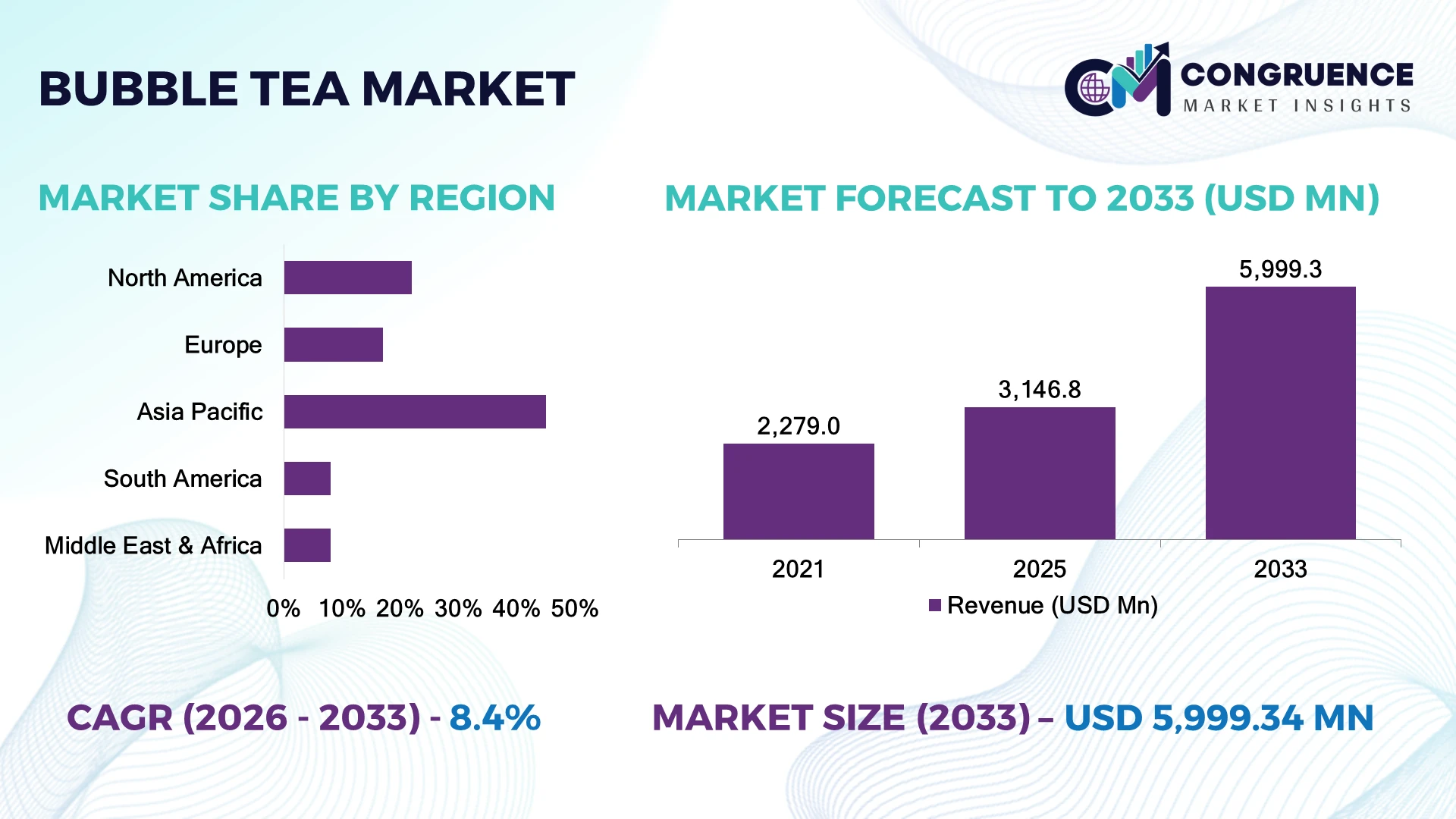
The Global Bubble Tea Market was valued at USD 3,146.8 Million in 2025 and is anticipated to reach a value of USD 5,999.3 Million by 2033 expanding at a CAGR of 8.4% between 2026 and 2033. Growth is driven by franchise-led store expansion, automated beverage preparation, customizable sweetness levels, fruit-based formulations, and diversified tea menus that improve product differentiation and repeat-purchase potential.
China remains a dominant production and consumption hub, accounting for approximately 17% of global bubble tea market revenue in 2025. Mixue operated 55,356 mainland Chinese stores at year-end 2025, with 58% located in third-tier cities and below, demonstrating the commercial strength of affordable franchise formats. Taiwan-origin brands maintain international recognition, while the United States offers a contrasting market driven by premium beverages and established specialty café networks.
Companies should prioritize localized menus, franchise economics, standardized preparation, and resilient ingredient sourcing to compete effectively across established and emerging markets.
Market Size & Growth: The market reached USD 3.15 billion in 2025 and is projected to reach USD 6.00 billion by 2033, supported by franchise expansion, product customization, and specialty beverage innovation.
Top Growth Drivers: Affordable franchise formats, premium tea formulations, and digital ordering strengthen market penetration; Mixue expanded its mainland Chinese network to 55,356 stores in 2025.
Short-Term Forecast: By 2028, automated dispensing, centralized ingredient preparation, and digital order management will strengthen opportunities to reduce preparation variability and improve peak-hour throughput.
Emerging Technologies: Smart beverage dispensers, automated portion control, digital inventory systems, and AI-assisted demand forecasting are improving recipe consistency and ingredient utilization.
Regional Leaders: North America accounted for 35.6% of global market revenue in 2025 according to one industry estimate; Asia-Pacific benefits from established tea-drinking cultures, while Europe offers opportunities through specialty beverage retail.
Consumer/End-User Trends: Customizable sweetness, fruit-forward flavors, alternative milk options, and adjustable toppings are broadening product choice, encouraging brands to balance indulgence with perceived ingredient quality.
Pilot/Case Example: In 2025, Mixue deployed smart beverage dispensers across more than 13,000 stores, supporting standardized preparation, operational consistency, and improved food-safety controls.
Competitive Landscape: Mixue's 59,823-store global network at the end of 2025 demonstrates the scale advantage of value-led franchising. Gong Cha, Chatime, CoCo Fresh Tea & Juice, and HEYTEA compete through international reach, product differentiation, and brand positioning.
Regulatory & ESG Impact: Food-safety requirements, allergen disclosure, packaging-waste reduction, and sugar-conscious product development are increasing the importance of standardized recipes and transparent ingredient information.
Investment & Funding: The reported potential USD 2 billion Gong Cha transaction in 2026 illustrates investor interest in established international beverage franchises, with expansion opportunities concentrated in scalable store networks and new geographic markets.
Innovation & Future Outlook: Reduced-sugar recipes, ready-to-drink formats, automated preparation, and localized flavor portfolios are shifting competition toward operational efficiency, broader consumption occasions, and stronger customer retention.
The global bubble tea market encompasses freshly prepared milk tea, fruit tea, tapioca-based beverages, alternative toppings, and packaged products distributed through specialty outlets, cafés, and retail channels. Demand is increasingly shaped by customization, product consistency, and the ability to introduce new flavors without complicating store operations. Automated dispensing, digital ordering, and standardized ingredient systems support multi-outlet expansion, while reduced-sugar formulations and recyclable packaging address evolving consumer expectations. Companies that combine distinctive beverage development with disciplined procurement and repeatable store economics are better positioned to expand across international markets.
The bubble tea market is becoming strategically important as beverage chains compete on affordability, flavor innovation, store productivity, and international brand recognition. China's large franchise networks demonstrate how standardized ingredients and centralized procurement can support rapid expansion, while Taiwan-origin brands such as Gong Cha and Chatime leverage established brand identities across international markets. In 2026, investor interest in established chains also reflects a shift toward scalable business models and stronger unit-level economics rather than store growth alone.
Traditional beverage preparation relies heavily on manual portioning, brewing schedules, and employee experience, whereas automated dispensers and digital recipe controls improve consistency across high-volume outlets. Mixue had deployed smart beverage dispensers in more than 13,000 stores by the end of 2025. China benefits from dense supply networks and extensive franchise penetration, while the United States emphasizes premium positioning, customized beverages, and differentiated store experiences. Automation creates operational value when standardized recipes and reliable ingredient quality reduce errors and simplify staff training.
During 2026–2028, competitive priorities will include international franchise development, reduced-sugar product innovation, digital demand forecasting, and more efficient packaging and ingredient sourcing. Brands entering new countries must adapt sweetness preferences, dairy alternatives, pricing, and food-safety procedures to local requirements. For example, an operator expanding into Southeast Asia can combine centralized concentrate procurement with locally sourced fresh ingredients and automated portion control. Companies that align product localization with disciplined expansion and measurable store productivity will build more defensible international positions.
Franchise-led expansion is strengthening bubble tea market growth by allowing brands to replicate store formats, procurement systems, and beverage recipes across diverse locations. Mixue increased its mainland Chinese store network from 41,584 in 2024 to 55,356 in 2025, while 58% of its mainland outlets operated in third-tier cities and below. This distribution demonstrates the commercial relevance of affordable formats beyond premium urban centers. Automated dispensing, centralized ingredient supply, and digital operating procedures help franchisees maintain consistency as networks expand. Companies are responding through standardized equipment, franchise training, and localized distribution infrastructure. The non-obvious advantage is that operational simplicity can support expansion into lower-density markets where limited staffing and purchasing power constrain premium store models.
Bubble tea operators face exposure to fluctuations in tea leaves, dairy, sugar, tapioca starch, fruit, and packaging costs. Fresh fruit and milk-based formulations also require reliable cold-chain handling and tighter inventory controls than shelf-stable beverage ingredients. These pressures affect gross margins when franchise agreements restrict price increases or when local competitors compete aggressively on affordability. International expansion introduces additional exposure to freight costs, import duties, currency movements, and supplier qualification requirements. Companies are mitigating these pressures through multi-supplier procurement, demand-based purchasing, standardized recipes, and regional warehousing. A critical operational distinction is that low ingredient prices alone do not ensure profitability: spoilage, inconsistent yields, and excessive menu complexity can erode savings. Brands should evaluate total ingredient cost per serving and store-level waste before expanding low-price formats.
Product development creates opportunities through reduced-sugar milk tea, fruit-forward beverages, alternative milk, seasonal flavors, and packaged bubble tea formats. Customizable sweetness and topping combinations allow brands to address different consumer preferences without abandoning recognizable core products. The opportunity extends beyond premium pricing: simplified recipes can reduce ingredient complexity, while shared bases allow operators to launch new beverages with fewer incremental procurement requirements. Brands are investing in research and development, regional flavor testing, and collaborations with ingredient suppliers to improve texture, shelf stability, and product consistency. In markets where sugar-conscious purchasing influences beverage selection, clearly communicated sweetness options can broaden customer appeal. Companies that develop locally relevant flavors using common production inputs can achieve differentiation without proportionately increasing inventory requirements or preparation time.
Scaling bubble tea operations across countries requires consistent brewing, tapioca preparation, ingredient storage, equipment calibration, and food-safety procedures. Tapioca pearls have limited holding windows after preparation, making demand forecasting and peak-hour staffing particularly important. Different water quality, ambient temperatures, dairy availability, and consumer sweetness preferences can also affect the final beverage. Operators must adapt recipes without compromising brand standards, while franchise partners need reliable training and quality-assurance systems. Companies are responding with digital preparation guides, equipment standardization, supplier audits, and localized distribution networks. The long-term challenge is maintaining the same sensory experience across thousands of outlets while accommodating regional requirements. Competitive advantage will depend on balancing central quality controls with local operating flexibility rather than imposing identical menus and processes in every market.
Automated Beverage Preparation Scales — Smart dispensing systems are becoming more relevant as chains expand beyond traditional flagship locations. Mixue reported deploying smart beverage dispensers in more than 13,000 stores by the end of 2025. Automated portioning supports recipe consistency, limits dependence on individual preparation techniques, and helps standardize high-volume workflows. Operators are integrating equipment with staff training and food-safety procedures to support faster network expansion without allowing preparation quality to vary substantially between outlets.
Value-Led Franchising Gains Momentum — Affordable beverage formats are extending market penetration into smaller cities and price-sensitive customer segments. In 2025, 58% of Mixue's mainland Chinese stores were located in third-tier cities and below, highlighting the importance of geographic reach beyond major metropolitan centers. Brands are strengthening centralized procurement, franchise support, and compact store formats to manage operating costs. This model favors disciplined unit economics and supply-chain efficiency over premium store design alone, particularly in highly competitive beverage markets.
International Expansion Becomes Selective — Global growth increasingly requires market-specific franchise strategies rather than uniform store rollouts. Mixue operated 4,467 stores outside mainland China at the end of 2025, compared with 4,895 a year earlier, illustrating that overseas expansion does not automatically produce sustained network growth. Operators are reassessing location quality, local demand, distribution capacity, and franchise performance before committing additional capital. Regional warehousing, local partnerships, and market-specific pricing are becoming important tools for balancing expansion ambitions with operational returns.
Ingredient Transparency Shapes Menus — Reduced-sugar options, alternative milk, fruit-based recipes, and clearer ingredient communication are gaining strategic relevance as beverage chains respond to changing customer expectations. These changes require adjustments to formulation, allergen management, supplier qualification, and menu communication. Brands are developing customizable sweetness levels and differentiated ingredient combinations while retaining shared bases for operational efficiency. The key shift is integrating product choice into standardized workflows, allowing operators to address varied preferences without creating excessive inventory complexity or inconsistent beverage preparation.
Milk tea remains the leading product type in the global bubble tea market, accounting for an estimated 50% of market value in 2025 under a product-format classification. Its dominance reflects established consumer familiarity, compatibility with tapioca pearls, standardized preparation, and broad availability across value-led franchises and premium specialty outlets. Fruit-based tea is among the fastest-expanding categories, supported by demand for refreshing beverages, dairy-free options, and seasonal flavor combinations. Cheese foam tea, taro-based beverages, matcha formulations, and other specialty variants serve differentiated preferences and premium positioning. Established milk tea products benefit from repeat purchasing and scalable ingredient procurement, whereas emerging formulations provide opportunities to attract new consumers and refresh menus without replacing core products.
Product strategies increasingly balance familiar recipes with flavor experimentation and adjustable sweetness. Fruit-based beverages represented approximately 38.3% of the market by flavor in 2025 in one industry estimate, illustrating the commercial relevance of flavor diversification, although flavor share is distinct from product-type share. Operators are expanding fruit concentrates, alternative milk choices, and specialty toppings while standardizing preparation to protect margins. Investment priorities favor flexible beverage platforms that accommodate new formulations without requiring extensive equipment changes. For manufacturers and franchise operators, combining high-volume milk tea with differentiated fruit and specialty beverages offers a stronger portfolio strategy than relying on a single product category.
Specialty bubble tea shops and tea cafés represent the leading application channel, accounting for an estimated 80% of market value in 2025 under a channel-based classification. Their dominance reflects freshly prepared beverages, extensive customization, visible product preparation, and direct customer engagement. Cafés, restaurants, and quick-service outlets extend availability through broader foodservice networks, while packaged ready-to-drink products and at-home preparation formats create additional consumption occasions. Specialty outlets benefit from control over sweetness, toppings, serving temperature, and presentation, whereas packaged products depend more heavily on shelf stability, packaging performance, and retail distribution. Ready-to-drink bubble tea is an emerging growth avenue as brands seek customers beyond dedicated beverage stores and traditional café locations.
Distribution strategies are shifting toward a combination of physical outlets, digital ordering, delivery partnerships, and retail availability. Delivery can extend customer reach without requiring additional storefronts, although packaging integrity, preparation timing, and delivery commissions affect profitability. Packaged formats offer access to supermarkets, convenience stores, and online retail, but manufacturers must preserve texture and beverage quality during storage. Companies are responding with sealed packaging, standardized formulations, improved inventory planning, and partnerships with established distributors. The strategic priority is to use specialty outlets for freshly prepared products and brand development while expanding packaged beverages selectively into channels that support repeat purchases and manageable distribution costs.
Individual consumers represent the principal end-user group, accounting for an estimated 70% of global bubble tea consumption value in 2025 under a consumer-purchase classification. Demand is supported by customization, social consumption, convenience, and the availability of products across affordable and premium price points. Students, young professionals, and urban consumers are important target audiences, while families and occasional buyers broaden the addressable market. Commercial foodservice operators, franchisees, and hospitality businesses form a strategically important buyer group because their purchasing decisions determine outlet expansion, ingredient volumes, equipment requirements, and menu standardization. Retail and packaged-beverage buyers provide an additional route to consumers who prefer at-home consumption or purchases through convenience-oriented channels.
Consumer purchasing increasingly reflects the balance between price, flavor variety, convenience, and control over sweetness and toppings. Adjustable sugar and ice levels help operators serve diverse preferences, while loyalty programs and digital ordering encourage repeat purchases. Commercial buyers prioritize consistent ingredient quality, predictable supply, preparation speed, and unit-level profitability; franchise operators additionally require training, equipment support, and standardized recipes. Packaged-product buyers emphasize shelf life, packaging integrity, and dependable retail replenishment. Companies are responding with tiered pricing, localized menus, franchise partnerships, and flexible product portfolios. Future demand will favor brands that connect consumer-level customization with operationally consistent delivery, allowing individual preferences to be served without excessive ingredient complexity or avoidable preparation costs.
Asia-Pacific accounted for the largest market share at an estimated 45.0% in 2025 however, North America is expected to register the fastest growth, expanding at an estimated CAGR of 9.2% between 2026 and 2033.

Premiumization and Multi-Channel Distribution Reshape Competition
North America represents a strategically important bubble tea market, supported by specialty beverage outlets, established foodservice infrastructure, and demand for customizable drinks. The United States leads regional activity through concentrated specialty café networks, franchise development, and product innovation, while Canada provides additional opportunities in metropolitan areas with established Asian beverage cultures. Digital ordering, delivery integration, and loyalty programs help operators increase order frequency and improve customer retention. Brands are expanding beyond traditional milk tea through fruit-based formulations, alternative milk, and reduced-sugar options. However, labor expenses, commercial rents, and delivery commissions place pressure on store-level margins. Operators are responding with standardized preparation, compact store formats, and carefully selected locations to balance product differentiation with operating efficiency.
United States Market Outlook: The United States benefits from a mature specialty-foodservice ecosystem, extensive digital payment adoption, and established third-party delivery infrastructure. Operators can use these capabilities to test new flavors, optimize promotions, and expand into supermarkets through packaged beverage partnerships. Franchise groups are prioritizing locations with strong foot traffic, student populations, and repeat-purchase potential. Competitive positioning increasingly depends on maintaining consistent product quality while controlling labor and occupancy costs across multi-location networks.
Specialty Beverage Retail and Ingredient Transparency Gain Importance
Europe's bubble tea market is developing through specialty cafés, urban foodservice networks, shopping-center outlets, and packaged beverage distribution. The United Kingdom, Germany, and France provide important commercial opportunities because of their large urban consumer bases and established retail infrastructure. Market expansion depends on localized flavor preferences, clear allergen information, and consistent food-safety practices. Packaging waste requirements and sustainability expectations are also influencing takeaway cup selection, material sourcing, and waste-management processes. Operators are improving digital ordering, menu standardization, and supply planning to manage labor costs and reduce ingredient waste. Compared with established Asian markets, European operators generally place greater emphasis on introducing the category through specialty retail and differentiated café experiences.
United Kingdom Market Outlook: The United Kingdom offers a developed café culture, concentrated urban retail locations, and established delivery platforms that support bubble tea distribution. London provides a particularly important testing ground for specialty flavors, premium toppings, and localized menu development. Businesses are strengthening allergen communication, packaging compliance, and inventory management to meet customer expectations and regulatory requirements. Expansion into other cities depends on maintaining repeat purchases and dependable ingredient supply without overextending store networks.
Franchise Scale and Integrated Supply Chains Reinforce Regional Leadership
Asia-Pacific leads the global bubble tea market through established consumption patterns, dense specialty beverage networks, and extensive ingredient-supply ecosystems. China anchors regional scale, while Taiwan contributes established product expertise and internationally recognized bubble tea brands. Southeast Asian markets provide further opportunities through urban retail development, franchising, and demand for affordable customized beverages. China's Mixue operated 55,356 stores in mainland China at the end of 2025, demonstrating the reach achievable through standardized menus and value-oriented franchise operations. Automated preparation, centralized procurement, and localized distribution help large chains manage consistency across extensive networks. However, price competition and rapid outlet expansion require careful site selection, quality controls, and disciplined franchise economics.
China Market Outlook: China benefits from a dense ecosystem of tea suppliers, ingredient processors, beverage-equipment manufacturers, and franchise operators. Large chains leverage centralized procurement and standardized recipes to manage high-volume preparation and competitive pricing. Mixue's deployment of smart beverage dispensers across more than 13,000 stores by the end of 2025 illustrates the operational role of automation. Manufacturers and operators are prioritizing product consistency, inventory control, and efficient franchise support to sustain scale while adapting menus to local preferences.
Urban Specialty Retail Creates Selective Expansion Opportunities
South America's bubble tea market remains less established than Asia-Pacific and North America, with demand concentrated in major urban centers, specialty cafés, shopping malls, and foodservice outlets. Brazil represents the region's most strategically significant opportunity because of its large consumer base, developed metropolitan retail networks, and established café culture. Localized fruit flavors offer a potential point of differentiation, while milk tea and tapioca-based products appeal to consumers seeking unfamiliar beverage experiences. Imported ingredients, currency volatility, and inconsistent availability of specialized toppings can complicate pricing and supply planning. Operators are responding through selective store openings, regional supplier relationships, and simplified menus that reduce inventory complexity. Market development will depend on building repeat consumption rather than relying solely on novelty-driven trial purchases.
Brazil Market Outlook: Brazil offers the region's largest potential consumer base and extensive retail infrastructure across cities such as São Paulo and Rio de Janeiro. São Paulo provides a practical entry point for specialty beverage brands seeking access to diverse consumers, established delivery services, and experienced foodservice operators. Businesses can differentiate through tropical fruit formulations and adjustable sweetness while retaining recognizable core products. Local sourcing where technically feasible, disciplined import management, and partnerships with established café operators can improve supply reliability and reduce exposure to currency-driven cost increases.
Modern Retail Infrastructure Supports Premium Beverage Expansion
The Middle East and Africa bubble tea market is developing through shopping malls, premium foodservice outlets, hospitality venues, and franchise-led specialty beverage retail. The United Arab Emirates and Saudi Arabia are strategically important Gulf markets because of their modern retail infrastructure, international consumer exposure, and established franchise ecosystems. In Africa, opportunities are concentrated in major commercial centers, where access to imported ingredients and suitable retail locations determines operating feasibility. Hot climates support interest in chilled fruit tea and customizable beverages, although demand remains sensitive to pricing and brand awareness. Operators are adapting menus to local preferences and using established franchise systems to standardize quality. Reliable cold storage, ingredient sourcing, and staff training remain essential for maintaining product consistency across markets with differing supply-chain capabilities.
United Arab Emirates Market Outlook: The UAE benefits from internationally connected retail centers, established hospitality operators, and a strong franchise-based foodservice environment. Dubai provides a practical platform for testing premium beverage concepts, localized flavors, and delivery-led sales strategies. Brands can use mall locations and partnerships with established restaurant groups to reach residents and international visitors. Success depends on maintaining cold-chain integrity, managing imported ingredient costs, and ensuring consistent preparation during high-demand periods. Operators that combine premium presentation with efficient service and reliable sourcing are better positioned to build repeat demand.
The global bubble tea market combines value-led franchise leaders, premium tea specialists, and regional brands competing for store expansion and customer loyalty. Mixue competes through affordability and procurement scale, while CHAGEE and HEYTEA emphasize premium tea preparation. Gong cha, Chatime, and CoCo Fresh Tea & Juice compete through international franchising and menu localization. The top five players' combined global share is not reliably established in publicly available disclosures; the market remains fragmented outside leading Asian networks. Competition centers on pricing, ingredient consistency, service speed, and franchise profitability. Standardized procurement can reduce ingredient costs by an estimated 3–5% in suitable operations, while automation targets faster, more consistent preparation rather than a universal efficiency gain. Gong cha's automated store model and Mixue's extensive dispenser rollout illustrate technology-led differentiation. International master-franchise agreements accelerate geographic expansion, while supply-chain integration strengthens value positioning. Entry barriers remain moderate, but brand recognition, reliable sourcing, and repeatable store economics challenge newcomers. Winning requires distinctive products, disciplined costs, and scalable operations.
Automated beverage dispensers, robotic preparation systems, and programmable recipe controls are transforming high-volume bubble tea operations. Unlike manual portioning, automated dispensing standardizes tea, syrup, milk, and topping quantities, reducing operator-dependent variation. Mixue reported deploying smart beverage dispensers across more than 13,000 stores by December 2025. This scale demonstrates commercial adoption within a major chain, although industry-wide penetration remains undisclosed. Operators can target 2–5% lower ingredient waste through improved portion control, subject to baseline performance and implementation quality.
Digital kiosks, mobile ordering, loyalty platforms, and integrated point-of-sale systems connect customer preferences with preparation workflows. Real-time sales data support demand forecasting, inventory planning, and promotional targeting, while automated cleaning and temperature monitoring strengthen operational control. Robotic kiosks can prepare customized drinks with limited direct handling, but equipment costs, maintenance, and menu complexity constrain suitability for smaller outlets. Technology-led chains gain the greatest advantage where high order volumes justify investment and standardized recipes simplify execution.
During 2026–2028, competitive differentiation will increasingly depend on integrating dispensing equipment with inventory systems, digital ordering, and store-level performance analytics. A 5–10% improvement in preparation throughput is a potential operating target for suitable deployments, not a verified industry-wide outcome. Large franchise networks are best positioned to spread equipment costs across outlets, while smaller operators can adopt modular dispensers and cloud-based ordering incrementally. Companies should prioritize measurable labor productivity, consistent beverage quality, and lower waste before scaling capital-intensive automation.
The global bubble tea market report examines product types including milk tea, fruit tea, and specialty formulations; applications spanning specialty beverage outlets, cafés, foodservice, and packaged products; and end-users encompassing individual consumers, franchise operators, commercial buyers, and retail customers. Regional coverage includes North America, Europe, Asia-Pacific, South America, and the Middle East and Africa, with country-level analysis of leading markets, emerging consumption centers, and international franchise opportunities.
The report evaluates competitive positioning, franchise expansion, ingredient procurement, automated beverage dispensing, digital ordering, recipe standardization, and product customization. It also assesses operational constraints involving ingredient costs, food safety, packaging, supply reliability, and store-level profitability. Company profiling and strategic comparisons help decision-makers evaluate established chains against emerging specialists. The analysis supports investment screening, market-entry planning, partnership selection, product development, and competitive positioning between 2026 and 2033, emphasizing scalable business models, localized menus, technology adoption, and operational efficiency.
| Report Attribute/Metric | Report Details |
|---|---|
|
Market Revenue in 2025 |
USD 3,146.8 Million |
|
Market Revenue in 2033 |
USD 5,999.3 Million |
|
CAGR (2026 - 2033) |
8.4% |
|
Base Year |
2025 |
|
Forecast Period |
2026 - 2033 |
|
Historic Period |
2021 - 2025 |
|
Segments Covered |
By Type
By Application
By End-User
|
|
Key Report Deliverable |
Revenue Forecast, Growth Trends, Market Dynamics, Segmental Overview, Regional and Country-wise Analysis, Competition Landscape |
|
Region Covered |
North America, Europe, Asia-Pacific, South America, Middle East, Africa |
|
Key Players Analyzed |
Mixue, Gong cha, Chatime, CoCo Fresh Tea & Juice, CHAGEE, HEYTEA, Kung Fu Tea, Sharetea, Happy Lemon, Yi Fang Taiwan Fruit Tea, Tiger Sugar, The Alley, Koi Thé, Boba Guys |
|
Customization & Pricing |
Available on Request (10% Customization is Free) |