
Reports
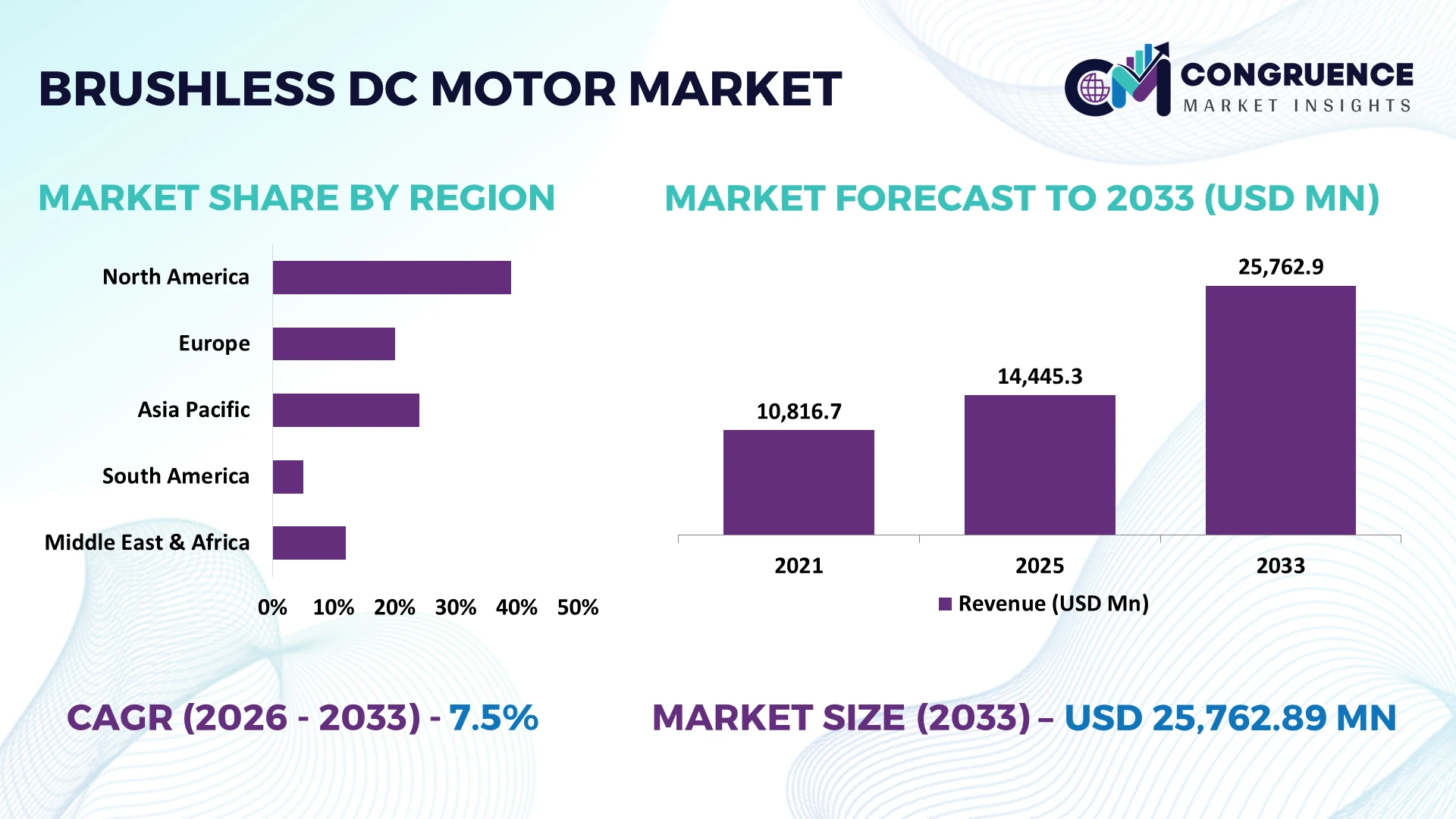
The Global Brushless DC Motor Market was valued at USD 14445.31 Million in 2025 and is anticipated to reach a value of USD 25762.89 Million by 2033 expanding at a CAGR of 7.5% between 2026 and 2033. Growth is driven by electric vehicle traction systems, electronically commutated HVAC equipment, industrial automation, robotics, drones, and energy efficient appliances replacing mechanically commutated motors.
China dominates global brushless DC motor demand through its electric vehicle, appliance, robotics, and industrial equipment manufacturing base. China represented more than 70% of global electric car production in 2024, compared with about 15% for Europe, giving Chinese motor suppliers exceptional production scale. Permanent magnet motor ecosystems also benefit from China's roughly 60% share of mined rare earth production and about 90% of rare earth processing, while geopolitical supply diversification is accelerating magnet investment in the United States, Japan, and Australia.
Motor manufacturers should prioritize magnet security, integrated electronic control, and Chinese automotive scale while developing alternative sourcing for critical magnetic materials.
Market Size & Growth: USD 14.45 billion in 2025 reaches USD 25.76 billion by 2033 at 7.5% CAGR, driven by electrified mobility and automated equipment.
Top Growth Drivers: Electric mobility contributes 38%, industrial automation 27%, and energy efficient HVAC and appliances 21% to incremental demand momentum.
Short Term Forecast: By 2028, advanced electronic commutation and optimized control algorithms are positioned to improve system efficiency by 5% to 10%.
Emerging Technologies: Sensorless control, AI assisted predictive diagnostics, and silicon carbide power electronics are advancing motor efficiency, thermal control, and compact drive integration.
Regional Leaders: By 2033, Asia Pacific approaches USD 12.4 billion, North America USD 6.2 billion, and Europe USD 5.1 billion, led respectively by manufacturing, automation, and electrification.
Consumer and End User Trends: Global electric car sales exceeded 17 million units in 2024, expanding the installed base for efficient permanent magnet motor systems.
Pilot and Case Example: In 2025, next generation axial flux motor programs demonstrated power density improvements exceeding 20% versus conventional radial architectures in targeted mobility applications.
Competitive Landscape: Nidec holds an estimated 12% position, competing with MinebeaMitsumi, Johnson Electric, Maxon, and Allied Motion across automotive, industrial, and precision applications.
Regulatory & ESG Impact: EU electric motor ecodesign requirements extend efficiency regulation to motors covering 0.12 kW through 1,000 kW, strengthening demand for optimized motor systems.
Investment & Funding: More than USD 1 billion in announced US rare earth magnet investments is supporting supply diversification for permanent magnet motors amid concentrated Asian processing capacity.
Innovation & Future Outlook: Motor efficiencies above 90%, integrated controllers, sensorless drives, and advanced magnet management are shifting competition toward compact, digitally controlled electromechanical platforms.
The Brushless DC Motor Market is increasingly concentrated around electric vehicles, automated production equipment, robotics, HVAC systems, drones, data center cooling, and high efficiency household appliances. Sensorless commutation, integrated motor controllers, silicon carbide electronics, and predictive diagnostics are reducing mechanical complexity while improving speed control and thermal performance. Premium BLDC systems routinely operate above 90% efficiency, strengthening their operating cost advantage in continuously running equipment. Meanwhile, rare earth supply diversification outside China is becoming strategically important for permanent magnet sourcing, linking motor technology decisions directly with procurement resilience and manufacturing localization.
Brushless DC motors are becoming strategically important as electrified transport, automated factories, data center cooling, and digitally controlled HVAC systems shift purchasing toward efficient variable speed drives. Premium BLDC systems regularly exceed 90% efficiency, while rare earth supply concentration is forcing manufacturers to restructure permanent magnet sourcing. China retains roughly 90% of rare earth processing capacity, encouraging localization investments in the United States, Japan, and Australia.
Compared with conventional brushed motors, BLDC architectures can deliver 10% to 20% higher operating efficiency while eliminating brush replacement and reducing maintenance interruptions. China provides unmatched electric vehicle and appliance manufacturing scale, whereas Germany and Japan concentrate on precision automation, robotics, and high performance drive systems. Through 2028, sensorless control, silicon carbide electronics, and integrated motor controllers will reduce component count while improving thermal management and power density.
A practical deployment shift is replacing fixed speed induction motors in fans, pumps, and compressors with electronically controlled BLDC systems that adjust output to real loads. Motor manufacturers are expanding controller integration, magnet sourcing partnerships, and application specific engineering. Competitive advantage will increasingly depend on combining motor efficiency with secure materials procurement, embedded intelligence, compact packaging, and dependable volume manufacturing.
Vehicle electrification is creating the strongest structural demand for BLDC motors across traction auxiliaries, thermal management, electric power steering, pumps, fans, and actuators. Electric cars represented more than 20% of global new car sales in 2024, while China accounted for over 70% of worldwide electric car production. BLDC systems can exceed 90% efficiency, supporting longer operating ranges and lower auxiliary power consumption. Automotive manufacturers are consequently replacing mechanically commutated motors with electronically controlled architectures across multiple vehicle subsystems. Suppliers are expanding integrated motor and controller platforms, strengthening automotive qualification capabilities, and locating production closer to Chinese and international electric vehicle manufacturing hubs. The strategic advantage extends beyond traction: increasing motor content per vehicle creates recurring opportunities across numerous auxiliary systems without requiring suppliers to compete directly in main propulsion.
Permanent magnet dependency creates a structural constraint because high performance BLDC motors commonly require neodymium based magnets, connecting motor economics directly to concentrated rare earth processing. China controls roughly 90% of global rare earth separation and processing and around 90% of permanent magnet production, while alternative supply remains substantially smaller. Magnet material can represent 20% to 30% of permanent magnet motor material cost depending on design and commodity conditions. Export controls and geopolitical trade tensions therefore expose manufacturers to procurement disruption, inventory requirements, and margin volatility. US, Japanese, and European suppliers are responding through longer procurement contracts, magnet recycling, localized supply investments, and ferrite based alternatives. The operational priority is reducing single country exposure without sacrificing torque density, because redesigning magnet systems can require simultaneous changes to rotor geometry, electronics, and thermal management.
Integrated electronics create an opportunity to move BLDC suppliers from component vendors toward intelligent motion platforms. Sensorless control can eliminate Hall sensors and associated wiring, reducing component requirements by 10% to 20% in suitable applications, while silicon carbide power devices can cut switching losses by more than 50% compared with conventional silicon solutions under targeted operating conditions. India provides an attractive deployment environment as industrial automation, electric two wheelers, HVAC equipment, and domestic electronics manufacturing expand simultaneously. Through 2028, embedded diagnostics, adaptive control algorithms, and connected drives will enable condition monitoring alongside speed and torque control. Manufacturers are increasing semiconductor partnerships, software engineering, and integrated controller development. The non obvious opportunity is aftermarket analytics: connected motors can generate operating data that supports predictive maintenance services, shifting competition from hardware pricing toward lifecycle performance and recurring digital value.
Higher power density creates an execution challenge because compact BLDC assemblies concentrate heat within windings, magnets, bearings, and power electronics. Permanent magnet performance can deteriorate when operating temperatures approach 150 degrees Celsius for common magnet grades, while inverter switching and copper losses can collectively reduce system efficiency by several percentage points under sustained high loads. Automotive applications also demand operating lifetimes exceeding 10,000 hours alongside vibration, moisture, and rapid load cycling. Germany's automotive and industrial equipment manufacturers increasingly require motor, inverter, software, and thermal systems to be validated as integrated assemblies rather than independent components. Suppliers must invest in electromagnetic simulation, advanced cooling, condition monitoring, functional safety expertise, and joint validation with OEMs. Long term competitiveness therefore depends on maintaining efficiency across real duty cycles, not simply achieving high laboratory peak efficiency.
Controllers Move Into Motor Housings: BLDC suppliers are integrating inverters, control electronics, and communications directly with motor assemblies, reducing external wiring and installation space. Integrated architectures can lower component count by 10% to 20% while eliminating separate controller enclosures. Manufacturers are redesigning thermal paths, connectors, and firmware together, giving OEMs faster assembly and fewer interfaces to validate.
HVAC Shifts Toward Variable Speed: Electronically commutated BLDC technology is replacing fixed speed motors in fans, blowers, and compressors as efficiency regulation tightens. Premium systems exceed 90% motor efficiency and variable speed operation can reduce fan energy consumption by more than 20% under partial loads. Equipment manufacturers are expanding electronically controlled product platforms and optimizing motors around actual duty cycles.
Rare Earth Designs Become Leaner: Magnet supply pressure is accelerating rotor optimization rather than simply increasing material inventories. China retains about 90% of rare earth processing and permanent magnet manufacturing, encouraging Japanese, US, and European motor developers to reduce magnet content per kilowatt. Companies are redesigning magnetic circuits, evaluating ferrite assisted architectures, and qualifying additional suppliers to protect production continuity.
Precision Automation Raises Servo Demand: Factory automation is increasing demand for compact BLDC servo motors with accurate speed and position control. Global factories installed 542,000 industrial robots in 2024, while Asia captured 74% of deployments. Motor suppliers are scaling high torque density platforms, encoder integration, and automated winding processes as robotics builders require smaller actuators with repeatable dynamic response.
Inner Rotor motors lead the type landscape with an estimated 38% share, supported by high rotational speed, effective heat dissipation, compact geometry, and established use across automotive systems, industrial drives, medical equipment, and power tools. Their mature manufacturing base supports scalable winding, balancing, and rotor assembly. Sensored motors retain importance where precise starting torque and position feedback are essential, particularly in servo systems. Outer Rotor configurations provide higher torque at lower speeds and remain valuable for fans, blowers, drones, and direct drive applications where packaging efficiency matters.
Integrated Drive is the fastest developing type as OEMs consolidate motor, inverter, sensing, and control functions into fewer assemblies. Integration can reduce external component requirements by 10% to 20% while shortening installation workflows. Sensorless designs are also strengthening in pumps, fans, and appliances because removing Hall sensors reduces wiring and electronic interfaces. Suppliers are therefore reallocating engineering toward embedded control software, compact power electronics, and thermally coordinated motor controller packages while retaining Inner Rotor platforms for performance intensive applications.
Automotive Systems represent the leading application with an estimated 34% share, reflecting extensive BLDC deployment across thermal management, power steering, pumps, cooling fans, seat systems, and other electronically controlled auxiliaries. Electric vehicles intensify motor content because battery and power electronics cooling require precisely controlled fluid and airflow management. HVAC Systems form another established application, where variable speed BLDC technology delivers substantial partial load efficiency advantages. Consumer Appliances and Power Tools increasingly favor compact motors because electronic commutation supports high rotational speed, lower maintenance, and improved power density.
Robotics is the fastest developing application as factories deploy increasingly compact servo axes, mobile robots, and automated handling systems. Industrial Automation consequently strengthens demand for precise speed control and rapid torque response, while Medical Equipment requires low noise, reliability, and compact packaging. Manufacturers are expanding application specific windings, encoder options, integrated electronics, and automated production. With global robot installations exceeding 600,000 units in 2025, motion suppliers increasingly prioritize scalable servo platforms rather than individually engineered motors.
Automotive is the leading end user with an estimated 36% share, driven by the number of electronically controlled motors required across electric and conventional vehicle platforms. Global electric car sales exceeded 20 million units in 2025 and represented 25% of new car sales, strengthening demand for BLDC pumps, fans, actuators, and thermal management systems. Consumer Electronics and HVAC remain established volume buyers, while Manufacturing increasingly purchases motors as integrated elements of automated machinery rather than standalone components.
Industrial Automation is the fastest developing end user as robotics, autonomous material handling, machine vision equipment, and electronically controlled production lines increase precision motion requirements. Healthcare prioritizes low vibration motors for pumps, surgical equipment, and diagnostic systems, while Aerospace and Defense emphasizes power density, reliability, and weight reduction. Suppliers are targeting these buyers through customized electromagnetic designs, integrated controllers, platform based pricing, and OEM engineering partnerships. Competitive investment is shifting toward motor families that can be configured across multiple power classes without redesigning the complete control architecture.
Asia Pacific accounted for the largest market share at 46.2% in 2025 however, Asia Pacific is expected to register the fastest growth, expanding at a CAGR of 8.1% between 2026 and 2033. Pasted markdown

Automation and Electrification Reshape Motor Demand
North America represents an estimated 24.1% of global Brushless DC Motor Market demand, supported by automotive electrification, industrial automation, data center cooling, aerospace systems, and high efficiency HVAC equipment. The United States provides the principal deployment base as manufacturers replace fixed speed and mechanically commutated motors with electronically controlled systems. US factories installed 38,000 industrial robots in 2025, increasing demand for precision servo motors, compact actuators, and automated material handling equipment. Data center expansion adds another operational requirement for efficient fans, pumps, and cooling assemblies capable of continuous variable speed operation. Motor suppliers are responding by integrating controllers, encoders, thermal management, and diagnostic functions into application specific platforms. Domestic semiconductor and critical mineral investment is simultaneously encouraging greater localization of motor electronics and permanent magnet supply chains.
United States Market Outlook: The United States combines large automotive, HVAC, aerospace, automation, and data center industries with expanding semiconductor manufacturing. Industrial robot installations increased 11% in 2025, while food industry installations rose 30%. This broadening automation base creates demand beyond automotive factories, favoring BLDC suppliers offering configurable servo systems, integrated drives, and localized technical support.
Efficiency Regulation Accelerates Motor Modernization
Europe accounts for an estimated 21.4% of global demand, with Germany, Italy, France, and the United Kingdom providing significant automotive, machinery, HVAC, and factory automation requirements. Ecodesign regulation is accelerating replacement of inefficient motor systems as European efficiency requirements cover electric motors between 0.12 kW and 1,000 kW. Germany's dense machinery and automotive manufacturing ecosystem strengthens demand for precision BLDC servo systems, electronically controlled pumps, thermal management units, and robotic actuators. Manufacturers increasingly evaluate the complete motor and drive package because inverter losses, control algorithms, and operating load profiles determine system efficiency beyond nominal motor ratings. Suppliers are consequently expanding high efficiency platforms, integrated electronics, digital condition monitoring, and application engineering. The competitive shift favors companies capable of meeting regulatory efficiency requirements while maintaining compact dimensions and predictable performance under variable industrial loads.
Germany Market Outlook: Germany remains Europe's strategic BLDC deployment center through automotive manufacturing, machine tools, robotics, and industrial automation. Manufacturing contributes roughly 18% of German gross value added, sustaining a large installed base of motor driven equipment. Suppliers compete through precision control, energy optimization, compact servo architectures, and engineering partnerships with machinery manufacturers.
Manufacturing Scale Anchors Global Leadership
Asia Pacific holds about 46.2% of global demand, reflecting its concentration of electric vehicle, consumer appliance, electronics, robotics, HVAC, and industrial equipment manufacturing. China provides unmatched production scale, while Japan contributes precision motor engineering and South Korea strengthens electronics and automotive integration. China produced more than 70% of global electric cars in 2024, creating substantial requirements for BLDC pumps, cooling fans, actuators, power steering systems, and thermal management equipment. The region also benefits from concentrated permanent magnet and electronics supply chains that shorten procurement cycles for motor manufacturers. Japanese suppliers retain competitive strength in miniature motors, bearings, motion control, and high precision manufacturing. Companies are expanding automated winding, integrated controller production, and localized application engineering to serve high volume OEM programs while improving manufacturing consistency and reducing assembly complexity.
China Market Outlook: China combines automotive electrification with extensive appliance, electronics, industrial equipment, and motor component manufacturing. Electric cars represented almost 50% of domestic car sales in 2024. Local BLDC suppliers benefit from proximity to magnet processing, semiconductor assembly, motor winding operations, and vehicle production, enabling rapid design iterations and high volume sourcing.
Industrial Efficiency Drives Selective Adoption
South America accounts for an estimated 4.6% of global demand, with Brazil providing the largest industrial base for automotive production, HVAC equipment, household appliances, agricultural machinery, and factory automation. Adoption is concentrated where variable speed operation produces measurable electricity savings or where maintenance reduction justifies replacing brushed motors. Brazil installed about 2,100 industrial robots during 2024, demonstrating an expanding but substantially smaller automation base than major Asian manufacturing economies. Local motor demand also benefits from refrigeration and air conditioning applications, where electronically commutated motors improve partial load performance. Currency exposure and dependence on imported magnets, semiconductors, and precision electronic components continue to affect procurement economics. Manufacturers are responding through localized assembly, distributor partnerships, standardized motor platforms, and broader component sourcing rather than replicating capital intensive upstream supply chains.
Brazil Market Outlook: Brazil offers the strongest regional demand concentration through automotive manufacturing, food processing, mining equipment, refrigeration, and consumer appliances. Its established motor manufacturing ecosystem supports localization of assembly and customization, while imported electronic controllers and magnetic materials remain strategically important. Suppliers combining domestic technical support with diversified component procurement gain stronger protection against currency and logistics disruption.
Infrastructure Modernization Expands Efficient Drives
Middle East and Africa represents an estimated 3.7% of global demand, with Saudi Arabia, the United Arab Emirates, South Africa, and major Gulf infrastructure markets driving adoption across HVAC, water systems, industrial equipment, data centers, healthcare facilities, and automated logistics. High cooling intensity makes variable speed motor efficiency particularly valuable in Gulf economies, where air conditioning can account for more than 50% of peak electricity demand. Data center construction and smart infrastructure programs are increasing requirements for continuously operating fans, pumps, and precision cooling systems. Local manufacturing depth remains limited compared with Asia, making imported motors, controllers, semiconductors, and magnetic materials important. Suppliers are targeting the region through distribution partnerships, engineering support, high temperature motor designs, and integrated drive systems optimized for energy intensive cooling and infrastructure applications.
Saudi Arabia Market Outlook: Saudi Arabia is strengthening BLDC demand through industrial diversification, data center investment, automated logistics, HVAC modernization, and water infrastructure. Industrial development under Vision 2030 is encouraging localized equipment assembly and technology partnerships. Motor suppliers positioned around high temperature reliability, variable speed cooling, and locally supported industrial systems can capture demand created by infrastructure modernization.
Nidec, MinebeaMitsumi, Johnson Electric, Maxon, and Regal Rexnord compete across automotive, industrial, appliance, robotics, and precision motion applications, with the five leading suppliers representing about 38% of market activity. Nidec leverages manufacturing scale and automotive integration, while Maxon emphasizes precision, power density, and customized motion systems. Johnson Electric competes through high volume automotive and consumer platforms, whereas MinebeaMitsumi combines motors, bearings, sensors, and electronics. Premium BLDC designs exceed 90% efficiency, while integrated drives can reduce external component requirements by 10% to 20%, shifting competition from standalone motor pricing toward complete electromechanical performance. Suppliers are expanding automated production, semiconductor partnerships, controller integration, and localized engineering. Rare earth concentration remains a major entry pressure because permanent magnet availability directly affects cost and production continuity. Winning requires efficient electromagnetic design, dependable magnet sourcing, scalable manufacturing, embedded control expertise, and application specific engineering that reduces OEM integration time while maintaining reliability across demanding duty cycles.
Nidec Corporation
MinebeaMitsumi Inc.
Johnson Electric Holdings Limited
Maxon Group
Regal Rexnord Corporation
ABB Ltd.
Siemens AG
AMETEK Inc.
Oriental Motor Co., Ltd.
Portescap
ElectroCraft Inc.
Moog Inc.
WEG S.A.
Faulhaber Group
Current BLDC technology combines permanent magnet rotors, electronic commutation, Hall sensing, vector control, and integrated motor drivers to raise efficiency while eliminating brush wear. Drone motors already reach 90% maximum efficiency, while optimized outer rotor designs deliver 7% higher torque constant than conventional molded inner motors. Integrated electronics reduce wiring, installation space, and maintenance, strengthening OEM productivity across automation, HVAC, mobility, and medical equipment.
Emerging platforms are shifting toward sensorless control, frameless motors, advanced magnetic circuits, and silicon carbide based power electronics. Sensorless architectures remove position sensors and wiring, while frameless designs place rotor and stator directly inside robotic joints. Compared with brushed motors, BLDC systems eliminate mechanical commutation and typically improve operating efficiency by 10% to 20% in matched applications. Robotics manufacturers, electric vehicle suppliers, and precision equipment producers benefit from higher power density, faster response, and reduced servicing.
Between 2026 and 2028, disruptive development will center on predictive diagnostics, AI optimized control, integrated functional safety, and rare earth efficient rotor designs. Connected drives will combine motor, controller, encoder, thermal monitoring, and industrial communications within one package. Companies investing now gain shorter integration cycles, reliable condition monitoring, and differentiated motion platforms as automation demands compact, digitally managed electromechanical systems.
November 2024 maxon launched the ECX PRIME 16 L brushless motor, delivering up to 25 mNm torque and 40,000 rpm from a 16 mm diameter platform. The compact design strengthened precision motion options for medical handheld equipment and miniaturized systems.
May 2025 Portescap introduced the 40EC Pro PT 55 brushless slotless motor with integrated cooling, increasing continuous power from 150 W to 425 W while reaching 30,000 rpm. The design strengthened battery tool performance, miniaturization, ergonomics, and sustained industrial operation.
May 2026 MinebeaMitsumi agreed to acquire Panasonic Industry’s automotive motor and cooling fan motor business, adding more than 90 years of accumulated motor expertise. The transaction strengthens miniaturization, high output, noise reduction, and fluid dynamic bearing capabilities for automotive applications.
June 2026 maxon presented its BLDC based UAV propulsion system for Farnborough, with the 87 mm motor producing 6,481 g thrust at 5.8 g/W efficiency. The integrated motor, controller, and propeller architecture strengthened lightweight drone propulsion and aerospace electrification positioning.
The report evaluates Inner Rotor, Outer Rotor, Sensorless, Sensored, and Integrated Drive technologies across Automotive Systems, Industrial Automation, HVAC Systems, Consumer Appliances, Robotics, Medical Equipment, and Power Tools. End user coverage includes Automotive, Manufacturing, Consumer Electronics, HVAC, Healthcare, Aerospace and Defense, and Industrial Automation. Technology assessment examines motors exceeding 90% efficiency, integrated controllers, frameless architectures, electronic commutation, predictive diagnostics, and advanced magnetic circuits.
Regional analysis covers North America, Europe, Asia Pacific, South America, and Middle East and Africa, with country level assessment of manufacturing scale, electrification, automation intensity, magnet sourcing, and deployment infrastructure. The report also evaluates precision robotics, drone propulsion, thermal management, and compact medical motion systems. Analysis from 2026 to 2033 supports investment prioritization, supplier selection, production localization, technology partnerships, portfolio expansion, and competitive positioning across emerging BLDC motor applications.
| Report Attribute/Metric | Report Details |
|---|---|
Market Revenue in 2025 | USD 14445.31 Million |
Market Revenue in 2033 | USD 25762.89 Million |
CAGR (2026 - 2033) | 7.5% |
Base Year | 2025 |
Forecast Period | 2026 - 2033 |
Historic Period | 2021 - 2025 |
Segments Covered | By Type
By Application
By End-User
|
Key Report Deliverable | Revenue Forecast, Growth Trends, Market Dynamics, Segmental Overview, Regional and Country-wise Analysis, Competition Landscape |
Region Covered | North America, Europe, Asia-Pacific, South America, Middle East, Africa |
Key Players Analyzed | Nidec Corporation, MinebeaMitsumi Inc., Johnson Electric Holdings Limited, Maxon Group, Regal Rexnord Corporation, ABB Ltd., Siemens AG, AMETEK Inc., Oriental Motor Co., Ltd., Portescap, ElectroCraft Inc., Moog Inc., WEG S.A., Faulhaber Group |
Customization & Pricing | Available on Request (10% Customization is Free) |




