
Reports
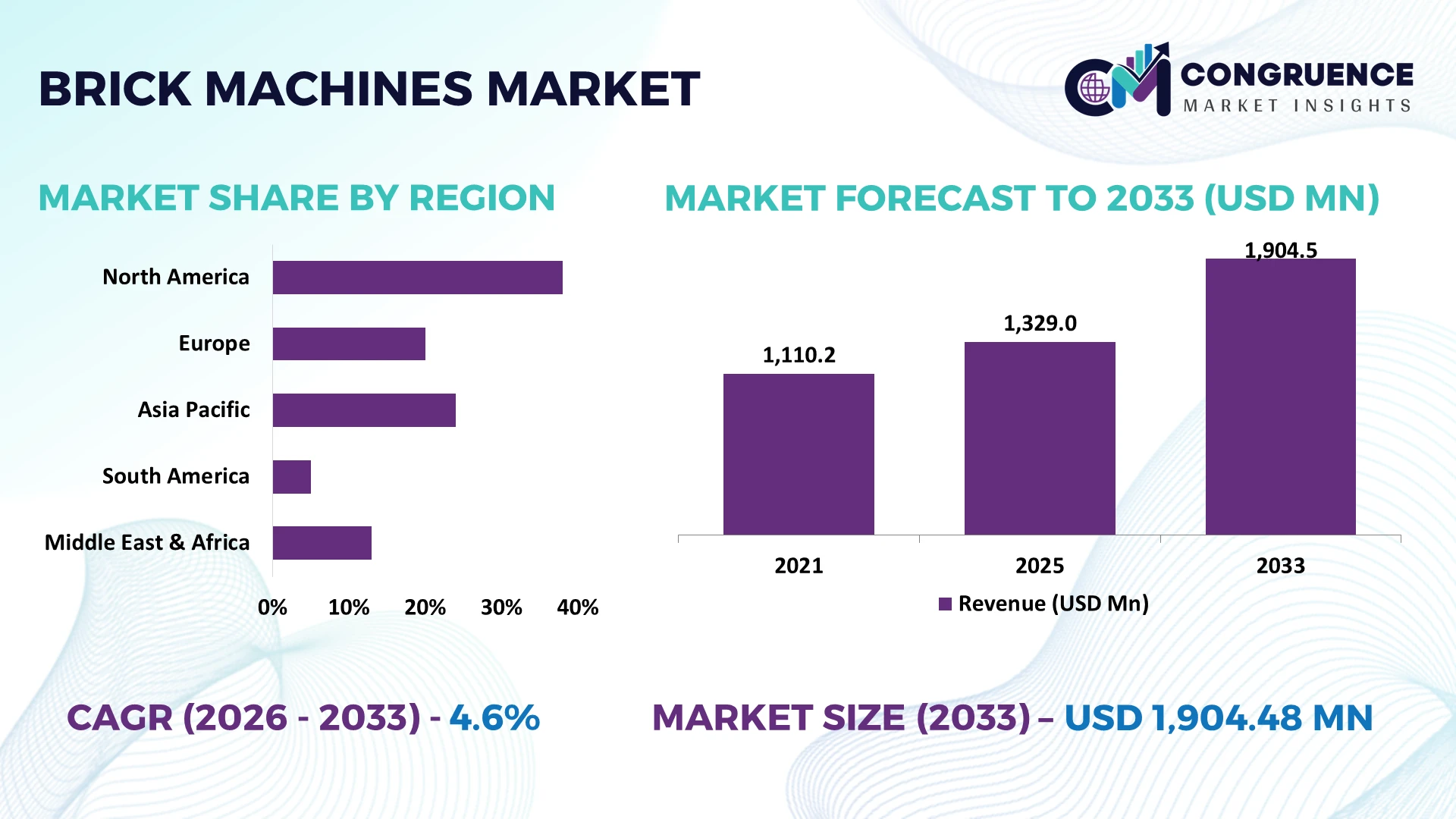
The Global Brick Machines Market was valued at USD 1329 Million in 2025 and is anticipated to reach a value of USD 1904.48 Million by 2033 expanding at a CAGR of 4.6% between 2026 and 2033. Growth is driven by automated brick production, infrastructure construction, stricter building material quality standards, and the adoption of energy efficient hydraulic pressing and fly ash brick manufacturing equipment.
China holds a dominant position in the global brick machines industry, supported by its extensive construction materials manufacturing base and established machinery export network. China's urbanization rate reached approximately 67% in 2024, compared with India's approximately 36%, highlighting differences in construction industrialization. Chinese manufacturers supply automatic clay brick production lines, hydraulic concrete block machines, and integrated material handling systems. India's infrastructure expansion and fly ash utilization policies are accelerating equipment modernization, creating opportunities for machinery exporters targeting emerging Asian construction markets.
Strategically, manufacturers should prioritize automated production lines and alternative material compatibility, targeting markets where urbanization exceeds 35% and industrial brick manufacturing is expanding.
Market Size & Growth: USD 1,329 million in 2025, reaching USD 1,904.48 million by 2033 at 4.6% CAGR, supported by automated construction material production.
Top Growth Drivers: China's 67% urbanization, India's approximately 36% urbanization, and increasing industrial fly ash utilization strengthen equipment demand.
Short Term Forecast: By 2027, a targeted 15% reduction in manual handling costs supports investment in automated brick production systems.
Emerging Technologies: AI quality inspection, robotic palletizing, and hydraulic compaction enable 3 major improvements in production consistency, handling, and material efficiency.
Regional Leaders: Indicative 2033 allocations place Asia Pacific at USD 952.24 million, Europe at USD 380.90 million, and North America at USD 285.67 million, emphasizing automation adoption.
Consumer/End User Trends: Industrial manufacturers increasingly prioritize 24 hour production capability, automated curing, and programmable brick dimensions.
Pilot/Case Example: A proposed 2027 automated fly ash brick production pilot targets 20% higher throughput through synchronized feeding and robotic stacking.
Competitive Landscape: Masa Group, Hess Group, QGM, Columbia Machine, and Besser Company compete across 3 major equipment categories, with no verified individual market share.
Regulatory & ESG Impact: India's fly ash utilization framework encourages waste recovery, while manufacturers target 10% lower material wastage through precise batching.
Investment & Funding: A proposed USD 10 million equipment modernization portfolio prioritizes hydraulic presses, robotic handling, and industrial partnerships.
Innovation & Future Outlook: Next generation machines integrate 3 capabilities: predictive maintenance, automated quality monitoring, and digitally controlled production scheduling.
The Brick Machines Market is transitioning toward precision manufacturing as construction material producers prioritize uniform compression, faster curing, and lower production losses. Automatic concrete block machines, fly ash brick presses, and robotic stacking systems are reshaping factory operations. Advanced hydraulic equipment supports consistent density and dimensional accuracy, while digital monitoring improves maintenance scheduling. Manufacturers targeting a 15% reduction in manual handling requirements increasingly favor integrated production lines. India's industrial waste utilization policies further support alternative raw material processing, strengthening the strategic importance of flexible machinery configurations and localized equipment servicing.
The Brick Machines Market is becoming strategically important as construction material manufacturers prioritize production efficiency, standardized product quality, and industrial automation. India's infrastructure modernization and China's established construction machinery manufacturing ecosystem are reshaping equipment procurement strategies. India's urbanization rate of approximately 36% contrasts with China's 67%, highlighting different levels of construction industrialization. Manufacturers are increasingly investing in hydraulic brick presses, automatic block molding equipment, and integrated production lines to improve throughput while reducing dependence on manual labor.
Automated brick manufacturing systems offer potential labor productivity improvements of 20% to 30% compared with conventional manual operations, depending on production configuration. Programmable hydraulic compression, automatic material feeding, and robotic stacking improve dimensional consistency and production continuity. Chinese manufacturers emphasize high capacity equipment exports, while Indian suppliers increasingly target affordable automation for small and medium construction material enterprises. During 2026 to 2028, digital monitoring and modular machinery upgrades are expected to become important procurement priorities.
A practical deployment involves integrating automatic batching, hydraulic pressing, and pallet handling within fly ash brick manufacturing facilities. Such configurations can target 15% lower material handling requirements through synchronized production. Equipment suppliers are strengthening technical partnerships, localized servicing, and modular product development. Competitive advantage increasingly depends on measurable equipment reliability, adaptable raw material processing, and dependable maintenance infrastructure.
Infrastructure development and construction material standardization are accelerating investment in automatic brick manufacturing machinery. China's urbanization rate of approximately 67% and India's approximately 36% demonstrate substantial differences in construction industrialization and equipment deployment requirements. Automated hydraulic brick presses can target 20% to 30% improvements in labor productivity compared with manual production arrangements, depending on operating conditions. India's fly ash utilization policies further encourage manufacturers to adopt machinery compatible with industrial byproducts. Equipment suppliers are expanding programmable molding systems, automated batching solutions, and integrated curing technologies. Manufacturers investing in flexible production configurations gain stronger capacity utilization, improved dimensional consistency, and reduced dependence on labor intensive manufacturing processes.
High initial machinery expenditure and dependence on specialized components constrain equipment modernization among smaller brick manufacturers. Automated production lines can require substantially higher upfront investment than conventional mechanical presses, with indicative equipment cost premiums of 30% to 50%, depending on automation scope. Imported hydraulic valves, programmable controllers, and precision sensors expose manufacturers to currency fluctuations and procurement delays. In India, electricity and maintenance expenses can represent significant operating cost components, while poorly maintained hydraulic systems can experience efficiency losses exceeding 10%. Equipment suppliers are responding through localized component sourcing, modular machine configurations, and extended maintenance contracts. Competitive positioning increasingly depends on lifecycle equipment costs rather than purchase prices alone.
Digital manufacturing technologies and alternative construction materials create opportunities for advanced brick machinery suppliers. Automated batching and programmable compression systems can target 10% to 15% reductions in material wastage compared with poorly controlled conventional operations. Predictive maintenance platforms offer potential equipment downtime reductions of 15% to 20% under suitable monitoring conditions. India's industrial fly ash utilization requirements encourage investment in machinery capable of processing supplementary cementitious materials and recycled aggregates. Manufacturers are developing sensor integrated hydraulic presses, modular block molding equipment, and automated quality inspection systems. Partnerships with construction material producers and industrial automation specialists strengthen equipment customization. Suppliers offering retrofit packages can access existing factories without requiring complete production line replacement.
Integrating advanced brick manufacturing equipment into established production facilities presents significant execution challenges involving process coordination, operator training, and production consistency. Automated lines require synchronized batching, compression, demolding, curing, and palletizing operations. Poorly calibrated equipment can create dimensional variation, with manufacturers commonly targeting tolerances within 2% for selected product specifications. Inadequate preventive maintenance can increase unplanned downtime, while digital monitoring systems require reliable connectivity and trained technical personnel. Indian manufacturing clusters face additional challenges when upgrading facilities designed around manual material handling. Equipment manufacturers must strengthen operator certification, remote diagnostics, and standardized control interfaces. Achieving targeted equipment availability above 90% requires disciplined maintenance planning and coordinated technical support.
Modular Production Line Configurations: Brick machinery suppliers are introducing modular production layouts that allow manufacturers to expand capacity without replacing entire equipment systems. Configurable production cells can target 15% to 20% shorter installation schedules and approximately 10% lower commissioning expenses. Chinese equipment manufacturers are expanding standardized machine platforms, enabling customers to add molding stations, curing equipment, and packaging modules as production requirements change.
Precision Curing Process Optimization: Brick manufacturers are improving curing consistency through controlled moisture management, temperature monitoring, and standardized production scheduling. Optimized curing workflows can target 10% to 15% fewer rejected units and approximately 8% lower water consumption under suitable operating conditions. Indian concrete brick producers are adopting controlled curing arrangements, while machinery suppliers are integrating moisture sensors and programmable curing controls to strengthen product uniformity.
Localized Machinery Service Networks: Equipment manufacturers are restructuring maintenance support around regional spare parts inventories and faster technical response. Localized servicing strategies can target 20% shorter repair turnaround and 10% to 15% lower emergency maintenance expenditure. Component supply disruptions have encouraged Indian machinery distributors to establish domestic service partnerships, improving equipment availability and reducing dependence on overseas technical assistance.
Flexible Product Format Manufacturing: Construction material producers increasingly require machinery capable of switching between multiple brick dimensions and surface finishes. Programmable mold configurations can target 25% faster product changeovers and 10% higher production scheduling flexibility compared with fixed tooling arrangements. Equipment suppliers are expanding interchangeable mold portfolios, allowing manufacturers to serve residential construction, commercial masonry, and specialized architectural applications through shared production infrastructure.
Hydraulic Brick Machines represent an estimated 30% of the global brick machines market, supported by consistent compression performance, adaptable mold configurations, and suitability for industrial manufacturing operations. These machines deliver controlled compaction pressure, improving product density and dimensional uniformity across commercial production facilities. Fully Automatic Machines represent the fastest expanding category, with automated production configurations targeting 20% to 30% improvements in labor productivity compared with conventional manual operations. Chinese machinery manufacturers are prioritizing integrated control systems and programmable production cycles, while Indian equipment suppliers emphasize affordable automation packages for medium capacity factories.
Semi-Automatic Machines remain important among manufacturers seeking gradual equipment modernization without extensive infrastructure replacement. Manual Brick Machines continue serving smaller production units where limited capital availability influences procurement decisions. Fly Ash Brick Machines occupy a specialized position, particularly in India, where industrial byproduct utilization supports alternative construction materials. Manufacturers are expanding modular hydraulic systems, interchangeable molds, and customized automation packages. The strategic investment shift favors equipment that combines production flexibility with reduced operating intervention and dependable servicing.
Concrete Brick Production accounts for an estimated 35% of global brick machinery applications, reflecting established demand for standardized masonry units across residential, commercial, and industrial construction. Automated concrete brick production systems provide consistent compaction and support multiple product dimensions, strengthening equipment utilization among industrial manufacturers. Clay Brick Production remains an important application in China, India, and other established masonry markets, where conventional firing operations coexist with increasingly mechanized forming equipment. Manufacturers are introducing improved molding precision, automated feeding arrangements, and production monitoring capabilities to maintain consistent output quality.
Fly Ash Brick Production represents the fastest expanding application, supported by industrial waste utilization policies and increasing interest in alternative masonry materials. Properly configured production systems can target 10% to 15% reductions in material handling losses through controlled batching and compression. Paving Block Production provides another specialized application, benefiting from interchangeable molds and controlled surface finishing. Equipment suppliers are expanding application specific production lines and developing flexible machinery platforms. Investment priorities increasingly favor facilities capable of manufacturing multiple construction products while maintaining consistent quality standards.
Brick Manufacturers account for an estimated 45% of global brick machine demand, reflecting their direct responsibility for production capacity, equipment utilization, product quality, and manufacturing efficiency. Established producers prioritize hydraulic compression systems, automated feeding equipment, and dependable mold configurations to maintain consistent industrial output. Construction Companies represent another important buyer group, particularly where integrated building material production improves supply reliability. Equipment procurement increasingly emphasizes production flexibility, maintenance accessibility, and compatibility with standardized construction specifications. Automated production arrangements can target 20% to 30% improvements in labor productivity compared with manual manufacturing configurations.
Infrastructure Developers represent the fastest expanding end user category, supported by increasing requirements for paving blocks, concrete masonry units, and standardized construction materials. Real Estate Developers also influence machinery demand through project specific material specifications and procurement partnerships. Equipment manufacturers are introducing customized production packages, flexible financing arrangements, and localized technical support services. Suppliers targeting large construction projects are strengthening relationships with material producers and infrastructure contractors. Competitive differentiation increasingly depends on production reliability, application customization, and equipment lifecycle support.
Asia Pacific accounted for the largest market share at an estimated 50% in 2025 however, Middle East & Africa is expected to register the fastest growth, expanding at an indicative CAGR of 5.8% between 2026 and 2033.

Advanced Concrete Block Manufacturing and Production Modernization
North America represented an estimated 15% of global brick machinery demand in 2025, with the United States accounting for the largest regional equipment deployment base. Concrete masonry manufacturing, commercial construction, and infrastructure rehabilitation support demand for hydraulic compression systems and automated block production lines. Equipment manufacturers increasingly prioritize dimensional accuracy, production scheduling, and integrated material handling to address labor availability constraints. Automated pallet handling configurations offer targeted reductions of 15% to 25% in manual handling requirements, depending on facility design. Canada's construction material manufacturers emphasize durable concrete products and adaptable molding systems suitable for varying climatic conditions. Machinery suppliers are strengthening maintenance networks, offering equipment retrofits, and integrating programmable controls into existing facilities. The principal purchasing consideration is production reliability, particularly where equipment interruptions affect contractual delivery schedules and masonry product availability.
United States Market Outlook: The United States benefits from established concrete masonry production infrastructure, domestic equipment engineering expertise, and standardized construction specifications. Columbia Machine and Besser Company serve industrial block manufacturers through molding equipment and production technology. Federal infrastructure investment under the Infrastructure Investment and Jobs Act, which authorized approximately USD 1.2 trillion in spending, supports broader construction material supply chain activity. Domestic equipment servicing and production flexibility remain important procurement advantages.
Precision Engineering and Low Carbon Manufacturing Transformation
Europe accounted for an estimated 20% of global brick machinery demand in 2025, supported by established manufacturing expertise in Germany, Italy, and the Netherlands. European equipment suppliers emphasize precision molding, automated production management, and efficient material utilization. Energy intensive ceramic manufacturing faces pressure from European climate policies and industrial emissions requirements, encouraging investment in process optimization and equipment modernization. Advanced production control configurations can target 10% to 15% reductions in material rejection through improved compression consistency and dimensional monitoring. German machinery engineering companies maintain strong positions in integrated concrete block production systems, while Italian manufacturers contribute specialized clay processing equipment. Equipment suppliers are developing modular production platforms and strengthening technical integration partnerships. Purchasing decisions increasingly favor machinery capable of meeting product certification requirements while maintaining predictable maintenance schedules and consistent production quality.
Germany Market Outlook: Germany maintains a strong position in advanced brick machinery engineering through established industrial automation capabilities and precision equipment manufacturing. Masa GmbH and other specialized machinery suppliers serve international construction material producers with integrated production systems. Germany's industrial strategy emphasizes manufacturing efficiency and resource productivity, supporting demand for programmable hydraulic controls, automated material handling, and precision mold engineering. Export competitiveness depends on technical reliability, application engineering, and comprehensive equipment lifecycle support.
Manufacturing Scale and Export Oriented Equipment Production
Asia Pacific dominated the global brick machines market with an estimated 50% share in 2025, supported by extensive construction material production in China, India, and Southeast Asia. China's established machinery manufacturing clusters supply hydraulic presses, clay brick extrusion equipment, and integrated concrete block production systems to domestic and export customers. India's infrastructure development and industrial fly ash utilization policies strengthen demand for specialized brick manufacturing machinery. Regional equipment suppliers compete through production capacity, flexible configurations, and accessible maintenance services. Industrial production lines increasingly incorporate programmable compression controls and automated mold handling, with suitable configurations targeting 20% to 30% labor productivity improvements over manual arrangements. Vietnam and Indonesia provide additional equipment deployment opportunities through construction industrialization. Manufacturers are expanding export distribution networks, localized assembly arrangements, and technical partnerships to improve equipment accessibility across different production scales.
China Market Outlook: China represents the region's principal brick machinery manufacturing and export center, supported by established industrial clusters and extensive component supply networks. The country's urbanization rate reached approximately 67% in 2024, reinforcing its mature construction materials ecosystem. Fujian Quangong Machinery and other domestic suppliers manufacture automatic block production lines, hydraulic equipment, and customized molding systems. Export competitiveness increasingly depends on automation integration, equipment durability, and overseas technical support capabilities.
Construction Material Localization and Flexible Equipment Deployment
South America represented an estimated 7% of global brick machinery demand in 2025, with Brazil maintaining the region's largest industrial construction materials base. Concrete masonry, residential construction, and urban infrastructure rehabilitation support equipment procurement across Brazil, Colombia, and Chile. Manufacturers increasingly prioritize machinery compatible with locally available aggregates and adaptable production capacities. Semi automatic brick machines remain relevant for smaller producers, while established industrial manufacturers adopt hydraulic compression systems and integrated block handling. Modular equipment configurations can target 10% to 15% lower initial installation expenditure compared with fully integrated production arrangements, depending on specifications. Currency volatility and imported component costs influence procurement decisions, encouraging domestic servicing partnerships and localized equipment assembly. Machinery suppliers are developing flexible financing arrangements and standardized replacement parts to improve equipment accessibility and reduce maintenance interruptions.
Brazil Market Outlook: Brazil benefits from an established concrete products industry, domestic construction material suppliers, and manufacturing clusters concentrated around São Paulo and Minas Gerais. The country's population exceeds 210 million, supporting a substantial residential and infrastructure construction base. Equipment procurement emphasizes concrete block production, hydraulic molding reliability, and locally accessible technical support. Manufacturers offering adaptable machinery configurations and dependable spare parts availability gain advantages among regional masonry producers.
Infrastructure Megaprojects and Industrial Production Localization
Middle East & Africa accounted for an estimated 8% of global brick machinery demand in 2025, with Saudi Arabia, the United Arab Emirates, and South Africa representing important equipment deployment markets. Saudi construction megaprojects and industrial localization initiatives support demand for concrete block production systems, automated molding equipment, and high capacity material handling. The United Arab Emirates emphasizes standardized construction products and efficient industrial manufacturing, while African markets retain demand for accessible hydraulic and semi automatic machinery. Integrated production configurations can target 15% to 20% improvements in manufacturing throughput compared with conventional equipment arrangements. Equipment suppliers are expanding distributor partnerships, operator training services, and regional maintenance capabilities. Local component availability and technical support remain important purchasing considerations, particularly where remote construction projects require consistent material production and dependable equipment operation.
Saudi Arabia Market Outlook: Saudi Arabia benefits from Vision 2030 infrastructure development, industrial diversification initiatives, and large construction projects requiring standardized masonry materials. NEOM and other major developments create procurement opportunities for concrete block manufacturing equipment and automated production systems. The Kingdom's Public Investment Fund has supported extensive domestic development programs, strengthening the broader construction supply chain. Equipment suppliers are prioritizing local partnerships, technical training, and production systems compatible with large construction material requirements.
The Brick Machines Market features competition between established equipment manufacturers Masa Group, Columbia Machine, Besser Company, Hess Group, and QGM, alongside cost competitive suppliers serving emerging construction markets. The five leading manufacturers collectively represent an indicative 25% to 30% market share, reflecting fragmented international supply and substantial domestic machinery production. European manufacturers emphasize precision engineering, automated controls, and integrated production systems, while Chinese suppliers compete through equipment affordability, manufacturing flexibility, and export distribution. Advanced automation configurations target 20% to 30% labor productivity improvements, while modular equipment designs offer potential installation cost reductions of 10% to 15%. Companies are expanding technical partnerships, localized servicing, and interchangeable molding technologies to strengthen customer retention. Competition increasingly centers on equipment lifecycle performance rather than initial pricing. Specialized hydraulic components, engineering expertise, and dependable maintenance infrastructure create entry barriers. Winning requires reliable automation, competitive ownership costs, application flexibility, and responsive technical support.
Masa GmbH
Columbia Machine, Inc.
Besser Company
Hess Group
Fujian Quangong Machinery Co., Ltd. (QGM)
SANY Group
Lontto Group
Aimix Group
Hydraform International (Pty) Ltd.
Sabo S.A.
Prensoland S.A.
Tabrick
Revaro (Pty) Ltd.
TARA Machines & Tech Services Pvt. Ltd.
Hydraulic compression systems, programmable logic controllers, and automatic material feeding represent established technologies in industrial brick manufacturing. Modern hydraulic presses offer targeted compression consistency improvements of 10% to 15% compared with conventional mechanical equipment. Automated batching systems can reduce material dosing deviations by approximately 5% to 8% under controlled conditions. Deployment is concentrated among industrial concrete block manufacturers, particularly in China, Germany, and the United States. Integrated controls improve product uniformity, reduce operator intervention, and strengthen production scheduling reliability.
Emerging technologies include machine vision inspection, intelligent curing controls, and sensor enabled predictive maintenance. Automated optical inspection can target 15% to 20% faster defect identification than manual sampling, while predictive maintenance platforms offer potential downtime reductions of 10% to 15%. Digital production dashboards integrate compression pressure, cycle timing, and moisture measurements. Manufacturers adopting connected equipment gain stronger process traceability and faster corrective action, particularly when producing multiple brick formats using shared machinery.
During 2026 to 2028, disruptive developments will center on AI assisted process optimization, robotic handling, and digitally synchronized production cells. Advanced configurations target 20% higher labor productivity compared with legacy manual operations. Established manufacturers benefit from retrofit compatibility, while specialized automation suppliers gain opportunities through modular upgrades and technical partnerships.
October 2026: Masa reported installation of its XL R 9.1 concrete block machine at SARL Top Rock's new Algerian plant. The integrated production facility strengthens automated manufacturing capabilities and supports expanded concrete product supply. Source: masa-group.com.
March 2026: Columbia Machine Engineering India highlighted expansions at its Makarpura and POR facilities in its company newsletter. The 2 location expansion strengthens manufacturing capacity and supports domestic equipment production, improving customer access to concrete block machinery. Source: colmac.in.
September 2025: QGM hosted an industry standardization review involving over 20 experts examining concrete brick forming machinery and mold specifications. The initiative strengthens equipment standardization, supports manufacturing quality consistency, and advances technical requirements for intelligent brick production. Source: cnqgm.com.
July 2025: QGM introduced its QT10 intelligent block making machine for diversified concrete product manufacturing. The equipment supports multiple brick formats through interchangeable molds, strengthening production flexibility and enabling manufacturers to serve different construction applications using shared machinery. Source: mcfmachine.com.
The Brick Machines Market Report evaluates manufacturing technologies, equipment deployment, competitive positioning, and investment opportunities between 2026 and 2033. Coverage includes five equipment types: Manual Brick Machines, Semi Automatic Machines, Fully Automatic Machines, Hydraulic Brick Machines, and Fly Ash Brick Machines. Application analysis examines Clay Brick Production, Concrete Brick Production, Fly Ash Brick Production, and Paving Block Production. End user coverage addresses Construction Companies, Brick Manufacturers, Real Estate Developers, and Infrastructure Developers, emphasizing procurement priorities and operational requirements.
Regional analysis covers North America, Europe, Asia Pacific, South America, and Middle East & Africa, including country specific manufacturing capabilities and infrastructure investment trends. Technology assessment evaluates hydraulic compression, intelligent controls, automated material handling, and predictive maintenance. Competitive benchmarking supports equipment selection, manufacturing expansion, partnership development, and long term operational planning.
| Report Attribute/Metric | Report Details |
|---|---|
Market Revenue in 2025 | USD 1329 Million |
Market Revenue in 2033 | USD 1904.48 Million |
CAGR (2026 - 2033) | 4.6% |
Base Year | 2025 |
Forecast Period | 2026 - 2033 |
Historic Period | 2021 - 2025 |
Segments Covered | By Type
By Application
By End-User
|
Key Report Deliverable | Revenue Forecast, Growth Trends, Market Dynamics, Segmental Overview, Regional and Country-wise Analysis, Competition Landscape |
Region Covered | North America, Europe, Asia-Pacific, South America, Middle East, Africa |
Key Players Analyzed | Masa GmbH, Columbia Machine, Inc., Besser Company, Hess Group, Fujian Quangong Machinery Co., Ltd. (QGM), SANY Group, Lontto Group, Aimix Group, Hydraform International (Pty) Ltd., Sabo S.A., Prensoland S.A., Tabrick, Revaro (Pty) Ltd., TARA Machines & Tech Services Pvt. Ltd. |
Customization & Pricing | Available on Request (10% Customization is Free) |




