
Reports
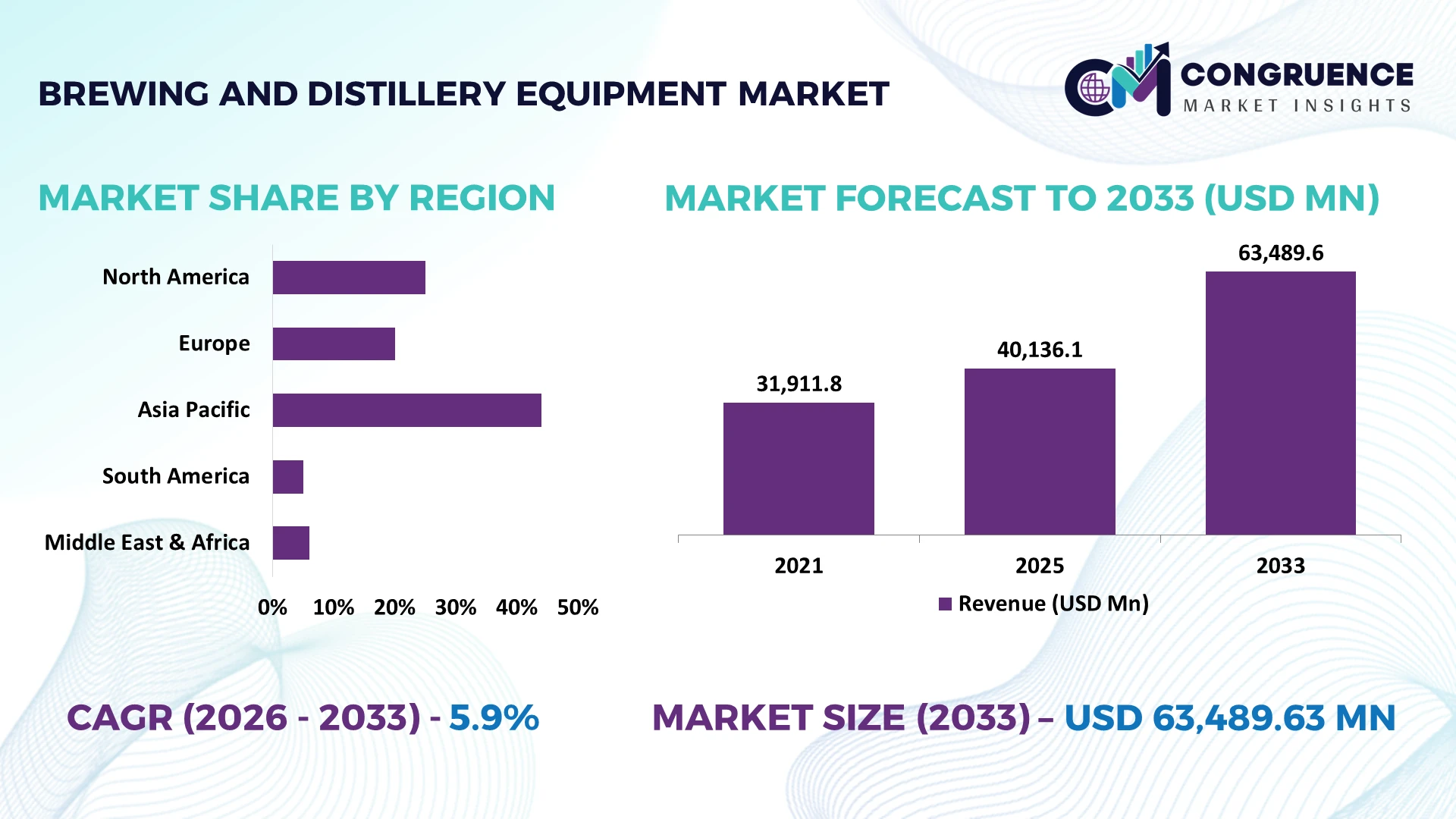
The Global Brewing and Distillery Equipment Market was valued at USD 40136.1 Million in 2025 and is anticipated to reach a value of USD 63489.63 Million by 2033 expanding at a CAGR of 5.9% between 2026 and 2033. Growth is driven by automated fermentation control, energy-efficient distillation systems, brewery capacity modernization, and investment in heat recovery, water recycling, and hygienic processing equipment.
China represents a major manufacturing and consumption center for brewing equipment, supported by large-scale beer production, stainless steel fabrication, and industrial automation capabilities. Chinese beer output reached approximately 35.21 million kiloliters in 2024, compared with roughly 8.4 million kiloliters in Germany, demonstrating substantial differences in processing scale. China's breweries are investing in automated fermentation vessels, filtration equipment, and integrated packaging lines. Government-supported industrial equipment modernization further encourages replacement of conventional processing machinery with digitally monitored systems.
Equipment manufacturers prioritizing modular production capacity, energy recovery integration, and localized engineering support gain stronger positioning in large-scale brewery modernization projects.
Market Size & Growth: USD 40,136.1 million in 2025, reaching USD 63,489.63 million by 2033 at 5.9% CAGR, driven by automated processing and equipment modernization.
Top Growth Drivers: Brewery water efficiency improved 36% against Heineken's 2008 baseline; US craft output declined 4% in 2025; renewable electricity reached 88% across Heineken's operations.
Short-Term Forecast: By 2028, advanced cleaning systems will target water consumption below 3 hectoliters per hectoliter of beer, strengthening processing efficiency.
Emerging Technologies: AI fermentation analytics, automated clean-in-place systems, and digital twins support 3 critical operations: temperature control, sanitation, and production scheduling.
Regional Leaders: Asia-Pacific prioritizes large-scale automated brewhouses; Europe advances energy recovery; North America emphasizes modular equipment across its approximately 9,000 craft breweries.
Consumer/End-User Trends: US craft brewers held 13.4% of beer volume in 2025, encouraging flexible equipment procurement despite contracting production.
Pilot/Case Example: Heineken's 2024 water efficiency program achieved 13% lower water consumption in Italy and 9% in Brazil through operational improvements.
Competitive Landscape: GEA Group, Alfa Laval, Krones, KASPAR SCHULZ, and Paul Mueller compete across 2 principal equipment categories: integrated processing lines and specialized brewing systems.
Regulatory & ESG Impact: Heineken reduced global brewery water intensity from 3.1 to 2.9 hl/hl in 2025, reinforcing demand for water-efficient processing technologies.
Investment & Funding: Anheuser-Busch committed over USD 300 million to US manufacturing in 2025, including brewery equipment and packaging upgrades.
Innovation & Future Outlook: Between 2026 and 2033, automated distillation controls, membrane filtration, and heat recovery integration will reshape 3 core equipment investment priorities.
The Brewing and Distillery Equipment Market is increasingly influenced by brewery refurbishment, precision fermentation control, modular distillation systems, and industrial energy management. Equipment manufacturers are introducing automated mash systems, variable-speed pumps, continuous monitoring instruments, and advanced heat exchangers to improve processing consistency. In 2025, approximately 60% of surveyed US craft breweries reported declining production, strengthening demand for flexible, right-sized processing equipment rather than indiscriminate capacity expansion. Meanwhile, water scarcity and industrial decarbonization requirements are encouraging brewers to adopt closed-loop cleaning systems and energy recovery technologies. These operational shifts establish important considerations for equipment investment, supplier selection, and long-term manufacturing competitiveness.
Brewing and distillery equipment is becoming strategically important as beverage manufacturers prioritize processing efficiency, production flexibility, and resource optimization over conventional capacity expansion. China's beer production reached approximately 35.21 million kiloliters in 2024, reinforcing the importance of industrial-scale processing infrastructure. Meanwhile, declining craft beer volumes in the United States are redirecting investment toward modular equipment and manufacturing consolidation. This structural shift encourages equipment suppliers to integrate automation, hygienic processing, and energy management into comprehensive modernization solutions.
Advanced heat recovery systems can recover 70–90% of usable thermal energy from suitable brewing operations, outperforming conventional configurations that discharge substantial process heat. Automated clean-in-place systems further improve sanitation consistency through controlled chemical dosing and validated cleaning cycles. Germany emphasizes energy-efficient brewing technologies and established equipment engineering, while India offers opportunities for flexible brewery installations and expanding distillery infrastructure. GEA Group, Alfa Laval, and Krones are strengthening integrated processing portfolios through automation development and engineering partnerships.
Between 2026 and 2028, breweries will increasingly prioritize predictive maintenance, intelligent fermentation monitoring, and heat integration. Heineken's water efficiency improvements demonstrate the operational value of resource-focused equipment investment. Suppliers combining modular engineering, digital process control, and dependable aftermarket services will secure stronger competitive positioning.
Breweries and distilleries are modernizing processing infrastructure to improve operational consistency and reduce resource consumption. Heineken reduced brewery water intensity from 3.1 to 2.9 hectoliters per hectoliter of beer in 2025, representing approximately 6.5% improvement. The company's renewable electricity utilization reached approximately 88%, reinforcing investment in energy-efficient processing systems. In China, industrial equipment modernization policies encourage replacement of aging machinery with automated production technologies. Manufacturers are responding through integrated brewhouse controls, variable-speed pumping systems, and intelligent cleaning equipment. GEA Group, Alfa Laval, and Krones are strengthening heat exchange, filtration, and process automation capabilities. The strategic advantage comes from improving production efficiency within existing facilities, limiting the need for expensive greenfield construction.
Brewing and distillery equipment procurement faces pressure from stainless steel pricing, financing conditions, and uneven beverage production volumes. US craft beer production declined approximately 4% in 2025, while craft brewers represented around 13.4% of national beer volume, demonstrating the sector's exposure to changing consumption patterns. Equipment fabrication depends heavily on stainless steel grades containing approximately 8–10.5% nickel in common 304 stainless steel specifications, creating sensitivity to alloy input costs. American breweries are consequently prioritizing equipment refurbishment and staged automation rather than complete production line replacement. Paul Mueller Company, KASPAR SCHULZ, and regional fabricators are addressing procurement constraints through modular equipment configurations, localized sourcing, and service contracts. Suppliers offering adaptable capacity and shorter installation schedules maintain stronger access to financially constrained customers.
Modular distillation platforms and advanced thermal recovery systems create opportunities to improve production economics across existing beverage facilities. Properly engineered heat recovery installations can capture 70–90% of usable thermal energy from suitable process streams, supporting lower utility requirements. Automated distillation controls improve consistency through continuous monitoring of temperature, pressure, and reflux conditions. India's ethanol blending program targets 20% ethanol in petrol, encouraging investment in industrial distillation, fermentation, and separation equipment. Equipment manufacturers are developing skid-mounted systems, integrated heat exchangers, and digitally controlled production modules. GEA Group and Alfa Laval are positioned to support process integration, while specialist fabricators address smaller installation requirements. Competitive advantage increasingly depends on delivering measurable utility savings and flexible capacity without extensive plant reconstruction.
Scaling digitally integrated brewing and distillation systems requires reliable instrumentation, process cybersecurity, and consistent sanitation performance across diverse production environments. Industrial fermentation temperatures frequently operate between 8°C and 22°C depending on yeast strain and beverage type, making precise control essential for product consistency. Automated cleaning systems must maintain validated chemical concentrations and contact times, while industrial cybersecurity standards such as IEC 62443 introduce additional system engineering requirements. Germany's established brewing sector faces challenges integrating advanced sensors and digital controllers with legacy production equipment. Krones, GEA Group, and automation integrators must strengthen software interoperability, operator training, and commissioning procedures. Long-term competitiveness depends on achieving reproducible processing performance while minimizing downtime, contamination risks, and dependence on specialized technical personnel.
Flexible Packaging Lines Replace Dedicated Formats: Beverage manufacturers are adopting multifunctional filling and packaging systems to accommodate changing product portfolios. US craft beer production declined approximately 4% in 2025, while craft beer represented around 13.4% of national beer volume. Krones and packaging equipment suppliers are developing rapid-changeover machinery, allowing breweries to manage smaller production batches without maintaining separate packaging lines.
Inline Quality Monitoring Gains Industrial Adoption: Breweries are integrating optical sensors, dissolved oxygen analyzers, and automated sampling systems into production workflows. Dissolved oxygen targets frequently remain below 50 parts per billion for packaged beer, while alcohol measurement requires precise temperature compensation. Anton Paar and GEA Group are advancing process instrumentation, reducing laboratory sampling dependence and improving consistency during high-volume production.
Low Alcohol Processing Reshapes Equipment Specifications: Growing interest in alcohol-free beverages is encouraging breweries to install vacuum dealcoholization and membrane separation equipment. European labeling practices commonly distinguish alcohol-free beer around 0.5% ABV, while US nonalcoholic beer contains less than 0.5% ABV. Alfa Laval and specialist processing manufacturers are developing low-temperature separation technologies that preserve beverage characteristics and expand product flexibility.
Hygienic Equipment Design Strengthens Production Reliability: Manufacturers are emphasizing sanitary welding, automated valve assemblies, and cleanable vessel geometries to reduce contamination risks. Brewing operations commonly use 304 and 316L stainless steel, while hygienic process temperatures frequently exceed 70°C during cleaning cycles. Paul Mueller Company and KASPAR SCHULZ are refining equipment construction and cleaning accessibility, supporting consistent sanitation and reduced maintenance complexity.
Fermentation Equipment represents the leading equipment category within brewing and distillery operations, supported by its essential role in converting fermentable sugars into alcohol and controlling product characteristics. Industrial breweries rely on temperature-controlled fermentation vessels, automated yeast management, and continuous monitoring systems to maintain production consistency. China produced approximately 35.21 million kiloliters of beer in 2024, demonstrating the scale of fermentation infrastructure requirements. Brewing Systems remain important for mash preparation, wort separation, and thermal processing, while Storage Tanks and Vessels provide essential capacity for intermediate handling and finished product management.
Distillation Equipment represents a major emerging investment priority, supported by industrial alcohol production and advanced separation technologies. Filtration Equipment is also gaining technical importance through membrane processing, clarification, and product stabilization. Equipment manufacturers including GEA Group, Alfa Laval, and Krones are developing integrated processing systems that combine instrumentation, automated control, and energy management. Investment decisions increasingly emphasize modular configurations, sanitation accessibility, and equipment compatibility rather than maximum installed capacity. Suppliers offering integrated fermentation and downstream processing solutions gain advantages in complex plant modernization contracts.
Beer Production represents the leading application for brewing and distillery equipment, supported by extensive industrial brewing infrastructure, high processing volumes, and established manufacturing systems. China's annual beer production reached approximately 35.21 million kiloliters in 2024, highlighting the scale of brewhouse, fermentation, filtration, and packaging requirements. Germany maintains sophisticated brewing engineering capabilities, while the United States supports a diversified network of industrial and independent breweries. Wine Production requires specialized fermentation vessels, temperature management, and clarification equipment, with procurement influenced by seasonal harvest cycles and product quality requirements.
Industrial Alcohol Production represents an important emerging equipment investment area, particularly in India, where the ethanol blending program targets 20% ethanol in petrol. Spirits Production emphasizes distillation precision, heat transfer efficiency, and consistent separation performance. Craft Brewing continues to require flexible processing systems, although declining US craft production encourages selective modernization rather than indiscriminate capacity expansion. GEA Group, Alfa Laval, and specialist equipment manufacturers are developing application-specific processing configurations. Competitive advantage increasingly depends on equipment utilization, process flexibility, and dependable technical servicing.
Breweries represent the leading end-user category for brewing and distillery equipment, supported by extensive installed production capacity and recurring requirements for process modernization. Industrial breweries operate interconnected brewhouses, fermentation vessels, filtration systems, and storage infrastructure, creating substantial demand for integrated equipment solutions. China and Germany maintain established brewing production networks, while the United States supports a large independent brewery sector. Distilleries represent another important purchasing group, requiring precision distillation columns, condensers, and automated temperature controls. Wineries emphasize fermentation management, product stabilization, and seasonal production flexibility.
Contract Brewing and Distilling Facilities represent an emerging customer group as beverage brands increasingly evaluate outsourced production arrangements. Contract operators prioritize equipment capable of handling different recipes, batch sizes, and packaging formats. In the United States, craft beer production declined approximately 4% during 2024, increasing pressure on independent operators to improve capacity utilization. Krones, GEA Group, and specialist fabricators are responding through modular equipment, integrated automation, and service-oriented commercial models. Suppliers delivering rapid changeovers and adaptable production configurations gain stronger positioning among contract manufacturers.
Asia-Pacific accounted for the largest market share at approximately 38% in 2025 however, Asia-Pacific is expected to register the fastest growth, expanding at a CAGR of approximately 7.1% between 2026 and 2033.
Production Consolidation Accelerates Flexible Equipment Modernization
North America represents an established brewing and distillery equipment market, supported by industrial breweries, independent beverage producers, and sophisticated processing infrastructure. The United States dominates regional equipment procurement, while Canada contributes specialized distillation engineering and established beverage manufacturing capabilities. US craft beer production declined approximately 4% during 2024, encouraging breweries to prioritize production efficiency, equipment refurbishment, and flexible manufacturing configurations. Large beverage producers are investing in automated filling systems, hygienic processing equipment, and integrated quality monitoring. Anheuser-Busch announced manufacturing investments exceeding USD 300 million in 2025, supporting domestic brewery modernization and production infrastructure improvements. Krones, GEA Group, and Paul Mueller compete through integrated processing equipment, stainless steel vessel manufacturing, and technical servicing. Regional procurement increasingly favors equipment suppliers offering rapid installation, flexible batch processing, and dependable maintenance support across geographically dispersed facilities.
United States Market Outlook: The United States benefits from extensive brewery manufacturing infrastructure, established stainless steel fabrication capabilities, and specialized equipment engineering expertise. Approximately 9,800 craft breweries operated nationwide in 2024, creating a substantial installed equipment base requiring maintenance and selective replacement. Wisconsin, Colorado, and California maintain established brewing equipment supply networks, while manufacturers increasingly emphasize automated sanitation, modular fermentation vessels, and advanced process instrumentation.
Energy Efficiency Requirements Reshape Processing Equipment Procurement
Europe maintains a strong competitive position through advanced brewing engineering, established distillation equipment manufacturing, and sophisticated industrial automation capabilities. Germany, Italy, France, and the United Kingdom represent important production and equipment supply centers. Germany's brewing industry produced approximately 8.4 million kiloliters of beer in 2024, sustaining demand for fermentation vessels, brewhouse systems, filtration equipment, and plant modernization services. European manufacturers increasingly prioritize energy-efficient heat exchangers, automated cleaning systems, and digitally controlled processing equipment. Industrial decarbonization requirements encourage breweries to reduce steam consumption and recover usable thermal energy from production operations. GEA Group, Alfa Laval, and Krones compete through integrated processing technologies and established engineering service networks. Equipment manufacturers combining hygienic design, energy management, and reliable aftermarket support gain advantages in modernization projects where operating expenditure reduction takes priority over capacity expansion.
Germany Market Outlook: Germany benefits from globally recognized brewing engineering capabilities and established equipment manufacturers, including Krones, GEA Group, and KASPAR SCHULZ. The country maintains more than 1,400 breweries, supporting extensive demand for specialized processing machinery and engineering services. German manufacturers emphasize precision fabrication, automated brewhouse controls, and advanced filtration technologies. Industrial energy efficiency requirements reinforce investment in heat recovery systems, digital process monitoring, and integrated plant engineering solutions.
Industrial Brewing Scale Strengthens Automated Equipment Deployment
Asia-Pacific dominates the Brewing and Distillery Equipment Market through extensive beverage manufacturing capacity, concentrated equipment fabrication, and expanding industrial processing infrastructure. China represents the largest regional brewing production center, supported by large-scale breweries and established stainless steel equipment manufacturing. India contributes significant distillation equipment opportunities through industrial alcohol production and ethanol blending initiatives. Japan emphasizes precision fermentation systems and advanced processing automation, while Australia maintains established craft brewing and distillation equipment requirements. China's beer production reached approximately 35.21 million kiloliters in 2024, demonstrating substantial industrial equipment utilization. Regional manufacturers are integrating programmable process controls, automated fermentation monitoring, and hygienic vessel engineering. GEA Group, Alfa Laval, and domestic Chinese equipment suppliers compete through localized manufacturing and engineering partnerships. Procurement advantages increasingly depend on production scale, equipment customization, and availability of technical servicing capabilities.
China Market Outlook: China maintains substantial brewing equipment demand through industrial producers including China Resources Beer, Tsingtao Brewery, and Yanjing Beer. Large production facilities increasingly integrate automated fermentation vessels, filtration systems, and high-capacity packaging equipment. National industrial modernization policies encourage intelligent manufacturing and equipment replacement. Domestic stainless steel fabrication capabilities strengthen local procurement, while international engineering suppliers compete through process optimization and advanced automation technologies.
Industrial Beverage Processing Drives Equipment Modernization
South America's brewing and distillery equipment market is influenced by established beer manufacturing, industrial alcohol production, and expanding process automation requirements. Brazil dominates regional equipment demand through large-scale breweries, sugarcane-based ethanol facilities, and established stainless steel fabrication capabilities. Argentina contributes wine processing and brewing infrastructure, while Chile emphasizes winery equipment modernization and specialized distillation systems. Brazil's ethanol blending framework supports continued investment in fermentation, separation, and industrial distillation technologies. Large beverage producers are introducing automated filling systems, temperature-controlled fermentation equipment, and advanced filtration processes to improve operational consistency. Alfa Laval, GEA Group, and regional equipment fabricators compete through process integration and localized engineering support. Currency volatility, imported equipment costs, and uneven industrial financing influence procurement schedules, encouraging refurbishment, domestic component sourcing, and phased production upgrades.
Brazil Market Outlook: Brazil benefits from established beverage manufacturing infrastructure and extensive industrial ethanol processing capabilities. The country operates a large sugarcane processing industry, supporting demand for fermentation tanks, distillation columns, heat exchangers, and separation equipment. Ambev maintains substantial domestic brewing operations, while industrial alcohol producers invest in processing efficiency. Local fabrication partnerships and automated process controls strengthen equipment availability and manufacturing competitiveness.
Industrial Beverage Infrastructure Supports Selective Equipment Investment
The Middle East & Africa brewing and distillery equipment market is shaped by established beverage manufacturing in selected African countries and expanding industrial processing infrastructure. South Africa, Nigeria, Ethiopia, and Kenya represent important brewing production centers, supported by domestic beverage consumption and multinational brewery operations. South Africa maintains sophisticated brewing infrastructure, while Nigeria emphasizes localized beverage manufacturing and equipment maintenance capabilities. Regional producers increasingly prioritize reliable fermentation systems, automated cleaning equipment, and water-efficient processing technologies. Water scarcity and inconsistent utility infrastructure create operational pressure, particularly for breweries dependent on continuous cooling and sanitation. GEA Group, Alfa Laval, and international equipment suppliers compete through process engineering, filtration technologies, and local technical partnerships. Equipment procurement favors durable configurations, dependable spare parts availability, and systems capable of maintaining production continuity under variable operating conditions.
South Africa Market Outlook: South Africa maintains established brewing infrastructure through South African Breweries and independent beverage manufacturers. Industrial operations require reliable fermentation equipment, water treatment systems, and automated packaging technologies. Water supply constraints encourage investment in efficient cleaning systems and process water recovery. Domestic engineering contractors support equipment installation and maintenance, while international suppliers provide advanced filtration, process automation, and energy-efficient heat exchange solutions.
The Brewing and Distillery Equipment Market features competition between integrated processing manufacturers and specialized equipment fabricators. GEA Group, Krones, Alfa Laval, Paul Mueller, and KASPAR SCHULZ compete through automation capabilities, engineering expertise, and installed equipment relationships. Their combined market share remains difficult to isolate because suppliers report broader processing equipment activities. Integrated manufacturers emphasize turnkey production systems, while specialist fabricators compete through customized vessels, modular configurations, and installation flexibility. Advanced heat recovery systems can capture 70–90% of usable process heat under suitable conditions, while automated cleaning systems improve chemical dosing precision and sanitation consistency. GEA and Alfa Laval strengthen process integration, Krones advances packaging automation, and specialist manufacturers prioritize engineering customization. Competition increasingly shifts toward lifecycle services, digital monitoring, and resource-efficient equipment. Technical certification, fabrication expertise, and established service networks create entry barriers. Winning suppliers combine measurable operational savings, flexible equipment configurations, and dependable long-term technical support.
GEA Group AG
Krones AG
Alfa Laval AB
Paul Mueller Company
KASPAR SCHULZ Brauereimaschinenfabrik
Bühler Group
Lehui International
Della Toffola Group
Specific Mechanical Systems Ltd.
Criveller Group
ABE Equipment
Portland Kettle Works
BrewBilt Manufacturing Inc.
JV Northwest, Inc.
Automated fermentation control, programmable brewhouses, and hygienic process instrumentation form the technological foundation of modern beverage production. Variable-frequency drives regulate pumping and agitation, while inline temperature, pressure, and dissolved oxygen sensors improve batch consistency. Industrial heat recovery systems can recover 70–90% of technically accessible process heat under suitable operating conditions. Compared with conventional brewhouses that discharge hot wastewater, integrated heat exchangers reduce thermal losses and external heating requirements. Large breweries deploy centralized supervisory control systems, enabling coordinated monitoring across fermentation, filtration, and packaging operations.
Emerging technologies include membrane dealcoholization, digital twins, and automated clean-in-place verification. Vacuum separation operates at reduced temperatures, supporting aroma retention during alcohol removal. Inline analytical instruments monitor dissolved oxygen concentrations below 50 parts per billion in sensitive packaging applications. Krones, GEA Group, and Alfa Laval are integrating sensors, automated valves, and process software into modular equipment platforms. Suppliers combining mechanical engineering with proprietary control systems strengthen aftermarket relationships and improve commissioning efficiency.
Between 2026 and 2028, predictive maintenance, machine-learning fermentation analytics, and connected equipment diagnostics will influence modernization decisions. Digital monitoring enables condition-based servicing, while automated recipe management supports consistent production across multiple facilities. Manufacturers prioritizing interoperable controls, validated sanitation, and energy integration gain stronger operational advantages.
September 2025: GEA showcased its QBOIL wort boiling system following industrial validation demonstrating up to 35% lower energy consumption compared with modern energy storage configurations. The technology supports brewery retrofits, reduces thermal processing costs, and preserves wort quality during production. Source: gea.com.
April 2025: Krones secured a contract to construct Bayreuther Brauhaus's new brewery in Germany, designed for annual production of 500,000 hectoliters. The greenfield project strengthens integrated brewhouse deployment and demonstrates investment in resource-efficient, large-scale brewing infrastructure and automated processing systems. Source: krones.com.
April 2025: Paul Mueller Company announced a 20,000-square-foot expansion of its Springfield components facility, increasing manufacturing capacity for tank heads, cones, and shells. The investment strengthens fabrication capabilities, supports larger processing equipment production, and expands access to specialized industrial applications. Source: globenewswire.com.
April 2024: Alfa Laval documented Vocation Brewery's adoption of its Aldox Mini deaeration module, supporting production exceeding 10 million pints annually. The installation improves deaerated water quality, strengthens beverage consistency, and demonstrates practical integration of specialized processing equipment within craft brewing operations. Source: alfalaval.ca.
The Brewing and Distillery Equipment Market Report examines manufacturing technologies, equipment procurement, production infrastructure, and competitive developments between 2026 and 2033. Type segmentation covers Fermentation Equipment, Distillation Equipment, Brewing Systems, Filtration Equipment, and Storage Tanks and Vessels. Application analysis includes Beer Production, Wine Production, Spirits Production, Craft Brewing, and Industrial Alcohol Production. End-user assessment evaluates Breweries, Distilleries, Wineries, and Contract Brewing and Distilling Facilities across North America, Europe, Asia-Pacific, South America, and Middle East & Africa.
Technology coverage examines automated fermentation controls, membrane separation, digital process monitoring, and energy recovery systems. Operational benchmarks include industrial wort boiling energy savings reaching 35% in validated applications. Competitive analysis evaluates equipment customization, manufacturing localization, installation capabilities, and aftermarket services, supporting investment prioritization, geographic expansion, supplier selection, and long-term competitive positioning.
| Report Attribute/Metric | Report Details |
|---|---|
Market Revenue in 2025 | USD 40136.1 Million |
Market Revenue in 2033 | USD 63489.63 Million |
CAGR (2026 - 2033) | 5.9% |
Base Year | 2025 |
Forecast Period | 2026 - 2033 |
Historic Period | 2021 - 2025 |
Segments Covered | By Type
By Application
By End-User
|
Key Report Deliverable | Revenue Forecast, Growth Trends, Market Dynamics, Segmental Overview, Regional and Country-wise Analysis, Competition Landscape |
Region Covered | North America, Europe, Asia-Pacific, South America, Middle East, Africa |
Key Players Analyzed | GEA Group AG, Krones AG, Alfa Laval AB, Paul Mueller Company, KASPAR SCHULZ Brauereimaschinenfabrik, Bühler Group, Lehui International, Della Toffola Group, Specific Mechanical Systems Ltd., Criveller Group, ABE Equipment, Portland Kettle Works, BrewBilt Manufacturing Inc., JV Northwest, Inc. |
Customization & Pricing | Available on Request (10% Customization is Free) |




