
Reports
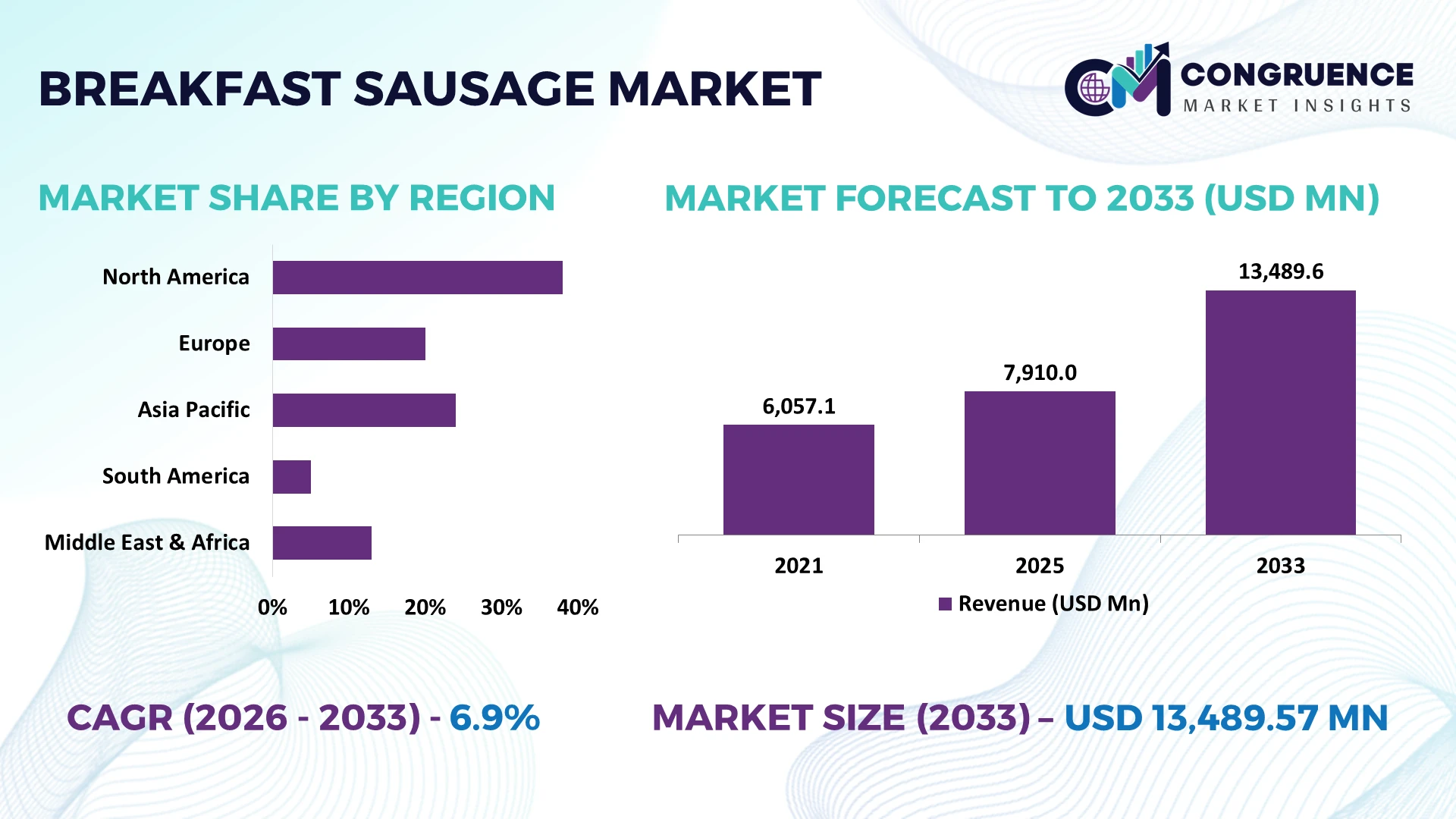
The Global Breakfast Sausage Market was valued at USD 7910 Million in 2025 and is anticipated to reach a value of USD 13489.57 Million by 2033 expanding at a CAGR of 6.9% between 2026 and 2033. Market expansion is driven by increasing consumption of convenient protein breakfast products, growing demand for premium meat sausages, expanding foodservice distribution, and advancements in automated meat processing technologies.
The United States represents a major market for breakfast sausages, supported by established pork processing infrastructure, extensive refrigerated retail distribution, and strong consumption of traditional American breakfast products. The country accounts for roughly 10% of global pork production, providing an established domestic raw material supply. Compared with India, where vegetarian breakfast preferences influence product development, the United States benefits from established demand for pork sausage patties and links. Automated portioning, vacuum packaging, and advanced refrigeration technologies support industrial production, while investments in processing automation strengthen manufacturing efficiency.
Manufacturers prioritizing automated processing, premium product differentiation, and refrigerated distribution infrastructure are positioned to capture opportunities across the global breakfast sausage market.
Market Size & Growth: The global breakfast sausage market reached USD 7910 million in 2025 and is projected to reach USD 13489.57 million by 2033, registering 6.9% CAGR, driven by convenient protein consumption.
Top Growth Drivers: Three major growth drivers are increasing protein consumption, expanding frozen breakfast product distribution, and growing demand for convenient meat products through supermarkets and quick service restaurants.
Short Term Forecast: Through 2028, automated sausage processing will support productivity improvements. Industrial automation projects demonstrate potential production capacity increases of 50% and labor cost reductions of 40%.
Emerging Technologies: Three important technologies include artificial intelligence for quality inspection, automated portioning systems, and advanced packaging. Digital manufacturing improves production consistency, traceability, and operational efficiency.
Regional Leaders: North America represents an established consumption center, with Europe maintaining substantial traditional sausage demand. Asia Pacific presents expansion opportunities through modern retail development and Western breakfast adoption.
Consumer Trends: Consumer preferences favor convenient protein products and traditional breakfast formats. An American consumer survey found that 54% of sausage consumers most frequently consumed sausage during breakfast.
Pilot and Case Example: In a documented Jimmy Dean manufacturing project, Tyson Foods implemented digital production monitoring, achieving a 50% reduction in waste and giveaway and saving 8 worker hours daily.
Competitive Landscape: Major manufacturers include Tyson Foods, Smithfield Foods, Hormel Foods, Johnsonville, and Conagra Brands. Competition centers on branded portfolios, manufacturing scale, product differentiation, and refrigerated distribution capabilities.
Regulatory and ESG Impact: European packaging regulations establish a 70% recycling target for packaging waste by 2030, strengthening incentives for sustainable packaging development and material optimization.
Investment and Funding: Tyson Foods reported USD 978 million in capital expenditure during fiscal 2025, supporting production growth, equipment upgrades, infrastructure improvements, and operational modernization across its businesses.
Innovation and Future Outlook: Advanced processing technologies, alternative protein formulations, and recyclable packaging are reshaping product development. Manufacturers are increasingly integrating digital monitoring with automated production and differentiated breakfast sausage portfolios.
The global breakfast sausage market serves household consumers, quick service restaurants, hotels, and institutional foodservice operators. Increasing demand for convenient protein products supports innovation in frozen sausage patties, chicken sausages, premium pork formulations, and alternative protein products. Manufacturing investment increasingly emphasizes automated processing, precision portioning, and digital production monitoring. Tyson Foods reports prepared foods manufacturing capacity of 72 million pounds weekly across its broader operations, illustrating the industrial scale supporting processed protein production. Expanding refrigerated distribution networks and changing urban breakfast preferences are creating opportunities for product differentiation and international market development.
Breakfast sausage is becoming strategically important as manufacturers compete on processing yield, convenience formats, protein diversification, and refrigerated distribution efficiency. The most consequential shift is digital adoption inside meat processing plants, where real time production monitoring connects portion control, line performance, traceability, and waste management. At a Jimmy Dean sausage facility processing more than 150 million pounds annually, digital production monitoring reduced waste and product giveaway by 50%.
Technology investment increasingly separates efficient processors from legacy operations. Digital monitoring delivered a 0.1% overall yield improvement within six months at the same facility while eliminating 8 worker hours of manual activity each day. Compared with conventional manual monitoring, connected systems therefore improve both material recovery and labor utilization. The United States benefits from large automated meat processing infrastructure, while emerging Asian markets remain more dependent on expanding cold storage, modern retail, and localized product formats.
Through 2028, investment priorities will increasingly center on automated portioning, machine vision, digital traceability, and packaging optimization. Companies are also broadening chicken, pork, and alternative protein offerings as channel requirements diversify. The strategic advantage will belong to processors combining manufacturing scale with precise yield management, flexible formulations, and resilient refrigerated supply networks.
Breakfast sausage demand is increasingly supported by convenient protein consumption across retail, foodservice, and prepared breakfast formats. In the United States, 54% of surveyed sausage consumers identified breakfast as their most frequent sausage eating occasion, reinforcing the category's strong daypart positioning. Conventional meat and seafood unit sales increased 1% during 2025 while dollar sales rose 5%, demonstrating continued consumer spending despite food inflation. U.S. agricultural exports to Mexico also increased 1% in 2025, with pork and pork products among major traded commodities. Manufacturers are responding by expanding frozen patties, precooked links, chicken formulations, and foodservice packs while investing in automated portioning. The operational advantage is clear: breakfast focused processors can increase channel coverage without depending exclusively on traditional fresh pork links.
Breakfast sausage processors remain exposed to meat input volatility, refrigeration costs, packaging expenses, and international agricultural trade disruption. U.S. agricultural exports to China fell 66% in 2025 amid reciprocal tariffs and weaker demand, illustrating how geopolitical shifts can rapidly redirect agricultural supply chains. Plant based meat provides limited immediate cost relief because many alternatives remain priced up to twice as high as conventional products. U.S. plant based meat and seafood unit sales also declined 11% during 2025, limiting processors' ability to offset animal protein exposure simply through portfolio substitution. Manufacturers are responding through supplier diversification, longer procurement contracts, formulation optimization, and multiple protein sourcing strategies. Maintaining margin therefore depends increasingly on procurement flexibility and yield control rather than straightforward price increases.
Product diversification creates a targeted opportunity beyond conventional pork sausage. Plant based breakfast links and patties already represent roughly 3% to 4% of their respective U.S. packaged meat subcategories, while only 11% of households purchased plant based meat and seafood during 2025. More importantly, over 95% of households purchasing plant based meat also purchase conventional meat, creating a clear opportunity for established sausage brands to target flexitarian rather than exclusively vegetarian consumers. Precision extrusion, improved protein texturization, automated formulation control, and frozen distribution can strengthen sensory consistency and production economics. Companies investing in hybrid portfolios and shared manufacturing infrastructure can address multiple dietary segments without building isolated supply chains. The strategic opportunity lies in extending established breakfast brands across protein formats while preserving familiar taste, texture, and preparation convenience.
The long term challenge is converting automation investment into repeatable performance across high volume plants, multiple formulations, and stringent food safety environments. A Jimmy Dean facility processing more than 150 million pounds annually demonstrated that even a 0.1% yield improvement can materially affect manufacturing economics, while digital monitoring reduced waste and giveaway by 50%. However, achieving comparable performance across different facilities requires standardized sensors, reliable production data, workforce training, equipment integration, and disciplined maintenance. The same deployment eliminated 8 worker hours of manual activity daily, showing why digital capability increasingly affects labor productivity as well as material efficiency. Companies must therefore invest beyond individual machines into connected production architecture, operator skills, cybersecurity, and plant level analytics. Sustainable competitive advantage depends on scaling digital discipline consistently across the manufacturing network.
Frozen Product Distribution Gains Importance: Frozen distribution is becoming increasingly important for manufacturers seeking longer inventory holding periods and more flexible retail replenishment. In 2025, frozen products represented 70% of United States plant based meat and seafood retail sales, compared with 66% in 2023. Although these figures cover the broader alternative protein category, they demonstrate a distribution shift relevant to breakfast sausage manufacturers. Companies are adjusting packaging formats, freezer placement, and inventory planning to improve product availability while reducing dependence on refrigerated shelf space.
Digital Ordering Reshapes Breakfast Distribution: Restaurant ordering patterns are changing procurement requirements for sausage patties, links, and prepared breakfast products. Nearly 75% of United States restaurant traffic occurs outside restaurant premises. Additionally, 47% of adults purchase takeaway meals weekly, while 42% use drive through services. Restaurant operators are responding by standardizing sausage portions, improving packaging compatibility, and coordinating production with anticipated morning order volumes.
Hospitality Breakfast Preferences Influence Procurement: Hotel breakfast preferences are creating opportunities for suppliers offering standardized portions and adaptable protein selections. During 2025, breakfast availability influenced accommodation searches among 14% of Indian travelers, compared with 13% of Thai travelers and 12% of Malaysian travelers. Hospitality operators are refining breakfast menus and procurement arrangements to accommodate international visitors while controlling preparation complexity.
Retail Promotions Influence Protein Purchasing: Pricing strategies are becoming increasingly important as manufacturers balance product differentiation against household purchasing constraints. During 2025, roughly 25% of plant based meat products were purchased through promotional offers, while average category retail prices increased 1%. These broader protein category trends highlight the importance of competitive pricing. Breakfast sausage manufacturers are adjusting promotional calendars, package sizes, and product positioning to protect retail distribution and encourage repeat purchases.
Pork Sausage represents an established product category within the global breakfast sausage market, supported by traditional consumption patterns, established meat processing infrastructure, and extensive retail availability. The United States maintains substantial pork processing capacity, providing manufacturers with established procurement and distribution networks. Pork sausage benefits from familiar flavor profiles, scalable manufacturing, and compatibility with conventional breakfast preparation. Chicken Sausage represents an important diversification category as manufacturers develop alternatives for consumers seeking different nutritional profiles. Turkey Sausage addresses similar preferences, particularly among consumers comparing protein content and fat composition.
Beef Sausage maintains relevance in markets with established beef consumption and dietary preferences that restrict pork. Plant Based Sausage represents an emerging product category, although its commercial performance differs considerably across distribution channels. During 2025, United States plant based meat and seafood retail unit sales declined 11%, demonstrating the importance of pricing, product quality, and consumer retention. Manufacturers are refining protein formulations, improving texture, and prioritizing product formats that closely reproduce conventional sausage characteristics. Investment decisions increasingly depend on balancing established animal protein demand against emerging dietary preferences.
Breakfast Meals represent the core consumption application for breakfast sausages, supported by established household preparation habits and commercial breakfast menus. Their importance reflects the product's compatibility with eggs, bread, potatoes, and other conventional breakfast ingredients. Sandwiches represent another significant application because standardized sausage patties simplify portion control and preparation. Breakfast Wraps provide additional opportunities for manufacturers supplying precooked sausage products to restaurants and convenience food producers. These applications benefit from standardized product dimensions, consistent cooking performance, and packaging suitable for commercial kitchens.
Fast Food represents an important distribution application as restaurant operators expand convenient meal formats. During 2025, the National Restaurant Association reported that 58% of limited service operators generated a larger proportion of sales outside restaurant premises than in 2019. Hotel Breakfasts require consistent product quality, predictable preparation times, and flexible buffet replenishment. Home Cooking maintains demand for traditional sausage links, frozen patties, and convenient family packaging. Manufacturers are responding through portion standardization, specialized foodservice packaging, and products compatible with rapid preparation. These developments strengthen the commercial importance of applications requiring consistent quality and operational efficiency.
Households represent an important purchasing group within the breakfast sausage market because of established home breakfast consumption and extensive supermarket distribution. Consumer purchasing patterns support demand for traditional pork links, frozen patties, and convenient preparation formats. Restaurants represent another major purchasing group, requiring consistent product specifications, predictable supply, and standardized preparation. Hotels purchase breakfast sausages for buffet services and prepared breakfast menus, while Cafes increasingly incorporate sausage products into sandwiches and convenient morning meals. These customer groups require different packaging specifications, portion sizes, and delivery arrangements.
Fast Food Chains represent a strategically important customer group because centralized procurement and standardized menus support large production contracts. Foodservice Providers supply institutional kitchens and commercial catering operations, while Food Manufacturers incorporate sausages into packaged breakfast meals and prepared food products. In 2025, 28% of restaurant operators planned investments in technologies including artificial intelligence, demonstrating increasing interest in operational modernization. Manufacturers are adapting through specialized product development, institutional distribution partnerships, and automated production systems. Competitive positioning increasingly depends on serving different purchasing requirements without sacrificing manufacturing efficiency.
North America accounted for the largest share of the global breakfast sausage market in 2025, supported by established consumption patterns and extensive meat processing infrastructure. Asia Pacific is expected to register the fastest growth between 2026 and 2033, driven by expanding foodservice distribution and changing breakfast consumption patterns.

Established Meat Processing and Advanced Manufacturing Infrastructure
North America maintains a strong position in the global breakfast sausage market through extensive meat processing infrastructure, established consumption patterns, and integrated refrigerated distribution. The United States anchors regional production through industrial pork processing, automated manufacturing, and established supermarket networks. Canada contributes livestock production and integrated meat processing capabilities, while Mexico provides opportunities through expanding commercial foodservice operations. The United States produced 12.61 million metric tons of pork during the 2024 to 2025 reporting period, demonstrating substantial raw material availability. Manufacturers increasingly prioritize automated filling, precision portioning, production monitoring, and specialized packaging to improve manufacturing consistency. Regional competition centers on production efficiency, retail brand recognition, and supply chain integration. Investments in flexible processing equipment support product diversification while maintaining consistent manufacturing standards across retail and institutional distribution channels.
United States Market Outlook: The United States benefits from established meat processing operations, integrated agricultural supply chains, and extensive commercial breakfast distribution. Major manufacturers are investing in production automation, digital monitoring, and convenient breakfast product development. Established foodservice relationships support commercial distribution, while refrigerated logistics infrastructure enables consistent product availability across supermarkets, restaurants, and institutional catering operations.
Processing Modernization and Changing Retail Procurement
Europe represents an established breakfast sausage manufacturing and consumption region, supported by traditional sausage production, developed retail infrastructure, and extensive livestock processing capabilities. Germany, the United Kingdom, Spain, and Denmark contribute established meat processing expertise and regional trade networks. European Union pork production reached 21.25 million metric tons during the 2024 to 2025 reporting period, demonstrating substantial industrial capacity. Manufacturers increasingly emphasize processing efficiency, traceability, animal welfare compliance, and packaging optimization. European food safety regulations reinforce investments in hygienic production equipment and documented manufacturing controls. Retailers are also strengthening domestic procurement relationships to improve supply chain resilience. Established supermarket distribution supports traditional sausage varieties alongside convenient breakfast formats. Regional competitiveness increasingly depends on maintaining manufacturing efficiency while adapting product formulations and packaging to evolving consumer preferences and regulatory requirements.
United Kingdom Market Outlook: The United Kingdom maintains established demand for traditional breakfast sausages through supermarkets, hospitality operators, and foodservice businesses. Domestic pig meat production increased 2.3% during 2025, reaching 975,200 tonnes. Manufacturers are strengthening domestic procurement relationships, expanding convenient product formats, and improving production efficiency. Retail distribution and traditional breakfast consumption provide established commercial opportunities for sausage processors.
Expanding Protein Processing and Modern Foodservice Distribution
Asia Pacific presents significant opportunities for breakfast sausage manufacturers through expanding meat processing infrastructure, changing urban consumption patterns, and increasing availability of international breakfast products. China provides extensive pork processing capacity, while Japan and Australia maintain established markets for convenient processed meat products. India presents opportunities for chicken sausage and alternative protein formulations suited to local dietary preferences. China's pork production reached 59.38 million tonnes in 2025, increasing 4.1% from the previous year. Poultry production also increased 6.7%, strengthening opportunities for diversified processed protein manufacturing. Regional manufacturers are investing in automated processing, refrigerated transportation, and retail distribution infrastructure. Product localization remains commercially important because dietary preferences, protein consumption patterns, and retail purchasing behavior differ considerably across individual countries.
China Market Outlook: China possesses extensive livestock processing infrastructure and substantial domestic meat production capacity. During 2025, the country slaughtered 719.73 million pigs, representing a 2.4% annual increase. Established pork processing capabilities provide a manufacturing foundation for developing processed meat products. Manufacturers targeting breakfast sausage applications must emphasize convenient preparation, localized seasoning, packaging innovation, and distribution through modern retail and commercial foodservice channels.
Expanding Meat Processing and Export Infrastructure
South America benefits from substantial livestock production, established meat processing capabilities, and expanding international protein trade. Brazil anchors regional industrial capacity through extensive pork and poultry production, while Argentina contributes established beef processing expertise. Chile and Colombia provide additional opportunities through modern retail development and diversified processed meat consumption. Brazil produced 5.592 million tonnes of pork during 2025, reinforcing its position as an important international protein supplier. The country's established agricultural infrastructure supports competitive raw material procurement and industrial processing. Manufacturers are increasingly emphasizing production efficiency, refrigerated logistics, and diversified product portfolios. Regional opportunities include conventional pork sausage, chicken formulations, and convenient frozen breakfast products. However, transportation infrastructure and refrigerated distribution remain important considerations when expanding commercial coverage beyond established metropolitan markets.
Brazil Market Outlook: Brazil maintains substantial advantages through integrated livestock production, industrial meat processing, and established export infrastructure. Pork exports reached 1.510 million tonnes during 2025, increasing 11.6% compared with the previous year. This expanding international distribution network provides opportunities for processors developing value added meat products. Manufacturers can strengthen their commercial positioning through automated processing, specialized packaging, and partnerships with established refrigerated logistics providers.
Halal Protein Processing and Refrigerated Infrastructure Expansion
The Middle East and Africa breakfast sausage market is shaped by expanding food processing infrastructure, hospitality development, and demand for convenient halal meat products. Saudi Arabia and the United Arab Emirates represent important commercial markets supported by investment in domestic food manufacturing and international hospitality operations. South Africa contributes established meat processing capabilities and modern retail distribution. Product development emphasizes chicken and beef sausage formulations suited to local dietary requirements. Saudi Arabia's food security strategy is encouraging investment in domestic protein processing and refrigerated distribution infrastructure. Manufacturers are strengthening local production partnerships and developing products compatible with institutional catering and commercial breakfast operations. Regional competitiveness depends on halal certification, reliable temperature controlled transportation, consistent product quality, and distribution partnerships connecting manufacturers with hotels, supermarkets, and foodservice operators.
Saudi Arabia Market Outlook: Saudi Arabia represents an important market for halal breakfast sausage development through its expanding food manufacturing infrastructure and hospitality industry. In February 2025, Tanmiah Food Company and Brazil's Vibra Agroindustrial announced a partnership involving investment exceeding USD 150 million in poultry production and processing. The investment supports expanded domestic processing capabilities and strengthens the underlying infrastructure available for developing value added poultry products, including chicken breakfast sausages.
The global breakfast sausage market combines established processors with regional specialists and alternative protein innovators. Tyson Foods competes with Smithfield Foods, Hormel Foods, Johnsonville, and Cranswick through brand recognition, processing capacity, and refrigerated distribution. Published estimates place the combined global share of five leading manufacturers at 29.8%, indicating substantial competition from regional producers and private labels. Smithfield held 6% of the United States branded uncooked breakfast sausage category by volume in 2025, illustrating how product positioning differs from broader market concentration. Johnsonville reports that over 77% of surveyed consumers perceived its breakfast sausage as premium, supporting differentiation beyond price. Manufacturers compete through automated portioning, proprietary seasoning, retailer partnerships, and vertically integrated meat procurement. Competitive investment increasingly targets convenient frozen formats, production monitoring, and diversified protein portfolios. Refrigerated logistics, food safety compliance, and dependable livestock procurement create substantial entry barriers. Sustained competitiveness requires consistent quality, efficient processing, differentiated products, and reliable distribution.
Tyson Foods
Smithfield Foods
Johnsonville
Hormel Foods
Conagra Brands
Cranswick
Maple Leaf Foods
The Kraft Heinz Company
Beyond Meat
Impossible Foods
Kayem Foods
Seaboard Corporation
Nestlé
Perdue Farms
Automation, digital production monitoring, and precision portioning are transforming breakfast sausage manufacturing by improving material utilization, product consistency, and production visibility. Automated filling equipment supports standardized sausage dimensions, while connected sensors identify processing losses. At Tyson Foods, digital production monitoring improved overall yield by 0.1% within six months. Compared with conventional manual monitoring, the connected system reduced waste and product giveaway by 50%, demonstrating the commercial importance of precise manufacturing controls.
Emerging technologies include artificial intelligence, machine vision inspection, advanced packaging, and automated thermal processing. Machine vision supports defect identification, while intelligent temperature monitoring strengthens food safety compliance. Fully cooked sausage processing offers another efficiency advantage, with selected commercial products delivering virtually 100% preparation yield. Integrated production systems connect manufacturing equipment, inventory management, and quality assurance, helping established processors improve consistency while enabling smaller manufacturers to strengthen operational competitiveness.
Between 2026 and 2028, technology investment will increasingly emphasize predictive maintenance, intelligent production scheduling, automated packaging, and digital traceability. Manufacturers integrating these capabilities can reduce operational variability and strengthen refrigerated distribution performance. Advanced formulation technologies will also support chicken, turkey, and alternative protein development. Competitive differentiation will increasingly depend on combining manufacturing automation with flexible product development, reliable food safety controls, and efficient processing infrastructure.
February 2025: Hormel Foods expanded its Applegate breakfast portfolio with two breakfast sandwich varieties featuring chicken and turkey sausage. Delivering 12 to 14 grams of protein per serving, these convenient products strengthened its presence in premium frozen breakfast retail distribution.
May 2025: Johnsonville introduced three precooked, presliced sausage varieties designed for commercial foodservice operations. Featuring a 270 day frozen shelf life, the products simplify kitchen preparation, reduce labor requirements, and expand menu flexibility across breakfast skillets, wraps, and other prepared meals.
September 2025: Tyson Foods announced ingredient reformulation across its United States branded portfolio, including Jimmy Dean. Targeting the removal of four specified ingredients by the end of 2025, the initiative aligned product development with evolving consumer preferences and ingredient transparency expectations.
February 2026: Conagra Brands introduced four Banquet MEGA Breakfast Bowl varieties, including sausage formulations, delivering 30 grams of protein per bowl. Featuring 25% more food than the leading breakfast bowl brand, the launch strengthened its convenient frozen breakfast portfolio.
The Breakfast Sausage Market Report provides comprehensive analysis of industry developments, competitive dynamics, manufacturing technologies, and commercial opportunities between 2026 and 2033. Segmentation covers Pork Sausage, Chicken Sausage, Turkey Sausage, Beef Sausage, and Plant Based Sausage. Application analysis examines Breakfast Meals, Sandwiches, Breakfast Wraps, Fast Food, Hotel Breakfasts, and Home Cooking. End user coverage includes Households, Restaurants, Hotels, Cafes, Fast Food Chains, Foodservice Providers, and Food Manufacturers.
Regional analysis encompasses North America, Europe, Asia Pacific, South America, and the Middle East and Africa, examining production infrastructure, consumption patterns, and distribution capabilities. Technology coverage includes automated processing, intelligent quality inspection, digital production monitoring, and advanced packaging. The report evaluates competitive positioning, product diversification, regulatory requirements, and emerging investment opportunities, supporting manufacturing expansion, procurement optimization, strategic partnerships, and long term business planning.
| Report Attribute/Metric | Report Details |
|---|---|
Market Revenue in 2025 | USD 7910 Million |
Market Revenue in 2033 | USD 13489.57 Million |
CAGR (2026 - 2033) | 6.9% |
Base Year | 2025 |
Forecast Period | 2026 - 2033 |
Historic Period | 2021 - 2025 |
Segments Covered | By Type
By Application
By End-User
|
Key Report Deliverable | Revenue Forecast, Growth Trends, Market Dynamics, Segmental Overview, Regional and Country-wise Analysis, Competition Landscape |
Region Covered | North America, Europe, Asia-Pacific, South America, Middle East, Africa |
Key Players Analyzed | Tyson Foods, Smithfield Foods, Johnsonville, Hormel Foods, Conagra Brands, Cranswick, Maple Leaf Foods, The Kraft Heinz Company, Beyond Meat, Impossible Foods, Kayem Foods, Seaboard Corporation, Nestlé, Perdue Farms |
Customization & Pricing | Available on Request (10% Customization is Free) |




