
Reports
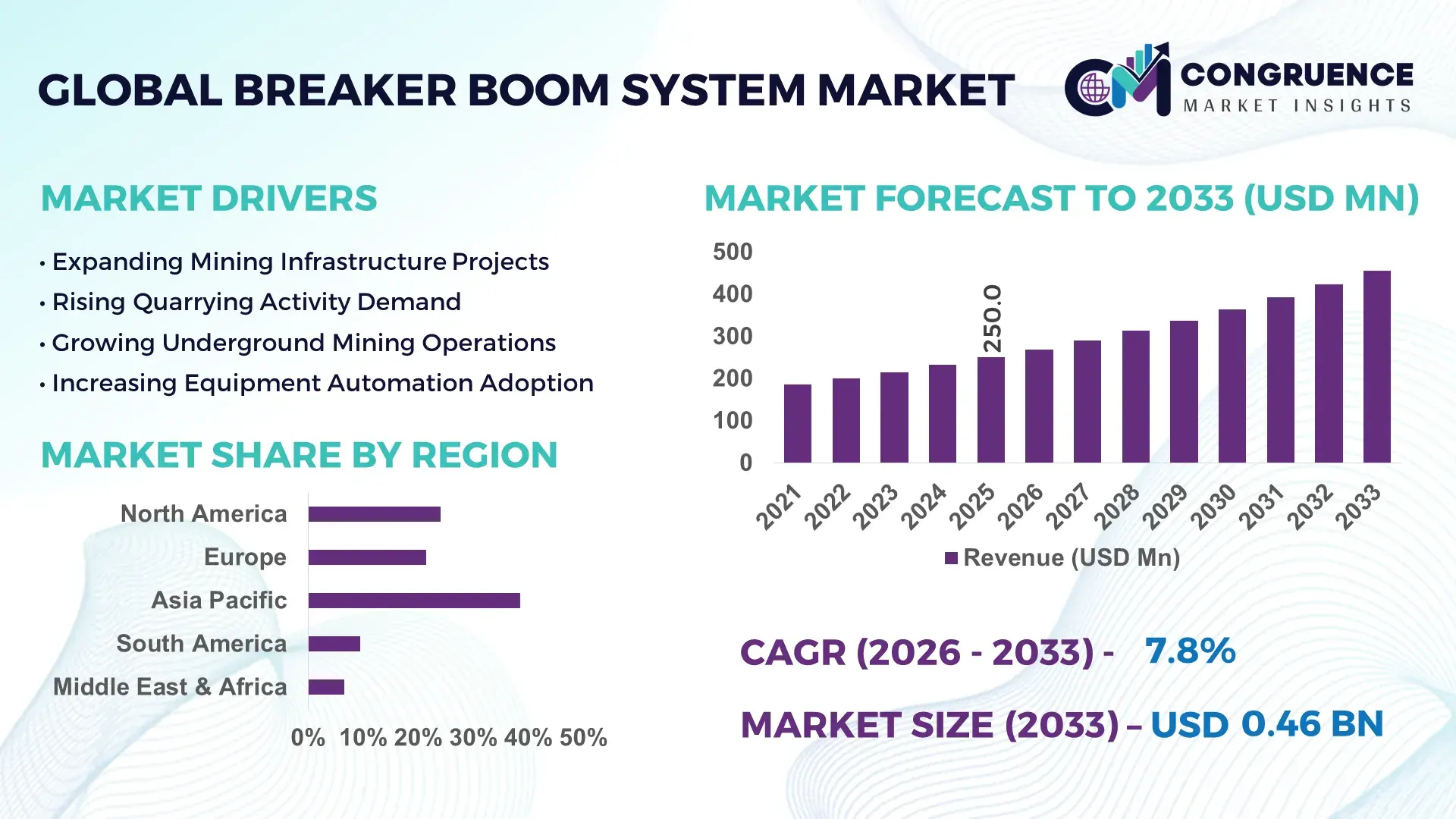
The Global Breaker Boom System Market was valued at USD 250.0 Million in 2025 and is anticipated to reach a value of USD 455.9 Million by 2033 expanding at a CAGR of 7.8% between 2026 and 2033. Growth is being driven by rising underground mining automation, stricter quarry safety mandates, and expanding hard-rock mineral extraction projects across major resource-producing economies.
Australia remains the dominant country in the Breaker Boom System Market, accounting for nearly 18% of global hard-rock mining output and operating more than 350 large-scale underground and surface mining sites requiring stationary rock-breaking systems. Mining capital expenditure exceeded USD 20 billion in recent project cycles, while automated drilling and material handling adoption surpassed 40% across major operators. In comparison, Canada demonstrates faster deployment of digitally integrated boom systems within gold and base-metal mines. The ongoing global critical minerals race continues to reinforce equipment modernization priorities across both markets.
Strategically, suppliers with advanced automation, remote-control functionality, and mine-specific customization capabilities are positioned to secure long-term contracts and strengthen competitive differentiation.
Market Size & Growth: USD 250.0 Million in 2025 reaching USD 455.9 Million by 2033, supported by mining automation, quarry modernization, and critical minerals expansion.
Top Growth Drivers: Underground mining automation (+40%), quarry safety investments (+28%), and critical mineral extraction projects (+35%) accelerate equipment deployment.
Short-Term Forecast: By 2028, remote-operated breaker systems are expected to improve operator productivity by 22% while reducing unplanned downtime by 18%.
Emerging Technologies: AI-enabled monitoring, tele-remote operation, predictive maintenance, and sensor-driven rock fragmentation optimization are reshaping advanced system performance.
Regional Leaders: Asia-Pacific (~USD 180 Million), North America (~USD 115 Million), and Europe (~USD 85 Million) lead through mining modernization and infrastructure expansion.
Consumer/End-User Trends: More than 45% of large mining operators now prioritize automated rock-breaking solutions to improve workforce safety and asset utilization.
Pilot/Case Example: A 2024 underground mining deployment achieved 25% faster blockage clearance and reduced operator exposure in hazardous zones by 30%.
Competitive Landscape: Leading manufacturers collectively control nearly 55% market share, with major participation from Sandvik, Epiroc, MacLean Engineering, Normet, and Astec.
Regulatory & ESG Impact: Enhanced workplace safety regulations contributed to a 20% increase in investment toward remotely operated equipment across major mining jurisdictions.
Investment & Funding: More than USD 1.2 Billion in mining equipment modernization programs supports automation partnerships and production efficiency initiatives globally.
Innovation & Future Outlook: Autonomous rock-breaking systems, digital twins, and integrated fleet management platforms are becoming key competitive differentiators amid supply-chain realignment.
The Breaker Boom System Market is witnessing stronger demand from underground metal mining, aggregates production, and tunneling operations where productivity and worker safety remain critical priorities. Recent innovations include tele-remote operation platforms, real-time equipment diagnostics, and predictive maintenance systems that reduce unplanned downtime by up to 20%. Growing investment in critical mineral extraction projects and mining fleet digitalization is creating new deployment opportunities, particularly as operators seek greater operational resilience amid evolving labor and safety requirements, setting the stage for broader strategic transformation.
Breaker boom systems are becoming strategically important as mining operators, quarry companies, and infrastructure developers prioritize operational continuity, workforce safety, and automated material handling. The market is increasingly linked to critical mineral supply chains, underground mine expansion, and large-scale infrastructure modernization projects. Growing labor shortages across mining-intensive economies are accelerating adoption of remotely operated and semi-autonomous rock-breaking solutions.
Modern tele-remote breaker boom systems deliver measurable operational advantages over conventional manually controlled equipment. Advanced systems can reduce hazardous-zone worker exposure by more than 30% while improving blockage-clearing efficiency by approximately 20–25%. Australia and Canada continue to lead deployment in hard-rock mining environments, whereas Chile is increasingly adopting integrated systems within copper mining operations. Over the next two to three years, automated monitoring integration is expected to exceed 45% among newly installed systems across major mining projects.
Mining equipment suppliers are expanding strategic partnerships with automation software providers and digital mining platform developers. For example, integrated boom systems connected to fleet management platforms enable predictive maintenance and utilization optimization across mine sites. Companies are prioritizing investments in remote operation technologies, aftermarket services, and customized solutions for underground applications. Organizations that combine automation expertise, equipment reliability, and digital service capabilities will secure stronger competitive positioning and long-term operational relevance.
Underground mining operators are accelerating investment in automated rock-breaking equipment as safety compliance and productivity targets become increasingly stringent. More than 45% of large mining sites have increased automation-related capital allocations, while remote-operation adoption has expanded by nearly 30% across advanced mining jurisdictions. Australia’s critical minerals expansion and Canada's underground mine modernization initiatives continue to reinforce equipment upgrades. The direct impact is higher demand for tele-remote breaker boom systems capable of reducing worker exposure to hazardous zones and minimizing production interruptions. In response, manufacturers are introducing intelligent control systems, expanding automation portfolios, and partnering with mining technology firms. A key strategic insight is that mines achieving higher equipment utilization rates increasingly prioritize integrated automation ecosystems rather than standalone machinery purchases.
Breaker boom systems require significant upfront investment, with automated configurations often costing 25–35% more than conventional alternatives. Component sourcing remains concentrated among specialized hydraulic, control-system, and steel structure suppliers, creating procurement risks. Lead times for certain hydraulic and electronic subsystems increased by approximately 15–20% during recent industrial supply disruptions. Mining operators in developing economies frequently postpone modernization projects due to financing constraints and infrastructure limitations. The result is slower deployment across mid-sized quarry and mining operations. To mitigate risks, manufacturers are expanding localized assembly capabilities, diversifying supplier networks, and establishing long-term procurement contracts. An important operational insight is that supplier diversification is becoming as strategically important as technological differentiation for sustaining project delivery schedules.
The convergence of mining automation, industrial IoT, and predictive analytics creates substantial opportunities for breaker boom system providers. Predictive maintenance platforms can reduce unexpected equipment downtime by nearly 20%, while connected asset monitoring improves maintenance planning efficiency by over 15%. Chile, Australia, and Mongolia are expanding smart mining initiatives that increasingly require digitally connected equipment fleets. Emerging technologies such as AI-assisted rock fragmentation analysis and digital twin-based equipment optimization are creating new value propositions beyond traditional rock-breaking functions. Companies are investing in software partnerships, cloud-enabled monitoring solutions, and integrated service platforms. A particularly attractive opportunity lies in recurring digital service revenues, which provide higher-margin business models compared with conventional equipment-only sales.
The transition toward automated breaker boom systems requires specialized technical expertise spanning hydraulics, automation software, sensor networks, and mine communication infrastructure. Industry assessments indicate that nearly 35% of mining operators report shortages of qualified automation technicians. Integration with existing fleet management and mine planning systems can increase deployment timelines by 15–20% when interoperability standards are inconsistent. Large-scale underground operations in countries such as South Africa and Peru often face additional connectivity and infrastructure constraints that complicate digital deployment. These challenges directly affect operational consistency, scalability, and long-term technology adoption. To address them, companies are expanding technical training programs, strengthening technology partnerships, and investing in standardized digital architectures. The strongest competitive advantage will belong to suppliers capable of delivering both equipment and end-to-end operational integration expertise.
Remote Operations Becoming Standard Remote-control functionality is rapidly moving from a premium feature to an operational requirement across large mining sites. More than 42% of newly commissioned breaker boom installations now incorporate tele-remote capabilities, while operator exposure to hazardous zones has declined by nearly 30% in digitally enabled deployments. Labor shortages in Australia and Canada are accelerating this transition. Equipment manufacturers are expanding automation portfolios and integrating advanced control interfaces to improve workforce utilization and operational continuity.
Predictive Maintenance Integration Expands Mining operators are increasingly embedding condition-monitoring technologies into breaker boom fleets. Sensor-enabled systems have reduced unexpected maintenance events by approximately 18% and improved equipment availability by over 15%. The shift is being driven by rising downtime costs and tighter production schedules. Suppliers are partnering with industrial software providers to deploy cloud-connected monitoring platforms that enable proactive maintenance scheduling and higher asset productivity.
Critical Minerals Projects Reshape Demand Growing investment in copper, lithium, nickel, and rare-earth extraction is altering equipment procurement priorities. Nearly 35% of new hard-rock mining projects now specify automated rock-breaking solutions during the design phase, compared with less than 20% five years ago. Mining operators are prioritizing high-capacity systems capable of supporting continuous production environments, prompting manufacturers to expand customization capabilities and site-specific engineering services.
Modular Design Gains Momentum Modular breaker boom architectures are becoming increasingly attractive as operators seek faster deployment and lower lifecycle costs. Installation timelines have been reduced by nearly 25% in several recent projects, while component replacement efficiency has improved by approximately 20%. Supply-chain volatility and project scheduling pressures are encouraging companies to standardize platforms. A notable emerging trend is the use of interchangeable boom assemblies that simplify maintenance planning and improve equipment scalability across multiple sites.
Pedestal Boom Systems represent the leading segment of the Breaker Boom System Market, accounting for an estimated 42% of installations due to their reliability in high-volume mining and quarrying environments. These systems deliver superior operational stability, continuous rock-breaking capability, and seamless integration with crushers and ore-handling infrastructure. Large mining operations in Australia, Chile, and Canada continue to favor pedestal configurations because they support round-the-clock production cycles and reduce crusher blockages by nearly 25%. Manufacturers are enhancing pedestal platforms through advanced hydraulic controls, remote operation modules, and predictive maintenance integration to improve uptime and asset utilization. Electric Boom Systems are emerging as the fastest-growing segment as operators pursue lower energy consumption and reduced maintenance requirements. Adoption of electric configurations increased by approximately 18% during recent modernization programs, particularly in underground environments with strict ventilation and emissions requirements. Hydraulic Boom Systems remain strategically important for heavy-duty applications requiring high power density and operational flexibility, while Mobile Boom Systems continue gaining traction in temporary mining, quarrying, and infrastructure projects where deployment mobility is critical. Equipment suppliers are increasingly balancing product portfolios between established hydraulic platforms and next-generation electrified solutions to address evolving operational priorities.
Underground Mining remains the dominant application segment, representing approximately 46% of total demand due to increasing development of hard-rock mineral deposits and deeper extraction activities. Breaker boom systems play a critical role in managing ore-pass blockages, crusher feed disruptions, and confined-space rock fragmentation tasks. Mining operators report productivity improvements exceeding 20% when automated rock-breaking systems are integrated into underground material handling workflows. Suppliers continue expanding automation, monitoring, and tele-remote capabilities to meet safety and efficiency requirements across large underground operations. Tunneling is the fastest-growing application segment as governments and infrastructure developers accelerate investments in transportation corridors, metro networks, and utility projects. Deployment activity in tunneling environments has increased by nearly 17% as project managers prioritize equipment capable of maintaining excavation continuity. Surface Mining continues to represent a mature but stable segment supported by large-scale mineral extraction projects, while Quarrying remains operationally significant due to growing demand for aggregates and construction materials. Companies are responding through application-specific product development, customized boom geometries, and enhanced attachment compatibility to improve performance across diverse operating environments.
Mining Companies constitute the largest end-user segment, accounting for nearly 58% of total equipment demand. Their dominance is driven by extensive deployment requirements across underground mines, surface operations, ore-processing facilities, and crusher stations. Large operators increasingly prioritize automation-enabled systems that improve safety compliance and reduce production bottlenecks. More than 45% of major mining organizations have expanded investment in remotely operated equipment fleets as workforce availability and operational efficiency become key competitive factors. Manufacturers are strengthening service agreements, aftermarket support programs, and digital integration capabilities to address evolving mining customer requirements. Infrastructure Developers are emerging as the fastest-growing end-user group, supported by rising investments in transportation, tunneling, and utility construction projects. Demand from this segment increased by approximately 16% as governments accelerated large-scale infrastructure modernization initiatives. Construction Companies continue utilizing breaker boom systems for heavy excavation and material handling applications, while Quarry Operators remain important buyers due to increasing aggregate production requirements. Vendors are tailoring product offerings through flexible financing models, modular configurations, and project-specific engineering support to strengthen penetration across non-mining sectors and diversify revenue streams.
Asia-Pacific accounted for the largest market share at 38.5% in 2025 however, South America is expected to register the fastest growth, expanding at a CAGR of 8.9% between 2026 and 2033.
North America represents approximately 24.0% of global market activity, supported by advanced mining operations, quarry modernization programs, and strong adoption of remote-operated equipment. Mining companies across Canada and the United States are increasingly integrating breaker boom systems with fleet management and predictive maintenance platforms to improve equipment utilization. More than 45% of newly deployed systems in major mining projects incorporate tele-remote functionality, reflecting a broader transition toward digital mining ecosystems. Growing investments in copper, gold, and critical mineral extraction continue to support deployment across underground and surface mining environments. Equipment suppliers are expanding aftermarket services and automation partnerships to strengthen long-term customer retention.
Canada Market Outlook: Canada maintains a strong competitive position through its extensive underground mining sector and high concentration of technologically advanced metal mines. The country accounts for a significant share of automated mining equipment deployment, particularly across Ontario and Quebec. More than 40% of large underground mine expansion projects now include digitally integrated rock-breaking systems during planning stages. Continued investment in critical mineral extraction and mine modernization programs supports sustained demand for advanced breaker boom platforms with remote-operation capabilities.
Europe accounts for nearly 21.5% of global demand, driven by stringent workplace safety requirements, quarry automation initiatives, and infrastructure rehabilitation projects. Mining and aggregate operators are increasingly replacing conventional rock-breaking equipment with digitally controlled systems capable of reducing operator exposure and improving operational precision. Quarry modernization programs have accelerated across several European industrial hubs, with automated equipment adoption increasing by approximately 18% over recent years. Manufacturers are responding through electrification initiatives, advanced control systems, and strategic partnerships focused on industrial automation and sustainability objectives.
Sweden Market Outlook: Sweden serves as a regional technology leader due to its advanced mining ecosystem and strong engineering capabilities. The country hosts several globally recognized mining equipment innovators and remains at the forefront of autonomous mining deployment. Underground mining operators continue investing in connected equipment platforms, with automated mining technologies integrated into numerous large-scale metal extraction projects. The emphasis on productivity optimization and worker safety strengthens demand for sophisticated breaker boom solutions across both mining and tunneling applications.
Asia-Pacific leads the global market with approximately 38.5% share, supported by extensive mining activity, infrastructure construction, and aggregate production operations. Australia, China, and Indonesia continue expanding mineral extraction capacity to support industrial and energy-transition supply chains. The region accounts for more than 45% of global hard-rock mining project development activity, creating substantial deployment opportunities for rock-breaking systems. Mining operators increasingly prioritize automation to improve safety and productivity, while infrastructure investments continue driving equipment demand across tunneling and quarrying applications. Manufacturers are expanding regional production, service networks, and localization strategies to strengthen market penetration.
Australia Market Outlook: Australia remains the most strategically significant country in the region due to its large-scale mining sector and strong adoption of automation technologies. The country operates hundreds of major mining sites across iron ore, gold, lithium, and copper segments. More than 50% of newly commissioned large mining projects incorporate advanced digital mining technologies, including remote-operated rock-breaking systems. Ongoing investment in critical mineral production and operational efficiency initiatives continues to reinforce demand for high-performance breaker boom equipment.
South America accounts for approximately 9.5% of global market activity and is emerging as the fastest-expanding regional opportunity. Growth is strongly linked to copper, lithium, and precious metal mining projects requiring reliable material handling and crusher support systems. Mining operators are increasingly deploying automated breaker boom systems to improve production continuity and reduce equipment-related interruptions. Several large-scale mining developments have expanded equipment procurement budgets by more than 20%, supporting modernization initiatives. However, infrastructure bottlenecks and project execution challenges continue to influence deployment timelines across certain mining jurisdictions.
Chile Market Outlook: Chile represents the region's most influential market due to its dominant position in global copper production and extensive mining infrastructure. Major mining enterprises continue modernizing processing facilities and underground operations to enhance productivity. Automated rock-breaking technologies are increasingly integrated into crusher stations and ore-handling systems to support continuous throughput. Strong investment activity across copper expansion projects and digital mining initiatives positions Chile as a critical deployment center for advanced breaker boom solutions over the coming years.
The Middle East & Africa region contributes approximately 6.5% of global demand, supported by mining diversification strategies, quarry expansion, and infrastructure development programs. Governments and industrial operators are increasing investments in mineral extraction and construction materials production to support economic diversification objectives. Adoption of modern rock-breaking equipment has expanded steadily as operators focus on reducing downtime and improving site safety. Several mining modernization initiatives launched across key African mining corridors have accelerated procurement of advanced hydraulic and remotely operated systems. Suppliers are strengthening regional partnerships and technical service capabilities to improve market access.
South Africa Market Outlook: South Africa remains the most strategically important market within the region due to its established mining sector and extensive underground extraction operations. Gold, platinum, and mineral mining activities continue generating consistent demand for heavy-duty rock-breaking equipment. A growing number of mining operators are integrating automated equipment into modernization programs aimed at improving workforce safety and operational efficiency. Continued investment in underground mine optimization and equipment upgrades supports long-term deployment opportunities for advanced breaker boom technologies.
The Breaker Boom System Market is led by global OEMs such as Epiroc, Sandvik, Normet, MacLean Engineering, and Astec Industries. Global technology leaders compete directly against regional equipment specialists and cost-focused manufacturers for mining, quarrying, and tunneling projects. The top five players collectively control approximately 58% of market activity, creating a moderately consolidated competitive structure.
Competition is increasingly centered on automation capability, lifecycle support, equipment uptime, and site-specific customization rather than equipment pricing alone. Remote-operation-enabled systems command nearly 20% higher project preference rates, while predictive maintenance integration can improve equipment availability by over 15%. Leading suppliers are expanding service networks, forming digital technology partnerships, and integrating automation platforms into product portfolios. The competitive shift is moving toward autonomous rock-breaking systems, digital mine connectivity, and integrated fleet solutions. High engineering requirements, safety certifications, and established customer relationships remain significant entry barriers. Winning requires automation leadership, operational reliability, rapid service response, and strong mining ecosystem integration.
Normet
MacLean Engineering
Astec Industries
Okada Aiyon Corporation
Furukawa Rock Drill Co., Ltd.
NPK Construction Equipment
Montabert
Indeco North America
BTI (Breaker Technology Inc.)
Tramac
Tecman
Rammer
The technology landscape is rapidly shifting from manually controlled hydraulic systems toward intelligent, connected, and remotely operated platforms. Tele-remote control technology has achieved deployment levels approaching 45% across newly commissioned underground mining projects, enabling operators to manage equipment from protected control centers. Compared with conventional manually operated systems, advanced remote-control solutions improve hazardous-zone safety exposure by more than 30% while increasing rock-breaking productivity by approximately 20%. Mining operators benefit through improved workforce utilization and reduced operational interruptions.
Emerging technologies include predictive maintenance platforms, AI-assisted rock fragmentation analysis, machine vision systems, and industrial IoT connectivity. Sensor-enabled breaker boom systems can reduce unexpected downtime by nearly 18% and improve maintenance planning efficiency by over 15%. Integration with digital mine management platforms allows real-time monitoring of equipment health, utilization rates, and performance metrics. Global technology leaders such as Epiroc, Sandvik, and Normet are leveraging these capabilities to strengthen customer retention and aftermarket service revenues.
Disruptive innovation is increasingly focused on autonomous rock-breaking. The introduction of fully autonomous breaker boom technology marks a significant operational shift, enabling continuous ore-flow management without direct operator intervention. Between 2026 and 2028, autonomous functionality, machine vision, and digital twin integration are expected to become major competitive differentiators. Companies adopting these technologies early will secure stronger operational efficiency, lower labor dependency, and superior long-term productivity performance.
December 2025 – Normet Xrock launched the world's first fully autonomous Xrock Autobreaker system. The solution enables operators to supervise multiple breaker systems remotely while eliminating direct hazardous-zone intervention. Business impact includes improved safety and higher operator productivity across underground mining operations. Source: www.normet.com
January 2026 – Normet Xrock expanded commercial deployment of its autonomous rock-breaking platform with machine-vision and sensor-fusion technology capable of automatically identifying oversized boulders and executing breakage sequences. The development strengthens autonomous mining workflows and improves ore-flow continuity.
April 2026 – Epiroc introduced the EC 122 hydraulic breaker featuring a redesigned maintenance architecture and an operating weight reduction of 80 kg compared with its predecessor. The upgrade improves maneuverability, maintenance efficiency, and equipment lifecycle performance.
May 2026 – Epiroc expanded its next-generation breaker portfolio through wider market availability of the EC 122 series, incorporating replaceable piston liner technology and field-serviceable wear components. The innovation reduces maintenance complexity and supports higher equipment uptime in demanding mining environments.
The report provides comprehensive analysis of the global Breaker Boom System Market across pedestal boom systems, mobile boom systems, hydraulic boom systems, and electric boom systems. Coverage spans key applications including underground mining, surface mining, quarrying, and tunneling, alongside end-user assessment across mining companies, construction companies, infrastructure developers, and quarry operators. The study evaluates deployment trends, equipment utilization patterns, automation adoption rates, and evolving procurement strategies across North America, Europe, Asia-Pacific, South America, and the Middle East & Africa.
The report further examines competitive positioning, technology innovation, autonomous operation developments, predictive maintenance integration, and digital mining transformation initiatives. Analysis includes market-share distribution, deployment concentration patterns, regional investment activity, and enterprise adoption behavior. More than half of new large-scale mining projects now incorporate advanced automation features, highlighting a significant operational shift. The research supports investment planning, product development, expansion strategies, partnership evaluation, and competitive benchmarking while identifying emerging opportunities expected to influence industry direction between 2026 and 2033.
| Report Attribute / Metric | Details |
|---|---|
| Market Revenue (2025) | USD 250.0 Million |
| Market Revenue (2033) | USD 455.9 Million |
| CAGR (2026–2033) | 7.8% |
| Base Year | 2025 |
| Forecast Period | 2026–2033 |
| Historic Period | 2021–2025 |
| Segments Covered |
By Type
By Application
By End-User Insights
|
| Key Report Deliverables | Revenue Forecast; Market Trends; Growth Drivers & Restraints; Technology Insights; Segmentation Analysis; Regional Insights; Competitive Landscape; Regulatory & ESG Overview; Recent Developments |
| Regions Covered | North America; Europe; Asia-Pacific; South America; Middle East & Africa |
| Key Players Analyzed | Epiroc; Sandvik Mining and Rock Solutions; Normet; MacLean Engineering; Astec Industries; Okada Aiyon Corporation; Furukawa Rock Drill Co., Ltd.; NPK Construction Equipment; Montabert; Indeco North America; Breaker Technology Inc. (BTI); Tecman; Rammer |
| Customization & Pricing | Available on Request (10% Customization Free) |




