
Reports
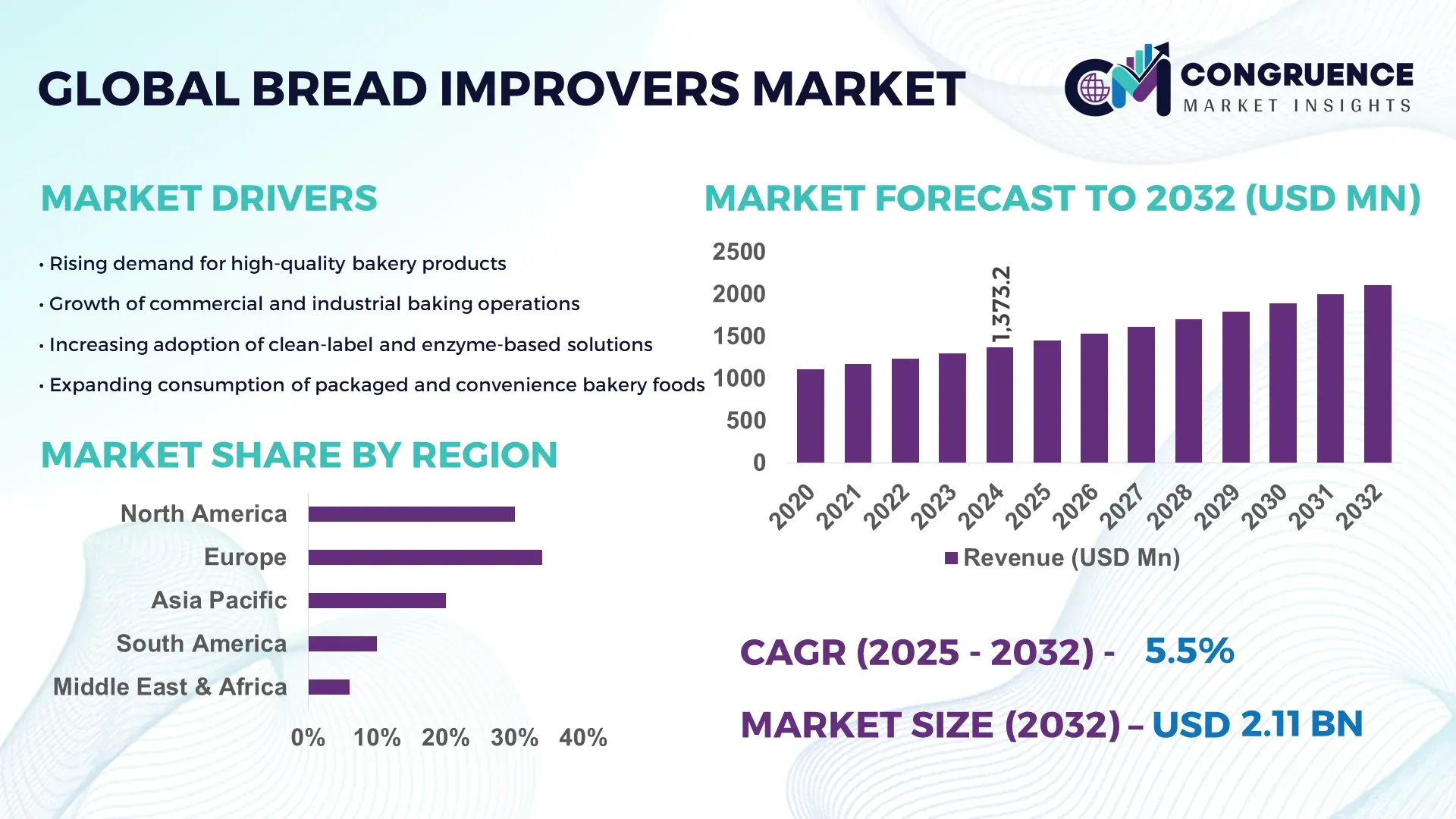
The Global Bread Improvers Market was valued at USD 1,373.18 Million in 2024 and is anticipated to reach a value of USD 2,107.41 Million by 2032 expanding at a CAGR of 5.5% between 2025 and 2032. This growth is supported by rising commercial baking activities and continuous formulation advancements.
France continues to hold a leading position in the global bread improvers landscape, backed by its strong industrial bakery infrastructure and high per-capita bakery consumption exceeding 50 kg annually. The country hosts more than 30,000 industrial and artisanal bakery production units, supported by advanced dough-processing automation technologies and sustained R&D investment in clean-label enzyme formulations. Additionally, France’s bakery ingredient manufacturers have expanded production capacities by over 12% since 2021 to meet growing demand from packaged and frozen bakery segments.
Market Size & Growth: Market valued at USD 1.37 billion in 2024 and projected to reach USD 2.10 billion by 2032, growing at a CAGR of 5.5%, driven by rising industrial baking and demand for consistent dough quality.
Top Growth Drivers: 42% increase in clean-label bakery adoption; 36% boost in enzyme-based improver efficiency; 28% rise in frozen bakery production volumes.
Short-Term Forecast: By 2028, dough processing efficiency expected to improve by 18% due to optimized enzymatic blends and automated mixing technologies.
Emerging Technologies: AI-driven dough optimization tools and next-generation enzyme complexes enhancing volume stability and crumb structure.
Regional Leaders: Europe projected at USD 890 million by 2032 with high specialty bread uptake; North America expected at USD 520 million with strong frozen bakery integration; Asia-Pacific set to reach USD 460 million driven by rapid urban bakery expansion.
Consumer/End-User Trends: Growing adoption among industrial bakeries, quick-service restaurants, and packaged bread brands focusing on texture stability and extended shelf life.
Pilot or Case Example: In 2024, a European baking group executed a production pilot using enzyme-only improvers achieving a 22% reduction in batch variability.
Competitive Landscape: Market leader holds approximately 14% share, followed by key competitors including IFF, Lesaffre, Puratos, and Corbion.
Regulatory & ESG Impact: Rising compliance with clean-label ingredient rules and sustainability-driven restrictions on chemical additives are influencing product reformulation.
Investment & Funding Patterns: Over USD 180 million invested recently in bakery ingredient processing upgrades and enzymatic innovation platforms.
Innovation & Future Outlook: Advancements in multi-enzyme technologies, digitalized baking optimization, and energy-efficient dough preparation systems expected to define the next growth phase.
Unique developments in the Bread Improvers Market point to rapid transformation across industrial baking, specialty bakery ingredients, and functional enzyme systems. Recent innovations focus on clean-label formulations, high-efficiency oxidizing agents, and improvers tailored for gluten-free applications. Regulatory requirements emphasizing ingredient transparency and reduced chemical additives are influencing product development strategies. Consumption is rising particularly in regions with growing packaged bakery penetration, while technological upgrades in fermentation control, dough rheology, and automated mixing continue to strengthen market performance. Emerging trends suggest long-term growth driven by advanced enzyme blends, sustainability-focused production models, and the rising integration of digital bakeries in mature and developing markets alike.
The Bread Improvers Market holds strategic importance within the global bakery ingredient ecosystem due to its direct influence on product consistency, operational efficiency, and process optimization across industrial and commercial baking environments. As global bakery output continues to grow, bread improvers have evolved from simple additives to multifunctional enhancer systems integrating enzymes, emulsifiers, oxidizing agents, and specialized functional blends. New-generation enzyme complexes deliver up to 32% improvement in dough handling compared to older chemical oxidizers, enabling manufacturers to optimize mixing times, reduce waste, and stabilize batch performance across high-speed production lines. Europe dominates in volume, while Asia-Pacific leads in adoption with 47% of commercial bakeries integrating advanced improver technologies.
By 2027, AI-driven dough rheology monitoring is expected to improve formulation accuracy by 19%, enabling highly optimized, real-time adjustments in fermentation and hydration. Firms are committing to ESG-driven ingredient transparency and process sustainability improvements such as 22% reduction in non-renewable additive usage by 2030. In 2024, a leading French bakery group achieved a 17% reduction in production downtime through an AI-enabled dough consistency control initiative. Looking forward, the Bread Improvers Market is positioned as a pillar of resilience, compliance, and sustainable growth across the global bakery manufacturing value chain.
The increasing demand for high-performance baking solutions is significantly elevating adoption of advanced bread improvers across industrial and commercial baking facilities. With global packaged bakery consumption expanding rapidly, manufacturers require improvers that enhance dough stability, boost fermentation efficiency, and maintain product uniformity across mass production lines. High-speed baking equipment and automated processing environments now require ingredients that can withstand variations in temperature, hydration, and mechanical stress. Enzyme-based improvers have demonstrated up to 28% improvement in dough extensibility and consistency, supporting streamlined production and reduced batch failures. Additionally, the growing penetration of frozen bakery products—which require improvers capable of retaining structure post-thawing—continues to amplify market momentum. These performance-driven requirements are collectively accelerating the integration of specialized improvers that improve operational efficiency, reduce waste, and ensure consistent output quality.
The Bread Improvers Market faces constraints due to increasingly stringent clean-label regulations that limit the use of traditional chemical oxidizers, synthetic emulsifiers, and certain processing aids. Regulatory authorities across Europe, North America, and parts of Asia are expanding scrutiny of additive safety, pushing manufacturers to reformulate with natural or enzyme-based alternatives. However, clean-label compliant formulations introduce challenges such as higher raw material costs, reduced functional flexibility, and longer development cycles. For many small and medium bakery operators, transitioning to cleaner improver systems results in a 10–18% increase in ingredient expenditure. Additionally, natural improvers often exhibit narrower tolerance ranges, making them less adaptable to fluctuating production conditions. These restrictions slow down product innovation timelines and create operational complexity for manufacturers navigating both compliance and performance expectations.
The rapid expansion of specialty bakery categories—including gluten-free, high-fiber, artisanal, and protein-fortified products—presents strong opportunities for the Bread Improvers Market. These segments require precision formulation support due to weaker dough structures, lower gluten content, and more complex hydration behavior. Enzyme technologies and customized functional blends offer up to 30% enhancement in texture stability and crumb uniformity in gluten-free bakery applications. The rising adoption of fortified and functional bread in Asia-Pacific and Latin America, supported by growing health-conscious consumer groups, is driving significant demand for improvers tailored to these niche categories. Furthermore, quick-service restaurants and convenience chains are expanding their specialty bread offerings, generating new supply opportunities for improver manufacturers. The push for sustainable, clean-label, and customized bakery solutions continues to open new avenues for ingredient innovation and value-added product development within the market.
The Bread Improvers Market is challenged by increasing operating costs, fluctuating raw material availability, and volatility in enzyme and emulsifier supply chains. Prices of key inputs such as wheat derivatives, natural enzymes, and specialty emulsifiers have experienced variability of 12–20% over recent years, increasing cost pressure on manufacturers. Transportation and energy expenses associated with bakery processing have also escalated, placing strain on both upstream and downstream players. Regulatory-driven transitions to natural alternatives introduce additional cost burdens due to complex production processes and limited supplier availability. Furthermore, bakery manufacturers operating in emerging markets often face inconsistent ingredient quality and limited access to advanced improver technologies, affecting product uniformity. These operational and cost-related challenges hinder production efficiency, impede large-scale reformulation efforts, and create obstacles to adoption of next-generation improver systems.
Surge in Enzyme-Optimized Formulations for High-Performance Baking: Enzyme-centric improver systems are gaining rapid traction as manufacturers seek cleaner, more efficient alternatives to traditional chemical oxidizers. New multi-enzyme blends are delivering up to 34% improvement in dough elasticity and a 27% enhancement in fermentation stability across industrial production lines. Adoption has accelerated in markets where automated bakery operations now account for more than 48% of total baked output, driving sustained demand for precision-engineered improvers capable of optimizing hydration, tolerance, and texture consistency in high-throughput environments.
Expansion of Clean-Label and Additive-Free Improvers: The shift toward clean-label bakery ingredients continues to reshape formulation strategies, with over 62% of global bakery brands reformulating product lines to eliminate synthetic emulsifiers and oxidizing agents. Natural improver systems using plant-based enzymes and fermentation-derived components have increased by 29% in commercial use over the last three years. Consumer surveys indicate that 71% of packaged bread buyers prefer labels with simplified ingredient lists, prompting manufacturers to invest in natural processing aids that maintain volume stability, softness retention, and structural integrity without compromising quality or shelf performance.
Growth of Frozen and Ready-to-Bake Bakery Applications: Frozen bakery consumption is driving a strong shift toward improvers engineered for freeze–thaw resilience. Demand for cold-tolerant improver systems has grown 31% year-over-year as global frozen bakery penetration surpasses 53% in retail and foodservice channels. New improver variants enhance crumb softness by 24% and reduce post-thaw deformation rates by 18%, enabling manufacturers to expand distribution into long-distance and export channels. This trend is particularly pronounced in North America and Asia-Pacific, where frozen bakery sales have risen by 16% and 21% respectively within a two-year period.
Rise in Modular and Prefabricated Construction Influencing Equipment Transformation: The adoption of modular construction is reshaping demand for industrial baking and ingredient-handling infrastructure linked to the Bread Improvers market. Research shows that 55% of new projects achieved measurable cost efficiencies through modular and prefabricated practices. Prefabricated, pre-engineered bakery components—such as pre-bent and cut stainless-steel lines—produced with automated machinery have reduced installation labor requirements by up to 28% and shortened deployment timelines by 22%. Demand for high-precision manufacturing and assembly systems is rising in Europe and North America, where project delivery speed and operational efficiency remain critical to bakery expansion strategies.
The Bread Improvers Market demonstrates a structured segmentation landscape shaped by product diversification, functional applications, and end-user adoption patterns. Types such as enzyme-based, emulsifier-based, oxidizing agents, and combination improvers continue to evolve in response to industrial baking efficiency requirements and clean-label expectations. Application trends highlight strong utilization in packaged bread, artisanal formats, frozen bakery, and quick-service preparations, each driven by distinct performance criteria. End-users including industrial bakeries, commercial bakeries, foodservice chains, and specialty manufacturers show varying adoption intensities, with measurable increases in technologically advanced improver utilization across automated facilities. Collectively, segmentation insights reveal a market driven by precision formulation needs, quality assurance requirements, and accelerating global bakery consumption.
Enzyme-based improvers currently lead the Bread Improvers Market, accounting for approximately 46% of total adoption due to their high functional efficiency, clean-label compatibility, and ability to improve dough tolerance under variable processing conditions. Enzyme-only blends deliver measurable performance enhancements—such as 29% improvement in dough extensibility and 22% reduction in batch variability—making them preferred across industrial bakeries operating high-speed production lines. Emulsifier-based improvers hold around 28% share but maintain strong relevance in regions with higher packaged bread consumption, providing softness retention and volume consistency. Oxidizing improvers, including ascorbic acid-based formulations, contribute nearly 14%, largely serving traditional applications requiring strengthened gluten networks. Combination improvers integrating enzymes, emulsifiers, and oxidants represent the remaining 12%, offering tailored solutions for specialized bakery formats.
Fastest adoption growth is observed in enzyme-only improvers, with demand rising at an estimated 7.8% CAGR, driven by regulatory pressures on synthetic additives and a shift toward sustainable, bio-based solutions.
Packaged bread production remains the dominant application in the Bread Improvers Market, capturing roughly 49% of usage due to consistently high global consumption and stringent requirements for volume, shelf stability, and uniform texture. Industrial producers increasingly rely on improvers to mitigate processing variability and enhance fermentation efficiency. Artisanal and specialty bread applications account for about 22%, driven by rising demand for premium bakery offerings with specific texture and flavor profiles. Frozen bakery applications hold approximately 19%, supported by a 24% increase in frozen bread distribution capacity across retail and foodservice channels. Quick-service restaurant bakery formats and ready-to-bake products represent the remaining 10%, benefiting from growth in convenience-driven meal solutions.
Frozen bakery is the fastest-growing application segment with an estimated 8.3% CAGR, driven by rapid global expansion of cold-chain logistics and the rising use of freeze–thaw-stable improvers that reduce crumb degradation by up to 17%.
This validates the increasing performance demands shaping improver innovation within the application spectrum.
Industrial bakeries lead the Bread Improvers Market, accounting for approximately 52% of total end-user adoption, supported by high-volume production requirements and advanced automation systems that rely on consistent ingredient performance. Commercial bakeries hold about 26%, driven by expanding urban bakery networks and growing demand for premium baked goods requiring customized improver formulations. Foodservice operators—including quick-service restaurants and café chains—represent nearly 14%, reflecting rising consumption of ready-to-serve bakery formats. Specialty producers and small-scale bakeries collectively contribute the remaining 8%, often adopting improvers tailored for artisan and health-focused bread varieties.
The fastest-growing end-user segment is foodservice, expanding at an estimated 7.6% CAGR as chains increasingly integrate ready-to-bake and par-baked bread solutions, supported by improvers offering 21% gains in texture consistency and improved freeze–thaw performance.
These evolving adoption patterns highlight a market environment where technology integration, product quality demands, and operational efficiency collectively shape end-user positioning.
Europe accounted for the largest market share at 34% in 2024; however, Asia-Pacific is expected to register the fastest growth, expanding at a CAGR of 7.9% between 2025 and 2032.

North America followed with 27%, supported by steady industrial bakery modernization, while South America recorded 11% and the Middle East & Africa represented 8% of global volume. Regional demand differs significantly, with packaged bread consumption rates reaching 68% in North America, 74% in Europe, and rapidly rising to 59% across Asia-Pacific. Investments in automated dough systems grew by 22% in European factories and 31% in Asia-Pacific facilities during 2023–2024, reflecting accelerating adoption cycles. Ingredient transparency compliance is strongest in Europe, where 81% of bakery manufacturers have updated formulations to meet reduced additive standards. Meanwhile, frozen bakery penetration is highest in North America at 57%, driving strong preference for freeze–thaw-stable improvers.
North America holds approximately 27% of the global Bread Improvers Market, driven by large-scale industrial bakeries, strong retail demand, and rising consumption of packaged and frozen bread formats. The region’s primary industries—commercial baking, quick-service restaurants, and ready-to-eat food manufacturers—continue to increase improver utilization as automated production expands. Regulatory initiatives promoting clean-label bakery goods are influencing manufacturers to transition toward enzyme-rich and natural improvers. Technological advancements include AI-enabled dough monitoring systems, with over 38% of major bakeries integrating digital quality-control platforms. A notable regional player, a leading U.S. bakery ingredient producer, recently introduced a next-generation enzyme improver that improved dough tolerance by 19% in industrial trials. Consumer behavior favors consistency and longer shelf-life, with 64% of North American buyers preferring packaged bread formats compared to fresh alternatives. This combination of automation, digital transformation, and consumer expectations continues to uplift regional demand.
Europe accounts for the largest regional share at 34%, supported by strong consumption in Germany, the UK, France, Italy, and Spain. The European bakery sector benefits from strict food-safety and additive-reduction regulations, which accelerate adoption of enzyme-based and clean-label improvers. Sustainability-driven policies—such as targets for reducing synthetic additives by national regulatory bodies—are prompting manufacturers to modernize formulation strategies. Germany and France lead in advanced bakery technologies, with 41% of factories utilizing automated dough-conditioning and fermentation systems. Several local players have introduced natural emulsifier alternatives with improved performance, such as 15% enhancements in crumb softness stability. Consumer behavior trends show that 72% of European buyers prefer products with transparent ingredient labels, boosting demand for premium improvers. Europe’s innovation-driven regulatory landscape continues to make it a global hub for next-generation improver development.
Asia-Pacific ranks as the fastest-growing region and holds nearly 20% of global market volume, driven by expanding bakery consumption in China, India, Japan, South Korea, and Southeast Asia. Large-scale manufacturing growth, modernization of commercial bakery infrastructure, and rising demand for packaged bread are accelerating improver adoption. Industrial bakeries in China increased automation integration by 33% in 2024, while India saw a 27% rise in demand for dough-conditioning improvers due to growth in quick-service outlets. Japan continues to lead in precision fermentation-based improver innovation. A notable regional company recently deployed an enzyme-optimized improver that boosted fermentation stability by 14% across high-hydration doughs. Consumer behavior is influenced by e-commerce and on-demand grocery platforms, where packaged bakery product orders grew 29% year-over-year. These structural and behavioral shifts position Asia-Pacific as a high-opportunity environment for Bread Improver manufacturers.
South America accounts for approximately 11% of the global Bread Improvers Market, led by Brazil, Argentina, and Chile. Brazil alone represents around 6% due to strong packaged bread consumption and expanding industrial bakery networks. Infrastructure upgrades in food processing plants have increased automated mixing and dough-handling capabilities by 18% over the last two years, supporting higher improver adoption. Governments in Brazil and Argentina have introduced food-quality enhancement initiatives that encourage use of standardized improver systems. A regional manufacturer in Brazil recently launched a heat-stable improver that enhanced baked-volume consistency by 12% in high-temperature environments. Consumer behavior varies significantly, with heightened preference for locally flavored bread types and rising interest in frozen bakery products, which grew 21% from 2022 to 2024. These factors collectively reinforce demand across diverse bakery segments.
The Middle East & Africa region represents around 8% of the global Bread Improvers Market, with major demand in the UAE, Saudi Arabia, South Africa, and Egypt. Rapid urban growth and expanding foodservice industries are increasing reliance on improvers that enhance texture stability and shelf-life in hot climates. Regional manufacturing modernization—such as the installation of automated bakery lines, which rose 23% in 2023–2024—continues to boost ingredient performance requirements. Governments are supporting food-security and local manufacturing initiatives that encourage use of standardized bakery formulations. A leading Middle Eastern bakery group adopted a new multi-enzyme improver that improved dough consistency by 16% across variable humidity conditions. Consumer behavior trends show growing preference for long-lasting packaged bread formats, especially in Gulf countries where ambient storage is common. These structural shifts are steadily advancing improver integration across bakery operations.
Germany – 14% market share
High adoption of automated bakery systems and strong demand for clean-label improvers contribute to Germany’s leadership in the Bread Improvers Market.
United States – 12% market share
Large-scale industrial bakery production and strong consumer preference for packaged and frozen bread formats reinforce the country’s dominant position.
The Bread Improvers market shows a moderately fragmented structure, with an estimated 35–40 active global competitors operating across commercial bakery, industrial milling, and food ingredient segments. The top five companies collectively account for approximately 42–47% of the total market share, indicating strong competitive pressure among mid-sized regional players. Product innovation remains a core differentiator, with more than 30% of new launches in 2023–2024 focused on clean-label, enzyme-rich formulations designed to enhance dough stability and shelf life. Strategic alliances have increased noticeably, with over 15 cross-border collaborations and 12 technology-driven partnerships recorded in the past two years to strengthen distribution networks and secure advanced baking enzyme capabilities. Additionally, around 20% of market participants expanded their production capacities through facility upgrades or automation investments, particularly in Europe and Asia-Pacific. Competition is further shaped by rising demand for performance-enhancing dough conditioners, driving companies to integrate digitally monitored production lines and AI-enabled quality testing, enabling up to 18% improvement in batch consistency.
Puratos Group
Lesaffre
IREKS GmbH
AB Mauri
Corbion
Zeelandia
Bakels Group
Lallemand Inc.
Technological advancements in the Bread Improvers market are shaping product performance, production efficiency, and formulation precision. Enzyme engineering remains a central pillar, with more than 55% of new improver formulations integrating optimized amylases, xylanases, and lipases that improve dough tolerance by up to 22% and enhance loaf volume by nearly 18%. These enzyme-based solutions allow manufacturers to reduce chemical additives, aligning with the growing global shift toward cleaner-label bakery solutions. Additionally, advanced emulsification technologies have gained momentum, with mono- and diglyceride systems now achieving up to 30% improvement in crumb softness retention over 72 hours, directly supporting extended shelf life without synthetic preservatives.
Automation and digitalization are further transforming production environments. Nearly 45% of industrial bakeries have adopted automated dosing and inline monitoring systems, enabling consistency improvements of 20–25% across large-scale batches. AI-enabled formulation platforms are also being deployed to simulate ingredient interactions, reducing R&D time by approximately 28% while improving accuracy in texture and dough rheology predictions. This shift toward predictive modeling supports faster customization of improvers tailored to regional flour qualities and climate conditions.
Fermentation-based technologies are another major growth driver. Advanced yeast fermentation processes are delivering stability improvements of 15–20% in high-speed baking operations. Clean-label sourdough improvers, produced through controlled multi-stage fermentation, have recorded a 35% rise in industrial adoption due to their ability to enhance flavor complexity and improve dough strength naturally. Meanwhile, encapsulation technologies are enabling controlled release of improver components, increasing formulation efficiency by as much as 17% in frozen and par-baked applications. Collectively, these technologies reinforce a competitive, innovation-driven market landscape where precision, automation, and natural performance enhancement are becoming core strategic priorities for manufacturers.
In May 2023, IFF launched its ENOVERA 2000 enzyme range in Europe, capable of replacing up to 50% of vital gluten in whole-wheat bread, offering equivalent dough strength to traditional emulsifiers without compromising quality. (IFF)
In June 2024, Puratos inaugurated its Sourdough Institute in Sankt Vith, Belgium, housing a Sourdough Library with 153 sourdough strains and over 1,500 isolated microbial strains to advance sourdough science and biodiversity. (puratos.com)
In August 2024, Corbion acquired the bread improver business of Novotech Food Ingredients in India, significantly expanding its regional presence and strengthening its local improver portfolio for Indian bakers. (GlobeNewswire)
At IBA 2023, Lallemand introduced ESSENTIAL® SOFT, an enzyme-based bread softener designed to provide improved initial crumb softness and resilience over a 10-day storage period. (iba)
This Bread Improvers Market Report provides a comprehensive analysis spanning multiple dimensions of the market. It covers product-type segmentation — including enzyme-based, emulsifier-based, oxidizing-agent, reducing-agent, and combination improvers — and examines their specific roles, performance characteristics, and industrial relevance. On the application side, the report evaluates improver usage in key bakery formats such as packaged bread, frozen bakery, artisan/specialty breads, and foodservice-ready doughs.
Geographically, the report offers a detailed breakdown across major regions including North America, Europe, Asia-Pacific, Latin America, and Middle East & Africa, with country-level insights into emerging demand, production trends, and regulatory influences. It explores technology trends driving the market, such as enzyme engineering, clean-label formulations, digital dough processing, and fermentation-based sourdough technologies.
The report also analyzes market dynamics from an end-user perspective, profiling industrial bakeries, commercial bakeries, foodservice operators, and specialty artisans. It includes strategic competitive intelligence on more than 35 active companies, with detailed competitive landscape mapping, product innovation tracking, and partnership activities. Sustainability and ESG themes are integrated within the report, highlighting efforts around ingredient transparency, additive reduction, and microbial heritage preservation. Finally, the report identifies emerging niche segments, such as clean-label sourdough improvers and freeze–thaw-stable systems, offering forward-looking insights to guide R&D and strategic investment decisions.
| Report Attribute/Metric | Report Details |
|---|---|
|
Market Revenue in 2024 |
USD 1373.18 Million |
|
Market Revenue in 2032 |
USD 2107.41 Million |
|
CAGR (2025 - 2032) |
5.5% |
|
Base Year |
2024 |
|
Forecast Period |
2025 - 2032 |
|
Historic Period |
2020 - 2024 |
|
Segments Covered |
By Types
By Application
By End-User
|
|
Key Report Deliverable |
Revenue Forecast, Growth Trends, Market Dynamics, Segmental Overview, Regional and Country-wise Analysis, Competition Landscape |
|
Region Covered |
North America, Europe, Asia-Pacific, South America, Middle East, Africa |
|
Key Players Analyzed |
Puratos Group , Lesaffre, IREKS GmbH, AB Mauri , Corbion , Zeelandia, Bakels Group, Lallemand Inc. |
|
Customization & Pricing |
Available on Request (10% Customization is Free) |




