
Reports
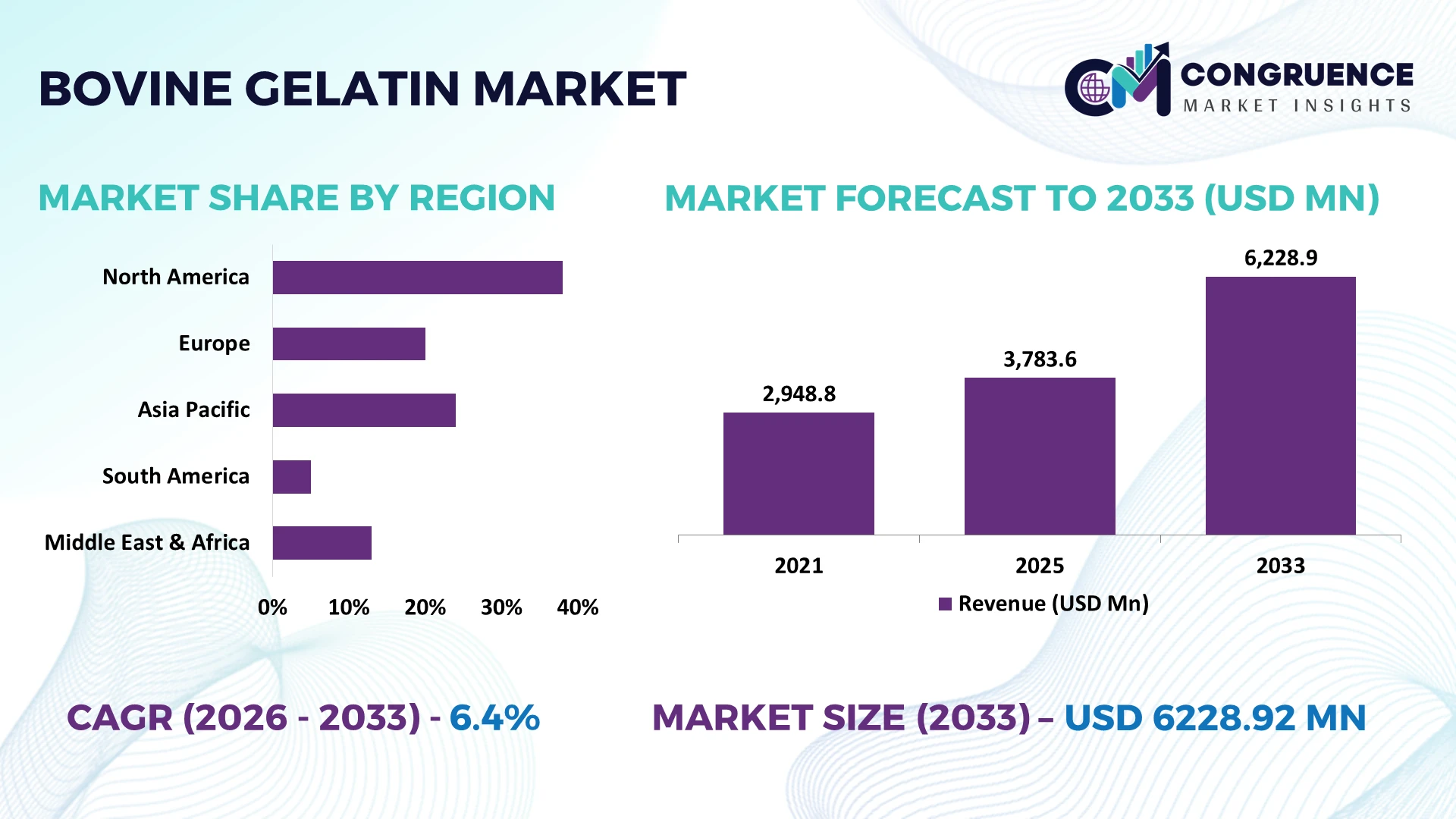
The Global Bovine Gelatin Market was valued at USD 3783.55 Million in 2025 and is anticipated to reach a value of USD 6228.92 Million by 2033 expanding at a CAGR of 6.43% between 2026 and 2033. Advanced pharmaceutical capsule manufacturing, expanding collagen peptide applications in nutraceuticals, and higher-value utilization of bovine by-products are accelerating global bovine gelatin market growth.
China accounts for nearly 27% of global bovine gelatin production capacity, supported by large pharmaceutical, confectionery, and nutraceutical industries and continuous investment in automated extraction facilities. Production capacity is approximately 2.3× higher than Germany, while digital process control has improved extraction efficiency by over 18%. Following the 2026 Red Sea shipping disruptions, manufacturers accelerated regional supply-chain diversification to strengthen raw material security and export reliability.
Companies expanding certified processing capacity and regional sourcing networks are strengthening long-term competitiveness across high-value bovine gelatin applications.
Market Size & Growth: USD 3783.55 Million in 2025, projected to reach USD 6228.92 Million by 2033 at a CAGR of 6.43%, driven by pharmaceutical-grade gelatin production and collagen processing innovation.
Top Growth Drivers: Pharmaceutical applications increased 31%, nutraceutical ingredient demand rose 24%, and premium confectionery usage expanded 18%.
Short-Term Forecast: By 2028, automated extraction systems are expected to improve production efficiency by 16% while lowering processing costs by 12%.
Emerging Technologies: AI-enabled quality inspection, automated extraction, and advanced membrane filtration improve batch consistency by approximately 20%.
Regional Leaders: Asia Pacific is projected at USD 2.8 Billion, Europe at USD 1.6 Billion, and North America at USD 1.2 Billion, supported by pharmaceutical and functional food expansion.
Consumer/End-User Trends: Functional nutrition products recorded over 28% higher bovine collagen ingredient adoption, reflecting stronger demand for clean-label formulations.
Pilot/Case Example: A 2026 automated processing initiative improved extraction yield by 14% while reducing manufacturing waste by 11% through digital process optimization.
Competitive Landscape: The top manufacturers collectively account for approximately 42% of global market share, led by Darling Ingredients, GELITA, Nitta Gelatin, Tessenderlo Group, and Weishardt.
Regulatory & ESG Impact: Improved traceability standards and energy-efficient production reduced operational emissions by nearly 15% while supporting stricter compliance requirements.
Investment & Funding: More than USD 500 Million has been invested in automation, facility expansion, and regional manufacturing partnerships amid global supply-chain realignment.
Innovation & Future Outlook: High-purity gelatin, precision extraction technologies, and digital quality management are accelerating premium product development and long-term market competitiveness.
The bovine gelatin market continues to expand across pharmaceuticals, functional foods, and nutraceutical formulations through high-purity processing technologies and advanced collagen extraction. Automated manufacturing has improved production efficiency by approximately 15%, while stricter traceability requirements and regional supply-chain optimization are reshaping procurement strategies. These developments reinforce the market's transition toward higher-value applications and set the stage for the strategic assessment that follows.
The bovine gelatin market has become strategically important as manufacturers transition from commodity ingredient production to high-value pharmaceutical, nutraceutical, and functional food applications. Supply-chain restructuring following recent global logistics disruptions has encouraged companies to diversify raw material sourcing and expand regional processing capacity, improving procurement resilience and product traceability while strengthening competitiveness in regulated end-use industries.
Modern automated extraction systems combined with digital quality monitoring improve processing efficiency by nearly 18% and reduce production losses by approximately 12% compared with conventional batch operations. China continues to lead large-scale manufacturing through integrated processing infrastructure, whereas Germany focuses on premium pharmaceutical-grade gelatin supported by advanced purification technologies. Over the next two to three years, digital production monitoring is expected to exceed 45% adoption across newly commissioned processing facilities, supporting higher consistency and lower operational variability.
One practical deployment strategy involves integrating automated extraction, digital traceability, and sustainability-certified sourcing within newly expanded manufacturing facilities to improve export readiness and regulatory compliance. Companies are increasing investments in capacity modernization, specialty gelatin development, and regional partnerships to strengthen operational resilience. Businesses combining efficient production, diversified sourcing, and certified quality management will secure stronger competitive positioning across high-value global supply chains.
Pharmaceutical manufacturing continues to represent the primary structural growth driver as hard capsules, collagen supplements, and regenerative healthcare products require high-purity bovine gelatin with consistent functionality. Pharmaceutical applications account for nearly 35% of premium gelatin demand, while automated extraction improves processing efficiency by approximately 18% and reduces batch variability by 15%. India is expanding pharmaceutical manufacturing capacity, while China continues investing in certified gelatin processing infrastructure. In response, manufacturers are expanding production facilities, strengthening partnerships with pharmaceutical companies, and implementing advanced traceability systems. This strategy enables higher-value product portfolios, stronger export competitiveness, and improved supply reliability for regulated healthcare markets.
Market expansion remains constrained by fluctuations in bovine raw material availability, stricter animal by-product regulations, and increasing compliance costs across major producing countries. Raw material procurement costs have shown periodic fluctuations of nearly 14%, while processing compliance expenses have increased by around 9% due to enhanced quality requirements. International logistics disruptions continue affecting procurement schedules and inventory planning. To minimize operational risks, manufacturers are diversifying sourcing networks, establishing long-term procurement contracts, and increasing localized processing capacity. These initiatives improve supply continuity while protecting production stability for pharmaceutical and premium food manufacturers operating under strict quality standards.
High-value applications in biomedical products, functional nutrition, and precision healthcare are creating opportunities beyond traditional food processing. Advanced extraction technologies improve protein recovery by approximately 16%, while digital process optimization reduces production waste by nearly 11%. Japan continues expanding research into pharmaceutical-grade collagen materials, supported by strong innovation capabilities and specialized manufacturing expertise. Companies are investing in research and development, expanding specialty production lines, and forming strategic partnerships with healthcare manufacturers. Developing customized gelatin grades with enhanced purity and functionality provides a competitive advantage while supporting premium product differentiation in specialized end-use industries.
Maintaining consistent pharmaceutical-grade quality across expanding production facilities remains a major execution challenge as regulatory expectations and customer quality requirements continue to evolve. More than 40% of conventional processing facilities require modernization to meet advanced digital quality management standards, while automated validation systems increase implementation complexity by nearly 20%. Germany continues raising traceability and documentation requirements for premium gelatin applications, increasing compliance expectations for international suppliers. Companies must invest in workforce training, digital manufacturing infrastructure, and real-time quality monitoring while strengthening standardized operating procedures. Successfully scaling premium production with consistent quality and operational efficiency will determine long-term competitiveness in the global bovine gelatin market.
Digital Quality Control Expansion Automated inspection systems and AI-assisted process monitoring now improve batch consistency by nearly 20% while reducing quality deviations by around 14%. Following stricter pharmaceutical compliance requirements, producers in Germany and China are integrating digital traceability into production workflows. Companies are modernizing facilities, adopting real-time monitoring platforms, and restructuring quality management processes to shorten release cycles and strengthen customer confidence.
Regional Processing Network Diversification Manufacturers are reducing dependence on single-country procurement by expanding localized sourcing and processing operations. Cross-border raw material procurement has declined by approximately 17%, while regional supplier partnerships have increased by nearly 22% since recent logistics disruptions. Companies are strengthening processing hubs in India and South America through long-term contracts, improving inventory stability and reducing transportation-related operational risks.
Premium Specialty Product Focus Pharmaceutical-grade and bioactive gelatin formulations continue replacing standard commodity products across healthcare and nutrition applications. Premium product portfolios have expanded by approximately 19%, while customized formulation demand has increased by 21%. Companies are scaling specialized production lines, investing in application-focused research, and collaborating with pharmaceutical manufacturers to improve product differentiation and long-term customer retention.
Sustainability-Centered Manufacturing Water recycling systems, energy-efficient extraction technologies, and certified raw material sourcing are becoming standard operational priorities. Modern production facilities have reduced water consumption by nearly 16% and energy intensity by approximately 13%. Increasing sustainability reporting requirements are encouraging manufacturers to automate environmental monitoring while expanding partnerships with certified suppliers to strengthen operational resilience and international market acceptance.
Hide Gelatin remains the leading product category, accounting for approximately 41% of global demand due to its consistent gel strength, broad application versatility, and reliable large-scale processing. Manufacturers continue prioritizing hide-based production because it offers stable raw material availability and efficient integration across food and pharmaceutical manufacturing. Bone Gelatin maintains strategic importance in specialized food processing and collagen extraction, while Food Grade gelatin continues supporting large-volume processed food manufacturing through cost-efficient production and established distribution networks.
Pharmaceutical Grade gelatin is emerging as the fastest-growing segment as regulated healthcare manufacturing demands higher purity, traceability, and functional consistency. Adoption has increased by approximately 23%, supported by expanding capsule manufacturing and biomedical applications. Companies are investing in dedicated pharmaceutical processing facilities, advanced purification technologies, and internationally certified production systems while strengthening partnerships with healthcare manufacturers. This investment shift reflects growing preference for premium formulations capable of delivering higher margins and long-term supply agreements.
Food & Beverages remains the largest application segment, representing approximately 38% of overall consumption because gelatin continues to serve as a stabilizer, gelling agent, and texture enhancer across dairy products, processed foods, and beverages. Confectionery remains a mature application supported by consistent production volumes, while Personal Care continues expanding through collagen-enriched cosmetic formulations and specialty skincare products.
Pharmaceuticals represent the fastest-growing application as manufacturers increase production of hard capsules, soft gels, and biomedical formulations requiring high-purity gelatin. Pharmaceutical demand has expanded by approximately 24%, while Nutraceutical applications have increased by nearly 20% through collagen peptide supplementation and functional wellness products. Companies are expanding automated manufacturing capacity, introducing specialized pharmaceutical formulations, and strengthening supply agreements with healthcare producers to improve production reliability and premium product positioning.
The Food Industry remains the largest end-user, accounting for approximately 44% of total bovine gelatin demand due to large-scale production of processed foods, dairy products, beverages, and confectionery. Established manufacturing infrastructure, consistent ingredient performance, and broad processing compatibility continue supporting high-volume procurement. The Personal Care Industry is steadily expanding as collagen-based formulations gain wider acceptance across premium skincare and cosmetic products.
The Nutraceutical Industry is the fastest-growing end-user segment, with adoption increasing by approximately 25% as collagen supplements and functional nutrition products become mainstream across preventive healthcare markets. Pharmaceutical Industry purchasing continues expanding through regulated capsule production and specialty healthcare formulations. Manufacturers are responding through customized product development, strategic partnerships, application-specific pricing strategies, and dedicated production capacity to strengthen long-term customer relationships and improve operational flexibility across specialized industries.
Asia-Pacific accounted for the largest market share at 39.8% in 2025 however, Middle East & Africa is expected to register the fastest growth, expanding at a CAGR of 7.4% between 2026 and 2033.

Advanced Pharmaceutical Integration and Premium Product Development
North America remains a strategically important bovine gelatin market due to its established pharmaceutical manufacturing base, advanced food processing infrastructure, and expanding nutraceutical production. The region contributes approximately 24% of global demand, supported by stringent quality standards and high adoption of pharmaceutical-grade gelatin across regulated industries. Nearly 16% of major processing facilities have upgraded digital quality monitoring and automated extraction systems to improve batch consistency and production efficiency. Companies are strengthening long-term procurement agreements, expanding specialty production capacity, and investing in traceability technologies to support premium healthcare applications. These operational improvements continue enhancing manufacturing reliability while reinforcing North America's position in high-value gelatin production.
United States Market Outlook: The United States represents the largest market within North America due to its extensive pharmaceutical manufacturing network and advanced nutraceutical industry. More than 60% of regional capsule production is concentrated in the country, encouraging continued investment in certified gelatin processing facilities and automated quality control systems. Manufacturers are strengthening strategic partnerships with healthcare companies while expanding specialized production capabilities to meet growing demand for regulated pharmaceutical ingredients.
Regulatory Compliance Driving Manufacturing Modernization
Europe continues to play a leading role in premium bovine gelatin production through advanced processing technologies, established manufacturing expertise, and strict regulatory compliance. The region accounts for approximately 28% of global market activity, with pharmaceutical-grade production receiving sustained industrial investment. More than 45% of large-scale facilities have implemented advanced purification systems and digital batch validation technologies to improve manufacturing consistency. Sustainability initiatives and resource-efficient processing are further modernizing production operations. Companies continue investing in premium product development, certified sourcing programs, and energy-efficient processing technologies to strengthen export competitiveness and operational performance.
Germany Market Outlook: Germany leads the European market through highly automated production facilities, advanced pharmaceutical infrastructure, and internationally recognized quality management systems. Nearly 50% of major gelatin manufacturing plants utilize digital production monitoring, improving operational consistency and supporting premium exports. Continued investment in production modernization enables manufacturers to strengthen competitiveness across pharmaceutical, biomedical, and specialized nutrition applications.
Large-Scale Manufacturing and Export Expansion
Asia-Pacific represents the largest bovine gelatin market because of its extensive food processing industry, strong pharmaceutical manufacturing capacity, and expanding nutraceutical production. The region contributes nearly 40% of global production, supported by integrated industrial supply chains and competitive manufacturing capabilities. Automated extraction technologies have improved production efficiency by approximately 18%, while continued investments in processing facilities are strengthening export capacity. Manufacturers are expanding quality-certified production lines and modernizing operational infrastructure to support growing international demand while maintaining cost-efficient large-scale manufacturing.
China Market Outlook: China dominates the regional market through its integrated pharmaceutical, confectionery, and nutraceutical manufacturing ecosystem. The country accounts for approximately 27% of global bovine gelatin production capacity and continues expanding automated extraction facilities alongside certified quality management systems. Ongoing investments in processing infrastructure and operational modernization are improving export competitiveness while supporting premium product manufacturing.
Raw Material Advantage Strengthens Processing Capacity
South America benefits from abundant livestock resources, expanding gelatin processing infrastructure, and growing value-added exports. The region contributes approximately 7% of global market activity through integrated bovine supply chains and competitive raw material availability. Processing efficiency has improved by nearly 14% following investments in automated extraction technologies and facility modernization. Although logistics infrastructure remains uneven across certain production areas, manufacturers are strengthening regional processing networks, expanding supplier partnerships, and improving production capabilities to enhance export performance and supply continuity.
Brazil Market Outlook: Brazil remains the leading market within South America because of its large cattle industry and well-developed animal by-product processing sector. More than 55% of national gelatin production capacity operates through modernized facilities equipped with advanced processing technologies. Manufacturers continue investing in quality certification, production efficiency, and export-focused operations to strengthen their position within global supply chains.
Manufacturing Investments Support Market Transformation
The Middle East & Africa market is progressing through expanding food manufacturing, pharmaceutical production, and industrial modernization initiatives. The region contributes approximately 5% of global demand, while localized ingredient manufacturing continues reducing dependence on imports. Processing infrastructure investment has increased by nearly 20%, supported by industrial diversification programs and growing domestic food production. Manufacturers are establishing regional processing facilities, expanding strategic partnerships, and strengthening supply-chain integration to improve operational stability and support higher-value bovine gelatin applications.
Saudi Arabia Market Outlook: Saudi Arabia has emerged as the region's leading market through continued investment in pharmaceutical manufacturing, food processing, and industrial diversification. More than 30% of recently announced food ingredient manufacturing projects incorporate advanced processing technologies and modern quality assurance systems. Expansion of domestic production capabilities is strengthening regional supply resilience while supporting long-term development of premium bovine gelatin manufacturing.
The competitive landscape is led by GELITA, Darling Ingredients, Nitta Gelatin, Weishardt, and Tessenderlo Group, which compete directly with regional manufacturers across China, India, and Brazil. The top five players collectively control approximately 44% of the global market, creating competition between premium technology leaders and cost-efficient regional processors. Differentiation depends on product purity, supply-chain integration, customized formulations, and production efficiency rather than pricing alone. Automated extraction technologies improve processing efficiency by nearly 18%, while digital quality management reduces batch deviations by around 15%, strengthening premium positioning. Regional manufacturers compete through localized sourcing, shorter delivery cycles, and lower processing costs averaging 10–12% below imported products. Global leaders continue expanding specialty manufacturing, strengthening pharmaceutical partnerships, and integrating upstream raw material procurement to secure stable supply. Industry consolidation increasingly favors companies controlling certified sourcing and advanced purification capabilities. Strict regulatory compliance, validated manufacturing infrastructure, and long-term customer qualification remain major entry barriers. Sustainable competitive advantage depends on combining operational scale, certified quality, diversified sourcing, and continuous product innovation.
GELITA AG
Darling Ingredients Inc.
Nitta Gelatin Inc.
Weishardt Group
Tessenderlo Group
Lapi Gelatine S.p.A.
Trobas Gelatine B.V.
Roxlor Group
Jellice Co., Ltd.
PB Gelatins GmbH
Gelnex
Sterling Gelatin
Modern bovine gelatin manufacturing is increasingly centered on automated extraction, digital process monitoring, and advanced membrane filtration technologies that improve production consistency and regulatory compliance. Automated extraction delivers approximately 18% higher processing efficiency while reducing production waste by nearly 12% compared with conventional batch processing. More than 45% of newly upgraded pharmaceutical-grade production lines now incorporate real-time quality monitoring, enabling faster batch validation and improved traceability for regulated applications.
Emerging technologies include AI-enabled quality inspection, digital traceability platforms, and precision purification systems that strengthen pharmaceutical and nutraceutical manufacturing. Compared with traditional manual inspection, AI-assisted quality control reduces inspection time by approximately 30% while improving defect detection accuracy by nearly 20%. Premium ingredient manufacturers benefit the most, as faster validation supports shorter production cycles and stronger customer qualification across healthcare supply chains.
Between 2026 and 2028, manufacturers are expected to accelerate deployment of smart manufacturing platforms, predictive maintenance, and digitally integrated quality management systems. Companies investing in connected production infrastructure, automated purification, and sustainability-focused processing will strengthen operational resilience, improve certified product consistency, and secure competitive advantages in high-value pharmaceutical, biomedical, and functional nutrition markets through faster production, lower operating costs, and stronger global supply-chain responsiveness.
March 2024 – Darling Ingredients announced a strategic alliance with an Asian collagen manufacturer to strengthen its bovine gelatin supply chain and expand regional market access. The collaboration targeted improved sourcing efficiency across Asia-Pacific, supporting faster customer deliveries and stronger operational resilience.
July 2024 – Nitta Gelatin introduced a new range of cold-water-soluble bovine gelatin products for dietary supplements and functional foods, improving formulation flexibility and faster dissolution performance. The launch strengthened the company's specialty ingredient portfolio for premium nutrition applications.
February 2025 – Nitta Gelatin India received approval to expand its Kerala gelatin production facility, increasing manufacturing capacity to support rising domestic and export demand. The expansion reinforces supply reliability and strengthens the company's long-term production footprint in India. Source: Nitta Gelatin
March 2026 – GELITA signed a research and development agreement with Black Drop to develop customized bioinks based on gelatin for advanced 3D bioprinting applications. The collaboration accelerates innovation in biomedical materials and expands high-value healthcare application opportunities. Source: GELITA
The report provides a comprehensive assessment of the bovine gelatin market across key product types, applications, end-user industries, and major geographical markets. It evaluates Bone Gelatin, Hide Gelatin, Food Grade, and Pharmaceutical Grade products while examining demand across Food & Beverages, Pharmaceuticals, Nutraceuticals, Confectionery, and Personal Care applications. The analysis also covers the Food Industry, Pharmaceutical Industry, Nutraceutical Industry, and Personal Care Industry, representing more than 90% of commercial bovine gelatin utilization.
The study delivers detailed regional assessments across North America, Europe, Asia-Pacific, South America, and the Middle East & Africa while examining manufacturing trends, supply-chain evolution, automation, digital quality management, and pharmaceutical-grade production technologies. Competitive benchmarking includes leading global manufacturers, product innovation, capacity expansion, and strategic positioning. The report supports investment evaluation, market entry planning, expansion strategy, competitive assessment, and long-term business decision-making for the 2026–2033 forecast period.
| Report Attribute/Metric | Report Details |
|---|---|
Market Revenue in 2025 | USD 3783.55 Million |
Market Revenue in 2033 | USD 6228.92 Million |
CAGR (2026 - 2033) | 6.43% |
Base Year | 2025 |
Forecast Period | 2026 - 2033 |
Historic Period | 2021 - 2025 |
Segments Covered | By Type
By Application
By End-User
|
Key Report Deliverable | Revenue Forecast, Growth Trends, Market Dynamics, Segmental Overview, Regional and Country-wise Analysis, Competition Landscape |
Region Covered | North America, Europe, Asia-Pacific, South America, Middle East, Africa |
Key Players Analyzed | GELITA AG, Darling Ingredients Inc., Nitta Gelatin Inc., Weishardt Group, Tessenderlo Group, Lapi Gelatine S.p.A., Trobas Gelatine B.V., Roxlor Group, Jellice Co., Ltd., PB Gelatins GmbH, Gelnex, Sterling Gelatin |
Customization & Pricing | Available on Request (10% Customization is Free) |




