
Reports
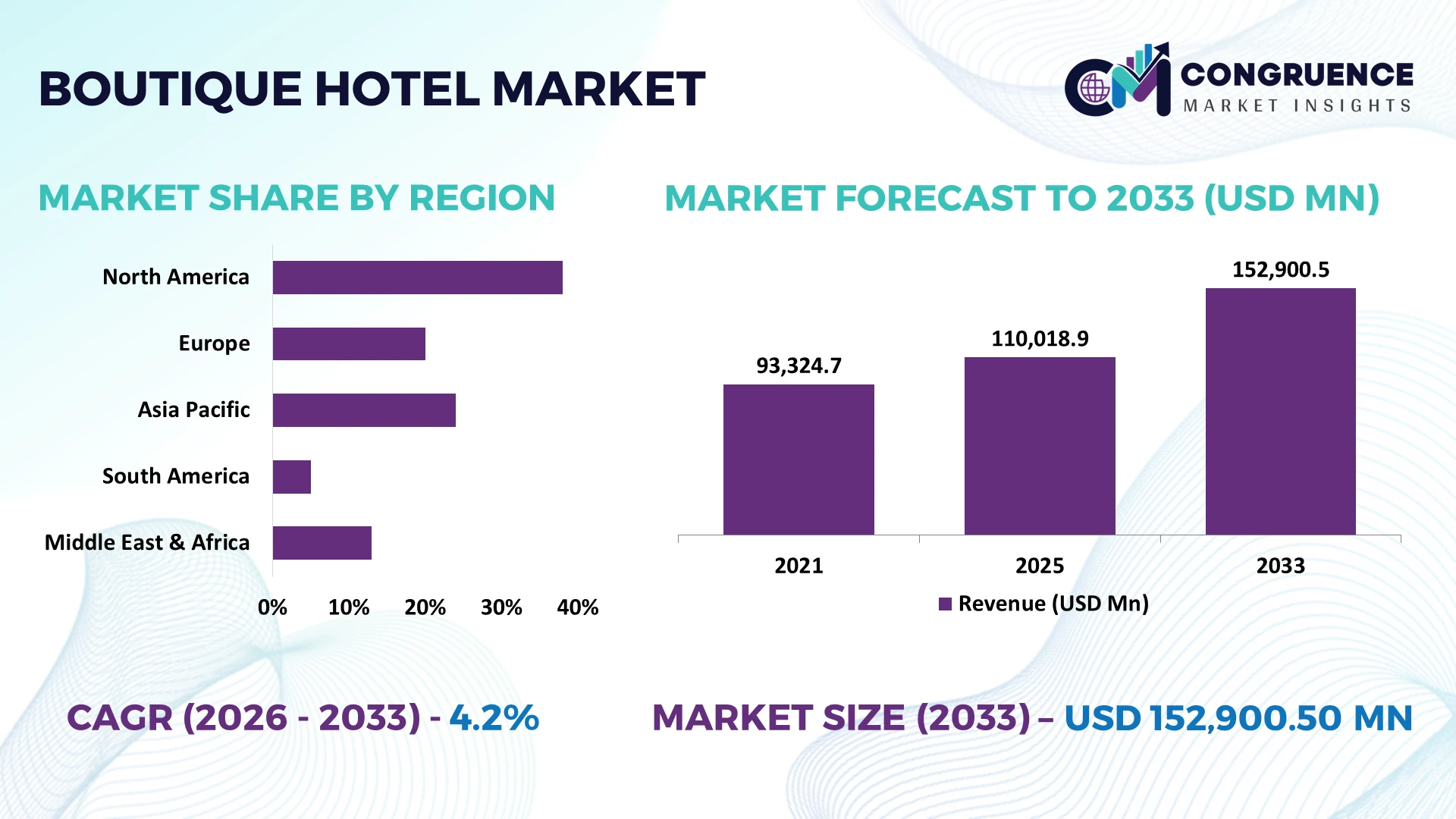
The Global Boutique Hotel Market was valued at USD 110018.9 Million in 2025 and is anticipated to reach a value of USD 152900.5 Million by 2033 expanding at a CAGR of 4.2% between 2026 and 2033. Growth is driven by experiential luxury travel, adaptive reuse of historic properties, personalized hospitality services, and independent hotel operators adopting digital distribution and revenue management platforms.
The United States represents a leading boutique hospitality market, supported by established lifestyle hotel brands, domestic tourism, and concentrated investment in urban hospitality assets. The country recorded approximately 72.4 million international visitor arrivals in 2024, compared with France's approximately 100 million, highlighting different tourism demand structures. New York, Miami, Los Angeles, and Nashville attract boutique hotel investment through entertainment, business travel, and premium leisure demand. Marriott's Autograph Collection exceeds 300 properties globally, demonstrating institutional investment in distinctive, independently styled accommodation.
Strategically, investors prioritizing differentiated locations, efficient property conversions, and technology-enabled personalization can strengthen occupancy performance and pricing resilience.
Market Size & Growth: USD 110,018.9 million in 2025, projected to reach USD 152,900.5 million by 2033 at 4.2% CAGR, supported by experiential travel.
Top Growth Drivers: International tourism recovered to approximately 99% of pre-pandemic levels in 2024, reinforcing premium leisure demand and hospitality investment.
Short-Term Forecast: By 2028, operators prioritize three performance indicators: direct booking conversion, average daily rate, and revenue per available room.
Emerging Technologies: Three technologies reshape boutique hospitality: AI-enabled guest personalization, mobile check-in, and automated revenue optimization.
Regional Leaders: North America benefits from established lifestyle brands, Europe emphasizes heritage conversions, and Asia-Pacific expands design-led accommodation across three major investment regions.
Consumer/End-User Trends: Global international tourist arrivals reached approximately 1.4 billion in 2024, strengthening demand for differentiated accommodation experiences.
Pilot/Case Example: In 2025, Marriott's Autograph Collection surpassed 300 properties globally, demonstrating the scalability of individually designed hotel portfolios.
Competitive Landscape: Marriott International, Hilton, Hyatt Hotels, IHG Hotels & Resorts, and Accor compete through lifestyle collections and independent hotel affiliations.
Regulatory & ESG Impact: The European Union's Energy Performance of Buildings Directive targets a 16% reduction in average residential primary energy use by 2030, influencing broader property efficiency investment.
Investment & Funding: Boutique hotel investment increasingly concentrates on two asset strategies: adaptive reuse and repositioning of existing hospitality properties.
Innovation & Future Outlook: By 2033, boutique operators will combine localized guest experiences, digital concierge services, and data-driven pricing across three operational priorities.
The Boutique Hotel Market is increasingly shaped by travelers seeking distinctive architecture, personalized services, neighborhood experiences, and premium accommodation outside standardized hotel formats. Independent operators and lifestyle hospitality groups are investing in heritage property conversions, curated food and beverage concepts, and mobile guest engagement platforms. International tourist arrivals recovered to approximately 99% of pre-pandemic levels in 2024, strengthening the operating environment for destination-focused properties. AI-enabled revenue management and direct booking technologies are also changing how smaller hotels compete with global chains. These developments establish the importance of location strategy, differentiated design, and operational efficiency in future hospitality investment decisions.
Boutique hotels are becoming strategically important as hospitality investors shift toward differentiated accommodation, adaptive reuse, and experience-led asset positioning. International tourist arrivals reached approximately 1.4 billion in 2024, restoring 99% of pre-pandemic volumes and strengthening destination-focused hotel investment. Established hospitality groups are expanding soft-brand collections that preserve independent property identities while providing centralized distribution, loyalty programs, and procurement capabilities. This model enables smaller hotels to access international booking channels without adopting standardized property designs.
Technology adoption is changing boutique hotel operating economics. Automated revenue management systems update room prices using demand forecasts, booking patterns, and competitor positioning, replacing manual rate adjustments with continuous optimization. Direct reservations also avoid intermediary commissions that commonly range between 10% and 25%. American operators emphasize branded distribution partnerships, while European investors prioritize heritage conversions and distinctive urban properties. Marriott's Autograph Collection, exceeding 300 hotels globally, demonstrates the commercial scalability of independent-style hospitality.
Between 2026 and 2028, operators will prioritize mobile guest services, property management integration, and energy-efficient refurbishment. Investors are expanding partnerships with hospitality technology providers and lifestyle brands to improve operating consistency. Competitive advantage will increasingly depend on distinctive property experiences supported by efficient distribution and disciplined asset management.
Experiential travel is strengthening boutique hotel demand as travelers increasingly prioritize distinctive accommodation, local culture, and personalized hospitality. International tourism recovered to approximately 99% of pre-pandemic levels in 2024, with global arrivals reaching 1.4 billion. France welcomed approximately 100 million international visitors, reinforcing demand for differentiated accommodation in established cultural destinations. In the United States, lifestyle hotel groups are expanding independently styled collections that combine distinctive design with centralized booking infrastructure. Marriott's Autograph Collection exceeds 300 properties globally, demonstrating the scalability of this operating model. Hotel owners are investing in heritage renovations, curated dining concepts, and loyalty partnerships. Properties that translate local identity into premium guest experiences strengthen pricing differentiation against standardized accommodation.
High refurbishment expenditure, labor intensity, and distribution costs constrain boutique hotel operating margins. Online travel agency commissions commonly range from 10% to 25%, reducing profitability when independent properties depend heavily on intermediary bookings. Boutique hotels also face substantial expenditure on specialized interiors, heritage preservation, and customized guest amenities. In the United Kingdom, the standard employer National Insurance contribution rate increased to 15% in April 2025, adding pressure to labor-intensive hospitality operations. Smaller properties lack the purchasing leverage of international chains, increasing exposure to construction materials and operating supply costs. Operators are negotiating longer supplier agreements, adopting direct booking technologies, and prioritizing phased renovations. Profitability increasingly depends on controlling customer acquisition costs without compromising distinctive service standards.
Adaptive reuse creates opportunities to convert historic commercial buildings into differentiated hospitality assets while preserving distinctive architectural characteristics. The United States recorded approximately 72.4 million international visitor arrivals in 2024, while France attracted around 100 million, demonstrating substantial tourism activity across mature destination markets. Independent properties can reduce intermediary dependence by strengthening direct reservations, avoiding booking commissions commonly ranging from 10% to 25%. Hospitality groups are expanding soft-brand affiliations that provide centralized distribution, loyalty access, and operational technology without eliminating local property identities. Investors in Italy, Portugal, and Japan are targeting historic urban buildings and culturally distinctive destinations. The strongest opportunity lies in combining existing architectural assets with digital guest acquisition and efficient property management.
Maintaining personalized hospitality while scaling technology-enabled operations presents a significant execution challenge. Boutique hotels typically operate with smaller room inventories than conventional full-service properties, increasing sensitivity to staffing shortages and inconsistent service delivery. International tourist arrivals recovered to approximately 99% of pre-pandemic levels in 2024, intensifying competition for experienced hospitality personnel. Digital distribution platforms also charge commissions commonly ranging from 10% to 25%, creating pressure to balance customer acquisition with profitability. In Japan, hospitality operators face workforce availability constraints alongside growing international tourism activity. Hotel groups must integrate property management systems, customer relationship platforms, and digital concierge tools without weakening personalized service. Long-term competitiveness depends on retaining skilled employees and delivering consistent guest experiences across distinctive properties.
Contactless Guest Journeys Become Standardized: Boutique operators are integrating mobile check-in, digital room access, and automated pre-arrival communication into property management systems. Digital check-in replaces multiple reception procedures with one coordinated workflow, while mobile access reduces physical key handling. Hotel groups are partnering with technology providers to simplify arrivals, improve staff allocation, and preserve personalized guest interactions.
Food Experiences Strengthen Property Differentiation: Boutique hotels are expanding chef-led dining, neighborhood partnerships, and locally sourced menus to increase guest engagement. France welcomed approximately 100 million international visitors in 2024, while Spain received approximately 93.8 million. Operators are developing destination-specific culinary concepts and collaborating with independent restaurants, strengthening their appeal beyond overnight accommodation and supporting higher-value guest experiences.
Energy Monitoring Reshapes Hotel Refurbishment: European boutique properties are upgrading building management systems, occupancy sensors, and efficient heating equipment. The revised Energy Performance of Buildings Directive requires member states to renovate the worst-performing 16% of non-residential buildings by 2030. Hotel owners are coordinating energy audits with renovation schedules, reducing inefficient equipment operation and improving compliance planning for older hospitality properties.
Guest Data Platforms Improve Service Coordination: Independent hotels are connecting reservation records, guest preferences, and service requests through integrated customer management platforms. International tourism reached approximately 1.4 billion arrivals in 2024, restoring 99% of pre-pandemic activity. Operators are adopting automated preference tracking and multilingual guest messaging, enabling smaller teams to coordinate personalized services without expanding administrative workloads proportionately.
Luxury Boutique Hotels represent a leading category within the Boutique Hotel Market, supported by premium room positioning, personalized services, and strong demand in established international tourism destinations. Properties in New York, Paris, London, and Dubai compete through distinctive interiors, curated hospitality, and exclusive guest experiences. France welcomed approximately 100 million international visitors in 2024, reinforcing the importance of destination appeal for premium accommodation. Lifestyle Boutique Hotels attract travelers seeking contemporary design, social spaces, and locally integrated hospitality concepts. International operators are expanding lifestyle collections and distribution partnerships to combine independent property identities with centralized reservations and loyalty infrastructure.
Heritage Boutique Hotels benefit from distinctive architecture and cultural positioning, particularly in European historic centers and established Asian tourism destinations. Design Boutique Hotels emphasize architectural innovation, customized interiors, and contemporary guest experiences. Marriott's Autograph Collection exceeds 300 properties globally, demonstrating institutional support for differentiated hospitality portfolios. Operators are investing in property-specific design, digital guest services, and curated food concepts. Competitive positioning increasingly depends on translating distinctive physical environments into measurable guest satisfaction and stronger booking conversion.
Leisure Travel represents the leading application within the Boutique Hotel Market, supported by destination tourism, cultural experiences, and demand for personalized accommodation. International tourist arrivals reached approximately 1.4 billion in 2024, strengthening the operating environment for leisure-focused properties. Boutique hotels in Italy, France, Thailand, and Japan compete through distinctive locations, curated local activities, and differentiated interior design. Business Travel contributes demand in financial centers and commercial districts, where travelers value convenient locations, flexible workspaces, and efficient digital services. Operators are adjusting room configurations, reservation technology, and guest experience packages to address leisure and professional travel requirements without standardizing property identities.
Wellness Tourism represents an increasingly important application as travelers seek integrated spa experiences, restorative stays, and destination-specific wellness programs. Weddings and Events support boutique hotels through private venue bookings, customized hospitality, and food service packages. France recorded approximately 100 million international visitors in 2024, illustrating the importance of destination tourism infrastructure. Hotel groups are expanding specialized wellness partnerships, event planning services, and direct reservation packages. Competitive advantage depends on aligning property facilities with specific travel purposes and improving utilization beyond conventional overnight stays.
Individual Travelers represent the leading end-user group within the Boutique Hotel Market, supported by independent booking behavior, destination exploration, and preferences for distinctive accommodation. Global international tourism reached approximately 1.4 billion arrivals in 2024, creating substantial demand across established and emerging destinations. Individual guests increasingly compare property design, location, service quality, and digital convenience before booking. Corporate Travelers represent another important segment, particularly in commercial centers where boutique properties combine premium accommodation with meeting facilities and flexible working environments. Operators are strengthening direct booking platforms, digital concierge services, and tailored corporate arrangements to improve guest acquisition and retention.
Couples represent a strategically important segment for romantic travel, destination celebrations, and premium leisure experiences. Event Organizers require properties offering coordinated accommodation, private venues, and customized hospitality services. Marriott's Autograph Collection exceeds 300 properties globally, demonstrating the operational scalability of distinctive accommodation concepts. Boutique hotel operators are developing experience packages, event partnerships, and personalized reservation services. Competitive positioning increasingly depends on matching guest expectations with property-specific amenities while maintaining efficient occupancy management and consistent service delivery.
North America accounted for the largest market share at an estimated 35% in 2025 however, Asia-Pacific is expected to register the fastest growth, expanding at a CAGR of an estimated 5.8% between 2026 and 2033.

Lifestyle Hospitality Expansion Strengthens Premium Urban Accommodation
North America maintains a leading position in the boutique hotel market through established lifestyle hospitality brands, concentrated investment in premium urban properties, and extensive domestic travel infrastructure. The United States represents the principal demand center, while Canada contributes through destination tourism and independent hospitality development. New York, Miami, Los Angeles, and Nashville attract investment in design-led hotels, adaptive property conversions, and neighborhood-focused accommodation. Marriott International, Hilton, and Hyatt are expanding lifestyle and soft-brand portfolios that combine distinctive property identities with centralized distribution and loyalty systems. The United States recorded approximately 72.4 million international visitor arrivals in 2024, reinforcing the importance of established tourism infrastructure. Boutique operators increasingly integrate digital guest services and automated pricing systems to improve operational efficiency. Regional competition emphasizes differentiated property experiences, direct booking capabilities, and disciplined asset repositioning.
United States Market Outlook: The United States benefits from extensive hospitality investment infrastructure, established hotel management companies, and strong demand for distinctive urban accommodation. Marriott's Autograph Collection exceeds 300 properties globally, demonstrating the scalability of independently styled hospitality portfolios. American operators are expanding lifestyle hotel affiliations, mobile guest services, and curated local experiences. Investors increasingly target adaptive reuse projects in established entertainment districts and commercially active neighborhoods.
Heritage Hospitality Conversions Support Distinctive Property Positioning
Europe represents a major boutique hospitality market, supported by extensive cultural tourism infrastructure, historic building inventories, and established premium accommodation destinations. France, Italy, Spain, and the United Kingdom provide concentrated opportunities for heritage conversions and design-led hotel development. France welcomed approximately 100 million international visitors in 2024, while Spain received approximately 93.8 million, illustrating the scale of tourism activity across leading destinations. European boutique operators emphasize architectural preservation, personalized hospitality, and locally integrated dining concepts. The revised Energy Performance of Buildings Directive is increasing attention to energy efficiency during property refurbishment. Hotel owners are integrating occupancy-based energy controls, efficient heating systems, and digital property management platforms. Competitive differentiation increasingly depends on balancing historic architectural character with modern operating efficiency and compliance requirements.
France Market Outlook: France maintains a strong boutique hospitality position through Parisian luxury accommodation, regional cultural tourism, and established heritage properties. Paris, Provence, Bordeaux, and the French Riviera attract investment in distinctive hotels combining historic architecture with contemporary guest services. French hospitality operators increasingly emphasize local culinary partnerships, curated cultural experiences, and premium interior design. Property renovation strategies prioritize architectural preservation and efficient building systems.
Tourism Recovery Accelerates Design-Led Hospitality Investment
Asia-Pacific is emerging as an important expansion region for boutique hospitality, supported by international tourism recovery, urban development, and demand for culturally distinctive accommodation. Japan, Thailand, India, China, and Indonesia represent major destination markets with different investment characteristics. Japan welcomed approximately 36.9 million international visitors in 2024, strengthening accommodation demand across Tokyo, Kyoto, and Osaka. Thailand's established leisure destinations support lifestyle hotel development, while India offers opportunities in heritage properties and experiential hospitality. Regional operators increasingly combine contemporary interior design with local architecture, wellness amenities, and digitally enabled guest services. International hospitality groups are expanding lifestyle brands and independent hotel affiliations through management partnerships. Competitive positioning depends on location selection, culturally relevant experiences, and operational flexibility across diverse tourism markets.
Japan Market Outlook: Japan's boutique hospitality sector benefits from established cultural tourism destinations, efficient transportation infrastructure, and distinctive architectural traditions. Kyoto attracts investment in converted traditional townhouses, while Tokyo supports contemporary design hotels serving international leisure and business travelers. Japan's tourism authorities recorded approximately 36.9 million international arrivals in 2024. Operators are expanding multilingual guest services, automated check-in, and locally curated accommodation experiences to address international visitor demand.
Destination Tourism Supports Independent Hospitality Development
South America's boutique hotel market is shaped by cultural tourism, nature-based travel, and investment in distinctive accommodation across established leisure destinations. Brazil represents a major regional market, while Argentina, Colombia, Chile, and Peru contribute through urban tourism and destination-focused hospitality. Brazil welcomed approximately 6.77 million international visitors in 2024, strengthening accommodation demand in Rio de Janeiro, São Paulo, and coastal leisure destinations. Boutique hotel operators emphasize localized design, regional cuisine, and personalized guest services to differentiate from standardized accommodation. Investment activity includes renovations of historic urban properties and smaller destination resorts. Infrastructure limitations, uneven air connectivity, and construction financing costs influence project feasibility. Operators are strengthening digital distribution partnerships and prioritizing locations with established tourism access to improve occupancy resilience.
Brazil Market Outlook: Brazil's boutique hotel market benefits from diverse leisure destinations, cultural attractions, and extensive domestic tourism activity. Rio de Janeiro, Paraty, Salvador, and Florianópolis support distinctive accommodation concepts combining local architecture and experiential hospitality. Hotel operators are investing in mobile reservation platforms, curated dining experiences, and property renovations. Domestic travel demand provides an important operating foundation alongside international tourism, supporting investment beyond major metropolitan centers.
Luxury Tourism Diversification Accelerates Hospitality Investment
The Middle East & Africa boutique hotel market is influenced by tourism diversification, premium hospitality investment, and expanding cultural destination development. Saudi Arabia and the United Arab Emirates represent major investment centers, while Morocco, South Africa, and Egypt support heritage hospitality and destination tourism. Saudi Arabia's Vision 2030 strategy targets 150 million annual domestic and international tourist visits by 2030, strengthening hospitality infrastructure development. The UAE continues expanding luxury accommodation and lifestyle hospitality concepts across Dubai and Abu Dhabi. Boutique operators increasingly emphasize distinctive architecture, personalized services, and culturally integrated guest experiences. International hospitality groups are entering through management agreements and lifestyle brand partnerships. Competitive positioning depends on destination accessibility, specialized hospitality staffing, and the ability to deliver differentiated experiences within expanding tourism ecosystems.
Saudi Arabia Market Outlook: Saudi Arabia is developing boutique hospitality opportunities through cultural tourism, heritage restoration, and large-scale destination investment. AlUla, Diriyah, and the Red Sea tourism developments support demand for distinctive accommodation concepts. Vision 2030's tourism strategy encourages investment in hospitality infrastructure and specialized guest experiences. Hotel operators are developing partnerships with international lifestyle brands, local designers, and hospitality training providers to strengthen service capabilities.
Marriott International, Hilton, Hyatt, Accor, and IHG compete through lifestyle collections, loyalty ecosystems, and independent hotel affiliations, while Ennismore and regional boutique operators emphasize design identity and destination experiences. The top five groups' combined boutique hotel market share remains undisclosed because portfolio classifications and ownership structures differ. Competition centers on distribution costs, guest personalization, property conversion speed, and brand flexibility. Online travel agency commissions commonly range from 10% to 25%, encouraging direct booking investment. Marriott's Autograph Collection exceeds 300 properties globally, demonstrating the scale achievable through soft-brand partnerships. Operators are expanding management agreements, integrating revenue optimization technology, and converting existing buildings instead of relying exclusively on new construction. The competitive shift favors asset-light expansion supported by centralized reservations and localized experiences. Heritage renovation requirements, prime-location scarcity, and guest acquisition costs constrain entrants. Winning requires distinctive positioning, disciplined conversion economics, distribution control, and consistently personalized service.
Marriott International, Inc.
Hilton Worldwide Holdings Inc.
Hyatt Hotels Corporation
Accor S.A.
InterContinental Hotels Group PLC
Ennismore
Minor Hotels
Rosewood Hotel Group
Mandarin Oriental Hotel Group
Standard International
CitizenM
Firmdale Hotels
Boutique hotels increasingly integrate cloud property management systems, automated revenue optimization, mobile check-in, and digital guest communication platforms. Cloud software connects reservations, housekeeping, billing, and guest preferences through centralized workflows. Compared with manual pricing, automated revenue management enables more frequent rate adjustments and reduces administrative intervention. Direct booking engines also help operators avoid online travel agency commissions commonly ranging between 10% and 25%. Independent hotels benefit from stronger distribution control and more consistent operational reporting.
Emerging technologies include AI-assisted concierge services, predictive maintenance, smart room controls, and integrated customer relationship platforms. Mobile access systems reduce physical key handling, while occupancy sensors adjust lighting and climate settings according to room utilization. European hotel refurbishment increasingly incorporates energy monitoring alongside building automation, reflecting tighter efficiency requirements. International hospitality groups are integrating these capabilities across lifestyle collections, while smaller operators adopt modular platforms to limit installation complexity and preserve customized guest experiences.
Between 2026 and 2028, technology investment will increasingly target unified guest profiles, automated service coordination, and real-time property performance dashboards. Hotels connecting booking behavior with service preferences gain stronger personalization capabilities than properties operating disconnected systems. Technology partnerships will become critical for independent operators lacking dedicated engineering teams. Competitive advantage will depend on implementation quality, employee adoption, and measurable improvements in guest acquisition efficiency and service delivery.
February 2025: IHG Hotels & Resorts acquired the Ruby brand, comprising 20 operating hotels and 3,483 rooms. The acquisition strengthened IHG's premium urban lifestyle portfolio and introduced a conversion-friendly hospitality model designed for expansion across international city destinations. Source: ihgplc.com
September 2025: Hilton expanded its partnership with Small Luxury Hotels of the World to more than 450 properties. The collaboration extended boutique accommodation distribution through Hilton Honors, strengthening independent hotel visibility, international booking access, and loyalty-driven customer acquisition. Source: stories.hilton.com
May 2025: Hyatt introduced Unscripted by Hyatt, targeting independent upscale hotels through flexible brand standards and adaptive reuse. More than 40 properties entered active discussions, establishing a conversion-oriented expansion channel that preserves individual hotel identities and local character. Source: costar.com
January 2025: Ennismore announced plans to open more than 20 hotels and 35 food-and-beverage destinations during 2025. The program expanded lifestyle hospitality across Australia, Ireland, and other destinations, integrating distinctive accommodation with destination dining and entertainment experiences. Source: hospitalitynet.org
The Boutique Hotel Market Report examines industry development from 2026 to 2033 across four accommodation types: Luxury Boutique Hotels, Lifestyle Boutique Hotels, Heritage Boutique Hotels, and Design Boutique Hotels. Application coverage includes Leisure Travel, Business Travel, Weddings and Events, and Wellness Tourism. End-user analysis evaluates Individual Travelers, Corporate Travelers, Couples, and Event Organizers. Technology assessment covers automated revenue management, mobile check-in, guest personalization, cloud property management, and energy-efficient building systems.
Regional coverage encompasses North America, Europe, Asia-Pacific, South America, and the Middle East & Africa, examining destination competitiveness, property conversions, hospitality infrastructure, and investment activity. Competitive analysis evaluates international hotel groups, independent operators, distribution partnerships, and differentiated service models. The report supports asset acquisition, refurbishment planning, geographical expansion, and hospitality technology investment while identifying strategic opportunities in heritage accommodation, lifestyle collections, and experiential tourism.
| Report Attribute/Metric | Report Details |
|---|---|
Market Revenue in 2025 | USD 110018.9 Million |
Market Revenue in 2033 | USD 152900.5 Million |
CAGR (2026 - 2033) | 4.2% |
Base Year | 2025 |
Forecast Period | 2026 - 2033 |
Historic Period | 2021 - 2025 |
Segments Covered | By Type
By Application
By End-User
|
Key Report Deliverable | Revenue Forecast, Growth Trends, Market Dynamics, Segmental Overview, Regional and Country-wise Analysis, Competition Landscape |
Region Covered | North America, Europe, Asia-Pacific, South America, Middle East, Africa |
Key Players Analyzed | Marriott International, Inc., Hilton Worldwide Holdings Inc., Hyatt Hotels Corporation, Accor S.A., InterContinental Hotels Group PLC, Ennismore, Minor Hotels, Rosewood Hotel Group, Mandarin Oriental Hotel Group, Standard International, CitizenM, Firmdale Hotels |
Customization & Pricing | Available on Request (10% Customization is Free) |