
Reports
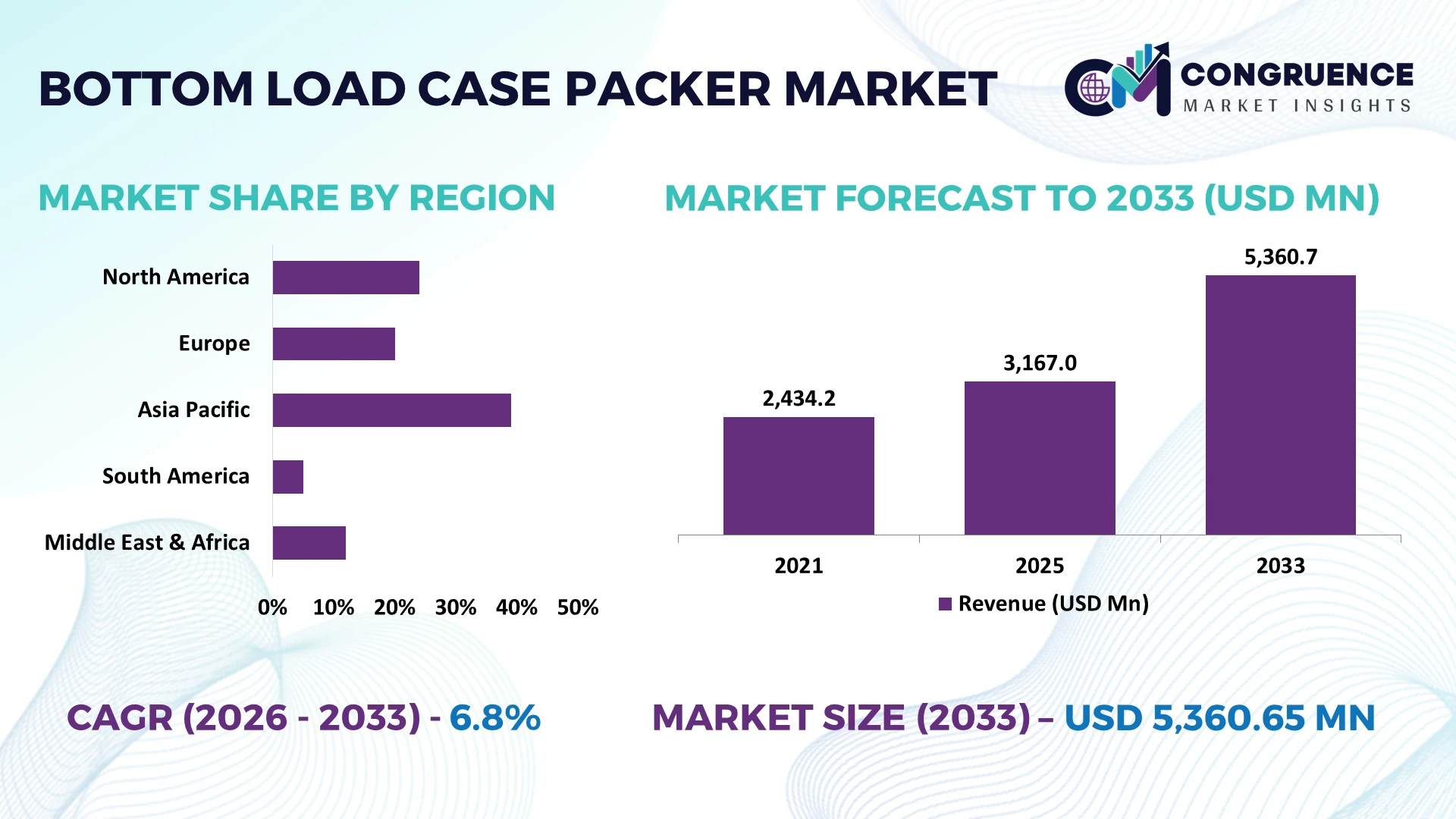
The Global Bottom Load Case Packer Market was valued at USD 3167 Million in 2025 and is anticipated to reach a value of USD 5360.65 Million by 2033 expanding at a CAGR of 6.8% between 2026 and 2033. Growth is driven by end-of-line labor automation, servo-controlled gentle handling of fragile products, faster SKU changeovers, and integration of case packing with robotic palletizing, inspection, labeling, and connected production controls.
The United States remains the strongest technology and deployment hub, supported by a packaging-machinery industry where shipments reached USD 10.9 billion in 2023 after 5.8% growth; 72% of surveyed packaging and processing end users now utilize robotics. Food, beverage, pharmaceutical, bakery, and CPG plants lead installations, while modern bottom-load systems achieve approximately 98% uptime and sub-20-minute changeovers. Compared with European plants increasingly adapting equipment for circular-packaging requirements, U.S. manufacturers face stronger productivity and labor-automation pressures: 78% of surveyed packaging stakeholders rank productivity as a top priority, versus 47% identifying automation. Europe’s regulatory pressure intensified as EU packaging rules became applicable in August 2026 and require all packaging to be recyclable by 2030.
Strategically, suppliers combining bottom-load handling, servo motion, rapid format changes, robotics connectivity, and lifecycle support are positioned to capture the highest-value modernization projects.
Market Size & Growth: USD 3,167 million in 2025 advances to USD 5,360.65 million by 2033 at 6.8% CAGR, supported by automated end-of-line packaging, SKU proliferation, and labor-saving line modernization.
Top Growth Drivers: Productivity is prioritized by 78% of surveyed packaging stakeholders, while cost and automation each register 47%, reinforcing investment in high-efficiency automated case handling.
Short-Term Forecast: By 2028, advanced installations will increasingly target 98% equipment uptime and changeovers below 20 minutes, reducing production interruptions across multi-SKU food and consumer-product lines.
Emerging Technologies: Servo motion, machine vision, robotic handling, digital recipe management, and Industry 4.0 connectivity are reshaping case packing; robotics already operates within 72% of surveyed packaging and processing end-user facilities.
Regional Leaders: North America, Europe, and Asia-Pacific form the three principal investment centers; regional USD splits are not disclosed in authoritative bottom-load-specific datasets, making unsupported regional revenue allocations unsuitable for decision-grade analysis.
Consumer/End-User Trends: Food, beverage, pharmaceuticals, bakery, cosmetics, and FMCG operations increasingly require flexible handling; commercial systems support cases from roughly 200–600 mm long and speeds reaching 25 cases per minute.
Pilot/Case Example: Current Massman bottom-load technology reports 98% verified uptime under multi-shift operation, while tool-less changeovers require less than 20 minutes, demonstrating measurable operational gains from servo-controlled automation.
Competitive Landscape: The global supplier base remains fragmented rather than controlled by a verified single-share leader; established competitors include Massman Automation, JLS Automation, Schneider Packaging Equipment, BluePrint Automation, and Cama Group.
Regulatory & ESG Impact: EU policy requires all packaging to become recyclable by 2030, while the established recycling target reaches 70% by weight, accelerating machinery compatibility with redesigned corrugated cases and material-efficient packaging.
Investment & Funding: U.S. packaging machinery shipments reached USD 10.9 billion in 2023, providing a measurable investment proxy as manufacturers fund new plants, line upgrades, automation, and resilient end-of-line infrastructure.
Innovation & Future Outlook: With 72% robotics penetration among surveyed packaging end users, competitive differentiation is shifting toward integrated case packing, robotic palletizing, predictive diagnostics, common PLC architectures, and rapid recipe-driven format conversion.
Bottom load case packers are gaining strategic importance in food, beverage, bakery, pharmaceutical, and consumer-goods lines requiring gentle handling of bags, trays, fragile containers, and difficult-to-pick products. Robotics already reaches 72% of surveyed packaging end users, while servo elevators, vision integration, digital recipes, and sub-20-minute changeovers strengthen flexibility. EU recyclable-packaging requirements add another operational catalyst, setting up the strategic discussion ahead.
Bottom load case packers are becoming strategically important as manufacturers redesign end-of-line packaging around labor productivity, SKU flexibility, and higher equipment utilization. Packaging operations increasingly integrate case packing with robotics, vision inspection, conveying, and palletizing rather than purchasing isolated machines. This digital shift is reinforced by EU packaging rules pushing producers toward recyclable formats and material-efficient secondary packaging, increasing demand for equipment capable of handling redesigned cases without extensive mechanical modification.
Modern servo-driven bottom-load systems can deliver approximately 98% uptime and complete tool-less format changeovers in under 20 minutes, outperforming legacy mechanically intensive equipment that requires longer manual adjustments. The United States leads deployment through large food, beverage, pharmaceutical, and consumer-goods plants; 72% of surveyed packaging and processing end users already deploy robotics, while European investment places greater emphasis on packaging-material compatibility and circularity.
A practical installation combines servo case elevators, robotic product loading, recipe-controlled changeovers, and downstream palletizing within one synchronized cell. Through 2026–2028, manufacturers will prioritize integrated controls, predictive diagnostics, and flexible handling as automation penetration advances. Equipment suppliers are consequently expanding engineering partnerships and lifecycle services. Competitive advantage will increasingly depend on delivering measurable uptime, rapid SKU transitions, and integration-ready packaging architectures.
Persistent manufacturing labor constraints are accelerating investment in automated case forming, bottom loading, sealing, and palletizing. In packaging and processing facilities, 72% of surveyed end users already use robotics, while 78% of packaging stakeholders identify productivity as a leading operational priority and 47% prioritize automation. U.S. food, beverage, pharmaceutical, and household-product plants are therefore replacing labor-intensive secondary packaging with servo-driven integrated cells. The structural shift toward fewer manual touchpoints improves throughput consistency while reducing repetitive handling requirements. A less obvious advantage is workforce redeployment: automation moves operators from continuous loading toward line supervision and exception management. Machinery suppliers are responding by integrating robotic loading, machine vision, common controls, remote diagnostics, and palletizing through partnerships and expanded engineering capabilities.
Brownfield integration remains a structural limitation because case packers must interface with existing conveyors, upstream fillers, case erectors, safety systems, and downstream palletizers. With 47% of packaging stakeholders identifying cost as a major priority, capital discipline directly affects automation approvals, while approximately 28% of surveyed end users still operate without robotics. U.S. plants containing mixed generations of PLCs and legacy mechanical equipment face particularly difficult integration economics because electrical, guarding, floor-space, and controls modifications can expand project scope beyond the packer itself. The overlooked constraint is changeover economics: automation loses value when legacy upstream equipment remains the bottleneck. Suppliers are reducing deployment risk through modular cells, standardized communication architectures, retrofit engineering, phased automation contracts, and local service inventories rather than requiring complete line replacement.
The strongest opportunity lies in transforming standalone bottom-load machines into software-connected flexible packaging cells. Robotics penetration has reached 72% among surveyed packaging end users, while modern equipment can achieve approximately 98% uptime and format changeovers below 20 minutes. Between 2026 and 2028, AI-assisted vision, condition monitoring, digital recipes, robotic product orientation, and predictive maintenance will increasingly support high-mix manufacturing. In India, expanding packaged-food, pharmaceutical, personal-care, and contract-manufacturing capacity creates an attractive entry point for modular automation that avoids highly customized line architecture. A non-obvious opportunity is data monetization: machine performance information enables preventive-service contracts and optimization services beyond equipment sales. Suppliers are strengthening R&D, controls partnerships, regional engineering support, and modular platforms that connect case packing directly with inspection and palletizing.
Scaling advanced case-packing technology requires more than installing robotics; manufacturers must maintain controls interoperability, cybersecurity, skilled technicians, reliable vision systems, and synchronized production data. Although 72% of surveyed packaging end users use robotics, the remaining 28% highlights a persistent automation-readiness gap, while achieving approximately 98% uptime requires disciplined preventive maintenance and controls expertise. U.S. manufacturers increasingly operate interconnected packaging cells where one PLC, sensor, network, or robotic fault can interrupt several downstream processes simultaneously. The strategic challenge therefore shifts from machine reliability toward system-level resilience. Connected equipment also expands industrial cybersecurity exposure as remote diagnostics become standard. Suppliers and manufacturers must invest in workforce training, standardized interfaces, segmented industrial networks, remote-support capabilities, spare-parts planning, and systems-integration partnerships to preserve consistent multi-shift performance.
High-Mix Production Reshapes Changeovers: Beverage manufacturers are restructuring lines for shorter runs and greater SKU diversity, with nearly 90% planning machinery purchases and 68% expecting increased equipment investment. Paper-based packaging usage is projected to rise 43%. Bottom-load OEMs are responding with recipe-driven servo adjustments, tool-less change parts, and modular handling architectures.
Reliability Becomes Procurement Priority: Equipment purchasing is shifting from maximum rated speed toward lifecycle performance and serviceability. In 2026, 69% of surveyed U.S. end users rated reliability and uptime as very important when selecting machinery OEMs, while robotics penetration reached 72%. Suppliers are expanding remote diagnostics, standardized components, spare-parts programs, and post-installation technical support.
Flexible Formats Alter Machine Design: Material transitions are forcing case-packing systems to accommodate greater variation in package rigidity and geometry. Beverage companies anticipate paper-based packaging increasing 43%, flexible formats 30%, and liquid cartons 16%. Machine builders are consequently redesigning guides, gripping systems, product collating, and servo motion profiles for gentler, format-independent handling.
Line Intelligence Moves Upstream: Packaging plants are connecting case packers with production data, inspection, coding, and downstream automation instead of operating isolated assets. Productivity ranks first for 78% of surveyed packaging stakeholders, versus 47% for both cost and automation. OEMs are standardizing digital diagnostics and interoperable controls, making commissioning quality a competitive differentiator.
RSC Case Packers represent the leading type, accounting for an estimated 35% of bottom load case packer deployments because regular slotted cases remain widely standardized across food, beverage, household, and consumer-goods distribution. Their established corrugated supply chain, straightforward sealing, and compatibility with automated conveying support high-volume installations. Wraparound systems account for approximately 27%, gaining preference where tighter cases, material optimization, and stable pallet loads justify additional forming complexity.
Robotic Packers are the fastest-growing type and represent roughly 23% of installations as articulated and delta robots improve product orientation, mixed-format handling, and recipe-based changeovers. Their strategic advantage strengthens in plants processing frequent SKU rotations rather than continuous single-format production. Tray Packers retain approximately 15%, particularly for shelf-ready beverages, cans, and bundled products. Suppliers are shifting engineering resources toward modular robotic platforms while retaining RSC and wraparound architectures for predictable high-throughput applications, creating a portfolio strategy that balances installed-base economics with flexible automation.
Case Packing leads application demand with an estimated 38% share, reflecting its direct role in secondary packaging for distribution, warehousing, and palletization. High-throughput food, beverage, pharmaceutical, and consumer-product facilities favor integrated bottom-load configurations because they combine product collation, case handling, loading, and closing within synchronized lines. Bottle Packing represents approximately 22%, supported by beverages, personal care, and household liquids where controlled placement reduces container damage and line instability.
Bag Packing is the fastest-growing application, approaching 17% of deployment as snacks, pouches, pet food, and flexible consumer formats expand. Bottom loading provides an operational advantage for products that deform or become difficult to side-load consistently. Can Packing remains important for beverages and shelf-stable foods, while Cartoning addresses smaller-format multipacks and retail-ready configurations. OEM investment is therefore moving toward adaptable infeed technology, vision-guided orientation, servo collating, and robotic handling that allow one platform to accommodate bags, bottles, cans, and cases with fewer mechanical conversions.
Food & Beverage is the dominant end-user group, representing an estimated 46% of bottom load case packer demand because high line speeds, extensive SKU portfolios, sanitation requirements, and continuous secondary-packaging operations create strong automation economics. Consumer Goods account for approximately 19%, supported by high-volume distribution and retail-ready packaging. Household Products and Personal Care increasingly require flexible systems capable of handling bottles, pouches, cartons, and promotional multipacks without prolonged mechanical changeovers.
Pharmaceuticals are the fastest-growing end-user group, representing approximately 13% of installations as serialization, traceability, controlled handling, and production flexibility increase machinery requirements. Pharmaceutical buyers place greater emphasis on validation, documentation, machine accessibility, and digital controls than conventional FMCG plants. Suppliers are responding with hygienic configurations, validated recipe management, vision inspection interfaces, and integrated track-and-trace capability. Competitive positioning increasingly depends on vertical-specific engineering rather than standardized machinery, particularly where pharmaceutical compliance and food sanitation impose materially different operating requirements.
North America accounted for the largest market share at approximately 35% in 2025 however, Asia-Pacific is expected to register the fastest growth, expanding at a CAGR of approximately 8.1% between 2026 and 2033.
Automation-Led Packaging Modernization
North America represents the largest deployment base, supported by concentrated food, beverage, pharmaceutical, household-product, and consumer-goods manufacturing in the United States and Canada. Approximately 72% of surveyed packaging and processing end users use robotics, reinforcing demand for servo-controlled case packing, vision-guided product handling, and integrated palletizing. Automated changeovers and machines capable of processing both legacy and emerging packaging formats are becoming central to capital-equipment selection. U.S. processors increasingly specify common controls, remote diagnostics, recipe management, and modular infeed systems to reduce commissioning complexity. Canada maintains a smaller but technologically mature machinery base, particularly across food processing and packaged consumer products. Labor availability and higher equipment prices are sharpening ROI scrutiny, pushing OEMs toward flexible platforms that consolidate multiple secondary-packaging operations while improving utilization and minimizing manual intervention.
United States Market Outlook: The United States anchors regional demand through its extensive CPG production infrastructure and established packaging-equipment ecosystem. Packaging machinery sales increased 4.7% in 2024, while manufacturers increasingly prioritize servo-driven automation and automatic changeovers. Large processors are directing capital toward integrated cells combining case loading, inspection, sealing, conveying, and robotic palletizing rather than standalone machinery.
Circular Packaging Reshapes Equipment Design
Europe combines advanced machinery engineering with increasingly stringent packaging requirements, making flexibility and material compatibility central purchasing criteria. Germany and Italy provide deep packaging-machinery manufacturing capabilities, while France, the Netherlands, and the United Kingdom sustain strong demand from food, beverage, pharmaceutical, and personal-care processors. EU packaging regulation is accelerating redesign toward recyclable formats, forcing case packers to accommodate changing board grades, dimensions, lightweight structures, and retail-ready configurations. German packaging-machinery output increased 8.9% in 2025, demonstrating continued industrial capacity despite difficult manufacturing conditions. European OEMs are consequently prioritizing servo motion, energy-efficient drives, modular changeovers, digital diagnostics, and PPWR-compatible packaging concepts. The competitive advantage increasingly lies in processing multiple sustainable secondary-packaging formats on one platform without sacrificing throughput, positioning flexible bottom-load architectures favorably in brownfield modernization programs.
Germany Market Outlook: Germany remains Europe’s strongest packaging-machinery technology center, with roughly 120 manufacturers represented within VDMA’s dedicated packaging machinery division. Its engineering base spans feeding, sorting, cartoning, filling, secondary packaging, and complete lines. German manufacturers increasingly combine digitalization, hygienic design, energy optimization, and sustainable packaging compatibility, strengthening their position in sophisticated export-oriented bottom-load applications.
Manufacturing Scale Accelerates Automation
Asia-Pacific is shifting from labor-intensive secondary packaging toward automated case handling as food processing, beverages, pharmaceuticals, personal care, and export manufacturing expand. China provides the largest industrial scale, while Japan leads high-precision automation and India offers substantial greenfield potential. Rising factory wages, SKU proliferation, and multinational quality requirements are increasing deployment of servo packers, robotics, vision inspection, and integrated conveyor systems. China’s extensive packaged-food and consumer-goods manufacturing ecosystem favors high-throughput platforms, whereas India increasingly requires modular equipment offering lower initial complexity and scalable automation. Japan’s mature manufacturers emphasize compact footprints and reliability. The strategic shift is toward locally engineered systems incorporating globally standardized controls, reducing dependence on imported turnkey lines. OEMs are expanding local integration, component sourcing, application engineering, and aftermarket capabilities to compete on lifecycle economics rather than equipment price alone.
China Market Outlook: China combines enormous food, beverage, pharmaceutical, e-commerce, and consumer-product production with increasingly sophisticated factory automation. Manufacturers are replacing manual packing stations with robotic and servo-driven equipment as labor economics change. Domestic machinery suppliers increasingly compete through localized components and faster service, while multinational OEMs retain advantages in high-speed integration, controls architecture, and complex multi-format applications.
Food Processing Drives Modernization
South American demand is concentrated around Brazil’s food, beverage, household-product, and personal-care manufacturing corridors, with Argentina, Chile, and Colombia providing secondary deployment opportunities. Brazil’s food industry produced 288 million tonnes in 2025, creating substantial secondary-packaging requirements across meat, dairy, bakery, beverages, processed foods, and export products. Manufacturers invested heavily in plant modernization and technology while absorbing a 5.1% increase in production costs, strengthening the operational case for automation that reduces waste and repetitive labor. Currency volatility and imported-component exposure nevertheless complicate machinery procurement and maintenance economics. Equipment suppliers are responding through Brazilian service operations, localized components, financing flexibility, and retrofit-oriented configurations. The strongest projects combine bottom loading with existing conveyors and palletizers rather than requiring complete line replacement, improving capital efficiency for established processing plants.
Brazil Market Outlook: Brazil provides the region’s clearest automation opportunity because its food industry invested R$41.3 billion during 2025, including R$26.7 billion directed toward innovation, plant modernization, and new technologies. Large processors increasingly prioritize productivity-enhancing equipment that supports export-quality packaging while managing labor, energy, packaging-material, and agricultural input cost pressures.
Localization Investment Expands Automation
Middle East & Africa deployment remains concentrated in Gulf food and beverage manufacturing, South African processing, pharmaceuticals, bottled products, and large consumer-goods facilities. Saudi Arabia and the UAE are strengthening domestic manufacturing and food-security infrastructure, increasing requirements for automated secondary packaging that supports higher local production volumes and consistent export-quality presentation. Gulf plants favor turnkey lines with centralized controls because greenfield facilities allow case packing, conveying, inspection, and palletizing to be engineered together. South African installations are more frequently shaped by brownfield modernization and capital discipline. A key operational constraint remains imported machinery and component dependence, making aftermarket responsiveness strategically important. Suppliers are therefore strengthening distributor networks, technical training, regional spare-parts inventories, and local integration partnerships while positioning modular systems for processors moving progressively from manual to automated packaging.
Saudi Arabia Market Outlook: Saudi Arabia stands out through industrial localization under Vision 2030 and expanding domestic food, beverage, pharmaceutical, and consumer-goods capacity. Local food manufacturing already supplies more than 80% of domestic food requirements in several product categories, increasing the relevance of reliable end-of-line automation. Greenfield factories provide particularly favorable conditions for integrated bottom-load packing and palletizing cells.
Bottom load case packer competition pits global automation specialists such as Cama Group, BluePrint Automation, SOMIC Packaging, Massman Automation Designs, and Douglas Machine against application-focused regional integrators. The top five suppliers are estimated to control roughly 30–35% of specialized deployments, leaving substantial space for engineered-to-order competitors. Technology increasingly outweighs basic machine price: advanced servo architectures can support changeovers below 20 minutes, while modern platforms target approximately 98% uptime and robotics already operates at 72% of surveyed packaging end users. Suppliers compete through modular machine platforms, vision integration, robotic loading, lifecycle service, and application engineering; regional firms counter with 10–20% lower implementation costs and faster local support. Partnerships with robotics, controls, and conveyor specialists are replacing isolated equipment development. The competitive shift favors integrated cells over standalone packers. Engineering customization, installed-service capability, validation expertise, and controls interoperability remain formidable entry barriers. Winning requires dependable throughput, rapid format flexibility, strong integration capability, and responsive aftermarket support.
Cama Group
BluePrint Automation
SOMIC Packaging
Massman Automation Designs
Douglas Machine
Schneider Packaging Equipment
JLS Automation
Serpa Packaging Solutions
AFA Systems
Fallas Automation
Brenton Engineering
Delkor Systems
Mpac Group
Senzani Brevetti
Servo motion, recipe-driven controls, machine vision, and robotic loading define current bottom-load case-packing technology. Robotics is already deployed by 72% of surveyed packaging end users, while automated format adjustment can make changeovers up to 70% faster. Compared with legacy equipment requiring two-to-four-hour manual changeovers, modern servo systems completing changes in about 10 minutes deliver roughly 92–96% time reduction, raising line availability and SKU flexibility.
Emerging systems combine delta or articulated robots, intelligent gripping, digital twins, multi-camera fault capture, and secure PLC/HMI diagnostics. Integrated robotic case handling can increase throughput by 28% and cut labor costs by 35% in practical packaging upgrades. Connected diagnostics further improve maintenance response by linking machine-sequence video with error logs, while modular platforms support multiple RSC, tray, and wraparound formats without dedicated machinery, lowering operational complexity.
Through 2026–2028, disruptive value will concentrate in AI-assisted vision, predictive maintenance, autonomous carton replenishment, and interoperable case-packing/palletizing cells. Suppliers offering integrated controls and lifecycle analytics benefit most because customers increasingly prioritize uptime over standalone machine speed. With modern platforms reaching 32 cycles per minute and automated carton feeding removing recurring manual intervention, early adopters gain faster format response, lower staffing exposure, and stronger utilization across high-mix production on packaging lines.
September 2024 Cama North America automated Blue Bell Creameries’ multipack case packing with a wraparound system, helping deliver 28% higher throughput and 35% lower labor costs while enabling consistent automated handling of irregular frozen-dessert multipacks across two lines. Source: PackagingWorld
October 2024 JLS Automation demonstrated an integrated sausage packaging line pairing dual IP69K delta robots with its Osprey sanitary case packer, linking thermoforming, case forming, packing, and sanitary conveyance to strengthen hygienic end-of-line automation for food processors’ operations. Source: FoodEngineering
September 2025 Wexxar Bel unveiled three next-generation case-handling systems for PACK EXPO Las Vegas, including robotic case erecting and automatic sealing platforms, expanding flexible end-of-line automation choices for manufacturers running diverse case formats and production scales across facilities. Source: ProcessingMagazine
August 2026 SOMIC Packaging announced North American introduction of the SOMIC 202 alongside Eagle and Connect digital services; the 202 handles RSC or flat blanks at up to 20 packs per minute, strengthening compact automated case-packing deployment capabilities. Source: SOMIC
The Bottom Load Case Packer Market report evaluates equipment demand across Wraparound, RSC Case Packers, Tray Packers, and Robotic Packers, with application coverage spanning Case Packing, Cartoning, Bottle Packing, Can Packing, and Bag Packing. End-user analysis covers Food & Beverage, Pharmaceuticals, Personal Care, Household Products, and Consumer Goods, while regional assessment includes North America, Europe, Asia-Pacific, South America, and Middle East & Africa.
Technology coverage examines servo motion, robotic loading, machine vision, digital recipe control, predictive diagnostics, and integrated case-packing/palletizing cells. With robotics already deployed by roughly 72% of surveyed packaging end users, the report tracks the shift toward flexible, high-mix automation and compact retrofit platforms. It also evaluates niche opportunities in sanitary packaging, shelf-ready formats, and digitally connected service models, supporting investment planning, geographic expansion, competitive benchmarking, partnership decisions, and technology positioning through 2033.
| Report Attribute/Metric | Report Details |
|---|---|
Market Revenue in 2025 | USD 3167 Million |
Market Revenue in 2033 | USD 5360.65 Million |
CAGR (2026 - 2033) | 6.8% |
Base Year | 2025 |
Forecast Period | 2026 - 2033 |
Historic Period | 2021 - 2025 |
Segments Covered | By Type
By Application
By End-User
|
Key Report Deliverable | Revenue Forecast, Growth Trends, Market Dynamics, Segmental Overview, Regional and Country-wise Analysis, Competition Landscape |
Region Covered | North America, Europe, Asia-Pacific, South America, Middle East, Africa |
Key Players Analyzed | Cama Group, BluePrint Automation, SOMIC Packaging, Massman Automation Designs, Douglas Machine, Schneider Packaging Equipment, JLS Automation, Serpa Packaging Solutions, AFA Systems, Fallas Automation, Brenton Engineering, Delkor Systems, Mpac Group, Senzani Brevetti |
Customization & Pricing | Available on Request (10% Customization is Free) |




