
Reports
The Global Bot Services Market was valued at USD 804.87 Million in 2025 and is anticipated to reach a value of USD 2964.42 Million by 2033 expanding at a CAGR of 17.7% between 2026 and 2033. Growth is driven by enterprise migration from rule-based chatbots toward LLM-powered conversational agents, automated customer-service workflows, multilingual virtual assistants, and cloud-native bot orchestration across BFSI, telecom, retail, healthcare, and travel.
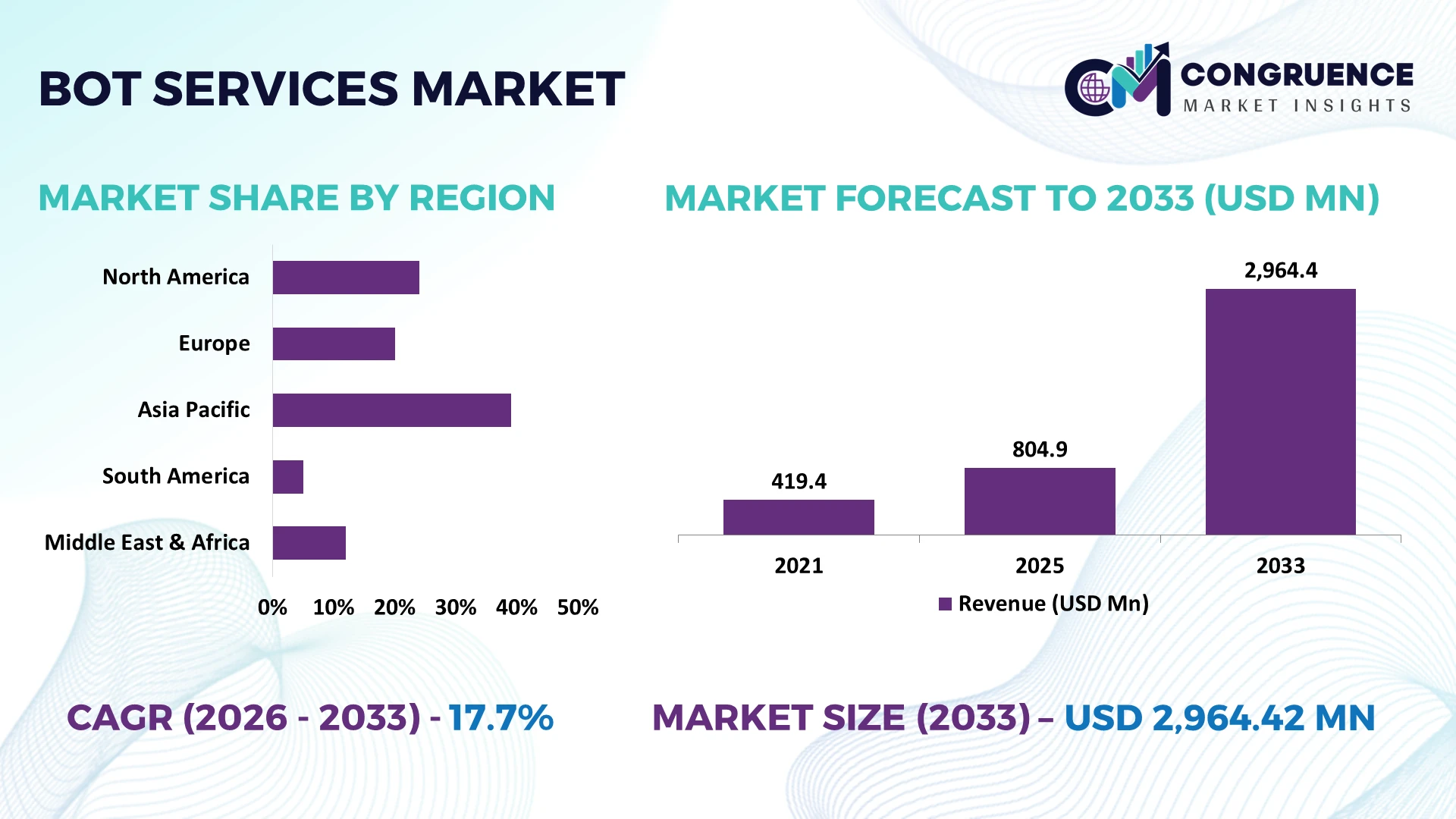
The United States anchors global bot-services adoption, supported by North America’s 31.2% market share and an 81.2% U.S. share of the regional market, versus Canada’s 10.3%. Microsoft’s USD 13 billion OpenAI investment strengthened the domestic AI ecosystem, while BFSI, telecom, retail, and healthcare accelerate production deployments. China provides the strongest geopolitical technology counterweight, with generative-AI adoption reaching 42.8% and 602 million users.
Strategically, vendors should prioritize enterprise-grade agentic automation, regulated-industry integrations, multilingual deployment, and U.S.–Asia expansion rather than standalone FAQ chatbot functionality.
Market Size & Growth: USD 804.87 million in 2025 is projected to reach USD 2,964.42 million by 2033 at 17.7%, driven by LLM-enabled enterprise automation.
Top Growth Drivers: 47% enterprise chatbot scaling, 70% customer-contact reduction in a major deployment, and 84% faster bot response demonstrate measurable automation economics.
Short-Term Forecast: By 2028, advanced deployments will increasingly target above-50% routine-contact containment as agentic AI replaces scripted conversational workflows.
Emerging Technologies: Agentic AI, retrieval-augmented generation, and multimodal bots are advancing rapidly; 20% of surveyed enterprises already report scaling AI agents.
Regional Leaders: North America is projected at USD 6.09 billion, Asia Pacific USD 5.19 billion, and Europe USD 4.38 billion by 2030 under broader industry benchmarks.
Consumer/End-User Trends: 47% of enterprises are scaling chatbots, showing movement from experimental assistants toward embedded customer-service and employee-support infrastructure.
Pilot/Case Example: Ryanair’s 2024 AI assistant achieved 94% answer accuracy, reduced service contacts per passenger by 70%, and cut response time 84%.
Competitive Landscape: Microsoft holds approximately 19% share, followed by AWS at about 15%; IBM, Google, Oracle, Kore.ai, and Salesforce intensify platform competition.
Regulatory & ESG Impact: EU AI Act Article 50 became applicable in August 2026, requiring customer-facing AI systems to disclose automated interaction clearly.
Investment & Funding: Microsoft’s USD 13 billion OpenAI investment highlights the capital shift toward foundation models, cloud infrastructure, strategic partnerships, and scalable enterprise agents.
Innovation & Future Outlook: China reached 602 million generative-AI users and 42.8% adoption, strengthening global competition around multilingual agents, sovereign AI infrastructure, and localized bot ecosystems.
Bot services are increasingly concentrated around customer support, IT service management, banking interactions, e-commerce assistance, healthcare administration, and employee workflows. Generative AI, retrieval-augmented responses, voice automation, and autonomous agents are replacing rigid decision-tree bots, while 47% of enterprises report scaling chatbot deployments. EU AI transparency requirements now reinforce governance-by-design, positioning secure agentic automation as the market’s next strategic battleground.
Bot services are becoming strategic enterprise infrastructure as companies move from scripted customer-service chatbots toward generative and agentic systems capable of executing multi-step workflows. In 2025, 62% of surveyed organizations were at least experimenting with AI agents, while 23% were already scaling agentic systems. The EU AI Act’s transparency requirements, effective from August 2026, are simultaneously shifting investment toward governed, auditable conversational AI architectures.
The technology advantage increasingly comes from workflow execution rather than simple response automation. Sicredi’s generative-AI assistant improved queries resolved without specialist escalation by 10–12% and reduced abandoned support calls by 8%, demonstrating an operational advantage over conventional support processes. India is advancing particularly quickly: 59% of business leaders reported using agents to automate team-level workstreams, while 93% intended to extend workforce capabilities through agents within 12–18 months.
During 2026–2028, investment will concentrate on multi-agent orchestration, retrieval-augmented generation, enterprise knowledge integration, and domain-specific assistants. Companies are expanding partnerships with cloud, CRM, contact-center, and cybersecurity providers to move pilots into production. The strategic differentiator will be reliable workflow automation: providers combining trusted enterprise data, interoperable agents, governance controls, and measurable task completion will secure stronger competitive positioning.
Enterprise migration from conversational assistance toward autonomous workflow execution is the strongest structural driver. Globally, 46% of business leaders reported using agents to fully automate workflows or business processes, while 62% of surveyed organizations were experimenting with AI agents and 23% were scaling agentic systems. India is moving faster, with 59% of leaders already using agents to automate team-level workflows. Customer service, IT support, knowledge management, marketing, and product development are becoming primary deployment environments. This transition expands bot services from query handling into task execution across connected enterprise applications. Technology vendors are responding through agent platforms, cloud partnerships, API integration, and orchestration investments. The strategic advantage is workflow density: connecting one bot architecture across multiple systems increases automation coverage without requiring separate interfaces for every process.
Enterprise data fragmentation is restricting the conversion of bot pilots into reliable production systems. Nearly two-thirds of enterprises have experimented with AI agents, yet fewer than 10% have scaled them to deliver tangible value, while 80% identify data limitations as an obstacle to agentic-AI scaling. Governance compounds this problem: 63% of breached organizations globally lacked an AI governance policy or were still developing one. The EU’s August 2026 transparency requirements also require organizations deploying interactive AI to provide appropriate disclosure, increasing compliance requirements for customer-facing bots. Poor data quality directly reduces retrieval accuracy, workflow reliability, and deployment economics. Companies are responding by modernizing data architectures, implementing governed retrieval layers, strengthening access controls, and adopting hybrid deployment models. Data readiness, rather than model availability, is increasingly the decisive scalability constraint.
Multi-agent automation creates an opportunity to extend bot services into complete operational processes rather than isolated conversations. Currently, 23% of organizations are scaling agentic AI somewhere in their businesses, another 39% are experimenting, yet no individual business function exceeds 10% scaled agent adoption. That deployment gap leaves substantial whitespace in IT service management, banking operations, healthcare administration, procurement, commerce, and enterprise knowledge workflows. India provides an attractive expansion environment, with 93% of leaders intending to use agents to extend workforce capabilities within 12–18 months and 64% prioritizing productivity improvements. Providers are investing in specialized agents, retrieval-augmented architectures, low-code orchestration, and cloud ecosystem partnerships. A particularly valuable opportunity is cross-functional agent reuse, where common identity, knowledge, and orchestration infrastructure supports multiple departmental bots and lowers incremental deployment effort.
Long-term scalability depends on controlling cybersecurity exposure as bots gain permission to access data and execute business actions. Globally, 13% of organizations reported breaches involving AI models or applications; among affected organizations, 97% lacked proper AI access controls, while 60% of AI-related incidents compromised data and 31% caused operational disruption. India illustrates the execution gap particularly clearly: only 37% of organizations reported having AI access controls, while nearly 60% lacked established AI governance policies or were still developing them. Autonomous agents amplify conventional chatbot risk because compromised credentials or incorrect tool execution can propagate across interconnected workflows. Providers must therefore invest in identity controls, agent permissions, continuous monitoring, human-in-the-loop escalation, and security testing. Competitive durability will depend on proving that autonomous execution remains observable, reversible, and consistently governed at enterprise scale.
Service Agents Enter Production: Customer-service AI agents are moving rapidly from experimentation into operational deployment. Adoption among service organizations increased from 39% in 2025 to 66% in 2026, a 1.7-fold increase, while 70% of adopters reported measurable value within 60 days. Companies are expanding AI-agent deployments across customer-facing and internal workflows, emphasizing resolution quality, contextual handoffs, and CRM integration rather than basic ticket deflection.
Human-Agent Workflows Reshape Operations: Enterprises are redesigning work around coordinated digital and human labor. Around 46% of business leaders report using agents to automate complete workstreams, while 29% of leaders save at least one hour daily using AI. In India, 57% of leaders expect teams to build multi-agent systems. Companies are restructuring workflows and creating AI-specific roles to supervise increasingly autonomous bot operations.
Enterprise Data Becomes Bot Infrastructure: Bot performance increasingly depends on proprietary data rather than model capability alone. Around 72% of CEOs identify proprietary data as essential for unlocking generative-AI value, while 68% consider integrated enterprise-wide data architecture critical for collaboration. However, 50% report disconnected technology resulting from rapid investment. Enterprises are consolidating knowledge repositories, APIs, retrieval layers, and data governance to improve bot accuracy and cross-functional execution.
Service Metrics Shift Toward Outcomes: Bot programs are moving beyond deployment counts toward measurable customer and workforce outcomes. Service teams estimate AI currently handles about 30% of cases and expect this to reach 50% by 2027, while AI-enabled representatives spend 20% less time on routine cases. Companies are consequently measuring resolution, customer satisfaction, containment, and escalation quality while reallocating human capacity toward complex interactions.
Chatbots account for approximately 47% of Bot Services Market demand, supported by established deployment across websites, mobile applications, messaging platforms, CRM environments, and enterprise knowledge systems. Their dominance reflects lower integration complexity, scalable text-based interactions, and broad applicability across customer and employee workflows. Voice Bots represent a more specialized segment as banks, telecom operators, and contact centers replace conventional IVR with conversational speech interfaces. Social Bots remain relevant for automated engagement and monitoring, while Service Bots increasingly support structured internal and customer-facing workflows.
Autonomous Bots represent the fastest-growing strategic category as generative AI shifts bot functionality from responding to requests toward planning and executing multi-step tasks. Around 23% of organizations were already scaling agentic AI somewhere in their businesses during 2025, while another 39% were experimenting. Companies are consequently redirecting product investment toward tool-enabled autonomous agents, multi-agent orchestration, retrieval-augmented generation, and governed execution. Investment priorities are moving from interface development toward reasoning, enterprise connectivity, and task completion.
Customer Support represents approximately 35% of Bot Services Market application demand, reflecting large interaction volumes, standardized service workflows, and immediate opportunities for automated resolution. Bots increasingly manage order status, account queries, troubleshooting, appointment scheduling, and knowledge retrieval before escalating complex cases. Sales & Marketing deployments focus on lead qualification, recommendations, conversational commerce, and campaign engagement, while Data Management bots increasingly assist with enterprise search, extraction, classification, and knowledge access.
Process Automation is emerging as the fastest-growing application as agentic systems move beyond conversation into multi-step workflow execution. Approximately 46% of business leaders reported organizations using agents to fully automate workflows or business processes, demonstrating the transition from assistance toward execution. IT Support is also strengthening through automated ticket triage, password assistance, incident resolution, and employee self-service. Providers are integrating bots with CRM, ERP, ITSM, and workflow platforms, shifting investment toward orchestration capabilities that allow one bot environment to execute processes across multiple enterprise systems.
Banking accounts for approximately 28% of Bot Services Market end-user demand, supported by high transaction volumes, 24/7 servicing requirements, authentication workflows, regulatory documentation, and extensive digital-channel infrastructure. Banks deploy bots for account servicing, payment assistance, fraud-related inquiries, onboarding, and employee knowledge access. Telecommunications remains another established buyer because billing, plan management, troubleshooting, and subscriber support generate large repetitive interaction volumes. Healthcare adoption concentrates on scheduling, administrative assistance, patient navigation, and internal service workflows.
Retail is emerging as the fastest-growing end-user segment alongside closely connected E-commerce deployments as conversational search, product discovery, order management, personalized recommendations, and post-purchase support converge. Retailers increasingly require bots capable of maintaining context across digital storefronts, applications, messaging channels, and service environments. Healthcare providers are progressing more cautiously because data sensitivity and workflow validation raise deployment requirements. Vendors are responding with verticalized models, regulated-data controls, industry-specific integrations, and ecosystem partnerships rather than relying on standardized horizontal chatbot products.
North America accounted for the largest market share at 30.15% in 2025 however, Asia-Pacific is expected to register the fastest growth, expanding at a CAGR of 32.5% between 2026 and 2033.
Enterprise AI Orchestration Defines Regional Leadership
North America maintains the strongest Bot Services Market position through concentrated cloud infrastructure, early enterprise AI deployment, and the presence of Microsoft, Google, AWS, IBM, Salesforce, OpenAI, and Kore.ai. Large enterprises are moving beyond standalone chatbots toward agents embedded across CRM, service management, marketing, and internal knowledge workflows. In 2025, 24% of business leaders reported organization-wide AI deployment, while 46% said agents were already automating complete workstreams or business processes. Financial services, retail, healthcare, telecom, and technology companies provide the deepest deployment base. Enterprise buyers increasingly prioritize security controls, retrieval architecture, multi-agent orchestration, and governed access to proprietary data. Vendors are consequently strengthening cloud partnerships and platform interoperability rather than competing solely on conversational accuracy, making ecosystem depth a critical regional competitive advantage.
United States Market Outlook: The United States dominates North American bot-services deployment because of hyperscale cloud capacity, enterprise software concentration, and advanced AI-development ecosystems. U.S.-based technology companies lead foundation-model integration, agent platforms, and developer tooling. Microsoft reported more than 230,000 organizations actively using Copilot Studio, while customers created over 3 million AI agents during FY2025, reinforcing the country’s advantage in converting conversational AI into enterprise workflow infrastructure.
Regulated AI Deployment Reshapes Enterprise Architecture
Europe is developing a governance-intensive Bot Services Market where regulated deployment, multilingual capability, and enterprise modernization increasingly determine vendor selection. In 2025, 20% of EU enterprises used AI technologies, rising from 13.5% in 2024, while adoption among large enterprises reached 55%. Written-language analysis was used by 12% of businesses and generation of written or spoken language by 9%, directly supporting conversational automation and enterprise bot deployment. The EU AI Act is accelerating investment in disclosure controls, documentation, human oversight, and risk-classification capabilities. Banks, insurers, telecom operators, public services, and industrial companies are therefore favoring bot architectures with strong governance, localization, and data-residency controls. Providers are adapting through sovereign-cloud partnerships, European data hosting, multilingual NLP, and policy-aware orchestration, creating a market where compliance capability increasingly functions as a commercial differentiator.
Germany Market Outlook: Germany offers one of Europe’s strongest enterprise deployment bases because of its industrial scale, regulated financial sector, and extensive business-software ecosystem. In 2025, 26% of German companies used AI, increasing to 57% among enterprises with at least 250 employees. However, 62% of non-users cited unclear legal consequences and 60% cited privacy concerns, reinforcing demand for governed and auditable bot architectures.
Scale and Mobile-First Deployment Accelerate Adoption
Asia-Pacific is emerging as the fastest-moving Bot Services Market as enterprises combine large digital-user bases, mobile-first commerce, expanding cloud capacity, and rapid agentic-AI adoption. China, India, Japan, South Korea, Singapore, and Australia are scaling conversational automation across banking, telecommunications, commerce, logistics, and enterprise operations. China recorded 602 million generative-AI users by December 2025, with national adoption reaching 42.8%, while 42 large-scale intelligent-computing clusters strengthened domestic AI infrastructure. India is simultaneously accelerating enterprise deployment, with 59% of business leaders already using agents to automate team-level workflows and 93% intending to extend workforce capacity through agents. Vendors are localizing language models, expanding cloud availability, and integrating bot services with messaging, payments, and digital-commerce platforms. The region’s strategic advantage lies in combining high interaction volumes with increasingly sophisticated AI infrastructure.
India Market Outlook: India is becoming a major enterprise bot-services deployment hub through its large digital workforce, software-services ecosystem, and rapid adoption of agentic automation. Around 90% of business leaders identified 2025 as a pivotal year for redesigning strategy around AI, while 57% expect teams to build multi-agent systems. PwC India also recorded 70% employee adoption of its internal AI platform within seven months, demonstrating strong organizational readiness.
Enterprise AI Adoption Broadens Beyond Large Firms
South America’s Bot Services Market is being shaped by expanding cloud adoption, customer-service modernization, digital banking, and growing enterprise access to packaged AI platforms. Brazil provides the largest operational base, supported by mature fintech, telecom, retail, and e-commerce ecosystems. AI adoption among Brazilian companies increased from 13% in 2024 to 17% in 2025, while adoption among large enterprises rose from 38% to 50%. Among AI-using businesses, natural-language generation increased from 20% to 30%, directly strengthening the addressable base for bot services. However, deployment remains uneven across company sizes and infrastructure maturity. Providers are responding with SaaS-based conversational platforms, local implementation partners, Portuguese-language capabilities, and managed services. The non-obvious opportunity lies in smaller enterprises, where packaged bots reduce implementation complexity and narrow the historical automation gap with large organizations.
Brazil Market Outlook: Brazil combines the region’s strongest enterprise scale with advanced banking, payments, telecom, and digital-commerce activity. Approximately 93,475 Brazilian companies used some form of AI in 2025, while 80% of AI-using firms acquired ready-made software and 60% hired external suppliers for development or adaptation. This favors bot-service vendors offering configurable platforms, implementation support, and localized workflow integration rather than infrastructure-heavy custom deployments.
Digital Government Investment Expands Bot Infrastructure
The Middle East & Africa Bot Services Market is increasingly influenced by state-backed digital transformation, cloud infrastructure investment, smart-city programs, and modernization of government and financial services. Saudi Arabia and the UAE are establishing the strongest deployment environments through sovereign AI initiatives, Arabic-language models, digital-government platforms, and data-center expansion. Saudi government entities reached 74.69% readiness for emerging-technology adoption in 2025, compared with 70.70% in 2024, strengthening the foundation for automated citizen-service and administrative bots. Banking, aviation, telecom, public services, and tourism are becoming priority deployment verticals. Infrastructure remains less uniform across African economies, encouraging cloud-based and managed bot models. Providers are responding through Arabic NLP development, sovereign-cloud partnerships, local data hosting, and public-sector alliances, positioning localization and infrastructure availability as decisive market-access factors.
Saudi Arabia Market Outlook: Saudi Arabia is emerging as the region’s most infrastructure-intensive AI market through Vision 2030 programs, sovereign investment, and large-scale digital-government modernization. A new Red Sea AI data-center initiative targets approximately 100 MW of initial capacity, while government technology-readiness scores continue rising. These investments strengthen the operating environment for Arabic-language bots, intelligent public services, enterprise agents, and high-volume automated customer interactions.
Microsoft, Google, IBM, AWS, Salesforce, and specialist conversational-AI vendors such as Kore.ai compete across enterprise bot orchestration, cloud deployment, customer service, and agentic automation. The top five players collectively control approximately 48% of the market, creating moderate concentration while leaving specialist vendors room in vertical applications. Competition increasingly centers on model accuracy, integration depth, deployment speed, and governance; generative-AI assistants have delivered 14% productivity improvement, while advanced service deployments demonstrate 10–12% higher resolution without specialist escalation. Microsoft and Google leverage cloud ecosystems, IBM emphasizes governed enterprise AI, Salesforce integrates agents with CRM data, and specialists compete through customization and industry workflows. Partnerships with cloud, CRM, ITSM, and contact-center providers are replacing standalone chatbot strategies. The competitive shift favors multi-agent orchestration and retrieval-augmented architectures over scripted bots. Proprietary data access, cybersecurity, integration complexity, and enterprise trust remain entry barriers. Winning requires interoperable agents, measurable automation outcomes, vertical expertise, and production-grade governance at scale.
Microsoft Corporation
Google LLC
Amazon Web Services
IBM Corporation
Salesforce, Inc.
Oracle Corporation
SAP SE
ServiceNow, Inc.
Kore.ai
LivePerson, Inc.
Cognigy
Yellow.ai
Amelia
Rasa Technologies Inc.
Generative AI, retrieval-augmented generation, natural-language understanding, and cloud orchestration currently define enterprise bot architecture. AI-enabled customer-service tools have demonstrated approximately 14% productivity improvement, while retrieval-based systems improve response grounding by connecting models with controlled enterprise knowledge. Agentic AI is gaining deployment momentum, with 23% of surveyed organizations already scaling agents and another 39% experimenting. Companies integrating bots with CRM, ITSM, ERP, and contact-center platforms gain broader workflow coverage and reduce dependence on isolated conversational interfaces.
Emerging multi-agent systems coordinate specialized bots across customer service, IT operations, sales, and knowledge management. Compared with legacy rule-based automation, Sicredi’s generative-AI implementation improved queries resolved without specialist escalation by 10–12% and reduced abandoned support calls by 8%. Voice AI, multimodal interaction, semantic retrieval, and smaller domain-specific models are further improving accessibility and deployment economics. Cloud-platform vendors benefit from integration scale, while specialist providers compete through vertical customization and orchestration flexibility.
During 2026–2028, disruptive development will center on autonomous execution, persistent context, agent-to-agent communication, and governed tool use. Enterprises will increasingly require identity controls, observability, human escalation, and auditable decision paths. Providers combining secure enterprise data, domain-specific reasoning, multimodal interfaces, and interoperable agents will gain operational advantage as bot technology shifts from conversational assistance toward dependable digital workforce infrastructure.
January 2024 Kore.ai secured $150 million in growth funding led by FTV Capital, with NVIDIA participating, to accelerate generative-AI product development and workforce expansion. The investment strengthened Kore.ai’s capacity to scale enterprise conversational automation globally across major industries. Source: techcrunch.com
May 2025 Microsoft introduced multi-agent orchestration in Copilot Studio, enabling specialized agents to collaborate across workflows. More than 230,000 organizations, including 90% of Fortune 500 companies, were already using Copilot Studio, strengthening enterprise-scale bot interoperability across business functions. Source: microsoft.com
March 2025 ServiceNow agreed to acquire Moveworks for $2.85 billion in cash and stock, combining agentic AI, enterprise search, and workflow automation. The transaction expanded ServiceNow’s ability to deliver unified employee-facing AI assistance across complex enterprise systems globally. Source: sec.gov
July 2026 IBM introduced the Agentic Control Plane in watsonx Orchestrate across AWS and IBM Cloud, centralizing governance, monitoring, scheduling, and agent reuse. The two-cloud deployment strengthened enterprise control over increasingly fragmented multi-agent environments and production operations worldwide. Source: ibm.com
The Bot Services Market report evaluates deployment across Chatbots, Voice Bots, Social Bots, Service Bots, and Autonomous Bots, with Chatbots representing approximately 47% of current type demand. Application coverage includes Customer Support, Sales & Marketing, Process Automation, Data Management, and IT Support, while end-user analysis examines Banking, Retail, Healthcare, Telecommunications, and E-commerce adoption patterns.
Regional assessment covers North America, Europe, Asia-Pacific, South America, and Middle East & Africa, including country-level technology adoption and infrastructure readiness. The report evaluates generative AI, retrieval-augmented generation, voice intelligence, multi-agent orchestration, and autonomous workflow execution, supported by enterprise signals such as 23% of organizations already scaling agentic AI. Strategic analysis identifies competitive positioning, deployment barriers, partnership models, emerging autonomous-bot opportunities, and investment priorities, helping stakeholders structure expansion, technology portfolios, and market-entry decisions through 2026–2033.
:::
| Report Attribute/Metric | Report Details |
|---|---|
Market Revenue in 2025 | USD 804.87 Million |
Market Revenue in 2033 | USD 2964.42 Million |
CAGR (2026 - 2033) | 17.7% |
Base Year | 2025 |
Forecast Period | 2026 - 2033 |
Historic Period | 2021 - 2025 |
Segments Covered | By Type
By Application
By End-User
|
Key Report Deliverable | Revenue Forecast, Growth Trends, Market Dynamics, Segmental Overview, Regional and Country-wise Analysis, Competition Landscape |
Region Covered | North America, Europe, Asia-Pacific, South America, Middle East, Africa |
Key Players Analyzed | Microsoft Corporation, Google LLC, Amazon Web Services, IBM Corporation, Salesforce, Inc., Oracle Corporation, SAP SE, ServiceNow, Inc., Kore.ai, LivePerson, Inc., Cognigy, Yellow.ai, Amelia, Rasa Technologies Inc. |
Customization & Pricing | Available on Request (10% Customization is Free) |




