
Reports
The Global Boat and Ship Telematics Market was valued at USD 3221.32 Million in 2025 and is anticipated to reach a value of USD 7466.56 Million by 2033 expanding at a CAGR of 11.08% between 2026 and 2033. Growth is driven by real-time vessel tracking, satellite connectivity, predictive maintenance, and automated fuel and route optimization across commercial and recreational fleets.
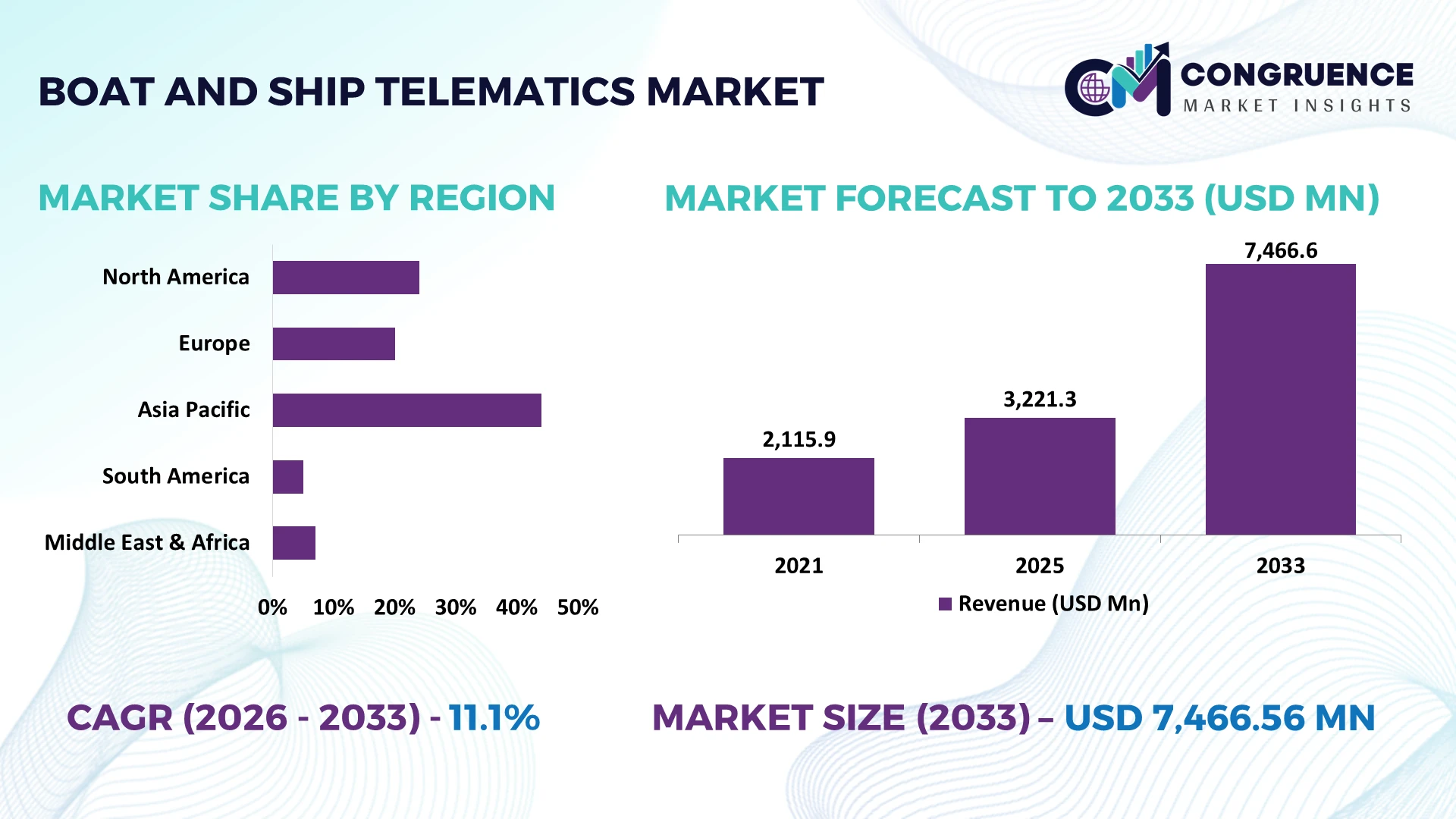
North America holds the leading position with approximately 40% market share, supported by commercial shipping, defense, offshore energy, and recreational boating. The U.S. accounts for more than 90% of regional demand, while maritime technology investments are accelerating AI-enabled navigation, remote monitoring, and connected fleet management. Europe follows with stronger emissions-compliance adoption, while Asia Pacific is expanding faster through port modernization and smart-shipping investments.
Strategically, providers should prioritize AI-enabled fleet intelligence and satellite-connected solutions in North America while scaling cost-efficient platforms across Asia Pacific and Europe.
Market Size & Growth: USD 3.22 billion in 2025 to USD 7.47 billion by 2033 at 11.08%, driven by connected fleet optimization.
Top Growth Drivers: Fleet tracking 35%, predictive maintenance 30%, fuel optimization 25%.
Short-Term Forecast: By 2028, advanced telematics can reduce vessel downtime by 8–12%.
Emerging Technologies: AI analytics, satellite-IoT, edge computing and autonomous navigation are reshaping fleet intelligence.
Regional Leaders: North America USD 2.25 billion, Europe USD 1.38 billion and Asia Pacific USD 1.59 billion in 2025.
Consumer/End-User Trends: Commercial vessels represent approximately 46%, making fleet monitoring a core adoption segment.
Pilot/Case Example: 2025 smart-vessel deployments achieved approximately 10–15% improvements in fuel-management efficiency.
Competitive Landscape: North America leads at 40%; major players include Garmin, ORBCOMM, Wärtsilä, Kongsberg Maritime and Furuno.
Regulatory & ESG Impact: Digital compliance and emissions monitoring are driving 10%+ growth in connected monitoring requirements.
Investment & Funding: More than USD 400 million in maritime AI and autonomy investment is accelerating connected-vessel innovation.
Innovation & Future Outlook: AI-based predictive analytics, autonomous systems and satellite connectivity will shift fleets toward real-time, integrated maritime intelligence.
The Boat and Ship Telematics Market is gaining traction across commercial fleets, offshore vessels, recreational boats, and port operations as operators prioritize real-time tracking, predictive maintenance, fuel optimization, and remote diagnostics. AI-enabled analytics, satellite-IoT connectivity, and edge computing are advancing vessel intelligence, while connected monitoring adoption is rising by approximately 10–15%. Stricter maritime emissions monitoring and supply-chain visibility are accelerating integration, creating a strong transition toward strategic fleet digitalization.
Boat and ship telematics is becoming strategically important as fleet operators shift from basic vessel tracking toward integrated intelligence for navigation, maintenance, fuel management, and compliance. Supply-chain restructuring and tighter maritime emissions requirements are accelerating digital fleet modernization. Connected platforms increasingly combine AIS, GPS, onboard sensors, satellite communications, and analytics to improve operational visibility and decision-making.
Advanced AI-enabled predictive maintenance can reduce unplanned downtime by approximately 10–15% compared with periodic maintenance models, while automated route and fuel optimization can deliver 5–8% efficiency gains. The United States maintains stronger deployment scale across commercial, defense, and recreational fleets, whereas Norway and the Netherlands are advancing innovation through smart-port infrastructure and autonomous vessel programs. Over the next 2–3 years, fleet-connected systems are expected to expand deployment by roughly 10–15% annually as operators prioritize measurable efficiency.
Practical deployments increasingly connect engine diagnostics, weather intelligence, cargo visibility, and shore-based control centers. Companies are responding through satellite-IoT partnerships, software acquisitions, sensor integration, and localized service networks. Competitive advantage will increasingly depend on interoperable telematics ecosystems that convert vessel data into lower operating costs, faster compliance decisions, and more resilient fleet performance.
AI-driven vessel analytics is strengthening demand as operators seek measurable improvements in fuel use, maintenance, and route planning. Predictive maintenance can reduce unplanned downtime by approximately 10–15%, while intelligent routing can lower fuel consumption by 5–8%. In the United States, commercial and defense fleets are increasing investment in connected monitoring, while Singapore is integrating digital vessel services with smart-port infrastructure. The shift from periodic inspections to continuous condition monitoring is particularly significant because maintenance decisions increasingly rely on live engine, propulsion, weather, and location data. Telematics providers are expanding AI capabilities and forming sensor, satellite, and software partnerships. The strategic advantage is moving from simple vessel visibility toward predictive fleet orchestration.
Fragmented connectivity infrastructure and legacy onboard systems remain major barriers to scalable telematics deployment. Retrofitting older vessels can increase implementation costs by approximately 15–25%, while interoperability gaps across navigation, propulsion, cargo, and communication platforms can extend integration cycles by 10–20%. Smaller operators in Southeast Asia and emerging maritime markets face additional constraints from inconsistent satellite coverage and limited shore-side digital infrastructure. Global supply-chain disruptions affecting electronic components have also increased procurement complexity for specialized sensors and communication modules. Companies are mitigating these pressures through modular architectures, multi-vendor sourcing, longer-term hardware contracts, and localized installation networks. The key operational challenge is achieving fleet-wide standardization without forcing operators into expensive replacement of functional legacy equipment.
The expansion of autonomous navigation, satellite-IoT, and edge analytics creates high-value opportunities beyond conventional tracking. Satellite-connected monitoring can extend visibility across remote routes, while edge processing can reduce data-transfer requirements by approximately 20–30% for selected onboard applications. Norway is emerging as a practical innovation hub through autonomous and remotely supervised vessel deployments, while Singapore is strengthening digital maritime infrastructure around high-density port operations. The next opportunity lies in combining telematics with digital twins, AI-based voyage optimization, and automated emissions reporting. Companies are increasing R&D spending, partnering with satellite operators, and developing open APIs to integrate propulsion, cargo, weather, and port data. This ecosystem approach can create recurring software and analytics revenue while improving fleet utilization.
Connected vessels face rising cybersecurity and integration pressures as more operational systems become remotely accessible. Cybersecurity incidents can disrupt navigation, cargo coordination, and engine-management workflows, while complex software environments increase maintenance requirements by an estimated 10–15%. European operators face additional pressure from evolving digital-security and maritime compliance frameworks, requiring stronger authentication, network segmentation, and incident-response capabilities. Workforce shortages in marine software engineering and cybersecurity further complicate deployment consistency, particularly for smaller fleets. Companies are responding through zero-trust architectures, encrypted communications, continuous monitoring, and specialist technology partnerships. The non-obvious challenge is balancing connectivity with operational isolation: excessive integration can expand attack surfaces, making cybersecurity architecture a core determinant of long-term telematics scalability.
AI-Driven Fleet Intelligence: AI-based vessel analytics is moving from pilot deployments into routine fleet workflows, with predictive maintenance improving equipment availability by 10–15% and route optimization reducing fuel use by 5–8%. Shipping operators are integrating engine sensors, AIS, weather feeds, and edge analytics to automate operational decisions and reduce dependence on manual monitoring.
Connected Vessel Standardization: Maritime operators are increasingly replacing isolated telematics systems with interoperable platforms, reducing duplicated data handling by 15–20% and accelerating shore-to-ship information exchange by roughly 10%. The 2026 IMO digitalization strategy is reinforcing this transition, prompting companies to prioritize API integration, standardized data models, and cybersecurity-ready architectures.
Remote Operations Expansion: Shore-based monitoring is gaining traction as labor availability and operating costs reshape vessel workflows. Remote diagnostics and supervisory systems can reduce onboard inspection workloads by 10–15%, particularly for short-sea shipping and offshore operations. Norwegian operators are scaling remote-control capabilities, while technology suppliers are partnering with fleet managers to consolidate vessel data into centralized operation centers.
Secure Next-Gen Tracking: Advanced tracking is shifting beyond conventional AIS toward authenticated, higher-capacity connectivity. VDES adoption is expected to strengthen data throughput and tracking security, with regulatory implementation scheduled from 2028. Companies are upgrading transceivers and communication infrastructure as spoofing concerns, supply-chain visibility requirements, and maritime cybersecurity pressures make secure vessel identification increasingly operationally critical.
Fleet Management is estimated to lead the Boat and Ship Telematics Market with approximately 38% share, supported by broad applicability across commercial fleets, centralized monitoring, maintenance scheduling, and voyage analytics. Its ability to integrate tracking, engine diagnostics, crew workflows, and operational dashboards gives fleet managers stronger scalability than standalone systems. Vessel Tracking remains highly mature, accounting for roughly 29% of deployments, particularly where regulatory visibility and location monitoring are primary requirements.
Navigation Systems represent about 20% of demand and are evolving through AI-assisted route guidance, electronic chart integration, and higher-resolution positioning. Fleet Management is also positioned as the fastest-growing type, with adoption expanding approximately 12–15% as operators move from visibility toward predictive decision-making. Remote Monitoring, at nearly 13%, is gaining importance for offshore and unmanned operations. Companies are therefore shifting investment toward integrated platforms rather than single-function hardware, increasing software partnerships and cross-system interoperability.
Fleet Optimization leads applications with approximately 34% market share because operators increasingly require centralized visibility across vessel performance, maintenance, scheduling, and utilization. Fuel Management follows at around 27%, while Route Planning represents nearly 23% as digital weather intelligence and real-time traffic data improve voyage decisions. Safety Monitoring accounts for roughly 16% but remains strategically important for compliance-intensive and high-risk operations.
Route Planning is emerging as the fastest-growing application, expanding adoption by approximately 13–16% as operators combine AIS, weather, port congestion, and engine-performance data. Fuel Management is also becoming operationally critical as emissions controls increase pressure for measurable consumption reductions. Companies are integrating these applications into unified dashboards, while larger fleets are shifting from manual voyage reviews toward automated recommendations. The business implication is significant: telematics is increasingly evaluated by measurable voyage outcomes rather than basic tracking capability.
Commercial Shipping leads end-user demand with approximately 46% share, reflecting large fleet sizes, continuous voyage activity, complex port interfaces, and stronger requirements for operational visibility. Offshore Operators account for roughly 22%, supported by remote asset monitoring and increasingly sophisticated connectivity requirements. Fishing represents about 18%, where tracking, regulatory visibility, and fleet coordination are strengthening adoption, while Passenger Transport contributes nearly 14%.
Offshore Operators represent the fastest-growing end-user segment, with telematics deployment expanding approximately 14–17% as remote diagnostics, autonomous support, and shore-based supervision gain traction. Commercial shipping remains the largest buyer but is shifting purchasing priorities toward integrated platforms capable of combining vessel data with port and cargo workflows. Passenger operators are emphasizing safety and service reliability, while fishing fleets prioritize compliance and location intelligence. Vendors are responding through customized packages, subscription models, satellite partnerships, and industry-specific integrations.
North Americabold accounted for the largest market share at 39.9% in 2025 however, Asia-Pacificbold is expected to register the fastest growth, expanding at a CAGR of 13.2% between 2026 and 2033.
Connected Fleet Intelligence Drives Regional Leadership
North America maintains the strongest Boat and Ship Telematics Market position, supported by dense commercial shipping activity, sophisticated recreational boating, offshore operations, and advanced maritime communications infrastructure. The region represented approximately 39.9% of global demand in 2025, with the United States accounting for the majority of regional deployments. Fleet operators are increasingly integrating AIS, satellite connectivity, engine diagnostics, and predictive analytics into centralized command platforms. U.S. defense and commercial maritime modernization is also accelerating demand for secure connectivity and autonomous-vessel technologies. Deployment of connected monitoring systems across larger fleets is increasingly moving beyond tracking toward fuel optimization and predictive maintenance. Companies are strengthening regional positions through technology partnerships, software integration, and expansion of remote-monitoring capabilities.
United States Market Outlook: The United States remains the region's principal technology and deployment hub, supported by extensive commercial fleets, offshore activity, naval modernization, and recreational boating infrastructure. More than 80% of large U.S. commercial operators increasingly prioritize integrated digital monitoring capabilities covering vessel location, machinery condition, and voyage performance. Investment is shifting toward AI-enabled analytics, satellite connectivity, and cybersecurity, giving domestic telematics providers a strong advantage in large-fleet deployments.
Regulatory Digitalization Reshapes Fleet Operations
Europe remains a technology-intensive market, driven by stringent maritime efficiency requirements, established shipping clusters, smart-port development, and early adoption of autonomous vessel technologies. Northern European countries account for a significant share of advanced deployments, with Norway, Germany, the Netherlands, and Denmark serving as important innovation centers. Approximately 30% of European fleet-technology deployments increasingly incorporate automated analytics or remote-monitoring functions. Decarbonization requirements are also pushing operators toward integrated fuel, emissions, route, and engine-performance monitoring. Norway's autonomous shipping ecosystem and the Netherlands' smart-port infrastructure are strengthening regional commercialization. Companies are responding by integrating telematics with digital twins, shore-control centers, and automated compliance systems, shifting investment from standalone tracking hardware toward interoperable maritime software platforms.
Norway Market Outlook: Norway holds a strategically important position because of its advanced maritime technology ecosystem, offshore fleet concentration, and autonomous-vessel development. More than 20 autonomous or remotely supervised maritime projects have strengthened domestic technology capabilities, while ferry and short-sea operators are integrating remote diagnostics, digital navigation, and connected propulsion systems. Norwegian suppliers are increasingly exporting these capabilities into European commercial shipping markets.
Fleet Modernization Accelerates Connected Vessel Deployment
Asia-Pacific is becoming the most important expansion zone as China, Japan, South Korea, Singapore, and India combine large shipping fleets with rapidly modernizing ports and maritime infrastructure. The region accounts for approximately 27% of global telematics demand and benefits from substantial shipbuilding capacity and dense trade corridors. Singapore is accelerating smart-port integration, while China and South Korea are embedding digital monitoring into new vessel construction and fleet modernization. Telematics adoption among large commercial fleets is rising by approximately 12–15% as operators seek fuel optimization, predictive maintenance, and cargo visibility. Companies are prioritizing local partnerships, onboard retrofits, and cloud-based fleet platforms. The strategic advantage is that new-build vessels can incorporate telematics architectures earlier, reducing retrofit complexity and improving deployment scalability.
China Market Outlook: China represents the region's largest industrial opportunity because of its extensive merchant fleet, shipbuilding capacity, port infrastructure, and domestic technology ecosystem. More than 30% of global commercial shipbuilding activity is concentrated in Chinese yards, creating a large installed base for factory-integrated telematics. Shipbuilders and technology providers are increasingly embedding navigation analytics, engine monitoring, and connectivity systems directly into new vessels.
Fleet Visibility Expands Across Maritime Corridors
South America's Boat and Ship Telematics Market is supported by commercial shipping, fishing fleets, offshore energy, and extensive coastal logistics. Brazil represents the dominant deployment center because of its large maritime economy, offshore oil and gas operations, and expanding port infrastructure. Approximately 20% of regional telematics deployments are linked to offshore or specialized vessel monitoring, where remote diagnostics and location visibility deliver direct operational value. Brazilian operators are increasingly adopting satellite-connected systems to monitor vessels operating beyond reliable terrestrial networks. However, uneven connectivity and limited digital infrastructure outside major ports continue to constrain standardized deployment. Companies are responding through satellite partnerships, modular hardware, and localized installation services. The strongest opportunity lies in connecting offshore assets with shore-based operational centers to reduce manual intervention and improve fleet utilization.
Brazil Market Outlook: Brazil provides the strongest country-level opportunity through offshore energy, commercial shipping, fishing, and port modernization. Petrobras-linked offshore operations have accelerated demand for continuous vessel and equipment monitoring, while major ports are expanding digital logistics capabilities. Offshore operators increasingly use satellite-enabled tracking and remote diagnostics across assets operating hundreds of kilometers from shore, making reliable telematics infrastructure operationally essential.
Port Modernization Creates Connected Fleet Demand
Middle East & Africa is increasingly shaped by large-scale port modernization, offshore energy projects, logistics diversification, and maritime infrastructure investment. The United Arab Emirates and Saudi Arabia are emerging as key deployment centers, while South Africa provides an important gateway for regional commercial shipping. Approximately 15% of regional telematics demand is associated with offshore, port, and specialized vessel operations, where remote monitoring delivers measurable operational benefits. Major logistics hubs are integrating vessel visibility with cargo and terminal systems, increasing demand for interoperable platforms. Companies are responding through strategic partnerships, localized support networks, satellite connectivity, and smart-port deployments. The non-obvious opportunity is the integration of vessel telematics with rapidly expanding port-digitalization systems, enabling operators to coordinate ship arrivals, berth availability, cargo movement, and fuel operations through connected workflows.
United Arab Emirates Market Outlook: The UAE leads regional maritime digitalization through Dubai and Abu Dhabi's advanced ports, logistics infrastructure, offshore services, and technology investment. Major maritime hubs increasingly use automated vessel identification, port-management platforms, and connected logistics systems. More than 70% of major UAE port operations are supported by digitalized workflow infrastructure, creating a strong foundation for integrating vessel telematics with port and cargo-management systems.
The Boat and Ship Telematics Market is led by technology-focused global players such as Garmin, ORBCOMM, Wärtsilä, Kongsberg Maritime, and Furuno, competing with regional marine-electronics specialists and connectivity providers. The top five players collectively hold approximately 38% share, leaving substantial room for specialized challengers. Competition centers on technology, integration, reliability, customization, and deployment economics, with advanced platforms improving fleet efficiency by 5–8% and predictive systems reducing maintenance costs by 8–12%. Global OEMs compete through integrated hardware-software ecosystems, while connectivity specialists differentiate through satellite coverage and data services. Companies are expanding through strategic partnerships, cloud integration, vessel retrofits, and acquisitions targeting analytics capabilities. The competitive shift is moving from standalone tracking devices toward AI-enabled fleet intelligence and interoperable platforms. High integration complexity, certification requirements, maritime cybersecurity, and established customer relationships create meaningful entry barriers. Winning requires combining reliable connectivity, scalable analytics, rapid deployment, strong marine-industry integration, and lifecycle support rather than competing primarily on hardware price.
Garmin Ltd.
ORBCOMM Inc.
Wärtsilä Corporation
Kongsberg Maritime
Furuno Electric Co., Ltd.
Navico Group
Raymarine
KVH Industries, Inc.
Iridium Communications Inc.
Inmarsat Maritime
Marlink
Thales Group
Honeywell International Inc.
Thome Group
AI-powered predictive analytics, IoT sensors, AIS integration, and cloud fleet-management platforms represent the current technology core. Approximately 55–65% of advanced commercial deployments now incorporate connected monitoring, while predictive analytics can improve maintenance efficiency by 8–12%. Cloud integration reduces manual data processing by 10–15%, enabling operators to combine propulsion, weather, location, and fuel information within centralized dashboards. Large commercial fleets and technology-integrated OEMs gain the strongest competitive advantage.
Emerging technologies include satellite-IoT, edge computing, digital twins, and AI-assisted route optimization. Satellite-IoT expands monitoring across remote maritime corridors, while edge analytics can reduce onboard data-transfer requirements by 15–20%. Digital twins improve equipment-performance visibility by approximately 10%, supporting faster maintenance decisions. New connected architectures outperform legacy standalone tracking systems by roughly 15–20% in data availability and operational responsiveness, accelerating replacement and retrofit programs.
From 2026–2028, autonomous navigation, shore-based supervision, secure VDES connectivity, and integrated cybersecurity will increasingly reshape telematics architecture. AI-enabled route optimization can deliver 5–8% fuel-efficiency improvements, strengthening the business case for adoption. Technology leaders benefit most as fleets shift toward interoperable ecosystems, making API integration, real-time analytics, and automated decision support decisive competitive differentiators.
July 2024 Garmin became exclusive marine electronics and audio supplier to IBBI through 2029, covering 15 boat-builder owners collectively producing more than 25% of U.S. boat sales. The agreement expands factory-integrated electronics access and strengthens Garmin’s OEM channel. Source: garmin.com
April 2025 S&P Global agreed to acquire ORBCOMM’s AIS business, providing satellite and terrestrial vessel-tracking data. The transaction strengthens maritime visibility capabilities across commercial and government users and deepens AIS intelligence integration into supply-chain and vessel-monitoring workflows globally. Source: orbcomm.com )
February 2025 Wärtsilä signed a Lifecycle Agreement with CMA Ships covering 14 LNG-fuelled container vessels. Its AI-based Expert Insight service supports predictive maintenance, remote operational assistance, and maintenance planning, improving cost predictability and strengthening lifecycle services across fleets. Source: wartsila.com
March 2026 The IMO Facilitation Committee approved the Maritime Digitalization Strategy and cybersecurity measures for single windows. The strategy emphasizes interoperability, standardization, data-sharing, and governance, speeding digital integration across ships, ports, and authorities while strengthening resilience against cyberthreats. Source: imo.org
The Boat and Ship Telematics Market report covers Vessel Tracking, Fleet Management, Navigation Systems, and Remote Monitoring across Fleet Optimization, Route Planning, Fuel Management, and Safety Monitoring. End-user analysis includes Commercial Shipping, Fishing, Passenger Transport, and Offshore Operators, providing a structured view of demand concentration, deployment intensity, and technology adoption.
Geographic coverage spans North America, Europe, Asia-Pacific, South America, and the Middle East & Africa, with country-level assessment of major maritime hubs and emerging deployment markets. The report evaluates AIS, IoT sensors, satellite connectivity, AI analytics, cloud platforms, edge computing, digital twins, and autonomous-navigation integration. More than 10 major industry participants are assessed for competitive positioning, product strategy, partnerships, and innovation priorities. The analysis supports investment planning, market-entry decisions, fleet modernization, expansion strategies, technology selection, and competitive positioning through 2033, with particular emphasis on deployment shifts emerging during 2026–2028.
| Report Attribute/Metric | Report Details |
|---|---|
Market Revenue in 2025 | USD 3221.32 Million |
Market Revenue in 2033 | USD 7466.56 Million |
CAGR (2026 - 2033) | 11.08% |
Base Year | 2025 |
Forecast Period | 2026 - 2033 |
Historic Period | 2021 - 2025 |
Segments Covered | By Type
By Application
By End-User
|
Key Report Deliverable | Revenue Forecast, Growth Trends, Market Dynamics, Segmental Overview, Regional and Country-wise Analysis, Competition Landscape |
Region Covered | North America, Europe, Asia-Pacific, South America, Middle East, Africa |
Key Players Analyzed | Garmin Ltd., ORBCOMM Inc., Wärtsilä Corporation, Kongsberg Maritime, Furuno Electric Co., Ltd., Navico Group, Raymarine, KVH Industries, Inc., Iridium Communications Inc., Inmarsat Maritime, Marlink, Thales Group, Honeywell International Inc., Thome Group |
Customization & Pricing | Available on Request (10% Customization is Free) |




