
Reports
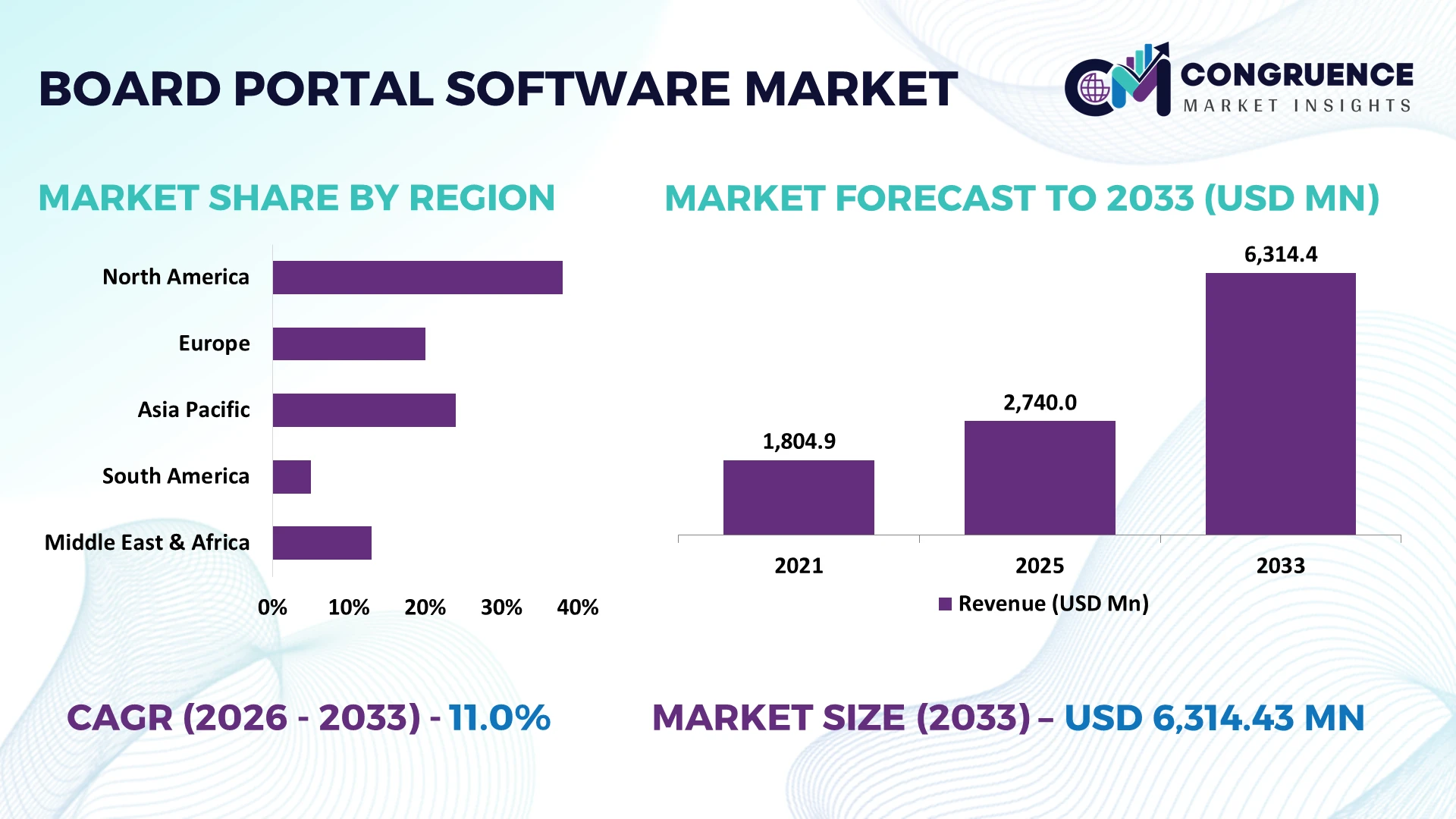
The Global Board Portal Software Market was valued at USD 2740 Million in 2025 and is anticipated to reach a value of USD 6314.43 Million by 2033 expanding at a CAGR of 11% between 2026 and 2033. Growth is driven by board level cybersecurity exposure, paperless governance mandates, AI assisted meeting workflows, and rising requirements for encrypted document distribution, voting, approvals, audit trails, and director collaboration.
The United States remains the dominant country market, supported by thousands of listed corporations, sophisticated financial services and healthcare governance requirements, and accelerated cybersecurity oversight following heightened geopolitical and infrastructure risks. Approximately 66% of U.S. boards report using AI within boardroom activities, although only 3% have extensively integrated it into risk oversight and strategic decision making. Compared with less mature digital governance markets, U.S. enterprises benefit from deeper cloud adoption and established compliance infrastructure, strengthening demand for secure board management platforms.
Strategically, vendors combining board grade AI, granular access controls, secure collaboration, and integrated governance workflows are positioned to capture enterprise replacement and platform consolidation spending.
Market Size & Growth: USD 2.74 billion in 2025 advances to USD 6.31 billion by 2033 at 11%, supported by AI enabled governance workflows.
Top Growth Drivers: Cybersecurity modernization 40%, board preparation efficiency 50%, and digital governance adoption 65% are strengthening platform replacement decisions.
Short Term Forecast: By 2028, advanced automation can reduce board meeting preparation workloads by approximately 50%, redirecting governance resources toward analysis and compliance.
Emerging Technologies: Generative AI summarization, automated minutes, intelligent document search, and role based workflow automation are transforming board portal functionality.
Regional Leaders: North America approaches USD 1.2 billion, Europe USD 0.8 billion, and Asia Pacific USD 0.5 billion, with cloud governance adoption strengthening across all three.
End User Trends: Nearly 65,000 organizations globally already use board portals, confirming substantial penetration across corporate, nonprofit, public sector, and regulated organizations.
Pilot/Case Example: In 2026, AI enabled board workflows demonstrated preparation efficiency gains reaching 50%, strengthening the operational case for replacing fragmented email based processes.
Competitive Landscape: Diligent holds a leading enterprise position, while Nasdaq Boardvantage, OnBoard, Azeus Convene, and Board Intelligence intensify competition through security, AI, and integrations.
Regulatory & ESG Impact: With 84% of surveyed directors changing scenario planning approaches, governance teams increasingly require auditable digital environments for risk and disclosure oversight.
Investment & Funding: Enterprise governance technology spending is shifting toward integrated platforms, with leading providers supporting 25,000 plus customers or 4,500 plus organizations globally.
Innovation & Future Outlook: Although 66% of boards use AI, only 3% report extensive integration, leaving a substantial commercialization opportunity for secure board specific AI.
Board Portal Software Market demand is concentrating across listed enterprises, financial institutions, healthcare organizations, government bodies, universities, and multinational boards managing sensitive governance information. AI generated summaries, automated minutes, intelligent search, electronic voting, and permission based document controls are moving portals beyond digital board books toward governance intelligence platforms. With roughly 90% of directors still lacking AI tools for complex scenario planning in one recent director survey, secure AI deployment represents a major adoption frontier. Rising cyber exposure and regulatory scrutiny are consequently shifting purchasing decisions toward integrated, auditable platforms, setting the foundation for the market’s strategic evolution.
Board portal software is becoming strategic governance infrastructure as boards confront cyber risk, faster disclosure cycles, distributed leadership, and expanding digital oversight. The shift from email based document circulation toward controlled cloud workspaces is changing enterprise investment priorities, particularly as 66% of boards report some AI use while extensive integration remains near 3%. Regulatory pressure around cybersecurity governance further elevates secure director communications from administrative tooling to enterprise risk architecture.
Modern portals combining automated agenda creation, intelligent search, electronic approvals, and AI summarization can reduce meeting preparation workloads by roughly 40% compared with manual document compilation. U.S. enterprises lead deployment through mature cloud ecosystems and stringent governance requirements, while India is accelerating adoption as listed companies digitize board processes and compliance workflows. A multinational board replacing emailed PDF packs with permission controlled digital books can shorten distribution cycles from several days to hours while maintaining version control.
Through 2028, investment will increasingly target governance specific AI, secure mobile access, identity controls, and integration with enterprise risk platforms. Vendors are strengthening partnerships with compliance technology providers and expanding localized cloud infrastructure. Competitive advantage will belong to platforms converting board information into secure, actionable governance intelligence.
Digital governance modernization is the primary structural driver as enterprises replace email attachments, printed board books, and disconnected approval processes with centralized board management software. Around 66% of boards now report using AI in some capacity, while digital workflows can cut meeting preparation time by approximately 40% and reduce paper dependent administration by over 50%. In the United States, SEC cybersecurity disclosure requirements have intensified board level accountability for material cyber incidents and risk oversight, strengthening demand for auditable communication environments. Financial institutions and listed enterprises are consequently prioritizing encrypted document repositories, electronic voting, director authentication, and immutable activity records. Vendors are responding by investing in AI assisted preparation, workflow automation, integrated risk dashboards, and enterprise identity integrations, shifting competition from basic document hosting toward governance infrastructure.
Enterprise adoption remains constrained by fragmented technology estates, migration complexity, and governance requirements surrounding confidential board information. Although roughly 90% of enterprises use cloud services across some workloads, organizations frequently maintain multiple identity, document management, legal, and compliance environments, making board portal integration operationally demanding. Nearly 60% of organizations identify cloud security as a significant concern, while legacy data migration can consume 20% to 30% of implementation effort in complex deployments. German and other European enterprises face additional configuration requirements when sensitive director information crosses jurisdictions under stringent data protection rules. These conditions extend procurement cycles and increase implementation costs, particularly for multinational organizations. Providers are reducing friction through regional data hosting, standardized APIs, single sign on integration, structured migration services, and contractual data residency controls rather than competing solely on subscription pricing.
Governance specific artificial intelligence represents a substantial opportunity because AI experimentation has moved faster than controlled boardroom deployment. Approximately 66% of boards report AI use, yet only about 3% have extensively embedded it into governance activities, creating a wide conversion gap for secure summarization, decision retrieval, meeting intelligence, and policy monitoring. In India, expanding digital corporate compliance infrastructure creates additional demand for platforms connecting board workflows with statutory documentation and electronic approvals. Next generation systems can reduce document discovery and preparation time by 30% to 50% by indexing historical minutes, resolutions, committee papers, and governance policies. Vendors are investing in private AI architectures, permission aware retrieval, multilingual interfaces, and compliance integrations. The less obvious opportunity lies in monetizing institutional board knowledge, transforming archived governance records from passive storage into searchable decision intelligence.
Long term differentiation depends on deploying AI without weakening confidentiality, accuracy, or director accountability. Generative systems can accelerate document analysis, but enterprise studies consistently show that more than 60% of organizations remain concerned about data privacy and security when implementing generative AI, while board materials contain exceptionally sensitive strategic, legal, acquisition, and personnel information. With extensive board level AI integration still near 3%, providers must solve permission inheritance, model hallucination, auditability, retention controls, and secure retrieval before automation scales across critical decisions. U.S. cybersecurity disclosure obligations further increase consequences when governance systems lack reliable access records or incident controls. Successful vendors therefore need sustained investment in zero trust architecture, human verification workflows, private model environments, cybersecurity partnerships, and AI governance controls. Competitive durability will depend on proving trustworthy intelligence, not simply adding generative features.
AI Moves Into Board Workflows Boardroom AI is shifting from experimentation into document analysis, briefing preparation, and meeting support. In 2026, 92% of surveyed directors reported using AI for board work within six months, while 60% operated without formal AI policies. Vendors are embedding permission aware summarization, semantic search, and controlled assistants directly into portals, reducing reliance on unmanaged external tools. Enterprises are simultaneously establishing AI usage policies and protected workspaces to contain confidential governance data.
Cyber Oversight Reshapes Reporting Board portals are evolving into structured cyber oversight environments as incident reporting becomes more frequent and decision critical. In 2025, 63% of directors planned increased cybersecurity investment, while cyber vulnerability exploitation had risen 34%. Providers are responding with configurable dashboards, committee reporting templates, granular permissions, and incident documentation workflows. The operational shift gives directors faster visibility into technology exposure without forcing security teams to reconstruct board reporting manually before every meeting.
Governance Analytics Gains Priority Directors increasingly expect portals to surface governance intelligence rather than simply distribute documents. More than 62% of public company directors allocated agenda time to full board AI discussions in 2025, while 44% planned external assistance for technology oversight. Platform developers are adding engagement analytics, decision histories, action tracking, and governance benchmarking. The less obvious shift is that searchable institutional memory is becoming a competitive feature, enabling boards to retrieve previous rationale alongside current decisions.
Mobile Governance Becomes Controlled Distributed directors are pushing mobile board access toward managed, policy driven deployment. Nearly 50% of public companies had not formally standardized AI tools for board activities by mid 2026, highlighting fragmented digital practices despite expanding remote access. Vendors are strengthening device authentication, offline encrypted reading, annotation synchronization, and remote session controls. Companies are consolidating board communication inside approved mobile environments, improving meeting readiness while reducing uncontrolled document copies across personal email, messaging applications, and local storage.
Cloud Based solutions lead the Board Portal Software Market with an estimated 58% share, supported by centralized upgrades, elastic user provisioning, remote accessibility, and lower infrastructure administration compared with locally maintained deployments. Enterprise buyers increasingly favor subscription environments that integrate identity management, document repositories, electronic signatures, and governance applications without dedicated server management. On Premise platforms retain strategic relevance among organizations maintaining tightly controlled internal infrastructure, particularly where confidential information policies restrict external hosting. Enterprise Based offerings remain important for multinational deployments requiring standardized governance across numerous subsidiaries and committees.
Hybrid is the fastest growing type as organizations seek cloud functionality without transferring every governance workload outside controlled infrastructure. Hybrid architectures can reduce locally managed infrastructure requirements by approximately 25% to 35% while preserving selective data residency. Mobile Based platforms are simultaneously gaining importance as directors expect secure access between scheduled meetings. Vendors are consequently prioritizing configurable hosting, mobile security, API interoperability, and enterprise authentication, redirecting product investment toward deployment flexibility rather than single architecture platforms.
Document Management represents the leading application with an estimated 29% share because board packs, committee reports, confidential attachments, historical minutes, and policy records form the core information layer of digital governance. Secure repositories replace fragmented email distribution while supporting controlled access, version histories, annotations, and retention policies. Board Meetings and Agenda Management remain mature workloads, increasingly connected through automated pack assembly and agenda sequencing. Meeting Scheduling provides supporting workflow value, particularly for organizations coordinating multiple committees and geographically dispersed directors.
Compliance Management is the fastest growing application as governance teams require traceable approvals, access records, retention controls, and oversight evidence. Approximately 63% of directors planned higher cybersecurity investment in 2025, while only 39% of executives in another governance study characterized board cybersecurity understanding as proactive. Secure Collaboration is therefore becoming more operationally important alongside Voting & Resolutions, where authenticated electronic decisions accelerate formal approvals. Providers are integrating workflow engines, searchable archives, resolution tracking, and compliance dashboards, shifting product development from meeting administration toward continuous governance execution.
Compliance Management leads the provided end user categories with an estimated 27% share, reflecting concentrated purchasing requirements around regulatory documentation, audit trails, policy oversight, and controlled director access. Secure Collaboration follows closely because sensitive strategy, cybersecurity, transactions, and executive matters require protected communication beyond conventional email. Document Management remains an established buying category where organizations need centralized board books and archival governance records, while Board Meetings and Agenda Management support recurring administrative workflows. Together, these established users favor integrated platforms rather than separate meeting utilities.
Voting & Resolutions is the fastest growing end user category as boards digitize formal approvals between scheduled meetings and require authenticated decision records. Electronic workflows can compress multi day circulation processes into same day execution where governance policies permit. Meeting Scheduling remains a supporting category but gains value when integrated with calendars, committee workflows, and automated notifications. Vendors are targeting these requirements through modular pricing, compliance templates, configurable approval workflows, and enterprise integrations, positioning secure governance execution rather than document storage as the stronger competitive differentiator.
North America accounted for the largest market share at 41.8% in 2025 however, Asia-Pacific is expected to register the fastest growth, expanding at a CAGR of 13.4% between 2026 and 2033.
Governance Digitization Deepens Enterprise Deployment
North America represents approximately 41.8% of global Board Portal Software demand, supported by concentrated adoption among listed corporations, financial institutions, healthcare systems, universities, and nonprofit boards. U.S. cybersecurity disclosure requirements have increased director accountability for cyber-risk oversight, pushing portals beyond meeting administration toward controlled governance environments. Around 66% of U.S. boards use AI within board activities, while extensive integration remains near 3%, leaving substantial scope for governed AI deployment. Canadian enterprises are simultaneously strengthening privacy-controlled cloud collaboration as hybrid board structures become established. Vendors are responding with AI-assisted board-book preparation, encrypted messaging, identity integration, granular permissions, and audit-ready workflows. Enterprise purchasing increasingly favors platforms capable of consolidating committee communication, risk reporting, electronic approvals, and institutional records rather than standalone digital board books.
United States Market Outlook: U.S. demand benefits from more than 4,000 exchange-listed domestic companies alongside a large private-enterprise and nonprofit governance base. SEC cyber-disclosure rules requiring material incident reporting within four business days strengthen the operational value of timestamped approvals, director access records, and integrated risk reporting. Vendors consequently prioritize U.S. enterprise integrations and governance-specific AI controls.
Regulatory Control Shapes Platform Architecture
Europe accounts for an estimated 27.6% market share, with deployment shaped strongly by privacy regulation, multinational governance structures, data residency, and increasingly formal cybersecurity oversight. GDPR requirements make permission architecture, retention management, encryption, and controlled cross-border information handling central purchasing criteria rather than optional security features. The EU NIS2 framework expands cybersecurity obligations across 18 critical sectors, strengthening board-level requirements for risk visibility and documented accountability. Germany, France, the Netherlands, and Nordic markets exhibit strong cloud governance adoption, while highly regulated enterprises continue evaluating hybrid configurations where sensitive records require tighter infrastructure control. Suppliers are expanding European hosting footprints, multilingual interfaces, audit functions, and sovereign-cloud compatibility. Competition therefore centers less on basic meeting functionality and increasingly on whether platforms can reconcile cross-jurisdiction collaboration with rigorous governance, privacy, and cyber-resilience requirements.
United Kingdom Market Outlook: The United Kingdom combines a mature listed-company ecosystem with advanced professional services, financial institutions, charities, and public bodies requiring structured board governance. The FTSE 350 alone provides a concentrated enterprise deployment base. UK buyers increasingly prioritize secure committee collaboration, board evaluation workflows, controlled document distribution, and integrations that reduce administrative dependence on email-based governance processes.
Digital Enterprise Scale Accelerates Adoption
Asia-Pacific holds approximately 19.2% of global demand but presents the strongest deployment momentum as enterprises modernize governance alongside cloud infrastructure and digital compliance systems. India, Australia, Singapore, Japan, and Southeast Asian financial centers are expanding electronic board workflows across listed companies, banks, state-linked enterprises, and diversified conglomerates. India’s corporate governance ecosystem is particularly significant, with more than 5,000 companies listed across its two principal stock exchanges, creating a broad addressable base for secure agenda, voting, resolution, and compliance platforms. Singapore contributes a high-value multinational governance hub, while Australia combines mature cloud adoption with established director accountability. Providers are expanding mobile-first interfaces, multilingual functionality, localized hosting, electronic-signature integration, and configurable compliance workflows. The strategic opportunity increasingly lies in adapting global governance platforms to country-specific corporate law and approval processes rather than deploying standardized Western configurations.
India Market Outlook: India combines extensive listed-enterprise scale with rapid digitization of statutory and corporate workflows. More than 100,000 companies were incorporated during recent annual registration cycles, continually expanding the future governance technology base. Domestic enterprises increasingly require mobile access, electronic approvals, committee documentation, and auditable resolution workflows, favoring configurable platforms with competitive pricing and localized compliance capabilities.
Governance Modernization Broadens Enterprise Demand
South America represents approximately 5.8% of global Board Portal Software demand, with Brazil accounting for the largest concentration through its listed enterprises, financial institutions, energy groups, industrial conglomerates, and expanding digital-services ecosystem. Brazil’s LGPD privacy regime has increased scrutiny of confidential corporate information handling, supporting migration from conventional email distribution toward controlled board repositories. Cloud infrastructure expansion by hyperscale providers is also improving enterprise access to locally hosted governance applications. Chile and Colombia provide additional adoption pockets where banks, utilities, pension-linked institutions, and larger corporations are formalizing digital governance. Deployment remains less uniform among smaller organizations because technology budgets and enterprise integration capabilities vary considerably. Suppliers are addressing this gap through cloud subscriptions, Portuguese and Spanish interfaces, modular deployment, and implementation partnerships that reduce infrastructure requirements while preserving security and governance controls.
Brazil Market Outlook: Brazil offers the region’s strongest addressable enterprise base, with B3 hosting hundreds of listed companies and sophisticated banking, mining, energy, retail, and industrial groups. LGPD compliance increases the importance of controlled director access and information traceability. Localized Portuguese workflows and domestic cloud availability therefore provide meaningful differentiation for international and regional board-platform vendors.
Institutional Modernization Drives Secure Governance
Middle East & Africa accounts for approximately 5.6% of global demand, with deployment concentrated in Gulf financial institutions, government-linked enterprises, sovereign investment organizations, energy companies, and large diversified groups. Saudi Arabia and the United Arab Emirates are advancing enterprise digitization through national transformation programs, increasing demand for secure executive and board collaboration infrastructure. Saudi Vision 2030 has accelerated institutional modernization, while the UAE’s extensive cloud and data-center investment supports enterprise SaaS deployment. South Africa provides a separate governance-driven market anchored by listed corporations, financial services, mining, and established corporate-governance frameworks. Vendors are strengthening Arabic-language functionality, local hosting options, mobile security, identity controls, and government-grade deployment configurations. Regional competitive advantage increasingly depends on aligning cloud architecture with national data policies and procurement requirements rather than relying solely on global product standardization.
Saudi Arabia Market Outlook: Saudi Arabia combines large state-linked enterprises, financial institutions, energy groups, and Vision 2030 transformation programs with expanding domestic cloud infrastructure. Government digital-transformation spending and hyperscaler investment are strengthening local hosting capacity. Board portal providers targeting Saudi enterprises are prioritizing Arabic interfaces, data residency, mobile governance, and secure integration with institutional identity environments.
Board Portal Software competition is led by Diligent, Nasdaq Boardvantage, OnBoard, Azeus Convene, and Board Intelligence, with enterprise governance specialists competing against workflow-focused technology providers. The top five collectively account for an estimated 48% of deployments, creating a moderately concentrated structure where installed enterprise relationships provide meaningful retention advantages. Diligent competes through governance breadth and integrations, while Nasdaq Boardvantage targets complex corporate boards; OnBoard and Convene emphasize usability, deployment speed, and accessible configuration. Advanced automation can reduce board preparation effort by 30%–50%, while cloud deployment lowers infrastructure administration by roughly 25%–35% versus locally managed environments. Vendors are adding generative AI, secure messaging, compliance workflows, and identity integrations while expanding through technology partnerships and geographic localization. Data residency, cybersecurity certification, migration complexity, and director trust remain substantial entry barriers. Competitive leadership increasingly requires secure AI, enterprise interoperability, rapid implementation, localized compliance, and governance intelligence that demonstrably replaces fragmented board workflows.
Diligent Corporation
Nasdaq Boardvantage
OnBoard
Azeus Convene
Board Intelligence
Govenda
BoardPro
Sherpany
iBabs
Ideals Board
BoardEffect
Passageways
Aprio
Ansarada
Current board portal technology centers on encrypted cloud workspaces, mobile board books, role-based access, electronic voting, and identity integration. Cloud deployment can lower infrastructure administration by roughly 25% versus locally managed environments, while connected agenda and document workflows reduce board-pack preparation time by about 30%. Governance teams consolidate committee materials, approvals, annotations, and audit trails within controlled platforms, improving version accuracy and reducing administrative handoffs.
Emerging platforms combine governance-specific generative AI, semantic search, automated minutes, and permission-aware retrieval. Board Intelligence reports 45% time savings in meeting preparation, while OnBoard’s 2026 survey found 92% of directors used AI for board work within six months. Compared with manual keyword search and document review, semantic AI can improve information-retrieval speed by approximately 40%, enabling directors to interrogate historical decisions, surface unresolved actions, and prepare faster without exporting confidential materials.
Through 2026–2028, agentic AI, continuous risk intelligence, and interoperable governance APIs will become differentiators. Diligent targets workflows where AI reduces cyber-risk analysis from weeks to hours, while private-model architectures strengthen data control. Providers integrating portals with GRC, audit, identity, and enterprise content systems gain competitive advantage. Buyers should prioritize governed AI and interoperability now because fragmented portals will increasingly underperform connected governance platforms.
June 2024 OnBoard acquired Govenda, combining its board management platform with Govenda’s AI-enhanced governance technology serving more than 600 customers. The consolidation expanded AI analytics and real-time collaboration capabilities, strengthening OnBoard’s competitive product depth across regulated sectors. Source: dadavidson.com
February 2025 Convene secured nine strategic MOUs with Saudi organizations during LEAP 2025, spanning banking, energy, education, technology, and other sectors. The agreements expanded deployment of its digital governance suite and strengthened Convene’s Saudi market position locally. Source: azeusconvene.com
October 2025 Board Intelligence launched Insight Driver, an AI capability addressing information overload in board packs. With 44% of boards spending more time backward-looking, the tool directly surfaces critical information and blind spots, improving directors’ decision preparation. Source: boardintelligence.com
April 2026 Diligent unveiled AI Board Member and an agentic GRC workforce at Elevate 2026, extending automation across governance, risk, compliance, and third-party workflows. The platform supports more than 700,000 board members, strengthening scalable AI-enabled oversight. Source: diligent.com
The Board Portal Software Market report evaluates five deployment types: Cloud-Based, On-Premise, Hybrid, Mobile-Based, and Enterprise-Based, alongside seven application and end-user categories covering board meetings, agenda management, document management, scheduling, compliance, secure collaboration, and voting and resolutions. Cloud-Based platforms represent approximately 58% of deployments, while Document Management holds about 29% of application demand, providing benchmarks for technology and product positioning.
Geographic coverage spans North America, Europe, Asia-Pacific, South America, and Middle East & Africa, with analysis extending to governance-specific AI, semantic search, automated minutes, mobile security, electronic approvals, and interoperable GRC workflows. The 2026–2033 assessment examines deployment migration, regulatory digitization, localization, enterprise integration, and emerging AI governance models, enabling companies to prioritize investment, identify expansion markets, benchmark competitive positioning, and align product roadmaps with evolving boardroom technology requirements.
| Report Attribute/Metric | Report Details |
|---|---|
Market Revenue in 2025 | USD 2740 Million |
Market Revenue in 2033 | USD 6314.43 Million |
CAGR (2026 - 2033) | 11% |
Base Year | 2025 |
Forecast Period | 2026 - 2033 |
Historic Period | 2021 - 2025 |
Segments Covered | By Type
By Application
By End-User
|
Key Report Deliverable | Revenue Forecast, Growth Trends, Market Dynamics, Segmental Overview, Regional and Country-wise Analysis, Competition Landscape |
Region Covered | North America, Europe, Asia-Pacific, South America, Middle East, Africa |
Key Players Analyzed | Diligent Corporation, Nasdaq Boardvantage, OnBoard, Azeus Convene, Board Intelligence, Govenda, BoardPro, Sherpany, iBabs, Ideals Board, BoardEffect, Passageways, Aprio, Ansarada |
Customization & Pricing | Available on Request (10% Customization is Free) |




