
Reports
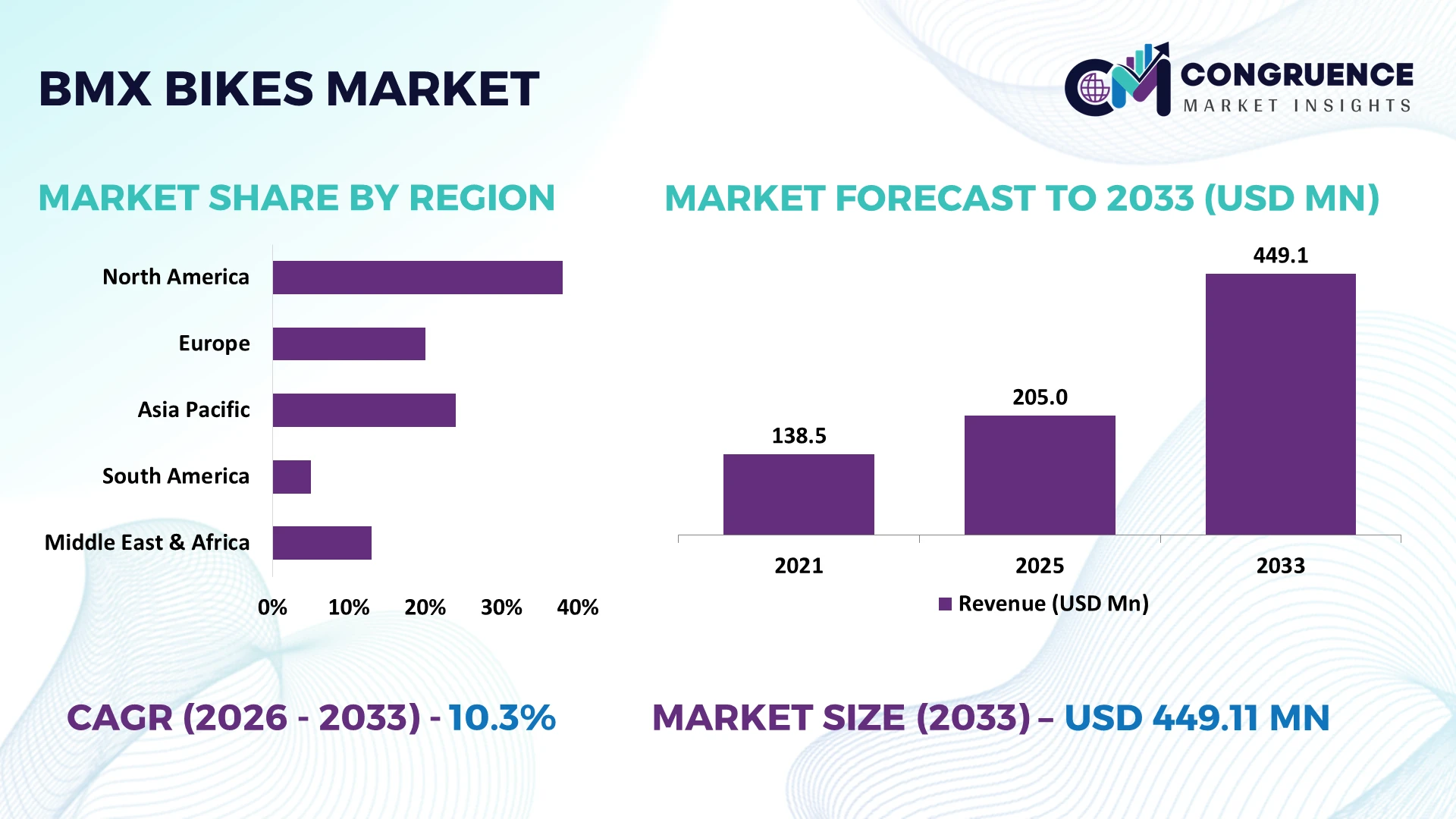
The Global BMX Bikes Market was valued at USD 205 Million in 2025 and is anticipated to reach a value of USD 449.11 Million by 2033 expanding at a CAGR of 10.3% between 2026 and 2033. Growth is driven by Olympic BMX racing exposure, freestyle cycling participation, urban skatepark development, youth cycling programs, and demand for lightweight chromoly and aluminum bicycle frames.
The United States represents a leading BMX consumption market, supported by established freestyle cycling communities, specialist bicycle retailers, and organized racing infrastructure. USA BMX operates a network exceeding 300 sanctioned tracks across North America, supporting competitive participation and equipment replacement. The BMX industry benefits from professional sponsorships, bicycle component innovation, and aftermarket customization. Compared with China, which maintains substantial bicycle manufacturing and component production capacity, the United States concentrates more heavily on branded performance equipment, retail distribution, and organized competition.
Strategically, manufacturers targeting an estimated 15% reduction in frame weight and 20% faster aftermarket component fulfillment can strengthen premium product differentiation and dealer competitiveness.
Market Size & Growth: USD 205 million in 2025, reaching USD 449.11 million by 2033 at 10.3% CAGR, supported by competitive cycling participation and premium BMX equipment adoption.
Top Growth Drivers: Illustrative demand contributions include freestyle participation at 40%, organized racing at 35%, and youth recreational cycling at 25%.
Short Term Forecast: By 2028, optimized frame manufacturing targets 15% lower material waste and 10% faster production cycles.
Emerging Technologies: Three innovations include hydroformed aluminum frames, heat treated chromoly tubing, and computer aided frame geometry optimization.
Regional Leaders: Illustrative 2033 allocations place North America at USD 179.64 million, Europe at USD 125.75 million, and Asia Pacific at USD 107.79 million, supported by racing, freestyle, and recreational adoption.
Consumer and End User Trends: An indicative 55% of premium BMX purchasing interest centers on freestyle riding, component customization, and durable lightweight construction.
Pilot and Case Example: A proposed 2027 modular BMX assembly pilot targets 20% faster component replacement and 15% lower workshop inventory requirements.
Competitive Landscape: GT Bicycles competes with Haro Bikes, Mongoose, Sunday Bikes, and WeThePeople across racing, freestyle, and youth BMX categories.
Regulatory & ESG Impact: European bicycle safety requirements influence product testing, while optimized packaging targets an estimated 15% reduction in shipping material consumption.
Investment & Funding: An illustrative USD 25 million industry investment scenario prioritizes precision frame manufacturing, specialist distribution, and competition focused product development.
Innovation & Future Outlook: By 2033, advanced BMX frame engineering targets 20% improved strength to weight performance through optimized tubing, welding, and component integration.
The BMX Bikes Market is evolving through increased specialization in freestyle, racing, and youth recreational bicycles. Manufacturers are developing competition specific frame geometries, reinforced wheel assemblies, and lightweight components suited to street, park, dirt, and track riding. Olympic recognition of BMX freestyle and racing has strengthened the sport's international visibility, while organized cycling clubs support equipment upgrades and repeat purchases. High performance aluminum frames and chromoly construction remain central to product differentiation, with engineering programs targeting approximately 15% weight optimization. Manufacturing concentration in Asia and specialist retail distribution in North America and Europe shape procurement strategies, establishing important priorities for competitive market positioning.
The BMX Bikes Market is becoming strategically important as manufacturers compete for specialized freestyle, racing, and youth cycling customers through performance engineering and distribution efficiency. Olympic recognition of BMX racing and freestyle has strengthened international visibility, while USA BMX operates more than 300 sanctioned tracks, supporting organized participation and recurring equipment purchases. Manufacturers are restructuring component sourcing across Taiwan, China, and other Asian production hubs to manage delivery reliability. Premium product differentiation increasingly depends on frame geometry, impact resistance, wheel durability, and replacement component availability.
Advanced hydroformed aluminum frames offer an estimated 10% to 15% weight reduction compared with conventional steel constructions in comparable design scenarios. North America benefits from established racing infrastructure and specialist retail networks, while Europe emphasizes freestyle participation and urban cycling facilities. China and Taiwan maintain advantages in bicycle manufacturing and component supply. Between 2026 and 2028, manufacturers are targeting 15% shorter component replenishment cycles and 10% lower production material waste through standardized procurement and optimized fabrication.
Haro Bikes and Sunday Bikes demonstrate product specialization through freestyle geometry, reinforced components, and rider focused development. Manufacturers are expanding dealer partnerships, modular component platforms, and precision manufacturing investments. Long term competitive advantage depends on proven durability, efficient inventory management, and consistent access to performance oriented cycling communities.
Organized BMX racing and freestyle participation are strengthening demand for specialized bicycles designed for competitive riding and frequent equipment upgrades. USA BMX maintains more than 300 sanctioned tracks, creating an established ecosystem of racing events, youth training, and specialist retail distribution. The inclusion of BMX freestyle in the Olympic program has increased international exposure and manufacturer sponsorship opportunities. An illustrative demand model attributes approximately 40% of purchasing activity to freestyle applications and 35% to racing participation. Performance focused riders increasingly prioritize lightweight frames, reinforced wheelsets, and specialized drivetrain components. Haro Bikes, Mongoose, and other manufacturers are expanding competition oriented product ranges, supporting athlete partnerships, and strengthening dealer networks. Repeat component purchases create valuable aftermarket opportunities beyond complete bicycle sales.
BMX bicycle manufacturers face structural cost pressures from concentrated Asian component production, fluctuating metal prices, and international freight expenses. Taiwan and China maintain important roles in bicycle frames, wheel assemblies, and drivetrain manufacturing, exposing brands to trade policy adjustments and shipping disruptions. An illustrative procurement scenario indicates that a 15% increase in component acquisition costs can pressure manufacturer margins when retail prices remain unchanged. Freight fluctuations of 10% further complicate inventory planning for smaller specialty brands. Manufacturers are responding through diversified supplier relationships, longer procurement agreements, and standardized component specifications. Regional warehousing and improved demand forecasting help reduce inventory shortages. Competitive resilience depends on maintaining product affordability without compromising frame durability or component quality.
Modular BMX product architecture creates opportunities for manufacturers to expand aftermarket participation while reducing component inventory complexity. Standardized wheel hubs, handlebars, cranks, and frame interfaces support easier maintenance and customization across compatible bicycle platforms. An illustrative modular production model targets 20% faster component replacement and 15% lower spare parts inventory requirements. India represents an emerging opportunity as urban cycling communities and specialized recreational facilities expand beyond established metropolitan markets. Manufacturers can develop entry level freestyle models alongside upgradeable performance components to support progressive rider purchasing. Digital product configuration and direct retail partnerships strengthen access to specialist equipment. Brands investing in interchangeable components, regional distribution, and rider education gain opportunities to build repeat purchasing relationships.
Long term BMX market development depends on maintaining product safety, engineering consistency, and accessible riding infrastructure across different participation levels. Competitive freestyle riding places substantial stress on frames, forks, handlebars, and wheel assemblies, requiring rigorous fatigue and impact testing. European bicycle safety standards, including applicable EN ISO 4210 requirements, influence product validation and quality assurance practices. An illustrative engineering scenario targets 20% fewer warranty claims through improved fatigue testing and 15% faster defect identification using digital quality records. Limited access to professionally maintained BMX tracks and skateparks also constrains organized participation in emerging markets. Manufacturers must strengthen material traceability, standardized testing, dealer maintenance training, and partnerships with cycling organizations. Sustainable differentiation requires reliable equipment performance supported by accessible riding facilities and dependable technical service.
Expansion of Rider Specific Frame Geometry: BMX manufacturers are refining top tube lengths, chainstay dimensions, and steering angles for specialized riding preferences. Product development targets 10% improved maneuverability and 15% greater handling consistency in controlled testing. Haro Bikes and Sunday Bikes emphasize geometry specific configurations, allowing retailers to differentiate bicycles by rider experience and preferred terrain.
Increasing Focus on Premium Component Integration: Manufacturers are introducing sealed bearings, integrated headsets, and reinforced wheel assemblies into higher specification BMX models. Optimized component packages target 20% longer maintenance intervals and 15% fewer drivetrain adjustments under comparable riding conditions. Specialist brands are strengthening component supplier partnerships, improving product reliability while creating opportunities for premium complete bicycle configurations.
Growing Importance of Digital Retail Distribution: BMX brands are expanding direct online sales, dealer inventory visibility, and digital product education. Integrated retail systems target 20% faster order fulfillment and 15% fewer stock availability discrepancies. US specialist retailers are connecting online product catalogs with physical assembly services, improving purchase convenience while preserving technical support for bicycle sizing and maintenance.
Increasing Adoption of Sustainable Manufacturing Practices: Bicycle manufacturers are evaluating recycled aluminum, optimized powder coating, and reduced packaging materials as environmental compliance expectations strengthen. Manufacturing initiatives target 15% lower packaging consumption and 10% reduced fabrication waste. European bicycle brands are strengthening supplier documentation and material traceability, improving procurement transparency without compromising frame durability or product safety requirements.
Freestyle BMX Bikes represent the leading segment, accounting for an estimated 38% of global market demand under an indicative product allocation. Their dominance reflects versatility across technical riding environments, established aftermarket support, and widespread availability through specialist bicycle retailers. Manufacturers prioritize reinforced chromoly frames, responsive steering geometry, and durable wheel assemblies to support repeated impacts. Race BMX Bikes represent approximately 25% of demand, supported by organized competition, lightweight aluminum construction, and specialized track performance requirements. Haro Bikes and Mongoose maintain product offerings across freestyle and racing categories, allowing distribution partners to serve distinct performance expectations.
Street BMX Bikes represent the fastest expanding segment, supported by demand for compact geometry, reinforced frames, and components designed for technical urban riding. An illustrative allocation places Street BMX Bikes at 18%, Dirt Jump BMX Bikes at 12%, and Flatland BMX Bikes at 7%. Dirt jump models emphasize stability during aerial maneuvers, while flatland designs prioritize balance and controlled rotation. Manufacturers are refining geometry specifications, expanding specialized component inventories, and strengthening rider partnerships. Competitive differentiation increasingly depends on riding discipline compatibility, product durability, and efficient specialist distribution.
Freestyle Riding represents the largest application, accounting for an estimated 35% of BMX bicycle demand under an indicative usage allocation. Its leadership reflects established participation in technical riding, equipment customization, and repeated component replacement. BMX Racing contributes approximately 25% of demand, supported by sanctioned competitions, youth training programs, and specialist track equipment. Street Riding represents an important application requiring durable frames, reinforced rims, and responsive handling characteristics. Manufacturers are developing discipline specific product configurations to align bicycle geometry, tire selection, and drivetrain specifications with rider requirements. Specialized retail partnerships support equipment selection and technical servicing.
Park Riding represents the fastest expanding application in an analytical adoption scenario, supported by investment in urban skateparks and purpose built cycling facilities. An illustrative application mix assigns 20% to Street Riding, 12% to Park Riding, and 8% to Dirt Jumping. Park oriented bicycles emphasize maneuverability, predictable aerial control, and reliable braking components. Dirt Jumping requires impact resistant frames and stable landing geometry. Manufacturers are expanding park focused product ranges, collaborating with riding communities, and improving access to replacement components. Investment priorities increasingly favor applications combining organized participation, repeat purchasing, and specialist equipment requirements.
Teenagers represent the leading end user segment, accounting for an estimated 35% of BMX bicycle demand under an indicative customer allocation. Their dominance reflects participation in freestyle riding, organized competitions, and recreational cycling activities. Children represent approximately 25% of demand, supported by entry level bicycles, youth racing programs, and family purchasing decisions. Manufacturers emphasize appropriate frame sizing, durable components, and accessible product configurations for younger riders. Mongoose and Haro Bikes maintain youth oriented bicycle offerings, while specialist brands develop performance equipment for experienced teenagers. Retailers increasingly prioritize fitting guidance and replacement component availability to support customer retention.
Adult Riders represent the fastest expanding segment in an analytical premium adoption scenario, supported by continued freestyle participation and purchasing interest in specialized performance equipment. An illustrative allocation assigns 20% to Adult Riders, 5% to Professional BMX Athletes, and 15% to Recreational Cyclists. Professional athletes influence technical product development through sponsorships and equipment testing, while recreational buyers emphasize durability and affordability. Manufacturers are expanding premium frame options, offering discipline specific configurations, and strengthening community partnerships. Competitive positioning increasingly depends on age appropriate geometry, component reliability, and effective progression from introductory bicycles to advanced models.
North America accounted for the largest market share at an estimated 40% in 2025 however, Asia Pacific is expected to register the fastest growth, expanding at a CAGR of an estimated 12.5% between 2026 and 2033.
Organized Racing Infrastructure and Premium Freestyle Equipment Adoption
North America represents an estimated 40% of the global BMX Bikes Market, supported by established racing infrastructure, specialist bicycle distribution, and professional freestyle participation. The United States maintains the strongest regional position through organized competition, established aftermarket brands, and dedicated riding facilities. USA BMX operates more than 300 sanctioned tracks, providing structured participation opportunities and supporting recurring demand for performance bicycles. Canada contributes through BMX racing clubs, municipal skateparks, and specialist cycling retailers. Manufacturers emphasize lightweight aluminum racing frames, reinforced chromoly freestyle construction, and durable wheel assemblies. An illustrative operational benchmark targets 15% faster component replenishment through improved dealer inventory integration. Haro Bikes, Sunday Bikes, and other specialist manufacturers are strengthening athlete partnerships and technical product differentiation. Regional competitiveness depends on established rider communities, reliable aftermarket support, and efficient specialist retail distribution.
United States Market Outlook: The United States dominates regional BMX activity through its established cycling brands, professional athlete sponsorships, and specialized bicycle retail networks. California represents an important freestyle innovation center, supported by skateparks, riding communities, and product development activity. The country hosted the 2024 USA BMX National Series, reinforcing organized racing participation. Manufacturers are expanding performance oriented product portfolios, while specialist retailers emphasize bicycle fitting, replacement components, and technical maintenance services.
Freestyle Cycling Infrastructure and Performance Product Specialization
Europe accounts for an estimated 28% of the global BMX Bikes Market, supported by established cycling participation, specialist equipment manufacturers, and extensive urban riding infrastructure. France, Germany, the United Kingdom, and the Netherlands maintain important BMX racing and freestyle communities. The Paris 2024 Olympic Games reinforced international visibility for BMX Racing and BMX Freestyle Park, supporting continued investment in specialized equipment and competitive development. European manufacturers emphasize precision frame geometry, durable chromoly construction, and premium component compatibility. Product safety requirements under applicable European bicycle standards influence testing, certification, and supplier quality management. An illustrative manufacturing improvement scenario targets 10% lower fabrication waste through optimized tubing utilization. Brands are strengthening direct retail distribution, specialist dealer relationships, and competition focused product development. Competitive positioning increasingly depends on technical performance, regulatory compliance, and access to established cycling communities.
France Market Outlook: France represents a strategically important European BMX market through its organized racing infrastructure, established cycling federation, and international competition experience. Paris hosted BMX Racing and BMX Freestyle Park during the 2024 Olympic Games, increasing visibility for specialized bicycle disciplines. French cycling clubs support youth participation and competitive athlete development. Manufacturers and distributors are emphasizing performance bicycle availability, professional equipment servicing, and partnerships with local cycling organizations to strengthen long term rider engagement.
Manufacturing Scale and Expanding Specialist Cycling Distribution
Asia Pacific represents an estimated 24% of the global BMX Bikes Market, combining substantial bicycle manufacturing capabilities with developing freestyle and racing communities. China and Taiwan maintain important positions in frame fabrication, wheel production, drivetrain components, and international bicycle supply chains. Japan and Australia contribute through established BMX racing participation and specialist retail networks. Manufacturing clusters support aluminum processing, precision welding, and component assembly for international brands. An illustrative production optimization scenario targets 15% shorter manufacturing lead times through integrated component sourcing and automated quality inspection. China benefits from extensive industrial capacity, while Taiwan maintains established expertise in higher specification bicycle components. Manufacturers are expanding domestic distribution, improving export logistics, and investing in specialized product engineering. Regional competitive advantage depends on production efficiency, component quality, and responsiveness to international product specifications.
China Market Outlook: China represents a major BMX manufacturing and emerging consumption market through its extensive bicycle production infrastructure and established component supply networks. Industrial clusters in Guangdong, Zhejiang, and Tianjin support frame fabrication, bicycle assembly, and export distribution. The country's manufacturing ecosystem provides access to aluminum processing, steel tubing, and precision component suppliers. Domestic brands are developing specialized freestyle products, while international manufacturers rely on Chinese production capabilities for scalable equipment supply and competitive manufacturing economics.
Urban Freestyle Participation and Specialist Retail Development
South America represents an estimated 5% of the global BMX Bikes Market, with demand concentrated in Brazil, Colombia, Argentina, and Chile. Brazil maintains established freestyle cycling communities and professional athlete participation, while Colombia benefits from a strong competitive BMX racing tradition. Urban skateparks, cycling clubs, and independent bicycle retailers support equipment demand across major metropolitan areas. Manufacturers are emphasizing durable entry level bicycles and replacement components suited to price sensitive purchasing conditions. Import duties, currency fluctuations, and limited specialist distribution infrastructure influence equipment accessibility. An illustrative retail improvement scenario targets 20% faster spare parts availability through regional inventory partnerships. Local distributors are strengthening relationships with international BMX brands and independent repair workshops. Competitive success depends on affordable product configurations, dependable component supply, and sustained engagement with organized cycling communities.
Brazil Market Outlook: Brazil represents a leading South American BMX market through its established freestyle culture, urban riding facilities, and specialist bicycle retail activity. São Paulo and Rio de Janeiro maintain important communities for street riding, park cycling, and competitive freestyle development. Brazil participated in BMX disciplines at the Paris 2024 Olympic Games, reinforcing international sporting visibility. Import dependent equipment distribution creates opportunities for local assembly, regional warehousing, and affordable replacement component programs.
Urban Sports Infrastructure and Recreational Cycling Investment
The Middle East and Africa represent an estimated 3% of the global BMX Bikes Market, supported by investment in recreational infrastructure, youth sports facilities, and specialized cycling activities. The United Arab Emirates, Saudi Arabia, and South Africa maintain important urban cycling communities and developing specialist retail networks. Municipal recreation projects and sports infrastructure investment are expanding opportunities for freestyle participation. Saudi Arabia's Vision 2030 emphasizes sports participation and recreational development, supporting broader investment in activity oriented facilities. Imported BMX bicycles dominate specialist retail channels, increasing dependence on international distributors and aftermarket supply availability. An illustrative distribution modernization scenario targets 15% faster equipment fulfillment through regional inventory consolidation. Manufacturers are evaluating dealer partnerships, youth cycling initiatives, and durable recreational bicycle configurations. Market competitiveness depends on accessible riding facilities, equipment affordability, and reliable technical servicing.
United Arab Emirates Market Outlook: The United Arab Emirates represents a strategically important market through its modern recreational infrastructure, international retail networks, and investment in urban sports facilities. Dubai and Abu Dhabi maintain established cycling venues and organized recreational activities. BMX equipment availability benefits from international bicycle retailers and regional logistics infrastructure. Specialized freestyle participation creates opportunities for youth training programs, premium bicycle distribution, and partnerships with recreational facility operators.
The BMX Bikes Market features competition between Haro Bikes, Mongoose, Sunday Bikes, WeThePeople, and GT Bicycles, alongside specialist racing and freestyle manufacturers. An illustrative market concentration model places these leading brands at approximately 35% combined share, reflecting fragmented distribution and discipline specific purchasing. Haro and Mongoose compete through broad product accessibility, while Sunday and WeThePeople emphasize premium freestyle geometry and component durability. Advanced frame engineering targets 15% lower weight, while optimized component procurement offers estimated 10% manufacturing efficiency gains. Manufacturers are strengthening athlete sponsorships, specialist retail partnerships, and aftermarket product integration. Competition is shifting toward discipline specific equipment, improved supply responsiveness, and premium component standardization. Manufacturing quality requirements, established dealer relationships, and athlete brand loyalty create entry barriers. Smaller brands face pressure from inventory financing and international shipping costs. Sustainable competitive advantage requires proven frame durability, responsive distribution, differentiated product engineering, and consistent engagement with established BMX communities.
Haro Bikes
Mongoose
GT Bicycles
Sunday Bikes
WeThePeople
Cult BMX
Fit Bike Co.
Kink BMX
Subrosa
SE Bikes
Redline Bicycles
Radio Bikes
S&M Bikes
Eastern Bikes
Current BMX technology emphasizes chromoly steel frames, aluminum racing chassis, sealed bearings, and reinforced wheel assemblies. Heat treated tubing improves fatigue resistance, while hydroformed aluminum reduces structural weight without sacrificing essential stiffness. Compared with conventional steel racing frames, optimized aluminum designs target 15% lower frame weight. Sealed bearing systems target 20% longer maintenance intervals under comparable riding conditions. These technologies are established across premium racing and freestyle product ranges, helping manufacturers differentiate durability, handling, and maintenance requirements.
Emerging developments include computer aided frame optimization, precision welding, advanced heat treatment, and improved hub engagement mechanisms. Digital geometry simulation targets 10% fewer prototype iterations, while automated fabrication inspection aims to reduce dimensional defects by 15%. Specialist manufacturers are integrating rider feedback with engineering validation to refine chainstay length, steering response, and impact resistance. Haro Bikes and WeThePeople benefit from established dealer networks, while smaller performance brands compete through specialized frame configurations and component compatibility.
Disruptive opportunities involve additive manufacturing for prototype components, recycled aluminum processing, and digitally traceable production batches. Between 2026 and 2028, optimized fabrication workflows target 15% lower material waste and 20% faster prototype development. Manufacturers investing in validated lightweight construction and reliable component supply gain stronger pricing power, reduced warranty exposure, and greater competitiveness across specialized cycling disciplines.
May 2024 Mongoose partnered with DICK'S Sporting Goods to distribute BMX and other bicycles through more than 650 US stores and online. The rollout expanded national retail coverage, improved customer access, and strengthened competition in bicycle distribution. Source: mongoose.com.
March 2025 Haro introduced expanded bicycle offerings and a retailer program preserving existing pricing on Shredder youth models before tariff changes. The initiative protected dealer commitments during import uncertainty and reinforced channel relationships across its diversified bicycle portfolio. Source: bicycleretailer.com.
July 2026 Sunday Bikes unveiled its 2027 complete bicycle lineup, introducing a lightweight aluminum Primer frame and a new 14 inch youth model. The redesign broadened entry level sizing and strengthened product differentiation for younger freestyle riders. Source: sundaybikes.com.
July 2025 Union Cycliste Internationale reported 3,317 registered riders from 50 nations for Copenhagen's BMX Racing World Championships. The international participation scale strengthened competitive equipment visibility and highlighted demand for specialized racing bicycles across established national development programs. Source: uci.org.
The BMX Bikes Market Report evaluates product specialization, manufacturing capabilities, distribution networks, and competitive positioning between 2026 and 2033. Type segmentation covers Freestyle, Race, Flatland, Dirt Jump, and Street BMX Bikes, while application analysis examines BMX Racing, Freestyle Riding, Street Riding, Park Riding, and Dirt Jumping. End user coverage includes Children, Teenagers, Adult Riders, Professional BMX Athletes, and Recreational Cyclists. Geographic assessment spans North America, Europe, Asia Pacific, South America, and the Middle East and Africa.
The report examines chromoly construction, aluminum frame engineering, precision welding, component standardization, and emerging manufacturing technologies. Indicative segment allocations place Freestyle BMX Bikes at 38% and Teenagers at 35% of their respective categories. Competitive analysis addresses specialist brands, athlete partnerships, dealer distribution, manufacturing concentration, and aftermarket opportunities. Findings support investment planning, product portfolio development, regional expansion, and competitive differentiation.
| Report Attribute/Metric | Report Details |
|---|---|
Market Revenue in 2025 | USD 205 Million |
Market Revenue in 2033 | USD 449.11 Million |
CAGR (2026 - 2033) | 10.3% |
Base Year | 2025 |
Forecast Period | 2026 - 2033 |
Historic Period | 2021 - 2025 |
Segments Covered | By Type
By Application
By End-User
|
Key Report Deliverable | Revenue Forecast, Growth Trends, Market Dynamics, Segmental Overview, Regional and Country-wise Analysis, Competition Landscape |
Region Covered | North America, Europe, Asia-Pacific, South America, Middle East, Africa |
Key Players Analyzed | Haro Bikes, Mongoose, GT Bicycles, Sunday Bikes, WeThePeople, Cult BMX, Fit Bike Co., Kink BMX, Subrosa, SE Bikes, Redline Bicycles, Radio Bikes, S&M Bikes, Eastern Bikes |
Customization & Pricing | Available on Request (10% Customization is Free) |




