
Reports
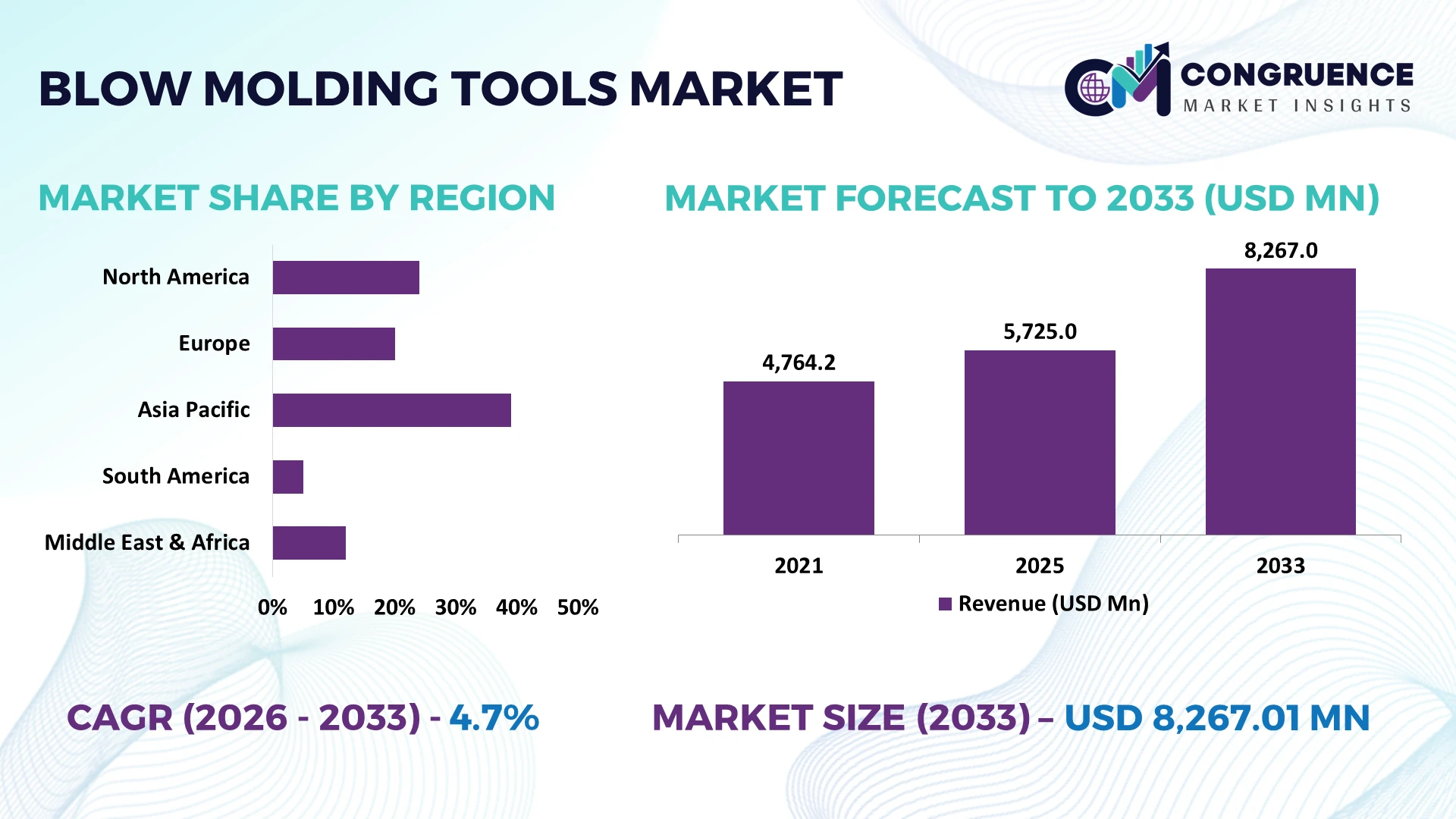
The Global Blow Molding Tools Market was valued at USD 5725 Million in 2025 and is anticipated to reach a value of USD 8267.01 Million by 2033 expanding at a CAGR of 4.7% between 2026 and 2033. Growth is driven by PET bottle lightweighting, recycled-content mandates, higher-speed stretch blow molding, rapid mold changeovers, and localization of beverage and consumer-packaging production.
China represents the strongest manufacturing base, producing 79.2 million tonnes of plastic products in 2025; eastern provinces accounted for 62.5% of output, with Guangdong and Zhejiang alone contributing 34.1% of December production. Packaging containers, automotive components, household products, beverages, and personal care sustain tooling demand as processors adopt precision cavities, hot-runner systems, and digitally optimized mold designs. Compared with China’s production scale, India is attracting localized tooling capacity as packaging-equipment suppliers expand manufacturing near Bangalore; Krones’ new 100,000-square-meter Vemagal site includes planned blow-mold production. U.S. tariff pressure is simultaneously accelerating regionalized machinery supply chains.
Strategically, tooling suppliers combining lightweight bottle engineering, faster changeovers, localized mold manufacturing, and recycled-resin compatibility will secure the strongest position in high-volume packaging programs.
Market Size & Growth: USD 5,725 million in 2025 reaches USD 8,267.01 million by 2033 at 4.7%, supported by lightweight PET tooling and localized packaging capacity.
Top Growth Drivers: China’s eastern plastics output share reached 62.5%, packaged-beverage units are rising 8.8%, and EU PET bottles require 25% recycled content.
Short-Term Forecast: By 2028, digitally optimized PET lines are targeting roughly 10% lower lifecycle ownership costs through integrated tooling, controls, and maintenance.
Emerging Technologies: AI mold simulation, digital twins, advanced cooling channels, and high-cavitation tooling support systems producing up to 108,000 lightweight preforms hourly.
Regional Leaders: Indicative 2033 positioning places Asia-Pacific near USD 3.6 billion, North America around USD 1.8 billion, and Europe near USD 1.7 billion.
Consumer/End-User Trends: Packaged beverage volume is projected to increase by 120 billion liters between 2025 and 2028, reinforcing high-cycle tooling requirements.
Pilot/Case Example: A 2025 integrated PET line demonstrated approximately 10% lower total lifecycle cost through synchronized molding, filling, digital monitoring, and service.
Competitive Landscape: Krones-linked advanced molding competes with Sidel, Kautex, Bekum, and specialist toolmakers; leading suppliers collectively command an estimated 30–35% share.
Regulatory & ESG Impact: EU rules require 25% recycled PET content in beverage bottles from 2025, rising to 30% for all single-use plastic bottles by 2030.
Investment & Funding: Krones is investing about USD 58 million-equivalent in U.S. expansion while adding approximately 60,000 square meters of planned Indian production space.
Innovation & Future Outlook: Ultra-light preforms, predictive mold maintenance, and localized tooling shift competitive advantage toward lower material use, faster service, and resilient supply chains.
Blow molding tools are increasingly critical across beverage bottles, household chemicals, personal care, automotive ducts, pharmaceuticals, and industrial containers. EU recycled-content rules now require 25% recycled PET in applicable beverage bottles, intensifying demand for precision tooling that handles variable resin behavior. Lightweight cavities, advanced cooling, digital mold simulation, and localized tool production are consequently reshaping equipment economics and setting up the next strategic discussion.
Blow molding tools are becoming strategically important as packaging producers compete on material efficiency, recycled-resin compatibility, line speed, and localized tooling support. EU rules requiring PET beverage bottles to contain at least 25% recycled plastic from 2025 are accelerating mold redesign, while beverage and consumer-goods producers are restructuring supply chains around regional mold production and faster changeover capability.
Advanced bottle-base and mold technologies deliver measurable advantages over legacy designs: optimized tooling can reduce blowing energy by up to 20%, enable approximately 10% higher output, and support bottle lightweighting of around 10%. Asia emphasizes high-volume tooling and localized manufacturing, while Europe leads recycled-content engineering and lightweighting. India is strengthening its production position as global equipment suppliers establish local manufacturing, including planned blow-mold capability near Bangalore.
A practical deployment combines quick-change molds, optimized cooling, pressure-controlled blowing, and digital bottle simulation to stabilize output across multiple PET formats. Through 2026–2028, rPET-ready tooling, predictive mold maintenance, lightweight neck and base designs, and digitally validated cavities will gain procurement priority. Suppliers are expanding local production and application engineering accordingly. Competitive advantage will rest on faster qualification, lower material consumption, and dependable lifecycle support.
Material reduction is reshaping blow molding tool specifications because resin represents roughly 70–80% of a PET bottle’s production cost. Current packaging optimization can reduce bottle-neck weight by up to 40%, body weight by 35%, and base weight by approximately 20% while maintaining mechanical performance. The EU’s requirement for 25% recycled plastic in PET beverage bottles from 2025 adds another design constraint, requiring molds that accommodate varying rPET behavior without sacrificing dimensional stability. This combination directly lowers material consumption while increasing tooling complexity and qualification value. The non-obvious shift is that mold engineering now influences packaging economics more than simple cavity replacement. Suppliers are responding through advanced simulation, redesigned bases, precision cooling, rPET validation, and closer partnerships with beverage producers.
Tooling economics remain constrained by precision requirements, machine compatibility, and the cost of requalifying high-speed bottle formats. Modern lines operate at up to 99% availability and approximately 98% production efficiency, meaning poorly matched molds can create disproportionate downtime losses. Converting legacy equipment to lighter bottles or higher recycled content also requires careful pressure, heating, cooling, and material-distribution adjustments. In Europe, the shift from 25% recycled PET requirements toward 30% recycled content for plastic beverage bottles by 2030 increases near-term redesign activity but also forces processors to avoid premature tooling choices. The hidden restraint is qualification risk rather than mold purchase price. Producers are reducing exposure through standardized neck finishes, retrofit-compatible base systems, longer tooling contracts, localized maintenance, and multi-format mold platforms.
The strongest opportunity lies in molds engineered simultaneously for lightweighting, recycled resin, and high-speed production. New bottle-base technologies already support 100% rPET applications, while advanced designs can reduce base material by 20% and body weight by as much as 35%. Certain optimized flat-container systems also raise mold output from 1,800 to 2,000 bottles per hour, an increase of roughly 11%. India offers a strategic manufacturing opportunity as global equipment suppliers expand local production and plan domestic blow-mold manufacturing, shortening lead times for beverage customers. A non-obvious opportunity is digital qualification: simulation reduces physical prototyping and accelerates SKU launches. Suppliers are positioning through application centers, localized mold production, lightweight bottle R&D, and integrated design-to-line validation services.
Long-term execution becomes harder as molds must simultaneously support recycled resin variability, lightweight geometry, high-speed blowing, rapid changeovers, and legacy machine interfaces. Modern blowers target 98% production efficiency and up to 99% availability, leaving limited tolerance for cavity imbalance, cooling inconsistency, or dimensional drift. At the same time, optimized designs can require blowing-pressure reductions approaching 20%, demanding tighter coordination between mold geometry, heating profiles, compressors, and controls. The strategic challenge therefore shifts from machining accuracy toward complete process integration. Plants running mixed virgin PET and rPET intensify qualification complexity because resin behavior changes across batches. Toolmakers must invest in digital simulation, metrology, local technical teams, standardized interfaces, predictive maintenance, and closer OEM partnerships to ensure repeatable performance across multiple machines and packaging formats.
Faster Changeovers Reshape Production: High-mix bottle production is pushing mold-change time down from approximately 60 minutes toward 30 minutes on advanced platforms, while automated systems target below 15 minutes. Beverage converters are standardizing mold shells, quick-release connections, and recipe controls, increasing productive hours and enabling shorter SKU campaigns without maintaining dedicated lines.
Digital Design Shortens Qualification: Toolmakers are moving cavity development into simulation-led workflows, reducing physical prototype iterations by roughly 30–50% and shortening development cycles by 20–30% in optimized programs. Digital bottle modeling validates wall thickness, cooling, and deformation before machining. Suppliers are expanding simulation engineering and virtual commissioning to accelerate customer approvals.
Cooling Performance Gains Priority: Cycle-time optimization increasingly centers on conformal cooling, improved aluminum alloys, and thermal management. Advanced cooling architectures can shorten molding cycles by approximately 10–20%, while high-conductivity mold materials improve heat transfer by more than 30% versus conventional tooling materials. Toolmakers are redesigning inserts and cooling channels to increase cavity productivity without adding machines.
Localized Tooling Networks Expand: Packaging producers are reducing dependence on long-distance mold supply as geopolitical and logistics disruptions expose replacement-tool lead times. India is gaining localized blow-mold manufacturing capacity, while Chinese plastics output reached 79.2 million tonnes in 2025. OEMs are expanding regional machining, refurbishment, spare-component inventories, and engineering support to shorten response times.
Extrusion Blow Molds lead the type segment with an estimated 31% share, supported by their extensive use for HDPE and PP bottles, containers, drums, and industrial packaging. Their ability to manufacture hollow products across broad sizes and geometries sustains high tooling utilization. Stretch Blow Molds account for approximately 27%, concentrated in high-volume PET beverage and consumer packaging where cavity precision, lightweighting, and production speed directly determine economics.
Custom Molds are the fastest-growing type, representing approximately 16% of demand as brand differentiation, shorter product cycles, lightweight structures, and specialized industrial geometries increase engineering requirements. Injection Blow Molds hold roughly 15%, retaining importance for smaller precision containers, particularly where neck accuracy is critical. Blow Mold Components account for approximately 11%, supported by maintenance, cavity replacement, neck changes, and refurbishment. Suppliers are investing in simulation, modular inserts, interchangeable components, high-conductivity materials, and regional machining capacity. Investment is shifting toward tooling platforms that extend machine flexibility rather than locking processors into single-package configurations.
Bottles remain the leading application with an estimated 45% share, reflecting enormous tooling intensity across water, carbonated beverages, edible oils, household chemicals, pharmaceuticals, and personal care. High-volume PET and HDPE bottle production requires multiple cavities, replacement sets, neck conversions, and frequent package redesigns. Containers represent approximately 22%, supported by food, household, lubricant, chemical, and institutional packaging where larger geometries favor extrusion blow molding.
Automotive Parts are the fastest-growing application, representing roughly 14% of tooling demand as blow molding expands across ducts, reservoirs, tanks, spoilers, and complex hollow components. Industrial Packaging contributes approximately 11%, particularly through chemical and bulk-material applications, while Drums account for around 8% and emphasize durability and repeatable wall distribution. Toolmakers are responding with 3D simulation, complex parting lines, automated deflashing, improved cooling, and multi-material engineering. The strategic shift favors suppliers capable of supporting both extremely high-cycle packaging and lower-volume, high-complexity engineered components.
Packaging is the dominant end-user segment with an estimated 52% share because beverage, food, personal-care, household, and industrial packagers operate high-cavity molds under continuous production conditions. Frequent bottle redesigns, lightweighting programs, and format conversions sustain replacement and modification demand. Consumer Goods represent approximately 17%, supported by detergents, cosmetics, home-care products, toys, and durable hollow components requiring differentiated shapes and surface quality.
Automotive is the fastest-growing end-user group at approximately 13%, driven by vehicle lightweighting and increasing use of complex blow-molded air ducts, tanks, and fluid systems. Healthcare represents around 10%, emphasizing dimensional consistency, validated materials, clean production, and precision neck finishes, while Industrial Manufacturing contributes approximately 8% through technical containers and engineered hollow products. Toolmakers are segmenting portfolios around high-speed packaging molds, validated healthcare tooling, and complex automotive geometries while expanding refurbishment and application-engineering services to secure recurring customer relationships.
Asia-Pacific accounted for the largest market share at approximately 41% in 2025 however, Asia-Pacific is expected to register the fastest growth, expanding at a CAGR of approximately 5.6% between 2026 and 2033.
Localized Tooling Strengthens Supply Resilience
North America represents approximately 24% of global blow molding tools demand, anchored by U.S. beverage, household-care, healthcare, automotive, and industrial-container production. Converters are prioritizing faster mold refurbishment, lightweight bottle engineering, recycled-resin compatibility, and domestic tooling support as supply-chain localization reduces exposure to long replacement lead times. The United States produced 10.56 million light vehicles in 2025, sustaining demand for blow-molded reservoirs, ducts, tanks, and other hollow components alongside high-volume packaging applications. Beverage processors increasingly pair advanced cavities with digital bottle simulation and quick-change mold systems, while packaging regulations and brand sustainability commitments are accelerating recycled-polymer qualification. Toolmakers are responding through regional machining, repair services, standardized inserts, and application engineering, making response speed and lifecycle support increasingly important alongside initial mold performance.
United States Market Outlook: The United States offers the strongest regional tooling ecosystem through concentrated beverage filling, household chemicals, pharmaceuticals, automotive production, and plastics converting. Domestic light-vehicle production exceeded 10 million units in 2025, while major beverage producers operate extensive PET and HDPE packaging networks. Tool suppliers are expanding local refurbishment and engineering capacity to shorten qualification and replacement cycles.
Circularity Rules Redefine Mold Engineering
Europe accounts for approximately 22% of global demand, with Germany, Italy, France, Austria, and Switzerland supporting advanced mold engineering and blow-molding equipment capabilities. Regulatory change is the dominant structural force: PET beverage bottles must contain at least 25% recycled plastic from 2025, while broader single-use plastic bottles move toward 30% recycled content by 2030. This transition requires molds capable of maintaining wall distribution, dimensional stability, base strength, and surface quality despite greater resin variability. European processors also emphasize bottle lightweighting and lower blowing pressure to reduce material and energy intensity. Germany and Italy remain important machinery-engineering centers, while French and multinational beverage groups drive high-volume packaging qualification. Toolmakers are investing in simulation, lightweight base geometries, precision thermal management, interchangeable mold components, and validation services tailored to circular packaging requirements.
Germany Market Outlook: Germany combines sophisticated plastics engineering with automotive, chemical, healthcare, and packaging demand. Its approximately 4.15 million passenger cars produced in 2025 support specialized hollow-component tooling alongside packaging applications. German mold makers compete through machining precision, automation integration, advanced materials, and engineering services rather than low-cost production, particularly for technically demanding applications requiring repeatable dimensional control.
Manufacturing Scale Drives Tooling Localization
Asia-Pacific commands approximately 41% of global blow molding tools demand, supported by enormous plastics conversion, beverage packaging, consumer-goods, automotive, and industrial manufacturing capacity. China produced approximately 79.2 million tonnes of plastic products in 2025, with eastern provinces accounting for 62.5%, concentrating tooling requirements around Guangdong, Zhejiang, Jiangsu, and other manufacturing hubs. India is simultaneously strengthening domestic mold capability as international packaging-equipment companies localize production around Bangalore and other industrial clusters. Japan contributes high-precision automotive and packaging engineering, while Southeast Asia attracts beverage and consumer-product capacity. The operational shift is from imported tooling toward regionally manufactured cavities, components, and refurbishment services. Suppliers are expanding CNC machining, application engineering, mold testing, digital design, and spare-component capacity to compete on delivery time as well as price.
China Market Outlook: China remains the region’s decisive scale market, combining extensive PET, HDPE, PP, automotive, appliance, and industrial-container manufacturing. Guangdong and Zhejiang together represented approximately 34% of national plastics-product output in December 2025. Domestic toolmakers benefit from integrated mold, machine, resin, and component supply chains, while premium suppliers differentiate through high-cavitation precision and lifecycle performance.
Beverage Packaging Anchors Tooling Demand
South America represents approximately 8% of global demand, with Brazil accounting for the majority of regional tooling activity through beverage, personal-care, household-chemical, automotive, lubricant, and industrial packaging production. Brazil produced approximately 2.64 million vehicles in 2025, creating additional demand for blow-molded tanks, reservoirs, air ducts, and fluid-management components. Beverage and household-product converters remain the principal volume users, requiring PET and HDPE molds that balance production speed with lightweighting. Currency volatility and dependence on imported precision components can extend tooling replacement cycles, encouraging refurbishment over complete mold substitution. Suppliers are responding through Brazilian technical-service networks, localized machining, inventory stocking, and partnerships with converters. The strongest opportunity lies in extending mold life and supporting format conversions without forcing customers into expensive full-machine upgrades.
Brazil Market Outlook: Brazil combines large beverage consumption with Latin America’s deepest automotive and plastics-converting infrastructure. Vehicle output above 2.6 million units in 2025 strengthens technical blow-molding applications beyond conventional packaging. Local mold maintenance, cavity repair, neck conversions, and rapid technical support provide a competitive advantage because imported tooling exposes converters to currency movements and longer logistics cycles.
Packaging Capacity Drives Tooling Modernization
Middle East & Africa represents approximately 5% of global demand, led by beverage bottling, household chemicals, pharmaceuticals, lubricants, water packaging, and industrial containers. Saudi Arabia and the UAE are expanding local manufacturing under industrial-diversification strategies, while South Africa provides the continent’s most developed automotive and plastics-processing base. Gulf water and beverage production creates intensive PET tooling requirements because hot climates and high packaged-water consumption favor large-scale bottling infrastructure. Saudi Arabia’s industrial strategy targets substantial expansion in non-oil manufacturing, encouraging localized packaging supply chains and technical services. Tool suppliers increasingly position refurbishment, lightweighting, mold conversion, and rapid spare-component support close to customers. African deployment remains constrained by fragmented processing capacity and imported equipment dependence, making durable molds and serviceability particularly important for sustaining production uptime.
Saudi Arabia Market Outlook: Saudi Arabia is the region’s strongest localization opportunity as Vision 2030 accelerates domestic food, beverage, pharmaceutical, chemical, and consumer-goods production. The Kingdom targets localization across industrial supply chains, increasing demand for nearby mold engineering and maintenance. High bottled-water consumption additionally supports intensive PET tooling utilization, making rapid mold servicing and energy-efficient bottle designs strategically valuable.
Blow molding tools competition pits Krones, Sidel, Kautex, BEKUM, and specialist mold engineers against lower-cost Asian toolmakers and regional machining firms. The top five suppliers are estimated to control 30–35% of specialized tooling demand, leaving significant share with application-focused producers. Premium suppliers compete through cavity precision, digital bottle simulation, lightweighting, cooling efficiency, and lifecycle support, while Asian manufacturers can offer tooling 15–25% below premium European pricing. Advanced designs reduce blowing energy by up to 20%, while optimized molds support approximately 10% higher output, making operating economics increasingly decisive. Players are expanding regional machining, refurbishment, application centers, and OEM partnerships to shorten qualification cycles. Competition is shifting from mold fabrication toward integrated package engineering, simulation, and predictive maintenance. High-precision machining, polymer expertise, customer validation, and installed-machine compatibility remain critical entry barriers. Winning requires repeatable high-speed performance, rapid localization, recycled-material expertise, competitive lifecycle cost, and dependable technical support across customer production networks.
Krones AG
Sidel
Kautex Maschinenbau
BEKUM Maschinenfabriken
Nissei ASB Machine
Aoki Technical Laboratory
R&D/Leverage
KHS Group
Graham Engineering
Jomar Corporation
PET Technologies
Chumpower Machinery
SIPA
Wilmington Machinery
Current blow-molding tooling is moving toward lightweight cavity design, optimized venting, servo-controlled machines, and recycled-resin compatibility. Sidel’s StarLITE-R STILL base supports 100% rPET and cuts blowing pressure by up to 20%, lowering compressed-air energy while maintaining high-speed production. Nissei ASB’s servo-assisted systems reduce energy consumption by 25%, with optional configurations reaching 50% versus previous models, strengthening operating margins for high-volume converters.
Emerging technologies combine digital bottle simulation, conformal cooling, intelligent mold-temperature control, quick-change tooling, and vision-based process monitoring. More than 60 PF36 systems have been deployed in Japan, signaling commercial adoption of flexible 1.5-step molding. Compared with older hydraulic platforms, newer hybrid-electric systems deliver roughly 25% lower drive-energy consumption while improving control precision. Toolmakers offering simulation-to-validation workflows benefit through faster qualification, fewer physical trials, and customer lock-in.
Through 2026–2028, disruptive value will shift toward AI-assisted mold optimization, predictive maintenance, digital twins, and tooling engineered for reusable and refillable PET. Current double-blow heat-set designs already support more than 25 refill cycles while using bottles 7.5% lighter than industry-standard equivalents. Suppliers integrating molds, process controls, resin expertise, and local service will gain competitive advantage. Acting now matters because recycled-content mandates and localized production are turning tooling performance into a procurement-level efficiency metric.
January 2024 Kautex Maschinenbau was acquired by Jwell Machinery, transferring operations and preserving 132 Bonn employees while retaining manufacturing, R&D, and service activities. The restructuring secured continuity for extrusion blow-molding technology and strengthened Jwell’s international global production footprint. Source: PackagingJournal
January 2025 Sidel launched StarLITE-R STILL, a bottle-base technology engineered for 100% rPET that reduces blowing pressure by up to 20%. The design supports lightweight, high-speed production while lowering compressed-air energy and improving mold performance under recycled-resin conditions. Source: Sidel
August 2025 Nissei ASB announced four K 2025 molding technologies, including the PF36/36-600 producing 13-gram, 500-milliliter bottles at 18,000 bottles hourly in 100% rPET. Three machines made global debuts, expanding high-efficiency sustainable bottle and mold capabilities worldwide globally. Source: NisseiASB
August 2026 Krones opened its Vemagal facility near Bengaluru after an INR 315 crore investment; the 16,000-square-meter plant was completed in 18 months and targets around 400 jobs. Planned blow-mold production strengthens localized tooling supply and customer support. Source: Krones
The Blow Molding Tools Market report covers Extrusion Blow Molds, Injection Blow Molds, Stretch Blow Molds, Blow Mold Components, and Custom Molds across Bottles, Containers, Drums, Automotive Parts, and Industrial Packaging. End-user analysis spans Packaging, Automotive, Healthcare, Consumer Goods, and Industrial Manufacturing, with geographic coverage across North America, Europe, Asia-Pacific, South America, and Middle East & Africa.
Technology assessment includes lightweight cavity engineering, conformal cooling, digital bottle simulation, quick-change tooling, servo-electric integration, rPET-compatible molds, predictive maintenance, and reusable PET solutions. Packaging accounts for approximately 52% of end-user demand, while Extrusion Blow Molds represent about 31% of type deployment, highlighting concentrated tooling requirements. The report supports investment planning, localization strategy, supplier benchmarking, technology partnerships, capacity expansion, and competitive positioning through 2033.
| Report Attribute/Metric | Report Details |
|---|---|
Market Revenue in 2025 | USD 5725 Million |
Market Revenue in 2033 | USD 8267.01 Million |
CAGR (2026 - 2033) | 4.7% |
Base Year | 2025 |
Forecast Period | 2026 - 2033 |
Historic Period | 2021 - 2025 |
Segments Covered | By Type
By Application
By End-User
|
Key Report Deliverable | Revenue Forecast, Growth Trends, Market Dynamics, Segmental Overview, Regional and Country-wise Analysis, Competition Landscape |
Region Covered | North America, Europe, Asia-Pacific, South America, Middle East, Africa |
Key Players Analyzed | Krones AG, Sidel, Kautex Maschinenbau, BEKUM Maschinenfabriken, Nissei ASB Machine, Aoki Technical Laboratory, R&D/Leverage, KHS Group, Graham Engineering, Jomar Corporation, PET Technologies, Chumpower Machinery, SIPA, Wilmington Machinery |
Customization & Pricing | Available on Request (10% Customization is Free) |




