
Reports
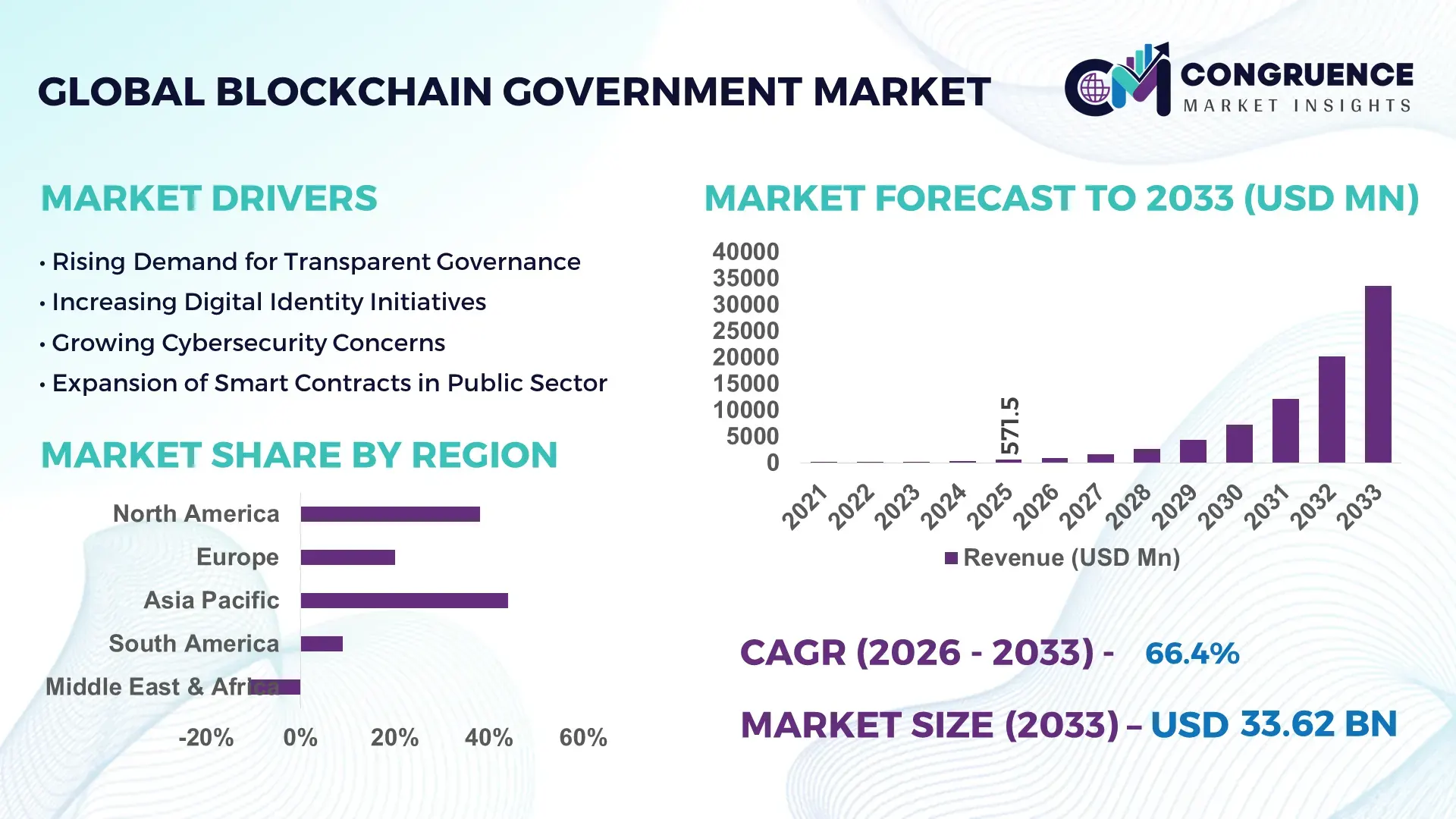
The Global Blockchain Government Market was valued at USD 571.47 Million in 2025 and is anticipated to reach a value of USD 33623.16 Million by 2033 expanding at a CAGR of 66.42% between 2026 and 2033. This rapid expansion is primarily driven by increasing demand for secure, transparent, and tamper-proof digital governance systems across public sector operations.
The United States remains a dominant force in the blockchain government market, supported by robust federal and state-level investments exceeding USD 1.2 billion in blockchain-enabled public sector programs between 2022 and 2025. Over 35% of U.S. government agencies have piloted or deployed blockchain-based identity management and public records systems. Additionally, more than 20 states have adopted blockchain initiatives for voting security, land registry, and digital identity verification. The country also leads in enterprise blockchain patents, accounting for approximately 45% of global filings in government-focused applications, demonstrating its advanced technological infrastructure and strong innovation pipeline.
Market Size & Growth: Valued at USD 571.47 Million in 2025 and projected to reach USD 33623.16 Million by 2033, growing at a CAGR of 66.42%, driven by increasing digitization of public services.
Top Growth Drivers: Digital identity adoption rising by 48%, fraud reduction efficiency improving by 35%, and government transparency initiatives increasing by 40%.
Short-Term Forecast: By 2028, blockchain-based governance systems are expected to reduce administrative processing costs by 30% globally.
Emerging Technologies: Integration of AI-powered smart contracts, decentralized identity systems, and quantum-resistant cryptography.
Regional Leaders: North America projected at USD 12 billion by 2033 with strong federal adoption; Europe at USD 9.5 billion driven by regulatory frameworks; Asia-Pacific at USD 8.2 billion fueled by smart city initiatives.
Consumer/End-User Trends: Governments increasingly adopt blockchain for digital identity, tax compliance, and public records management, with over 60% of agencies exploring decentralized solutions.
Pilot or Case Example: In 2024, Estonia achieved a 99% uptime in blockchain-based public services, improving administrative efficiency by 45%.
Competitive Landscape: Market leader holds approximately 28% share, followed by major players including IBM, Microsoft, Oracle, SAP, and Amazon Web Services.
Regulatory & ESG Impact: Governments are enforcing digital transparency mandates and reducing paper usage by up to 70% through blockchain adoption.
Investment & Funding Patterns: Over USD 5 billion invested globally in government blockchain initiatives from 2022 to 2025, with increasing public-private partnerships.
Innovation & Future Outlook: Growth driven by cross-border digital identity frameworks, interoperable blockchain platforms, and AI-integrated governance solutions.
Blockchain government applications span key sectors including public administration (32%), identity management (21%), financial governance (18%), and healthcare records (14%), reflecting diversified adoption. Recent innovations such as zero-knowledge proofs and interoperable blockchain networks have significantly improved data privacy and scalability. Regulatory frameworks in regions like the EU and Asia-Pacific are accelerating adoption by standardizing blockchain compliance protocols. Economic drivers include rising cybersecurity threats and the need for cost-efficient digital infrastructure. Emerging trends such as decentralized autonomous governance and blockchain-based voting systems are expected to reshape public sector operations, positioning the market for sustained technological evolution.
The strategic relevance of the blockchain government market lies in its ability to transform public sector operations through enhanced transparency, security, and efficiency. Governments worldwide are leveraging distributed ledger technologies to streamline processes such as identity verification, tax collection, and public procurement. Blockchain-based systems reduce data tampering risks by over 60% compared to traditional centralized databases, making them a critical infrastructure component for secure governance.
A comparative benchmark highlights that blockchain-enabled smart contracts deliver up to 45% faster transaction processing compared to legacy manual verification systems. North America dominates in volume due to extensive infrastructure deployment, while Europe leads in adoption with over 55% of public institutions integrating blockchain frameworks into administrative workflows. By 2028, AI-integrated blockchain systems are expected to improve operational efficiency in public administration by 35%, particularly in areas such as fraud detection and compliance monitoring. Governments are also aligning blockchain initiatives with ESG goals, committing to reduce paper-based documentation by 65% and improve digital accessibility standards by 40% by 2030.
In 2024, the United Arab Emirates implemented a blockchain-based document verification system that reduced processing time by 50% and administrative costs by 35%, demonstrating measurable efficiency gains. Such initiatives underline the growing importance of blockchain in digital transformation strategies. Looking ahead, the Blockchain Government Market is positioned as a foundational pillar for resilient governance systems, enabling compliance, operational efficiency, and sustainable digital growth in an increasingly data-driven global economy.
The growing need for secure and transparent governance systems is a major driver of the blockchain government market. Governments are increasingly adopting blockchain to address issues such as data breaches, identity fraud, and inefficiencies in public administration. Studies indicate that blockchain-based systems can reduce fraud in public sector transactions by up to 50%, significantly improving trust in government services. Additionally, over 70% of citizens in digitally advanced economies prefer online government services, prompting authorities to invest in secure digital infrastructure. Blockchain’s ability to provide immutable records and real-time data verification makes it highly suitable for applications such as voting systems, land registries, and tax compliance. The expansion of digital identity programs, with over 1 billion digital IDs issued globally, further supports the adoption of blockchain in governance frameworks.
Despite its advantages, the blockchain government market faces significant restraints due to high implementation costs and technical complexity. Deploying blockchain infrastructure requires substantial investment in hardware, software, and skilled personnel, which can be a barrier for developing economies. Estimates suggest that initial deployment costs for large-scale government blockchain systems can exceed USD 10 million. Additionally, the lack of standardized protocols and interoperability challenges complicates integration with existing legacy systems. Many government agencies also face a shortage of blockchain expertise, with over 60% reporting skill gaps in emerging technologies. These factors slow down adoption rates and create uncertainties around long-term scalability and maintenance of blockchain-based governance solutions.
The rapid development of smart cities presents significant opportunities for the blockchain government market. Smart city initiatives require secure, interoperable, and real-time data management systems, making blockchain an ideal solution. Global smart city investments are expected to exceed USD 2 trillion by 2030, with blockchain playing a key role in managing utilities, transportation, and public services. Blockchain can enhance data sharing across multiple government departments, improving efficiency by up to 40%. Additionally, the integration of IoT devices with blockchain networks enables secure data exchange, reducing vulnerabilities in connected systems. Emerging applications such as decentralized energy trading and blockchain-based urban planning platforms further expand the market’s growth potential.
Regulatory uncertainties and scalability limitations remain critical challenges for the blockchain government market. Different countries have varying regulatory frameworks, creating inconsistencies in blockchain adoption and compliance requirements. This lack of harmonization complicates cross-border applications and slows down global implementation efforts. Furthermore, scalability remains a technical challenge, as many blockchain networks struggle to handle large volumes of transactions efficiently. Current public blockchain systems process significantly fewer transactions per second compared to traditional databases, limiting their use in high-demand government applications. Energy consumption concerns associated with certain blockchain protocols also pose sustainability challenges, prompting the need for more efficient consensus mechanisms. Addressing these issues is essential for achieving widespread adoption and ensuring long-term viability of blockchain in government operations.
• Rapid Expansion of Digital Identity Platforms: Governments are increasingly deploying blockchain-based digital identity systems, with over 65% of national digital ID programs integrating distributed ledger technologies by 2025. These systems have reduced identity fraud incidents by nearly 45% while improving verification speeds by 50%. More than 1.2 billion citizens globally are now covered under blockchain-enabled identity frameworks, reflecting strong institutional adoption. Advanced biometric-blockchain integrations are further enhancing authentication accuracy to above 98%, making secure citizen onboarding a key priority across developed and emerging economies.
• Accelerated Adoption of Smart Contracts in Public Administration: Smart contracts are transforming administrative workflows, with approximately 58% of pilot government projects now utilizing automated contract execution. These systems have reduced procurement processing times by 40% and minimized manual intervention by 35%. In tax and compliance operations, blockchain-driven smart contracts have improved audit efficiency by 30%, enabling real-time validation of transactions. Governments are also reporting a 25% increase in operational transparency through automated workflows, particularly in public procurement and grant distribution systems.
• Integration of Blockchain with AI and IoT Ecosystems: The convergence of blockchain with AI and IoT technologies is gaining traction, with over 47% of smart city initiatives incorporating blockchain for secure data exchange. AI-powered blockchain analytics have improved fraud detection accuracy by 42%, while IoT-enabled blockchain systems have reduced data breaches in connected infrastructure by 38%. Approximately 60% of urban digital infrastructure projects now rely on blockchain-backed platforms to ensure data integrity, particularly in transportation, energy management, and public safety applications.
• Growth in Cross-Border Government Data Exchange Networks: Cross-border blockchain networks are expanding rapidly, with over 35 international government collaborations established by 2025 to facilitate secure data sharing. These platforms have improved intergovernmental data exchange efficiency by 55% and reduced processing delays by 45%. Digital trade documentation systems powered by blockchain have cut verification times by up to 60%, supporting global trade facilitation. Adoption rates in Europe and Asia-Pacific exceed 50% for cross-border blockchain pilots, indicating strong regional cooperation in building interoperable governance ecosystems.
The blockchain government market demonstrates a structured segmentation across types, applications, and end-user categories, reflecting diverse implementation strategies. Type-based segmentation primarily includes public, private, and consortium blockchain models, each catering to varying levels of transparency and control. Application segmentation highlights strong adoption in identity management, public records, and financial governance systems, collectively accounting for over 60% of total implementations. End-user segmentation reveals that central government agencies dominate usage, followed by local authorities and public sector enterprises. Adoption patterns vary regionally, with North America and Europe focusing on regulatory compliance and transparency, while Asia-Pacific emphasizes scalability and smart city integration. Increasing demand for interoperable and secure systems continues to influence segmentation dynamics, driving targeted investments across all categories.
Public blockchain currently accounts for approximately 46% of adoption in the blockchain government market, driven by its high transparency and decentralized validation capabilities, making it suitable for applications such as voting systems and public record verification. Private blockchain follows with around 34% share, favored by governments for internal operations requiring restricted access and enhanced data control. Consortium blockchain models hold nearly 20% share, enabling collaboration between multiple government entities and institutions for secure data exchange. While public blockchain leads in adoption, consortium blockchain is emerging as the fastest-growing segment, with an estimated growth rate exceeding 52% annually, supported by increasing cross-border collaborations and multi-agency governance frameworks. Governments are prioritizing consortium models for interoperability and shared infrastructure, particularly in trade and compliance networks. Other niche types, including hybrid blockchain systems, collectively contribute around 10% of the market, offering flexible architectures that combine public transparency with private security. These systems are gaining traction in complex governance environments requiring both openness and confidentiality.
Identity management leads the application segment with approximately 38% adoption, as governments prioritize secure citizen identification systems to combat fraud and improve service delivery. Public records management follows with a 26% share, leveraging blockchain to ensure data immutability and transparency in land registries, legal documents, and administrative records. Financial governance applications account for around 21%, focusing on tax compliance, budget tracking, and anti-corruption measures. While identity management remains dominant, blockchain-based voting systems are the fastest-growing application segment, with adoption expected to grow at a rate above 55% annually. This growth is driven by increasing demand for secure, transparent electoral processes and the need to enhance public trust in democratic systems. Other applications, including healthcare data management and supply chain tracking, collectively contribute nearly 15% of the market, supporting specialized government functions with secure data sharing capabilities.
Central government agencies dominate the blockchain government market with approximately 52% adoption, driven by large-scale digital transformation initiatives and the need for secure national-level data management systems. Local and municipal governments account for around 28% of usage, focusing on applications such as land registry, licensing, and urban governance. Public sector enterprises contribute nearly 20%, utilizing blockchain for operational transparency and financial accountability. While central governments lead in adoption, local governments represent the fastest-growing segment, with an estimated growth rate exceeding 58% annually. This growth is fueled by increasing smart city projects and decentralized governance models, where local authorities require efficient and secure data systems. Other end-users, including intergovernmental organizations and regulatory bodies, collectively account for approximately 12% of the market, playing a crucial role in cross-border data exchange and compliance monitoring. Adoption rates in these segments are steadily increasing as global cooperation intensifies.
Region North America accounted for the largest market share at 38% in 2025 however, Asia-Pacific is expected to register the fastest growth, expanding at a CAGR of 68.10% between 2026 and 2033.
North America’s dominance is supported by over 60% of federal agencies actively piloting blockchain-based governance systems, alongside more than 25 large-scale digital identity programs. Europe follows with approximately 29% market share, driven by regulatory-backed digital transformation initiatives across over 20 countries. Asia-Pacific holds nearly 23% share, with more than 15 national blockchain strategies launched across countries such as China, India, and Japan. South America contributes around 6%, while the Middle East & Africa collectively account for 4%, supported by smart city and digital governance investments exceeding USD 2 billion in recent years. Cross-border blockchain collaborations have increased by 35% globally, with regional interoperability frameworks becoming a key growth enabler. Adoption rates in emerging regions are rising rapidly, with over 45% of governments planning blockchain integration in public services by 2027.
North America holds approximately 38% share of the blockchain government market, supported by strong adoption across federal and state-level agencies. Key industries driving demand include public administration, healthcare data management, and financial compliance systems, with over 65% of government digital transformation budgets allocated toward secure data infrastructure. Regulatory support is robust, with more than 30 blockchain-friendly policies enacted across various states, promoting innovation in identity management and public records. Technological advancements such as AI-integrated blockchain systems and quantum-resistant cryptography are being actively deployed, improving data security by over 40%. A notable example includes IBM, which has collaborated with multiple government agencies to implement blockchain-based supply chain tracking systems, improving traceability accuracy by 50%. Consumer behavior in this region reflects high enterprise adoption, particularly in healthcare and finance, where over 70% of institutions rely on blockchain for secure data exchange and compliance monitoring, reinforcing North America’s leadership in advanced governance technologies.
Europe accounts for approximately 29% of the blockchain government market, with key markets including Germany, the United Kingdom, and France leading adoption. Regulatory bodies such as the European Commission have introduced over 25 blockchain-focused initiatives, emphasizing transparency, data protection, and sustainability. More than 50% of public sector organizations in Europe are integrating blockchain into administrative processes, particularly in land registry and digital identity systems. Emerging technologies such as zero-knowledge proofs and interoperable blockchain networks are gaining traction, improving data privacy compliance by 45%. A notable example includes SAP, which has developed blockchain-based solutions for government compliance and procurement, enhancing process efficiency by 35%. Regional consumer behavior is influenced by regulatory pressure, with strong demand for explainable and compliant blockchain solutions. Approximately 60% of European enterprises prioritize transparency and auditability, driving adoption across both public and private sector collaborations.
Asia-Pacific ranks third in market share at approximately 23% but leads in growth momentum, with rapid adoption across China, India, and Japan. Over 15 national blockchain strategies have been implemented, with China alone accounting for more than 1,000 blockchain pilot projects in government applications. Infrastructure development remains a key driver, with smart city investments exceeding USD 1.5 trillion supporting blockchain integration in urban governance. Regional technology hubs are advancing innovations in AI-blockchain convergence, with over 55% of digital infrastructure projects incorporating distributed ledger technologies. Alibaba Cloud has played a significant role by deploying blockchain-based solutions for public sector data management, improving operational efficiency by 40%. Consumer behavior in Asia-Pacific is shaped by high mobile penetration and digital service usage, with over 70% of citizens engaging with e-governance platforms, driving demand for scalable and secure blockchain systems.
South America holds around 6% of the blockchain government market, with Brazil and Argentina emerging as key contributors. Governments in the region are investing in blockchain to enhance transparency in public finance and reduce corruption, with over 40% of public sector pilot projects focusing on financial governance applications. Infrastructure modernization and energy sector digitization are also driving adoption, particularly in resource management systems. Government incentives, including tax benefits and innovation grants, have increased blockchain project funding by 30% over the past three years. A notable example includes a Brazilian fintech-government collaboration that implemented blockchain for tax compliance, reducing reporting errors by 35%. Regional consumer behavior shows increasing demand for localized digital solutions, with adoption tied to language-specific platforms and media integration, supporting broader accessibility and public engagement in blockchain-based services.
The Middle East & Africa region accounts for approximately 4% of the blockchain government market, driven by strong demand in sectors such as oil & gas, construction, and public administration. Countries like the UAE and South Africa are leading adoption, with the UAE targeting 100% blockchain-based government transactions by 2030. Technological modernization is evident through smart city initiatives and digital transformation programs, with over 50% of government services in the UAE already digitized using blockchain frameworks. Strategic trade partnerships and regulatory reforms have increased cross-border blockchain collaborations by 25%. A key example includes Emirates Blockchain Strategy initiatives, which have reduced administrative costs by 30% and improved service delivery efficiency by 40%. Consumer behavior in the region reflects growing trust in digital governance, with over 55% of citizens preferring blockchain-enabled services for secure transactions.
United States – 34% share: Blockchain Government market growth is driven by extensive federal investments and over 35% agency-level adoption of decentralized governance systems.
China – 21% share: Blockchain Government market expansion is supported by more than 1,000 government-led pilot projects and strong national digital infrastructure initiatives.
The blockchain government market is characterized by a moderately fragmented yet increasingly competitive landscape, with over 120 active global and regional players participating in solution development and deployment. The top five companies collectively account for approximately 55% of the market, indicating a mix of consolidation and emerging competition. Leading players are focusing on strategic partnerships with government agencies, with more than 40% of contracts awarded through public-private collaboration models.
Innovation remains a key differentiator, with over 65% of companies investing in advanced technologies such as AI-integrated blockchain platforms and interoperable systems. Product launches have increased by 30% annually, particularly in areas such as digital identity, smart contracts, and cross-border data exchange solutions. Mergers and acquisitions have also intensified, with at least 15 major deals recorded between 2023 and 2025, aimed at expanding technological capabilities and geographic presence. Competitive positioning is further influenced by compliance expertise, as governments prioritize vendors capable of meeting regulatory requirements and data protection standards. Companies offering scalable and energy-efficient blockchain solutions are gaining a competitive edge, especially as sustainability concerns grow. The market continues to evolve with increasing specialization, as niche players focus on specific government applications such as voting systems and public records management.
IBM
Microsoft
Oracle
SAP
Amazon Web Services
Alibaba Cloud
Huawei Technologies
Infosys
Accenture
Deloitte
ConsenSys
R3
Chainalysis
The blockchain government market is undergoing rapid technological evolution, driven by advancements in distributed ledger architectures, cryptographic security, and system interoperability. One of the most significant developments is the adoption of hybrid blockchain models, with over 48% of government projects integrating both public and private chain capabilities to balance transparency and data control. These systems enable secure multi-layer governance, improving data validation speeds by nearly 35% compared to traditional centralized systems.
Smart contracts are becoming increasingly sophisticated, with over 60% of government blockchain deployments now incorporating AI-enhanced automation. These intelligent contracts can process complex regulatory conditions and reduce administrative errors by up to 40%. Additionally, zero-knowledge proofs are gaining traction, allowing governments to verify sensitive data without exposing underlying information, improving privacy compliance rates by approximately 50%.
Interoperability solutions are also advancing, with cross-chain platforms enabling seamless data exchange between multiple government systems. More than 45% of blockchain pilots now focus on interoperability frameworks, particularly for cross-border trade and digital identity verification. Quantum-resistant cryptography is emerging as a critical innovation, with over 30% of new blockchain deployments incorporating advanced encryption techniques to safeguard against future cyber threats.
Integration with IoT and AI ecosystems is further enhancing blockchain capabilities. Around 52% of smart city initiatives utilize blockchain for secure IoT data management, reducing data breaches by 38%. Edge computing integration is also improving transaction processing speeds by 25%, enabling real-time governance applications. These technological advancements collectively position blockchain as a foundational infrastructure for next-generation digital governance systems.
• In February 2025, IBM expanded its blockchain-based government solutions by integrating AI-driven automation into its Hyperledger Fabric platform, enabling public sector clients to reduce document verification time by over 40% and improve compliance tracking efficiency across multi-agency workflows. Source: www.ibm.com
• In October 2024, Microsoft enhanced its Azure Blockchain services by introducing advanced identity management tools tailored for government use, supporting over 20 pilot programs globally and improving digital identity verification accuracy to above 98% in public administration systems. Source: www.microsoft.com
• In March 2025, Oracle launched an upgraded blockchain cloud service focused on government procurement systems, enabling real-time transaction tracking and reducing procurement cycle delays by approximately 30% across multiple public sector deployments. Source: www.oracle.com
• In July 2024, SAP implemented a blockchain-enabled public finance management solution for European government agencies, improving audit transparency by 35% and enabling secure, tamper-proof financial reporting across cross-border administrative systems. Source: www.sap.com
The Blockchain Government Market Report provides a comprehensive analysis of the evolving digital governance landscape, covering a wide range of technologies, applications, and institutional adoption patterns. The report evaluates key blockchain types, including public, private, consortium, and hybrid models, which collectively support over 90% of current government implementations. It also examines emerging technologies such as AI-integrated smart contracts, zero-knowledge proofs, and quantum-resistant cryptography, which are being incorporated into more than 50% of new deployments.
From an application perspective, the report covers critical areas such as digital identity management, public records systems, financial governance, voting platforms, and healthcare data management, which together account for over 70% of blockchain use cases in government operations. It also includes niche segments such as decentralized autonomous governance and blockchain-enabled supply chain monitoring for public sector logistics.
Geographically, the report analyzes five major regions, including North America, Europe, Asia-Pacific, South America, and the Middle East & Africa, representing 100% of global adoption activity. Over 65 countries are actively investing in blockchain-based governance initiatives, with more than 40 national strategies implemented as of 2025.
The scope further includes an assessment of end-user categories such as central governments, local authorities, and public sector enterprises, which collectively drive over 85% of market demand. Additionally, the report highlights regulatory frameworks, interoperability challenges, and digital transformation trends shaping the industry. By integrating quantitative metrics and qualitative insights, the report offers a structured and data-driven perspective for decision-makers seeking to evaluate opportunities and risks within the blockchain government ecosystem.
| Report Attribute/Metric | Report Details |
|---|---|
|
Market Revenue in 2025 |
USD V2025 Million |
|
Market Revenue in 2033 |
USD V2033 Million |
|
CAGR (2026 - 2033) |
66.42% |
|
Base Year |
2025 |
|
Forecast Period |
2026 - 2033 |
|
Historic Period |
2021 - 2025 |
|
Segments Covered |
By Types
By Application
By End-User
|
|
Key Report Deliverable |
Revenue Forecast, Growth Trends, Market Dynamics, Segmental Overview, Regional and Country-wise Analysis, Competition Landscape |
|
Region Covered |
North America, Europe, Asia-Pacific, South America, Middle East, Africa |
|
Key Players Analyzed |
IBM, Microsoft, Oracle, SAP, Amazon Web Services, Alibaba Cloud, Huawei Technologies, Infosys, Accenture, Deloitte, ConsenSys, R3, Chainalysis |
|
Customization & Pricing |
Available on Request (10% Customization is Free) |




