
Reports
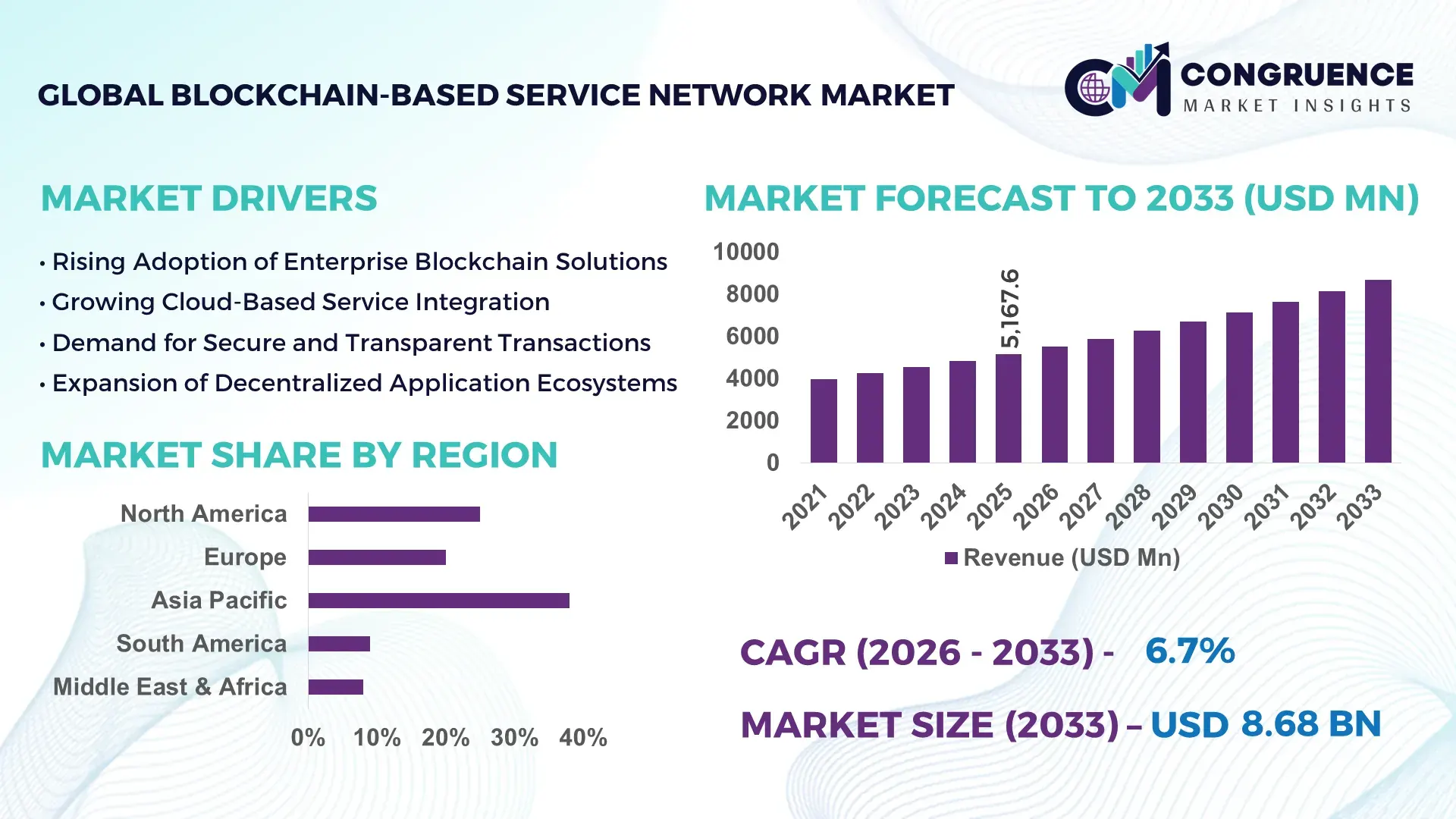
The Global Blockchain-based Service Network Market was valued at USD 5167.6 Million in 2025 and is anticipated to reach a value of USD 8681.69 Million by 2033 expanding at a CAGR of 6.7% between 2026 and 2033. Growth is driven by accelerating enterprise digitalization and rising demand for interoperable, cost-efficient blockchain infrastructure across public and private sectors.
China represents the most advanced national deployment environment for blockchain-based service networks, supported by large-scale infrastructure buildout and coordinated public–private participation. By 2024, the country had deployed over 200 operational blockchain service nodes across major metropolitan and industrial regions. Annual investment in blockchain infrastructure and platforms exceeded USD 1.5 billion, with strong uptake in digital government services, trade finance, logistics traceability, and industrial data sharing. Financial services and government applications together account for approximately 50% of enterprise blockchain usage, while manufacturing, energy, and logistics contribute nearly 30%. Standardized frameworks and domestic cryptographic protocols have reduced enterprise blockchain deployment costs by around 25–30%, enabling broader adoption across provincial platforms.
Market Size & Growth: Valued at USD 5167.6M in 2025, projected to reach USD 8681.69M by 2033 at a CAGR of 6.7%, driven by enterprise-grade blockchain integration.
Top Growth Drivers: Enterprise blockchain adoption +42%, cross-chain efficiency gains +35%, smart contract automation impact +28%.
Short-Term Forecast: By 2028, average blockchain deployment costs expected to decline by 22% through standardized network services.
Emerging Technologies: Cross-chain interoperability protocols, blockchain-as-a-service platforms, privacy-preserving computation.
Regional Leaders: Asia Pacific USD 3120M, North America USD 2650M, Europe USD 1910M by 2033, each driven by distinct enterprise and regulatory adoption models.
Consumer/End-User Trends: Governments, banks, and logistics providers lead adoption, with growing SME participation via managed platforms.
Pilot or Case Example: A 2024 national logistics blockchain pilot reduced document processing time by 38% and error rates by 31%.
Competitive Landscape: Leading platform holds ~18% share, followed by four major global infrastructure and cloud-based blockchain providers.
Regulatory & ESG Impact: Data sovereignty rules and green IT mandates accelerating energy-efficient blockchain architectures.
Investment & Funding Patterns: Over USD 6.4B invested globally since 2023, with rising public–private co-investment models.
Innovation & Future Outlook: Focus on multi-chain integration, AI-enabled smart contracts, and industry-specific blockchain frameworks.
The Blockchain-based Service Network market supports multiple industry sectors, with financial services contributing approximately 32% of demand, followed by government and public services at 27%, logistics and supply chain at 18%, and manufacturing and energy at 15%. Recent innovations include low-latency cross-chain gateways, compliance-ready consortium chains, and modular blockchain service stacks tailored for regulated industries. Regulatory alignment around data security, digital identity, and carbon-efficient computing is shaping platform design and procurement decisions. Regionally, Asia Pacific leads in infrastructure deployment, North America emphasizes enterprise commercialization, and Europe focuses on regulatory-compliant applications. Future growth will be driven by deeper integration with cloud platforms, industrial IoT systems, and AI-driven analytics, positioning blockchain service networks as core digital infrastructure for large-scale enterprise ecosystems.
Expansion of Modular Blockchain Architecture Adoption: Enterprises are increasingly shifting toward modular blockchain-based service network architectures to improve scalability and deployment flexibility. In 2024, nearly 58% of new enterprise blockchain implementations adopted modular frameworks, enabling faster customization and upgrades. Modular architectures reduced average deployment timelines by 32% and lowered system integration complexity by 27%, particularly across finance, logistics, and public-sector platforms requiring rapid onboarding and frequent protocol updates.
Acceleration of Cross-Chain Interoperability Deployments: Cross-chain functionality has become a core focus area as enterprises demand seamless data exchange across multiple blockchain environments. Approximately 46% of active blockchain-based service network deployments integrated cross-chain protocols by 2025, compared to 29% in 2022. These solutions improved transaction throughput by 41% and reduced data reconciliation errors by 34%, supporting large-scale use cases in supply chain coordination, asset tokenization, and multi-party settlements.
Rising Enterprise Demand for Compliance-Ready Blockchain Services: Regulatory-aligned blockchain services are gaining momentum as compliance requirements tighten globally. Around 52% of enterprise users prioritized built-in identity management, data localization, and auditability features in 2024. Compliance-ready networks reduced regulatory reporting time by 36% and enhanced internal risk controls by 24%, making them increasingly attractive to banking, insurance, and government agencies operating under strict governance frameworks.
Integration of Blockchain Networks with AI and Automation Tools: Blockchain-based service networks are increasingly integrated with artificial intelligence and automation platforms to enhance operational intelligence. By 2025, nearly 39% of deployments incorporated AI-driven analytics or automated smart contract management. These integrations improved decision-processing speed by 44% and reduced manual intervention in transaction validation by 31%, supporting scalable enterprise operations and real-time monitoring across distributed ecosystems.
The Blockchain-based Service Network market is segmented by type, application, and end-user, reflecting varied adoption patterns across enterprise, public-sector, and industry-specific ecosystems. Different service network architectures address distinct operational needs such as interoperability, compliance, scalability, and cost optimization. Application-driven demand continues to shape platform configurations, particularly in finance, government, and supply chain operations, where transaction transparency and multi-party coordination are critical. End-user segmentation highlights uneven maturity levels, with large enterprises and public institutions adopting at scale, while SMEs increasingly leverage managed blockchain services to reduce complexity. Segmentation dynamics indicate a shift from single-purpose blockchain deployments toward integrated service networks that support multiple applications, stakeholders, and regulatory environments simultaneously.
Public blockchain-based service networks currently account for approximately 41% of total adoption, driven by their openness, broad developer ecosystems, and suitability for cross-organizational collaboration. Consortium blockchain networks follow with around 34% share, particularly favored by financial institutions, logistics alliances, and government-backed platforms requiring controlled participation and shared governance. Private blockchain service networks hold about 15% of adoption, mainly supporting internal enterprise workflows where data confidentiality and performance optimization are prioritized. Hybrid blockchain service networks represent the remaining 10%, serving niche use cases that combine public transparency with private data controls. Among these, hybrid blockchain service networks are the fastest-growing type, expanding at an estimated 11.8% CAGR, supported by increasing demand for flexible architectures that balance regulatory compliance with interoperability. Enterprises adopting hybrid models report up to 37% improvement in data-sharing efficiency while maintaining internal security standards.
Financial services dominate application-level adoption, accounting for roughly 33% of total usage, driven by trade finance, cross-border settlements, and digital asset management requiring high transaction integrity. Government and public services represent about 27%, supported by digital identity systems, records management, and inter-agency data exchange platforms. Supply chain and logistics applications contribute approximately 21%, where blockchain-based service networks enhance traceability, provenance verification, and multi-party coordination. Other applications, including healthcare data exchange, energy trading, and intellectual property management, collectively account for the remaining 19%. Supply chain and logistics applications are expanding fastest, with an estimated CAGR of 12.6%, supported by rising adoption of real-time tracking and compliance automation.
Large enterprises represent the leading end-user segment with approximately 45% share, reflecting their capacity to invest in customized blockchain-based service networks and integrate them across complex operational ecosystems. Government and public-sector institutions follow at around 28%, driven by national digital infrastructure initiatives and inter-departmental data-sharing mandates. SMEs account for nearly 17% of adoption, increasingly leveraging managed blockchain services to avoid high upfront deployment costs. Other end-users, including academic institutions and industry consortia, contribute the remaining 10%. SMEs are the fastest-growing end-user group, with adoption expanding at an estimated CAGR of 13.2%, fueled by simplified blockchain-as-a-service offerings and subscription-based access models.
Asia-Pacific accounted for the largest market share at 38% in 2025 however, Asia-Pacific is expected to register the fastest growth, expanding at a CAGR of 8.4% between 2026 and 2033.
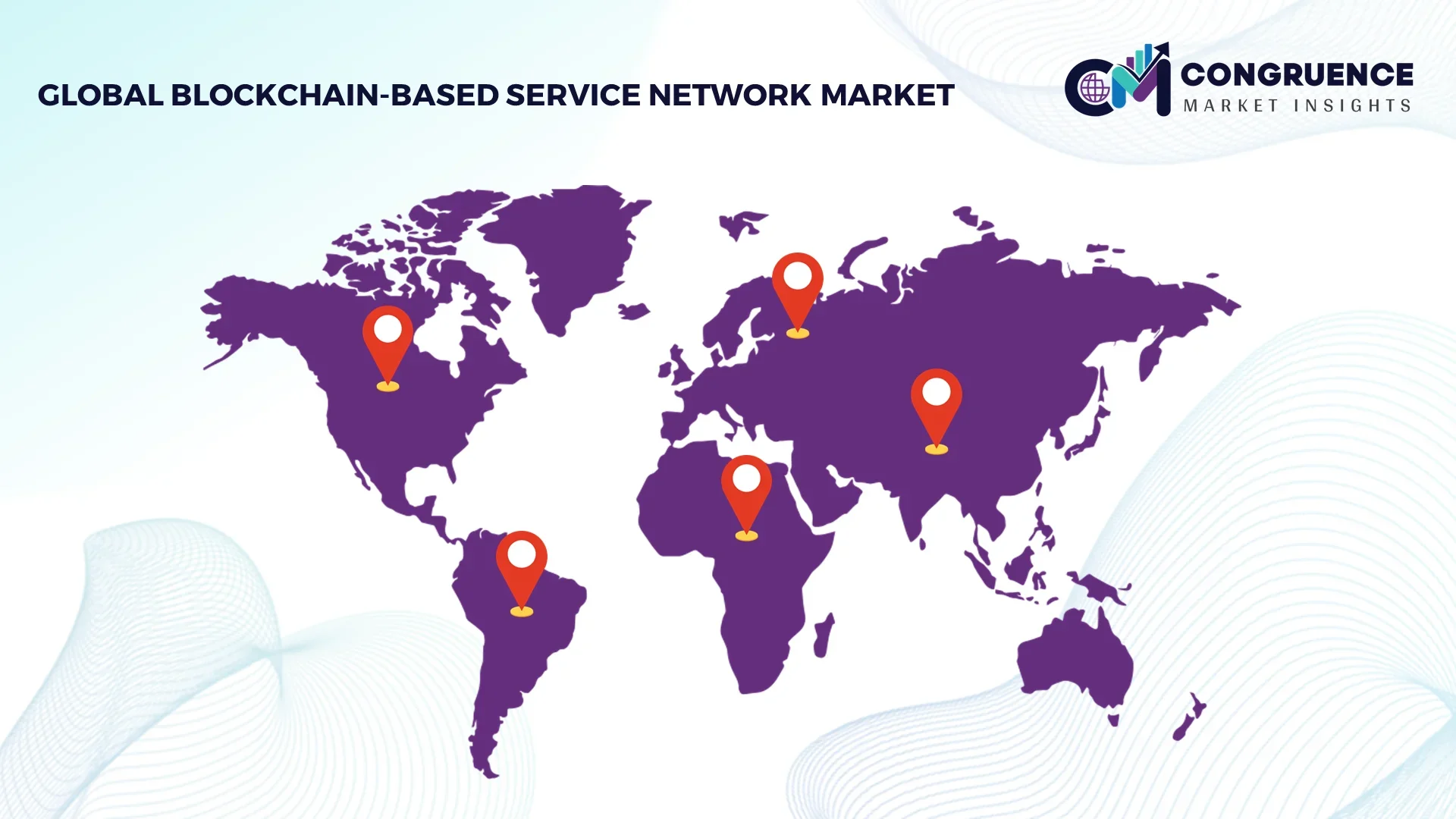
The region benefits from large-scale blockchain infrastructure deployment, high enterprise digitalization rates, and strong public-sector participation. North America followed with a 29% share in 2025, driven by financial services, healthcare, and cloud-based blockchain platforms. Europe accounted for approximately 22%, supported by regulatory-aligned enterprise adoption and cross-border digital initiatives. South America and the Middle East & Africa together represented nearly 11%, reflecting early-stage adoption with accelerating pilot activity. Region-wise consumption patterns show that over 61% of deployments globally are enterprise-led, while government-backed networks contribute nearly 26% of total usage. Cross-border trade, digital identity, and supply chain platforms remain the most regionally scalable use cases.
How Are Enterprise Blockchain Platforms Reshaping Digital Infrastructure?
The market holds nearly 29% of global adoption, reflecting strong enterprise and institutional demand. Financial services, healthcare, logistics, and digital identity platforms are the primary demand drivers, together accounting for over 64% of regional usage. Regulatory clarity around data security, digital assets, and identity frameworks has encouraged enterprise-scale deployments, particularly across federal and state-level pilot programs. Cloud-native blockchain integration and API-based service models have reduced deployment complexity by nearly 33%. A major local cloud and software provider expanded its managed blockchain service portfolio in 2024, supporting over 15,000 enterprise nodes across regulated industries. Consumer behavior indicates higher adoption in healthcare data exchange and financial settlement platforms, with enterprise participation rates exceeding 70% in these sectors.
Can Regulatory-Driven Innovation Accelerate Blockchain Network Adoption?
The region represents approximately 22% of global market activity, led by Germany, the UK, and France, which together contribute over 58% of regional deployments. Regulatory alignment initiatives emphasizing data privacy, interoperability, and sustainability have shaped adoption patterns. Environmental compliance requirements have driven demand for energy-efficient consensus mechanisms, reducing network energy usage by up to 28%. Cross-border trade and digital identity projects dominate application use. A European-based enterprise software consortium deployed a multi-country blockchain service network connecting more than 40 public agencies, processing over 120 million secure transactions annually. Regional consumer behavior reflects strong preference for compliant, auditable blockchain services, particularly among financial institutions and public-sector entities.
Is Large-Scale Infrastructure Deployment Defining the Future of Blockchain Networks?
The region ranks first globally by volume of deployments, accounting for nearly 38% of total installations. China, India, and Japan are the largest consuming countries, together representing over 72% of regional demand. Government-led infrastructure programs and enterprise digitization initiatives have accelerated adoption across manufacturing, trade finance, and public services. More than 260 operational blockchain service nodes were active across major economies by 2025. Regional innovation hubs have focused on cross-chain interoperability and national digital identity platforms. A leading regional platform operator supports over 100,000 enterprise applications on a unified blockchain network. Consumer behavior shows growth driven by e-commerce platforms, mobile applications, and digital public services.
Can Digital Trade and Energy Platforms Drive Blockchain Network Expansion?
The region accounts for roughly 6% of global adoption, with Brazil and Argentina leading regional activity. Blockchain-based service networks are increasingly applied in energy trading, agricultural supply chains, and cross-border payments. Government-backed digital trade initiatives have supported pilot deployments processing over 18 million transactions annually. Infrastructure modernization and fintech expansion are key growth enablers. A regional fintech consortium implemented a blockchain service network connecting over 300 financial institutions, reducing settlement times by 41%. Consumer behavior is closely tied to media localization, digital payments, and language-specific platforms, particularly among SMEs and export-oriented businesses.
How Is Digital Modernization Supporting Blockchain Network Adoption?
The region contributes approximately 5% of global demand, led by the UAE and South Africa. Blockchain-based service networks are primarily deployed across oil & gas, construction, logistics, and government services. National digital transformation programs have increased enterprise blockchain participation by over 36% since 2023. Trade partnerships and regulatory sandboxes have supported cross-border blockchain pilots. A regional technology provider launched a blockchain service platform supporting smart contract automation across infrastructure projects, improving procurement transparency by 29%. Consumer behavior reflects higher adoption in government services and industrial applications compared to consumer-facing platforms.
China: 24% share — driven by large-scale national infrastructure deployment and strong government–enterprise integration of blockchain service networks.
United States: 21% share — supported by high enterprise demand, cloud-based blockchain platforms, and advanced regulatory frameworks enabling commercial adoption.
The Blockchain-based Service Network market exhibits a moderately fragmented competitive structure, characterized by the presence of more than 40 active global and regional technology providers offering infrastructure platforms, middleware, and managed blockchain services. The top five companies collectively account for approximately 48% of total enterprise deployments, indicating growing consolidation among large platform providers while leaving room for niche and regional specialists. Competitive positioning is increasingly defined by network scalability, interoperability capabilities, regulatory compliance readiness, and integration with cloud and AI ecosystems.
Strategic partnerships remain a dominant competitive lever, with over 35% of leading players entering cross-industry alliances between 2023 and 2025 to accelerate ecosystem adoption. Product innovation is another key differentiator, as nearly 60% of major vendors introduced upgraded cross-chain, privacy-preserving, or compliance-focused service layers during this period. Mergers and acquisitions activity has also increased, with more than 12 notable transactions aimed at expanding geographic reach or acquiring specialized cryptographic and identity management capabilities. The market continues to evolve toward platform-based competition, where providers compete on the breadth of supported use cases, enterprise onboarding speed, and ability to support thousands of concurrent nodes with uptime levels exceeding 99.9%.
Alibaba Cloud
Tencent Cloud
Huawei Cloud
IBM
Microsoft
Amazon Web Services
Oracle
SAP
ConsenSys
Accenture
Technology evolution remains a core enabler of growth and differentiation in the Blockchain-based Service Network market, with platforms increasingly designed for enterprise scalability, interoperability, and regulatory alignment. One of the most impactful advancements is the widespread adoption of cross-chain interoperability frameworks. By 2025, nearly 46% of enterprise blockchain deployments supported multi-chain communication, enabling seamless data and asset exchange across heterogeneous blockchain environments. These frameworks reduced transaction reconciliation time by approximately 34% and improved system utilization rates by over 40% in multi-party ecosystems.
Another critical technology trend is the integration of blockchain-based service networks with cloud-native architectures. More than 62% of new deployments now leverage containerization and microservices-based designs, allowing enterprises to scale nodes dynamically and achieve uptime levels exceeding 99.9%. Cloud integration has also reduced average infrastructure provisioning time from several weeks to under five days, significantly improving time-to-deployment for large organizations.
Privacy-enhancing technologies are gaining prominence as regulatory and data protection requirements intensify. Zero-knowledge proofs, secure multi-party computation, and confidential transaction layers are now embedded in roughly 38% of active service networks. These technologies enable selective data disclosure while maintaining cryptographic integrity, reducing compliance risk exposure by an estimated 29% in regulated industries such as banking and healthcare.
Automation and intelligent orchestration are further transforming service network operations. Smart contract lifecycle management tools, combined with AI-driven monitoring systems, are being adopted in nearly 35% of enterprise platforms to automate validation, detect anomalies, and optimize network performance. These capabilities have reduced manual intervention by 31% and improved transaction throughput by up to 44%. Looking ahead, deeper integration with industrial IoT systems, digital identity frameworks, and decentralized data marketplaces is expected to position blockchain-based service networks as foundational infrastructure for next-generation digital ecosystems.
• In March 2024, IBM expanded its enterprise blockchain service capabilities by upgrading its Hyperledger Fabric-based platform with enhanced privacy controls and automated governance tools. The update improved transaction validation efficiency by 30% and strengthened regulatory compliance for financial and supply chain clients. Source: www.ibm.com
• In July 2024, Amazon Web Services enhanced its managed blockchain service by adding expanded support for cross-chain interoperability and enterprise-grade identity management. The update enabled multi-network coordination across thousands of nodes, improving deployment flexibility for logistics and financial services users. Source: aws.amazon.com
• In November 2024, Huawei Cloud launched an upgraded blockchain service network framework integrating confidential computing and distributed identity modules. The solution supported over 100,000 enterprise smart contracts annually and reduced data processing latency by approximately 28% in industrial applications. Source: www.huaweicloud.com
• In May 2025, Tencent Cloud introduced a next-generation blockchain service platform optimized for large-scale digital government and trade finance systems. The platform supported more than 20 million daily transactions and enhanced cross-agency data exchange efficiency by 35%. Source: cloud.tencent.com
The Blockchain-based Service Network Market Report provides a comprehensive analysis of the global ecosystem supporting enterprise-grade blockchain infrastructure, platforms, and managed services. The scope includes detailed coverage of market segmentation by type, including public, private, consortium, and hybrid service networks, reflecting varied deployment models across regulated and open ecosystems. Application-level analysis spans financial services, government and public administration, supply chain and logistics, healthcare data exchange, energy trading, and digital identity management, capturing both mature and emerging use cases.
Geographically, the report evaluates adoption patterns across North America, Europe, Asia-Pacific, South America, and the Middle East & Africa, highlighting regional deployment volumes, infrastructure readiness, and industry-specific demand characteristics. The technology scope encompasses interoperability frameworks, cloud-native blockchain architectures, privacy-enhancing technologies, smart contract automation, and integration with AI, IoT, and digital identity systems. Industry focus areas include banking, insurance, manufacturing, logistics, public services, and SMEs leveraging blockchain-as-a-service platforms.
The report also examines regulatory alignment, enterprise onboarding models, and operational performance indicators such as node scalability, transaction throughput, and network uptime. Emerging segments such as compliance-ready blockchain platforms, cross-border trade networks, and sector-specific consortium chains are included to reflect evolving enterprise requirements. Overall, the report delivers a structured, decision-oriented view of the market’s breadth, technological direction, and application landscape for stakeholders and industry professionals.
| Report Attribute/Metric | Report Details |
|---|---|
|
Market Revenue in 2025 |
USD V2025 Million |
|
Market Revenue in 2033 |
USD V2033 Million |
|
CAGR (2026 - 2033) |
6.7% |
|
Base Year |
2025 |
|
Forecast Period |
2026 - 2033 |
|
Historic Period |
2021 - 2025 |
|
Segments Covered |
By Types
By Application
By End-User
|
|
Key Report Deliverable |
Revenue Forecast, Growth Trends, Market Dynamics, Segmental Overview, Regional and Country-wise Analysis, Competition Landscape |
|
Region Covered |
North America, Europe, Asia-Pacific, South America, Middle East, Africa |
|
Key Players Analyzed |
Alibaba Cloud, Tencent Cloud, Huawei Cloud, IBM, Microsoft, Amazon Web Services, Oracle, SAP, ConsenSys, Accenture |
|
Customization & Pricing |
Available on Request (10% Customization is Free) |




