
Reports
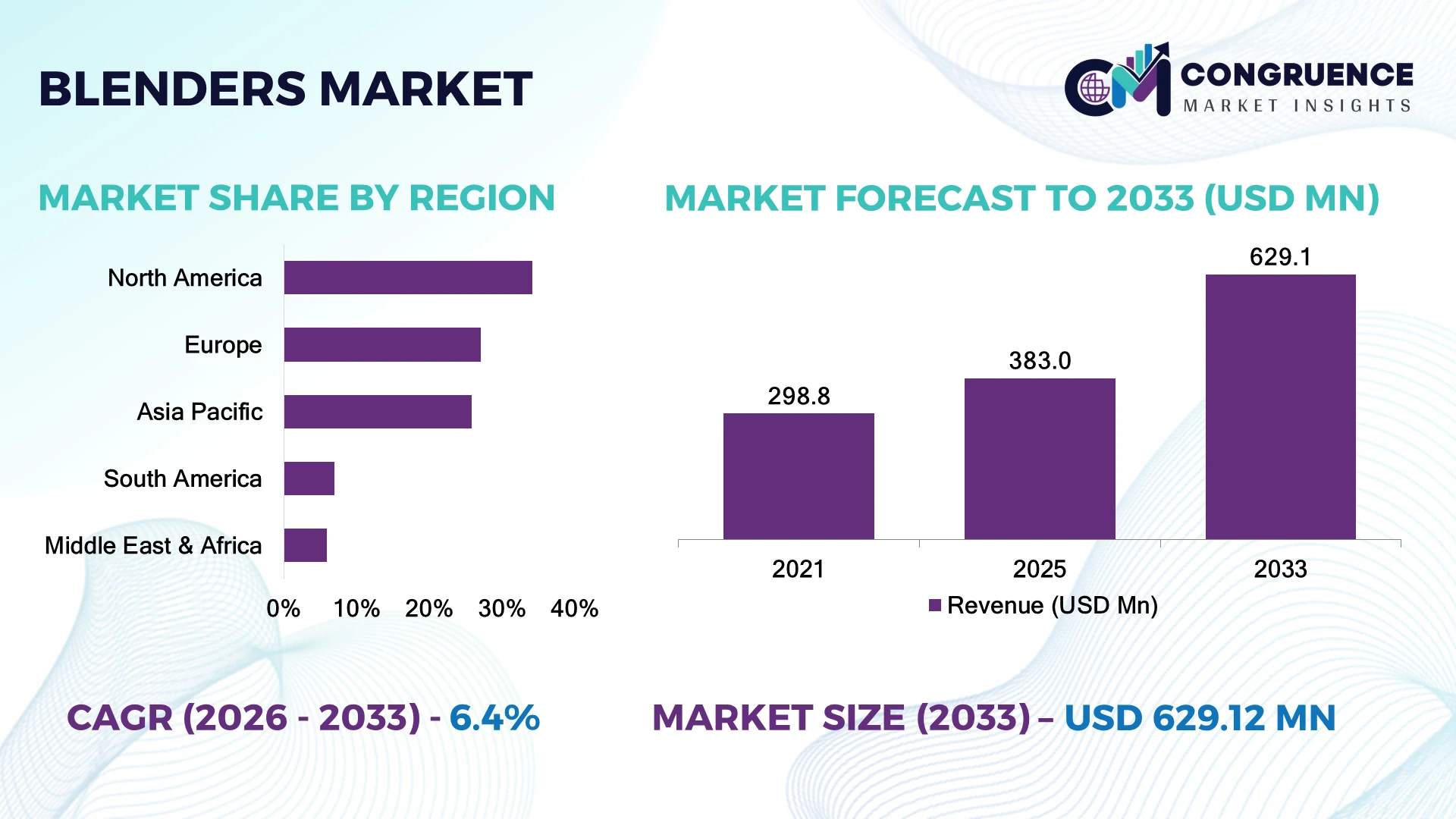
The Global Blenders Market was valued at USD 383.0 Million in 2025 and is anticipated to reach a value of USD 629.1 Million by 2033 expanding at a CAGR of 6.4% between 2026 and 2033. Growth is driven by AI-assisted blending, quieter high-efficiency motors, cordless formats, and expanding commercial foodservice applications.
In the United States, premium and commercial blender adoption remains strong, while China is accelerating value-segment manufacturing and smart-appliance integration; e-commerce already represents about 34.7% of blender sales in related market channels. The U.S. remains ahead in premium technology adoption, while Asian manufacturers gain through cost-efficient production and localized product launches.
Companies should prioritize smart controls, energy-efficient motors, regional sourcing, and digitally enabled distribution to defend margins and capture high-growth demand.
Market Size & Growth: Market value rises from USD 383.0 million in 2025 to USD 629.1 million by 2033 at a 6.4% CAGR, supported by smart controls, multifunctionality, and premium high-performance appliances.
Top Growth Drivers: Health-focused consumption 67.3%, e-commerce penetration 34.7%, and commercial application expansion 32.2% are reshaping purchasing and deployment patterns.
Short-Term Forecast: By 2028, automated blending programs are positioned to improve preparation consistency by roughly 10–15%, while efficient motor designs target 8–12% lower operating energy.
Emerging Technologies: AI recipe recognition, IoT-connected controls, load detection, noise-reduction systems, and cloud-linked nutrition features are moving advanced blenders beyond basic mechanical operation.
Regional Leaders: North America remains a premium technology hub, Europe emphasizes energy efficiency and sustainable materials, while Asia-Pacific leads manufacturing expansion and value-oriented smart-appliance adoption.
Consumer/End-User Trends: Personal blenders account for about 22.4% of related household blender demand, reflecting portability, fitness-oriented consumption, and single-serve preparation.
Pilot/Case Example: In 2025, Ninja expanded its portable Blast platform with Blast Max and Stealth IQ, while its food-preparation share reached 26% in June, demonstrating the impact of product-led innovation.
Competitive Landscape: Vitamix leads with approximately 16.3% share, followed by Ninja at 12.4%, Breville at 7.8%, Philips at 3.2%, and Cuisinart at 3.1%.
Regulatory & ESG Impact: Recyclable materials, lower-energy motors, and packaging redesign are becoming competitive requirements, with approximately 63% of manufacturers adopting low-energy motor technologies.
Investment & Funding: Manufacturers are directing investment toward automated production, smart electronics, direct-to-consumer platforms, and regional supply-chain expansion as appliance sourcing becomes more localized.
Innovation & Future Outlook: Next-generation blenders will combine AI-assisted recipes, sensor-based load management, self-cleaning, quieter motors, and connected nutrition ecosystems, shifting competition toward integrated appliance experiences.
The Blenders Market is increasingly concentrated around high-performance household appliances, personal nutrition, commercial foodservice, and connected kitchen systems. Approximately 34.7% e-commerce penetration is strengthening direct-to-consumer distribution, while AI recipe functions, quieter motors, and portable cordless designs improve product differentiation. Supply-chain restructuring and localization across Asian manufacturing hubs are also pushing brands toward shorter product cycles and region-specific portfolios, setting the stage for strategic competition.
The Blenders Market is becoming strategically important because manufacturers are moving from basic motor-and-blade appliances toward connected, programmable, and multifunctional kitchen platforms. Competition increasingly depends on motor efficiency, noise control, sensor integration, digital recipes, and channel reach rather than power ratings alone. E-commerce penetration of about 34.7% is also changing how brands launch products, collect consumer data, and manage inventory.
Technology is creating measurable operating advantages. Sensor-controlled and programmed blending can improve preparation consistency by roughly 10–15% compared with manual operation, while efficient motor architectures target energy reductions of 8–12%. North America remains stronger in premium appliance adoption, whereas India and China offer greater volume potential through affordable personal, portable, and multifunctional models.
Commercial operators are deploying programmable systems to standardize smoothies, sauces, and beverage preparation across multiple outlets. Manufacturers are responding through partnerships, localized assembly, digital commerce, and expanded product ecosystems. Over the next 2–3 years, competitive advantage will increasingly come from combining appliance performance with automation, serviceability, sustainability, and connected consumer experiences.
AI-enabled controls and high-efficiency motors are becoming central growth mechanisms as consumers and foodservice operators prioritize consistency and convenience. Around 73% of appliance firms reportedly adopted AI-based blending automation features in 2025, while 67% introduced smart recipe-recognition capabilities. E-commerce penetration near 34.7% is accelerating product discovery and direct brand engagement. In the United States, premium brands are combining quieter motors, programmable cycles, and connected recipes to justify higher price points. Companies are responding with R&D investment, digital platforms, and portable product launches. The non-obvious advantage is operational standardization: programmable blending allows commercial kitchens to reproduce recipes consistently across shifts, reducing dependence on individual operator technique and strengthening multi-location foodservice expansion.
Motor assemblies, electronic controls, sensors, and specialized blade systems create cost pressure, particularly for smart and premium models. Approximately 63% of manufacturers are adopting lower-energy motor technologies, but the transition requires redesigned components and higher upfront engineering expenditure. Asian electronics and component supply chains remain critical, exposing manufacturers to freight disruptions, tariff changes, and localization pressures. In 2025, manufacturers continued shifting toward recyclable materials and redesigned packaging, adding compliance and material-management requirements. These pressures directly affect margins in price-sensitive markets such as India, where consumers compare feature-rich imports with locally assembled alternatives. Companies are mitigating exposure through dual sourcing, regional assembly, longer supplier contracts, and simplified electronics architectures. Strategic localization is becoming a margin-protection tool rather than merely a manufacturing preference.
Connected blenders create an opportunity to move beyond one-time appliance sales toward digital nutrition and food-preparation ecosystems. Personal blenders already represent about 22.4% of related household demand, while smart recipe platforms are gaining traction among health-focused consumers. AI recipe recommendations, cloud-linked nutritional tracking, automatic presets, and self-cleaning functions provide opportunities for differentiated premium products. India offers a particularly attractive expansion pathway as urban consumers adopt compact appliances through digital commerce and quick-delivery channels. Manufacturers are investing in app integration, subscription-oriented content, and ecosystem partnerships rather than competing solely on motor wattage. A key opportunity lies in using connected usage data to improve product design and after-sales engagement, creating recurring customer relationships from an appliance category traditionally dependent on replacement purchases.
The shift toward connected and automated blenders introduces execution challenges involving software reliability, sensor calibration, cybersecurity, and component durability. Approximately 60% of manufacturers are expanding multifunctional blending systems, increasing the number of electronic and mechanical interfaces that must operate reliably. Commercial environments intensify the pressure because repeated high-load cycles expose motors, seals, blades, and control systems to greater wear. In the United States and Europe, connected appliance expectations also raise requirements for data protection, software support, and product traceability. Companies must invest in firmware testing, modular components, predictive maintenance, and stronger after-sales networks. The strategic challenge is balancing feature density with serviceability: excessive complexity can increase failure points, while overly basic systems risk losing premium positioning and technological differentiation.
Smart Controls Move Mainstream: Connected controls, preset programs, and sensor-assisted operation are moving from premium models toward mainstream appliances. About 44% of recent blender purchases are associated with smart-kitchen features, while AI integration in foodservice operations reached 28% among restaurant operators in 2025. Manufacturers are responding with app-enabled controls and automated programs that reduce operator input and improve recipe consistency.
Portable Formats Gain Momentum: Personal and cordless blenders are gaining traction as consumers prioritize single-serve preparation and mobility. Personal models account for roughly 28–32% of demand in several current market estimates, while portable designs increasingly target fitness, travel, and workplace use. Companies are shortening product cycles, expanding battery-powered ranges, and using direct-to-consumer channels to reach convenience-focused buyers.
Efficiency Becomes Procurement Metric: Energy-efficient motors, noise reduction, durable blade assemblies, and repair-oriented construction are becoming product-selection factors. Around 75% of EU consumers reported that energy labels influenced appliance purchasing decisions over the previous five years, while EU standby rules introduced in May 2025 reinforce efficiency expectations. Manufacturers are redesigning motors and electronics while simplifying serviceability to protect margins.
Commercial Workflows Become Digital: Restaurants, cafés, and beverage operators are integrating blenders into increasingly standardized digital workflows. The National Restaurant Association reported that 51% of operators used workforce-management software in 2025, while 47% used inventory-management software, creating stronger demand for equipment that supports repeatable preparation processes. Brands are responding with programmable commercial units, service partnerships, and standardized equipment packages for multi-location operators.
Countertop blenders remain the leading type, accounting for approximately 42.3% of global demand in 2025 because their larger capacity, high-torque motors, and versatility support smoothies, soups, sauces, frozen beverages, and batch preparation. Personal blenders follow at about 28.1%, benefiting from compact footprints and single-serve convenience, while immersion blenders represent roughly 19.4% and retain strong relevance for soups, sauces, and professional culinary preparation. Manufacturers continue to invest in high-performance countertop platforms while broadening compact portfolios.
Personal and immersion formats are shifting faster than mature full-size models because consumers increasingly value portability, simplified cleanup, and task-specific operation. Personal blenders are growing through fitness-oriented use, while immersion models gain from space-efficient professional workflows. Companies are responding with cordless designs, quieter motors, improved blade geometry, and multifunction accessories. The strategic implication is a two-track portfolio: countertop products protect premium revenue pools, while portable formats expand addressable demand among younger, space-constrained consumers.
Household applications lead the market with approximately 71.6% share, reflecting the broad use of blenders for smoothies, sauces, soups, purees, and everyday meal preparation. Commercial applications account for roughly 21.8%, supported by restaurants, cafés, hotels, juice bars, and beverage chains that prioritize throughput and durability. Industrial applications remain smaller at about 6.6%, where specialized blending requirements favor equipment designed around controlled processing rather than conventional consumer functionality.
Commercial use is the faster-moving application as foodservice operators standardize beverage preparation and seek shorter preparation cycles. Commercial-grade systems increasingly incorporate programmable controls, high-capacity containers, sound enclosures, and service agreements, while household manufacturers emphasize compactness and multifunctionality. Companies are expanding commercial portfolios through foodservice partnerships and multi-unit procurement programs, while consumer brands are strengthening online distribution. The key shift is operational: commercial buyers increasingly evaluate blenders on throughput and total ownership cost rather than purchase price alone.
Residential users represent approximately 72.4% of blender demand, supported by widespread household adoption, frequent meal-preparation use, and growing interest in smoothies, protein beverages, and convenient cooking. Commercial users account for about 27.6% and purchase higher-duty equipment where motor durability, cycle time, sanitation, and service availability influence procurement. Residential purchasing remains more price-sensitive and design-led, whereas commercial buyers place greater emphasis on uptime, standardized output, and lifecycle economics.
Commercial end-users are gaining strategic importance as restaurant chains, cafés, hotels, and beverage outlets expand standardized preparation workflows. Multi-location operators can secure approximately 12–18% purchasing savings through volume procurement, creating an incentive for standardized equipment platforms. Manufacturers are responding with customized commercial configurations, extended warranties, replacement-part programs, and distributor partnerships. Residential brands are simultaneously emphasizing compact designs and online-first launches. The competitive implication is clear: residential products provide scale, while commercial accounts offer deeper equipment relationships and recurring service opportunities.
North America accounted for the largest market share at 34.2% in 2025 however, Asia-Pacific is expected to register the fastest growth, expanding at a CAGR of 7.2% between 2026 and 2033.

North America held approximately 34.2% of the global blenders market in 2025, supported by high household penetration, premium countertop appliances, and strong commercial foodservice demand. The United States dominates regional consumption, while Canada contributes through premium household and foodservice channels. More than 60% of U.S. households use small kitchen appliances regularly, supporting replacement demand for high-performance models. Commercial operators are increasingly prioritizing programmable controls, quieter motors, and durable blade assemblies to standardize beverage preparation. Direct-to-consumer distribution and omnichannel retail are strengthening product launches, while manufacturers are expanding service networks and localized fulfillment. The region's strategic advantage lies in its ability to monetize advanced features through premium pricing and established brand ecosystems.
United States Market Outlook: The United States remains the principal regional market because of its large appliance installed base, sophisticated foodservice sector, and strong premium-brand presence. Commercial beverage chains are increasingly standardizing equipment across locations, while consumers favor multifunctional appliances. Leading manufacturers are investing in connected controls, cordless formats, and quieter high-torque motors. The country's mature e-commerce infrastructure also enables rapid product testing and direct consumer feedback.
Europe accounted for approximately 27.1% of global blender demand in 2025, with Germany, the United Kingdom, France, and Italy representing important consumption centers. Product development increasingly reflects energy efficiency, repairability, material reduction, and tighter appliance sustainability requirements. European consumers demonstrate strong sensitivity to appliance operating costs, encouraging manufacturers to improve motor efficiency and standby performance. Approximately 75% of European consumers consider energy efficiency when purchasing appliances, reinforcing the shift toward optimized electronics and longer-life components. Foodservice modernization is also supporting commercial blender adoption in hotels, cafés, and restaurant groups. Manufacturers are responding through recyclable housings, modular components, improved motors, and regional distribution partnerships, while premium brands increasingly position durability as a lifecycle-cost advantage.
Germany Market Outlook: Germany represents a strategically important European market because of its advanced manufacturing ecosystem, engineering expertise, and strong emphasis on energy-efficient appliances. German consumers typically place substantial value on product durability and technical performance, supporting premium blender categories. Manufacturers are increasingly emphasizing efficient motors, robust mechanical assemblies, and serviceable components. The country's established appliance distribution network also supports rapid penetration of technologically differentiated models.
Asia-Pacific represented approximately 25.8% of the global market in 2025 and is becoming increasingly important as both a manufacturing base and consumer market. China dominates regional production, supported by extensive electronics, motor, plastics, and small-appliance supply chains, while India is expanding through urban household adoption and digital retail. China accounts for more than 30% of global small-appliance manufacturing capacity, giving manufacturers significant component and assembly advantages. Regional brands are shortening development cycles and launching localized products across price tiers. Smartphone penetration above 75% in major Asian markets is also supporting connected-appliance interfaces and app-based product engagement. Companies are responding through local sourcing, contract manufacturing, regional partnerships, and differentiated personal-blender portfolios.
China Market Outlook: China is the region's most strategically significant market because it combines large-scale appliance manufacturing with a rapidly evolving domestic consumer base. Dense supplier networks for motors, electronic controls, batteries, plastics, and precision components shorten production cycles and support competitive pricing. Manufacturers are increasingly integrating smart controls and compact formats into mass-market appliances. China's export-oriented production infrastructure also enables brands to serve multiple international markets from established manufacturing clusters.
South America accounted for approximately 7.0% of global blender demand in 2025, with Brazil representing the principal consumption and manufacturing center. Urban households increasingly favor compact multifunctional appliances suited to smaller kitchens and faster meal preparation, while commercial demand is concentrated in cafés, juice outlets, hotels, and quick-service restaurants. Brazil's population exceeds 200 million, creating a substantial installed-consumer base and replacement opportunity. Currency volatility and imported-component costs remain important procurement considerations, encouraging manufacturers to increase domestic assembly and distributor partnerships. Companies are adapting portfolios with durable mid-range models, simplified electronics, and locally serviced products. The strategic opportunity is strongest where manufacturers combine competitive pricing with reliable after-sales support and locally available replacement components.
Brazil Market Outlook: Brazil is the dominant South American market because of its large consumer base, established appliance manufacturing capabilities, and extensive retail network. Local production helps manufacturers manage import exposure and improve replenishment speed. The country's strong juice, beverage, hospitality, and foodservice culture also supports commercial blender usage. Companies are increasingly combining locally assembled products with digital retail channels, enabling broader penetration beyond major metropolitan centers.
The Middle East & Africa region represented approximately 5.9% of global blender demand in 2025, with Saudi Arabia, the United Arab Emirates, South Africa, and Egypt serving as important demand centers. Hospitality development, tourism infrastructure, modern retail, and expanding foodservice capacity are supporting commercial equipment deployment. The UAE and Saudi Arabia continue investing heavily in hospitality and tourism infrastructure, increasing requirements for durable beverage-preparation equipment across hotels, cafés, restaurants, and catering operations. Commercial buyers increasingly prioritize high-duty motors, large-capacity containers, and service availability. Manufacturers are responding through distributor partnerships, localized technical support, and premium product positioning. The region's non-obvious advantage is the concentration of new hospitality projects, which allows equipment suppliers to secure standardized multi-site contracts rather than relying solely on individual household purchases.
Saudi Arabia Market Outlook: Saudi Arabia offers the strongest strategic opportunity in the region because large-scale tourism, hospitality, and urban-development projects are expanding professional foodservice infrastructure. The country's Vision 2030 program targets substantial tourism expansion, creating demand for commercial kitchen equipment across hotels, restaurants, entertainment venues, and catering facilities. Manufacturers are positioning through local distributors, project-based procurement, and high-durability commercial models designed for intensive operating conditions.
The market pits premium leaders Vitamix, SharkNinja, and Breville against diversified appliance groups such as Philips and Tefal, while regional OEMs compete primarily on price and supply-chain speed. The top five players collectively command an estimated 32% share, leaving fragmented room for regional manufacturers. Competition centers on technology, pricing, product launches, and customization: automated programs improve usability by roughly 15%, while advanced motor platforms can deliver 20–30% faster processing. SharkNinja emphasizes rapid category expansion and product innovation, Vitamix protects premium positioning through high-performance systems, and Tefal competes through high-speed motors and multifunctional programs. The competitive shift is moving toward integrated controls, portable formats, quieter operation, and digitally supported product ecosystems. Supply-chain localization and component availability remain key pressure points for smaller entrants. Brand trust, engineering capability, distribution reach, and after-sales infrastructure create substantial entry barriers. Winning requires combining differentiated technology with cost-efficient sourcing, rapid product cycles, and strong omnichannel execution.
Vitamix Corporation
SharkNinja Operating LLC
Breville Group Limited
Koninklijke Philips N.V.
Tefal
Groupe SEB
De'Longhi S.p.A.
Hamilton Beach Brands Holding Company
Blendtec
Panasonic Holdings Corporation
Whirlpool Corporation
Electrolux AB
Smeg S.p.A.
Hurom Co., Ltd.
Blender technology is shifting from fixed-speed motors toward adaptive controls, automated programs, sensor-assisted operation, and connected interfaces. Vitamix’s newer systems incorporate adaptive blending, while SharkNinja uses Auto-iQ and automatic speed adjustment. Automated programs can reduce manual intervention by roughly 20–30%, improving recipe consistency and workflow repeatability. By 2026, premium manufacturers are increasingly treating software-assisted operation as a core product differentiator.
High-efficiency motor and blade systems are also displacing conventional architectures. Vitamix states that its large-rotor motor is at least 30% more efficient than previous generations, while Tefal’s advanced systems deliver up to 30% faster results than earlier models. These improvements shorten processing cycles and reduce operator intervention. The advantage favors brands with established engineering platforms and component ecosystems.
From 2026–2028, adaptive blending, self-cleaning, noise reduction, portable battery systems, and app-linked recipe ecosystems will gain wider commercial relevance. Connected controls can shift blenders from standalone appliances into digitally managed kitchen equipment, while modular components improve serviceability. Companies acting now on motor efficiency, software integration, and scalable electronics architectures will strengthen differentiation before these capabilities become mainstream purchasing requirements.
September 2024 — Vitamix: Launched the Ascent X Series with up to 10 blending programs, including automatic self-cleaning, expanding premium multifunctionality and strengthening differentiation through programmable preparation. Source: vitamix.com
February 2025 — Hamilton Beach Commercial: Introduced the 9-inch BigRig immersion blender, extending its commercial portfolio with a compact format designed for professional kitchens requiring power in smaller operating spaces. Source: hamiltonbeachcommercial.com
August 2025 — SharkNinja: Reported second-quarter sales growth of 15.7% and raised its full-year outlook, while allocating $180–$200 million in capital expenditure primarily toward new product launches and technology, strengthening its rapid innovation strategy. Source: sharkninja.com
February 2026 — Vitamix: Launched the VX1 with a 2.2 HP motor, self-cleaning program, variable-speed dial, pulse control, and 64-ounce container, expanding its premium platform into a more accessible product tier at $379.99. Source: vitamix.com
The Blenders Market Report covers countertop, personal, and immersion blender types across household, commercial, and industrial applications, with analysis of residential and commercial end-users. Geographic coverage spans North America, Europe, Asia-Pacific, South America, and the Middle East & Africa, with country-level assessment of manufacturing, consumption, distribution, and technology adoption.
The report evaluates approximately 14 major company profiles alongside emerging regional participants, covering competitive positioning, product innovation, automated controls, high-efficiency motors, portable formats, self-cleaning systems, and connected blending technologies. Segment-level analysis highlights demand concentration, deployment patterns, premiumization, and localization trends. The 2026–2033 strategic outlook supports investment planning, market-entry decisions, manufacturing expansion, partnership development, product portfolio prioritization, and competitive positioning across mature and emerging markets.
| Report Attribute / Metric | Details |
|---|---|
| Market Revenue (2025) | USD 383.0 Million |
| Market Revenue (2033) | USD 629.1 Million |
| CAGR (2026–2033) | 6.4% |
| Base Year | 2025 |
| Forecast Period | 2026–2033 |
| Historic Period | 2021–2025 |
| Segments Covered |
By Type
By Application
By End-User
|
| Key Deliverables | Revenue Forecast; Market Trends; Growth Drivers & Restraints; Technology Insights; Segmentation Analysis; Regional Insights; Competitive Landscape; Regulatory & ESG Overview; Recent Developments |
| Regions Covered | North America; Europe; Asia-Pacific; South America; Middle East & Africa |
| Companies Profiled | Vitamix Corporation; SharkNinja Operating LLC; Breville Group Limited; Koninklijke Philips N.V.; Tefal; Groupe SEB; De'Longhi S.p.A.; Hamilton Beach Brands Holding Company; Blendtec; Panasonic Holdings Corporation; Whirlpool Corporation; Electrolux AB; Smeg S.p.A.; Hurom Co., Ltd. |
| Customization & Pricing | Available on Request (10% Customization Free) |




