
Reports
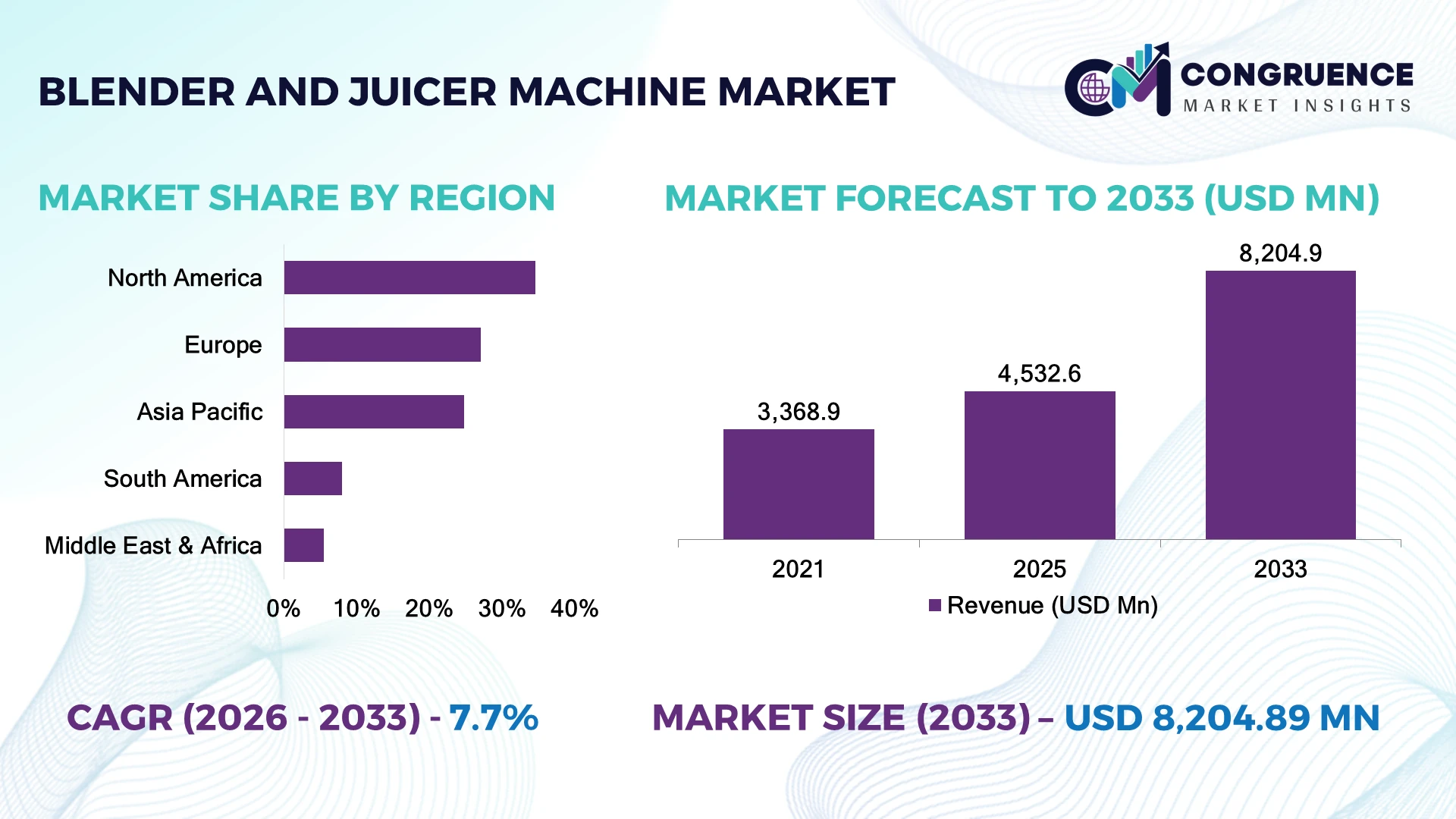
The Global Blender And Juicer Machine Market was valued at USD 4,532.6 Million in 2025 and is anticipated to reach a value of USD 8,204.9 Million by 2033 expanding at a CAGR of 7.7% between 2026 and 2033. Growth is being driven by compact multifunctional appliances, premium blade and motor systems, e-commerce-led replacement cycles, and smart-kitchen integration, with China’s appliance ecosystem accelerating product innovation.
China holds the strongest strategic position, supported by advanced appliance manufacturing, dense supplier networks, and large-scale e-commerce distribution; its small-kitchen-appliance sector represented 21% of global revenue in 2024, while India is emerging faster, with small-kitchen-appliance growth projected at 8.3% through 2033. China’s 2025 trade-in programme and shifting U.S. tariff policies are also pushing manufacturers toward overseas localization and supply-chain diversification.
Manufacturers that combine motor efficiency, compact multifunctionality, localized production, and omnichannel distribution will capture the strongest replacement and premiumization opportunities.
Market Size & Growth: USD 4.53 billion in 2025 to USD 8.20 billion by 2033 at 7.7% CAGR, driven by multifunctional appliances and premium motor systems.
Top Growth Drivers: Multifunctionality 31%, health-oriented usage 27%, smart features 19%.
Short-Term Forecast: By 2028, automated programmes and optimized blade systems target 8–12% lower energy use and 10% faster preparation cycles.
Emerging Technologies: AI-assisted programmes, sensor-controlled blending, self-cleaning systems and digitally optimized motor control are reshaping premium appliances.
Regional Leaders: Asia Pacific leads with 40.6% of small-kitchen-appliance revenue; North America emphasizes premium multifunctionality, while Europe prioritizes compact and efficient designs.
Consumer/End-User Trends: Around 30% of premium appliance buyers increasingly prioritize multifunctional functionality over single-purpose equipment.
Pilot/Case Example: 2025 smart-appliance deployments demonstrated roughly 10%–15% workflow-efficiency gains through automated preparation programmes.
Competitive Landscape: Midea leads China’s small-cooking-appliance market with about 30% volume share, competing with Supor, Joyoung, Bear and international brands.
Regulatory & ESG Impact: Energy-efficient motor design and longer product lifecycles are targeting 5%–10% reductions in operating consumption and material waste.
Investment & Funding: Appliance manufacturers are directing increasing investment toward overseas localization, e-commerce infrastructure and premium product development as tariff uncertainty reshapes supply chains.
Innovation & Future Outlook: 2026–2028 competition centers on quieter motors, portable formats, automated cleaning, connected controls and multifunctional preparation platforms.
The Blender And Juicer Machine Market is increasingly concentrated around health-oriented food preparation, compact urban kitchens, premium multifunctionality, and digitally enabled appliances. China remains a major manufacturing and innovation hub, while India is becoming an important expansion market. In 2025, Chinese manufacturers faced softer appliance volumes but stronger premiumization, reinforcing the shift toward feature-rich products rather than volume-only competition.
The market is becoming strategically important because appliance manufacturers are moving from basic mechanical products toward multifunctional preparation platforms that support premium pricing, faster replacement cycles, and differentiated user experiences. In China, 2025 demand showed a clear split: appliance volumes softened while value-oriented premiumization and smart functionality gained importance.
Technology is changing the cost-performance equation. Advanced motor control, optimized blade geometry, automated programmes and sensor-based operation can reduce preparation energy requirements by roughly 8%–12% while shortening processing cycles by about 10% versus conventional operating configurations. Asia Pacific provides scale and manufacturing density, whereas North America and Europe place greater emphasis on premium functionality, compact design, convenience and product efficiency.
Over the next 2–3 years, connected controls, self-cleaning functions and portable formats are positioned to move from premium niches toward broader adoption, with feature-enabled models targeting 15%–20% higher functional differentiation. Manufacturers are responding through localized production, retailer partnerships and omnichannel expansion. China’s trade-in policies and tariff uncertainty are simultaneously encouraging overseas manufacturing diversification.
The competitive advantage will increasingly come from combining reliable motor performance, compact multifunctionality, efficient manufacturing and differentiated digital features rather than competing solely on appliance price.
Rising preference for fresh beverages, smoothies, plant-based preparations, and home food processing is shifting blender and juicer purchases toward multifunctional, higher-performance models. Approximately 30% of urban appliance buyers prioritize multifunctionality, while premium products increasingly command 10–15% higher price positioning than basic single-purpose units. In India, expanding organized retail and e-commerce availability is accelerating access to higher-specification appliances, while Chinese manufacturers are integrating brushless motors, automated programmes, and quieter operating systems. Companies are responding with product-line expansion, attachment ecosystems, and localized assembly to control costs. The non-obvious shift is that manufacturers increasingly compete on appliance utilization per countertop footprint rather than motor power alone, strengthening demand for compact products capable of replacing multiple kitchen devices.
Motor assemblies, copper, plastics, magnets, electronic controls, and packaging remain exposed to procurement volatility, with input-cost fluctuations of 6–10% affecting appliance margins and contract pricing. Imported components can represent roughly 25–35% of bill-of-materials value in mid-range models, increasing exposure to freight disruption, currency movements, and supplier concentration. China-based manufacturers also face tariff-related supply-chain adjustments for North American shipments. These pressures constrain margin expansion and complicate inventory planning, while component shortages can extend production lead times by 5–8%. Companies are responding through dual sourcing, regional assembly, longer-term supplier contracts, and localization of motors, housings, and control electronics. The strategic priority is shifting from lowest-cost procurement toward resilient, geographically diversified supply networks.
Connected controls, automated programmes, and self-cleaning systems are creating opportunities to reposition blender and juicer machines as higher-value kitchen platforms. Smart-feature penetration in premium kitchen appliances is approaching 15–20% in leading urban markets, while multifunctional models can command approximately 10–15% higher price positioning than basic single-function products. India offers an attractive expansion opportunity as organized retail and e-commerce improve access to premium appliances. Manufacturers are investing in quieter brushless motors, sensor-based speed control, and app-enabled recipe ecosystems, while retailers strengthen bundled-product strategies. A less obvious opportunity lies in compact appliances for smaller urban kitchens, where multifunctionality can replace two or three separate devices and increase household appliance utilization.
Connected blender and juicer platforms face execution barriers involving firmware compatibility, mobile applications, sensors, connectivity modules, and cloud-enabled controls. Approximately 20–30% of smart-appliance development effort can be absorbed by software integration, testing, and cybersecurity requirements rather than mechanical engineering. Interoperability limitations across operating systems and fragmented connectivity standards can reduce connected-feature utilization by 10–15%. In India and Southeast Asia, inconsistent home-network infrastructure further complicates reliable smart-appliance deployment. Manufacturers must strengthen embedded-software teams, cybersecurity protocols, and interoperability testing while partnering with technology providers where internal capabilities are limited. The critical execution issue is not adding connectivity, but ensuring dependable operation across diverse household environments without increasing warranty exposure or service complexity.
Multifunctionality Replaces Single-Purpose Designs Multifunctional models are capturing greater premium demand, with approximately 30% of urban consumers prioritizing appliances that combine blending, juicing, and food-processing functions. Manufacturers are consolidating attachments and programmable modes, reducing countertop footprint by 15–20% while improving product utilization and supporting higher-value positioning.
Brushless Motors Improve Efficiency Brushless and electronically controlled motors are moving into higher-volume premium models, delivering roughly 8–12% better energy efficiency and approximately 10% faster speed response than conventional configurations. Chinese manufacturers are scaling these systems as copper, electricity, and production costs place greater pressure on appliance economics.
Smart Controls Enter Mainstream Appliances Sensor-based programmes, digital interfaces, automated cleaning, and preset operating modes are expanding beyond flagship products, with connected functionality approaching 15–20% penetration across premium kitchen-appliance ranges. Manufacturers are integrating firmware and mobile controls while simplifying user interfaces to reduce service complexity and improve repeat usage.
Supply Chains Shift Toward Localization Tariff uncertainty, freight volatility, and component concentration are accelerating regional sourcing and assembly strategies, particularly for China-to-North America supply routes. Manufacturers are targeting 10–15% greater local component sourcing, while dual-supplier arrangements reduce exposure to shortages and improve production continuity. This shift is also encouraging localized motor, housing, and electronic-control production closer to major consumer markets.
Blenders represent the leading type, accounting for approximately 84% of India’s food-preparation-appliance value in 2025, supported by broader functionality, established household penetration, and use across beverages, grinding, pureeing, and meal preparation. Juice extractors remain a smaller category at around 2%, but represent the fastest-growing type as wellness-focused consumption and fresh-juice preparation gain traction. Mature blender demand is increasingly replacement-led, while juicer demand is shifting toward premium health-oriented usage. Manufacturers are responding by expanding high-power blender portfolios, compact formats, and multifunctional attachments while investing selectively in advanced extraction systems.
Within the blender category, multifunctional configurations account for roughly 20–25% of premium product launches, reflecting stronger consumer preference for appliance consolidation. Centrifugal juicers retain advantages in speed and affordability, while slow-extraction models are gaining premium positioning. Companies are prioritizing quieter motors, compact designs, automated programmes, and differentiated extraction technologies, shifting investment from basic capacity expansion toward higher-value product architectures.
India’s 2026 Consumer Affairs comparative testing identifies food processors incorporating juicing, mixing, and grinding capabilities, reinforcing multifunctionality as an important product-selection factor.
Residential applications account for approximately 80–85% of Blender And Juicer Machine demand, supported by household use for smoothies, juices, grinding, pureeing, and meal preparation. Urban households increasingly favor compact appliances capable of replacing multiple kitchen devices, strengthening demand for multifunctional configurations. Commercial applications represent a smaller but faster-growing opportunity, particularly across cafés, juice bars, QSRs, hotels, and institutional kitchens. Commercial buyers prioritize throughput, durability, cleaning speed, and repeatable output, creating stronger demand for high-torque and programmable equipment. Manufacturers are therefore developing distinct product architectures rather than extending consumer platforms into professional environments.
Approximately 60–65% of mainstream residential buyers remain strongly value-oriented, whereas premium consumers place greater emphasis on performance, convenience, and warranty coverage. Commercial operators increasingly evaluate equipment through labor productivity and preparation consistency, with advanced systems targeting 10–15% faster processing cycles. Companies are responding through professional-grade product lines, service agreements, customized configurations, and specialized distribution partnerships.
A 2026 survey of 250 professional kitchen operators found that 64% reported significant staffing bottlenecks, strengthening the operational case for automation and equipment designed to improve preparation consistency.
Households remain the dominant end-user group, representing approximately 80% of demand through first-time purchases, replacement cycles, and multifunctional appliance adoption. Household purchasing increasingly balances motor performance, versatility, warranty coverage, energy efficiency, and online reviews. Commercial foodservice represents the fastest-growing end-user segment because equipment directly affects preparation throughput, menu consistency, and labor utilization. Cafés, juice outlets, QSRs, hotels, and catering businesses are increasingly evaluating machines through operational productivity rather than purchase price alone. Approximately 15–20% of premium commercial demand is shifting toward programmable or automation-enabled equipment.
Household buyers remain comparatively price-sensitive, while commercial operators accept higher upfront costs when equipment reduces preparation time and staff dependency. Manufacturers are responding with differentiated consumer and professional portfolios, extended warranties, service contracts, bulk procurement programs, and customized motor configurations. India is particularly attractive as organized retail and e-commerce extend premium appliance availability beyond major metropolitan markets. Companies are consequently shifting competitive investment toward reliability, after-sales support, and professional-use customization rather than competing solely through entry-level pricing.
KPMG’s 2025 India consumer research found that 23% of small-appliance consumers were willing to pay more for brands consistently delivering quality, durability, or energy efficiency, reinforcing reliability-led premium positioning.
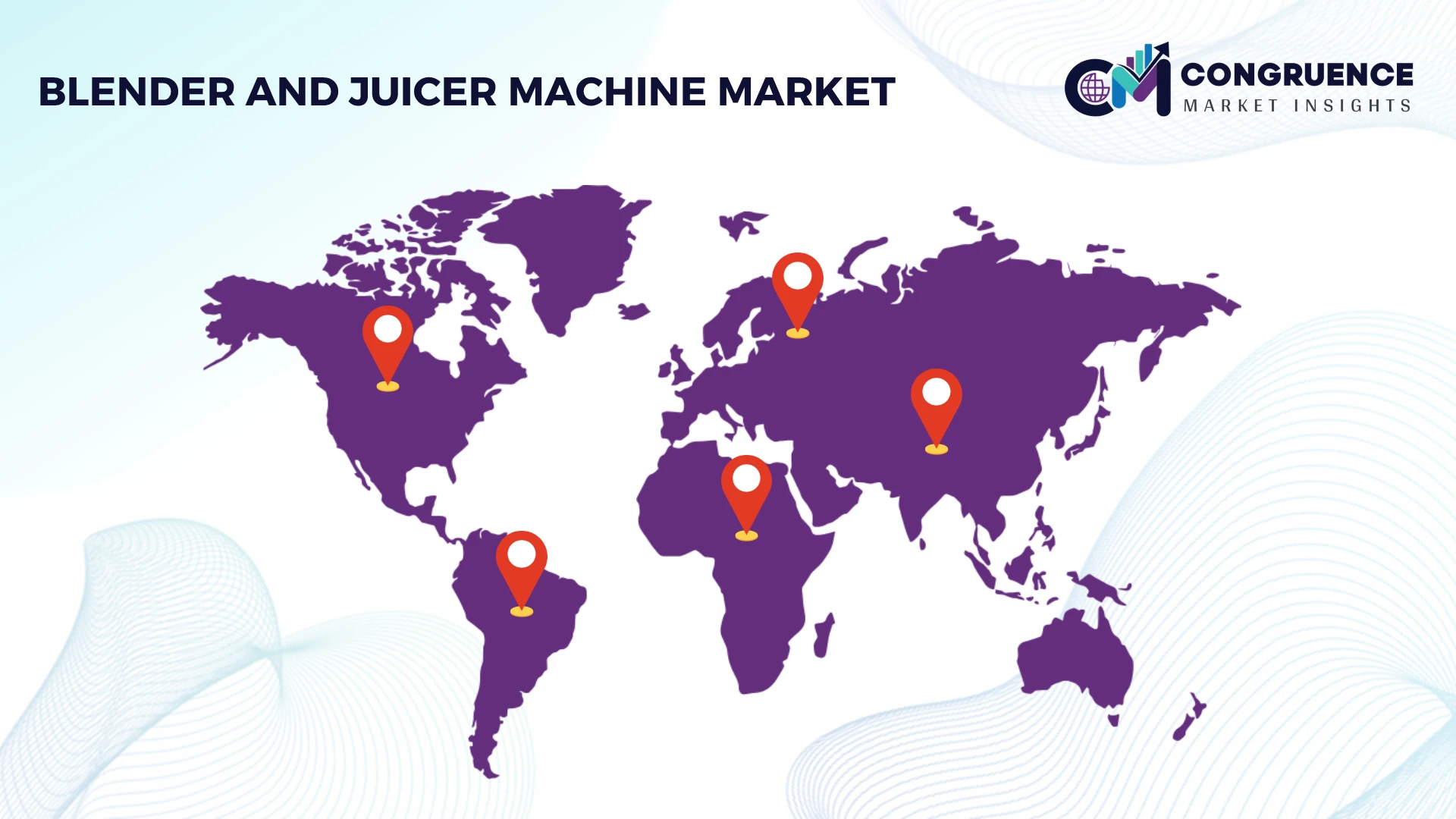
North America accounted for the largest market share at 34.6% in 2025 however, Asia-Pacific is expected to register the fastest growth, expanding at a CAGR of 9.1% between 2026 and 2033.
Premiumization and Smart-Kitchen Integration Reshape Appliance Demand
North America maintains the strongest commercial position, supported by high penetration of countertop appliances, premium kitchen equipment, health-focused consumption, and replacement-led purchasing. The region represented approximately 34.6% of global demand in 2025, with the U.S. accounting for the majority of regional sales. High-power blending systems, multifunctional machines, self-cleaning programs, and connected controls are strengthening product differentiation. Commercial deployment across juice bars, cafés, fitness facilities, and foodservice chains is also expanding the addressable customer base. Manufacturers are prioritizing quieter motors, compact footprints, and automated cleaning to defend premium price points. Retailers increasingly favor multifunctional SKUs that combine blending, crushing, and juicing capabilities, reducing shelf-space requirements while increasing average transaction value.
United States Market Outlook: The U.S. remains the region's principal market, supported by extensive appliance retail infrastructure and strong replacement demand. Approximately 60% of North American category sales are concentrated in the U.S., while premium multifunctional appliances increasingly target households seeking restaurant-style beverage preparation. Manufacturers are emphasizing motor durability, digital presets, and low-noise operation to strengthen differentiation.
Energy Efficiency Drives Product Reengineering
Europe is shifting toward energy-efficient, durable, and multifunctional countertop appliances as households and commercial kitchens respond to stricter product-efficiency expectations. Germany, the United Kingdom, France, and Italy represent major demand centers, while premium appliances account for an estimated 40% of regional category value. European manufacturers are emphasizing recyclable plastics, repairability, lower standby consumption, and modular components. Retail demand is increasingly influenced by lifecycle performance rather than motor power alone, forcing brands to balance performance with material efficiency and regulatory compliance. Commercial cafés and hospitality operators are also upgrading equipment to reduce preparation time and simplify cleaning workflows.
Germany Market Outlook: Germany represents a strategically important European market because of its strong appliance-manufacturing ecosystem, engineering capabilities, and established premium-kitchen segment. More than 45% of premium appliance buyers increasingly prioritize durability and energy performance alongside functionality. Manufacturers are therefore focusing on high-efficiency motors, modular components, and quieter operating systems to strengthen long-term product positioning.
Manufacturing Scale Accelerates Smart Appliance Adoption
Asia-Pacific is becoming the most important expansion zone as rising household appliance penetration intersects with large-scale electronics manufacturing and rapidly developing urban foodservice networks. China, Japan, South Korea, and India are key demand and production centers, while China remains central to global component and appliance manufacturing. Approximately 35% of global blender and juicer machine production capacity is concentrated in Chinese manufacturing ecosystems. Companies are expanding affordable multifunctional models while introducing app-connected controls, automated programs, and compact designs for smaller urban kitchens. India is particularly important for volume expansion as organized retail and e-commerce broaden access beyond major metropolitan markets.
China Market Outlook: China combines manufacturing depth, component availability, and extensive domestic appliance distribution, giving producers a structural cost advantage. Around 50% of Asia-Pacific production capacity is linked to Chinese manufacturing networks. Leading manufacturers are integrating brushless motors, touch controls, automated cleaning, and smart presets while using domestic supplier ecosystems to shorten product-development cycles and control component costs.
Urban Retail Expansion Broadens Appliance Access
South America is experiencing demand concentration in Brazil, Argentina, Colombia, and Chile, with household appliances increasingly distributed through organized retail and digital commerce. Brazil represents the principal regional market and contributes more than 45% of South American category demand. Price sensitivity remains significant, but multifunctionality is becoming an important purchasing criterion as consumers seek appliances capable of blending, crushing, and preparing juices with one motor base. Manufacturers are responding with locally adapted product ranges, extended warranty programs, and simplified service networks. Currency volatility and imported-component exposure continue to influence pricing, making localized assembly and diversified sourcing strategically valuable for maintaining competitive margins.
Brazil Market Outlook: Brazil is the region's strongest commercial market, supported by its large urban consumer base, established appliance distribution network, and extensive foodservice sector. Approximately 50% of regional premium appliance demand is concentrated in Brazil's major metropolitan markets. Manufacturers are prioritizing durable motors, larger-capacity jars, accessible replacement parts, and competitive pricing to improve penetration beyond affluent households.
Hospitality Investment Accelerates Premium Appliance Deployment
The Middle East & Africa market is being shaped by hospitality construction, foodservice modernization, urban retail expansion, and premium household appliance adoption. The United Arab Emirates and Saudi Arabia represent major commercial demand centers, particularly across hotels, cafés, restaurants, and high-income residential developments. Commercial applications account for an estimated 30% of regional demand, giving suppliers an attractive route to premium equipment sales. Manufacturers are emphasizing high-duty-cycle motors, thermal protection, stainless-steel components, and rapid-service capabilities for demanding foodservice environments. Retailers are simultaneously expanding compact multifunctional models for residential customers, creating a two-tier market between professional equipment and value-oriented household appliances.
Saudi Arabia Market Outlook: Saudi Arabia offers strong strategic potential through hospitality expansion, urban development, and investment in modern foodservice infrastructure. Commercial beverage-preparation equipment represents approximately 35% of premium blender and juicer machine demand in major hospitality clusters. Suppliers are positioning through distributor partnerships, localized after-sales service, and heavy-duty equipment designed for high-frequency preparation environments.
Vitamix, Ninja, Breville, Philips, and Panasonic compete as global brand leaders, while Hurom, Kuvings, Hamilton Beach, and regional OEMs challenge them on specialty performance and price. The top five players collectively hold about 43% share, leaving meaningful room for focused brands. Competition centers on technology, pricing, distribution, and supply-chain control: premium models command roughly 15–30% price premiums, while multifunctional products can cut appliance purchases by 20–25%. Players are expanding through e-commerce, retail partnerships, localized product lines, and integrated blending-juicing platforms. Philips and Breville emphasize multifunctionality; Ninja pushes portability and value; Vitamix protects premium performance; Kuvings and Hurom deepen cold-press specialization. The competitive shift is moving from motor power alone toward automation, connectivity, noise reduction, extraction efficiency, and compact design. Entry barriers remain high because brand trust, tooling, certification, retail access, and after-sales networks require substantial investment. Winning requires differentiated engineering, disciplined sourcing, rapid product refreshes, and channel strength worldwide effectively.
Vitamix Corporation
SharkNinja Operating LLC
Breville Group Limited
Koninklijke Philips N.V.
Panasonic Corporation
Hamilton Beach Brands Holding Company
Cuisinart
Hurom Co., Ltd.
Kuvings
Omega Juicers
Tribest Corporation
Smeg S.p.A.
De’Longhi S.p.A.
Electrolux AB
High-speed motor platforms remain central, but current development is shifting toward multifunctional architectures, vacuum blending, cold-press extraction, automated cleaning, and programmable controls. Premium systems increasingly combine blending and juicing in one platform, reducing countertop equipment requirements by approximately 20–25%. Adoption is strongest in premium households and commercial beverage preparation, where workflow simplification directly improves throughput.
Vacuum blending and hands-free juicing are becoming important differentiators. Vacuum systems reduce oxidation exposure and improve visual consistency, while automated feeding reduces manual preparation steps by roughly 15–20%. Compared with conventional single-function appliances, integrated platforms can improve preparation efficiency by approximately 20% while reducing cleaning-related handling. Premium technology leaders benefit most because these features support higher price realization and stronger brand differentiation.
Between 2026 and 2028, sensor-assisted programs, quieter brushless motors, connected recipe platforms, USB-C portable blending, and recyclable materials will move from niche features toward broader premium adoption. Philips is integrating blending and juicing, while Kuvings is advancing automated cold-press systems. Companies investing now gain advantages through shorter preparation cycles, lower user friction, differentiated product portfolios, and stronger sustainability credentials.
March 2025 Vitamix launched the Ascent X series with four models, digital displays, 48-ounce containers, and up to 10 recipe settings, strengthening premium positioning through programmable performance and redesigned controls. Business impact: higher-value differentiation in advanced home blending. Source: T3 (T3)
July 2025 Panasonic introduced a new blender with soup-making functionality alongside a recipe smartphone application, targeting busy households and integrated meal preparation. The launch expanded multifunctional appliance positioning and strengthened digital engagement around kitchen workflows. Source: Panasonic (Panasonic)
September 2025 Philips introduced the Flip&Juice Blender, combining blending and juicing with 1,500W power, 22,000 rpm, and more than 90% recycled case materials. The platform consolidates functions while improving product-level sustainability positioning. Source: Philips (FlixCar)
October 2025 Kuvings showcased AUTO10S hands-free slow juicer, commercial CS600 juicer, and CB1000 vacuum blender at Canton Fair, attracting buyers from over 200 countries. The expansion strengthened export partnerships and premium positioning across emerging markets. Source: Kuvings (Kuvings)
The Blender And Juicer Machine Market Report covers countertop blenders, personal blenders, centrifugal juicers, masticating juicers, cold-press systems, and multifunctional blender-juicer platforms. Application coverage spans household beverage preparation, smoothies, fresh juice, food preparation, cafés, restaurants, hospitality, fitness facilities, and commercial beverage operations. Analysis evaluates conventional, high-speed, low-speed, vacuum-assisted, automated, and connected technologies, with emphasis on performance, extraction efficiency, cleaning automation, noise reduction, and portability.
Regional assessment covers North America, Europe, Asia-Pacific, South America, and the Middle East & Africa, with country-level analysis of the United States, Germany, China, India, Brazil, Japan, and other priority markets. The report evaluates leading manufacturers, premium versus value positioning, channel strategies, manufacturing concentration, adoption patterns, and emerging product niches. These insights support investment planning, geographic expansion, product development, competitive positioning, and strategic decisions through 2026–2033.
| Report Attribute/Metric | Report Details |
|---|---|
|
Market Revenue in 2025 |
USD 4,532.6 Million |
|
Market Revenue in 2033 |
USD 8,205.9 Million |
|
CAGR (2026 - 2033) |
7.7% |
|
Base Year |
2025 |
|
Forecast Period |
2026 - 2033 |
|
Historic Period |
2021 - 2025 |
|
Segments Covered |
By Type
By Application
By End-User
|
|
Key Report Deliverable |
Revenue Forecast, Growth Trends, Market Dynamics, Segmental Overview, Regional and Country-wise Analysis, Competition Landscape |
|
Region Covered |
North America, Europe, Asia-Pacific, South America, Middle East, Africa |
|
Key Players Analyzed |
Vitamix Corporation, SharkNinja Operating LLC, Breville Group Limited, Koninklijke Philips N.V., Panasonic Corporation, Hamilton Beach Brands Holding Company, Cuisinart, Hurom Co., Ltd., Kuvings, Omega Juicers, Tribest Corporation, Smeg S.p.A., De’Longhi S.p.A., Electrolux AB |
|
Customization & Pricing |
Available on Request (10% Customization is Free) |




