
Reports
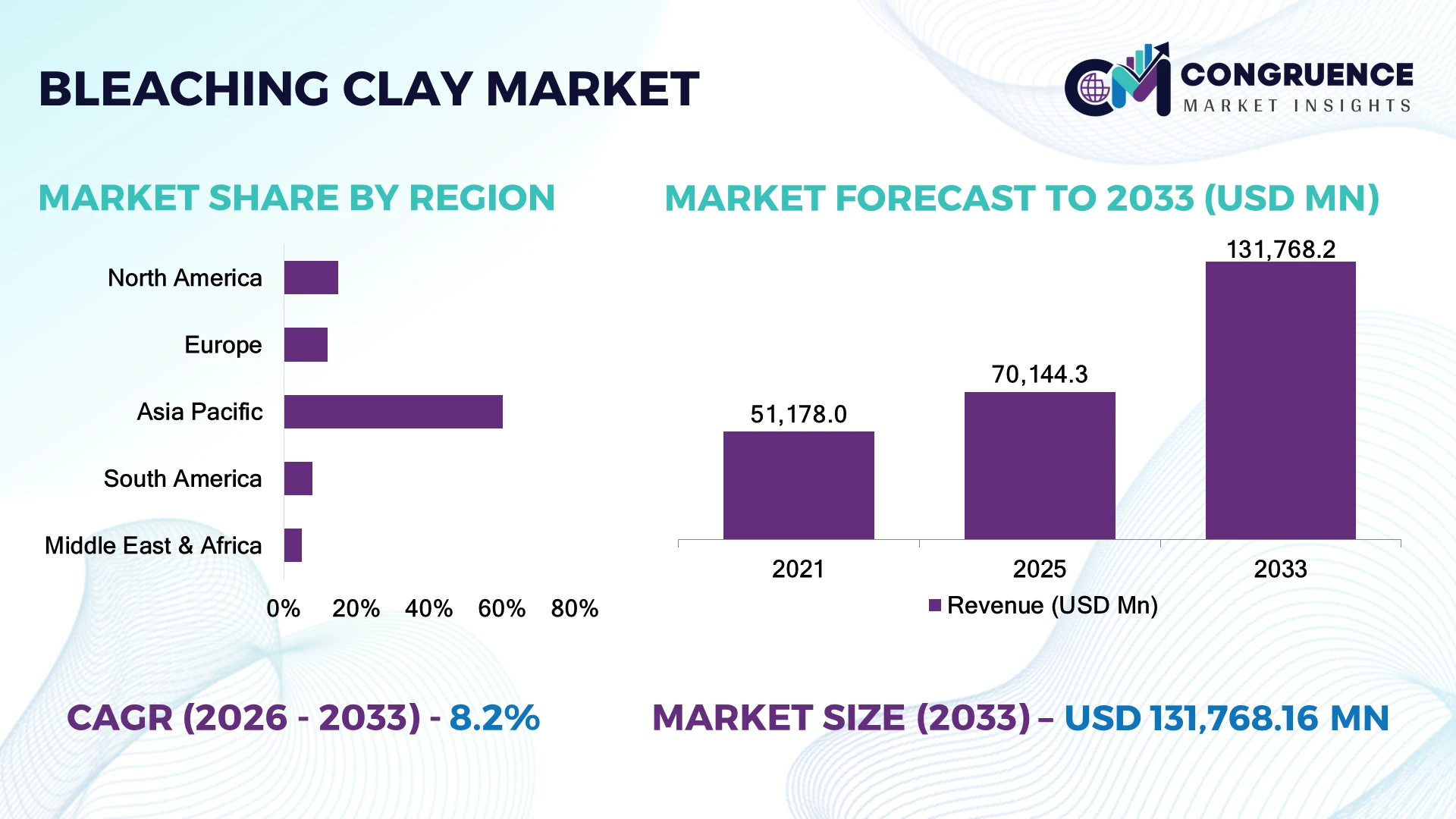
The Global Bleaching Clay Market was valued at USD 70,144.3 Million in 2025 and is anticipated to reach a value of USD 131,768.2 Million by 2033 expanding at a CAGR of 8.2% between 2026 and 2033. Growth is driven by higher bleaching-earth consumption in edible-oil and biodiesel refining, tighter contaminant-control requirements, and demand for higher-adsorption grades that reduce clay dosage and oil retention.
India is emerging as a strategically important bleaching-clay production base, particularly Gujarat. More than 90% of mineral inputs can be sourced from captive mines in vertically integrated operations, while value-added conversion significantly increases mineral realization. India is strengthening its position against China as buyers diversify mineral supply chains. Edible-oil refining remains the principal industrial demand center, with process optimization increasingly focused on adsorption efficiency and lower oil retention.
Strategically, producers with captive mineral resources, efficient activation processes, and export-oriented logistics hold the strongest position as feedstock security becomes increasingly important.
Market Size & Growth: USD 70.14 billion in 2025 to USD 131.77 billion by 2033 at 8.2% CAGR, driven by oil refining and higher-performance activated clay.
Top Growth Drivers: Edible-oil refining, biodiesel processing, and contaminant removal contribute approximately 60–70% of demand intensity.
Short-Term Forecast: By 2028, optimized bleaching systems can reduce clay dosage by 10–20% while improving adsorption efficiency by 8–15%.
Emerging Technologies: Controlled acid activation, particle-size engineering, filterless processing, and low-oil-retention grades are improving refinery performance.
Regional Leaders: Asia Pacific held approximately 60.1% in 2025, while Europe emphasizes premium grades and South America strengthens biodiesel-linked consumption.
Consumer/End-User Trends: Edible-oil refiners remain the core buyers, with process optimization increasingly targeting 10–15% lower adsorbent consumption.
Pilot/Case Example: In 2025, vertically integrated producers demonstrated captive mineral sourcing above 90%, strengthening control from bentonite extraction through value-added bleaching-clay processing.
Competitive Landscape: Ashapura, Clariant, Taiko Group, Oil-Dri, and Manek compete through adsorption performance, feedstock control, logistics, and customized refinery grades.
Regulatory & ESG Impact: Spent bleaching earth is increasingly targeted for oil recovery, biofuel utilization, and resource recovery, reducing disposal intensity.
Investment & Funding: Integrated activated-clay processing requires substantial capital, with a 7,500-ton/year production model indicating fixed investment of approximately USD 13.5 million.
Innovation & Future Outlook: Low-dosage grades, filterless processing, spent-clay valorization, and captive-mine integration are shifting competition toward resource efficiency and lifecycle economics.
Bleaching clay demand is concentrated in edible-oil refining, biodiesel processing, mineral-oil purification, and specialty fat processing. High-adsorption acid-activated grades are gaining preference because refiners target lower dosage and oil retention; optimized grades can reduce clay usage by roughly 10–20%. In 2026, pricing pressure is reinforcing procurement focus on captive mineral resources, regional inventories, and longer-term supply contracts.
Bleaching clay is becoming strategically important because its performance directly affects refinery yield, oil quality, filtration efficiency, and operating cost. The competitive shift is moving from commodity clay supply toward engineered adsorbents with controlled surface area, pore structure, acidity, and particle-size distribution. Suppliers with captive bentonite resources gain a material advantage as mineral costs and international logistics become less predictable.
Modern acid-activation and filterless wet-processing routes provide more consistent adsorption characteristics than basic untreated clay, while optimized formulations can reduce bleaching-earth dosage by approximately 10–20%. Asia Pacific remains the largest operating base, supported by extensive edible-oil refining and palm-oil processing, while Europe and North America prioritize higher-specification grades, contaminant control, and process efficiency.
During 2026–2028, suppliers will focus on low-oil-retention grades, customized formulations, refinery process trials, and spent-earth recovery. Vertically integrated producers with more than 90% captive mineral sourcing demonstrate how resource ownership can protect margins while supporting value-added processing. Companies that combine mineral security, activation expertise, refinery-specific formulations, and reliable logistics will hold the strongest long-term competitive position.
Edible-oil refiners are shifting toward high-adsorption bleaching clay as contaminant control and oil-loss reduction become tighter operating priorities. Optimized grades can reduce clay dosage by approximately 10–20%, improve adsorption efficiency by 8–15%, and lower residual oil losses by 3–6%. Indian, Indonesian, and Malaysian refiners are upgrading bleaching systems alongside larger processing capacities and stricter quality requirements. Producers are responding with controlled acid activation, engineered pore structures, and refinery-specific formulations rather than commodity-grade products. The non-obvious advantage is process consistency: a higher-performance clay can reduce filtration loading and stabilize downstream operations, allowing refiners to evaluate suppliers on total refining cost rather than price per tonne.
Bleaching-clay producers remain exposed to bentonite quality, acid costs, energy consumption, and mineral logistics, with raw-material and processing inputs collectively influencing approximately 35–50% of product economics. Freight disruptions can add 10–20% to delivered costs for export-dependent buyers, particularly when mineral supply and activation facilities are geographically separated. India has an advantage through captive mineral resources, while smaller producers relying on purchased feedstock face greater margin pressure. Companies are responding through mine ownership, dual-source procurement, regional stockpiles, and longer-term logistics contracts. A key operational constraint is feedstock variability: inconsistent mineral chemistry can alter adsorption performance by 5–10%, forcing refiners to conduct additional qualification trials before switching suppliers.
Spent bleaching earth is becoming a commercially relevant recovery stream as refiners seek to capture residual oil and reduce disposal volumes. Oil recovery can extract approximately 15–30% of the spent material's weight in recoverable oil in suitable processes, while controlled regeneration or downstream utilization can reduce disposal requirements by 20–40%. Indonesia and Malaysia offer particularly relevant opportunities because of their concentrated palm-oil refining infrastructure. Suppliers are developing partnerships with refiners, biofuel processors, and waste-recovery operators to build closed-loop systems. The strategic opportunity extends beyond clay sales: companies can monetize recovered oil, reduce waste-management costs, and strengthen sustainability credentials while differentiating their products through lifecycle economics.
Scaling bleaching-clay production across different mineral deposits remains technically difficult because bentonite composition, acidity, pore structure, and particle-size distribution directly influence refinery performance. Variations in feedstock chemistry can shift adsorption efficiency by approximately 5–10%, while poorly controlled activation can increase clay consumption by 10–15%. Producers operating across India, China, and Southeast Asia therefore face pressure to standardize mineral beneficiation and activation conditions. Companies are investing in laboratory characterization, automated process controls, particle-size monitoring, and refinery-scale trials. The long-term challenge is not simply producing greater tonnage but maintaining equivalent performance across batches. Suppliers that establish digital quality-control systems and formulation libraries can reduce qualification cycles and strengthen customer retention.
Higher-Adsorption Grades Gain Preference: Refiners are increasingly prioritizing activated clays that deliver 10–20% lower dosage and 8–15% higher adsorption efficiency. Indian and Southeast Asian processors are optimizing activation conditions and particle-size distributions to stabilize filtration. Suppliers are moving toward application-specific formulations, while buyers increasingly compare clay on total oil-loss economics rather than purchase price alone.
Spent Earth Enters Recovery: Refiners are placing greater emphasis on recovering residual oil from spent bleaching earth, with suitable processes recovering approximately 15–30% of the material's weight as oil. Rising disposal costs and sustainability requirements are accelerating partnerships with recovery and biofuel operators. The shift converts a conventional waste stream into a secondary value source while reducing disposal volumes.
Supply Chains Become More Integrated: Mineral producers are strengthening captive-mine and processing integration to reduce exposure to feedstock volatility. Vertically integrated operations can source more than 90% of mineral requirements internally, while regional inventory strategies can reduce supply interruption exposure by approximately 10–20%. Indian producers are expanding value-added processing as buyers diversify sourcing beyond China, making mineral ownership an increasingly important competitive differentiator.
Process Control Gets Tighter: Automated activation monitoring, particle-size control, and laboratory characterization are gaining importance as refiners demand consistent adsorption performance. Improved process control can reduce batch-to-batch variability by approximately 5–10% and lower excessive clay consumption by 10–15%. Producers are investing in quality-control systems and refinery trials, turning consistency into a commercial differentiator rather than treating bleaching clay as a standardized commodity.
Activated bleaching clay accounts for approximately 68% of global demand, supported by its higher adsorption capacity, controlled acidity, and suitability for large-scale edible-oil refining. Its performance advantage allows refiners to achieve target color reduction with approximately 10–20% lower dosage than lower-activity grades in optimized processes. Natural bleaching clay retains a significant position in cost-sensitive applications, particularly where moderate purification requirements favor simpler processing and lower treatment costs.
Activated clay is also the fastest-growing type as refiners increasingly prioritize consistent adsorption and lower oil retention. Premium formulations can improve adsorption efficiency by approximately 8–15%, encouraging suppliers to invest in acid-activation control, pore-structure engineering, and refinery-specific grades. Natural grades remain strategically relevant for mineral-oil purification and applications where processing economics outweigh maximum adsorption performance. The investment priority is therefore shifting toward engineered activation rather than incremental mining capacity.
Edible-oil refining represents approximately 72% of bleaching-clay demand, making it the dominant application because bleaching earth removes pigments, oxidation products, trace metals, phospholipids, and other impurities before final processing. Palm, soybean, sunflower, and rapeseed oil refiners collectively create substantial recurring consumption. Optimized bleaching systems can reduce adsorbent usage by approximately 10–20%, while improved filtration can lower downstream processing losses by 3–6%.
Biodiesel purification is the fastest-growing application, supported by expanding feedstock processing and the need to remove contaminants before fuel conversion and downstream treatment. Demand is strengthening particularly in Indonesia, Malaysia, Brazil, and the U.S., where biofuel production creates additional purification requirements. Mineral-oil purification and specialty-fat processing remain smaller but higher-specification applications. Companies are responding through customized formulations, refinery trials, and technical partnerships that link clay performance directly with filtration throughput and final product quality.
Edible-oil refiners account for approximately 74% of bleaching-clay consumption because continuous refining operations require predictable adsorbent performance, filtration compatibility, and reliable replenishment. Large processors purchase through recurring contracts and technical qualification programs, placing greater emphasis on total refining cost than clay price alone. Integrated refiners can achieve approximately 10–15% lower consumption through optimized dosage and activation conditions, creating strong incentives for formulation partnerships.
Biodiesel producers represent the fastest-growing end-user group as renewable-fuel capacity expands and feedstock quality becomes more variable. Their purchasing requirements increasingly emphasize contaminant removal, process consistency, and supply reliability. Mineral-oil processors and specialty chemical manufacturers remain smaller users but often require customized grades with tighter performance specifications. Producers are therefore segmenting their portfolios by refinery process, offering technical trials, application engineering, volume contracts, and regional inventories. The strategic shift is from transactional bulk supply toward long-term performance-based relationships with major processing companies.
Asia-Pacific accounted for the largest market share at approximately 60.1% in 2025 however, South America is expected to register the fastest growth, expanding at a CAGR of 9.0% between 2026 and 2033.
Refinery optimization shifts competition toward performance grades
North America represents approximately 15% of global bleaching-clay consumption, with demand concentrated across U.S. edible-oil, biodiesel, and specialty-oil processing facilities. Large refiners increasingly evaluate bleaching earth through adsorption efficiency, oil retention, filtration rate, and delivered cost rather than nominal price. Approximately 10–15% lower clay consumption is achievable through optimized dosage and activation, encouraging suppliers to conduct refinery-specific trials. U.S. processors are also strengthening supplier diversification following freight volatility and changing global mineral flows. Producers are responding through customized activated grades, regional warehousing, and technical service partnerships. The competitive advantage is shifting toward suppliers capable of maintaining consistent mineral chemistry and adsorption performance across high-throughput refining operations.
U.S. Market Outlook: The U.S. is the region's dominant consumption center, supported by established soybean, sunflower, corn, and specialty-oil refining infrastructure. Large processors increasingly use automated dosing and filtration controls to stabilize bleaching performance. Optimized clay formulations can reduce adsorbent consumption by approximately 10–15%, improving refinery economics. Suppliers are therefore prioritizing long-term contracts, technical trials, and customized activation profiles for major refining customers.
Premium purification standards strengthen formulation requirements
Europe accounts for approximately 12% of global bleaching-clay demand, with Germany, Spain, Italy, the Netherlands, and France serving important refining and food-processing markets. European refiners increasingly emphasize contaminant removal, process efficiency, traceability, and waste reduction. Advanced formulations can reduce clay consumption by approximately 8–15% while maintaining target purification performance. Sustainability requirements are also encouraging greater attention to spent-earth handling and oil recovery. Suppliers are responding with higher-activity grades, lower-oil-retention formulations, and technical partnerships with refiners. The Netherlands and Spain remain particularly relevant because of their established edible-oil processing infrastructure and strong logistics connectivity.
Germany Market Outlook: Germany provides an important high-specification market because of its food-processing base, chemical expertise, and stringent quality expectations. Refiners increasingly prioritize consistent adsorption and predictable filtration behavior, making controlled activation particularly valuable. Higher-performance grades can reduce clay requirements by roughly 10% in optimized processes. Suppliers competing in Germany are emphasizing laboratory qualification, traceable mineral inputs, and application-specific formulations rather than undifferentiated bulk products.
Refining scale and mineral integration reinforce regional dominance
Asia-Pacific accounts for approximately 60.1% of global bleaching-clay demand, supported by China's mineral-processing capacity and the large edible-oil refining industries of China, India, Indonesia, and Malaysia. Palm-oil and soybean-oil processing generate substantial recurring demand, while local bentonite resources strengthen manufacturing economics. Integrated producers can source more than 90% of mineral requirements internally, reducing exposure to external feedstock volatility. Indonesian and Malaysian refiners are increasingly adopting higher-activity grades to improve color removal and filtration efficiency. Producers are expanding activation capacity, technical laboratories, and regional inventory networks. China's manufacturing scale remains significant, but procurement diversification is creating opportunities for Indian suppliers with captive resources and export-ready processing infrastructure.
India Market Outlook: India is a strategically important bleaching-clay production and consumption hub, particularly through Gujarat's mineral-processing ecosystem. Captive-resource models can cover more than 90% of mineral requirements, providing stronger cost and supply control. Domestic edible-oil refining creates a stable customer base, while export opportunities are expanding as buyers diversify mineral sourcing. Producers are investing in activation technology, particle-size control, and customized grades to compete on refinery performance rather than commodity pricing.
Biofuel expansion broadens purification demand
South America accounts for approximately 8% of global bleaching-clay consumption, with Brazil representing roughly 60% of regional demand. Edible-oil refining remains the principal application, while biodiesel production is strengthening requirements for feedstock purification and contaminant control. Brazil's large soybean-processing industry creates recurring demand for activated grades, and optimized formulations can reduce clay dosage by approximately 10–15%. Argentina also maintains significant oilseed-processing activity. Import dependence for specialized grades remains a constraint, encouraging distributors and producers to establish regional inventories and technical support. The strategic opportunity is strongest where bleaching-clay suppliers can connect directly with soybean crushers, refiners, and biodiesel processors rather than relying solely on commodity distribution.
Brazil Market Outlook: Brazil is the region's most significant bleaching-clay market because of its extensive soybean crushing, edible-oil refining, and biodiesel infrastructure. High-volume processors increasingly prioritize consistent adsorption and filtration performance, particularly as feedstock variability increases. Optimized bleaching systems can reduce adsorbent consumption by approximately 10–15%. Suppliers are strengthening local distribution, refinery trials, and customized formulations to reduce dependence on imported specialty grades and shorten replenishment cycles.
Refining diversification creates specialized demand pockets
Middle East & Africa represents approximately 5% of global bleaching-clay demand, with Saudi Arabia, the UAE, Egypt, Turkey, and South Africa providing the strongest commercial opportunities. Demand is concentrated in edible-oil refining, specialty fats, mineral-oil purification, and emerging biofuel applications. New and modernized processing facilities increasingly require higher-performance adsorbents, with optimized formulations capable of reducing clay consumption by approximately 10–15%. Gulf markets benefit from strong port infrastructure and access to imported mineral grades, while African processors face greater logistics and technical-service constraints. Suppliers are responding through regional warehouses, distributor partnerships, and application laboratories. The commercial advantage increasingly depends on maintaining reliable inventory and technical support near major refining clusters.
Saudi Arabia Market Outlook: Saudi Arabia is the region's most strategically significant market because of its expanding food-processing infrastructure, modern refining facilities, and strong logistics connectivity. Large processors increasingly favor consistent, high-activity bleaching grades that support automated refining operations. Regional inventory can reduce replenishment exposure by approximately 15–25% compared with fully import-dependent procurement. Suppliers are therefore prioritizing local distribution partnerships, technical support, and formulation programs tailored to high-throughput edible-oil processors.
Clariant, Taiko Group, Ashapura, Oil-Dri, and Musim Mas compete as global activated-clay specialists, while Indian and Chinese producers challenge them through lower-cost grades and regional supply. The top five players collectively account for approximately 30% of the market. Competition centers on adsorption performance, dosage, oil retention, feedstock security, and delivered cost. Premium formulations can reduce clay consumption by 10–30%, while vertically integrated sourcing can lower raw-material exposure by 10–20%. Clariant competes through engineered TONSIL grades and global technical support; Ashapura emphasizes captive minerals and large-scale activation; Oil-Dri leverages vertical integration; Musim Mas combines refining and clay supply. Producers are expanding capacity, developing lower-oil-retention formulations, and building refinery partnerships. Competitive advantage is shifting from commodity pricing toward total cost of ownership, supply reliability, and sustainability. Entry barriers include mineral access, activation expertise, food-grade qualification, and customer trials. Winners will combine consistent adsorption, secure feedstock, efficient processing, and application-specific technical support globally.
Bleaching-clay technology is shifting toward controlled acid activation, filterless processing, particle-size engineering. Advanced activation can increase effective surface area substantially, while optimized grades reduce clay dosage by 10–30% in applications. Adoption is strongest among edible-oil refiners seeking predictable filtration and lower oil losses. Producers are investing in laboratory characterization and refinery trials to convert mineral chemistry into repeatable performance.
Next-generation formulations increasingly target low oil retention, contaminant removal, and lower waste generation. High-performance grades can reduce retained oil by approximately 10%, while process optimization can improve filtration efficiency by 5–15%. Compared with conventional bleaching earth, engineered high-activity grades can deliver up to 30% lower clay consumption in suitable refining applications without changing the purification process. Clariant and other premium suppliers benefit because performance-based selling reduces direct price comparison.
Through 2026–2028, digital process monitoring, automated dosing, and mineral blending will become more important. Automated dosing can improve clay utilization by 5–10%, while standardized feedstock characterization can reduce batch variability by 5–10%. Vertically integrated producers gain the cost and supply advantage. Companies should prioritize activation technology, quality analytics, and refinery partnerships now, because future differentiation will depend on measurable total cost of ownership rather than tonnes supplied.
August 2025 Ashapura Minechem reported bleaching-clay operations near full capacity and evaluated debottlenecking and brownfield expansion. Its 9MW solar plant was commissioned alongside the facility, targeting at least 20% lower power costs and improving overall manufacturing economics and resilience. Source: ashapura.com
February 2026 Clariant refreshed its TONSIL bleaching-earth portfolio for edible-oil and biofuel purification, emphasizing tailor-made grades and supply flexibility across Europe, America, and Asia. The update reinforces high-performance adsorbents as strategic tools for lower clay consumption and purification efficiency. Source: clariant.com
April 2025 Oil-Dri reported specialty adsorbents serving edible oils, biodiesel, renewable diesel, and jet fuel, with vertically integrated operations spanning research, manufacturing, supply chain, marketing, and sales. Its portfolio supports multiple purification markets, strengthening cross-application manufacturing resilience and reliability. Source: oildri.com
April 2025 Indonesia raised its biodiesel mandate from B35 to B40, with 2025 biodiesel allocation of 15.6 billion liters. The policy strengthens purification-material demand across palm-oil processing and biofuel supply chains, increasing strategic importance of reliable bleaching-clay supply. Source: fas.usda.gov
The Bleaching Clay Market Report covers natural and activated bleaching clay across edible oils and fats, mineral oils and lubricants, biodiesel, specialty oils, and other purification applications. End-user analysis includes edible-oil refiners, biodiesel producers, mineral-oil processors, specialty-fat manufacturers, and chemical processors. Regional coverage spans North America, Europe, Asia Pacific, South America, and Middle East & Africa, with country-level assessment of production, sourcing, refining capacity, logistics, and competitive positioning.
Technology analysis evaluates acid activation, thermal activation, filterless processing, particle-size engineering, low-oil-retention formulations, automated dosing, and spent-clay recovery. The report assesses activated clay's approximately 68% type share, edible-oil refining's approximately 72% application concentration, supplier integration, capacity utilization, and refinery qualification patterns. Strategic analysis supports investment planning, capacity expansion, sourcing diversification, partnership development, product positioning, and competitive strategy through 2026–2033.
| Report Attribute/Metric | Report Details |
|---|---|
|
Market Revenue in 2025 |
USD 70,144.3 Million |
|
Market Revenue in 2033 |
USD 131,768.2 Million |
|
CAGR (2026 - 2033) |
8.2% |
|
Base Year |
2025 |
|
Forecast Period |
2026 - 2033 |
|
Historic Period |
2021 - 2025 |
|
Segments Covered |
By Type
By Application
By End-User
|
|
Key Report Deliverable |
Revenue Forecast, Growth Trends, Market Dynamics, Segmental Overview, Regional and Country-wise Analysis, Competition Landscape |
|
Region Covered |
North America, Europe, Asia-Pacific, South America, Middle East, Africa |
|
Key Players Analyzed |
Clariant, Taiko Group, Ashapura Minechem, Oil-Dri Corporation of America, Musim Mas, AMC Group, Manek Active Clay, HRP Industries, Indian Clay & Mineral, The W Clay Industries, Refoil Earth, Global Bleach Chem, Zeotec Adsorbents, Phoenix Chemicals |
|
Customization & Pricing |
Available on Request (10% Customization is Free) |




