
Reports
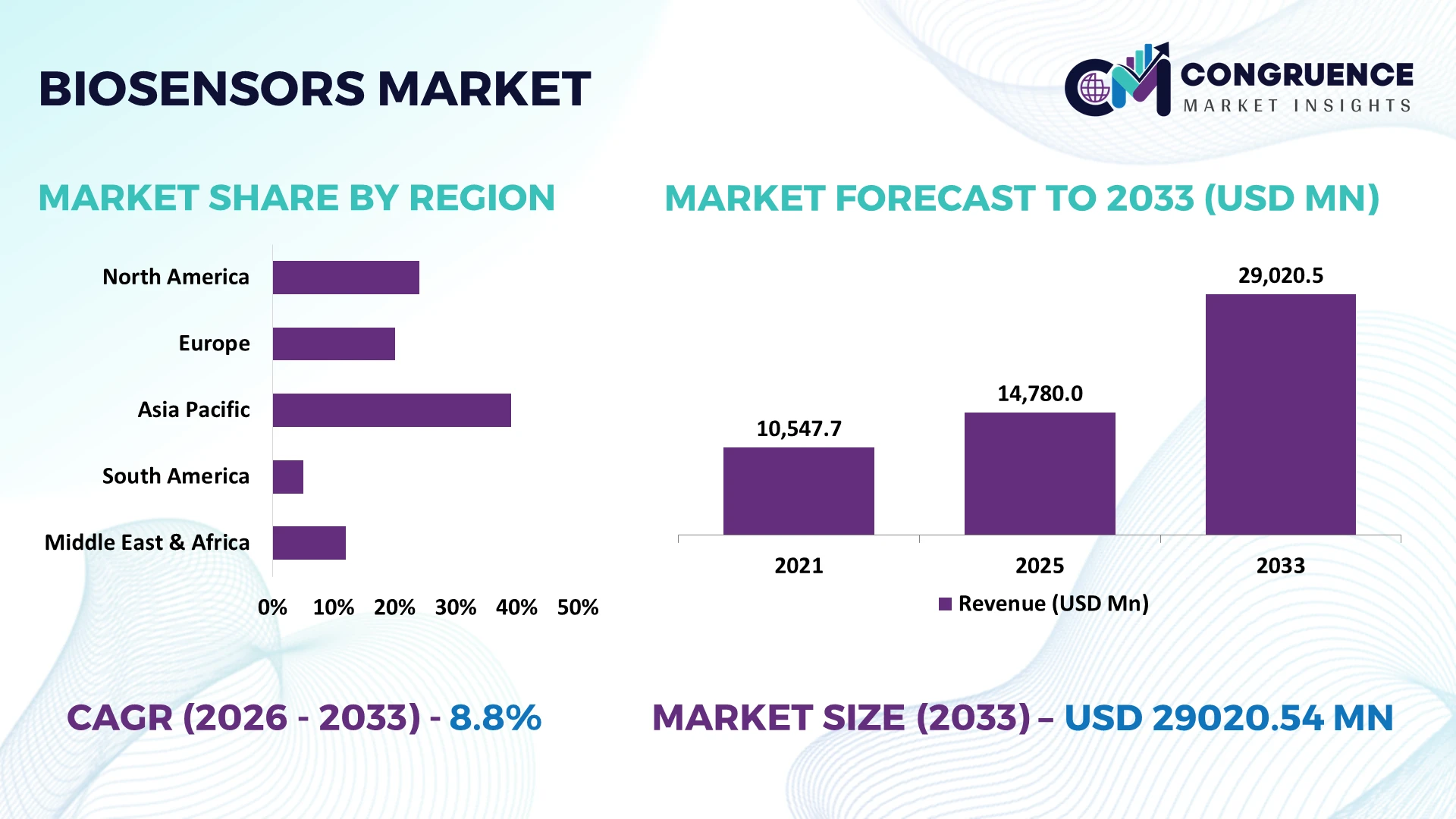
The Global Biosensors Market was valued at USD 14780 Million in 2025 and is anticipated to reach a value of USD 29020.54 Million by 2033 expanding at a CAGR of 8.8% between 2026 and 2033. Growth is driven by rising integration of AI-enabled diagnostics, wearable monitoring systems, and advanced electrochemical sensing platforms across healthcare, industrial automation, and environmental monitoring applications.
The United States leads biosensor innovation with approximately 35% global market influence through strong investments in digital healthcare, biotechnology, and point-of-care diagnostics, while China is expanding manufacturing capacity with over 25% growth in biosensor production facilities. Europe maintains strong adoption through regulatory-backed medical technology programs, with Germany and the UK accelerating smart diagnostic deployment. Geopolitical supply-chain diversification after global semiconductor disruptions is pushing regional biosensor component localization and manufacturing resilience.
Strategic implication: Companies prioritizing AI integration, scalable sensor manufacturing, and regional supply-chain networks are positioned to capture the next phase of biosensor market expansion.
Market Size & Growth: USD 14780 Million (2025) to USD 29020.54 Million (2033) with 8.8% CAGR, supported by AI-powered diagnostics and wearable healthcare adoption.
Top Growth Drivers: Healthcare monitoring 42%, industrial sensing 28%, environmental applications 18% driving global biosensors market expansion.
Short-Term Forecast: By 2028, automated biosensor platforms reduce testing costs by 20% and improve diagnostic efficiency by 35%.
Emerging Technologies: AI biosensors, flexible electronics, nanomaterials, and lab-on-chip technologies are reshaping advanced sensing capabilities.
Regional Leaders: North America reaches USD 10500 Million, Europe USD 7600 Million, and Asia-Pacific USD 8200 Million, driven by digital health adoption and manufacturing expansion.
Consumer/End-User Trends: Over 45% of healthcare providers are adopting continuous monitoring devices for chronic disease management and preventive care.
Pilot/Case Example: In 2025, smart glucose monitoring projects achieved approximately 30% improvement in patient tracking efficiency through connected biosensor platforms.
Competitive Landscape: Abbott leads with nearly 15% share, followed by Medtronic, Siemens Healthineers, Roche, and Bio-Rad in the global biosensors market.
Regulatory & ESG Impact: Sustainable sensor materials and healthcare compliance programs reduce medical device waste by nearly 20% across advanced markets.
Investment & Funding: More than USD 2 billion invested in biosensor startups, partnerships, and manufacturing expansion focused on AI diagnostics and wearable technologies.
Innovation & Future Outlook: Next-generation biosensors using molecular detection, wireless connectivity, and autonomous monitoring are accelerating strategic shifts toward personalized healthcare.
The Biosensors Market is experiencing stronger demand from continuous health monitoring, precision diagnostics, and industrial safety applications. Recent innovations include miniaturized wearable sensors, AI-assisted detection systems, and biodegradable sensor materials. Healthcare applications account for nearly 50% of adoption growth, while manufacturers are strengthening supply chains due to evolving medical device regulations and regional production strategies. These advancements are creating new opportunities for strategic investment and technology partnerships.
The Biosensors Market is becoming strategically important as healthcare providers, industrial operators, and technology companies compete to build faster, connected, and decentralized sensing ecosystems. Rising adoption of remote patient monitoring, AI diagnostics, and automated quality control is transforming biosensors from standalone devices into integrated data platforms. Supply-chain restructuring after semiconductor shortages is pushing manufacturers to localize critical sensor components and strengthen production resilience.
Advanced biosensors using nanomaterials and AI analytics deliver up to 40% faster detection cycles compared with conventional laboratory testing methods while reducing operational costs by nearly 25% in selected applications. The United States leads high-value medical deployments, while China focuses on manufacturing scale and cost-efficient production, creating a competitive contrast between innovation intensity and supply capacity.
Over the next 2–3 years, companies are prioritizing partnerships between sensor developers, healthcare providers, and semiconductor firms. For example, wearable glucose monitoring systems are expanding in hospitals and home-care settings through connected platforms that improve patient data access. Strategic investment in scalable manufacturing, cybersecurity, and energy-efficient sensor designs will define long-term competitive positioning.
The primary growth driver for the Biosensors Market is the rapid adoption of connected healthcare technologies and real-time diagnostic systems. Wearable biosensor usage has increased by more than 35%, while remote monitoring adoption among healthcare providers has expanded by over 40% in advanced markets. Regulatory support for digital health approvals in countries such as the United States and Japan is accelerating commercialization. Companies are investing in AI-enabled sensor platforms, miniaturized components, and strategic healthcare partnerships to improve diagnostic accuracy and reduce clinical workload. The shift toward decentralized testing is creating opportunities for manufacturers that combine biosensing hardware with cloud-based analytics.
High manufacturing complexity and dependence on specialized electronic components remain key restraints for biosensor scalability. Advanced sensor production costs are affected by raw material fluctuations, with certain semiconductor and nanomaterial inputs experiencing price variations of nearly 15%. Interoperability challenges also limit adoption, as approximately 30% of healthcare systems still face difficulties integrating multiple digital monitoring platforms. Countries including India and Brazil encounter infrastructure gaps that slow large-scale deployment. Companies are reducing exposure through supplier diversification, localized production agreements, and modular sensor architectures that improve compatibility across healthcare and industrial systems.
Emerging opportunities in the Biosensors Market are centered on AI-driven analytics, flexible electronics, and molecular detection technologies. AI-powered biosensing solutions improve diagnostic interpretation speed by nearly 50%, while flexible wearable sensors enhance user comfort and continuous monitoring capabilities. China, South Korea, and Germany are increasing investments in advanced semiconductor-based sensing ecosystems to support next-generation medical and industrial applications. Companies are expanding R&D programs and forming technology partnerships to develop low-power, disposable, and connected biosensors. A significant opportunity lies in combining biosensor data with predictive analytics platforms, enabling preventive healthcare models and improving operational efficiency in industrial environments.
The major challenge for the Biosensors Market is maintaining consistent performance while scaling connected sensor networks across diverse applications. Cybersecurity concerns affect nearly 45% of connected medical device operators, increasing pressure on manufacturers to strengthen data protection frameworks. Production standardization remains difficult as biosensors combine biological elements, electronics, and software components requiring precise calibration. Countries such as the United States and Germany are advancing stricter medical device security requirements, increasing compliance complexity. Companies must invest in secure architectures, workforce expertise, and automated manufacturing systems to ensure reliable deployment and maintain competitiveness in expanding digital health and industrial sensing markets.
AI-Driven Sensor Analytics: AI integration is reshaping biosensor workflows, with automated interpretation improving diagnostic processing speed by nearly 40% and reducing manual analysis requirements by 30%. Healthcare companies are deploying machine-learning-enabled platforms to improve accuracy, while manufacturers are restructuring product portfolios around connected sensing ecosystems and predictive analytics.
Wearable Monitoring Expansion: Continuous monitoring devices are gaining adoption as wearable biosensors increase healthcare workflow efficiency by approximately 35% and improve patient engagement rates by over 25%. Rising chronic disease management needs and digital health regulations are pushing companies to scale compact sensors, wireless connectivity, and remote monitoring partnerships.
Flexible Sensor Manufacturing: Flexible electronics and advanced materials are changing production models, reducing prototype development cycles by nearly 20% and improving device comfort by 30%. Companies in Japan and South Korea are expanding material innovation programs to support lightweight, low-power biosensor designs for healthcare and industrial applications.
Localized Supply Chain Strategies: Semiconductor supply disruptions have accelerated biosensor component localization, with manufacturers increasing regional sourcing activities by approximately 30% and reducing dependency risks. Companies are adopting multi-supplier models, automated production systems, and strategic partnerships to improve resilience after global logistics pressures.
Electrochemical biosensors represent the leading segment, accounting for approximately 45% of the market due to cost efficiency, compact design, rapid detection capability, and compatibility with portable diagnostic devices. Their scalability across glucose monitoring and point-of-care applications has encouraged companies to expand production capacity and improve sensor sensitivity. Optical biosensors follow with nearly 30% share, supported by advanced imaging capabilities and high accuracy requirements in research and diagnostics.
Piezoelectric and thermal biosensors remain specialized segments, contributing around 15% and 10% respectively, with demand concentrated in industrial monitoring and advanced analytical applications. Optical biosensors are emerging as the fastest-growing type, driven by integration with AI-based imaging systems and laboratory automation. Companies are increasing investments in hybrid sensor platforms, partnerships, and miniaturization technologies to capture evolving healthcare and industrial opportunities.
Glucose monitoring remains the largest application segment, representing approximately 40% market share due to strong demand for continuous diabetes management solutions and wearable monitoring devices. Hospitals and patients are increasingly adopting connected glucose sensors that improve real-time tracking efficiency by nearly 35%. Disease diagnostics follows with around 25% share, supported by rapid testing requirements and expansion of point-of-care diagnostic infrastructure.
Drug discovery is emerging as the fastest-growing application area, driven by automation, precision research models, and AI-supported biological analysis. Food safety and environmental monitoring together account for nearly 25% adoption, with companies deploying biosensors for faster contamination detection and compliance monitoring. Businesses are expanding partnerships with technology providers to integrate biosensors into automated workflows and improve operational decision-making.
Hospitals represent the dominant end-user segment with approximately 45% market share due to high diagnostic volumes, advanced infrastructure, and increasing adoption of continuous patient monitoring systems. Diagnostic laboratories hold nearly 25% share, supported by demand for high-throughput testing and automated analysis platforms. Healthcare providers are prioritizing biosensor integration to reduce testing delays and improve clinical workflow efficiency.
Pharmaceutical companies are the fastest-growing end-user group, driven by increasing use of biosensors in drug development, biomarker analysis, and personalized medicine research. Their adoption growth exceeds 30% as companies invest in precision-based research models. Food and beverage companies and research institutes continue expanding usage through quality control and experimental applications. Manufacturers are responding with customized solutions, strategic collaborations, and application-specific sensor platforms.
North America accounted for the largest market share at 38% in 2025 however, Asia-Pacific is expected to register the fastest growth, expanding at a CAGR of 10.2% between 2026 and 2033.
AI-Integrated Healthcare Monitoring Reshapes Deployment Models
North America maintains a leading position in the Biosensors Market due to advanced healthcare infrastructure, strong biotechnology investment, and rapid adoption of connected diagnostic systems. The region contributes approximately 38% of global biosensor demand, with the United States accounting for the majority of clinical and wearable device deployments. Hospitals and pharmaceutical companies are increasing adoption of real-time monitoring platforms, while manufacturers are expanding domestic production capabilities following semiconductor supply-chain disruptions. More than 60% of advanced diagnostic providers in the region are integrating digital sensing technologies into healthcare workflows. Strategic partnerships between medical device companies and AI technology firms are accelerating product development and improving operational efficiency.
United States Market Outlook:
The United States remains the primary innovation hub, supported by strong medical device manufacturing, research infrastructure, and healthcare digitization. Over 50% of North American biosensor technology investments are concentrated in the country, with increasing deployment of wearable monitoring systems, point-of-care diagnostics, and AI-assisted detection platforms across hospitals and research institutions.
Regulatory Modernization Accelerates Smart Diagnostic Adoption
Europe is advancing biosensor adoption through healthcare modernization, strict medical technology standards, and sustainability-focused innovation programs. Countries including Germany, the United Kingdom, and France are increasing deployment of biosensor-based diagnostics across hospitals, laboratories, and pharmaceutical research facilities. The region represents nearly 25% of global demand, supported by advanced clinical infrastructure and strong biotechnology ecosystems. Regulatory frameworks promoting digital healthcare solutions are encouraging manufacturers to improve sensor accuracy, interoperability, and energy efficiency. More than 35% of European healthcare providers are expanding connected monitoring capabilities to improve patient management. Companies are investing in localized manufacturing and strategic collaborations to strengthen supply resilience and meet evolving compliance requirements.
Germany Market Outlook:
Germany leads Europe through advanced medical engineering, industrial automation capabilities, and strong research networks. The country’s healthcare sector has increased adoption of automated diagnostic systems by nearly 30%, while manufacturers are developing precision biosensors for clinical testing, industrial monitoring, and pharmaceutical applications through innovation partnerships.
Manufacturing Scale Drives Next-Generation Sensor Expansion
Asia-Pacific is becoming the fastest-expanding biosensor market due to large-scale electronics manufacturing, healthcare digitization, and increasing biotechnology investments. China, Japan, South Korea, and India are strengthening production ecosystems for advanced sensors, semiconductor components, and wearable devices. The region contributes nearly 22% of current market demand but holds a significant share of global manufacturing capacity. China has expanded biosensor-related production facilities by more than 25% through investments in medical technology and smart manufacturing. Companies are focusing on cost-efficient production, export expansion, and integration of AI-enabled sensing solutions to compete globally. Growing healthcare access and industrial automation are creating new deployment opportunities.
China Market Outlook:
China remains the strategic manufacturing center for biosensors due to extensive electronics supply chains and government-supported healthcare technology initiatives. The country accounts for more than 40% of Asia-Pacific sensor production capacity, with increasing investments in wearable healthcare devices, diagnostic platforms, and advanced material-based sensing technologies.
Healthcare Accessibility Expands Diagnostic Technology Adoption
South America is gradually increasing biosensor adoption through healthcare infrastructure improvements, diagnostic modernization, and rising demand for affordable monitoring solutions. Brazil and Argentina represent key markets as hospitals and laboratories invest in portable diagnostic technologies. The region contributes around 8% of global biosensor demand, with adoption concentrated in healthcare and food safety applications. Limited infrastructure remains a challenge, but partnerships between technology providers and healthcare organizations are improving access. Brazil has expanded digital healthcare initiatives, supporting nearly 20% growth in connected medical device deployment. Companies are focusing on cost-effective sensor solutions and distribution partnerships to overcome regional accessibility barriers.
Brazil Market Outlook:
Brazil represents the largest biosensor opportunity in South America due to its healthcare network, biotechnology research capacity, and industrial base. The country is increasing adoption of portable diagnostic devices, with more than 25% of major healthcare facilities implementing digital monitoring technologies to improve testing efficiency and patient management.
Healthcare Modernization Creates New Deployment Opportunities
The Middle East & Africa Biosensors Market is developing through healthcare modernization programs, smart hospital investments, and expanding diagnostic infrastructure. Gulf countries are leading adoption through advanced healthcare facilities, while African markets are gradually increasing access through portable and affordable sensing technologies. The region contributes approximately 7% of global biosensor demand, with deployment concentrated in hospitals, research centers, and environmental monitoring projects. Healthcare technology investments in countries such as Saudi Arabia and the UAE have increased connected medical system adoption by nearly 30%. Companies are forming regional partnerships and adapting products for cost efficiency, remote monitoring, and challenging operating environments.
Saudi Arabia Market Outlook:
Saudi Arabia is emerging as a key biosensor adoption center through healthcare transformation initiatives and smart hospital development. The country is investing heavily in digital diagnostics, with connected healthcare infrastructure expansion supporting increased deployment of wearable sensors, automated testing systems, and AI-enabled medical monitoring solutions.
The Biosensors Market features competition between global medical technology leaders such as Abbott, Medtronic, and Roche against specialized innovators developing advanced sensing platforms and regional manufacturers competing through cost efficiency. The top five players collectively account for approximately 45% market share, creating a moderately consolidated structure. Competition centers on sensor accuracy, AI integration, manufacturing scalability, and supply-chain reliability. Leading companies achieve differentiation through continuous monitoring solutions, with advanced platforms improving diagnostic speed by 30% and reducing workflow costs by nearly 20%. Players are expanding through healthcare partnerships, localized production, acquisitions, and vertical integration of sensor hardware and analytics software. The market is shifting toward AI-enabled biosensing, flexible electronics, and connected diagnostics, increasing pressure on traditional suppliers. High regulatory requirements, specialized material expertise, and clinical validation create significant entry barriers. Winning companies must combine technological innovation, reliable supply networks, and scalable healthcare integration.
Abbott
Medtronic
Roche Diagnostics
Siemens Healthineers
Bio-Rad Laboratories
Dexcom
Becton Dickinson
Nova Biomedical
Cytiva
Analog Devices
Texas Instruments
Thermo Fisher Scientific
The Biosensors Market is advancing through AI-enabled analytics, nanotechnology-based sensors, flexible electronics, and wireless monitoring platforms. AI integration is improving diagnostic interpretation speed by nearly 40%, while nanomaterial-based sensors enhance detection sensitivity by approximately 30% compared with conventional sensing technologies. Healthcare providers are increasingly adopting connected biosensor systems, with more than 45% of advanced medical facilities integrating digital monitoring workflows.
Wearable biosensors and lab-on-chip platforms are replacing traditional testing approaches by reducing analysis time by nearly 50% and lowering operational costs by around 25%. Compared with older laboratory-dependent systems, modern portable biosensors provide faster results, continuous data capture, and improved accessibility. Companies benefiting most include medical device manufacturers, semiconductor suppliers, and software providers developing integrated sensing ecosystems.
Between 2026 and 2028, biosensor innovation will increasingly focus on autonomous monitoring, low-power designs, and AI-driven predictive diagnostics. Competitive advantage will shift toward companies capable of combining hardware precision, cloud connectivity, and data security. Manufacturers investing in advanced materials, automated production, and ecosystem partnerships are positioned to improve efficiency, expand deployment, and strengthen market differentiation.
August 2025 Abbott launched FreeStyle Libre 2 Plus in India, introducing continuous glucose readings every minute with optional alarms. The sensor improves diabetes management access through smartphone connectivity and strengthens Abbott’s wearable biosensor portfolio expansion in emerging healthcare markets. Source: https://www.abbott.in
September 2024 Dexcom expanded consumer access with Stelo, the first over-the-counter continuous glucose biosensor approved in the U.S. The 15-day wearable device broadened glucose monitoring adoption beyond traditional users and increased competition in consumer health technology. Source: https://www.reuters.com
June 2025 Philips and Medtronic expanded their patient monitoring partnership, integrating advanced monitoring technologies and validated biosensor-based solutions. The collaboration strengthened hospital deployment capabilities, combining Philips healthcare platforms with Medtronic sensor technologies across global clinical environments. Source: https://www.philips.com
2025 Advanced research groups accelerated wearable biosensor innovation through non-invasive sweat monitoring technologies using optical sensing and nanomaterials. New prototypes demonstrated detection sensitivity improvements with 0.12 mM glucose detection capability, supporting future personalized healthcare applications.
The Biosensors Market Report covers comprehensive analysis across technology types including electrochemical, optical, piezoelectric, and thermal biosensors, along with applications such as glucose monitoring, disease diagnostics, food safety, environmental monitoring, and drug discovery. The report evaluates adoption patterns across hospitals, diagnostic laboratories, pharmaceutical companies, food and beverage companies, and research institutes.
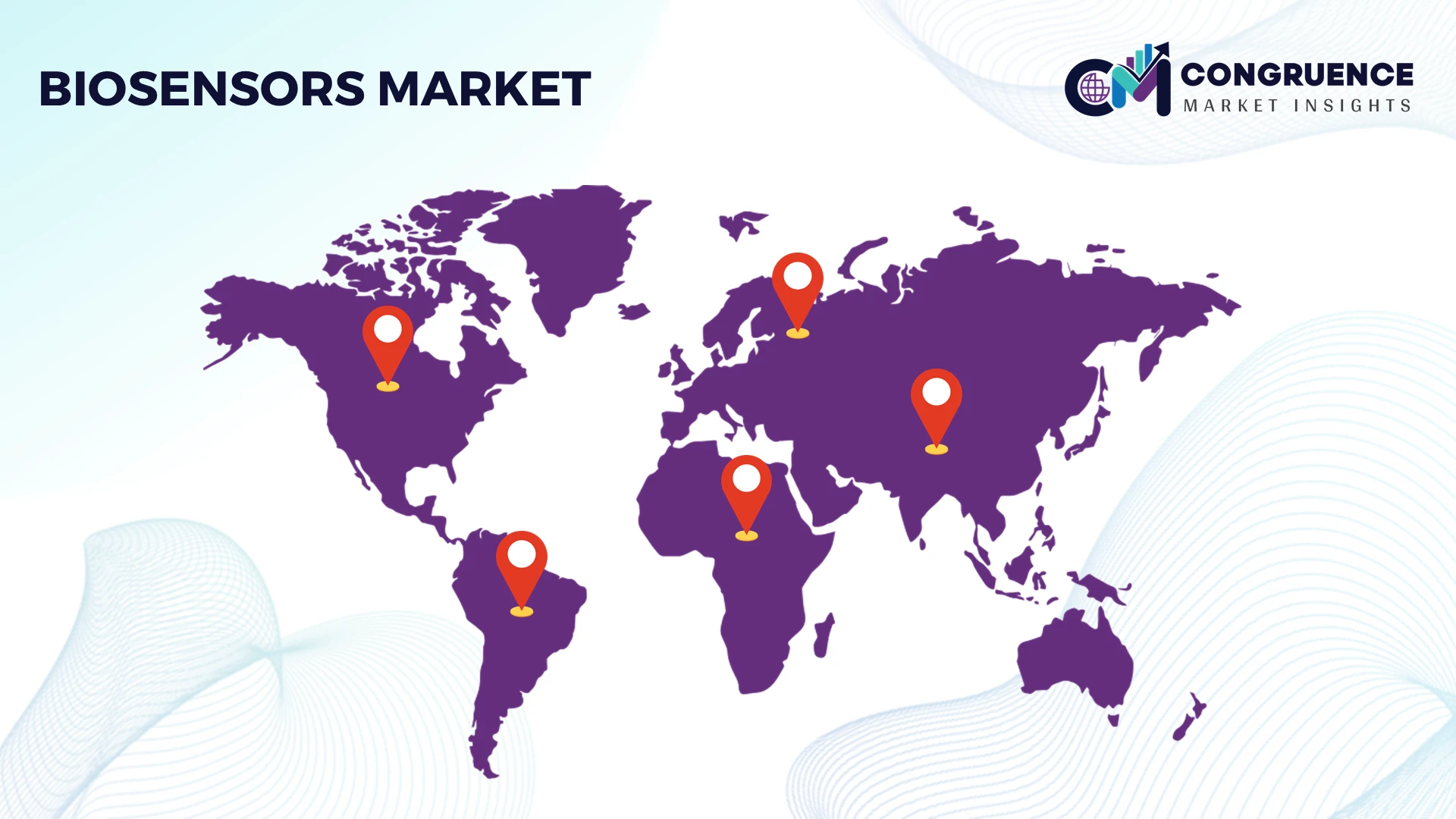
The study provides regional insights across North America, Europe, Asia-Pacific, South America, and Middle East & Africa, highlighting deployment trends, manufacturing capabilities, and technology advancements. With analysis of AI integration, wearable monitoring, miniaturized sensors, and connected diagnostic platforms, the report supports investment planning, competitive positioning, partnership strategies, and expansion decisions between 2026 and 2033. It also identifies emerging opportunities in personalized healthcare, automation, and next-generation sensing ecosystems.
| Report Attribute/Metric | Report Details |
|---|---|
Market Revenue in 2025 | USD 14780 Million |
Market Revenue in 2033 | USD 29020.54 Million |
CAGR (2026 - 2033) | 8.8% |
Base Year | 2025 |
Forecast Period | 2026 - 2033 |
Historic Period | 2021 - 2025 |
Segments Covered | By Type
By Application
By End-User
|
Key Report Deliverable | Revenue Forecast, Growth Trends, Market Dynamics, Segmental Overview, Regional and Country-wise Analysis, Competition Landscape |
Region Covered | North America, Europe, Asia-Pacific, South America, Middle East, Africa |
Key Players Analyzed | Abbott, Medtronic, Roche Diagnostics, Siemens Healthineers, Bio-Rad Laboratories, Dexcom, Becton Dickinson, Nova Biomedical, Cytiva, Analog Devices, Texas Instruments, Thermo Fisher Scientific |
Customization & Pricing | Available on Request (10% Customization is Free) |




