
Reports
The Global Biorefinery Market was valued at USD 62,044.5 Million in 2025 and is anticipated to reach a value of USD 116,552.4 Million by 2033 expanding at a CAGR of 8.2% between 2026 and 2033. Growth is being driven by integrated conversion of biomass and waste into biofuels, chemicals, and materials, improving feedstock utilization and product diversification.
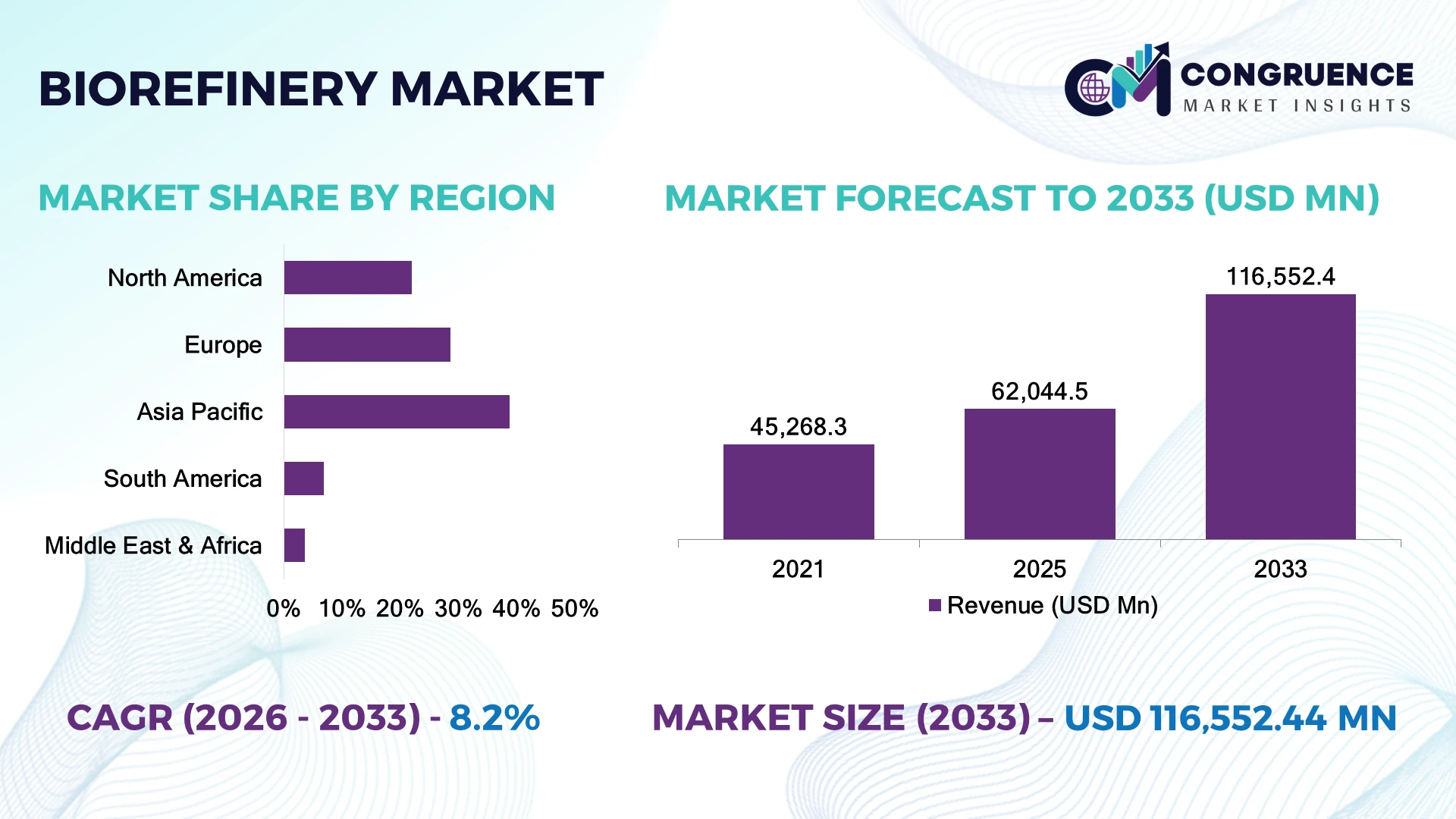
Asia-Pacific holds 38.79% of the global biorefinery market, with China valued at about USD 10.56 billion and India at USD 6.49 billion in 2026. China’s scale exceeds India’s, while the U.S. focuses heavily on advanced fuels and biochemicals. Europe is accelerating circular projects, including 2026 financing of €500 million for Italy’s Sannazzaro conversion, amid energy-security and supply-chain restructuring.
Strategically, investors should prioritize flexible multi-feedstock assets, regional feedstock security, and technologies capable of producing multiple low-carbon products.
Market Size & Growth: USD 62,044.5M in 2025 to USD 116,552.4M by 2033 at 8.2% CAGR, driven by integrated biomass conversion and multi-product output.
Top Growth Drivers: Biofuels account for 35%; transportation represents 47%; lignocellulosic feedstocks contribute 42%, strengthening integrated biorefinery economics.
Short-Term Forecast: By 2028, advanced process optimization is positioned to deliver 10–15% lower processing costs through enzyme optimization, heat integration, and digital controls.
Emerging Technologies: AI process optimization, enzymatic conversion, thermochemical processing, and third-generation algae platforms are increasing feedstock flexibility and product-yield potential.
Regional Leaders: Asia-Pacific reaches about USD 45.2B, Europe USD 33.3B, and North America USD 20.7B by 2033 based on the 2025 regional mix; adoption centers on scale, circularity, and advanced fuels.
Consumer/End-User Trends: Transportation represents 47% of end-use demand, while chemical and materials producers increasingly prioritize low-carbon feedstocks and traceable sourcing.
Pilot/Case Example: 2026 Eni’s Sannazzaro conversion secured €500M financing and targets approximately 550,000 tonnes annually of HVO and SAF from 2028, demonstrating brownfield conversion economics.
Competitive Landscape: Asia-Pacific leads with 38.79% share; Neste, POET, UPM, Clariant, and VERBIO compete through feedstock access, conversion technology, product integration, and commercialization scale.
Regulatory & ESG Impact: U.S. biorefinery programs target fuels achieving at least 70% lifecycle-emission reductions, increasing the importance of verified carbon intensity and traceable feedstocks.
Investment & Funding: Europe committed €172M across 24 circular bioeconomy projects in 2026, including €68M for four first-of-kind industrial biorefineries, accelerating commercialization partnerships.
Innovation & Future Outlook: Through 2028, modular multi-feedstock plants, carbon utilization, AI controls, and SAF/HVO co-production will shift advantage toward flexible assets and integrated offtake partnerships.
The Biorefinery Market is increasingly centered on waste-derived fuels, bio-based chemicals, advanced materials, and integrated multi-feedstock platforms. Asia-Pacific holds 38.79% of global market share, supported by biomass availability and industrial scale. In 2026, refinery conversions increasingly integrate waste pretreatment, digital process controls, and SAF/HVO production, while carbon-intensity requirements strengthen the case for traceable feedstocks and diversified output portfolios.
Biorefineries are becoming strategic assets because they convert regional biomass, waste streams, and captured carbon into multiple products, reducing exposure to petroleum-linked feedstock volatility. The shift is reinforced by supply-chain restructuring and stricter carbon-intensity requirements, making feedstock security and verified lifecycle performance central to investment decisions.
Advanced enzymatic and integrated process routes improve conversion economics versus legacy single-product systems, with optimized operations targeting 10–15% lower processing costs and higher feedstock flexibility. Asia-Pacific combines scale and abundant agricultural residues, while Europe emphasizes circularity and low-carbon certification; North America prioritizes advanced fuels and domestic feedstock networks. Over the next 2–3 years, digital controls and multi-feedstock configurations will become standard in new projects.
In 2026, Eni’s Sannazzaro refinery conversion secured €500 million in financing and targets about 550,000 tonnes annually of HVO and SAF from 2028, using existing infrastructure alongside waste-feedstock pretreatment. Similar projects are redirecting capital toward brownfield conversions, technology partnerships, and long-term offtake agreements. Competitive advantage will increasingly depend on flexible assets, reliable feedstock procurement, measurable carbon performance, and integrated product portfolios.
Industrial biorefineries are shifting toward multi-product conversion, with biofuels representing about 35% of demand, transportation applications 47%, and lignocellulosic feedstocks approximately 42%. This structure improves feedstock monetization by converting residues into fuels, chemicals, and biomaterials rather than relying on single-output processing. In China, integrated biomass projects are expanding alongside agricultural-processing clusters, while U.S. operators are prioritizing advanced-fuel pathways. Companies are responding through technology partnerships, enzyme optimization, and modular pretreatment systems. The non-obvious advantage is improved revenue resilience: diversified product streams reduce dependence on one commodity market and strengthen plant utilization when fuel or chemical margins fluctuate.
Biorefinery economics remain exposed to feedstock logistics, with transportation and handling frequently accounting for 10–20% of delivered biomass costs, while moisture can reduce usable energy content by more than 30%. In India, fragmented agricultural-residue collection complicates year-round supply, whereas China benefits from denser industrial processing networks. These constraints increase pretreatment requirements, inventory costs, and plant utilization pressure. Companies are reducing exposure through multi-feedstock contracts, localized aggregation hubs, and long-term procurement agreements. A critical operational insight is that proximity to reliable biomass can matter more than nominal feedstock price; developers increasingly evaluate plant location against collection radius, moisture management, and transport infrastructure before committing capital.
Advanced biorefineries are expanding beyond fuels into bio-based chemicals, specialty materials, and functional ingredients, where higher-value products can improve asset economics. Biochemicals currently represent roughly 20% of biorefinery output in several integrated configurations, while process digitalization can deliver 10–15% efficiency improvements through predictive control and optimized energy integration. India is emerging as an attractive deployment market because agricultural residues provide scalable feedstock pools. Companies are investing in enzymatic processing, fermentation platforms, and partnerships with chemical manufacturers. The strongest opportunity lies in flexible plants capable of switching product slates according to market pricing, allowing operators to monetize the same feedstock through multiple downstream pathways rather than locking capacity into commodity fuels.
Commercial-scale biorefineries face integration challenges across pretreatment, fermentation, separation, utilities, and downstream purification, with energy consumption potentially representing 15–25% of operating costs and process losses reducing recoverable feedstock value by 5–10%. In the U.S. and Europe, increasingly stringent lifecycle-carbon accounting adds data-management and traceability requirements across complex supply chains. Companies must invest in digital twins, advanced process controls, operator training, and interoperable automation platforms. The non-obvious challenge is maintaining consistent performance when feedstock composition changes seasonally; facilities optimized for a narrow biomass specification can experience yield instability. Strategic operators therefore prioritize flexible process windows and real-time feedstock characterization before expanding capacity.
Waste-Based Feedstock Integration: Industrial operators are increasing waste-residue utilization as landfill restrictions and feedstock competition intensify. Advanced facilities are targeting 15–25% greater feedstock flexibility through preprocessing, blending, and automated quality monitoring. The shift reduces dependence on dedicated crops while improving procurement resilience. Companies are establishing local aggregation networks and multi-source contracts, particularly around agricultural and municipal waste clusters.
Brownfield Refinery Conversion: Existing petroleum infrastructure is increasingly being repurposed for renewable products, reducing construction requirements and accelerating deployment. Recent projects are targeting 20–30% lower infrastructure investment versus fully greenfield configurations while retaining storage, utilities, and distribution assets. European operators are prioritizing HVO and sustainable aviation fuel integration, creating a practical pathway for legacy refineries to transition without abandoning established logistics networks.
Digital Process Optimization: Biorefineries are adopting AI-assisted monitoring, digital twins, and predictive controls to manage variable biomass characteristics. Automated optimization can target 10–15% lower processing costs and 5–10% higher throughput by adjusting temperature, enzyme dosage, residence time, and energy flows in real time. Companies are integrating plant historians and sensor networks into centralized operating platforms, shifting optimization from periodic engineering reviews toward continuous process management.
Carbon-Intensity-Based Procurement: Carbon accounting is increasingly influencing feedstock selection, technology configuration, and offtake negotiations. Facilities targeting low-carbon fuel markets increasingly track lifecycle emissions across procurement and processing, with optimized pathways targeting 50–70% lower lifecycle emissions than conventional petroleum alternatives. Regulatory pressure and corporate decarbonization commitments are pushing operators toward certified waste feedstocks, traceability systems, and long-term low-carbon offtake agreements.
Second-generation biorefineries lead with approximately 46% share, supported by lignocellulosic residues, waste biomass, and established conversion pathways that avoid direct dependence on food crops. First-generation facilities remain commercially mature, particularly around corn, sugarcane, and starch processing, but their feedstock competition limits incremental expansion. Second-generation systems are gaining preference as operators target waste utilization and lower lifecycle emissions. Companies are investing in pretreatment, enzymatic hydrolysis, and integrated fermentation to improve conversion yields, with advanced configurations targeting 10–15% higher process efficiency than conventional systems. First-generation assets remain strategically relevant for dependable volumes, while third-generation algae platforms retain a smaller position but attract R&D funding for specialized fuels and bioproducts.
Third-generation biorefineries represent the fastest-emerging technology shift, driven by algae-based feedstocks requiring less conventional agricultural land. Adoption remains below 10% in commercial deployments, but pilot investment is increasing as companies pursue high-value lipids, specialty chemicals, and advanced fuels. This is shifting capital allocation toward flexible facilities capable of combining multiple feedstocks and product pathways.
The International Energy Agency identifies biochemical conversion as the most commonly deployed biorefinery pathway, reinforcing continued investment in fermentation, enzymatic processing, and integrated conversion platforms.
Energy production dominates application demand with approximately 54% share, reflecting the established deployment of biorefineries for ethanol, renewable diesel, biomethane, and other biofuels. Transportation remains the largest downstream outlet at roughly 47%, supported by blending mandates and decarbonization requirements. Chemical production follows as companies increasingly convert intermediate sugars, oils, and syngas into platform chemicals. Agriculture and materials manufacturing remain smaller applications, but their strategic importance is increasing as operators seek higher-value co-products and improve total feedstock utilization.
Chemical production represents the fastest-growing application shift, with specialized biochemicals gaining traction where petroleum substitution delivers stronger margins than commodity fuels. Companies are expanding fermentation capacity, forming partnerships with chemical manufacturers, and integrating separation technologies. Materials manufacturing is also advancing through bio-based polymers and fibers, while agricultural applications increasingly monetize residual streams as fertilizers and soil amendments. The business implication is clear: multi-output plants increasingly outperform single-product configurations by spreading commodity-price exposure across several markets.
The International Energy Agency reports that refiners operate about 80% of current renewable diesel production capacity, demonstrating how established energy infrastructure is accelerating biorefinery deployment.
Transportation fuels represent approximately 47% of biorefinery end-use demand, supported by blending requirements, fleet decarbonization, and expanding sustainable aviation fuel procurement. Power generation and industrial users follow, with demand concentrated where renewable fuels can replace fossil-based thermal or process energy. Residential and commercial heating remains comparatively smaller but benefits from biomethane and renewable liquid-fuel adoption. Established transportation buyers prioritize certified volumes, infrastructure compatibility, and reliable long-term supply, making offtake agreements increasingly important to project financing.
Industrial and chemical users represent the fastest-shifting buyer group as manufacturers seek renewable carbon for plastics, solvents, intermediates, and specialty chemicals. Their procurement increasingly emphasizes traceability and lifecycle emissions alongside price and specification compliance. Companies are responding with dedicated production lines, long-term partnerships, and customized feedstock strategies. In the United States, transportation-focused projects benefit from established fuel infrastructure, while European industrial buyers place greater emphasis on circular feedstocks and carbon accounting. This divergence is pushing suppliers toward differentiated product portfolios rather than standardized output.
The International Energy Agency expects India’s liquid and gaseous biofuels supply to rise from 293 PJ in 2025 to 609 PJ by 2030 in its accelerated case, highlighting transportation and industrial fuel demand as major deployment drivers.
Asia-Pacific accounted for the largest market share at 38.79% in 2025 however, Middle East & Africa is expected to register the fastest growth, expanding at a CAGR of 12.3% between 2026 and 2033.

North America combines established biofuel infrastructure with rapid conversion of conventional refining assets toward renewable feedstocks. The United States represented the region’s principal market, supported by 19 renewable-diesel and other biofuel plants with combined capacity of 4,719 million gallons annually as of January 2025. California alone accounted for 1,684 million gallons, demonstrating strong production concentration. Feedstock diversification is accelerating as refiners integrate used cooking oils, agricultural residues, and other low-carbon inputs. Companies are prioritizing brownfield conversion, renewable-fuel integration, and long-term feedstock contracts to reduce logistics exposure. The strategic advantage increasingly lies in leveraging existing hydrogen, storage, pipeline, and distribution infrastructure rather than developing fully greenfield facilities.
U.S. Market Outlook: The United States remains North America’s strongest biorefinery investment hub, with 48 biodiesel plants providing 1,986 million gallons of annual capacity and a large renewable-fuel distribution network. Federal clean-fuel incentives are encouraging refiners to add renewable diesel, sustainable aviation fuel, and co-processing capabilities. California, Louisiana, and Texas remain particularly important for project development because of concentrated refining infrastructure, feedstock access, and established fuel logistics.
Europe accounted for approximately 28.55% of global biorefinery activity in 2025, with Italy, Germany, France, and the Netherlands anchoring industrial deployment. Regulatory pressure under European decarbonization policies is accelerating conversion of petroleum assets toward HVO, SAF, and bio-based intermediates. Italy is particularly active: a 2026 financing package of €500 million supports conversion of the Sannazzaro refinery, including waste-feedstock pretreatment and flexible renewable-fuel production. Companies are favoring brownfield modernization because existing utilities and logistics reduce infrastructure duplication while accelerating commercial deployment. The resulting model links refinery conversion, waste sourcing, and aviation-fuel offtake rather than treating biorefinery capacity as a standalone asset.
Italy Market Outlook: Italy has emerged as a strategic European biorefinery hub through refinery conversions and flexible renewable-fuel production. The Sannazzaro project is designed for approximately 550,000 tonnes of annual HVO and SAF-related production from 2028. Eni is also developing a 500,000-tonne annual facility at Priolo, creating a combined platform for flexible fuel production and strengthening domestic waste-feedstock utilization.
Asia-Pacific held 38.79% of the global biorefinery market in 2025, making it the largest regional market. China represented the largest country market at approximately USD 10.56 billion in 2026, followed by India at USD 6.49 billion and Japan at USD 1.85 billion. Agricultural residues, expanding biofuel programs, and large chemical-processing bases support integrated facilities. China’s industrial scale enables faster equipment localization and feedstock aggregation, while India is strengthening ethanol and bioenergy infrastructure. Companies are increasing investment in fermentation, biomass conversion, and multi-feedstock systems, with partnerships increasingly linking agricultural processors to downstream fuel and chemical manufacturers.
China Market Outlook: China’s advantage stems from large agricultural-processing networks, extensive chemical manufacturing, and established biomass utilization infrastructure. The country is the world’s third-largest ethanol producer and has introduced policies supporting biofuel production and consumption. Major industrial clusters provide dense feedstock and downstream markets, allowing developers to integrate fermentation, chemical conversion, and fuel production while reducing transportation intensity and improving plant utilization.
South America is anchored by Brazil, where sugarcane processing supports ethanol, electricity, biomethane, and emerging sustainable-fuel pathways from a common feedstock base. Brazil’s integrated mills provide a structural advantage because agricultural residues can support multiple downstream products rather than remaining low-value waste. In January 2025, financing of up to USD 165 million supported São Martinho’s biomethane project using sugarcane vinasse, strengthening the connection between ethanol production and renewable gas. Companies are expanding brownfield assets and investing in waste-to-energy integration. However, biomass logistics and regional infrastructure remain important cost variables, making plant proximity to feedstock-producing zones a decisive investment criterion.
Brazil Market Outlook: Brazil dominates South American biorefinery development through its large sugarcane, ethanol, and renewable-energy ecosystem. São Martinho’s financed biomethane project demonstrates the commercial shift toward extracting additional value from existing processing streams rather than relying solely on ethanol. The model improves asset utilization, creates additional energy products, and strengthens decarbonization economics across sugar-energy operations.
Middle East & Africa accounted for approximately 3.72% of the global biorefinery market in 2025, but its strategic importance is increasing as Gulf economies diversify beyond petroleum. Saudi Arabia and the United Arab Emirates are prioritizing circular-economy projects, renewable fuels, waste conversion, and low-carbon industrial infrastructure. Existing refining, petrochemical, logistics, and export capabilities provide an unusual platform for integrating bio-based products into established energy networks. Companies are pursuing partnerships and technology licensing rather than relying exclusively on domestic feedstock development. The key advantage is infrastructure reuse: established ports, storage terminals, hydrogen systems, and industrial zones can lower deployment complexity for renewable-fuel projects.
Saudi Arabia Market Outlook: Saudi Arabia offers the region’s strongest industrial platform because of its integrated refining, petrochemical, logistics, and energy infrastructure. National diversification programs are encouraging investment in circular feedstocks, renewable fuels, and low-carbon chemicals. The country’s large industrial clusters provide downstream demand and export connectivity, positioning biorefinery projects around waste conversion and advanced fuels as extensions of existing energy assets rather than isolated facilities.
Neste, UPM, Eni, POET, and Clariant compete through distinct positions: renewable-fuel scale, wood-based chemicals, refinery conversion, ethanol technology, and biochemical platforms. The top five control approximately 35–40% collectively. Competition centers on feedstock security, technology, cost, and product flexibility, with integrated plants targeting 10–15% efficiency gains and 5–10% lower logistics exposure. Eni is expanding refinery conversions and partnerships, Neste is scaling Rotterdam, and UPM is commercializing wood-based chemicals. Regional producers compete aggressively on feedstock proximity and operating cost, while global leaders defend premium customers through proprietary processes and long-term offtake agreements. Consolidation and vertical integration are shifting advantage toward companies controlling both biomass sourcing and downstream markets. Entry barriers include capital-intensive processing assets, technology qualification, regulatory certification, and reliable feedstock contracts. Winning requires flexible multi-product plants, secured feedstock, proven conversion technology, strong offtake relationships, and disciplined execution that delivers competitive carbon intensity and dependable industrial-scale output. Favors scale, flexibility, and execution.
Neste Corporation
Eni S.p.A.
UPM-Kymmene Corporation
POET, LLC
Archer Daniels Midland Company
Cargill, Incorporated
Clariant AG
VERBIO AG
Borregaard ASA
Raízen S.A.
Green Plains Inc.
LanzaTech Global, Inc.
Biorefineries are adopting enzymatic hydrolysis, advanced fermentation, thermochemical conversion, AI process control, and digital twins. Automated optimization can target 10–15% lower processing costs, while integrated heat recovery can reduce energy consumption by 8–12%. Adoption is strongest in facilities where sensor-rich architectures are designed from inception.
Compared with conventional fixed-parameter operation, AI-assisted process control can improve throughput consistency by approximately 5–10% by adjusting feedstock, temperature, residence time, and enzyme dosage dynamically. UPM benefits from wood-to-chemical integration, while Eni gains from proprietary conversion technology and refinery infrastructure. These approaches strengthen yield management and reduce dependence on manual intervention.
During 2026–2028, disruptive development will center on flexible multi-feedstock pretreatment, carbon-intensity optimization, modular separation, and bio-based platform chemicals. Digital twins will increasingly support commissioning and predictive maintenance, targeting 10% fewer process interruptions. Companies combining proprietary conversion platforms with open automation interfaces will gain an advantage because equipment, feedstock, and product changes can be coordinated without redesigning entire plants. The technology priority is therefore not isolated automation, but integrated control across feedstock quality, conversion yield, energy use, emissions accounting, and downstream product switching. Operators that deploy these capabilities early will improve asset utilization while building stronger qualification evidence for regulated low-carbon markets and demanding industrial customers.
January 2025 Eni started SAF production at Gela, commissioning a 400,000-tonne annual plant. The facility can cover nearly one-third of European SAF demand for 2025, strengthening renewable-fuel supply ahead of ReFuelEU requirements and improving regional availability. Source: eni.com
December 2025 UPM produced its first commercial product at Leuna, Germany, advancing its 220,000-tonne annual wood-based biochemicals refinery. The milestone validates commercial-scale conversion and expands renewable-material supply for packaging, textiles, and chemical applications across European customers. Source: upm.com
March 2026 Neste reported a EUR 700 million green bond supporting Rotterdam expansion. Completion in 2027 will lift renewable-products capacity there to 2.7 million tonnes annually, strengthening lower-carbon fuel supply and feedstock-derived product availability across Europe. Source: neste.com
April 2026 EIB and Eni signed EUR 500 million financing for Sannazzaro conversion. The project will produce about 550,000 tonnes annually of HVO and SAF from 2028, accelerating brownfield biorefinery deployment and expanding capacity in Italy. Source: eib.org (Eni)
The Biorefinery Market Report covers first-, second-, and third-generation biorefinery technologies across energy production, chemicals, materials, agriculture, and other industrial applications. End-user analysis includes transportation, chemical manufacturing, power generation, industrial processing, and emerging bio-based product industries, with coverage across North America, Europe, Asia-Pacific, South America, and Middle East & Africa.
The report evaluates enzymatic processing, fermentation, thermochemical conversion, AI-enabled process control, digital twins, waste-feedstock utilization, carbon-intensity optimization, and integrated refinery conversion. It assesses established feedstock pathways alongside niche opportunities in lignocellulosic biomass, algae, waste oils, biomethane, SAF, HVO, and wood-based chemicals. Strategic analysis supports investment planning, plant-location decisions, technology selection, partnerships, expansion priorities, competitive positioning, and portfolio diversification between 2026 and 2033.
| Report Attribute/Metric | Report Details |
|---|---|
|
Market Revenue in 2025 |
USD 62,044.5 Million |
|
Market Revenue in 2033 |
USD 116,552.4 Million |
|
CAGR (2026 - 2033) |
8.2% |
|
Base Year |
2025 |
|
Forecast Period |
2026 - 2033 |
|
Historic Period |
2021 - 2025 |
|
Segments Covered |
By Type
By Application
By End-User
|
|
Key Report Deliverable |
Revenue Forecast, Growth Trends, Market Dynamics, Segmental Overview, Regional and Country-wise Analysis, Competition Landscape |
|
Region Covered |
North America, Europe, Asia-Pacific, South America, Middle East, Africa |
|
Key Players Analyzed |
Neste Corporation, Eni S.p.A., UPM-Kymmene Corporation, POET, LLC, Archer Daniels Midland Company, Cargill, Incorporated, Clariant AG, VERBIO AG, Borregaard ASA, Raízen S.A., Green Plains Inc., LanzaTech Global, Inc. |
|
Customization & Pricing |
Available on Request (10% Customization is Free) |




