
Reports
The Global Bioprocessing Equipment Market was valued at USD 70091 Million in 2025 and is anticipated to reach a value of USD 134617.07 Million by 2033 expanding at a CAGR of 8.5% between 2026 and 2033. Growth is driven by rapid adoption of single-use bioreactors, intensified continuous processing, and expansion of biologics and biosimilar manufacturing capacity, particularly for monoclonal antibodies, vaccines, and cell therapies.
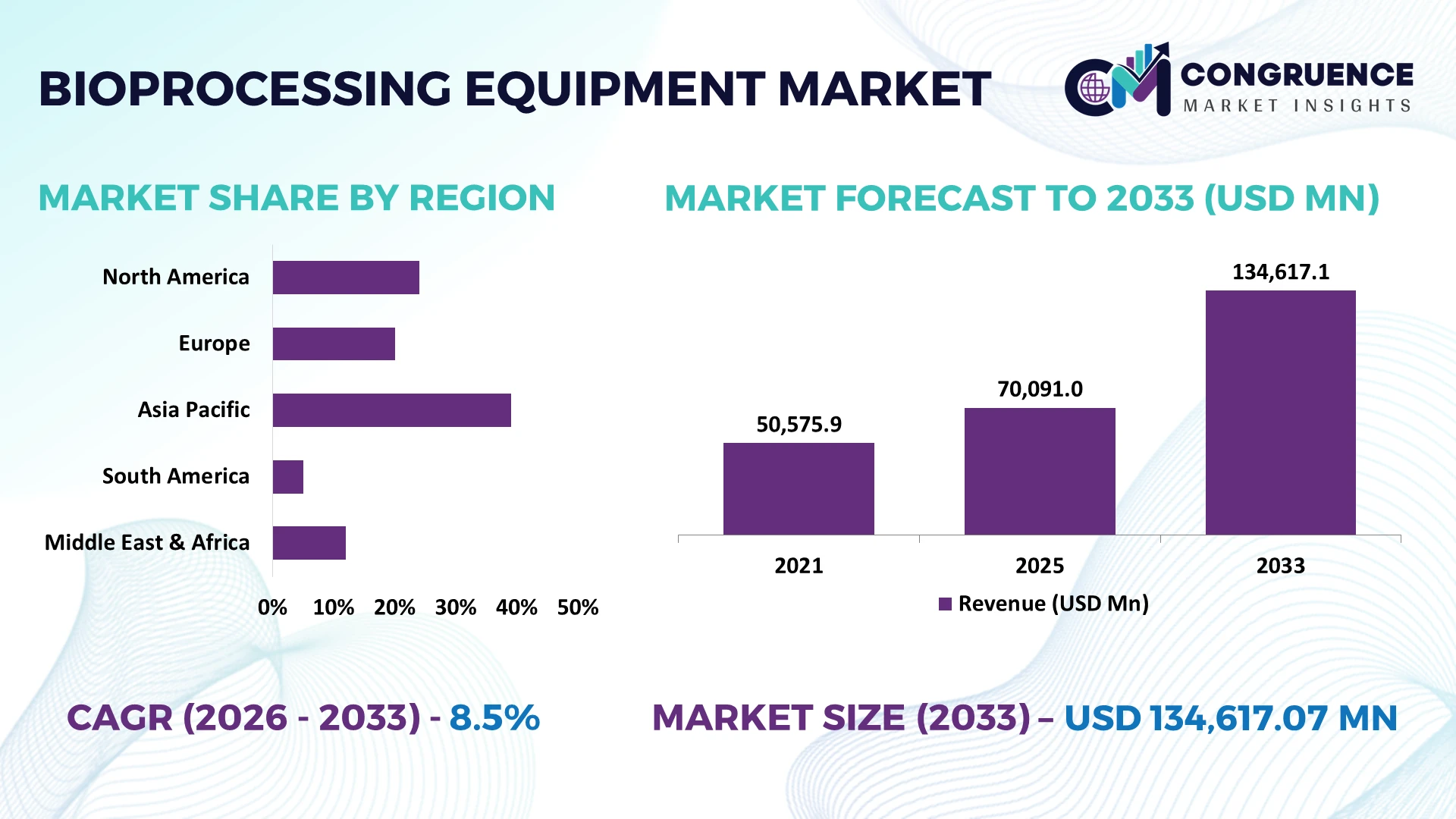
The United States remains the dominant country, accounting for approximately 38% of global bioprocessing equipment demand, supported by more than USD 20 billion in annual biopharmaceutical manufacturing investments and strong adoption of single-use systems across biologics facilities. Europe follows at roughly 27%, while Asia-Pacific is expanding capacity fastest, led by China and India. U.S. facilities deploy advanced automation at rates exceeding 60%, strengthening productivity and batch consistency.
The strategic implication is clear: equipment suppliers prioritizing flexible, automated, single-use platforms will capture the strongest high-growth biopharmaceutical capacity expansions.
Market Size & Growth: USD 70.09 billion in 2025 to USD 134.62 billion by 2033 at 8.5% CAGR, driven by biologics manufacturing expansion.
Top Growth Drivers: Single-use systems 32%, biologics production 28%, process automation 24%.
Short-Term Forecast: By 2028, automation is projected to cut processing costs 9% and improve equipment efficiency 12%.
Emerging Technologies: AI monitoring, continuous bioprocessing, and advanced single-use materials are reshaping high-throughput production.
Regional Leaders: North America reaches about USD 52 billion, Europe USD 37 billion, and Asia-Pacific USD 34 billion by 2033.
Consumer/End-User Trends: More than 55% of biopharma manufacturers increasingly prefer disposable processing assemblies for flexible production.
Pilot/Case Example: A 2025 automated biologics facility reduced batch-changeover time by 18% through integrated digital process controls.
Competitive Landscape: Leading suppliers collectively control approximately 40% of the market, with Danaher, Thermo Fisher Scientific, Sartorius, Merck, and Repligen leading global competition.
Regulatory & ESG Impact: Single-use adoption reduces cleaning-water consumption by approximately 30%, aligning manufacturing with stricter sustainability requirements.
Investment & Funding: More than USD 25 billion in global biopharma capacity investment is supporting equipment expansion, automation, and regional supply-chain diversification.
Innovation & Future Outlook: Continuous manufacturing, AI-enabled predictive maintenance, modular facilities, and next-generation sensors will shift competition toward intelligent, flexible production platforms.
The Bioprocessing Equipment Market is expanding across monoclonal antibodies, vaccines, cell and gene therapies, and biosimilars, with single-use technologies representing roughly 55% adoption in newly commissioned flexible facilities. Recent innovation centers on automated bioreactors, real-time sensors, AI-driven process control, and modular manufacturing. Geopolitical supply-chain diversification following pandemic-era disruptions is accelerating regional equipment localization, creating stronger strategic opportunities across Asia-Pacific and emerging biopharma hubs.
Bioprocessing equipment is becoming strategically important because manufacturers increasingly compete on production flexibility, batch consistency, speed-to-market, and facility utilization rather than equipment capacity alone. The shift toward biologics, biosimilars, and cell-based therapies is restructuring plant investment, while supply-chain localization is pushing pharmaceutical companies to establish more resilient production footprints closer to major demand centers.
Single-use bioreactors typically reduce cleaning and validation requirements by around 20–30% versus conventional stainless-steel systems, while shortening changeover cycles by roughly 15–25%. The United States leads in advanced automation deployment, whereas China and India are expanding modular manufacturing infrastructure at a faster pace. Over the next 2–3 years, automated process monitoring, continuous manufacturing, and digital batch analytics are positioned to increase utilization and reduce manual intervention across new facilities.
Companies are redirecting capital toward flexible manufacturing suites, automated upstream and downstream platforms, and strategic supplier partnerships. A practical deployment example is the integration of single-use bioreactors with real-time sensors to enable faster product changeovers without rebuilding fixed infrastructure. Suppliers that combine equipment, software, validation support, and consumables are gaining stronger customer lock-in. Competitive positioning will increasingly depend on integrated platforms that deliver measurable productivity, compliance, and sustainability advantages.
The strongest growth driver is the rapid transition toward flexible biologics manufacturing. Single-use equipment adoption has surpassed 50% across many newly commissioned facilities, while automated process monitoring can reduce manual intervention by approximately 20% and improve batch consistency by 10–15%. In the United States, expanding cell and gene therapy capacity is accelerating investment in modular bioprocessing suites. Pandemic-era supply disruptions also strengthened demand for localized production infrastructure. Equipment manufacturers are responding through expanded single-use portfolios, automation partnerships, and integrated digital platforms. The sharp strategic advantage lies in reducing facility changeover requirements, enabling manufacturers to produce multiple therapies within the same footprint.
High equipment qualification costs, specialized infrastructure requirements, and dependence on advanced components remain structural restraints. Validation and commissioning can account for roughly 10–15% of project expenditure, while specialized sensors, filtration assemblies, and polymer components can experience price fluctuations exceeding 8%. Japan and several European manufacturing hubs also face tighter qualification requirements that lengthen deployment cycles. Supply-chain disruptions involving specialty polymers and precision instrumentation can delay facility commissioning and increase inventory requirements. Companies are mitigating exposure through dual sourcing, longer supplier contracts, localized component procurement, and standardized equipment architectures. The key operational constraint is not equipment availability alone but maintaining validated interoperability across complex processing ecosystems.
AI-enabled monitoring, continuous processing, and modular facilities create high-value opportunities beyond conventional equipment replacement. Predictive analytics can reduce unplanned equipment downtime by approximately 15%, while automated control systems can improve process productivity by 10–12%. India is emerging as an attractive manufacturing base as pharmaceutical companies expand cost-efficient biologics capacity and strengthen domestic supply chains. Next-generation sensors connected to manufacturing execution systems will enable real-time quality decisions rather than post-batch correction. Companies are increasing R&D investment, forming automation partnerships, and developing equipment-as-a-service models. A non-obvious opportunity is integrating consumables, software, and equipment into recurring revenue ecosystems that increase customer retention while lowering adoption barriers.
Complex integration between bioreactors, filtration systems, sensors, software, and manufacturing execution platforms remains a major execution challenge. Approximately 30% of bioprocessing organizations still report significant interoperability or data-integration constraints, while skilled automation and validation personnel remain concentrated in established pharmaceutical hubs. Cybersecurity requirements are also expanding as connected equipment moves deeper into production networks. In Germany and the United States, increasingly automated facilities require coordinated engineering, quality, and IT expertise to maintain validated digital workflows. Companies must invest in standardized interfaces, workforce training, cybersecurity architecture, and lifecycle service capabilities. The strategic risk is fragmented automation: isolated technologies can increase complexity instead of delivering the expected productivity gains.
Single-Use Standardization Accelerates: Single-use systems now represent more than 50% adoption in newly commissioned flexible facilities, while qualification workflows are becoming 15–20% faster through standardized assemblies. Supply-chain disruptions are pushing manufacturers toward interchangeable components and dual sourcing, with suppliers expanding standardized portfolios to improve continuity and reduce validation friction.
Digital Control Moves Upstream: Automated sensing, Raman spectroscopy, and feedback controls are moving from pilots into production, targeting 10–15% higher process consistency and 15% less manual intervention. BioPhorum’s 2025 MES work identified progress in modular architecture and data integration, prompting manufacturers to prioritize connected equipment rather than isolated automation.
Downstream Monitoring Gets Real-Time: Real-time analytical technologies are increasingly replacing conservative UV-based pooling, improving yield consistency by approximately 5–10% and reducing deviation exposure by 8–12%. Monoclonal-antibody facilities are integrating PAT with chromatography workflows, while equipment suppliers are partnering on inline measurement and quality-control platforms.
Flexible Plants Replace Fixed Assets: Multi-modal facilities are gaining traction as manufacturers seek 20–30% faster product changeovers and 10–15% better asset utilization. In 2026, BioPhorum highlighted the risk of stranded purpose-built capacity, accelerating investment in modular equipment capable of supporting multiple modalities and shorter production cycles.
Bioreactors represent the leading type at approximately 30% market share, reflecting their central role in cell-culture productivity, scalability, and process control. Single-use bioreactors increasingly replace fixed stainless-steel configurations in flexible facilities, with adoption exceeding 50% among many newly commissioned plants. Upstream equipment follows closely at around 24%, supported by automated feed systems and intensified cultivation. Filtration systems account for nearly 18%, while chromatography systems contribute about 16%, remaining essential for high-purity downstream processing.
Filtration systems are among the fastest-moving segments, with adoption expanding roughly 12–15% as manufacturers pursue shorter processing cycles and reduced hold times. Chromatography remains mature but is shifting toward continuous and real-time monitored configurations. Companies are directing investment toward integrated upstream-downstream platforms, while suppliers are expanding single-use assemblies and automated controls. The strategic priority is increasingly synchronized process architecture rather than standalone equipment optimization.
Monoclonal antibodies lead applications with approximately 48% market share because their large-scale production requires highly controlled upstream cultivation, robust purification, and repeatable downstream workflows. Vaccines account for nearly 24%, supported by rapid-response manufacturing requirements, while recombinant proteins represent about 18%. Cell and gene therapy remains smaller at roughly 10% but is expanding fastest as manufacturers adopt specialized closed processing, advanced analytics, and flexible equipment architectures.
Cell and gene therapy equipment demand is increasing at approximately 15–18% annually in deployment activity, driven by complex batch requirements and tighter process-control expectations. Monoclonal-antibody facilities increasingly prioritize real-time aggregate monitoring and automated chromatography, while vaccine manufacturers emphasize rapid changeover capability. Companies are reallocating engineering resources toward flexible platforms that accommodate multiple modalities without duplicating infrastructure, making application versatility a stronger purchasing criterion.
Biopharmaceutical companies represent the leading end-user group at approximately 52% market share, reflecting their extensive manufacturing footprints, stringent validation requirements, and continuous investment in biologics capacity. Biotechnology companies account for around 20%, increasingly favoring modular and single-use equipment that limits upfront infrastructure commitments. Contract manufacturing organizations contribute approximately 18%, while research institutions and academic laboratories collectively represent about 10%.
Contract manufacturing organizations are showing the fastest equipment expansion, with deployment activity increasing approximately 12–15% as developers outsource more production to flexible external capacity. BioPharmaceutical companies emphasize integrated automation and lifecycle service contracts, whereas biotechnology firms prioritize scalable systems that can transition from development to commercial manufacturing. Suppliers are responding with configurable platforms, partnership models, and bundled consumables. The non-obvious competitive shift is toward equipment ecosystems that secure recurring demand beyond the initial capital purchase.
North America accounted for the largest market share at 42% in 2025 however, Asia-Pacific is expected to register the fastest growth, expanding at a CAGR of 10.2% between 2026 and 2033.
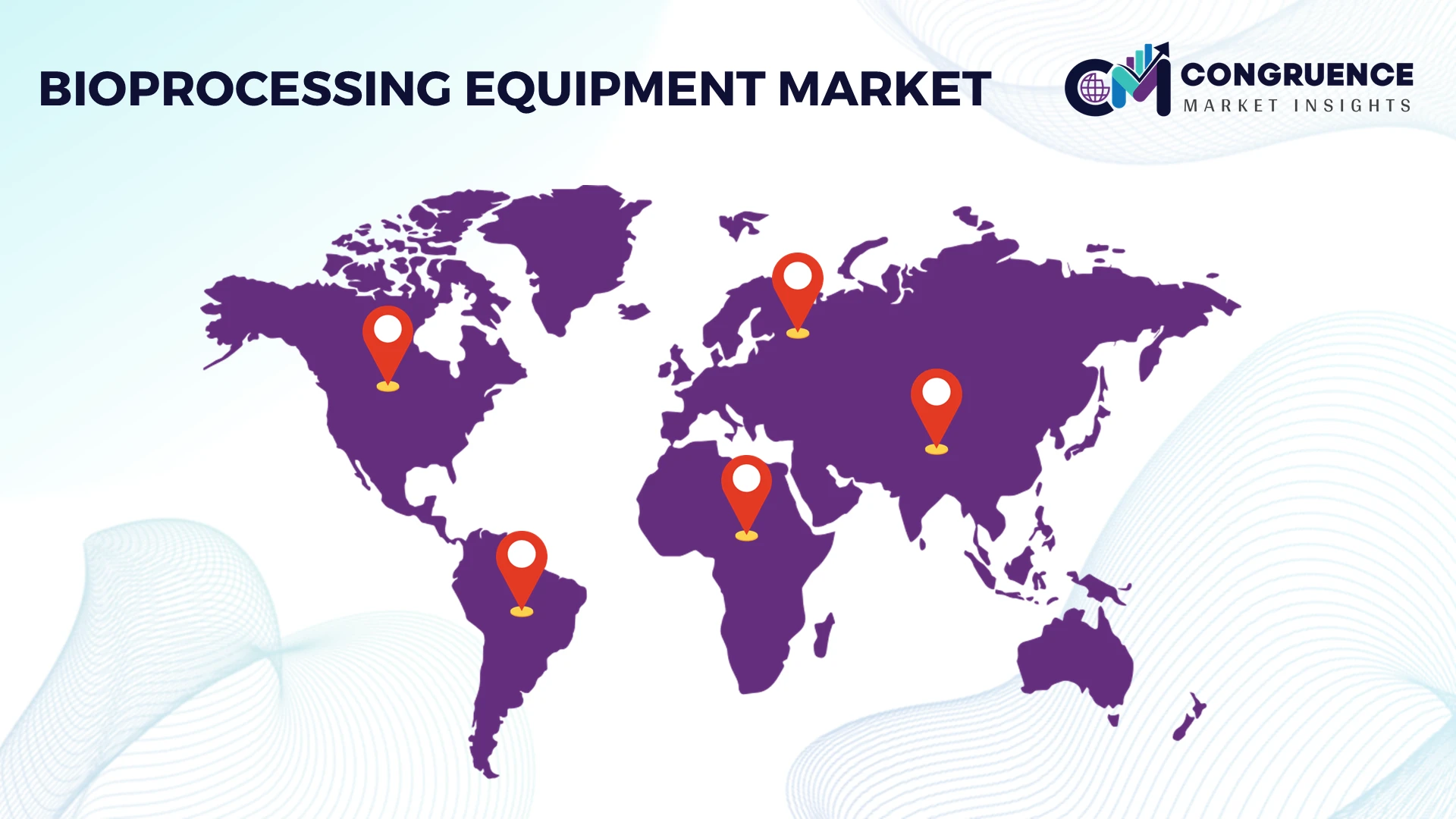
Automation and flexible manufacturing redefine capacity deployment
North America held approximately 42% of global bioprocessing equipment demand in 2025, supported by dense biologics manufacturing infrastructure, established CDMOs, and advanced automation. The United States accounts for the majority of regional demand, with more than 60% of newly commissioned biopharmaceutical facilities integrating automated process monitoring or digital control capabilities. Investment is concentrating on single-use bioreactors, continuous processing, advanced filtration, and integrated downstream systems. Pharmaceutical companies are also expanding domestic production to strengthen supply-chain resilience following pandemic-era disruptions. Partnerships between equipment manufacturers, software providers, and biopharma producers are accelerating deployment of predictive maintenance and real-time quality monitoring. The strategic advantage increasingly comes from integrated equipment ecosystems that reduce commissioning complexity and improve facility utilization.
United States Market Outlook: The United States remains the region's dominant national market because of its extensive biologics manufacturing base, strong pharmaceutical investment, sophisticated regulatory infrastructure, and concentration of biotechnology companies. More than half of advanced facilities increasingly incorporate automated process controls, supporting faster batch decisions, improved consistency, and greater utilization of flexible manufacturing assets.
Regulatory efficiency accelerates sustainable facility modernization
Europe accounted for approximately 28% of global bioprocessing equipment demand in 2025, supported by mature pharmaceutical manufacturing clusters across Germany, Switzerland, France, and the United Kingdom. Manufacturers are prioritizing single-use processing, continuous manufacturing, and digital quality systems to reduce cleaning requirements and improve resource efficiency. Single-use technologies now exceed 50% adoption across many newly commissioned flexible facilities. Stricter sustainability expectations are also increasing demand for equipment that lowers water consumption and minimizes process waste. Germany and Switzerland remain important engineering and manufacturing centers, while the United Kingdom maintains strong advanced-therapy capabilities. Equipment suppliers are responding through partnerships with pharmaceutical manufacturers and CDMOs, combining automation, validation services, and process analytics into modernization packages that improve operational flexibility.
Germany Market Outlook: Germany represents Europe's strongest industrial base for bioprocessing equipment, supported by pharmaceutical manufacturing clusters, precision engineering expertise, and specialized process-technology suppliers. Approximately 50% of advanced facilities increasingly incorporate single-use processing architectures, while manufacturers are investing in automated controls, energy-efficient systems, and advanced purification technologies.
Rapid capacity localization strengthens manufacturing scale
Asia-Pacific represented approximately 21% of global bioprocessing equipment demand in 2025 and is establishing the strongest deployment momentum through new biologics and biosimilar manufacturing capacity. China, India, South Korea, and Singapore are expanding pharmaceutical infrastructure, with modular single-use systems increasingly selected to shorten construction and commissioning cycles. Automated process monitoring adoption is rising by approximately 10–15% across advanced facilities as manufacturers improve quality consistency and labor productivity. India is strengthening its biosimilar and vaccine manufacturing base, while China combines large-scale pharmaceutical production with expanding biotechnology investment. Companies are establishing local service centers, supplier partnerships, and regional manufacturing capabilities to reduce imported-equipment dependence. The strategic shift favors suppliers that can deliver localized technical support alongside scalable equipment platforms.
China Market Outlook: China is the region's largest strategic manufacturing base, supported by extensive pharmaceutical production, expanding biologics capacity, and growing domestic biotechnology investment. Advanced facilities increasingly deploy automated bioreactors, filtration systems, chromatography platforms, and digital process controls, strengthening demand for suppliers with localized manufacturing and technical-support capabilities.
Brazil anchors pharmaceutical infrastructure modernization
South America represented approximately 5% of global bioprocessing equipment demand in 2025, with Brazil accounting for the largest share through vaccine manufacturing, biologics production, and public pharmaceutical infrastructure. Modernization is increasing demand for bioreactors, filtration systems, chromatography equipment, and automated monitoring platforms. Single-use technology adoption in advanced facilities is approaching 30%, reflecting the industry's effort to reduce cleaning requirements and improve production flexibility. However, dependence on imported sensors, specialized filtration components, and automation equipment continues to extend procurement cycles. Companies are responding through distributor partnerships, local technical-service networks, and longer supplier agreements. Brazil's established vaccine and pharmaceutical manufacturing ecosystem provides the strongest deployment base, while suppliers offering localized support and validated equipment integration gain an advantage over purely price-focused competitors.
Brazil Market Outlook: Brazil remains the most strategically significant country because of its pharmaceutical manufacturing scale, vaccine infrastructure, and public-sector production capabilities. Domestic manufacturers are increasingly upgrading flexible processing systems and automated quality controls, while supplier partnerships are strengthening equipment availability and technical support.
Localization programs drive pharmaceutical infrastructure investment
Middle East & Africa accounted for approximately 4% of global bioprocessing equipment demand in 2025, with Saudi Arabia, the United Arab Emirates, and South Africa emerging as important deployment centers. Pharmaceutical localization programs are supporting investment in vaccine, biologics, and sterile manufacturing infrastructure. New facilities increasingly favor modular processing equipment to reduce construction complexity and accelerate commissioning. Automated process monitoring remains below 25% adoption across many developing facilities, leaving substantial scope for modernization. Saudi Arabia is attracting international pharmaceutical partnerships, while the UAE is strengthening advanced healthcare and life-science infrastructure. Equipment suppliers are responding with regional service partnerships, local training, validation support, and turnkey solutions. The strongest competitive opportunity lies in combining equipment delivery with lifecycle support rather than selling standalone machinery.
Saudi Arabia Market Outlook: Saudi Arabia holds the strongest strategic position through pharmaceutical localization initiatives, healthcare infrastructure investment, and expanding domestic manufacturing capabilities. New production projects increasingly prioritize automated processing and modular equipment, creating demand for suppliers that combine technology, commissioning expertise, workforce training, and long-term maintenance.
The Bioprocessing Equipment Market is led by Danaher, Thermo Fisher Scientific, Sartorius, Merck, and Repligen, competing against specialized equipment suppliers and regional technology providers. The top five players collectively account for approximately 40% of market share, creating a moderately concentrated competitive structure. Competition increasingly centers on technology integration, supply reliability, customization, and service capability rather than equipment price alone. Single-use platforms reduce changeover requirements by roughly 15–25%, while automated controls can improve process consistency by 10–15%, strengthening demand for integrated systems. Leading companies are expanding manufacturing capacity, developing automation partnerships, strengthening regional service networks, and integrating equipment with consumables and analytics. Supply-chain localization is becoming a major competitive lever as pharmaceutical manufacturers seek validated alternatives to concentrated component sources. High qualification requirements, technical expertise, and regulatory compliance create significant entry barriers. Winning requires broad platform capabilities, reliable supply, rapid deployment, validated interoperability, and strong lifecycle support.
Danaher Corporation
Thermo Fisher Scientific Inc.
Sartorius AG
Merck KGaA
Repligen Corporation
Eppendorf SE
Getinge AB
Agilent Technologies, Inc.
Parker Hannifin Corporation
3M Company
Solaris Biotech Solutions
Meissner Filtration Products, Inc.
Single-use bioreactors, automated process analytical technology, and intensified downstream processing are defining current bioprocessing technology. Single-use systems now exceed 50% adoption in many newly commissioned flexible facilities, reducing changeover requirements by 15–25%. Integrated sensors, digital controllers, and manufacturing-execution platforms improve process consistency by 10–15%, giving biopharmaceutical manufacturers faster batch decisions and greater facility flexibility.
Emerging technologies include continuous perfusion, AI-assisted process control, Raman spectroscopy, and advanced membrane chromatography. Process intensification can deliver 2–3 times higher throughput while reducing manufacturing footprint, compared with conventional batch architectures. Membrane-based purification is gaining attention for large-scale processing, while automated monitoring reduces manual intervention by approximately 15%. Suppliers combining equipment, software, consumables, and analytics gain stronger competitive positioning than standalone equipment vendors.
Between 2026 and 2028, connected automation, digital twins, predictive maintenance, and closed-system processing will move from selective deployment toward broader commercial manufacturing integration. AI-enabled monitoring is positioned to improve operational efficiency by 10–12%, while modular platforms can shorten facility deployment timelines by approximately 15%. Technology leaders benefit most as customers prioritize validated interoperability, rapid scale-up, lower resource consumption, and resilient supply chains, making integrated digital-bioprocessing architectures the immediate investment priority.
September 2025 Thermo Fisher Scientific completed its approximately $4.0 billion acquisition of Solventum’s Purification & Filtration business, adding advanced filtration technologies and strengthening its bioprocessing portfolio. The integration expands upstream and downstream capabilities and reinforces Thermo Fisher’s vertically integrated position. Source: thermofisher.com
June 2025 Sartorius completed its Aubagne, France expansion, nearly doubling cleanroom space and adding automated single-use bag production lines. The site reached approximately 90,000 square meters, improving manufacturing capacity, logistics, product development, and delivery resilience for biopharma customers. Source: sartorius.com
December 2025 Thermo Fisher Scientific expanded bioprocess design infrastructure across Asia with a new Hyderabad center and expanded facilities in Incheon and Singapore. The three-hub network supports process simulation, single-use systems, training, and scale-up, strengthening localized customer support and accelerating regional deployment. Source: thermofisher.com
July 2024 Repligen agreed to acquire Taiwan-based Tantti Laboratory, adding macroporous chromatography bead technology for viral vectors, nucleic acids, and other large biologics. The platform combines membrane-like throughput with rapid mass transfer, strengthening Repligen’s downstream purification position. Source: repligen.com
The report covers the Bioprocessing Equipment Market across Upstream Equipment, Downstream Equipment, Bioreactors, Filtration Systems, and Chromatography Systems. Application analysis includes Monoclonal Antibodies, Vaccines, Recombinant Proteins, and Cell & Gene Therapy, while end-user coverage spans Biopharmaceutical Companies, Biotechnology Companies, Contract Manufacturing Organizations, Research Institutions, and Academic Laboratories. Regional assessment covers North America, Europe, Asia-Pacific, South America, and Middle East & Africa.
The study evaluates technology adoption, deployment concentration, automation integration, single-use penetration, manufacturing modernization, and supply-chain localization. It also examines emerging areas such as continuous processing, process analytical technology, AI-enabled monitoring, modular facilities, and advanced purification. Competitive analysis covers major equipment providers, strategic partnerships, capacity expansion, product innovation, and ecosystem positioning. The findings support investment planning, geographic expansion, technology prioritization, supplier strategy, and competitive positioning through 2033, with particular emphasis on operational shifts expected between 2026 and 2028.
| Report Attribute/Metric | Report Details |
|---|---|
Market Revenue in 2025 | USD 70091 Million |
Market Revenue in 2033 | USD 134617.07 Million |
CAGR (2026 - 2033) | 8.5% |
Base Year | 2025 |
Forecast Period | 2026 - 2033 |
Historic Period | 2021 - 2025 |
Segments Covered | By Type
By Application
By End-User
|
Key Report Deliverable | Revenue Forecast, Growth Trends, Market Dynamics, Segmental Overview, Regional and Country-wise Analysis, Competition Landscape |
Region Covered | North America, Europe, Asia-Pacific, South America, Middle East, Africa |
Key Players Analyzed | Danaher Corporation, Thermo Fisher Scientific Inc., Sartorius AG, Merck KGaA, Repligen Corporation, Eppendorf SE, Getinge AB, Agilent Technologies, Inc., Parker Hannifin Corporation, 3M Company, Solaris Biotech Solutions, Meissner Filtration Products, Inc. |
Customization & Pricing | Available on Request (10% Customization is Free) |




