
Reports
The Global Bioplastic for Interior Market was valued at USD 2234.4 Million in 2025 and is anticipated to reach a value of USD 3670.23 Million by 2033 expanding at a CAGR of 6.4% between 2026 and 2033. Growth is driven by automotive manufacturers integrating renewable polymers, natural fiber composites, and sustainable interior components to reduce dependence on conventional petroleum plastics.
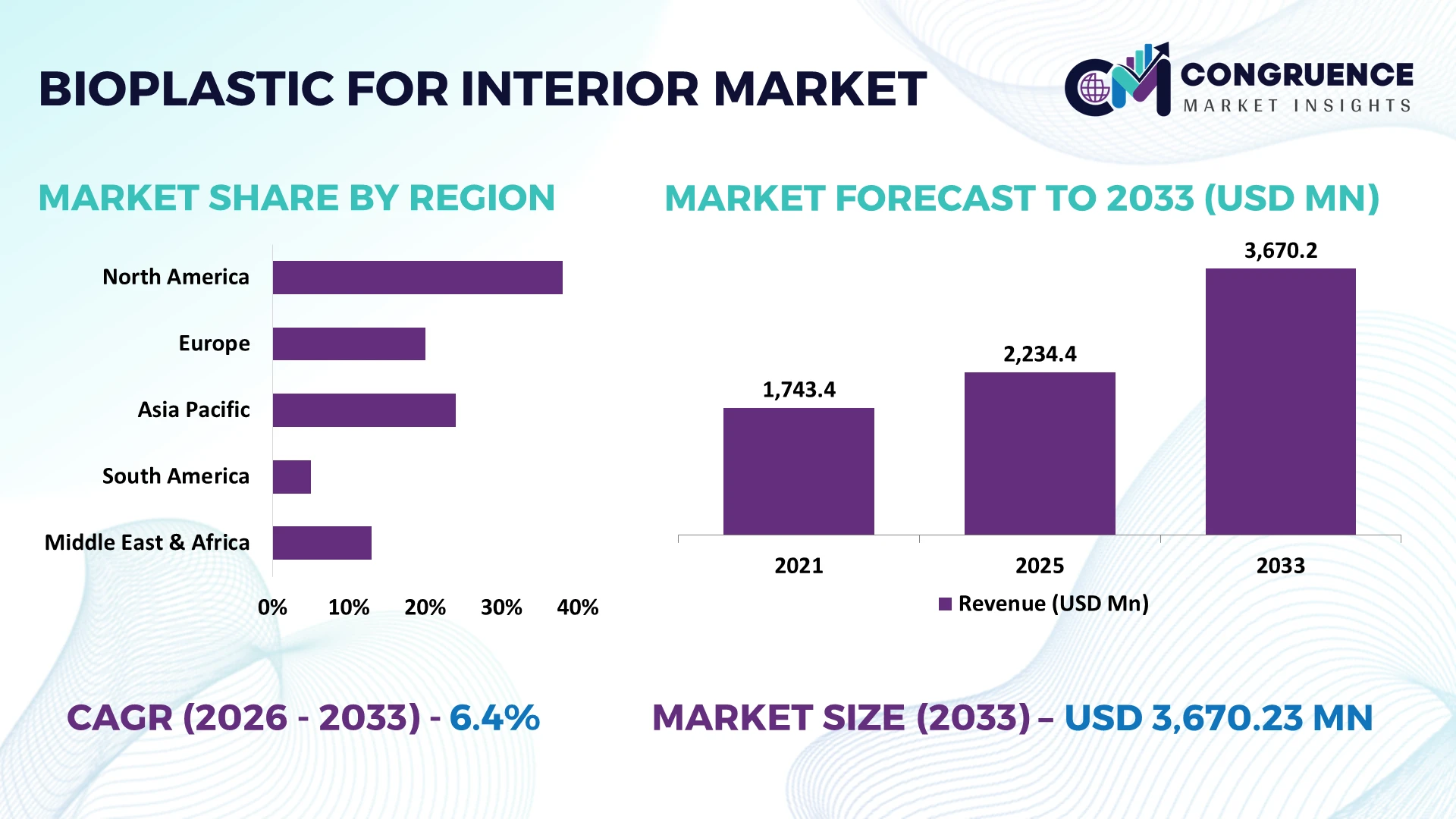
China represents an important manufacturing and automotive supply chain hub within Asia, which accounted for approximately 55.6% of global bioplastics production capacity in 2025. Europe's corresponding share stood at 14.7%, reflecting a substantial regional manufacturing difference. Global bioplastics production capacity reached 2.31 million tonnes, with automotive and transportation applications representing approximately 10.3%. Germany provides an important European comparison, supported by automotive manufacturers incorporating alternative interior materials and developing advanced circular manufacturing technologies. Country specific interior bioplastic market shares and investment totals remain unverified.
Strategically, manufacturers should prioritize automotive material qualification, reliable renewable polymer sourcing, and production partnerships across established Asian and European manufacturing clusters.
Market Size & Growth: USD 2234.4 million in 2025, reaching USD 3670.23 million by 2033 at 6.4% CAGR, supported by automotive interior material substitution.
Top Growth Drivers: Renewable polymer capacity expansion, automotive sustainability requirements, and advanced composite development are the three principal growth drivers. Individual percentage contributions remain unverified.
Short Term Forecast: By 2028, material qualification and manufacturing efficiency will determine commercial scalability. Verified interior specific efficiency improvement percentages are unavailable.
Emerging Technologies: Three important technologies include advanced biopolymer compounding, natural fiber reinforcement, and automated composite manufacturing for lightweight interior components.
Regional Leaders: Asia held 55.6% of global bioplastics production capacity in 2025, compared with Europe's 14.7%. Interior specific regional revenue projections remain unverified.
Consumer and End User Trends: Automotive and transportation applications represented 10.3% of global bioplastics production capacity in 2025, indicating an established industrial application base.
Pilot and Case Example: Mercedes Benz introduced independently certified vegan interior materials in September 2025, covering seats, headliners, door panels, and carpeting. This demonstrates material qualification progress rather than verified bioplastic adoption.
Competitive Landscape: Automotive manufacturers and polymer suppliers compete through material performance, sustainability credentials, and manufacturing compatibility. Verified company shares for this specific market remain unavailable.
Regulatory & ESG Impact: Europe's 73% bioplastics production capacity utilization in 2025 highlights the importance of manufacturing efficiency alongside its evolving bioeconomy policies.
Investment & Funding: Global bioplastics production capacity is projected to reach 4.69 million tonnes by 2030, reflecting manufacturing expansion. Verified investment specifically allocated to interior applications remains unavailable.
Innovation & Future Outlook: Advanced bioPP, bioPE, and PHA technologies support material diversification, while global bioplastics production capacity is projected to approximately double between 2025 and 2030.
The Bioplastic for Interior Market encompasses renewable polymer materials and sustainable composites used in automotive cabin components, furniture, decorative surfaces, and architectural interiors. Automotive applications provide an established development pathway, with transportation representing 10.3% of global bioplastics production capacity in 2025. Advanced polymer compounding and natural fiber reinforcement are important technologies for improving material functionality. Europe's evolving bioeconomy framework provides additional regulatory context for renewable material development. Manufacturers must align material certification, processing compatibility, and supply chain availability with customer specifications, establishing the foundation for evaluating the market's strategic opportunities.
The Bioplastic for Interior Market is becoming strategically important as automotive manufacturers integrate renewable materials into vehicle interiors while strengthening supply chain resilience and environmental compliance. Global bioplastics production capacity reached 2.31 million tonnes in 2025, with automotive and transportation applications representing 10.3%. This industrial transition encourages material suppliers to develop renewable polymer compounds, natural fiber composites, and recyclable interior components that satisfy automotive performance specifications.
Advanced natural fiber composites offer measurable advantages over conventional glass fiber materials. Research comparing automotive components demonstrated approximately 11.7% weight reduction using cellulose composites and 7% using kenaf alternatives. Asia accounted for approximately 55.6% of global bioplastics production capacity in 2025, compared with Europe's 14.7%, highlighting differences in manufacturing scale. Germany's automotive industry provides an established application base for advanced renewable composites and material engineering.
During 2026 to 2028, manufacturers will prioritize material qualification, processing efficiency, and localized supply partnerships. Automotive door panels incorporating natural fiber reinforcement demonstrate practical lightweighting applications. Global bioplastics capacity utilization reached 72% in 2025, indicating opportunities to improve existing manufacturing productivity before committing additional capital. Companies integrating material development with automotive component manufacturing will strengthen procurement flexibility, product differentiation, and long term competitive positioning.
Automotive lightweighting requirements and renewable material integration are important structural drivers of the Bioplastic for Interior Market. Automotive and transportation applications represented 10.3% of global bioplastics production capacity in 2025, equivalent to approximately 0.24 million tonnes. Research demonstrates that replacing conventional glass fiber composites with cellulose alternatives can reduce component weight by approximately 11.7%. Germany's established automotive manufacturing ecosystem supports the development of natural fiber reinforced door panels, interior trim, and structural cabin components. These applications connect material substitution with vehicle weight optimization and sustainability objectives. Manufacturers are strengthening polymer formulation capabilities, collaborating with component suppliers, and investing in material qualification to expand commercially viable automotive interior applications.
Bioplastic manufacturing faces structural limitations associated with feedstock availability, processing economics, and uneven production capacity utilization. Global bioplastics production operated at approximately 72% of installed capacity in 2025, while individual polymer utilization ranged from 28% to 100%. European manufacturing recorded approximately 73% utilization, highlighting differences in commercial maturity across polymer categories. Agricultural feedstock dependence introduces exposure to crop availability, competing industrial applications, and procurement fluctuations. These conditions complicate predictable material pricing for automotive interior manufacturers operating under established purchasing contracts. Suppliers are responding through diversified renewable feedstock procurement, localized compounding operations, and contractual arrangements that improve production planning while reducing exposure to individual agricultural supply chains.
Advanced biopolymer development creates opportunities to expand renewable material applications beyond established automotive components into furniture, architectural panels, and premium interior surfaces. Global bioplastics production capacity is projected to increase from 2.31 million tonnes in 2025 to approximately 4.69 million tonnes by 2030. Europe's share of global capacity is projected to increase from 14.7% to 17.2%, supported by additional bioPP, bioPE, and PHA manufacturing capabilities. These developments provide opportunities for material suppliers to commercialize specialized compounds with improved processing compatibility and application specific properties. German automotive suppliers can leverage existing component engineering capabilities to develop renewable interior materials. Investment priorities include advanced compounding, formulation research, and partnerships connecting polymer producers with interior component manufacturers.
Achieving consistent material performance across industrial production environments represents a significant execution challenge for bioplastic interior manufacturers. Global bioplastics production capacity utilization varies between 28% and 100% across polymer categories, demonstrating substantial differences in manufacturing maturity. Bioplastics also represent approximately 0.5% of global annual plastics production, indicating their comparatively limited industrial scale. Automotive applications account for 10.3% of bioplastics production capacity, but interior components require additional validation for thermal stability, durability, emissions, and dimensional consistency. German automotive manufacturers operate within demanding component qualification frameworks that complicate rapid material substitution. Suppliers must invest in standardized testing, processing optimization, and collaborative engineering programs to establish consistent manufacturing performance and support reliable commercial deployment.
Improving Bioplastic Manufacturing Capacity Utilization: Global bioplastics manufacturing utilization reached 72% in 2025, compared with 58% in 2024. Actual production reached 1.67 million tonnes, demonstrating improving industrial output. Manufacturers are optimizing production scheduling and material processing to increase throughput without proportionate investment in additional manufacturing infrastructure.
Increasing Automotive Interior Material Customization: Automotive and transportation applications represented 10.3% of global bioplastics production capacity in 2025, equivalent to approximately 240,000 tonnes. Material suppliers are refining polymer formulations for dashboards, interior trim, and decorative components. Automotive manufacturers are strengthening supplier collaboration to integrate renewable materials into established component manufacturing processes.
Restructuring Global Bioplastic Production Networks: Global bioplastics manufacturing capacity reached 2.31 million tonnes in 2025, with Asia accounting for approximately 55.6% and Europe representing 14.7%. Manufacturers are adjusting production networks to balance manufacturing scale with proximity to industrial customers. European companies are emphasizing specialized material processing and technical collaboration.
Strengthening Material Traceability and Certification: Global bioplastics production represented approximately 0.5% of total plastics manufacturing in 2025, while European production capacity utilization reached 73%. Increasing regulatory scrutiny is encouraging manufacturers to improve renewable content verification, material traceability, and environmental documentation. Companies are integrating certification requirements into procurement and product development workflows.
PLA represents the leading material category within the Bioplastic for Interior Market, accounting for approximately 26.4% of the market in 2024. Its established processing characteristics, renewable feedstock availability, and compatibility with conventional polymer manufacturing equipment support adoption in decorative surfaces, furniture components, and interior panels. PLA provides manufacturers with an established material platform for developing commercially scalable interior products. Bio-PET and Bio-PE offer alternative material characteristics, particularly where manufacturers require compatibility with existing polymer processing infrastructure and established component specifications.
PHA represents an emerging material category supported by advances in microbial fermentation and biodegradable polymer manufacturing. However, a verified growth ranking across the specified interior material categories is unavailable. Starch-Based materials provide formulation flexibility for selected interior applications, while Cellulose-Based composites support natural fiber reinforcement and differentiated surface characteristics. Manufacturers are prioritizing application specific polymer formulations, processing compatibility, and technical partnerships. Investment decisions increasingly depend on material qualification requirements, production consistency, and the ability to integrate renewable polymers into established manufacturing operations.
Automotive Interiors represent the leading application category within the Bioplastic for Interior Market, accounting for approximately 27.9% of the market in 2024 under a published application classification. Automotive manufacturers incorporate renewable polymers into dashboards, door components, trim assemblies, and decorative cabin surfaces to support material substitution and vehicle lightweighting. Interior Panels represent another important application because their established manufacturing processes support the integration of polymer composites. Furniture and Decorative Surfaces provide additional opportunities for renewable material substitution where appearance, processing compatibility, and surface performance influence purchasing decisions.
Flooring and Wall Coverings require specialized formulations addressing dimensional stability, wear resistance, and installation performance. Upholstery applications emphasize material flexibility, durability, and surface characteristics. These technical requirements create distinct qualification pathways across interior applications. A verified fastest growing category within the specified application classification remains unavailable. Manufacturers are developing specialized compounds and strengthening collaboration with component producers to improve manufacturing consistency. Commercial deployment priorities increasingly reflect the technical requirements and production volumes associated with individual interior applications.
Automotive represents the dominant end user within the Bioplastic for Interior Market. One published 2025 market estimate assigns automotive original equipment manufacturers approximately 41% of the market under its end use classification. Large automotive manufacturers provide concentrated procurement opportunities through standardized component specifications, established supplier networks, and recurring vehicle production programs. Furniture Manufacturers represent another important customer group, incorporating renewable polymers into decorative components and furniture structures. Commercial Buildings and Residential Construction create additional demand through interior material specifications and sustainable building requirements.
Hospitality and Retail Spaces provide opportunities for differentiated interior materials, particularly where visual characteristics and procurement requirements influence material selection. Interior Designers support product specification and material selection across several end user categories. A verified fastest growing category under the specified classification remains unavailable. Suppliers are developing application specific product portfolios and establishing partnerships with component manufacturers, construction material distributors, and interior product specialists. Competitive positioning increasingly depends on balancing technical performance, material availability, certification requirements, and procurement compatibility across different customer groups.
North America accounted for the largest market share at approximately 31% in 2025 however, Asia Pacific is expected to register the fastest growth, expanding at a CAGR of approximately 7.5% between 2026 and 2033.

Automotive Integration Strengthens Commercial Deployment
North America holds an estimated 31% share of the Bioplastic for Interior Market, supported by established automotive manufacturing, polymer processing infrastructure, sustainable construction activity, and advanced material development. The United States anchors regional adoption, with bioplastics increasingly evaluated for vehicle trim, dashboards, panels, furniture components, and architectural interiors. Automotive manufacturers are emphasizing lightweight materials that integrate with existing injection molding and thermoforming equipment, reducing conversion complexity. NatureWorks provides significant domestic PLA manufacturing capability through its Nebraska operations, strengthening regional material availability. Regulatory initiatives and corporate material substitution programs are also pushing suppliers toward certified renewable feedstocks and improved lifecycle performance. Competition increasingly centers on processing compatibility and consistent industrial scale supply rather than sustainability credentials alone.
United States Market Outlook: The United States is the region's primary commercial center, supported by automotive production, advanced polymer research, and established bioplastic manufacturing infrastructure. NatureWorks operates approximately 150,000 tonnes of annual PLA capacity in Nebraska, providing domestic supply for downstream converters. Vehicle manufacturers and component suppliers are increasingly qualifying renewable polymers for interior applications where lightweighting, surface quality, and manufacturing compatibility determine adoption.
Circular Material Engineering Reshapes Interiors
Europe maintains a strong position through automotive engineering, circular material development, environmental regulation, and specialized biopolymer processing. The region represented approximately 14.7% of global bioplastics production capacity in 2025, while capacity utilization reached approximately 73%. Germany, France, Italy, and the Netherlands provide established ecosystems connecting polymer developers, automotive suppliers, furniture producers, and research institutes. Current development is shifting beyond basic renewable content toward recyclability, volatile organic compound control, odor performance, and closed loop interior materials. Germany's Interior Loop initiative targets recovery and recompounding of plastics from end of life vehicles for reuse in automotive interiors. This technical emphasis strengthens Europe's position in higher specification applications where material qualification and circularity requirements create stronger barriers than basic resin production scale.
Germany Market Outlook: Germany combines a large automotive manufacturing base with advanced polymer engineering and component validation infrastructure. In 2026, Fraunhofer IMWS and industrial partners advanced natural fiber reinforced bio polyamides for vehicle interiors, with the SkaNaPA program running through September 2027. Development targets industrial injection molding, seat structures, emission control, mechanical performance, and eventual series production.
Manufacturing Scale Accelerates Material Adoption
Asia Pacific combines the world's strongest bioplastics manufacturing concentration with extensive automotive, furniture, electronics, and construction supply chains. Asia accounted for approximately 55.6% of global bioplastics production capacity in 2025, giving converters substantial proximity to resin manufacturing and downstream processing infrastructure. China, Japan, South Korea, India, and Thailand are strengthening renewable polymer capabilities alongside large scale injection molding, textile, component, and surface finishing industries. China provides particularly strong demand potential because automotive manufacturing scale enables bioplastic interior materials to move from specialized programs toward higher volume component qualification. Thailand is also gaining strategic importance through new PLA capacity. The operational advantage is increasingly supply chain integration: polymer production, compounding, component molding, and final assembly can be concentrated within established manufacturing corridors.
China Market Outlook: China provides the region's strongest combination of vehicle production scale, polymer conversion capability, and manufacturing infrastructure. The country produced more than 31 million vehicles in 2024, creating substantial addressable demand for dashboards, door panels, trim, seating structures, and decorative surfaces. Domestic suppliers are increasingly positioned to integrate renewable compounds into high volume automotive component programs.
Bio Feedstock Availability Supports Localization
South America's strategic position is shaped by renewable feedstock availability, established petrochemical infrastructure, automotive manufacturing, and expanding bio based polymer production. Brazil provides the principal industrial platform through sugarcane derived ethanol and bio polyethylene manufacturing, creating a differentiated supply advantage for renewable interior materials. Braskem increased green ethylene production capacity to 275,000 tonnes annually in 2025, representing a 37% expansion from its original capacity. This strengthens feedstock availability for bio polyethylene converters serving automotive, furniture, consumer goods, and interior component applications. Regional deployment remains constrained by smaller downstream bioplastic conversion networks compared with major Asian manufacturing hubs. Suppliers are therefore concentrating on integrating renewable resin production with established polymer processing and export channels rather than building entirely separate manufacturing ecosystems.
Brazil Market Outlook: Brazil combines sugarcane feedstock availability with industrial scale renewable polyethylene manufacturing. Braskem's Triunfo facility reached 275,000 tonnes of annual green ethylene capacity following its expansion. This provides Brazilian converters with a localized renewable feedstock platform and supports greater integration of bio polyethylene into molded interior components, furniture products, decorative surfaces, and automotive supply chains.
Industrial Diversification Expands Material Potential
Middle East and Africa remain developing deployment markets for bioplastic interior materials, with adoption concentrated around construction modernization, hospitality development, automotive assembly, furniture manufacturing, and sustainable building programs. Saudi Arabia and the United Arab Emirates provide the strongest investment environment through petrochemical expertise and large construction pipelines, while South Africa offers an established automotive manufacturing platform. The region lacks the bioplastics production concentration seen in Asia, increasing dependence on imported specialized resins and compounds. Saudi Arabia's industrial diversification strategy is nevertheless expanding advanced materials and downstream manufacturing capabilities. Suppliers entering the region are prioritizing partnerships with converters, construction material companies, automotive suppliers, and interior specialists rather than standalone resin capacity, allowing market development to follow existing industrial infrastructure.
Saudi Arabia Market Outlook: Saudi Arabia offers strategic potential through its established petrochemical ecosystem and Vision 2030 industrial diversification agenda. The country is expanding downstream manufacturing and advanced materials capabilities while large scale construction programs create demand for sustainable interior products. Local processing partnerships can reduce imported finished component dependence and establish qualification channels for bio based panels, surfaces, furniture, and architectural materials.
NatureWorks, BASF, Braskem, Arkema, TotalEnergies Corbion, and Mitsubishi Chemical compete across renewable polymers, specialty compounds, and high performance interior materials, while downstream converters compete through application customization. The top five broader bioplastics suppliers collectively account for approximately 48% to 50% share, indicating meaningful concentration in upstream material supply. NatureWorks benefits from PLA scale, Braskem from bio polyethylene feedstock integration, while BASF, Arkema, and Mitsubishi Chemical emphasize specialty material performance. Competition increasingly centers on processing compatibility, durability, supply reliability, and renewable content. Leading suppliers are expanding capacity, forming compound development partnerships, and integrating feedstock procurement with polymer manufacturing. Braskem expanded green ethylene capacity by 37% to 275,000 tonnes annually, illustrating supply control as a competitive lever. Automotive qualification remains a critical entry barrier because odor, emissions, thermal stability, surface quality, and mechanical performance require extensive validation. Winning requires scalable renewable feedstock access, application specific formulations, dependable processing performance, and direct collaboration with interior component manufacturers.
NatureWorks LLC
BASF SE
Braskem S.A.
Arkema S.A.
Mitsubishi Chemical Group
Covestro AG
Evonik Industries AG
Celanese Corporation
FKuR Kunststoff GmbH
Biome Bioplastics Limited
Kaneka Corporation
Avantium N.V.
Green Dot Bioplastics
Cardia Bioplastics
Advanced polymer compounding, injection molding, and natural fiber reinforcement are transforming bioplastic interior manufacturing. PLA, bio polyethylene, and bio polyamide offer different processing characteristics for automotive components, furniture, and architectural surfaces. Global bioplastics production capacity utilization reached approximately 72% in 2025, indicating opportunities for manufacturing optimization. Integrated polymer production improves feedstock coordination, while automated extrusion supports consistent material formulation and industrial processing.
Emerging technologies include recyclable bio composites, hybrid injection molding, and advanced fermentation. Natural fiber reinforced biopolyamides are undergoing industrial validation for automotive seat structures and interior components. Research indicates that selected cellulose composites can achieve approximately 11.7% weight reduction compared with conventional glass fiber alternatives, although performance depends on component design. These technologies provide lightweighting advantages while requiring validation of mechanical properties, thermal stability, and emissions.
Disruptive innovation increasingly combines renewable polymers with recycled materials and integrated manufacturing systems. Advanced biomaterial development has demonstrated environmental improvements, including 95% lower greenhouse gas emissions for selected grain based leather alternatives compared with traditional leather. These findings concern upholstery alternatives rather than structural bioplastics. Between 2026 and 2028, automotive suppliers will prioritize industrial qualification, material traceability, and scalable processing. Manufacturers combining polymer engineering with established component production infrastructure gain competitive advantages through faster material integration, consistent specifications, and more resilient renewable feedstock procurement.
March 2026: Fraunhofer IMWS announced the SkaNaPA project to develop natural fiber reinforced biopolyamides for automotive interiors. The project targets industrial injection molding and 2 application stages, beginning with seat structures before expanding into additional interior components.
April 2026: NatureWorks inaugurated its fully integrated PLA manufacturing facility in Thailand, providing 75,000 metric tonnes of annual production capacity. The expansion integrates renewable feedstock processing and polymer manufacturing, strengthening regional supply availability for downstream converters.
May 2025: Braskem confirmed its expanded green ethylene production capacity reached 275,000 tonnes annually, representing a 37% increase over its original capacity. The expansion strengthens renewable polyethylene feedstock availability for converters serving automotive components and other industrial applications.
November 2024: Arkema partnered with Authentic Material to develop compounds combining recycled leather with renewable polyamide 11 and thermoplastic elastomers. The collaboration targets automotive interiors and other applications, supporting material customization through conventional molding, extrusion, and additive manufacturing.
The Bioplastic for Interior Market Report examines material innovation, manufacturing developments, competitive positioning, and industrial adoption between 2026 and 2033. Material segmentation covers PLA, PHA, Bio-PET, Bio-PE, Starch-Based, and Cellulose-Based polymers. Application analysis includes Interior Panels, Flooring, Wall Coverings, Furniture, Decorative Surfaces, Upholstery, and Automotive Interiors. End-user coverage evaluates Residential Construction, Commercial Buildings, Automotive, Hospitality, Furniture Manufacturers, Interior Designers, and Retail Spaces.
Regional analysis covers North America, Europe, Asia Pacific, South America, and the Middle East and Africa. The report examines polymer compounding, natural fiber reinforcement, automated processing, and renewable feedstock integration. With automotive and transportation applications representing approximately 10.3% of global bioplastics production capacity in 2025, automotive material development receives particular attention. Competitive analysis supports investment planning, supplier selection, manufacturing expansion, technology qualification, and identification of emerging commercial opportunities.
| Report Attribute/Metric | Report Details |
|---|---|
Market Revenue in 2025 | USD 2234.4 Million |
Market Revenue in 2033 | USD 3670.23 Million |
CAGR (2026 - 2033) | 6.4% |
Base Year | 2025 |
Forecast Period | 2026 - 2033 |
Historic Period | 2021 - 2025 |
Segments Covered | By Type
By Application
By End-User
|
Key Report Deliverable | Revenue Forecast, Growth Trends, Market Dynamics, Segmental Overview, Regional and Country-wise Analysis, Competition Landscape |
Region Covered | North America, Europe, Asia-Pacific, South America, Middle East, Africa |
Key Players Analyzed | NatureWorks LLC, BASF SE, Braskem S.A., Arkema S.A., Mitsubishi Chemical Group, Covestro AG, Evonik Industries AG, Celanese Corporation, FKuR Kunststoff GmbH, Biome Bioplastics Limited, Kaneka Corporation, Avantium N.V., Green Dot Bioplastics, Cardia Bioplastics |
Customization & Pricing | Available on Request (10% Customization is Free) |




