
Reports
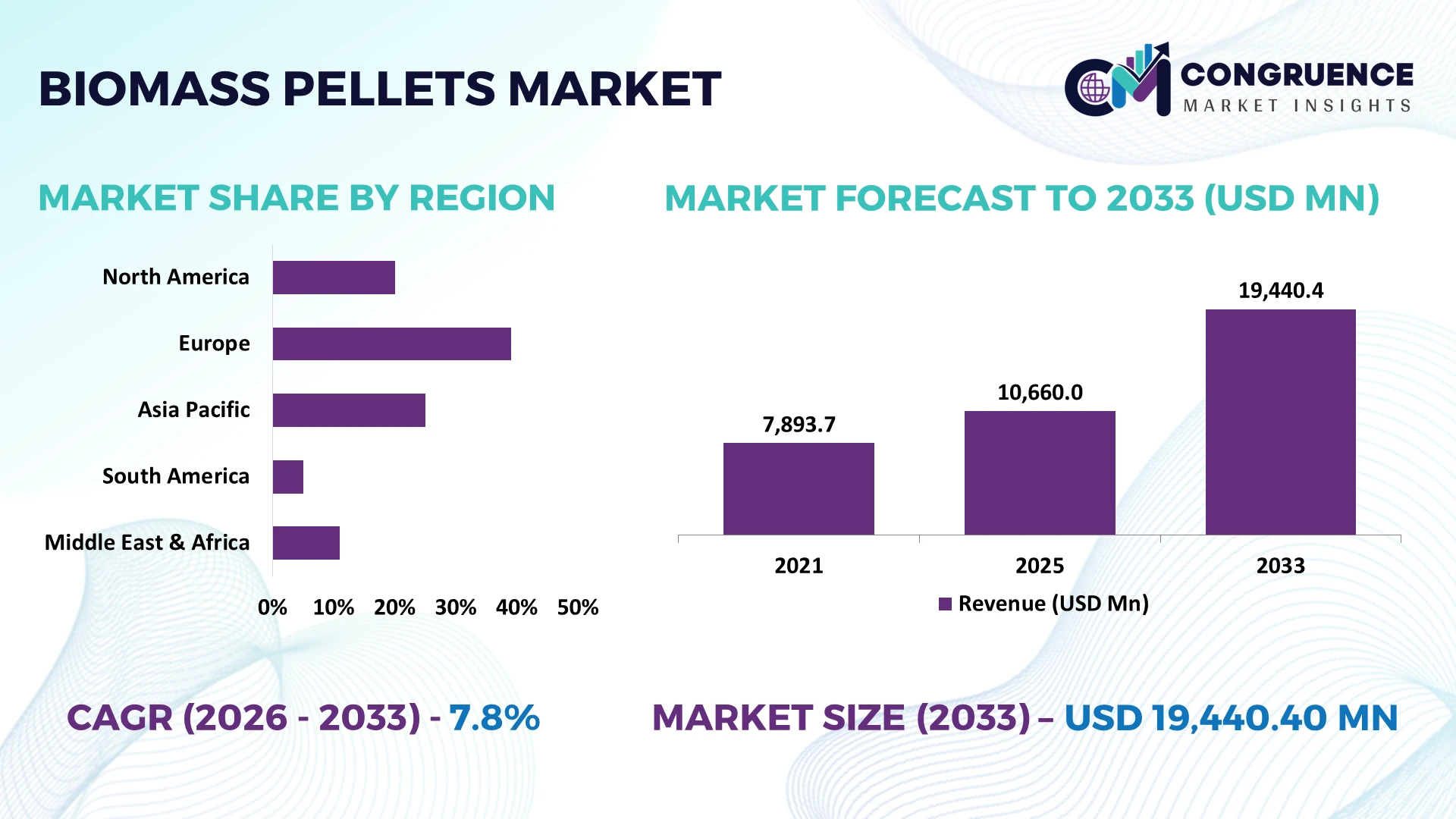
The Global Biomass Pellets Market was valued at USD 10660 Million in 2025 and is anticipated to reach a value of USD 19440.4 Million by 2033 expanding at a CAGR of 7.8% between 2026 and 2033. Growth is driven by coal-to-biomass fuel substitution, mandatory co-firing policies, industrial boiler conversions, and investments in high-density pellet manufacturing infrastructure.
The United States leads global biomass pellet production, accounting for approximately 19% of worldwide wood pellet and related agglomerated fuel output in 2024, compared with Vietnam's 12%. American production benefits from southeastern forestry resources, established export terminals, and industrial pellet manufacturing facilities. Drax's USD 50 million Aliceville expansion increased annual production capacity from 250,000 to 380,000 tonnes, strengthening transatlantic biomass supply. European renewable energy policies and Japanese power-sector procurement sustain demand for American pellets, reinforcing the country's export-oriented competitive position.
Long-term supply agreements, certified feedstock sourcing, and efficient pellet logistics are becoming decisive investment priorities for global biomass fuel manufacturers.
Market Size & Growth: Valued at USD 10660 Million in 2025, projected to USD 19440.4 Million by 2033 at 7.8% CAGR, driven by coal phase-out and industrial decarbonization mandates.
Top Growth Drivers: European renewable heating demand at 70% global consumption share, Japan and South Korea co-firing expansion, and industrial power generation commanding 44.68% end-user share .
Short-Term Forecast: By 2027, UK Bridge Policy reduces Drax output from 14–16 TWh to 6 TWh, creating significant oversupply as North American exporters supplying over 80% of UK imports face demand shock .
Emerging Technologies: AI-assisted moisture and temperature monitoring ensuring consistent pellet quality, predictive maintenance reducing production downtime, and torrefied pellets capturing 76.63% product share through higher energy density .
Regional Leaders: Europe at 70% consumption with USD 7.6 billion market size, North America at USD 4.69 billion with US export dominance, and Asia-Pacific at USD 1.8 billion driven by Japan and China .
Consumer/End-User Trends: Industrial sector commands 44.68% share for power generation and heating; residential consumption reached 15.3 million tonnes in Europe with 6.5 million households using pellet appliances .
Pilot/Case Example: Denmark’s Aarhus coal-fired power plant converted to biomass pellets, significantly reducing emissions and demonstrating utility-scale fuel switching viability .
Competitive Landscape: Enviva, Drax Group, Graanul Invest, Segezha Group, and Lignetics hold approximately 28.1% combined share; market remains fragmented across regional producers .
Regulatory & ESG Impact: EU Renewable Energy Directive II mandates sustainable sourcing with greenhouse gas savings thresholds; ENplus certification governs residential and commercial pellet quality standards .
Investment & Funding: Drax committed USD 12.5 billion to BECCS expansion in the US (2024); Woodland Biofuels invested USD 1.35 billion at Port of Louisiana for export-oriented production .
Innovation & Future Outlook: Torrefied pellets gaining traction for higher energy density and durability; AI and automation improving production efficiency and reducing costs as sustainability certification becomes procurement prerequisite.
The global biomass pellets industry serves utility-scale electricity generation, commercial heating, district energy networks, and industrial steam production. Advanced densification equipment, automated drying systems, and torrefied agricultural residues are strengthening fuel uniformity and compatibility with existing combustion infrastructure. Approximately 64% of installed global pellet production capacity was utilized in 2024, highlighting opportunities to improve operational throughput without proportionate greenfield expansion. Meanwhile, European sustainability certification requirements are influencing feedstock traceability and international procurement standards. These developments position manufacturing efficiency, secured raw materials, and application-specific fuel specifications as central considerations for strategic investment and competitive differentiation.
The global biomass pellets market is becoming strategically important as electricity generators, industrial heating operators, and fuel suppliers restructure procurement around renewable solid fuels. Global pellet production reached 48.3 million tonnes in 2024, while consumption exceeded 45 million tonnes, demonstrating established industrial-scale demand. India's biomass co-firing policies are accelerating agricultural residue commercialization, while European sustainability requirements increasingly influence international supply contracts. Manufacturers are responding through integrated feedstock sourcing, automated densification lines, and long-term utility partnerships to improve delivery reliability and production economics.
Technology advancement is changing the competitive advantages of biomass fuel processing. Experimental torrefaction technology has demonstrated energy density improvements of 27–46% over untreated pellets, supporting more efficient transportation and storage. Japan imported over 6 million tonnes in 2024, contrasting with Germany's strong domestic certified pellet manufacturing base. Drax's Aliceville facility expansion added 130,000 tonnes of annual capacity, demonstrating how established producers are prioritizing existing infrastructure over entirely new production sites.
During 2026–2028, automated moisture control, biomass traceability platforms, and advanced pellet specifications will influence procurement qualification and plant utilization. Producers achieving consistent fuel quality and securing dependable agricultural or forestry residues will strengthen contract retention, reduce operational disruptions, and establish sustainable competitive positions.
Government-directed coal substitution is establishing contracted demand for agricultural biomass pellets across electricity generation facilities. India's co-firing framework introduced a 5% biomass blending requirement, with earlier policy provisions targeting 7%, increasing the importance of organized residue collection and processing capacity. In 2026, enforcement authorities imposed penalties on six thermal plants for noncompliance with requirements that included a minimum 3% threshold for FY 2024–25. These measures encourage utilities to procure standardized pellets rather than depend exclusively on coal. NTPC and other power producers are integrating biomass procurement into fuel management, while pellet manufacturers are expanding regional collection networks, negotiating multiyear contracts, and investing in industrial-scale densification systems to secure recurring institutional orders.
Concentrated raw material sourcing and international transportation requirements constrain biomass pellet procurement economics. Japan's domestic pellet self-sufficiency declined to 2.4% in 2024, while Vietnam, Canada, and the United States collectively supplied 87.8% of Japanese imports. This dependency exposes electricity producers to shipping disruptions, currency movements, and changing forestry residue availability. Additionally, standard commercial pellets require moisture levels below 10%, increasing drying and covered-storage requirements for producers handling variable agricultural feedstocks. Canada's constrained fibre availability has already pressured pellet production margins, prompting Drax to review its Canadian operations. Manufacturers are responding through diversified wood residue procurement, domestic agricultural feedstock substitution, flexible supplier agreements, and improved transportation planning to protect production continuity.
Expanding certified fuel production creates opportunities for specialized pellet manufacturers supplying premium heating systems and industrial customers. ENplus-certified production exceeded 14.5 million tonnes in 2025, with Germany contributing approximately 3.95 million tonnes and Austria supplying 1.89 million tonnes. These established markets demonstrate the commercial importance of verified fuel specifications and consistent combustion performance. Meanwhile, the United Kingdom increased domestic certified pellet production capacity by approximately 60% between 2013 and 2025, illustrating opportunities for localized processing. During 2026–2028, manufacturers can integrate optical feedstock sorting, automated quality monitoring, and modular pelletization equipment to serve decentralized heating networks. Partnerships with sawmills and agricultural cooperatives offer access to underutilized residues and differentiated fuel products.
Scaling biomass pellet adoption requires consistent combustion performance across different boiler configurations, milling systems, and feedstock compositions. ENplus A1 specifications limit ash content to 0.7%, require mechanical durability of at least 98%, and restrict bulk pellet fines to 1%. Maintaining these parameters becomes technically demanding when manufacturers process heterogeneous crop residues rather than uniform forestry materials. India's industrial co-firing expansion also requires specialized handling procedures for pulverized-fuel boilers, creating operational challenges involving combustion stability, ash behavior, and milling compatibility. Manufacturers must strengthen laboratory testing, develop application-specific pellet formulations, and collaborate with boiler manufacturers on combustion optimization. Investment in operator training and digital process monitoring will determine reliable deployment at industrial scale.
Global Production Recovery Accelerates Supply Rebalancing: Global wood pellet production reached 53.5 million tonnes in 2025, increasing 10% annually, while consumption reached 51.5 million tonnes. European manufacturers contributed 24.1 million tonnes, representing 45% of worldwide output. Producers are adjusting plant utilization, inventory schedules, and shipping allocations to accommodate stronger demand while limiting excessive stockholding and working capital requirements.
Residential Heating Recovery Reshapes Distribution Networks: European household pellet consumption increased 5% to 15.3 million tonnes in 2025, supported by more than 6.5 million households using pellet heating appliances. Italy operates over 2.3 million pellet appliances, compared with approximately 2 million in France. Suppliers are strengthening packaged fuel distribution, seasonal replenishment systems, and direct retailer partnerships to improve availability during winter demand peaks.
Dispatchable Biomass Generation Changes Procurement Cycles: The United Kingdom's revised Drax agreement covers four generating units during 2027–2031, with a 27% supported annual load factor and approximately 6 TWh generation allowance. This shifts biomass purchasing toward variable operating schedules rather than continuous baseload consumption. Fuel suppliers are restructuring delivery contracts and storage arrangements to match dispatch requirements while controlling inventory financing costs.
German Producers Optimize Domestic Fuel Distribution: German pellet manufacturers produced 1.041 million tonnes during the fourth quarter of 2025, with 91.6% supplied domestically and 77.7% distributed in bulk. Companies are prioritizing silo-compatible deliveries, regional dealer networks, and automated loading systems. The shift reduces dependence on export channels and enables more predictable transportation scheduling for heating customers.
Wood Pellets represent the leading type in the global biomass pellets market, supported by established forestry processing networks, standardized fuel characteristics, and large-scale commercial adoption. Germany's fourth-quarter 2025 manufacturing data demonstrates this mature supply structure, with sawmill residues accounting for 95.7% of pellet feedstock and approximately 97.9% of production meeting ENplus A1 standards. Wood Pellets dominate premium heating and industrial export contracts because consistent bulk density, controlled moisture, and predictable ash characteristics simplify fuel handling. Industrial Biomass Pellets occupy an important commercial category, emphasizing combustion specifications for large boilers and generating units rather than household heating requirements.
Agricultural Residue Pellets are positioned for the fastest expansion, particularly where crop residue collection supports localized fuel manufacturing. India's rice straw, wheat straw, and other agricultural processing residues provide alternatives to forestry-based inputs. Energy Crop Pellets offer dedicated feedstock pathways but require dependable cultivation economics and land availability. Torrefied Biomass Pellets remain an emerging technology segment, offering improved hydrophobicity and energy density. Manufacturers are directing investment toward flexible feedstock processing, drying optimization, and specialized pellet formulations to address different combustion requirements.
Power Generation represents the leading application in the global biomass pellets market, supported by utility-scale generating facilities requiring substantial and continuous fuel procurement. Industrial electricity production and associated large-scale applications account for a significant proportion of global pellet consumption, particularly in the United Kingdom, Japan, and South Korea. Drax Power Station demonstrates this concentration through its four biomass generating units and approximately 2.6 GW of installed capacity. Residential Heating represents another established application, with European household consumption reaching 15.3 million tonnes during 2025. Suppliers serving these markets prioritize different pellet specifications, contract structures, and distribution arrangements.
Co-firing in Coal Plants is emerging as a high-growth application as existing thermal power stations introduce biomass into conventional fuel systems. Industrial Boilers benefit from process heating requirements across food processing, textiles, and manufacturing. Combined Heat and Power installations offer integrated electricity and thermal energy production, improving overall fuel utilization. Animal Bedding remains a specialized application emphasizing absorbency and material consistency. Pellet manufacturers are adapting through utility-specific fuel formulations, automated bulk handling, and application-focused supply partnerships.
Power Plants constitute the leading end-user category in the global biomass pellets market, supported by large combustion installations, structured procurement agreements, and intensive fuel consumption requirements. Japan's biomass electricity industry demonstrates substantial institutional demand, with Asian pellet consumption reaching approximately 11.5 million tonnes in 2024. Utility operators prioritize calorific consistency, delivery reliability, and storage compatibility when selecting suppliers. Residential Consumers represent an established purchasing category, particularly in Germany, Italy, and France, where pellet stoves and boilers provide decentralized heating. Commercial Buildings increasingly incorporate automated pellet heating systems to replace conventional fossil-fuel installations.
Industrial Manufacturers represent a strategically important expansion segment as facilities modernize steam generation and process heating equipment. District Heating Operators require dependable bulk deliveries and centralized thermal distribution infrastructure, while Agricultural Businesses increasingly participate in localized biomass supply and consumption networks. Suppliers are differentiating institutional procurement packages through technical servicing, customized pellet specifications, and long-term delivery arrangements. Residential-oriented manufacturers focus on packaged product availability and distributor coverage, while industrial specialists concentrate on high-capacity loading infrastructure and combustion compatibility, creating distinct competitive positions across end-user categories.
Europe accounted for the largest market share at approximately 40.5% in 2025 however, Asia-Pacific is expected to register the fastest growth, expanding at a CAGR of approximately 10% between 2026 and 2033.

Export-Oriented Production and Integrated Forestry Supply Chains
North America remains a major global biomass pellets manufacturing hub, supported by concentrated forestry processing infrastructure across the southeastern United States and western Canada. Regional pellet production reached approximately 14.2 million tonnes in 2024, representing nearly 29% of global output. Manufacturing operations benefit from established sawmill residue collection, industrial drying infrastructure, and dedicated port terminals connecting Atlantic and Pacific export markets. During 2025, American pellet exports increased approximately 2%, while Canadian exports rose 5% over the preceding comparable twelve-month period. Producers are refining feedstock procurement systems and transportation agreements to maintain competitiveness in international utility contracts. Canadian manufacturers are also strengthening traceability procedures and collaboration with forestry operators as Japanese buyers tighten biomass sustainability requirements. Long-term operational efficiency increasingly depends on dependable fibre allocation, export logistics, and manufacturing utilization.
United States Market Outlook: The United States maintains a leading position in industrial pellet exports, with manufacturing concentrated in Georgia, Alabama, Mississippi, Louisiana, and North Carolina. Southeastern forestry operations provide access to substantial commercial timber-processing residues, while ports along the Gulf and Atlantic coasts support international shipments. Enviva and Drax are important industrial pellet suppliers. Investments in rail connectivity, automated handling, and plant maintenance are strengthening export-oriented manufacturing operations.
Residential Heating Modernization and Certified Fuel Leadership
Europe dominates global biomass pellet consumption, accounting for approximately 70% of worldwide demand in 2025. Regional production reached 24.1 million tonnes, increasing 10% annually as manufacturers recovered from earlier inventory adjustments and weaker heating demand. Residential consumption climbed to 15.3 million tonnes, supported by automated pellet boilers, modern stove installations, and established bulk delivery networks. Germany, Austria, France, and Italy maintain extensive heating equipment and fuel distribution ecosystems, while the United Kingdom operates large-scale biomass electricity infrastructure. Certification requirements increasingly influence manufacturing practices, with ENplus-certified worldwide pellet production exceeding 14.5 million tonnes in 2025. European producers are investing in fuel quality monitoring, efficient drying equipment, and supply-chain documentation. Regulatory developments surrounding renewable heating and sustainable forestry sourcing are reshaping procurement standards and competitive differentiation.
Germany Market Outlook: Germany represents a strategic center for certified wood pellet manufacturing and decentralized heating equipment. National ENplus-certified production reached approximately 3.95 million tonnes in 2025, placing the country ahead of other participating countries. Domestic manufacturers benefit from advanced mechanical engineering capabilities, established sawmill relationships, and automated distribution infrastructure. Investments increasingly prioritize high-efficiency combustion equipment, standardized fuel handling, and dependable regional deliveries for residential and commercial heating customers.
Utility-Scale Biomass Procurement and Southeast Asian Export Expansion
Asia-Pacific is emerging as the fastest-expanding biomass pellet consumption and trade center, supported by Japanese renewable electricity procurement, South Korean industrial fuel requirements, and Vietnamese manufacturing capacity. Regional production exceeded 10 million tonnes in 2024, increasing approximately 24% annually as Southeast Asian producers expanded export-oriented operations. Japan's pellet imports subsequently increased 35% to 8.64 million tonnes in 2025, demonstrating rising dependence on internationally sourced bioenergy feedstocks. Vietnam and Malaysia benefit from established wood-processing industries, competitive manufacturing operations, and maritime connections to major importing countries. India is developing agricultural residue pellet production around rice-growing and thermal power clusters, creating opportunities for localized manufacturing. Producers are investing in automated pellet presses, moisture management systems, and port handling infrastructure to improve shipment consistency and meet increasingly demanding utility procurement specifications.
Japan Market Outlook: Japan represents a major institutional biomass pellet purchasing market, supported by dedicated bioenergy power plants and long-term fuel supply agreements. Vietnam supplied approximately 66% of Japanese pellet imports in 2025, highlighting the importance of Southeast Asian procurement relationships. Japanese utilities increasingly emphasize verified feedstock sustainability, fuel quality, and shipment traceability. Biomass power operators are strengthening supplier diversification and inventory planning to maintain dependable electricity generation.
Forestry Residue Commercialization and Industrial Fuel Diversification
South America's biomass pellets market is developing through expanded forestry residue utilization, industrial heat applications, and export-oriented manufacturing. Regional pellet production reached approximately 1.04 million tonnes in 2024, increasing 4% annually from the preceding year. Brazil, Chile, and Uruguay possess established timber processing and pulp manufacturing industries capable of supplying residual biomass for densification. Brazilian industrial clusters in Paraná, Santa Catarina, and Rio Grande do Sul provide favorable conditions for commercial pellet manufacturing, particularly where sawmills operate near industrial energy consumers. Export development increasingly depends on certified feedstock availability, consistent pellet specifications, and efficient inland transportation. Manufacturers are evaluating partnerships with forestry businesses and industrial boiler operators to secure predictable offtake. Long-distance logistics and uneven port access continue to influence commercial viability, favoring facilities positioned close to major residue-generating industries.
Brazil Market Outlook: Brazil offers significant industrial biomass processing opportunities through its extensive plantation forestry and pulp manufacturing infrastructure. Suzano reported that renewable sources represented 89% of its energy matrix in 2025, predominantly supported by wood-based biomass. Its industrial facilities demonstrate the availability of established biomass handling systems and specialized energy infrastructure. Pellet manufacturers can leverage surrounding forestry residue networks, commercial transport corridors, and industrial fuel substitution opportunities to strengthen domestic supply chains.
Port-Linked Manufacturing and Industrial Boiler Conversion
The Middle East & Africa biomass pellets market remains comparatively small but is developing specialized production capabilities around forestry resources, industrial energy requirements, and export infrastructure. South Africa leads several visible commercial manufacturing initiatives, particularly around the Eastern Cape and KwaZulu-Natal forestry industries. Coega Biomass Centre operates a modernized pellet manufacturing facility near Gqeberha, with approximately 80,000 tonnes of planned output for 2026 and direct access to the Port of Ngqura. Industrial boiler conversion is creating additional demand from manufacturers seeking standardized solid biomass fuels. Meanwhile, Kenya's agricultural processing sector supports decentralized biomass fuel manufacturing using locally available organic residues. Producers are emphasizing moisture control, combustion consistency, and reliable bulk transportation. Commercial expansion depends on concentrated industrial customers, dependable raw material aggregation, and appropriately sized processing equipment rather than widespread household pellet heating adoption.
South Africa Market Outlook: South Africa is establishing an industrial biomass pellet manufacturing base through forestry residue processing, invasive vegetation utilization, and export-oriented infrastructure. Coega Biomass Centre reported producing 28,500 tonnes of wood pellets in 2025, alongside estimated emissions reductions of 77,300 tonnes of CO₂. The facility's location approximately 7 kilometers from a deep-sea port supports industrial distribution and international logistics. Manufacturers are developing partnerships with boiler technology providers and industrial fuel distributors to strengthen commercial adoption.
Enviva, Drax Group, Graanul Invest, Segezha Group, and Lignetics anchor the biomass pellets market, with the top five players commanding approximately 28.1% combined share—a fragmented structure reflecting regional feedstock dispersion and localized production economics. Competition bifurcates between large-scale industrial exporters competing on long-term utility supply contracts and sustainability certification, and regional producers competing on feedstock proximity and domestic heating market penetration. The basis of competition centers on certified sustainability credentials and landed cost per gigajoule rather than production volume: ENplus and SBP certification now function as procurement prerequisites for European utilities and Japanese trading houses. Players compete through vertical integration into feedstock sourcing, port terminal ownership for export logistics, and BECCS project development capturing carbon removal credits. The competitive shift is toward supply-chain reorientation: UK Bridge Policy contraction and Japan’s emergence as leading importer are redirecting trade flows from North American exporters toward low-cost Southeast Asian producers in Vietnam, Malaysia, and Indonesia. Entry barriers center on feedstock aggregation scale and certification compliance.
Enviva
Drax Group
Graanul Invest
Segezha Group
Lignetics
Fram Renewable Fuels
German Pellets
Andritz
Pinnacle Renewable Energy
Ekman Group
Biomass Secure Power
Viridis Energy
Zilkha Biomass Energy
AS Graanul
Automated pelletization, rotary drying, and digital moisture monitoring are improving biomass fuel manufacturing consistency. Modern ring-die pellet mills achieve mechanical durability exceeding 97.5%, while ENplus A1 specifications restrict moisture content to 10% and ash content to 0.7%. Compared with conventional manually adjusted production lines, integrated moisture sensors and variable-frequency drives enable tighter process control, reducing unnecessary drying and equipment wear. German manufacturers demonstrate commercial deployment, with approximately 97.9% of national pellet output meeting ENplus A1 specifications during late 2025.
Emerging torrefaction technologies improve biomass energy density through controlled thermal treatment at approximately 200–300°C. Research demonstrates energy density improvements of 20–30% compared with untreated biomass, reducing transportation requirements per delivered energy unit. Optical sorting, automated feedstock blending, and predictive maintenance systems complement advanced densification equipment. Industrial producers benefit from improved combustion consistency and lower handling losses, while manufacturers processing heterogeneous agricultural residues gain advantages through flexible production configurations and integrated quality monitoring.
During 2026–2028, digital traceability, continuous moisture optimization, and torrefied pellet commercialization will reshape manufacturing investments. Producers integrating forestry certification records with automated production monitoring will strengthen compliance documentation and utility procurement eligibility. Established exporters benefit from scalable quality assurance, while smaller manufacturers can differentiate through specialized industrial fuel specifications, localized feedstock integration, and lower operational variability.
July 2026: Graanul Invest reported approximately 15% higher pellet production in 2025 alongside improved operational sustainability performance. Investments in logistics and energy systems strengthened manufacturing efficiency, supporting the company's competitive position in certified European biomass fuel supply chains. Source: graanulinvest.com.
February 2025: Drax reported commissioning its Aliceville pellet facility expansion, adding 130,000 tonnes of annual capacity. The project strengthened North American manufacturing infrastructure and contributed to higher pellet output, improving supply availability for industrial biomass customers and utility operations. Source: biomassmagazine.com.
March 2024: Enviva initiated Chapter 11 restructuring, securing commitments for $500 million in debtor-in-possession financing. The financial restructuring supported continued operations and the Epes facility's completion, prioritizing liquidity preservation, operational productivity, and the company's industrial pellet supply commitments. Source: sec.gov.
November 2025: India's Ministry of New and Renewable Energy inaugurated a 240-tonne-per-day biomass pellet facility in Rewari, Haryana. The project strengthened agricultural residue processing infrastructure, supporting domestic pellet availability for thermal power co-firing and organized rural biomass procurement networks. Source: pib.gov.in.
The Biomass Pellets Market Report examines global production, consumption, trade flows, and competitive developments between 2026 and 2033. Segmentation covers Wood Pellets, Agricultural Residue Pellets, Energy Crop Pellets, Torrefied Biomass Pellets, and Industrial Biomass Pellets. Application analysis evaluates Residential Heating, Industrial Boilers, Power Generation, Combined Heat and Power, Co-firing in Coal Plants, and Animal Bedding. End-user coverage includes Power Plants, Industrial Manufacturers, Residential Consumers, Commercial Buildings, District Heating Operators, and Agricultural Businesses, identifying differences in fuel specifications and procurement behavior.
Regional analysis covers North America, Europe, Asia-Pacific, South America, and the Middle East & Africa. The report evaluates automated pelletization, torrefaction, moisture control, and digital feedstock traceability alongside certification requirements and infrastructure constraints. Competitive assessment supports manufacturing investment decisions, supplier diversification, capacity expansion, technology adoption, and long-term positioning across established and emerging biomass fuel applications.
| Report Attribute/Metric | Report Details |
|---|---|
Market Revenue in 2025 | USD 10660 Million |
Market Revenue in 2033 | USD 19440.4 Million |
CAGR (2026 - 2033) | 7.8% |
Base Year | 2025 |
Forecast Period | 2026 - 2033 |
Historic Period | 2021 - 2025 |
Segments Covered | By Type
By Application
By End-User
|
Key Report Deliverable | Revenue Forecast, Growth Trends, Market Dynamics, Segmental Overview, Regional and Country-wise Analysis, Competition Landscape |
Region Covered | North America, Europe, Asia-Pacific, South America, Middle East, Africa |
Key Players Analyzed | Enviva, Drax Group, Graanul Invest, Segezha Group, Lignetics, Fram Renewable Fuels, German Pellets, Andritz, Pinnacle Renewable Energy, Ekman Group, Biomass Secure Power, Viridis Energy, Zilkha Biomass Energy, AS Graanul |
Customization & Pricing | Available on Request (10% Customization is Free) |




