
Reports
The Global Biomass Gasification Market was valued at USD 470.8 Million in 2025 and is anticipated to reach a value of USD 717.07 Million by 2033 expanding at a CAGR of 5.4% between 2026 and 2033. Growth is driven by improved syngas purification, industrial conversion of agricultural residues into usable fuel, and combined heat and power systems that increase energy recovery from biomass feedstocks.
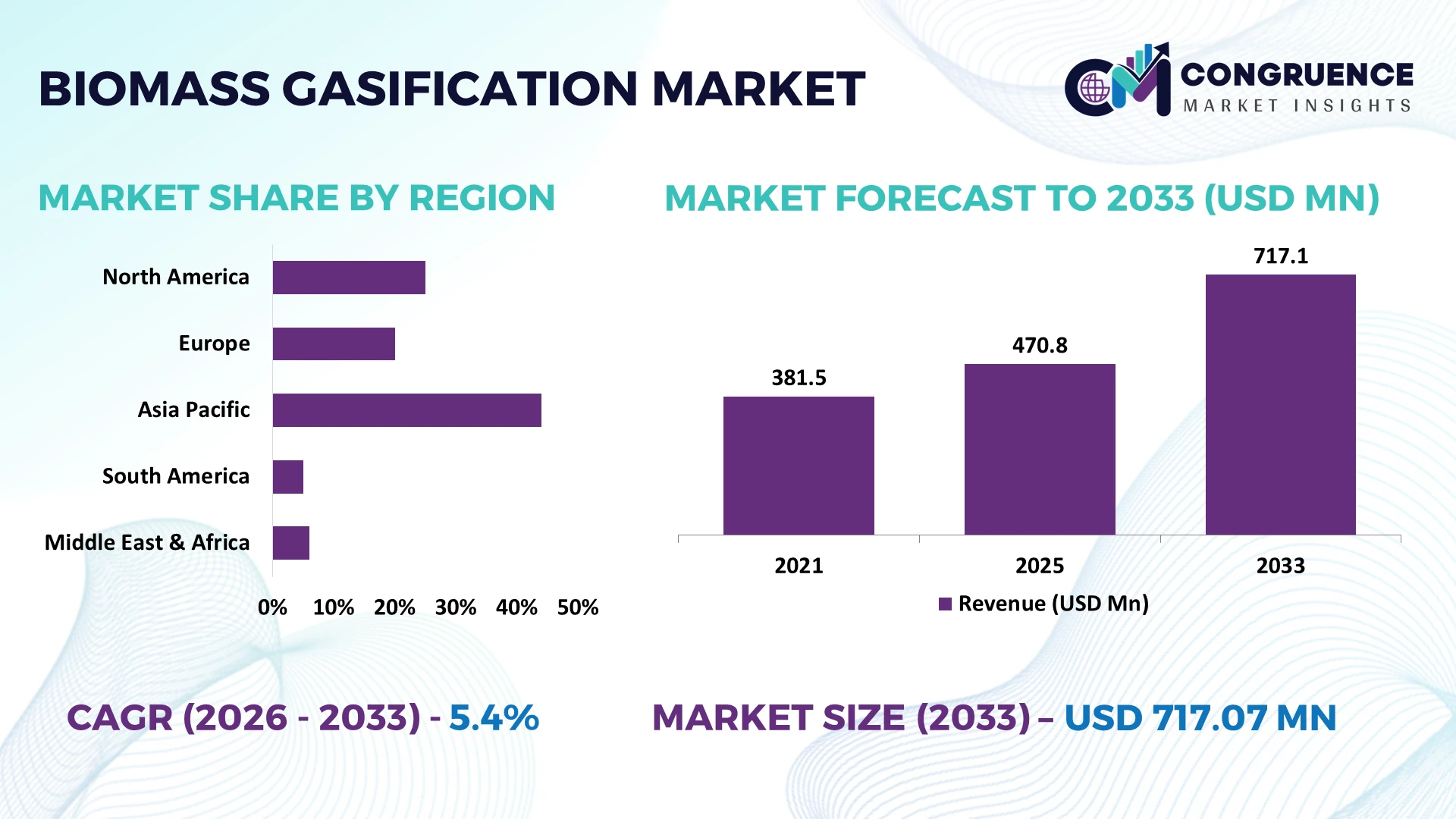
China holds a strategic position in Asia-Pacific through its industrial manufacturing base and clean-energy investments, while India offers opportunities in agricultural-residue utilization and decentralized power generation. India's biomass gasifier support program provides eligible projects using 100% gas engines with central financial assistance of ₹15,000 per kWe. In comparison, the US market emphasizes industrial heat and waste-wood conversion, while European projects prioritize emissions reduction and combined heat and power integration. These regional differences make feedstock availability, industrial offtake, and project economics decisive factors in market positioning.
Strategic implication: Prioritize regions where reliable biomass supply, industrial fuel demand, and policy incentives align, with investment screening focused on feedstock logistics, syngas quality, and plant utilization.
Market Size & Growth: Valued at USD 470.8 Million in 2025, projected to USD 717.07 Million by 2033 at 5.4% CAGR, driven by waste-to-energy mandates and industrial decarbonization targets.
Top Growth Drivers: Agricultural residue utilization programs, municipal solid waste diversion mandates, and industrial heat decarbonization demand across cement and steel sectors.
Short-Term Forecast: By 2027, fluidized-bed gasifier adoption expands as feedstock flexibility improvements reduce pre-processing requirements and enable mixed biomass and waste streams.
Emerging Technologies: Plasma gasification for hazardous waste, catalytic gasification enhancing syngas quality, and AI-enabled feedstock optimization improving gasifier efficiency and reducing tar formation.
Regional Leaders: China at 34.6% capacity share with 1,800 operational units, North America fastest-growing through DOE demonstration funding, and Europe driven by Germany and Scandinavian countries.
Consumer/End-User Trends: Electricity generation commands dominant application share; hydrogen production represents fastest-growing segment through biomass gasification and reforming pathways.
Pilot/Case Example: Raven SR received final approval for waste-to-hydrogen facility at West Contra Costa Sanitary Landfill processing 99 tonnes of organic waste daily into transportation-grade hydrogen.
Competitive Landscape: Andritz, Valmet, EQTEC, and Lurgi lead; Nexterra, Biomass Engineering, and SynTech Bioenergy compete on modular and distributed gasification platforms.
Regulatory & ESG Impact: EU Renewable Energy Directive II mandates sustainable biomass sourcing; US Renewable Fuel Standard provides credit pathways for cellulosic and advanced biofuels.
Investment & Funding: DOE Bioenergy Technologies Office funds gasification demonstration projects; private equity investment targets modular, distributed gasification platforms serving industrial heat applications.
Innovation & Future Outlook: Green hydrogen from biomass gasification, syngas fermentation for biofuel production, and integrated biorefinery models combining gasification with Fischer-Tropsch synthesis reshape market economics.
The biomass gasification market is gaining strategic relevance across industrial heating, decentralized electricity, combined heat and power, and syngas production for chemical applications. Agricultural residues, forestry waste, and wood-processing by-products offer feedstock opportunities where collection networks support consistent plant utilization. Advanced gas cleaning and automated process control are central to improving operating reliability, while hybrid solar-biomass systems offer additional flexibility. A Ghana-based study reported 62% overall combined cooling, heating, and power efficiency. Feedstock traceability, transport disruptions, and emissions compliance remain critical operational considerations, making supply-chain resilience and verified lifecycle emissions essential inputs to investment decisions.
Biomass gasification is becoming strategically important as manufacturers seek alternatives to fossil-fuel-based industrial heat, improve energy security, and convert agricultural and forestry residues into usable syngas. Its competitive value depends on feedstock consistency, gas-cleaning performance, and proximity to industrial consumers—not simply the availability of biomass. India's agricultural-residue management priorities and Europe's industrial decarbonization requirements are redirecting investment toward projects that combine reliable fuel sourcing with measurable emissions performance.
Technology selection is reshaping project economics. Modern gasifiers equipped with automated controls and advanced tar-removal systems offer tighter process control than conventional installations, although efficiency gains depend on feedstock moisture, gasifier design, and end-use configuration. Over the next two to three years, operators should prioritize measurable improvements in plant availability, feedstock conversion, and syngas quality rather than assume uniform performance gains across installations.
Deployment strategies also differ by geography. India benefits from agricultural-residue networks and decentralized industrial applications, while Germany emphasizes integration with industrial energy systems and stringent environmental requirements. A practical deployment model locates gasifiers near rice mills, sugar plants, or wood-processing facilities to reduce biomass transport costs and secure consistent feedstock. Developers are strengthening these models through industrial offtake agreements, equipment partnerships, and localized maintenance capabilities. Long-term competitive advantage will belong to companies that integrate feedstock procurement, gasification technology, and dependable energy delivery into a single operating model.
Industrial fuel substitution and agricultural-residue monetization are strengthening the commercial case for biomass gasification. India's biomass gasifier program specifies central assistance of ₹15,000 per kWe for eligible electricity projects using 100% gas engines, with assistance 20% higher for qualifying installations in designated special-category states and union territories. The policy improves project economics while encouraging localized energy infrastructure. Separately, industrial operators are prioritizing waste-heat recovery and syngas integration to reduce dependence on conventional fuels. Companies are responding through partnerships with agricultural processors, investments in gas-cleaning systems, and equipment customization. The decisive advantage lies in securing low-cost feedstock near continuous industrial demand.
Biomass quality directly affects conversion efficiency, equipment reliability, and delivered energy costs. Feedstock moisture above 30% can reduce gas yield and increase drying requirements, while moisture exceeding 40% significantly undermines thermal performance in many systems. Gasifier design also influences tar concentrations: reported levels range from approximately 1 g/Nm³ in downdraft systems to 100 g/Nm³ in updraft systems. These differences create substantial variation in downstream cleaning requirements and maintenance expenditure. In India, seasonal crop-residue availability and fragmented collection networks complicate continuous plant operation. Developers are mitigating exposure through moisture specifications, decentralized preprocessing, diversified feedstock contracts, and location-specific reactor selection. Feedstock quality control is a core profitability lever, not merely a procurement function.
Advanced gas cleaning creates opportunities to improve equipment reliability and expand syngas applications beyond electricity generation. Research on gasification systems reports catalytic and thermal tar-cracking efficiencies reaching 98–100% under suitable operating conditions, although whole-system performance varies. In India, rice mills, sugar factories, and agro-processing clusters offer opportunities to integrate residue conversion with onsite heat and power consumption. In Germany, industrial energy integration and emissions requirements strengthen the case for carefully engineered syngas applications. Companies can differentiate through catalyst development, automated process optimization, and modular gas-cleaning packages. A particularly valuable opportunity is retrofitting existing industrial sites with localized gasification systems that monetize residues while reducing purchased-fuel exposure.
Scaling biomass gasification requires tighter coordination between reactor design, feedstock preparation, gas purification, and downstream equipment. Conventional downdraft fixed-bed systems face significant scale-up constraints above approximately 1 MW in certain applications, while fuel flexibility remains limited by feedstock specifications. India's biomass gasifier support framework also requires qualifying projects to demonstrate operational performance, including a 60% plant load factor under the prescribed commissioning conditions. These requirements expose the gap between successful demonstrations and dependable commercial operation. Companies must invest in modular engineering, operator training, predictive maintenance, and standardized performance monitoring. Partnerships between technology suppliers and industrial offtakers can improve commissioning discipline. Sustained competitiveness depends on reproducible plant performance under variable real-world operating conditions.
Fixed-bed gasifiers accounted for approximately 48.7% of the global biomass gasification market's technology segment in 2025, supported by relatively simple reactor configurations, lower capital requirements, and established performance in small-to-medium installations. Downdraft gasifiers are suited to applications requiring lower-tar producer gas, while updraft designs offer advantages in thermal efficiency for selected heating applications. Crossdraft gasifiers retain relevance in specialized, compact installations. Entrained-flow systems serve more demanding high-temperature conversion and synthesis applications, where feed preparation and process integration influence capital decisions.
Fluidized-bed gasifiers represent the strongest technology shift, with a projected growth rate of 10.9% annually in one 2025–2033 industry forecast. Their improved mixing, temperature uniformity, and feedstock flexibility support larger industrial projects. Companies are increasing investment in reactor optimization, automated controls, and gas-cleaning integration. The strategic distinction is clear: fixed-bed systems retain an advantage in decentralized deployment, while fluidized-bed systems offer greater potential for industrial-scale diversification.
Electricity generation represented approximately 39.0% of the global biomass gasification market's application segment in 2025, reflecting established use of syngas in engines and distributed power systems. Agricultural processors, rural facilities, and industrial sites benefit from electricity production close to biomass sources, reducing dependence on external energy supply. Combined heat and power strengthens project economics by recovering useful thermal energy alongside electricity, while industrial heating provides an alternative for facilities with substantial process-heat requirements. Synthetic gas production and biofuel production extend the technology into higher-value chemical and fuel pathways.
Hydrogen production is emerging as a strategically important application, with one industry forecast projecting annual growth of 17.9% through 2033. Gasification-based hydrogen requires effective reforming, purification, and, where applicable, carbon capture. Companies are prioritizing demonstration projects, hydrogen offtake partnerships, and integrated gas-cleaning infrastructure. The investment implication is that electricity generation offers a more established deployment model, whereas hydrogen projects require stronger integration across process engineering, carbon management, and downstream demand.
Power generation remains a major end-user category because gasification systems supply electricity to utilities, independent power producers, and decentralized facilities. A single globally comparable 2025 market-share figure for the specified end-user categories is not consistently available; an unsupported percentage would distort investment decisions. Industrial users, including chemical manufacturing, pulp and paper, food processing, and cement manufacturing, purchase systems according to process-heat requirements, fuel substitution potential, and plant integration constraints. District heating operators prioritize dependable thermal output, while agricultural users emphasize onsite residue utilization and energy independence.
Industrial adoption is becoming more application-specific. Pulp and paper facilities can leverage wood residues, while food processors and agricultural enterprises can align gasifier operation with seasonal by-product availability. Cement manufacturers face different requirements for thermal integration and fuel consistency. Companies are responding with customized reactor configurations, service agreements, and partnerships with biomass suppliers. Investment priorities increasingly favor buyers with continuous energy consumption, secure feedstock access, and measurable fossil-fuel displacement potential. The strongest customer proposition combines predictable operating costs with a reliable supply of usable heat, electricity, or syngas.
Asia-Pacific accounted for the largest market share at an estimated 38% in 2025; however, the Middle East & Africa region is positioned to register comparatively strong growth as industrial decarbonization, agricultural-residue utilization, and decentralized energy projects gain traction.

Industrial integration and renewable-fuel diversification reshape deployment
North America's biomass gasification market benefits from established forestry supply chains, industrial wood residues, and demand for alternatives to fossil-fuel-based process heat. The United States and Canada provide contrasting advantages: the US offers a large industrial customer base and technology-development ecosystem, while Canada benefits from forestry residues and pulp-and-paper infrastructure. Project economics depend on delivered feedstock costs, gas-cleaning performance, and the ability to integrate syngas with existing boilers, engines, and thermal systems. Developers are increasingly evaluating modular systems for industrial facilities rather than relying exclusively on standalone electricity generation. This shift places greater emphasis on site-specific engineering, maintenance support, and long-term fuel contracts. Investment decisions favor projects that demonstrate reliable year-round operation and measurable reductions in conventional fuel consumption.
United States Market Outlook: The United States benefits from substantial wood-processing capacity, agricultural residues, and established industrial engineering capabilities. Biomass gasification developers can target pulp and paper mills, food-processing facilities, and industrial heat users with consistent energy demand. The commercial advantage lies in integrating gasification with existing plant infrastructure, reducing the need for entirely new energy systems. Federal clean-energy incentives and state-level policies influence project economics, making eligibility assessment and documented emissions performance important components of investment planning.
Industrial decarbonization and established CHP infrastructure drive adoption
Europe benefits from mature biomass-energy infrastructure, industrial heat demand, and stringent environmental requirements that favor efficient conversion technologies. Germany, Finland, Sweden, and Austria have established expertise in biomass conversion, district heating, and combined heat and power integration. IEA Bioenergy's 2025 status assessment identifies more than 1,700 operational small-scale gasification-based CHP units across Europe, demonstrating the region's deployment maturity. However, sustainable feedstock sourcing and biomass import exposure influence project economics. The European Union's Renewable Energy Directive and industrial decarbonization policies encourage residue-based pathways, while emissions monitoring and fuel traceability increasingly shape procurement. Technology suppliers are prioritizing higher syngas quality, automated controls, and integration with existing industrial energy systems. The strategic advantage lies in converting established deployment experience into dependable, compliant, and commercially replicable installations.
Germany Market Outlook: Germany combines industrial engineering capabilities, technical research institutions, and demand from manufacturing facilities seeking alternatives to fossil-based process heat. Biomass gasification projects can serve industrial CHP, thermal applications, and synthetic fuel development. German engineering firms benefit from expertise in process integration and emissions control, while project developers must account for permitting requirements and sustainable feedstock availability. Investments in modular systems and advanced gas cleaning can improve deployment flexibility across industrial sites.
Manufacturing scale and agricultural residues shape deployment priorities
Asia-Pacific leads the global biomass gasification market, supported by manufacturing activity, agricultural residues, and demand for decentralized energy. The region accounted for approximately 40.7% of global market share in 2025 in one industry estimate. China benefits from its industrial manufacturing capacity and established biomass-power infrastructure, while India offers substantial opportunities through rice husks, sugarcane residues, and other agricultural by-products. Japan and South Korea contribute advanced process engineering and industrial energy technologies. Deployment models differ across these markets: large industrial projects prioritize continuous operation, whereas smaller installations emphasize local feedstock utilization and energy access. Companies are adapting equipment to diverse biomass characteristics, developing local service networks, and partnering with agricultural processors. The strongest regional advantage is the ability to align biomass availability with concentrated industrial energy demand.
China Market Outlook: China benefits from established biomass-power infrastructure, large industrial energy users, and domestic equipment manufacturing capabilities. Its industrial clusters support opportunities for syngas applications in thermal processing, distributed electricity, and chemical production. Developers are positioned to scale projects where feedstock collection, grid access, and industrial offtake can be coordinated. Equipment suppliers that improve conversion consistency across variable agricultural and forestry residues can strengthen their competitive position.
Agro-industrial residues create localized conversion opportunities
South America's biomass gasification market is supported by sugarcane processing, forestry operations, agricultural production, and expanding interest in industrial energy diversification. Brazil occupies a strategically important position because its sugar and ethanol industries generate substantial quantities of bagasse and other organic residues. These materials can support onsite energy systems when seasonal supply is matched with industrial consumption. Argentina and Chile offer additional opportunities linked to agricultural processing and forestry by-products. However, project economics remain sensitive to collection distances, moisture content, transport infrastructure, and the availability of qualified service providers. Developers are increasingly evaluating installations close to mills and processing facilities to minimize logistics costs. Equipment manufacturers can gain an advantage through feedstock-specific reactor designs and partnerships with established agro-industrial operators.
Brazil Market Outlook: Brazil offers a strong industrial base for residue-based energy conversion through sugar mills, ethanol producers, and forestry companies. The country's established bioenergy ecosystem provides potential partners for feedstock procurement, engineering, and onsite energy integration. Gasification suppliers can target facilities seeking to improve residue utilization and reduce exposure to purchased fossil fuels. Commercial deployment depends on matching reactor design to seasonal feedstock characteristics and securing dependable demand for generated heat, electricity, or syngas.
Distributed energy and waste valorization define investment priorities
The Middle East and Africa market remains comparatively emerging, with opportunities concentrated in agricultural processing, industrial waste management, and decentralized energy supply. South Africa offers a base of industrial energy users and agricultural residues, while Kenya and other African markets present opportunities for localized energy systems near agro-processing facilities. Gulf countries are evaluating waste conversion and industrial decarbonization alongside broader energy diversification programs. However, limited feedstock aggregation infrastructure, financing constraints, and uneven technical-service coverage affect project deployment. Developers are responding with modular installations, local engineering partnerships, and feedstock-specific system configurations. Waste-to-energy integration can improve project economics when residues have an established disposal cost or a reliable industrial use. Commercial success depends on securing an identifiable feedstock stream and energy customer before equipment procurement.
South Africa Market Outlook: South Africa offers opportunities across agricultural processing, forestry, and industrial energy applications. Its established manufacturing base creates potential demand for onsite heat and electricity, particularly where biomass residues are available near production facilities. Developers must evaluate feedstock seasonality, competing biomass uses, and electricity-system constraints before committing capital. Partnerships with agricultural processors and industrial energy users can strengthen project bankability and support long-term equipment servicing.
The biomass gasification market combines global engineering groups, specialist gasifier manufacturers, and regional project developers. Valmet and ANDRITZ compete through industrial process integration and biomass-handling expertise, while EQTEC focuses on advanced gasification systems and syngas applications. Ankur Scientific and Spanner Re² target decentralized and industrial installations, competing on configuration flexibility, operating reliability, and local service support. The market remains fragmented, and a defensible combined market-share figure for the five largest players is not publicly established. Assigning a percentage would create false precision. Competition instead centers on delivered project cost, feedstock flexibility, gas-cleaning performance, and commissioning reliability. For procurement planning, a 5–10% reduction in lifecycle operating costs and a 10% improvement in equipment availability are useful evaluation targets, not verified industry-wide results. Established suppliers strengthen positions through engineering partnerships, equipment integration, and service networks, while smaller specialists differentiate through modular designs and application-specific customization. Entry barriers include proven operating references, financing requirements, emissions compliance, and reliable after-sales support. Winning requires demonstrable plant performance, dependable feedstock integration, and competitive lifecycle economics—not equipment price alone.
Valmet
ANDRITZ
EQTEC
Ankur Scientific Energy Technologies
Mitsubishi Heavy Industries
Burkhardt GmbH
Spanner Re²
Xylowatt
PRM Energy Systems
SynTech Bioenergy
ALL Power Labs
Thyssenkrupp Industries India
Advanced gas cleaning is becoming a decisive technology for commercial deployment. A 2025 pilot-scale fluidized-bed study achieved 82.8–98.0% tar-removal efficiency using an iron-based catalyst derived from bauxite residue. Compared with conventional untreated syngas, this substantially reduces contaminants that damage downstream equipment. Operators benefit from improved gas quality, while equipment suppliers gain opportunities to deliver integrated gasification and purification packages.
Fluidized-bed gasifiers, particularly circulating and bubbling configurations, support larger industrial applications through improved mixing and temperature control. A 2025 two-stage pilot study reported 70.8% cold-gas efficiency and complete tar removal under its tested conditions. These results demonstrate technical potential rather than universal commercial performance. Fixed-bed systems retain advantages in simpler, smaller installations, while advanced reactor designs suit projects requiring greater feedstock flexibility and tighter process control.
Digital monitoring, automated feed preparation, catalytic conversion, and integrated hydrogen or biomethanol production are shaping investment priorities. Current adoption is strongest in established small-scale European gasification-based CHP installations, with more than 1,700 operational units reported in 2025. During 2026–2028, suppliers combining reliable reactor performance with low-contaminant syngas and modular integration will strengthen their position in industrial heat, renewable fuels, and distributed energy markets.
The Global Biomass Gasification Market Report evaluates industry structure, technology adoption, competitive positioning, and commercial opportunities across 2026–2033. Type coverage includes fixed-bed, fluidized-bed, entrained-flow, downdraft, updraft, and crossdraft gasifiers. Application analysis spans electricity generation, combined heat and power, industrial heating, synthetic gas production, biofuel production, and hydrogen production. End-user coverage includes power generation, chemical manufacturing, pulp and paper, food processing, cement manufacturing, agriculture, and district heating.
Regional analysis examines North America, Europe, Asia-Pacific, South America, and the Middle East and Africa, highlighting country-specific deployment conditions, infrastructure readiness, industrial feedstock availability, and policy frameworks. The report assesses syngas purification, catalytic tar removal, process automation, modular plant configurations, and emerging biochar and renewable-fuel pathways. Competitive profiling covers 10–14 major industry participants, supporting supplier evaluation, investment screening, geographic expansion, technology selection, and strategic planning based on operational performance, feedstock security, and evolving end-user requirements.
| Report Attribute/Metric | Report Details |
|---|---|
Market Revenue in 2025 | USD 470.8 Million |
Market Revenue in 2033 | USD 717.07 Million |
CAGR (2026 - 2033) | 5.4% |
Base Year | 2025 |
Forecast Period | 2026 - 2033 |
Historic Period | 2021 - 2025 |
Segments Covered | By Type
By Application
By End-User
|
Key Report Deliverable | Revenue Forecast, Growth Trends, Market Dynamics, Segmental Overview, Regional and Country-wise Analysis, Competition Landscape |
Region Covered | North America, Europe, Asia-Pacific, South America, Middle East, Africa |
Key Players Analyzed | Valmet, ANDRITZ, EQTEC, Ankur Scientific Energy Technologies, Mitsubishi Heavy Industries, Burkhardt GmbH, Spanner Re², Xylowatt, PRM Energy Systems, SynTech Bioenergy, ALL Power Labs, Thyssenkrupp Industries India |
Customization & Pricing | Available on Request (10% Customization is Free) |




