
Reports
The Global Biodegradable Grass Seed Mat Market was valued at USD 460.2 Million in 2025 and is anticipated to reach a value of USD 897.0 Million by 2033 expanding at a CAGR of 8.7% between 2026 and 2033. Growth is driven by stricter erosion-control regulations, expanding roadside revegetation projects, and increasing adoption of biodegradable landscaping materials across infrastructure and environmental restoration programs.
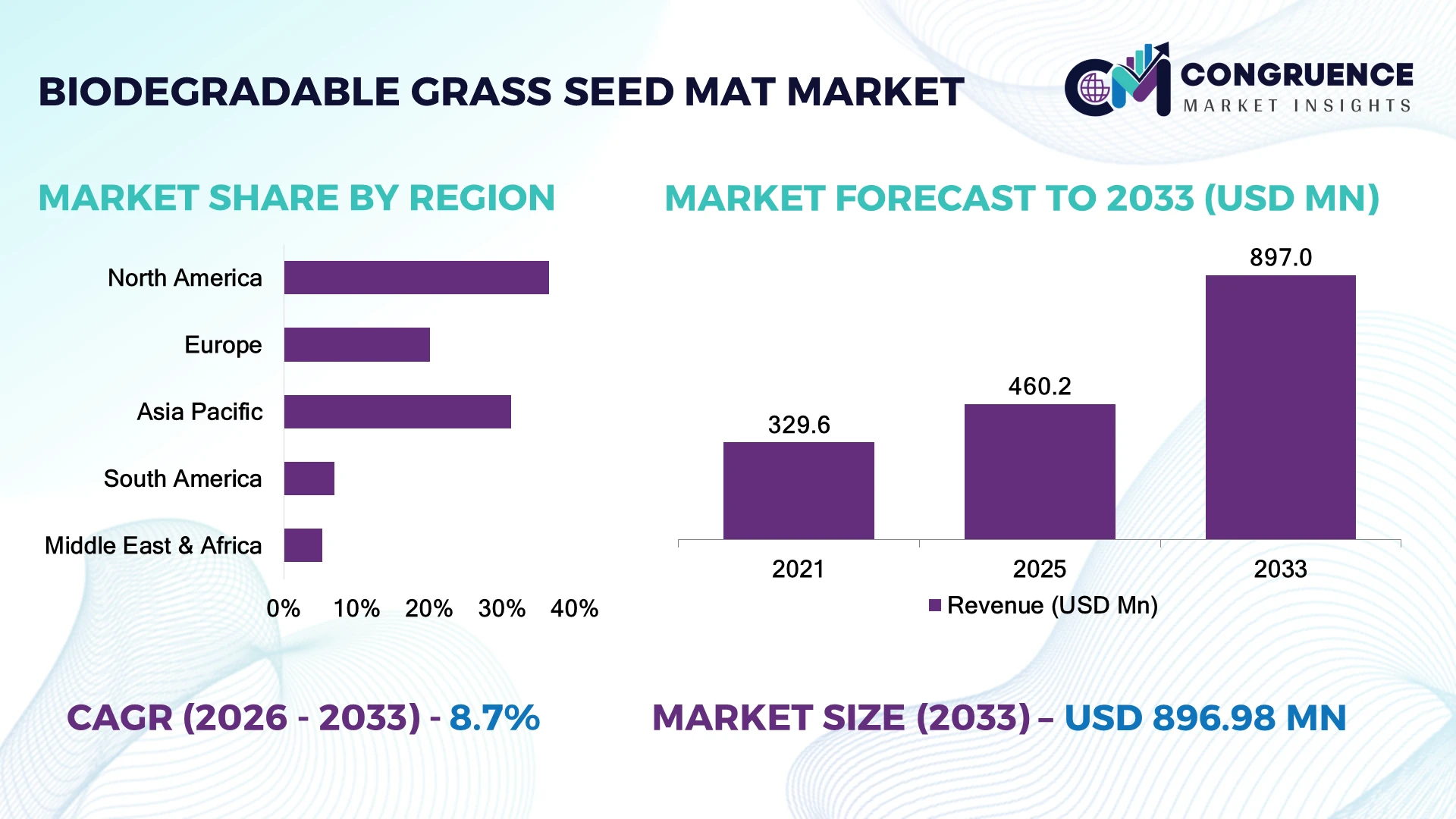
The United States leads the market with an estimated 31% share, supported by large-scale highway rehabilitation, watershed restoration, and sustainable landscaping initiatives, while over 65% of state-level erosion control projects increasingly specify biodegradable ground-cover solutions. Compared with Germany, where ecological restoration standards are expanding steadily, the U.S. benefits from broader infrastructure funding following post-2021 public investment programs and stronger adoption across transportation and municipal sectors. Rising environmental compliance requirements and resilient supply chains continue strengthening domestic manufacturing capacity.
Strategic investment should prioritize certified biodegradable materials, scalable manufacturing, and infrastructure-focused distribution partnerships to capture long-term procurement opportunities.
Market Size & Growth: USD 460.2 Million (2025) to USD 897.0 Million (2033), CAGR 8.7%, driven by sustainable erosion-control deployment.
Top Growth Drivers: Road infrastructure 38%, ecological restoration 29%, municipal landscaping 24%.
Short-Term Forecast: By 2028, installation efficiency improves 18% through pre-seeded biodegradable mat systems.
Emerging Technologies: Natural-fiber composites, hydroseeding integration, bio-based binders improve germination consistency by 15%.
Regional Leaders: North America, Europe, and Asia-Pacific exceed USD 620 Million combined by 2033 with infrastructure-led adoption.
Consumer/End-User Trends: Around 61% of municipal buyers prioritize biodegradable landscaping products over synthetic alternatives.
Pilot/Case Example: 2025 roadside restoration projects reduced soil erosion by approximately 35% using layered seed mats.
Competitive Landscape: Top supplier group controls nearly 42% through product innovation and contractor partnerships.
Regulatory & ESG Impact: Plastic reduction initiatives increased biodegradable procurement by nearly 28% across public projects.
Investment & Funding: More than USD 180 Million supports manufacturing expansion and sustainable fiber processing.
Innovation & Future Outlook: Smart moisture-retention layers enhance establishment rates by nearly 20%, supporting climate-resilient landscaping.
The Biodegradable Grass Seed Mat Market is expanding across highway embankments, slope stabilization, mining reclamation, and urban landscaping where rapid vegetation establishment is operationally critical. Multi-layer natural fiber mats with enhanced moisture retention improve germination performance by nearly 18%, while stricter environmental procurement standards accelerate adoption of compostable materials, positioning sustainable erosion-control technologies at the center of future infrastructure development.
The biodegradable grass seed mat market has become strategically important as governments, infrastructure developers, and environmental contractors increasingly replace synthetic erosion-control products with sustainable alternatives. Infrastructure modernization, stricter environmental procurement standards, and land restoration mandates are reshaping purchasing priorities, encouraging manufacturers to expand biodegradable product portfolios and strengthen regional production capabilities. Supply-chain localization is also reducing dependence on imported natural fibers while improving project delivery reliability.
Advanced multi-layer biodegradable mats incorporating moisture-retention fibers and optimized seed distribution improve germination success by approximately 20% compared with conventional loose-seeding methods while reducing installation labor by nearly 25%. North America continues leading infrastructure deployment, whereas Asia-Pacific is rapidly expanding production capacity to support transportation corridors, watershed restoration, and urban greening initiatives. Over the next two to three years, contractor adoption of integrated erosion-control systems is expected to exceed 60% across newly specified public restoration projects.
Manufacturers are partnering with civil engineering contractors and landscape developers to introduce application-specific mat configurations for highways, mining rehabilitation, and flood-control projects. Companies investing in biodegradable material innovation, localized manufacturing, and performance-certified products will secure stronger competitive positioning as sustainable land restoration becomes a core requirement across public and private infrastructure development.
Government-funded erosion control and ecological restoration programs are rapidly shifting toward biodegradable ground stabilization materials, making grass seed mats a preferred solution. Approximately 64% of public landscaping tenders now prioritize biodegradable products, while installation time is reduced by nearly 25% compared with conventional hydroseeding in suitable terrain. In the United States, transportation agencies are expanding roadside revegetation standards following increased resilience investments, strengthening long-term procurement pipelines. This regulatory shift improves project consistency, lowers post-installation maintenance, and expands recurring demand. Manufacturers are responding through capacity expansion, natural fiber innovation, and partnerships with civil engineering contractors. A notable strategic advantage lies in integrating seed, mulch, and erosion-control layers into a single deployable system, reducing labor dependency while improving vegetation establishment across infrastructure projects.
The market continues facing structural pressure from fluctuating prices and seasonal availability of coir, jute, and other biodegradable raw materials. Raw material costs have fluctuated by approximately 18% over recent procurement cycles, while transportation expenses remain nearly 12% above pre-disruption benchmarks in several sourcing corridors. India and Sri Lanka, key natural fiber suppliers, continue experiencing weather-related production variability that affects manufacturing schedules and delivery reliability. These disruptions compress margins and complicate long-term pricing for infrastructure contracts. Companies are mitigating exposure through supplier diversification, localized fiber processing, and multi-year procurement agreements. Strategic investment in alternative cellulose-based substrates is also improving raw material flexibility while reducing dependence on single-origin agricultural feedstocks.
Advanced biodegradable composites incorporating bio-based polymers, precision seed layering, and moisture-retention technologies are creating high-value product opportunities beyond conventional landscaping. Enhanced mat structures improve germination efficiency by approximately 20% while reducing irrigation requirements by nearly 15%, making them attractive for water-stressed environments. Australia and the United Arab Emirates are expanding ecological restoration initiatives that increasingly favor low-maintenance revegetation technologies. Manufacturers are investing in R&D, collaborating with environmental engineering firms, and developing application-specific products for mining reclamation, solar farms, and highway embankments. A significant emerging opportunity lies in integrating beneficial microbial treatments within biodegradable mats to accelerate vegetation establishment and improve long-term soil regeneration without increasing installation complexity.
Achieving consistent field performance across diverse climatic and soil conditions remains a critical execution challenge. Germination success can vary by more than 22% between arid and temperate environments, while degradation rates differ by nearly 30% depending on moisture exposure and soil composition. Large infrastructure projects in Canada and Australia require products capable of maintaining structural integrity during transport while decomposing predictably after vegetation establishment. Manufacturers must balance durability, biodegradation timing, and seed viability without compromising environmental compliance. Companies are addressing these challenges through climate-specific product formulations, expanded field validation programs, and partnerships with research institutions. Long-term competitiveness depends on delivering standardized performance across varying environmental conditions while maintaining scalable manufacturing efficiency.
Integrated Natural Fiber Systems Multi-layer biodegradable mats combining seed, mulch, and erosion-control fibers are replacing conventional installation methods. Adoption has increased by approximately 27%, reducing installation labor by nearly 24% while improving vegetation establishment rates by about 18%. Manufacturers are scaling integrated production lines to meet infrastructure and ecological restoration specifications.
Climate-Resilient Material Innovation Manufacturers are introducing advanced coir-cellulose blends with improved moisture retention and controlled biodegradation. Water consumption during early establishment declines by nearly 16%, while survival rates improve approximately 19%. Australia's expanding climate-resilient restoration initiatives are accelerating commercialization of durable biodegradable formulations tailored for extreme environmental conditions.
Mechanized Deployment Expansion Contractors increasingly deploy machine-compatible grass seed mats for highways, utility corridors, and slope stabilization projects. Installation productivity improves nearly 30%, while project completion times decline around 17%. Equipment manufacturers and material suppliers are collaborating to standardize deployment systems that reduce labor shortages and improve operational efficiency.
Specialized Restoration Applications Product development is shifting toward mining reclamation, renewable energy sites, and watershed rehabilitation rather than general landscaping. Approximately 34% of new product launches target application-specific performance, including enhanced root reinforcement and extended moisture retention. Companies are expanding strategic partnerships with environmental engineering firms to deliver customized ecological restoration solutions for large infrastructure developments.
Natural fiber grass seed mats accounted for approximately 58% of the market in 2025, supported by widespread adoption in erosion control, roadside revegetation, and municipal landscaping projects. Coir-based and straw-based mats remain the preferred solutions because they offer high moisture retention, gradual biodegradation, and strong root stabilization while meeting environmental compliance requirements. Compostable polymer-based mats represent the fastest-growing segment as adoption accelerates across premium landscaping and infrastructure projects where longer service life and controlled degradation improve installation performance. Hybrid fiber composites continue gaining traction for demanding slope stabilization, while paper-based mats remain a cost-effective solution for residential lawn establishment. Manufacturers are expanding bio-based material portfolios, optimizing fiber blends, and investing in higher-performance biodegradable formulations to improve durability without compromising environmental performance.
Growing investment in engineered biodegradable materials is shifting competitive priorities from basic erosion protection toward lifecycle performance and installation efficiency. Companies are strengthening product portfolios through material innovation, regional manufacturing expansion, and collaborations with landscaping contractors, creating differentiated solutions for infrastructure and environmental restoration projects. Premium biodegradable composite mats are increasingly attracting higher-value contracts despite representing a smaller share of overall demand, highlighting shifting investment priorities across sustainable landscape development.
Industry assessments released during 2025 indicated that more than 60% of new erosion-control specifications for public landscaping projects in developed markets included biodegradable natural-fiber solutions, reflecting stronger sustainability procurement standards.
Roadside landscaping and erosion control represented the largest application, contributing approximately 42% of market demand in 2025 due to extensive deployment across highways, railway embankments, flood-control projects, and public infrastructure. Residential landscaping is emerging as the fastest-growing application as homeowners increasingly adopt pre-seeded biodegradable mats for faster lawn establishment and lower maintenance. Commercial landscaping continues expanding with corporate campuses and urban green spaces, while sports fields and golf courses increasingly utilize premium biodegradable mats for uniform turf establishment and rapid surface recovery. Manufacturers are enhancing installation convenience, improving seed retention performance, and developing customized products for different climate conditions and vegetation requirements.
Application diversity is expanding beyond traditional landscaping into ecological restoration, stormwater management, and biodiversity enhancement initiatives. Suppliers are strengthening contractor partnerships, expanding regional distribution, and offering project-specific product configurations, enabling them to secure larger infrastructure contracts while simultaneously addressing rising residential demand for sustainable vegetation establishment. Business investment is increasingly focused on specialized application-specific product development rather than standardized offerings.
Industry organizations monitoring green infrastructure projects reported during 2026 that biodegradable vegetation establishment products were incorporated into more than 55% of newly approved roadside ecological restoration programs across several developed economies.
Government agencies represented the largest end-user segment with an estimated 39% market share in 2025, supported by continuous investments in highway construction, slope stabilization, flood-control infrastructure, and environmental restoration. Landscaping contractors are projected to register the fastest expansion as municipalities and commercial developers increasingly outsource large-scale vegetation establishment projects. Agricultural enterprises continue adopting biodegradable mats for soil conservation, while residential homeowners and sports facility operators remain important demand contributors for lawn establishment and surface rehabilitation. Manufacturers are introducing customized product portfolios, contractor-focused training programs, and volume-based pricing strategies to strengthen relationships with institutional buyers while expanding penetration into private landscaping markets.
Demand is steadily shifting toward end-users seeking lifecycle cost savings rather than the lowest upfront pricing. Companies are increasingly differentiating through technical support, installation guidance, and project-specific product recommendations, strengthening customer retention across infrastructure and commercial landscaping contracts while positioning themselves for long-term procurement opportunities.
Enterprise landscaping surveys conducted during 2026 found that over 52% of professional contractors preferred biodegradable vegetation establishment products for publicly funded green infrastructure projects because they reduced post-installation maintenance requirements while supporting environmental compliance.
North America accounted for the largest market share at 36.4%in 2025 however, Asia-Pacific is expected to register the fastest growth, expanding at a CAGR of 9.8% between 2026 and 2033.
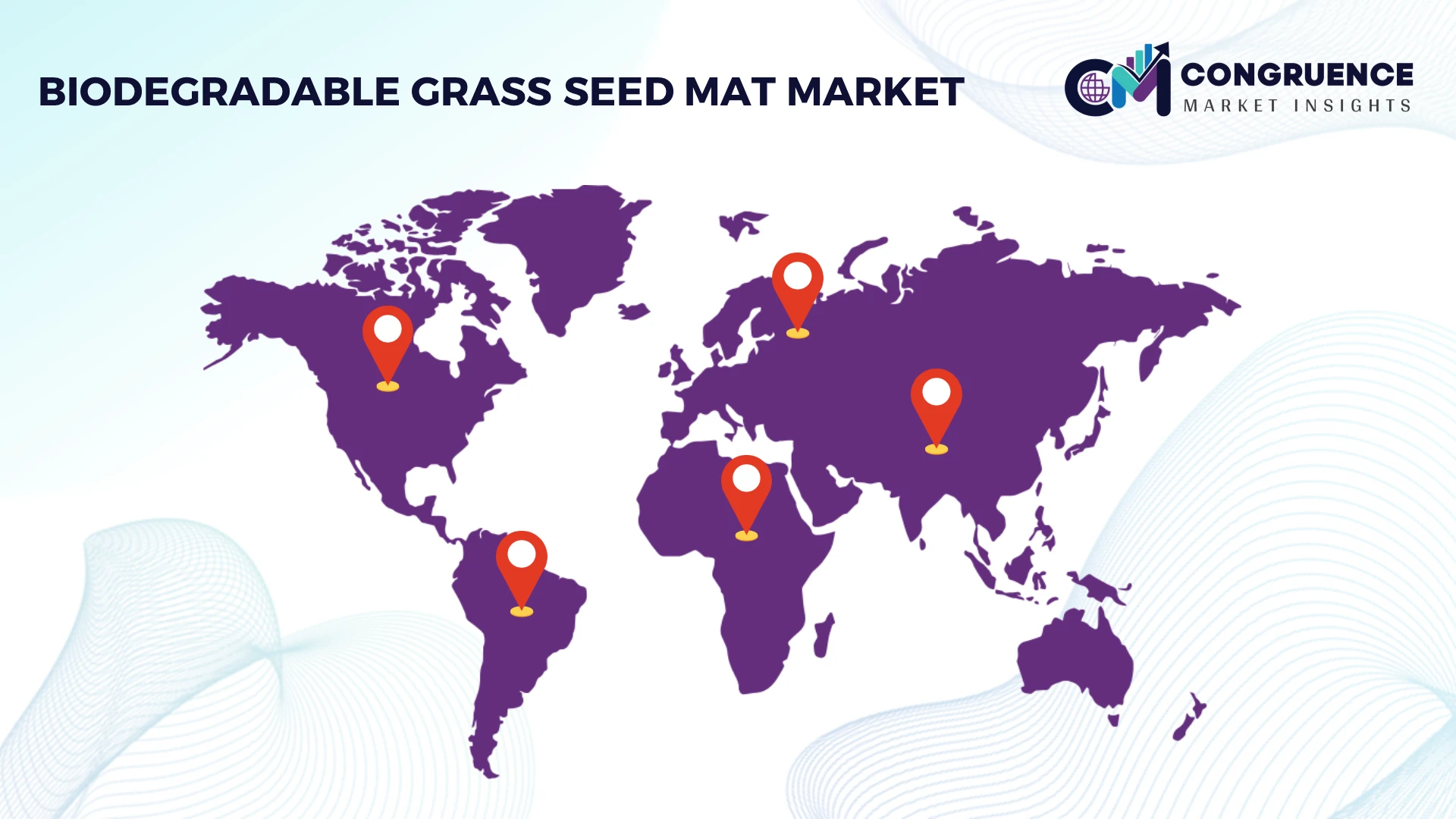
Infrastructure Rehabilitation Accelerates Sustainable Erosion Control Adoption
North America maintains its leadership through extensive deployment of biodegradable erosion control systems across highway expansion, watershed restoration, utility corridors, and public landscaping projects. Federal and state infrastructure rehabilitation programs continue prioritizing environmentally compliant slope stabilization products, increasing demand for natural-fiber seed mats. The region contributes nearly 38% of global commercial landscaping deployments, supported by mature contractor networks and established environmental procurement standards. More than 65% of large transportation revegetation contracts now specify biodegradable erosion-control materials, encouraging manufacturers to expand domestic production and strengthen distribution partnerships. Companies are introducing application-specific mat configurations, improving installation efficiency, and integrating native seed solutions to enhance project performance while reducing maintenance requirements.
U.S. Market Outlook: The United States remains the region's largest market because of continuous investments in transportation infrastructure, ecological restoration, and stormwater management projects. State transportation departments increasingly incorporate biodegradable vegetation systems into highway rehabilitation specifications, while commercial landscaping firms continue expanding sustainable product adoption. More than 70% of large-scale roadside restoration projects utilize biodegradable erosion-control solutions, reinforcing the country's leadership in product deployment, contractor specialization, and environmental landscaping innovation.
Circular Landscaping Policies Strengthen Product Adoption
Europe continues expanding biodegradable grass seed mat utilization through strict environmental regulations, biodiversity restoration initiatives, and sustainable public landscaping investments. Municipal authorities increasingly replace synthetic erosion-control products with biodegradable alternatives across riverbanks, rail corridors, and urban redevelopment projects. Approximately 58% of publicly funded ecological landscaping contracts now prioritize bio-based vegetation establishment materials. Manufacturers are expanding natural-fiber processing capacity and collaborating with environmental engineering firms to deliver region-specific erosion-control solutions that comply with evolving sustainability standards while improving vegetation establishment performance.
Germany Market Outlook: Germany leads regional adoption through advanced environmental engineering capabilities, extensive transportation modernization projects, and strong regulatory support for biodegradable landscaping materials. Road expansion, flood mitigation, and ecological restoration programs continue driving procurement of natural-fiber erosion-control systems. Contractor adoption has increased significantly as municipalities prioritize sustainable landscape rehabilitation, while domestic manufacturers focus on high-performance biodegradable materials with enhanced durability under diverse climatic conditions.
Rapid Infrastructure Expansion Drives Volume Demand
Asia-Pacific represents the fastest-expanding regional market as governments accelerate railway construction, highway development, watershed restoration, and urban greening programs. Large-scale infrastructure expansion creates sustained demand for economical biodegradable erosion-control products across construction corridors and environmental rehabilitation projects. Nearly 45% of newly developed transportation corridors in major economies now integrate vegetation stabilization measures during construction planning. Manufacturers continue investing in higher-capacity production facilities, localized raw material sourcing, and automated processing technologies to support growing domestic and export demand while reducing production costs.
China Market Outlook: China dominates regional demand through extensive infrastructure development, ecological restoration initiatives, and large-scale afforestation programs. Provincial governments increasingly integrate biodegradable erosion-control materials into transportation and watershed rehabilitation projects. Domestic manufacturers benefit from integrated natural-fiber supply chains and expanding production capacity, enabling competitive pricing while supporting large-volume public infrastructure contracts and international market expansion.
Environmental Restoration Supports Commercial Expansion
South America is experiencing increasing adoption of biodegradable grass seed mats across mining rehabilitation, highway stabilization, agricultural conservation, and watershed restoration activities. Infrastructure modernization and environmental recovery initiatives continue strengthening commercial demand despite varying procurement capacities across countries. Around 48% of newly approved ecological restoration projects now specify biodegradable vegetation establishment materials for erosion management. Companies are expanding distributor partnerships, improving contractor training, and introducing climate-adapted products designed for tropical rainfall conditions and challenging terrain, supporting broader commercial acceptance.
Brazil Market Outlook: Brazil represents the largest regional market owing to extensive road infrastructure, mining rehabilitation requirements, and growing investment in environmental restoration. Public and private land recovery initiatives increasingly utilize biodegradable vegetation systems to stabilize disturbed landscapes. Domestic distributors continue expanding technical support services while manufacturers introduce products optimized for high-rainfall environments, improving project success rates and strengthening long-term market penetration.
Land Rehabilitation Investments Expand Sustainable Landscaping
The Middle East & Africa market is advancing through government-supported land rehabilitation, urban greening initiatives, and infrastructure modernization programs requiring sustainable vegetation establishment solutions. Water conservation priorities and desert landscaping projects are increasing demand for biodegradable mats capable of improving seed germination while minimizing soil erosion. Approximately 35% of newly developed public landscaping projects now integrate biodegradable ground-cover materials. Suppliers are strengthening regional partnerships and expanding localized inventories to support contractors executing large-scale environmental rehabilitation and infrastructure developments.
Saudi Arabia Market Outlook: Saudi Arabia leads regional growth through ambitious landscape development, transport infrastructure expansion, and environmental restoration initiatives aligned with long-term national development objectives. Large public landscaping projects increasingly prioritize biodegradable vegetation solutions that improve soil stabilization under arid conditions. Companies are expanding regional distribution networks and technical advisory services to support contractors implementing sustainable land rehabilitation across infrastructure and urban development projects.
The market is characterized by competition between global erosion-control specialists including American Excelsior Company, Western Green, BonTerra Corporation, Profile Products, and Propex, versus regional manufacturers emphasizing cost efficiency and localized distribution. The top five players collectively account for approximately 48% of global demand, supported by broad product portfolios and contractor relationships. Competition centers on fiber technology, product longevity, installation performance, and regulatory compliance rather than price alone. Premium natural-fiber solutions typically command 12–18% higher pricing, while localized production reduces logistics costs by nearly 15%. Companies compete through manufacturing expansion, distributor partnerships, proprietary biodegradable formulations, and vertically integrated fiber sourcing to improve supply resilience. The competitive landscape is shifting toward certified plastic-free and bio-based erosion products as environmental procurement standards tighten. New entrants face barriers from stringent infrastructure specifications, long qualification cycles, and established contractor networks. Winning requires validated product performance, reliable regional supply, technical support, and sustainable material innovation.
American Excelsior Company
Western Green
BonTerra Corporation
Profile Products LLC
Propex Operating Company LLC
East Coast Erosion Control
Greenfix Soil Stabilisation & Erosion Control Ltd.
Terrafix Geosynthetics Inc.
Maccaferri
GeoSolutions, Inc.
ECBVerdyol
Straw Innovations Ltd.
Material innovation is transforming biodegradable grass seed mats through engineered coir fibers, advanced straw composites, biodegradable bio-polymers, and optimized fiber bonding technologies. Natural-fiber composite structures improve moisture retention by approximately 22% while increasing seed germination efficiency by nearly 18% compared with conventional straw blankets. Around 62% of newly introduced premium products now incorporate multi-layer biodegradable reinforcement to enhance erosion resistance and vegetation establishment. Manufacturers adopting engineered natural fibers benefit from improved product consistency and stronger acceptance in infrastructure specifications.
Emerging technologies emphasize biodegradable net-free constructions, precision seed integration, and bio-based binding systems that replace conventional synthetic mesh. Compared with legacy polypropylene-reinforced blankets, advanced fully biodegradable systems reduce post-installation material recovery requirements by approximately 30% while improving environmental compliance. Companies specializing in environmentally certified erosion-control products gain competitive advantages as transportation authorities increasingly prioritize plastic-free solutions. Digital manufacturing and automated fiber distribution also improve production uniformity by nearly 15%, supporting consistent field performance.
Between 2026 and 2028, smart bio-material engineering, climate-specific fiber formulations, and regenerative natural materials will reshape product development. Manufacturers are investing in customized vegetation establishment systems optimized for regional rainfall intensity, soil conditions, and restoration objectives. Early adopters integrating sustainable raw-material sourcing, automated production, and application-specific engineering will strengthen competitive positioning by delivering higher installation efficiency, longer functional performance, and greater compliance with evolving environmental procurement requirements.
September 2024 American Excelsior Company expanded production capacity through a 50,000-square-foot manufacturing expansion supporting biodegradable erosion control blanket production, strengthening North American supply availability and reducing delivery lead times for infrastructure restoration projects.
October 2024 North American Green received updated ASTM D6453 certification for Curlex Excelsior Blanket III, validating performance on slopes up to 2:1 and strengthening product qualification for transportation, infrastructure, and environmental restoration projects.
June 2024 East Coast Erosion introduced the Excel BioD Coir Blanket featuring enhanced UV resistance and approximately 24-month functional longevity for demanding tropical applications, expanding high-performance biodegradable solutions for erosion control and revegetation.
March 2024 BonTerra Corporation showcased an expanded biodegradable erosion blanket portfolio, including new SlopeTopper variants at the International Erosion Control Association Expo, broadening product coverage across restoration and slope stabilization applications. Source: International Erosion Control Association Conference Report.
The report provides comprehensive analysis of biodegradable grass seed mats across product types, applications, end-users, and major regional markets between 2026 and 2033. It evaluates natural-fiber, paper-based, hybrid, and compostable material technologies while assessing demand across erosion control, roadside landscaping, commercial landscaping, ecological restoration, and residential lawn establishment. The study benchmarks adoption patterns, deployment intensity, material innovation, and competitive positioning across more than 20 major countries while profiling leading manufacturers and their strategic initiatives.
The report also examines evolving production technologies, sustainable material engineering, biodegradable reinforcement systems, and application-specific product development. It highlights procurement trends, contractor adoption, infrastructure deployment patterns, and environmental compliance requirements supporting investment planning and market expansion. Strategic insights include competitive benchmarking, regional manufacturing capabilities, innovation priorities, distribution strategies, and emerging opportunities across ecological restoration, transportation infrastructure, watershed rehabilitation, and climate-resilient landscape management, enabling informed business decisions and long-term competitive positioning.
| Report Attribute/Metric | Report Details |
|---|---|
|
Market Revenue in 2025 |
USD 460.2 Million |
|
Market Revenue in 2033 |
USD 897.0 Million |
|
CAGR (2026 - 2033) |
8.7% |
|
Base Year |
2025 |
|
Forecast Period |
2026 - 2033 |
|
Historic Period |
2021 - 2025 |
|
Segments Covered |
By Type
By Application
By End-User
|
|
Key Report Deliverable |
Revenue Forecast, Growth Trends, Market Dynamics, Segmental Overview, Regional and Country-wise Analysis, Competition Landscape |
|
Region Covered |
North America, Europe, Asia-Pacific, South America, Middle East, Africa |
|
Key Players Analyzed |
American Excelsior Company, Western Green, BonTerra Corporation, Profile Products LLC, Propex Operating Company LLC, East Coast Erosion Control, Greenfix Soil Stabilisation & Erosion Control Ltd., Terrafix Geosynthetics Inc., Maccaferri, GeoSolutions, Inc., ECBVerdyol, Straw Innovations Ltd. |
|
Customization & Pricing |
Available on Request (10% Customization is Free) |




