
Reports
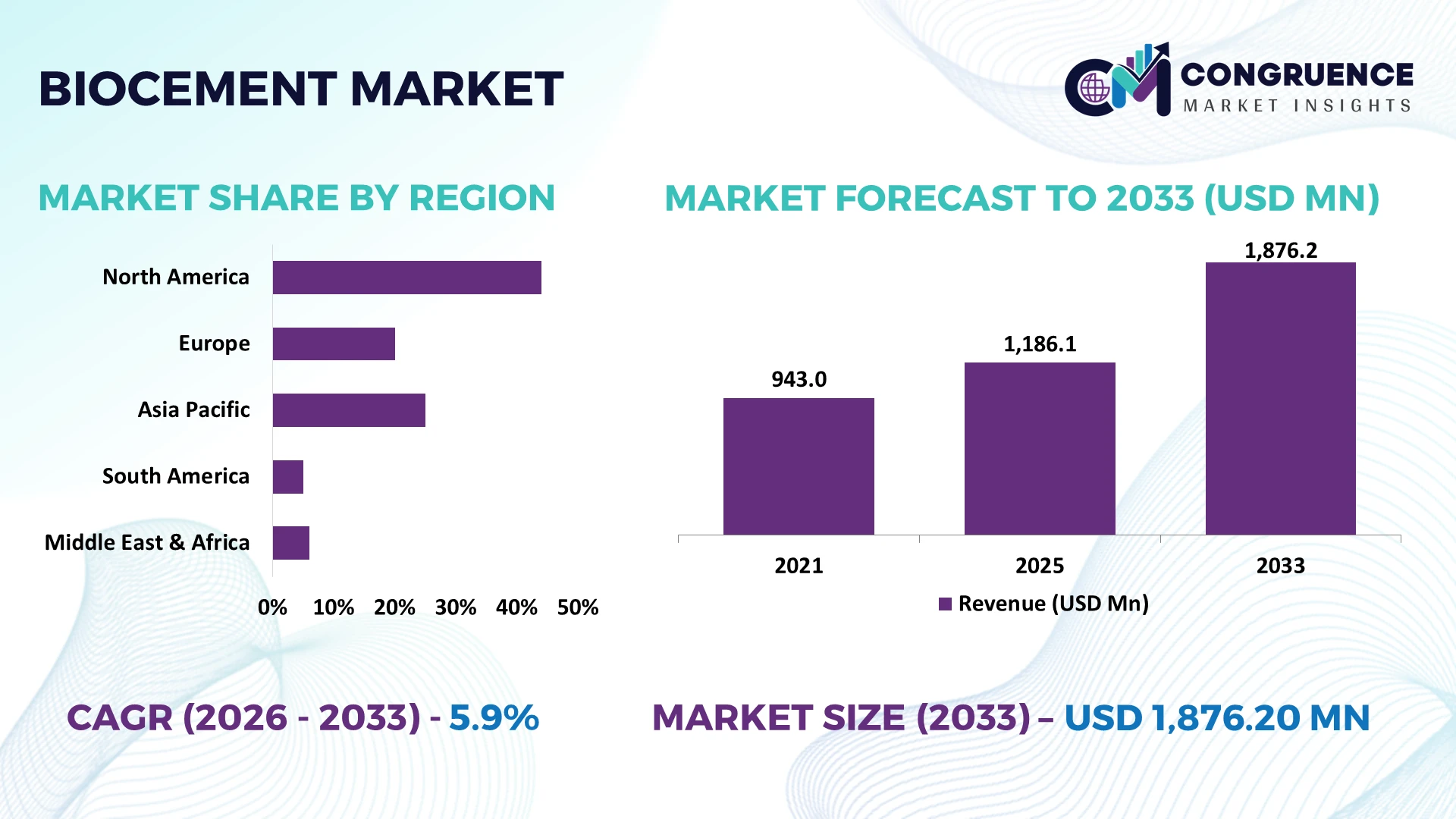
The Global Biocement Market was valued at USD 1186.08 Million in 2025 and is anticipated to reach a value of USD 1876.2 Million by 2033 expanding at a CAGR of 5.9% between 2026 and 2033. Growth is driven by microbial-induced calcium carbonate precipitation (MICP), low-carbon construction requirements, and increasing deployment of biological soil stabilization technologies in infrastructure rehabilitation.
The United States represents a strategically important market for advanced biocement technologies, supported by biotechnology research, infrastructure investment, and commercialization of microbial mineralization. The USD 1.2 trillion Infrastructure Investment and Jobs Act strengthens the broader infrastructure investment environment, while cement production accounts for roughly 8% of global anthropogenic CO₂ emissions. American developers are advancing biofabricated masonry and microbial soil treatment, whereas China emphasizes large-scale infrastructure applications and materials manufacturing. European markets prioritize low-carbon construction materials under increasingly stringent environmental standards.
Strategically, the combination of the United States' USD 1.2 trillion infrastructure investment framework and the global cement sector's 8% emissions contribution positions scalable biological mineralization as an important opportunity for construction material innovation.
Market Size & Growth: USD 1,186.08 million in 2025, reaching USD 1,876.2 million by 2033 at 5.9% CAGR, supported by microbial mineralization and low-carbon building materials.
Top Growth Drivers: Cement manufacturing's 8% global CO₂ contribution, 26% higher calcium carbonate formation in experimental soil treatment, and 83.7% lower permeability demonstrate environmental and engineering incentives.
Short-Term Forecast: By 2028, commercial development will prioritize treatment uniformity, supported by laboratory evidence of 100% to 200% strength improvements in selected biocemented soils.
Emerging Technologies: Three advancing technologies include enzyme-induced carbonate precipitation, automated bacterial fermentation, and sensor-controlled mineralization for consistent material performance.
Regional Leaders: North America leads commercialization, Europe advances low-carbon construction certification, and Asia-Pacific expands infrastructure applications. Regional USD forecasts require consistent geographic segmentation.
Consumer/End-User Trends: Infrastructure contractors prioritize ground reinforcement, with experimental biocement treatments achieving 3.6–7.6 MPa compressive strength in outdoor trials.
Pilot/Case Example: A 2024 Indonesian soil stabilization study achieved 20% California Bearing Ratio after 150 days, quadrupling untreated soil performance.
Competitive Landscape: Biomason, Prometheus Materials, Biozeroc, Basilisk, and Green Island International compete through biological formulations, manufacturing scalability, and construction partnerships.
Regulatory & ESG Impact: The EU's 2050 climate neutrality objective strengthens procurement interest in alternatives to conventional cement production.
Investment & Funding: The USD 1.2 trillion US infrastructure framework supports the broader construction ecosystem, while biological materials attract specialized commercialization partnerships.
Innovation & Future Outlook: Next-generation MICP systems target controlled carbonate deposition, with experimental mineral contents reaching 13.6%–15.3% in successfully treated sand specimens.
The Biocement Market is advancing through applications in soil stabilization, erosion control, sustainable masonry, and infrastructure rehabilitation. Innovations in bacterial cultivation, enzyme-mediated mineralization, and precision nutrient delivery are improving carbonate bonding and treatment consistency. Experimental microbial treatments have demonstrated permeability reductions exceeding 80%, highlighting opportunities in water-retaining infrastructure and geotechnical reinforcement. European construction decarbonization policies are accelerating interest in biologically manufactured building materials, while Asian infrastructure programs provide opportunities for field deployment. These developments establish a strategic foundation for evaluating commercialization pathways, manufacturing scalability, and competitive differentiation across global biocement technologies.
Biocement is becoming strategically important as construction manufacturers seek alternatives to energy intensive clinker production and conventional chemical ground stabilization. Traditional cement manufacturing contributes roughly 8% of global anthropogenic CO₂ emissions, creating pressure to commercialize microbial induced calcium carbonate precipitation (MICP). This transition is reshaping construction material supply chains by introducing bacterial cultivation, nutrient processing, and controlled biomineralization into established manufacturing systems. Companies are prioritizing biological formulations that reduce dependence on high temperature processing while maintaining structural performance.
Technology differentiation increasingly determines commercial positioning. Conventional Portland cement clinker production requires temperatures near 1,450°C, whereas microbial carbonate precipitation operates under comparatively mild conditions, commonly around 20–35°C. This eliminates kiln heating during the mineralization stage, although total production energy depends on nutrient preparation and processing. American companies emphasize biofabricated masonry, while Chinese research institutions prioritize soil reinforcement and geotechnical applications.
During 2026–2028, commercialization will concentrate on repeatable mechanical performance, automated nutrient delivery, and larger demonstration projects. Biomason's biologically manufactured masonry materials illustrate industrial adoption beyond laboratory research. Manufacturers are strengthening partnerships with construction contractors and biotechnology specialists to improve process control. Competitive advantage will depend on validated durability, manufacturing throughput, and integration with existing construction specifications.
Cement manufacturing's roughly 8% contribution to global anthropogenic CO₂ emissions is accelerating interest in biological alternatives. Conventional clinker production requires approximately 1,450°C, while MICP operates at substantially lower temperatures, reducing dependence on thermal processing. Experimental biocementation has demonstrated compressive strength improvements exceeding 100% in selected treated soils, strengthening its relevance for foundation stabilization and erosion control. The European Union's 55% net greenhouse gas reduction target for 2030 reinforces procurement pressure on carbon intensive construction materials. Companies such as Biomason are developing biologically manufactured masonry products and improving industrial fermentation capabilities. The strategic advantage lies in replacing energy intensive processing stages while preserving application specific mechanical performance.
Biocement commercialization faces immediate cost pressure from bacterial culture media, calcium salts, and wastewater treatment. In Chinese laboratory formulations, microbial culture media account for 50%–80% of preparation expenses, making reagent procurement a critical profitability factor. Experimental low cost nutrient formulations have reduced reagent expenses by up to 90%, but field operations still require additional delivery and monitoring expenditure. Ureolytic mineralization generates 2 moles of ammonium per mole of calcium carbonate, creating wastewater management obligations. Treatment rinsing equivalent to 180% of soil pore volume further increases water requirements. Manufacturers are evaluating industrial byproducts, localized nutrient sourcing, and wastewater recovery systems to improve commercial feasibility.
Self-healing concrete creates a differentiated opportunity for biocement manufacturers targeting infrastructure maintenance and specialized construction materials. Experimental bacterial healing systems have demonstrated 55%–85% strength recovery and 81%–99% permeability reduction under controlled conditions, supporting applications in tunnels, wastewater structures, and underground construction. Dutch companies such as Basilisk are commercializing biological concrete repair technologies, while automated mineralization monitoring offers opportunities for quality assurance integration. Emerging machine learning models have achieved predictive accuracy represented by R² values exceeding 0.95 in selected biomineralization studies. During 2026–2028, manufacturers can prioritize factory controlled admixtures, sensor assisted curing, and licensing partnerships with concrete producers. The strategic opportunity lies in reducing maintenance interventions rather than replacing conventional cement entirely.
Scaling biocement from laboratory specimens to infrastructure projects requires consistent carbonate distribution across heterogeneous geological conditions. Experimental systems have achieved compressive strengths exceeding 10 MPa, but equivalent performance remains unvalidated across large field installations. In marine exposure experiments, treated specimens retained only 35.19% of their original strength after 30 days, revealing significant durability challenges. Field erosion stabilization has demonstrated 92.6% soil loss reduction over 11 months, although performance depends on injection geometry and environmental conditions. China's extensive infrastructure construction environment highlights the importance of validating biological treatments under variable soils and groundwater chemistry. Developers must invest in multistage injection, spatial monitoring, standardized durability testing, and contractor partnerships. Long-term competitiveness depends on reproducible engineering performance, not isolated laboratory results.
Industrial Fermentation Moves Toward Standardization: Biocement manufacturers are introducing controlled bioreactor cultivation to improve microbial consistency across production batches. Operating temperatures of 25–35°C and pH conditions near 8–9 support ureolytic bacterial activity. American producers are integrating automated culture monitoring and standardized nutrient dosing, reducing variability in carbonate precipitation. This shift improves production scheduling and strengthens product qualification for construction supply chains.
Alternative Calcium Feedstocks Gain Industrial Attention: Manufacturers are evaluating calcium-rich industrial residues to reduce dependence on purified chemical inputs. Eggshell waste contains roughly 94%–97% calcium carbonate, while suitable limestone residues provide additional mineral feedstock opportunities. Indian researchers are investigating waste-derived calcium sources for microbial precipitation. Suppliers are developing material preprocessing partnerships, improving resource utilization and reducing exposure to specialty reagent procurement constraints.
Prefabricated Biocement Products Enter Commercial Workflows: Factory-manufactured biological masonry is gaining attention as producers prioritize controlled processing over unpredictable construction site conditions. Conventional clinker processing approaches 1,450°C, whereas biological mineralization proceeds near ambient temperatures. Biomason's BioLITH technology demonstrates biological mineral bonding in prefabricated products. Manufacturers are strengthening quality control systems and production partnerships to support consistent dimensions, installation compatibility, and commercial specification requirements.
Digital Monitoring Improves Treatment Traceability: Biocement developers are adopting conductivity monitoring, optical measurements, and automated injection records to evaluate mineral precipitation. Treatment programs increasingly track 3 operating variables: pH, calcium concentration, and injection pressure. Conductivity measurements provide indirect evidence of ureolysis, while repeated sampling identifies uneven mineral distribution. Companies are integrating digital process records to improve technical documentation, reduce unnecessary sampling, and strengthen contractor acceptance.
Microbial Biocement represents the leading technology category, with an indicative 60%–65% share of the global biocement market. Its positioning reflects extensive research validation, established bacterial cultivation techniques, and applicability across multiple construction environments. Microbially induced calcium carbonate precipitation uses urease producing bacteria to generate mineral bonds between particles, strengthening granular materials without conventional high temperature cement processing. Experimental applications have achieved compressive strengths exceeding 10 MPa, supporting technical interest in engineered soil reinforcement. Manufacturers are prioritizing microbial strain optimization, controlled fermentation, and reproducible carbonate precipitation to improve commercial deployment.
Enzyme-Induced Biocement represents the fastest advancing alternative, particularly where bacterial transport through fine soil pores restricts treatment effectiveness. Cell free urease systems offer greater flexibility in injection design and mineralization control. Plant-Based Biocement remains an emerging category, incorporating plant derived enzymes and biological binding materials. Companies are developing lower cost enzyme extraction methods and hybrid formulations to address specialized construction requirements. Investment priorities increasingly distinguish scalable microbial production from targeted enzymatic applications, creating differentiated opportunities for technology suppliers.
Soil Stabilization represents the leading application, with an indicative 40%–45% share of global biocement demand. Its commercial relevance reflects extensive geotechnical research, infrastructure foundation requirements, and compatibility with established ground improvement workflows. Microbial precipitation strengthens particle contacts and improves shear resistance, supporting applications in sandy foundations and loose geological formations. Laboratory investigations have demonstrated unconfined compressive strengths exceeding 10 MPa under optimized conditions. Infrastructure contractors are increasingly evaluating staged mineral injection and controlled treatment methods to improve engineering reliability. Commercial developers are prioritizing repeatable performance, geotechnical testing, and integration with conventional soil investigation procedures.
Crack Repair represents the fastest advancing application, supported by biological mineral deposition within damaged concrete structures. Building Construction is progressing through prefabricated biocement products and specialized masonry components, while Erosion Control addresses exposed soils and vulnerable embankments. Field demonstrations have reported wind erosion reductions reaching 95%, highlighting operational potential beyond structural reinforcement. Manufacturers are adapting product formulations, treatment equipment, and quality assurance procedures to address distinct application requirements. Competitive positioning increasingly depends on demonstrated durability and application specific performance rather than universal material substitution.
Construction Companies represent the leading end-user category, with an indicative 35%–40% share of global biocement demand. Their position reflects direct involvement in building material procurement, foundation preparation, and specialized concrete applications. Biological mineralization offers an alternative treatment pathway for selected construction activities, while controlled manufacturing supports consistent product dimensions and installation compatibility. Experimental biocement systems have achieved 70%–90% strength retention following 12 freeze thaw cycles, demonstrating potential for engineered construction materials under defined testing conditions. Manufacturers are working with contractors to validate material specifications, installation methods, and project level performance requirements.
Infrastructure Developers represent the fastest advancing end-user category as biological ground improvement gains attention for transportation corridors, coastal protection, and foundation rehabilitation. Mining Companies are investigating microbial binding for tailings stabilization and particulate control, while Government Agencies influence adoption through infrastructure procurement and environmental performance requirements. Research indicates that certain biocement treatments reduce fractured rock permeability by 3–4 orders of magnitude, creating specialized opportunities in underground infrastructure. Suppliers are strengthening engineering partnerships, field testing capabilities, and project specific formulation services to secure technically demanding contracts.
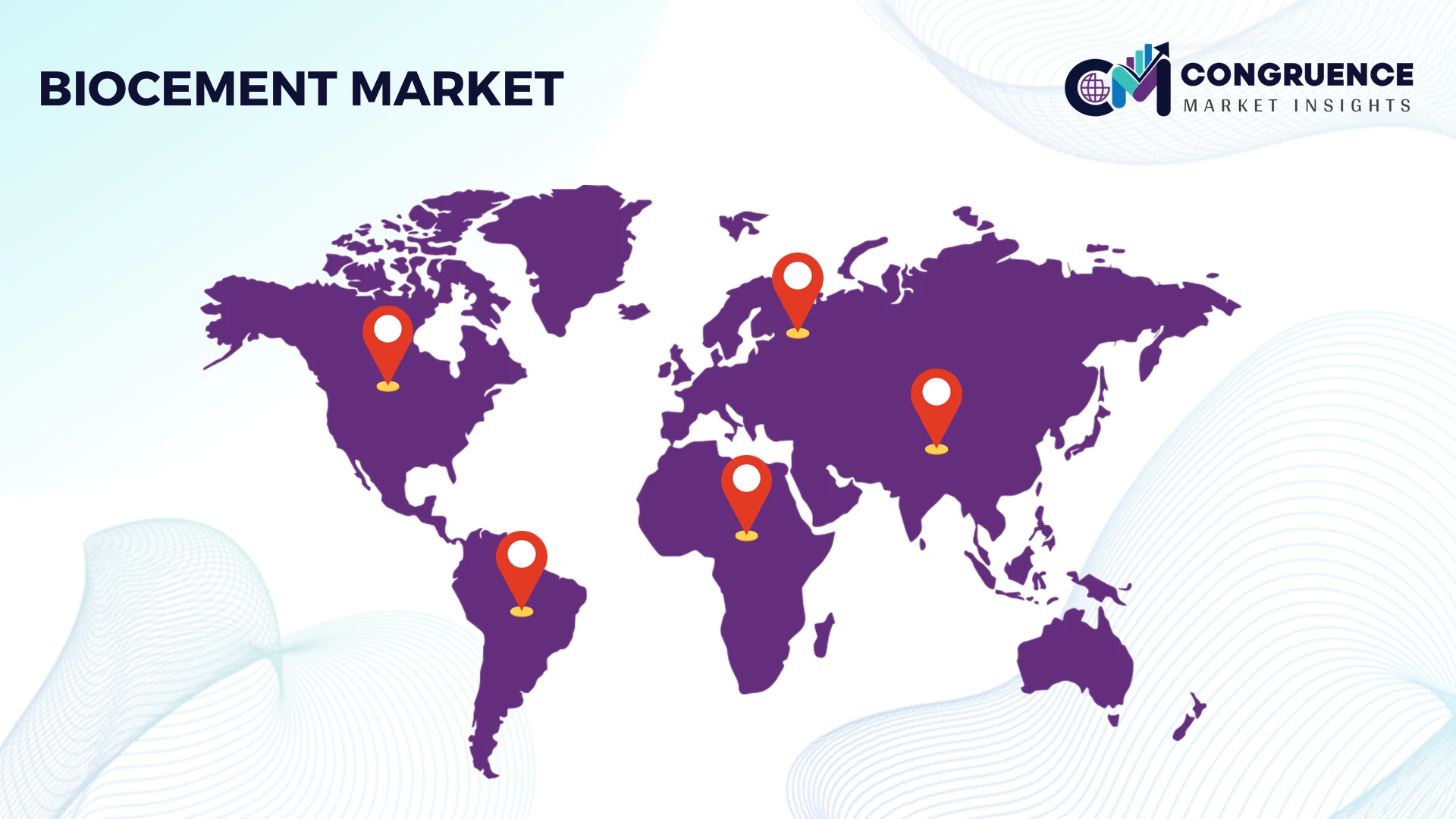
North America accounted for the largest indicative market share at 35% in 2025 however, Asia-Pacific is expected to register the fastest growth, expanding at an indicative CAGR of 7.2% between 2026 and 2033.
Biotechnology Commercialization and Advanced Construction Materials Leadership
North America holds an indicative 35% share of the global biocement market, supported by biotechnology commercialization, specialized construction materials manufacturing, and geotechnical engineering research. The United States concentrates commercial development around microbial mineralization, prefabricated masonry, and engineered soil treatment. Biological construction technologies benefit from established fermentation infrastructure, university research networks, and specialized material testing facilities. Canada's infrastructure sector provides complementary opportunities in ground stabilization and cold-climate construction, where freeze-thaw durability remains an important qualification requirement. American developers are advancing mineralization processes operating near ambient temperatures, compared with conventional clinker production temperatures approaching 1,450°C. The region's strategic advantage lies in translating laboratory biomineralization into standardized products through construction industry partnerships, performance certification, and industrial process optimization. Companies prioritizing manufacturing repeatability and contractor integration hold stronger commercialization positions.
United States Market Outlook: The United States leads regional technology development through enterprises such as Biomason and Prometheus Materials, which focus on biological building materials and microbial mineralization. The Infrastructure Investment and Jobs Act authorized approximately USD 1.2 trillion in infrastructure spending, creating a substantial broader investment environment. Commercial differentiation increasingly depends on material qualification, reliable production cycles, and compatibility with established construction procurement standards.
Circular Construction Materials and Biological Repair Commercialization
Europe represents an indicative 27% share of the global biocement market, supported by stringent environmental standards, advanced construction chemistry, and biological concrete repair technologies. The European Union's revised Construction Products Regulation strengthens the framework for product performance documentation and environmental transparency. The region's climate policy targets at least 55% net greenhouse gas emission reductions by 2030 compared with 1990 levels, encouraging construction material manufacturers to evaluate alternative mineral binders. The Netherlands leads commercial activity in bacterial concrete healing, while Germany contributes advanced materials engineering and industrial biotechnology capabilities. European developers increasingly concentrate on controlled biological repair formulations rather than unrestricted substitution of structural cement. This positioning supports applications where maintenance savings and extended service life justify specialized material costs. Manufacturers are strengthening testing partnerships and technical documentation to improve acceptance among infrastructure owners and engineering consultants.
Netherlands Market Outlook: The Netherlands is strategically important through Basilisk, which commercializes bacterial self-healing concrete technologies. Dutch infrastructure engineering expertise supports applications involving water-retaining structures, tunnels, and reinforced concrete maintenance. Biological crack-healing formulations are designed to activate when water enters damaged concrete, enabling calcium carbonate deposition. The country's established water management sector provides a technically demanding environment for validating repair durability and service-life extension.
Infrastructure Scale and Geotechnical Treatment Innovation
Asia-Pacific accounts for an indicative 25% share of the global biocement market, with China, Japan, India, and Australia contributing distinct research and deployment capabilities. China dominates conventional cement manufacturing, producing more than 50% of global cement output, creating substantial industrial infrastructure for evaluating alternative construction technologies. Research institutions are advancing microbial carbonate precipitation for sandy soil reinforcement, foundation improvement, and erosion control. Japan emphasizes high-performance construction materials and infrastructure durability, while Australia contributes geotechnical research targeting granular soil stabilization. India is developing biological treatment approaches for infrastructure rehabilitation and industrial waste utilization. The region benefits from established construction supply chains and extensive engineering research capacity, although commercial biocement adoption remains less mature than conventional cement production. Competitive positioning increasingly depends on locally sourced reagents, field treatment consistency, and integration with existing engineering specifications.
China Market Outlook: China offers significant industrial scale through its extensive construction materials manufacturing base and geotechnical research institutions. National infrastructure development and soil improvement requirements create opportunities for microbial treatment technologies. Research programs have demonstrated substantial improvements in treated sand strength through controlled calcium carbonate precipitation. Chinese developers are investigating injection strategies, bacterial cultivation efficiency, and industrial byproduct utilization to reduce treatment costs and improve field applicability.
Mining Rehabilitation and Biological Ground Improvement Demand
South America represents an indicative 7% share of the global biocement market, with applications concentrated around mining operations, geotechnical research, and specialized infrastructure stabilization. Brazil and Chile provide strategically relevant environments for evaluating biological soil strengthening and erosion management. Chile's copper mining industry contributes approximately one-quarter of global mined copper production, creating extensive requirements for tailings management and ground engineering. Microbial carbonate precipitation offers a potential supplementary treatment for selected granular materials, although large-scale mining deployment requires additional field validation. Brazil's construction and infrastructure sectors support academic research into bacterial mineralization and alternative binding systems. Regional commercialization remains constrained by specialized reagent availability and limited industrial biocement production facilities. Companies pursuing this market benefit from partnerships with mining operators, engineering universities, and local chemical suppliers to develop site-specific formulations.
Brazil Market Outlook: Brazil combines extensive construction activity with biotechnology research capabilities relevant to microbial mineralization. Its infrastructure requirements include slope stabilization, foundation rehabilitation, and erosion control across varied soil conditions. Brazilian researchers are investigating bacterial precipitation and biological treatment methods for geotechnical applications. The country's industrial biotechnology base supports opportunities for localized microbial cultivation and lower-cost nutrient preparation, reducing dependence on imported specialized treatment materials.
Desert Infrastructure Engineering and Sustainable Construction Investment
The Middle East & Africa region holds an indicative 6% share of the global biocement market, supported by emerging biological soil treatment research and large infrastructure development programs. Saudi Arabia and the United Arab Emirates provide relevant environments for evaluating microbial stabilization of loose sandy soils. High-temperature conditions, groundwater chemistry, and mineral precipitation uniformity influence treatment performance in desert environments. Saudi Arabia's Vision 2030 infrastructure transformation is encouraging interest in advanced construction technologies, while the UAE emphasizes material innovation and resource-efficient construction. South Africa contributes mining engineering capabilities relevant to biological ground treatment and tailings stabilization. Commercial deployment remains at an early stage, requiring field validation under saline and arid conditions. Technology developers are prioritizing locally compatible microbial strains, controlled injection methods, and partnerships with infrastructure engineering contractors to address application-specific performance requirements.
Saudi Arabia Market Outlook: Saudi Arabia offers strategically important opportunities through its large construction programs and extensive sandy terrain. NEOM and other infrastructure initiatives create a broader testing environment for innovative ground improvement technologies. Microbial treatment systems operating around 25–35°C provide a biological alternative to selected conventional stabilization processes, although desert temperature extremes require careful process control. Research partnerships and localized formulation development remain central to establishing commercially reliable treatment methods.
Biomason, Prometheus Materials, Biozeroc, Basilisk, and Green Island International compete across microbial binders, biological masonry, and concrete repair technologies. The five companies collectively represented an estimated 41% of the narrower biocement construction application market in 2024, indicating concentrated leadership within an emerging industry. Biomason competes through industrial biocement manufacturing, while Prometheus Materials emphasizes carbon-reducing cement formulations. Basilisk differentiates through bacterial crack healing, competing against conventional repair technologies. Evonik strengthens competition through biological concrete admixtures. Product performance increasingly determines procurement: selected biological repair systems demonstrate up to 80% lower water absorption, while validated Dutch field applications recorded 10% lower environmental impact. Manufacturers are expanding production partnerships, refining microbial formulations, and integrating biological processes into existing co
Biomason Inc.
Prometheus Materials Inc.
Biozeroc Ltd.
Basilisk B.V.
Medusoil SA
Evonik Industries AG
Soletanche Bachy
BioCement Technologies
StoneBio
Avecom N.V.
Green Island International Ltd.
Halliburton Company
Microbially induced calcium carbonate precipitation (MICP) remains the principal biocement technology, using ureolytic bacteria to bind soil particles and manufacture mineralized construction materials. Conventional Portland cement clinker requires approximately 1,450°C processing, whereas microbial mineralization typically operates at 20–35°C. Experimental biocementation has delivered strength improvements exceeding 100% in selected granular soils. Industrial adoption is progressing through prefabricated masonry manufacturing and specialized geotechnical demonstrations, where controlled bacterial cultivation improves consistency and reduces thermal processing requirements.
Emerging enzyme induced carbonate precipitation (EICP) eliminates bacterial cultivation during application, enabling treatment of finer pore networks. Experimental systems have achieved permeability reductions exceeding 80%, supporting targeted ground sealing applications. Automated nutrient dosing, conductivity sensors, and digital mineralization monitoring improve treatment traceability. Plant derived urease and industrial calcium residues further diversify formulation options, allowing biotechnology suppliers to compete through localized feedstocks and application specific performance rather than conventional cement pricing.
Disruptive developments include engineered microbial strains, continuous mineralization reactors, and digitally optimized injection systems. Between 2026 and 2028, manufacturers will prioritize field validation, standardized durability testing, and scalable production partnerships. Biological materials specialists gain competitive advantage through reproducible strength, lower temperature processing, and compatibility with existing construction workflows.
September 2026: Prometheus Materials appointed 2 board directors and 1 technology director to accelerate ProZERO commercialization. Its technology serves projects involving six datacenter hyperscalers, strengthening technical oversight and industrial deployment capabilities. Source: prometheusmaterials.com
July 2026: Visibuilt secured EUR 3.34 million in seed funding to advance mycelium-based construction binders. The investment supports pilot-scale development and industrial commercialization, strengthening alternatives to conventional cementitious materials through biotechnology innovation and manufacturing partnerships in Denmark. Source: visibuilt.com
February 2026: Citrine Informatics launched a BioMADE-supported artificial intelligence project targeting biologically produced cement. The initiative applies predictive modeling to microbial mineralization, addressing 1 critical commercialization requirement: optimizing biocement production efficiency and accelerating the transition toward scalable manufacturing processes. Source: citrine.io
May 2025: Medusoil's microbial biocement research, highlighted by EPFL, examined 50 environmental bacterial strains for mineralization performance. The investigation supports strain selection and biological binder optimization, strengthening the technical foundation for industrial production at its Swiss manufacturing facility. Source: epfl.ch
The Biocement Market Report evaluates technological development, commercial deployment, competitive positioning, and investment opportunities between 2026 and 2033. Type segmentation covers Microbial Biocement, Enzyme-Induced Biocement, and Plant-Based Biocement. Application analysis examines Soil Stabilization, Crack Repair, Building Construction, and Erosion Control, while end-user coverage includes Construction Companies, Infrastructure Developers, Mining Companies, and Government Agencies. The analysis evaluates biological mineralization efficiency, material durability, manufacturing scalability, and application specific adoption patterns.
Regional coverage includes North America, Europe, Asia-Pacific, South America, and the Middle East & Africa, examining commercialization maturity, infrastructure requirements, and industrial biotechnology capabilities. The report also assesses microbial cultivation, enzyme based precipitation, automated mineralization control, and advanced biological binders. Competitive benchmarking supports manufacturing investment, technology partnerships, geographic expansion, and long-term product differentiation.
| Report Attribute/Metric | Report Details |
|---|---|
Market Revenue in 2025 | USD 1186.08 Million |
Market Revenue in 2033 | USD 1876.2 Million |
CAGR (2026 - 2033) | 5.9% |
Base Year | 2025 |
Forecast Period | 2026 - 2033 |
Historic Period | 2021 - 2025 |
Segments Covered | By Type
By Application
By End-User
|
Key Report Deliverable | Revenue Forecast, Growth Trends, Market Dynamics, Segmental Overview, Regional and Country-wise Analysis, Competition Landscape |
Region Covered | North America, Europe, Asia-Pacific, South America, Middle East, Africa |
Key Players Analyzed | Biomason Inc., Prometheus Materials Inc., Biozeroc Ltd., Basilisk B.V., Medusoil SA, Evonik Industries AG, Soletanche Bachy, BioCement Technologies, StoneBio, Avecom N.V., Green Island International Ltd., Halliburton Company |
Customization & Pricing | Available on Request (10% Customization is Free) |




