
Reports
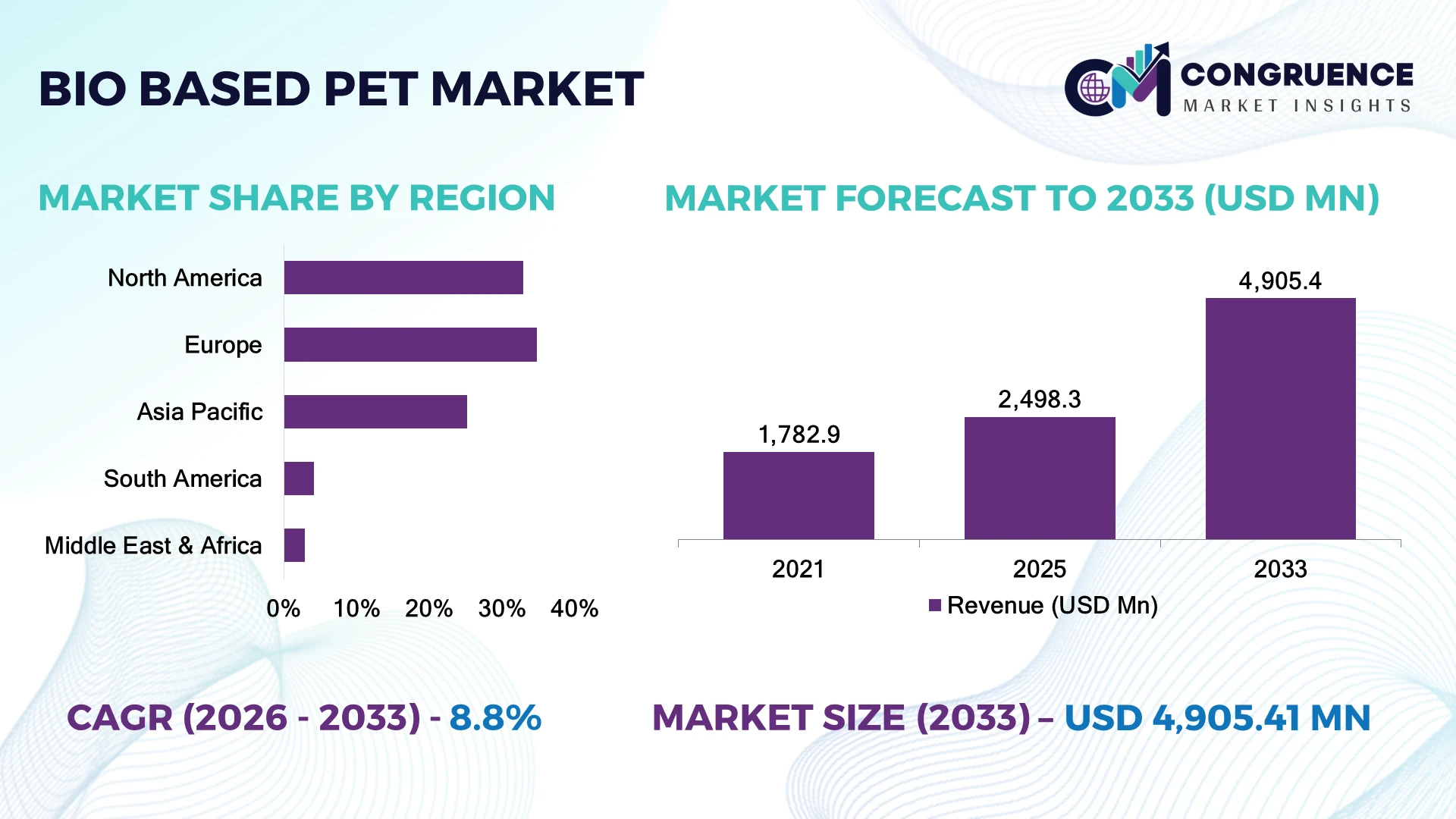
The Global Bio-based PET Market was valued at USD 2,498.3 Million in 2025 and is anticipated to reach a value of USD 4,905.4 Million by 2033 expanding at a CAGR of 8.8% between 2026 and 2033. Demand is supported by brand-owner packaging commitments, renewable monoethylene glycol (bio-MEG) availability, and efforts to reduce dependence on fossil-based polymer feedstocks.
Brazil holds a strategic feedstock advantage through its established sugarcane and bioethanol industries, which support renewable chemical pathways. Conventional PET contains approximately 30% monoethylene glycol and 70% purified terephthalic acid by weight, making bio-MEG a commercially practical entry point for partially bio-based PET. By contrast, fully bio-based PET requires renewable routes for both components and faces greater technology and scale-up requirements. The European Union's packaging policy framework is also increasing scrutiny of material circularity and lifecycle performance. For investors, the priority is to distinguish scalable bio-MEG-based PET from emerging fully renewable routes and evaluate feedstock security, certification, and end-of-life compatibility before committing capacity.
Market Size & Growth: The supplied market estimate rises from USD 2,498.3 million in 2025 to USD 4,905.4 million by 2033, reflecting an 8.8% CAGR, supported by renewable feedstock adoption and packaging decarbonization.
Top Growth Drivers: Bio-MEG substitution, brand-owner sustainability commitments, and renewable chemical innovation are the principal drivers; their individual percentage contributions require validated market data.
Short-Term Forecast: By 2028, procurement teams should benchmark renewable content, lifecycle emissions, and feedstock traceability alongside polymer quality to improve sourcing decisions.
Emerging Technologies: Renewable MEG, bio-based terephthalic acid, and advanced catalytic conversion are key pathways toward partially and fully bio-based PET.
Regional Leaders: Asia-Pacific offers major polymer-processing and packaging demand, Europe emphasizes material sustainability and compliance, and Brazil benefits from sugarcane-based feedstock infrastructure; regional market values require validated allocation data.
Consumer/End-User Trends: Beverage and consumer-goods companies increasingly evaluate packaging through renewable content, recyclability, product protection, and compatibility with existing filling operations.
Pilot/Case Example: In 2015, Coca-Cola unveiled a prototype PET bottle made entirely from plant materials, demonstrating the technical feasibility of renewable routes for both major PET building blocks.
Competitive Landscape: Braskem, The Coca-Cola Company, Virent, Gevo, and technology developers compete across renewable feedstocks, monomer production, polymer pathways, and packaging applications rather than as identical resin suppliers.
Regulatory & ESG Impact: EU Packaging and Packaging Waste Regulation 2025/40 establishes recycled-content requirements for specified packaging formats, reinforcing the need to assess bio-based content alongside recycling performance.
Investment & Funding: Investment focuses on renewable monomer pathways, feedstock conversion, and industrial scale-up; project-level capacity and financing should be evaluated before estimating total sector investment.
Innovation & Future Outlook: The next strategic shift is from partially renewable PET toward routes using renewable sources for both MEG and terephthalic acid, subject to cost, performance, and lifecycle validation.
Bio-based PET provides a route to replace fossil-derived feedstocks while retaining the material properties and established processing advantages of conventional PET. Beverage bottles, food packaging, personal-care containers, and selected textile applications represent relevant demand areas. Commercial deployment is strongest where renewable MEG can enter existing PET production systems without requiring a complete conversion of manufacturing infrastructure. The next stage depends on improving renewable feedstock economics and demonstrating credible lifecycle benefits across sourcing, production, and end-of-life management.
Bio-based PET is strategically important because it allows packaging manufacturers to reduce fossil-feedstock dependence without abandoning PET's established performance, processing equipment, and recycling pathways. The near-term commercial route is partially bio-based PET made with renewable MEG and conventional terephthalic acid. Fully bio-based PET requires renewable production pathways for both components, creating a more complex technology and investment challenge.
Regional capabilities differ significantly. Brazil benefits from established sugarcane and bioethanol infrastructure, while Asia-Pacific provides substantial polymer processing, packaging conversion, and consumer-market capacity. European buyers place particular emphasis on packaging sustainability, traceability, and lifecycle evidence. Renewable content alone does not guarantee lower environmental impact: feedstock cultivation, land-use change, process energy, and water consumption can materially affect results. Companies must therefore compare pathways using consistent lifecycle assessment boundaries rather than relying solely on bio-based-content claims.
Between 2026 and 2028, investment decisions should focus on renewable monomer availability, qualified supply agreements, polymer consistency, and compatibility with existing bottle-production and recycling systems. Manufacturers can begin with partially bio-based formulations and validate more advanced pathways through targeted production trials. Partnerships across feedstock suppliers, chemical producers, polymer manufacturers, and packaging brands will help distribute scale-up risk. Competitive advantage will depend on verified environmental performance, dependable commercial supply, and cost-effective integration into existing PET value chains.
Consumer-goods and beverage companies are seeking ways to reduce fossil-based packaging inputs while preserving PET's strength, transparency, and manufacturing compatibility. Renewable MEG is a practical starting point because it represents approximately 30% of conventional PET by weight and can be incorporated without changing the polymer's basic identity. Partially bio-based PET therefore offers a more accessible transition than routes requiring both monomers to be renewable. Brand-owner procurement commitments and supplier decarbonization programmes reinforce demand for traceable renewable inputs. Producers are responding through renewable feedstock partnerships, monomer development, and supply qualification. The strategic advantage lies in integrating renewable content into existing production systems while verifying lifecycle benefits and maintaining reliable supply.
Bio-based PET faces cost and supply constraints because renewable monomers compete with established petrochemical inputs and depend on agricultural feedstock availability, conversion yields, and processing costs. MEG represents approximately 30% of PET by weight, but renewable sourcing for the remaining 70% represented by terephthalic acid requires additional technological development and qualification. Feedstock prices can also be affected by crop yields, land availability, energy inputs, and competing uses of biomass. These factors complicate long-term pricing and capacity planning for polymer manufacturers. Companies are mitigating exposure through diversified feedstocks, multi-year supply arrangements, process optimization, and phased investment. Commercial expansion depends on securing consistent monomer supply at a cost acceptable to packaging converters and brand owners.
Developing renewable routes for both monoethylene glycol and terephthalic acid creates a pathway toward fully bio-based PET rather than formulations relying on only one renewable component. Advanced catalytic processes, biomass conversion, and alternative feedstocks can expand the range of potential production pathways. The opportunity extends beyond beverage bottles to food packaging, personal-care containers, and polyester applications where customers value renewable sourcing. Companies can strengthen commercial prospects through partnerships with chemical technology developers, feedstock processors, and packaging brands. The immediate opportunity is to scale reliable renewable MEG supply while advancing the technically more demanding renewable terephthalic acid pathway. Investment should follow validated yields, lifecycle results, polymer specifications, and customer qualification milestones.
Bio-based PET manufacturers must demonstrate that renewable feedstocks deliver credible environmental benefits without compromising polymer quality or established recycling operations. Lifecycle performance depends on biomass origin, land-use change, energy sources, water consumption, and manufacturing efficiency, so a renewable-content percentage alone is insufficient. PET's two principal building blocks account for approximately 30% and 70% of polymer weight respectively, making the renewable sourcing pathway for each component central to environmental claims. Packaging producers also need consistent intrinsic viscosity, colour, barrier performance, and processing behaviour. Companies must invest in lifecycle assessment, chain-of-custody documentation, application testing, and recycler engagement. Successful commercialization requires verified sustainability performance alongside equivalent functional quality and dependable end-of-life management.
Renewable MEG Gains Commercial Relevance: Partially bio-based PET remains a practical entry point because renewable MEG represents approximately 30% of conventional PET by weight. This approach allows manufacturers to incorporate renewable carbon while retaining established PET processing and product properties. Producers are focusing on feedstock traceability, supply agreements, and consistent monomer quality to make renewable-content claims commercially credible.
Fully Renewable PET Advances Technically: Fully bio-based PET requires renewable pathways for both MEG and terephthalic acid, with the latter accounting for approximately 70% of PET by weight. Development efforts focus on renewable aromatic intermediates and conversion technologies. Companies are using technology partnerships and staged qualification to reduce scale-up risk, but broad commercial availability depends on cost, yield, and reliable monomer supply.
Lifecycle Evidence Shapes Procurement: Buyers are increasingly examining feedstock origin, land-use change, energy intensity, and water use rather than treating renewable content as a standalone sustainability indicator. Lifecycle studies show that results vary by biomass pathway and production assumptions. Suppliers are responding with more transparent environmental assessments and traceability systems, helping packaging customers compare materials on a consistent basis.
Packaging Rules Reinforce Circularity: The EU's Packaging and Packaging Waste Regulation 2025/40 strengthens recycled-content requirements for specified packaging formats and requires broader attention to packaging design and end-of-life performance. Bio-based PET suppliers must therefore demonstrate how renewable feedstocks complement recycling systems rather than substitute for circularity. Producers are prioritizing compatibility testing, material documentation, and coordination with packaging converters and recyclers.
Partially Bio-based PET Leads Through Commercial Scalability
Partially bio-based PET is estimated to account for approximately 90% of the type segment, reflecting its established commercial viability and compatibility with conventional PET manufacturing. Replacing fossil-derived monoethylene glycol (MEG) with renewable MEG allows producers to introduce renewable carbon without fundamentally changing polymer processing or established recycling systems. Fully bio-based PET remains an emerging category because renewable sourcing of both MEG and terephthalic acid requires more advanced conversion technologies and dependable monomer supply. The commercial distinction is significant: partially bio-based grades support near-term procurement, while fully renewable formulations offer longer-term differentiation for brands seeking deeper fossil-feedstock substitution.
Partially bio-based PET therefore remains the primary investment priority, while fully bio-based PET is the potential faster-advancing innovation segment as renewable aromatic intermediates develop. The latter's growth trajectory remains dependent on technology readiness, cost competitiveness, and commercial-scale availability. Producers are strengthening partnerships across renewable feedstocks, monomer development, and polymer manufacturing. Investment decisions should distinguish current commercial volumes from demonstration-stage capacity, with product qualification, traceability, and lifecycle performance serving as key selection criteria.
Bottles Anchor Demand Through Existing PET Infrastructure
Bottles are estimated to represent approximately 55% of Bio-based PET application demand, supported by beverage packaging, water containers, carbonated drinks, and selected personal-care products. Their dominance reflects PET's established transparency, strength, barrier performance, and compatibility with existing preform, filling, and recycling infrastructure. Films and sheets serve flexible and rigid packaging formats, while fibres support polyester textiles and industrial applications. Other uses remain more specialized. Compared with emerging applications, bottles provide a more straightforward commercialization pathway because renewable MEG can be incorporated without requiring a complete redesign of packaging production systems.
Films and sheets are a potential faster-growing application group as converters explore renewable-content materials for food packaging, trays, and other formats, although their relative growth requires application-specific sales validation. Bottles are estimated to account for approximately 50–60% of application demand, while fibres provide diversification beyond packaging. Producers are responding through grade qualification, converter partnerships, and compatibility testing across forming, filling, and recycling processes. The business priority is to scale bottle-grade supply while selectively expanding into films, sheets, and fibres where performance requirements and customer procurement commitments justify additional qualification costs.
Food and Beverage Brands Lead Renewable Packaging Adoption
Food and beverage companies are estimated to account for approximately 45% of Bio-based PET end-user demand, driven by beverage bottles, packaged water, carbonated drinks, and selected food containers. These buyers value PET's established packaging performance and the ability to incorporate renewable feedstocks without fundamentally changing filling-line operations. Consumer goods and personal-care manufacturers provide another demand stream through bottles and containers, while textile producers use bio-based polyester in selected fibre applications. Automotive and industrial users remain more specialized, with adoption dependent on component specifications, material economics, and customer sustainability requirements.
Consumer goods and personal care are potential faster-growing end-user groups as brands diversify renewable-content packaging beyond beverages, although a definitive growth ranking requires validated end-user sales data. Food and beverage demand remains structurally important because large packaging programmes can support repeat procurement and supplier qualification. Producers are targeting brand owners through long-term supply arrangements, packaging-converter partnerships, traceability documentation, and product-performance validation. Investment should prioritize customers able to absorb commercial volumes while developing smaller, specification-driven opportunities in textiles, automotive, and other industrial applications.
Europe accounted for the largest market share at approximately 34.8% in 2025; however, Asia-Pacific is expected to register the fastest growth between 2026 and 2033 as packaging demand, polymer manufacturing capabilities, and renewable-material investments expand. Regional shares are indicative estimates and may vary by market definition and treatment of partially versus fully bio-based PET.
Brand Commitments Favor Drop-In Renewable Packaging Materials
North America represented an estimated 32.9% of the global Bio-based PET market in 2025, supported by established beverage brands, advanced packaging-conversion infrastructure, and established PET collection and recycling systems. The United States remains the regional demand center, where large consumer-goods companies can incorporate renewable feedstocks into familiar packaging formats without requiring major changes to filling lines. Commercial adoption nevertheless depends on dependable bio-MEG supply, price competitiveness, and credible lifecycle documentation. Companies are prioritizing supplier partnerships, renewable-feedstock traceability, and packaging trials that preserve clarity, strength, and recyclability. The region's competitive advantage lies more in brand-owner purchasing power and commercialization capabilities than in a clearly established, large-scale domestic supply base for fully bio-based PET. Investment decisions therefore favor qualified renewable inputs and scalable customer programmes.
United States Market Outlook: The United States combines a large beverage-packaging market with advanced polymer processing, brand-owner procurement, and established recycling infrastructure. These capabilities support the qualification of partially bio-based PET for bottles and other packaging formats. The commercial opportunity is strongest where manufacturers can demonstrate consistent resin performance and reliable feedstock sourcing. Suppliers are likely to prioritize partnerships with beverage companies and packaging converters, while evaluating domestic renewable-chemical production and imported intermediates as alternative supply routes.
Regulatory Readiness and Circular Packaging Shape Material Choices
Europe held an estimated 34.8% of the Bio-based PET market in 2025, supported by sustainability-focused brand procurement, established packaging-conversion capabilities, and a mature recycling-policy environment. The EU Packaging and Packaging Waste Regulation entered into force in February 2025 and applies from August 2026, with several packaging obligations phased in over subsequent years. Its recycled-content requirements should not be mistaken for a direct Bio-based PET mandate; nevertheless, they increase the importance of evaluating renewable feedstocks alongside recycling compatibility and lifecycle impacts. German, French, Italian, and Benelux packaging and chemical businesses provide potential qualification and commercialization channels. Producers are responding with traceability systems, lifecycle assessments, and partnerships with converters, while investment increasingly depends on proving environmental performance rather than relying on renewable-content claims alone.
Germany Market Outlook: Germany offers a strong base of chemical engineering expertise, packaging manufacturers, and industrial recycling capabilities. Its regulatory environment encourages companies to evaluate recyclability and document material performance before scaling packaging changes. Germany's Central Agency Packaging Register published a 2025 recyclability assessment standard intended to help businesses prepare for a target under which packaging should be at least 70% recyclable by 2030. For Bio-based PET suppliers, this creates a practical incentive to validate sorting and recycling compatibility while developing customer-specific grades.
Polymer Manufacturing Scale Creates a Route to Broader Adoption
Asia-Pacific accounted for an estimated 25.2% of the Bio-based PET market in 2025 and is positioned for comparatively strong expansion as packaging demand and polymer-processing capacity develop. China provides extensive PET and polyester manufacturing infrastructure, while Japan and South Korea contribute advanced materials expertise and demanding packaging specifications. India offers an expanding consumer-packaging base, although cost sensitivity and renewable-intermediate availability remain important adoption constraints. The region's broader bioplastics manufacturing base supports process development and downstream conversion, but this should not be interpreted as equivalent to installed Bio-based PET capacity. Companies are focusing on supply agreements, local converter qualification, and feedstock diversification. Competitive advantage will depend on integrating renewable intermediates with existing polymer assets while meeting brand-owner requirements for quality, scale, and documented environmental performance.
China Market Outlook: China is strategically positioned through its large polyester and PET processing ecosystem, extensive packaging-conversion capacity, and integrated chemical supply chains. These capabilities can help manufacturers evaluate renewable intermediates using established polymerization and downstream production infrastructure. The key constraint is not simply manufacturing scale but access to competitively priced, traceable renewable monomers at commercial volumes. Producers and converters are therefore well placed to test partially bio-based formulations first, while more advanced fully renewable routes depend on further development of bio-based aromatic intermediates and demonstrated process economics.
Brazilian Sugarcane Infrastructure Supports Renewable Feedstock Potential
South America represented an estimated 4.2% of the Bio-based PET market in 2025, with Brazil providing the region's principal strategic advantage through its sugarcane, ethanol, and industrial biotechnology ecosystem. Sugarcane-derived ethanol can serve as an upstream input for renewable chemical pathways, including bio-MEG, although conversion economics and dedicated chemical capacity determine how much feedstock reaches PET production. Brazil's agricultural scale offers potential for competitive renewable-carbon sourcing, but regional Bio-based PET adoption remains constrained by the need for integrated monomer supply, polymer qualification, and dependable offtake agreements. Companies can reduce execution risk by connecting ethanol producers, chemical processors, packaging converters, and consumer brands. Investment priorities center on feedstock traceability, conversion efficiency, and partnerships that can convert Brazil's agricultural advantage into commercially qualified polymer inputs.
Brazil Market Outlook: Brazil's sugarcane industry provides a significant renewable-feedstock platform. The Brazilian Institute of Geography and Statistics reported approximately 766.1 million tonnes of sugarcane production in 2025, demonstrating the scale of the agricultural resource base. This volume does not represent available feedstock for Bio-based PET directly, as sugar, fuel ethanol, and other uses compete for supply. The opportunity is to develop efficient chemical-conversion routes and secure long-term supply arrangements that connect ethanol infrastructure with renewable polymer production.
Packaging Modernization Creates Selective Entry Opportunities
The Middle East and Africa accounted for an estimated 2.9% of the Bio-based PET market in 2025, reflecting a smaller established market than Europe or North America. Demand opportunities are concentrated in packaged beverages, consumer goods, and modern retail supply chains, particularly in Gulf economies and South Africa. The region's existing petrochemical and packaging infrastructure can support PET conversion, but renewable feedstock availability, specialized monomer supply, and price premiums remain constraints. Rather than assuming immediate large-scale local production, suppliers are more likely to enter through imported resin or renewable intermediates, converter partnerships, and brand-led packaging trials. Investment decisions will depend on stable procurement commitments, access to recycling systems, and evidence that renewable-content packaging meets performance and sustainability requirements without undermining cost competitiveness.
Saudi Arabia Market Outlook: Saudi Arabia offers a substantial industrial chemicals and plastics-processing base, established logistics infrastructure, and experience in large-scale polymer production. These strengths can support downstream evaluation of Bio-based PET and the development of packaging-conversion partnerships, even where renewable monomers must initially be sourced externally. The strategic opportunity is to apply existing chemical-engineering and manufacturing capabilities to renewable-material integration, while building credible feedstock traceability and customer qualification processes. Commercial expansion will depend on demonstrated demand from beverage and consumer-goods companies rather than polymer capacity alone.
The market pits established PET producers such as Indorama Ventures, Far Eastern New Century, and JBF against renewable-intermediate specialists UPM Biochemicals and Sustainea, plus technology developers Virent and Anellotech. Resin makers compete with feedstock innovators for brand-owner contracts; converters turn qualified resin into packaging. The top five players are estimated to represent 35–45% of commercial activity globally, an indicative estimate because audited Bio-based PET-specific shares are not consistently disclosed. Competition centers on renewable monomer availability, drop-in compatibility, traceability, and price. A 5–10% cost premium can constrain adoption in price-sensitive packaging, while verified lifecycle reductions and compatibility with existing lines improve qualification. Leaders are securing feedstock partnerships, advancing bio-MEG and bio-paraxylene routes, and validating products with beverage and pharmaceutical brands. The shift is from pilot demonstrations toward dependable certified supply. Capital intensity, monomer bottlenecks, and customer qualification create entry barriers. Winners need competitive pricing, credible carbon data, and reliable volume delivery.
Conventional fossil-derived PET remains the baseline because it benefits from mature assets, specifications, and large-scale supply. Partially bio-based PET replaces fossil monoethylene glycol with renewable bio-MEG while retaining conventional terephthalic acid, enabling drop-in processing and existing recycling routes. This is more commercially mature than fully bio-based PET, which also requires renewable terephthalic acid. Existing equipment can avoid line-conversion expenditure, although renewable feedstock premiums remain a constraint.
Emerging bio-MEG pathways use sugar, corn dextrose, or woody biomass, while bio-paraxylene routes target renewable terephthalic acid. Mass-balance certification and chain-of-custody systems help trace renewable content through chemical supply chains, but do not improve polymer performance. Adoption remains concentrated in beverage and packaging programmes, not the majority of PET output. Under optimized conditions, a 1–2% improvement in conversion yield or energy use could support unit economics; this is an operational target, not a verified result.
During 2026–2028, competitive advantage will depend on certified monomer supply and lifecycle benefits proven at scale. Compared with fossil PET, renewable-input PET can use existing processing infrastructure, reducing switching friction. Brand owners with packaging commitments and suppliers with integrated feedstock access are best positioned. Teams should qualify multiple feedstock routes, verify carbon accounting, and secure offtake before expanding capacity.
October 2024 Suntory announced commercial PET bottles using bio-paraxylene derived from used cooking oil, targeting approximately 45 million beverage bottles in Japan from November. The launch demonstrated renewable input for the terephthalic-acid component, broadening bio-PET beyond bio-MEG substitution at launch. Source: suntory.com
October 2024 UPM Biochemicals, Selenis, and Bormioli Pharma introduced pharmaceutical bottles using wood-based BioMEG in partially bio-based PET. Approved under European Pharmacopoeia monograph 3.1.15, the bottles were scheduled for availability from Q1 2025, supporting regulated packaging qualification and market entry. Source: upmbiochemicals.com
October 2024 Sustainea and Primient announced a co-location partnership for corn dextrose supply to a planned Bio-MEG facility in Indiana. The project represented an investment of approximately USD 400 million, linking renewable feedstock supply with production for packaging and textiles. Source: primient.com
December 2024 Meraxis described a partnership with JBF and UPM to supply PET containing renewable bio-MEG from sustainably sourced wood. The drop-in material was designed for compatibility with conventional PET processing, giving converters a lower-fossil-input option without equipment changes today. Source: meraxis-group.com
The report assesses the global Bio-based PET market across partially and fully bio-based PET, product forms, packaging and non-packaging applications, and end users including food and beverage, consumer goods, textiles, and industrial users. It evaluates renewable MEG and bio-paraxylene pathways, feedstock availability, mass-balance certification, processing compatibility, recycling considerations, and the emerging potential of fully renewable monomer systems. Regional coverage spans North America, Europe, Asia-Pacific, South America, and the Middle East and Africa, with country-level analysis of manufacturing capability, packaging demand, and supply-chain readiness.
The study compares established PET producers, renewable-chemical suppliers, technology developers, and packaging converters, examining their partnerships, commercialization strategies, and qualification barriers. Segment-level indicators and adoption patterns help distinguish near-term drop-in opportunities from longer-term technology bets. The findings support investment screening, supplier selection, regional expansion, competitive positioning, and planning for material adoption and capacity decisions through 2033.
| Report Attribute/Metric | Report Details |
|---|---|
|
Market Revenue in 2025 |
USD 2,498.3 Million |
|
Market Revenue in 2033 |
USD 4,905.4 Million |
|
CAGR (2026 - 2033) |
8.8% |
|
Base Year |
2025 |
|
Forecast Period |
2026 - 2033 |
|
Historic Period |
2021 - 2025 |
|
Segments Covered |
By Type
By Application
By End-User
|
|
Key Report Deliverable |
Revenue Forecast, Growth Trends, Market Dynamics, Segmental Overview, Regional and Country-wise Analysis, Competition Landscape |
|
Region Covered |
North America, Europe, Asia-Pacific, South America, Middle East, Africa |
|
Key Players Analyzed |
Indorama Ventures Public Company Limited, Far Eastern New Century Corporation, JBF Global Pte Ltd., UPM Biochemicals, Sustainea Bioglycols, Anellotech, Inc., Virent, Inc., Gevo, Inc., Neste Corporation, Selenis, LanzaTech Global, Inc., Origin Materials, Inc. |
|
Customization & Pricing |
Available on Request (10% Customization is Free) |




