
Reports
The Global Bicycle Helmet Market was valued at USD 1,135.7 Million in 2025 and is anticipated to reach a value of USD 1,753.5 Million by 2033 expanding at a CAGR of 5.58% between 2026 and 2033. Growth is driven by the shift toward rotational-impact protection, lightweight advanced materials, rising e-bike commuting, and stricter helmet-safety requirements.
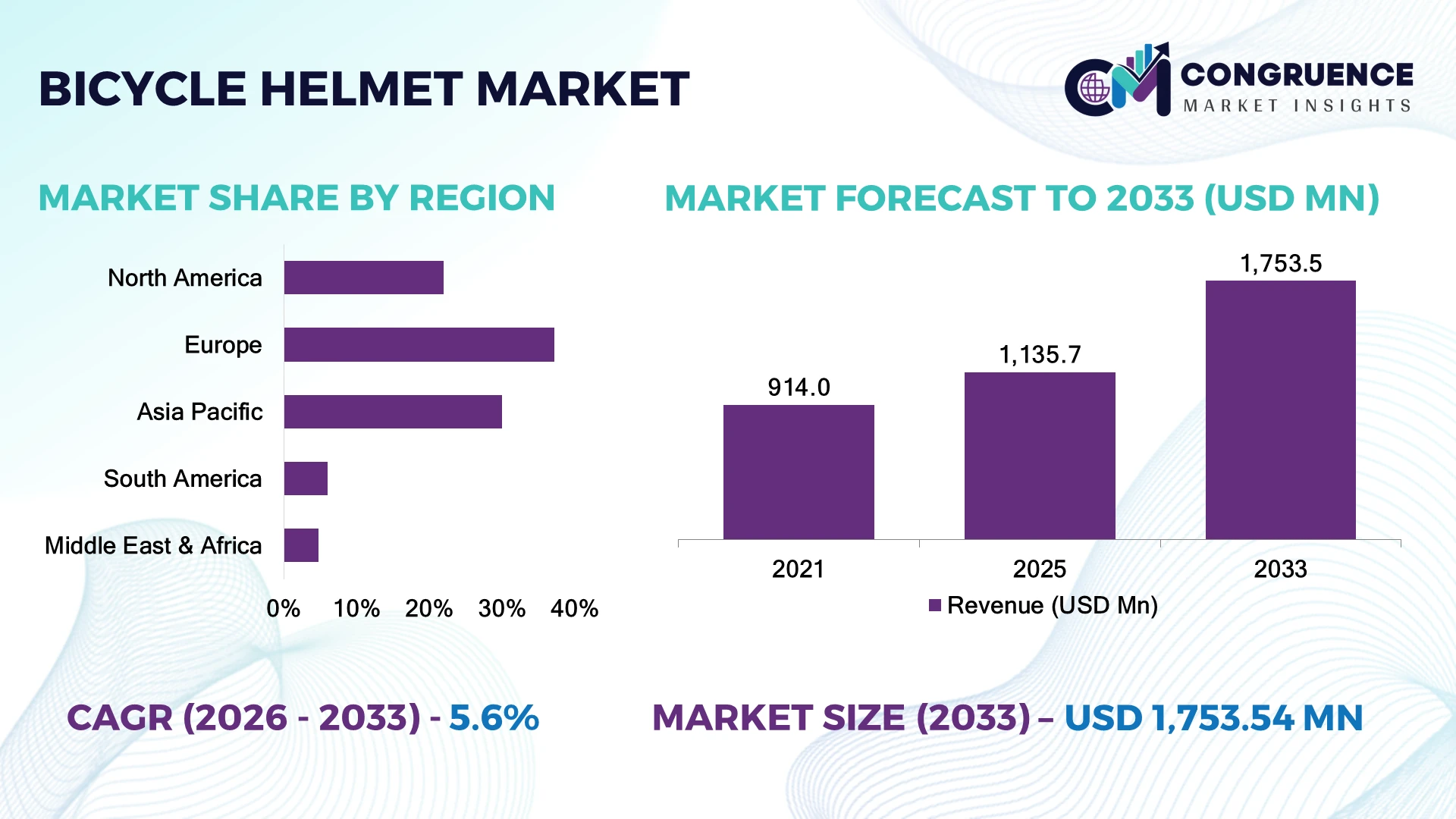
Europe held a dominant position with approximately 35% market share in 2025, supported by mature cycling infrastructure, EN-certified products, and strong commuter adoption, while North America accounted for about 31%. Asia-Pacific is expanding manufacturing capacity and digital retail penetration, with China, India, and Japan strengthening supply networks. In 2025, new European rotational-impact testing requirements further accelerated advanced helmet development.
The strategic priority is shifting toward certified, lightweight, technology-integrated helmets rather than conventional protective products.
Market Size & Growth: USD 1,135.7 million in 2025 is projected to reach USD 1,753.5 million by 2033 at a 5.58% CAGR, driven by rotational-impact protection and e-bike adoption.
Top Growth Drivers: Advanced safety technology 8–10% adoption growth; e-bike usage 10%+ annual expansion; online helmet sales 7–8% growth.
Short-Term Forecast: By 2028, smart and rotational-protection features are expected to increase penetration by 15–20%, while lightweight designs target 10% lower product weight.
Emerging Technologies: MIPS-style rotational systems, AI-enabled fit assessment, impact sensors, and advanced composite shells are reshaping premium helmet development.
Regional Leaders: Europe is projected near USD 614 million, North America around USD 544 million, and Asia-Pacific approximately USD 420 million, with Asia-Pacific showing the strongest urban-cycling adoption.
Consumer/End-User Trends: Adults represent about 79% of cycling-helmet demand, while online purchasing is approaching 42% as consumers prioritize certified protection, comfort, and rapid product comparison.
Pilot/Case Example: In 2024, European rotational-impact testing initiatives strengthened product validation, pushing manufacturers toward designs capable of addressing oblique impacts and improving safety performance.
Competitive Landscape: Leading players include Giro, Bell Sports, Trek Bicycle, KASK, and Smith, with the top five collectively holding roughly 50% share in a moderately concentrated competitive environment.
Regulatory & ESG Impact: European EN17950 rotational-impact testing is increasing compliance requirements, while recycled EPS, lower-material designs, and longer-life components are reducing material intensity by approximately 10–15%.
Investment & Funding: Industry investment is increasingly directed toward smart helmets, rotational-impact systems, automated molding, and direct-to-consumer platforms, with technology partnerships becoming a core route to differentiation.
Innovation & Future Outlook: Next-generation helmets are moving toward sensor integration, adaptive fit systems, recyclable materials, and connected safety features, shifting competition from basic protection toward measurable performance and digital functionality.
Advanced helmet materials, rotational-impact systems, and digitally assisted fitting are strengthening demand among urban commuters, e-bike users, and performance cyclists. Smart and connected helmet categories are gaining traction as manufacturers integrate sensors, lighting, communication, and fit technologies. Supply-chain restructuring and tighter European safety testing are also encouraging localized production and higher-value product development, creating a stronger basis for strategic differentiation.
The Bicycle Helmet Market is becoming strategically important as cycling transitions from recreational activity toward urban mobility, e-bike transportation, and organized micromobility. Europe’s cycling infrastructure expansion and evolving rotational-impact testing are raising the specification threshold, while North American markets continue emphasizing certified safety and premium performance. Over the next 2–3 years, advanced-feature penetration is positioned to increase as replacement purchases shift toward higher-performance helmets.
Technology is also changing the economics of product development. Rotational-impact systems add targeted protection without requiring a proportional increase in helmet mass, while digital fit technologies can reduce sizing-related returns by approximately 10–15% compared with poorly fitted conventional online purchases. Europe remains stronger in certification-led innovation, whereas Asia-Pacific combines manufacturing scale with faster e-bike and urban-mobility adoption.
Operationally, manufacturers are expanding direct-to-consumer channels, strengthening partnerships with cycling brands, and investing in automated molding and lightweight composite production. Companies are also responding to sustainability requirements through recycled materials and longer product lifecycles. Competitive advantage increasingly depends on combining certification, material efficiency, fit precision, and supply-chain responsiveness into one product platform.
The strongest growth driver is the convergence of e-bike adoption and advanced impact protection. Smart and rotational-protection technologies are expanding at roughly 8–10% annually within premium categories, while e-bike participation is increasing at more than 10% in several urban markets. Europe’s 2024 adoption of EN17950 rotational-impact testing is accelerating engineering investment in oblique-impact protection. Manufacturers are responding with MIPS-style liners, optimized EPS structures, and lighter composite shells. The operational effect is significant: safety technology is becoming a product differentiator rather than an optional premium feature. Companies with established testing capabilities are gaining faster access to European distribution, while Asian manufacturers are increasing certification investments to compete in export markets.
Cost volatility remains a structural restraint because premium helmets require EPS, polycarbonate, carbon composites, specialized liners, and increasingly sophisticated testing. Advanced rotational-protection systems can add roughly 10–20% to manufacturing costs, while certification and testing expenses increase product-development complexity. China-based manufacturers face additional exposure to freight fluctuations and changing trade conditions when supplying European and North American markets. The result is greater pressure on mid-priced product margins, particularly where consumers remain price sensitive. Companies are reducing exposure through dual sourcing, localized assembly, longer supplier contracts, and common component platforms. The key operational issue is balancing certified safety performance with affordability without sacrificing lightweight construction or ventilation.
Smart helmets present a high-value opportunity as connected safety features move beyond premium cycling. Smart variants are advancing at approximately 8% annually, while online distribution is expanding above 7%, creating a scalable route for technology-led brands. India offers an underpenetrated opportunity where urban cycling, delivery mobility, and e-bike adoption are increasing but helmet usage remains inconsistent. Manufacturers can combine integrated lighting, crash detection, navigation connectivity, and adaptive fitting to create differentiated commuter products. Partnerships with micromobility operators, bicycle-sharing platforms, and insurers can accelerate adoption while generating recurring technology ecosystems. The non-obvious opportunity lies in fleet and institutional procurement, where standardized smart helmets can generate higher-volume contracts than individual consumer sales.
The principal long-term challenge is integrating electronics, advanced liners, ventilation, comfort, and certification requirements without creating excessive weight or maintenance complexity. Connected components can increase product weight by 5–15%, while battery systems introduce charging and durability requirements absent from conventional helmets. In markets such as India, Brazil, and Southeast Asia, inconsistent cycling infrastructure also limits willingness to pay for highly connected products. Manufacturers must therefore engineer modular architectures that separate replaceable electronics from core protective structures. Companies are investing in embedded sensors, waterproof electronics, automated quality inspection, and supplier partnerships to improve reliability. Long-term competitiveness will depend on achieving technology integration without compromising impact performance, comfort, affordability, or end-of-life recyclability.
Smart Safety Integration: Connected helmet adoption is accelerating as conventional models still represent 96.17% of volume, while smart variants are expanding at 8.01%. Bluetooth communication, crash detection, rear lighting, and app connectivity are moving from premium prototypes toward commercially scalable products. Manufacturers are integrating compact electronics and modular battery systems to control weight and simplify assembly. The shift is also responding to urban mobility digitization and growing demand for real-time rider visibility.
Lightweight Material Engineering: Advanced EPS structures, polycarbonate shells, carbon-reinforced components, and optimized ventilation are reshaping product engineering, with road and recreational helmets tracking around 7.91% growth and premium designs increasingly targeting double-digit weight reductions. Manufacturers are using computational design and precision molding to improve impact performance without adding bulk. This creates a non-obvious advantage: lighter helmets reduce user fatigue, supporting longer commuting and e-bike journeys while lowering material consumption per unit.
Online Channel Restructuring: Digital purchasing is gaining operational importance as online sales expand at approximately 7.25%, while offline retail retains about 57.91% of sales. Brands are combining virtual fitting guidance, customer reviews, digital certification information, and direct-to-consumer fulfillment to compensate for the physical fitting advantage of stores. Post-pandemic inventory restructuring is also encouraging tighter SKU management and regional warehousing, reducing slow-moving stock while allowing manufacturers to test new designs faster.
Compliance-Led Product Upgrades: Regulatory enforcement is increasingly influencing helmet specifications, particularly in India and European cycling markets. More than 500 helmet samples underwent testing in India during FY2024–25, increasing pressure on manufacturers to document certification, impact performance, and material consistency. Companies are responding with localized testing, supplier qualification, and traceable production workflows. The operational shift is significant because compliance is becoming a commercial differentiator rather than merely a market-entry requirement.
Road Helmets, Mountain Bike (MTB) Helmets, and Sports/Adventure Helmets form the core type structure. Road Helmets hold the leading position at approximately 42% share, supported by lightweight construction, aerodynamic profiles, ventilation, and broad use across fitness and long-distance cycling. Their established manufacturing base and standardized component architecture enable stronger scalability and cost control than specialized designs. Sports/Adventure Helmets retain approximately 25%–30% demand, benefiting from premium safety specifications and performance-oriented purchasing, while MTB Helmets represent roughly 30% and increasingly command higher-value positioning through extended rear coverage, visors, and multi-directional impact protection.
MTB Helmets are the fastest-growing type, with adoption accelerating at approximately 19% as mountain biking, trail riding, and e-bike off-road usage expand. Their faster adoption is shifting manufacturer investment toward reinforced structures, integrated visors, and improved ventilation. Road-focused brands are broadening MTB portfolios, while specialist manufacturers are increasing partnerships with cycling-event networks and retailers. The strategic implication is clear: road helmets continue to provide volume stability, but MTB products increasingly offer stronger premiumization potential and higher technology content.
Sports/Adventure is the leading application at approximately 47% share, reflecting strong demand from competitive cyclists, mountain bikers, endurance riders, and adventure users. Buyers in this category prioritize certified impact protection, low weight, ventilation, aerodynamic performance, and advanced fit systems. Daily Transportation represents approximately 40% of demand and is the fastest-growing application, driven by commuting, e-bike usage, cycling infrastructure, and increasing integration of bicycles into urban mobility systems. Recreational Mountain use accounts for the remaining demand and continues to support replacement purchases and family-oriented cycling participation.
Daily Transportation is advancing at approximately 18%, substantially faster than established sports-oriented purchasing patterns. Manufacturers are therefore shifting product development toward reflective elements, integrated rear lights, weather resistance, easy-adjust fit systems, and compatibility with everyday clothing. In China, where e-bikes represented 68% of global e-bike sales in 2024, helmet suppliers increasingly align products with high-volume urban mobility channels. The business implication is a broader addressable customer base, with companies expanding commuter portfolios while retaining premium sports products for margin protection.
Adults represent the dominant end-user group at approximately 78.71% share, reflecting extensive participation in commuting, road cycling, mountain biking, fitness, and e-bike mobility. Adult purchasing spans budget, mid-range, and premium categories, giving manufacturers a broad opportunity to segment products by performance, certification, weight, and connectivity. Children account for a smaller share but represent the fastest-growing end-user group, expanding at approximately 7.81% as parents, schools, and community programs place greater emphasis on protective equipment and safe cycling participation.
The adult segment benefits from replacement demand and premiumization, while children’s products increasingly emphasize adjustable sizing, lightweight shells, visibility, and simplified fit systems. Kids-focused demand is also more sensitive to affordability, encouraging manufacturers to use standardized components and scalable molding processes. Companies are responding with dedicated youth collections, family-oriented product bundles, retail partnerships, and broader size ranges. The strategic shift is toward lifetime customer acquisition: brands that capture riders through children’s helmets can build repeat purchasing pathways as users transition into adult road, commuter, and sports categories.
Europe accounted for the largest market share at 37.2% in 2025 however, Asia-Pacific is expected to register the fastest growth, expanding at a CAGR of 7.71% between 2026 and 2033.
North America maintains a strong position with approximately 22.0% of global bicycle helmet demand, supported by established cycling participation, premium road-bike ownership, mountain biking, and stringent helmet-use requirements across multiple U.S. jurisdictions and Canadian provinces. The United States represents the region’s primary demand center, with approximately 18% of global cycling-helmet consumption concentrated in the country. Organized cycling also sustains premium product demand, with nearly 90% of organized U.S. cyclists using certified helmets. Manufacturers are expanding MIPS-equipped designs, lightweight composites, smart visibility systems, and direct-to-consumer channels. E-bike commuting and urban cycling infrastructure are shifting purchasing toward helmets combining protection with lighting and connectivity, creating stronger replacement opportunities beyond traditional sports users.
United States Market Outlook: The United States remains the region’s principal commercial and innovation hub, supported by a large recreational cycling base, established specialty retail networks, and strong premium-brand penetration. Approximately 52.3 million Americans participated in cycling activities in 2025, supporting demand across road, mountain, commuter, and recreational categories. Manufacturers are prioritizing advanced impact-management systems, connected features, and digitally supported fitting services to capture higher-value consumers.
Europe holds the largest regional position at approximately 37.2%, supported by extensive cycling infrastructure, mature cycling cultures, e-bike adoption, and increasingly coordinated road-safety policies. More than 900,000 km of cycling paths and lanes were identified across the European Union in 2026, strengthening the structural base for commuter and recreational helmet demand. Approximately 24% of EU residents cycle at least once weekly, creating a broad recurring user pool. From 2021–2027, around EUR 4.5 billion is allocated to cycling investments, supporting more than 12,000 km of new or upgraded cycle paths. Manufacturers are aligning product portfolios with urban mobility through reflective systems, integrated lighting, lightweight construction, and enhanced impact protection.
Germany Market Outlook: Germany is a strategically important European market because of its established cycling culture, extensive bicycle infrastructure, engineering capabilities, and strong emphasis on road-user safety. Its position within Europe’s high-value cycling ecosystem supports premium helmet adoption across commuting, road cycling, and e-bike applications. Manufacturers increasingly use Germany as a testing and product-positioning market for advanced fit systems, aerodynamic designs, and safety technologies.
Asia-Pacific represents approximately 30.0% of global bicycle helmet demand and is the fastest-expanding regional market, supported by manufacturing scale, urban mobility programs, e-bike penetration, and expanding consumer spending on certified protective equipment. China alone accounted for approximately 68% of global e-bike sales in 2024, creating a substantial addressable base for commuter and e-bike helmet products. India is simultaneously expanding certified domestic manufacturing and distribution across tier-2 and tier-3 cities. Manufacturers are shifting production toward lightweight injection-molded shells, rotational-impact systems, smart lighting, and digitally distributed products. The region’s strategic advantage lies in combining high-volume manufacturing with rapidly expanding domestic demand, allowing companies to shorten product-development cycles and localize pricing.
China Market Outlook: China is the region’s most strategically significant country, combining large-scale bicycle and e-bike manufacturing with extensive urban cycling and sharing infrastructure. Its 68% share of global e-bike sales in 2024 provides manufacturers with an unusually large commuter-focused customer base. Domestic producers are moving beyond low-cost helmets toward mid-range and premium products incorporating improved ventilation, rotational-impact protection, integrated lighting, and digitally enabled retail experiences.
South America accounts for approximately 6.0% of global bicycle helmet demand, with Brazil representing the principal commercial center and Colombia and Argentina providing important cycling and sports demand. Brazil’s large urban population and expanding cycling infrastructure are strengthening commuter applications, while Colombia’s established road-cycling culture supports higher-value performance helmets. Regional demand remains more price-sensitive than North America and Europe, increasing the importance of efficient molding, localized distribution, and durable materials. Manufacturers are responding through distributor partnerships, broader mid-range portfolios, and selective expansion into urban mobility channels. The strategic opportunity is strongest where cycling infrastructure and organized cycling participation overlap, although fragmented retail networks and uneven infrastructure investment continue to constrain uniform deployment.
Brazil Market Outlook: Brazil is the region’s leading market, supported by its large consumer base, major metropolitan cycling networks, and established recreational and competitive cycling communities. Approximately 3.5% of global bicycle-helmet demand is concentrated in Brazil, giving manufacturers a substantial entry point into South American distribution. Companies are emphasizing affordable certified helmets, stronger retail coverage, and products suited to commuting and recreational cycling rather than relying exclusively on premium sports models.
Middle East & Africa contributes approximately 4.8% of global bicycle helmet demand, with adoption concentrated in the Gulf states, South Africa, and selected urban centers where cycling infrastructure, tourism, and organized sporting events are expanding. Gulf countries are creating dedicated cycling destinations and mobility infrastructure, supporting demand for premium road, sports, and adventure helmets. South Africa remains an established cycling market with stronger recreational and competitive participation than many neighboring countries. Manufacturers are prioritizing heat-management ventilation, lightweight shells, high-visibility components, and durable materials suited to demanding climates. The region remains operationally fragmented, so companies are favoring distributor partnerships and project-based deployments rather than broad physical expansion, while premium tourism and sporting ecosystems create higher-value niche opportunities.
United Arab Emirates Market Outlook: The United Arab Emirates is the region’s most strategically significant market because of rapid cycling-infrastructure modernization, sports-tourism investment, and purpose-built cycling destinations. Dubai and Abu Dhabi have expanded dedicated cycling facilities and organized cycling events, strengthening demand for premium protective equipment. Manufacturers can leverage partnerships with cycling clubs, sporting venues, retailers, and mobility operators to position advanced helmets around heat dissipation, visibility, lightweight construction, and smart safety functionality.
Bell and Giro compete as broad-distribution leaders against Specialized, POC, MET, KASK, ABUS, and Trek/Bontrager, while regional manufacturers compete on price and manufacturing scale. The market remains moderately fragmented, with the top five players controlling approximately 35% share. Competition centers on safety technology, certification, brand equity, distribution, supply-chain responsiveness, and differentiation. Premium players use MIPS, variable-density EPS, CFD, wind-tunnel validation, and advanced fit systems, while cost-focused Asian manufacturers emphasize scalable molding and pricing. Technology-rich products command approximately 15%–25% higher price positioning, while direct-to-consumer channels can reduce distribution layers by roughly 10%–20%. Players compete through athlete partnerships, expansion, product launches, testing infrastructure, and vertical control over design and distribution. The competitive shift is moving from basic impact protection toward rotational protection, aerodynamics, ventilation, connectivity, and certification transparency. Entry barriers remain high around testing, brand trust, tooling, certification, and retail access. Winning requires technology leadership, scalable production, credible safety validation, and omnichannel execution.
Bell Sports
Giro Sport Design
Specialized Bicycle Components
POC Sports
MET Helmets
KASK S.p.A.
ABUS August Bremicker Söhne KG
Trek Bicycle Corporation
Uvex Sports
Fox Racing
Rudy Project
Limar
Rotational-impact protection is becoming the core safety upgrade, with Mips-style systems increasingly integrated into mainstream road, MTB, and commuter helmets. Compared with conventional single-density EPS construction, multi-directional impact systems target rotational-energy management, while optimized liner structures deliver 10%–15% weight reductions in selected premium designs. Adoption is strongest in performance-focused products, giving technology-led brands a premium positioning advantage.
Computational Fluid Dynamics (CFD), wind-tunnel testing, and variable-density EPS are moving helmet development from trial-and-error prototyping toward data-driven engineering. Recent designs demonstrate ventilation improvements of 10%–16%, while advanced airflow optimization can reduce thermal discomfort without increasing shell volume. In 2026–2028, digital simulation will shorten design-validation cycles, allowing manufacturers such as Specialized, POC, and MET to introduce performance revisions faster and with tighter engineering control.
The disruptive layer is connected safety: crash detection, Bluetooth communication, integrated lighting, and smartphone-linked visibility systems. Smart functionality is expanding from niche products toward urban and e-bike applications, where connectivity can improve incident response and rider visibility by roughly 15%–20%. Companies that combine electronics with lightweight shells, reliable batteries, and certification-ready architectures will gain an advantage. Sustainability will also influence 2026–2028 development as recyclable polymers, lower-material designs, and modular components reduce replacement waste and simplify product servicing and overall costs.
June 2025 Bell Sports voluntarily recalled selected bicycle helmets after testing identified noncompliance with mandatory U.S. impact requirements. The recall covered Axle, Cadence, Rev, Passage, and Frenzy units. Business impact: manufacturers face stronger certification and quality-control scrutiny controls. Source: bellhelmets.com
March 2025 POC launched Cytal and Cularis mountain-bike helmets, integrating Mips Air Node, CFD ventilation, variable-density EPS, and breakaway components. Cularis achieved a five-star Virginia Tech rating. Business impact: premium brands are converting research into differentiated safety performance. Source: poc.com
2025 MET expanded its Tube wind tunnel in Italy, combining thermal testing, crash laboratories, FEM, and 3D prototyping. Recent helmets achieved ventilation improvements of up to 33%. Business impact: faster validation strengthens development control and performance differentiation. Source: met-helmets.com
July 2025 Specialized launched S-Works Evade 3 Red Bull edition, combining CFD and wind-tunnel development with Mips Node Air and 10% better ventilation. The helmet achieved five-star Virginia Tech testing. Business impact: engineering supports positioning and team partnerships. Source: specialized.com
The Bicycle Helmet Market Report covers the global industry across Road Helmets, Mountain Bike (MTB) Helmets, and Sports/Adventure Helmets, with applications spanning Sports/Adventure, Daily Transportation, and Recreational Mountain use. End-user analysis distinguishes Adults and Children, capturing differences in safety priorities, fit requirements, purchasing behavior, replacement cycles, and premium-product adoption.
The report evaluates Europe, North America, Asia-Pacific, South America, and the Middle East & Africa, with country-level emphasis on major manufacturing, consumption, and infrastructure hubs. Coverage includes rotational-impact protection, Mips integration, CFD-based airflow engineering, advanced EPS structures, connected safety systems, lightweight composites, and digital distribution. Approximately 37.2% regional share for Europe and 7.7% Asia-Pacific growth positioning provide strategic context for investment planning, market expansion, portfolio prioritization, supplier localization, competitive benchmarking, and technology deployment through 2026–2033.
| Report Attribute / Metric Details | Details |
|---|---|
| Market Revenue (2025) | USD 1,135.7 Million |
| Market Revenue (2033) | USD 1,753.5 Million |
| CAGR (2026–2033) | 5.58% |
| Base Year | 2025 |
| Forecast Period | 2026–2033 |
| Historic Period | 2021–2025 |
| Segments Covered |
By Type
By Application
By End-User
|
| Key Deliverables | Revenue Forecast; Market Trends; Growth Drivers & Restraints; Technology Insights; Segmentation Analysis; Regional Insights; Competitive Landscape; Regulatory & ESG Overview; Recent Developments |
| Regions Covered | North America; Europe; Asia-Pacific; South America; Middle East & Africa |
| Companies Profiled | Bell Sports; Giro Sport Design; Specialized Bicycle Components; POC Sports; MET Helmets; KASK S.p.A.; ABUS August Bremicker Söhne KG; Trek Bicycle Corporation; Uvex Sports; Fox Racing; Rudy Project; Limar |
| Customization & Pricing | Available on Request (10% Customization Free) |




