
Reports
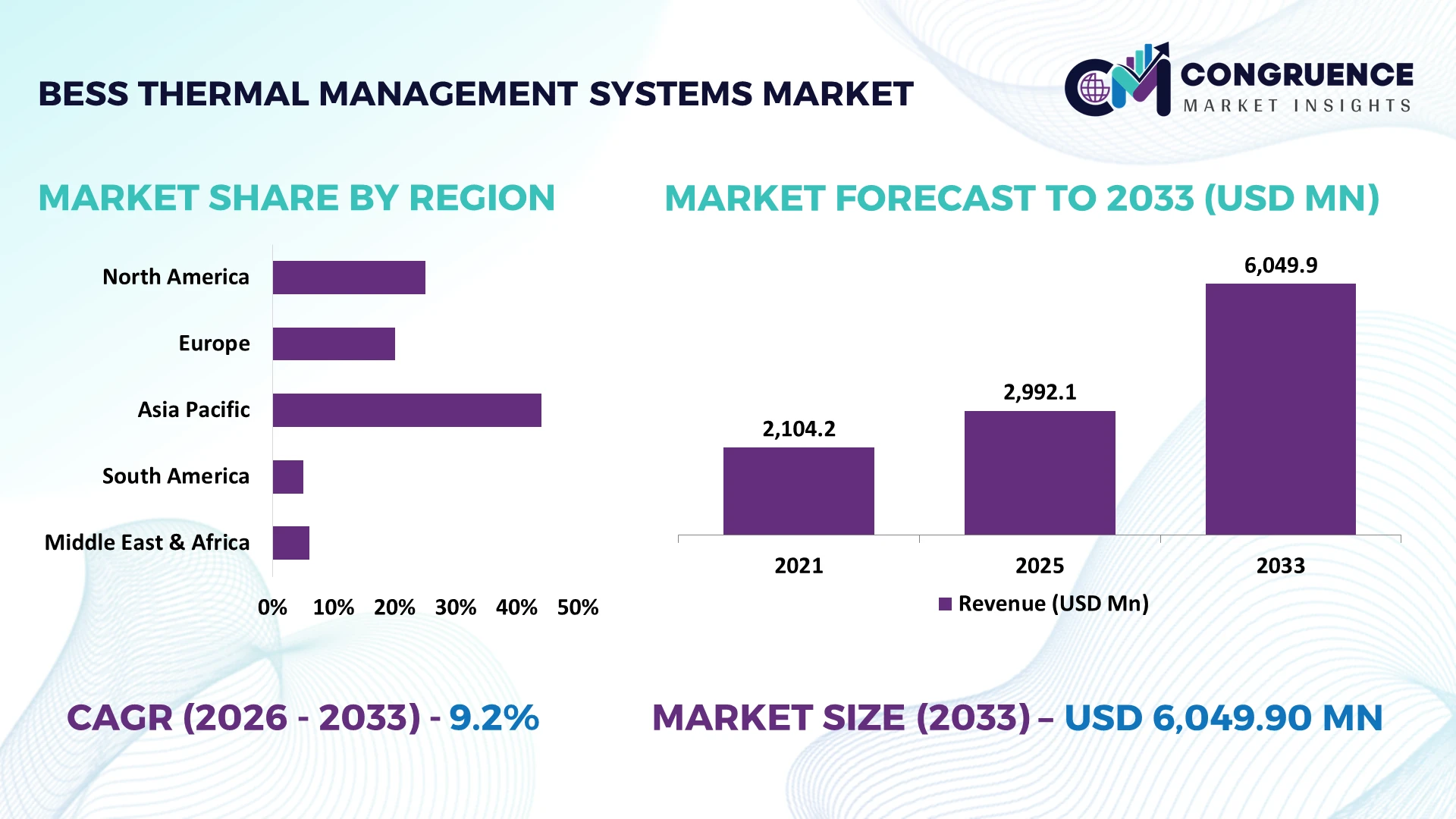
The Global BESS Thermal Management Systems Market was valued at USD 2992.08 Million in 2025 and is anticipated to reach a value of USD 6049.9 Million by 2033 expanding at a CAGR of 9.2% between 2026 and 2033. Growth is driven by the transition from air cooling to liquid cooling architectures, rising energy density in grid scale lithium ion storage, and stricter thermal runaway prevention requirements for utility scale battery installations.
China dominates the deployment landscape, accounting for more than 50% of global BESS installed capacity by the end of 2025. Its new type energy storage base reached 136 GW and 351 GWh, with lithium ion technology representing 96.1% of installed capacity. Government backed expansion targets 300 GW of new energy storage by 2030, strengthening investment across battery manufacturing, renewable power, grid infrastructure and industrial storage. By comparison, the United States recorded 57.6 GWh of new installations in 2025, while Europe added 36 GWh. China's manufacturing scale and deployment concentration establish it as the primary sourcing and technology development hub.
Strategic implication: Prioritize liquid cooling partnerships, localized manufacturing and thermal safety engineering in China while expanding project specific solutions across North American and European utility scale markets.
Market Size & Growth: USD 2,992.08 million in 2025 to USD 6,049.9 million by 2033, at 9.2% CAGR, supported by liquid cooling adoption and larger grid scale battery installations.
Top Growth Drivers: China represents over 50% of global installed BESS capacity, utility scale applications account for nearly 65% of global BESS investment, and utility scale systems contributed 55% of new EU installations.
Short Term Forecast: By 2028, advanced liquid cooling adoption is positioned to improve thermal control efficiency by 5% to 10% through optimized coolant circulation and intelligent temperature monitoring.
Emerging Technologies: AI enabled thermal prediction, direct liquid cooling and immersion cooling are advancing battery temperature uniformity, automated fault detection and thermal runaway prevention.
Regional Leaders: Asia Pacific is projected to reach USD 3,025 million, North America USD 1,512 million and Europe USD 1,210 million by 2033, based on indicative regional revenue allocations. China leads manufacturing, the US expands utility storage, and Europe accelerates grid connected installations.
Consumer and End User Trends: Utility scale operators are driving procurement, representing approximately 65% of global BESS investment in 2025, with growing emphasis on continuous cooling performance and lifecycle reliability.
Pilot and Case Example: A 2025 liquid cooling research demonstration combining mechanical vapor recompression and falling film evaporation achieved 76.7% higher energy efficiency than conventional air cooling, strengthening the economics of advanced thermal architectures.
Competitive Landscape: Shenzhen Envicool is a prominent thermal management supplier alongside Vertiv, Sungrow, Delta Electronics and Pfannenberg. BYD, Tesla and Sungrow collectively held approximately 33% of global BESS system shipments in 2025, demonstrating the influence of vertically integrated suppliers.
Regulatory and ESG Impact: UL 9540A testing under NFPA 855 and the International Fire Code strengthens thermal runaway assessment, increasing the importance of integrated cooling, fire protection and safety monitoring.
Investment and Funding: Global BESS investment approached USD 80 billion in 2025, increasing more than 30% year on year, with utility scale projects attracting nearly 65% of spending.
Innovation and Future Outlook: Next generation systems will combine AI diagnostics, predictive maintenance, immersion cooling and low energy refrigeration, shifting competition toward integrated thermal safety, operational efficiency and long term asset performance.
Demand is concentrated in utility scale battery installations, renewable energy integration projects, commercial energy storage and grid stabilization infrastructure. Liquid cooling is gaining traction as high capacity lithium ion installations require tighter temperature control and improved operating reliability. A 76.7% energy efficiency improvement demonstrated by an advanced liquid cooling research design highlights the performance advantage over conventional air cooling. Another emerging trend is integrating AI based diagnostics with battery management systems to detect thermal abnormalities earlier. China's expanding storage manufacturing ecosystem and tightening international fire safety requirements are accelerating the shift toward integrated thermal management solutions, creating opportunities for suppliers to differentiate through efficiency, safety and lifecycle performance.
BESS thermal management is becoming a strategic differentiator because battery temperature control directly influences asset lifespan, usable capacity, fire safety and project economics. Competition is shifting from standalone cooling equipment toward integrated thermal architectures combining liquid cooling, battery management systems and predictive diagnostics. Supply chain restructuring is equally important: China controls over 80% of global lithium ion battery cell production, prompting US and European manufacturers to strengthen domestic sourcing and manufacturing partnerships.
Technology selection is changing project economics. Experimental research published in 2026 found that indirect liquid cooling reduced average battery temperature by 17°C compared with air cooling, while reducing the measured state of health degradation from 4.4% to 1.7%. This represents a 61% reduction in degradation under the tested conditions. China benefits from manufacturing scale, whereas the United States emphasizes supply chain security and Europe prioritizes safety compliance and system efficiency.
During 2027–2029, procurement priorities will increasingly include automated temperature monitoring, coolant leakage detection, modular servicing and predictive maintenance. A 2025 field study of two phase liquid cooling in a containerized storage installation demonstrates the transition toward application tested cooling architectures. Manufacturers are responding through localized assembly, engineering partnerships and investment in intelligent cooling platforms. Competitive advantage will depend on delivering measurable battery life improvements, thermal safety and lower auxiliary energy consumption rather than cooling capacity alone.
Increasing battery energy density and intensive charge discharge cycles are strengthening demand for advanced thermal management. Lithium ion batteries typically achieve 85% to 95% energy efficiency, while a 1 MWh system can generate 10 to 50 kW of thermal power under the assessed operating assumptions. Higher heat loads increase temperature gradients, accelerate cell degradation and intensify thermal runaway exposure. China's expansion of large scale LFP storage installations reinforces demand for liquid cooling and precision temperature regulation. Manufacturers are responding through integrated cooling plates, variable speed pumps and rack level monitoring. The strategic advantage lies in reducing battery degradation and cooling energy consumption simultaneously, improving lifetime asset economics.
China's dominance in battery manufacturing creates procurement exposure for thermal management suppliers sourcing battery compatible components, power electronics and specialized materials. In 2025, China accounted for over 80% of global battery cell production, approximately 85% of cathode active material production and more than 90% of anode active material production. This concentration increases exposure to export restrictions, logistics disruptions and supplier pricing pressure. US manufacturers face additional localization requirements as domestic battery infrastructure expands. Companies are mitigating exposure through dual sourcing, regional assembly partnerships and longer term component contracts. The critical restraint is not cooling technology availability but securing consistent, competitively priced components across geographically concentrated supply chains.
Advanced liquid cooling, microchannel heat exchangers and AI enabled thermal diagnostics offer opportunities to improve battery utilization and reduce lifetime maintenance requirements. A 2026 experimental study demonstrated a 17°C reduction in average battery temperature and a reduction in state of health degradation from 4.4% to 1.7% compared with air cooling. These results strengthen the commercial case for precision cooling in high density installations. India's expanding renewable energy storage infrastructure also creates opportunities for localized thermal management manufacturing and service networks. Suppliers are investing in modular cooling platforms, digital twins and predictive maintenance partnerships. The strongest opportunity lies in monetizing improved battery longevity through performance based service agreements rather than equipment sales alone.
Integrating thermal management with battery management systems, power conversion equipment and energy management software creates substantial engineering complexity. Battery operating efficiency typically ranges between 85% and 95%, making cooling energy consumption and auxiliary loads important determinants of overall system performance. Thermal management must also maintain consistent operation across changing ambient temperatures, charging rates and battery aging conditions. In the United States, the sixth edition of UL 9540A, published in March 2026, reinforces the importance of rigorous thermal runaway propagation testing. Cybersecurity adds another operational challenge as remote monitoring expands across interconnected installations. Manufacturers must invest in interoperable controls, leak detection, cybersecurity validation and qualified service personnel. Long term competitiveness depends on delivering reliable thermal protection across the complete battery lifecycle.
Liquid Cooling Standardization Accelerates: High density battery installations are accelerating the transition toward liquid cooled thermal architectures. Utility scale systems accounted for approximately 80% of new battery storage capacity additions in 2025, increasing demand for rack level cooling, coolant circulation controls and integrated heat exchangers. Manufacturers are standardizing modular cooling units to simplify installation, servicing and thermal performance across large battery enclosures.
Longer Duration Storage Changes Design: Average duration of newly commissioned battery projects increased from 2 hours in 2023 to 3 hours in 2025. Longer discharge cycles increase sustained thermal loads, requiring improved heat dissipation and temperature uniformity. Chinese manufacturers are adapting cooling plate configurations and pump controls to support larger LFP battery installations and continuous operating cycles.
LFP Chemistry Reshapes Cooling Requirements: LFP batteries represented approximately 90% of global battery storage deployments in 2025, compared with less than 50% five years earlier. Their growing use in stationary storage is encouraging manufacturers to redesign thermal interfaces around high cycle frequency, cell configuration and container density rather than relying exclusively on conventional cooling capacity.
Digital Monitoring Enters Operations: Battery based UPS capacity additions increased 30% to 45 GW in 2025, reflecting growing data centre requirements. Operators are integrating temperature sensors, automated alarms and predictive diagnostics to reduce thermal faults and maintenance interruptions. Equipment suppliers are strengthening software integration and remote monitoring capabilities to differentiate their thermal management portfolios.
Liquid Cooling Systems represent the leading type, with an estimated 62% share of the BESS thermal management market in 2025. Their dominance reflects superior heat transfer, temperature uniformity and compatibility with high capacity battery racks. Air Cooling Systems retain an estimated 25% share, particularly in smaller installations and cost sensitive projects where simpler maintenance and lower system complexity outweigh cooling intensity. Direct Cooling Systems provide targeted heat extraction for specialized battery configurations, while Immersion Cooling Systems are emerging for applications requiring advanced thermal uniformity and high power density. HVAC Based Systems remain relevant for enclosure temperature regulation and environmental conditioning.
Liquid cooling is also the fastest growing mainstream architecture, supported by increasing container density and longer operating cycles. Immersion cooling represents a differentiated investment opportunity, although fluid compatibility, servicing requirements and deployment economics limit broader adoption. Manufacturers are prioritizing integrated coolant distribution, modular chillers and application specific product portfolios. The investment shift favors systems that combine thermal performance with lower auxiliary consumption and simplified maintenance.
Grid Scale Energy Storage represents the leading application, with an estimated 58% share of thermal management system demand. Large installations require continuous temperature regulation across multiple battery racks, making cooling reliability essential for availability and asset protection. Renewable Energy Storage is the fastest growing application, driven by increasing solar and wind integration and the need to manage intermittent generation. Peak Shaving and Frequency Regulation remain important applications, although their thermal requirements differ according to discharge intensity, response speed and operating frequency. Backup Power and Microgrid Storage support localized resilience, particularly in industrial facilities and electricity constrained locations.
In 2025, approximately 80% of newly deployed battery capacity was utility scale, reinforcing procurement concentration in grid connected projects. Meanwhile, energy shifting accounted for more than 90% of new battery projects by primary application, compared with around 40% in 2015. This shift increases demand for cooling systems engineered for sustained discharge rather than occasional grid response. Suppliers are developing containerized cooling packages, renewable integrated controls and application specific service contracts.
Utility Companies represent the leading end user group, with an estimated 60% share of BESS thermal management demand in 2025. Their dominance reflects large scale grid storage procurement, electricity network modernization and the need for continuous battery temperature regulation. Renewable Energy Developers are the fastest growing end user category as solar and wind operators increasingly integrate battery storage to manage generation variability. Commercial and Industrial Facilities are expanding adoption to control electricity costs, support peak demand management and improve power reliability. Battery Storage Operators prioritize cooling reliability, predictive maintenance and lifecycle performance, while Microgrid Operators require compact thermal architectures suited to decentralized electricity networks.
Approximately 80% of new battery capacity deployed in 2025 was utility scale, reinforcing infrastructure focused purchasing. By contrast, commercial and industrial buyers increasingly prioritize modular equipment, lower auxiliary consumption and simplified maintenance. Suppliers are responding with customized cooling configurations, long term service agreements and partnerships with battery integrators. China remains important for large volume utility procurement, while US commercial installations create opportunities for localized engineering and service networks. Future competitive positioning will depend on matching cooling capacity, maintenance economics and system integration requirements to distinct buyer operating models.
Asia Pacific accounted for the largest market share at 45.5% in 2025; however, South America is expected to register the fastest growth, expanding at a CAGR of 10.8% between 2026 and 2033.
Utility Scale Expansion and Domestic Manufacturing Reshape Procurement
North America represents an estimated 29.5% of global BESS thermal management demand, supported by large utility installations, grid modernization and data center power requirements. The United States dominates regional procurement, with 57.6 GWh of new energy storage installations in 2025, representing a 30% annual increase. Utility scale projects create demand for high capacity liquid cooling, integrated fire protection and remote temperature monitoring. Domestic manufacturing incentives and supply chain diversification are encouraging thermal equipment suppliers to establish regional assembly, service and engineering capabilities. Increasing deployment of four hour storage configurations is also shifting procurement toward cooling systems designed for sustained thermal loads rather than short duration operation. Suppliers with established relationships across battery integrators, utilities and engineering contractors hold an advantage in project qualification and installation speed.
United States Market Outlook: The United States benefits from established battery integration companies, advanced power electronics manufacturing and extensive utility procurement. Its 2025 deployment of 57.6 GWh strengthens demand for containerized cooling equipment, modular chillers and intelligent thermal controls. Domestic content requirements and grid reliability investments are encouraging suppliers to expand local manufacturing and technical support capabilities.
Grid Flexibility and Safety Compliance Drive Equipment Upgrades
Europe accounts for an estimated 20% of global BESS thermal management demand, supported by renewable integration, electricity network modernization and stringent battery safety requirements. Germany, the United Kingdom and Italy remain important deployment markets, while Bulgaria and Spain are attracting additional project investment. Europe installed 36 GWh of new battery storage capacity in 2025, representing 48% annual growth. Utility scale installations contributed more than half of new capacity, changing procurement priorities toward centralized cooling infrastructure and continuous monitoring. European equipment suppliers are emphasizing energy efficient chillers, refrigerant management and integrated safety controls. The shift toward larger grid connected installations also increases demand for standardized thermal interfaces that simplify maintenance across multiple battery enclosures.
Germany Market Outlook: Germany combines industrial engineering expertise, established electrical equipment manufacturing and advanced renewable integration capabilities. Its large battery installation base supports demand for precision cooling, industrial HVAC integration and automated monitoring. The expansion of large scale battery capacity to 3.7 GWh in 2025, a 57% increase, strengthens opportunities for suppliers offering modular cooling and lifecycle maintenance solutions.
Manufacturing Concentration and Deployment Scale Strengthen Leadership
Asia Pacific commands an estimated 45.5% of global BESS thermal management demand, supported by China's battery manufacturing concentration, large scale energy storage deployment and expanding renewable infrastructure. China added approximately 63 GW of battery storage capacity in 2025, representing nearly 60% of global additions. Its extensive LFP battery manufacturing ecosystem supports integrated cooling plate production, liquid circulation systems and containerized thermal management. India, Australia, Japan and South Korea are strengthening regional demand through grid stabilization, renewable integration and industrial storage projects. China's manufacturing scale creates cost advantages, while Australian and Indian projects increasingly prioritize localized engineering and service capabilities. Suppliers are expanding production capacity, forming battery integrator partnerships and developing climate adapted cooling equipment to serve diverse installation conditions.
China Market Outlook: China maintains a structural advantage through concentrated battery cell production, established thermal equipment manufacturing and large utility procurement programs. Its 2025 battery deployment exceeded 63 GW, creating substantial requirements for liquid cooling, rack level temperature monitoring and thermal safety integration. Domestic suppliers benefit from proximity to battery manufacturers, shorter qualification cycles and established component sourcing networks.
Solar Integration Creates Demand for Grid Scale Cooling
South America represents an estimated 3% of global BESS thermal management demand, with Chile and Brazil emerging as important deployment markets. Chile's solar intensive electricity system creates demand for battery installations that absorb daytime generation surpluses and support evening peak consumption. Brazil offers a larger electricity infrastructure opportunity through renewable integration, industrial power management and grid flexibility requirements. Regional battery deployment reached approximately 1.2 GW in 2024, with Brazil and Chile accounting for most installations. Limited domestic battery manufacturing and dependence on imported cooling components increase procurement costs and project delivery complexity. Suppliers are responding through distributor partnerships, modular containerized cooling systems and localized maintenance arrangements. The strongest commercial opportunities involve equipment designed for high ambient temperatures, remote installations and variable grid operating conditions.
Chile Market Outlook: Chile benefits from concentrated solar generation, mining electricity requirements and established renewable infrastructure. Its northern regions create strong operational demand for battery storage to manage solar intermittency and evening electricity requirements. The country's approximately 1.2 GW regional installed battery base in 2024 provides a foundation for specialized liquid cooling, dust resistant enclosures and remote monitoring solutions.
Utility Modernization and Extreme Climate Engineering Accelerate Adoption
The Middle East and Africa account for an estimated 2% of global BESS thermal management demand, with Saudi Arabia emerging as a major deployment center. Regional battery additions exceeded 3 GW in 2025, more than tripling the previous year's level, driven primarily by large Saudi utility projects. High ambient temperatures and dust exposure increase the importance of heat exchanger performance, filtration efficiency and sealed cooling architectures. South Africa also presents opportunities through electricity reliability investments and renewable linked storage. Limited local manufacturing and specialized maintenance infrastructure create dependence on imported thermal equipment. Suppliers are responding with climate engineered liquid cooling packages, regional service partnerships and integrated temperature monitoring. Equipment durability and maintenance accessibility are particularly important purchasing criteria in remote desert installations.
Saudi Arabia Market Outlook: Saudi Arabia is strengthening its position through utility scale storage procurement, renewable energy development and electricity infrastructure modernization. Its battery deployment expansion creates opportunities for suppliers specializing in high ambient temperature operation, corrosion resistant components and liquid cooling systems. Companies establishing local technical support, installation partnerships and long term maintenance capabilities gain an advantage in large infrastructure contracts.
The market remains fragmented, with an estimated 35% combined share for the five largest thermal management suppliers; this is an analytical estimate because suppliers rarely disclose BESS specific cooling revenue. Envicool, Vertiv, Delta Electronics, Pfannenberg and Munters compete in engineered cooling equipment, while Sungrow and CATL leverage battery integration and manufacturing scale. Boyd, Danfoss and Modine compete through heat transfer components and industrial cooling expertise. Competition spans global thermal specialists, Chinese cost leaders, battery OEMs and system integrators. Product performance, price, supply assurance and customization determine awards. Liquid cooling is increasingly specified for utility projects, where 80% of 2025 battery additions were utility scale; this shifts value toward rack design, controls and service coverage. Suppliers are expanding local assembly, partnering with integrators and bundling monitoring with cooling hardware. Qualification testing, safety compliance and field service create entry barriers. Winning requires reliable thermal performance, competitive lifecycle cost and rapid regional support.
Shenzhen Envicool Technology Co., Ltd.
Vertiv Holdings Co.
Sungrow Power Supply Co., Ltd.
Delta Electronics, Inc.
Pfannenberg Group Holding GmbH
Boyd Corporation
Danfoss A/S
Modine Manufacturing Company
Munters Group AB
Rittal GmbH & Co. KG
CATL
Fluence Energy, Inc.
Beijing HyperStrong Technology Co., Ltd.
Chengdu Tecloman Energy Storage Technology Co., Ltd.
Current BESS installations increasingly use liquid cooling, variable speed pumps, precision heat exchangers and intelligent temperature sensors. Compared with conventional air cooling, advanced liquid cooling can reduce battery temperature by 17°C under tested conditions and lower state of health degradation from 4.4% to 1.7%. This 61% reduction strengthens battery lifecycle performance and supports higher density utility installations. Liquid cooling adoption is particularly strong in large containerized storage projects.
Emerging technologies include AI driven thermal diagnostics, microchannel cooling plates and two phase cooling architectures. Predictive monitoring improves fault detection and reduces unnecessary maintenance interventions, while optimized coolant circulation targets 5% to 10% reductions in auxiliary cooling consumption. Integration with battery management and energy management systems enables coordinated temperature regulation, operational alerts and performance optimization. These capabilities benefit suppliers offering integrated controls alongside cooling hardware.
Between 2026 and 2028, immersion cooling, advanced refrigerants and digital twins will reshape high capacity installations. A 5% to 8% improvement in cooling energy consumption represents a meaningful operational target for next generation systems. Chinese manufacturers benefit from production scale, while established thermal engineering companies gain through specialized heat transfer technologies. Early investment in interoperable controls, modular cooling and predictive maintenance will strengthen equipment differentiation and long term competitiveness.
January 2026: Sungrow launched PowerTitan 3.0 for European utility storage, integrating liquid cooling with a 7.14 MWh battery and 1.78 MW power conversion system. The platform targets longer duration projects and stronger thermal control under demanding grid conditions at scale. Source: sungrow.com.
October 2025: MAHLE entered stationary storage cooling after securing its first series order for a liquid cooling module rated at 42 kW. Production is scheduled for 2026, extending automotive thermal engineering into containerized grid storage applications for industrial customers globally. Source: mahle.com.
June 2025: CATL's 5 MWh EnerD liquid cooled system received China's first national product certification for energy storage systems. The certification validates an integrated cabin combining batteries, BMS, conversion, cooling and fire protection, supporting standardized procurement across domestic projects nationally. Source: catl.com.
December 2025: EticaAG partnered with Shell to combine immersion cooled BESS technology with dielectric liquids. The collaboration targets grid scale and commercial storage, with Shell contributing fluid expertise and technical support to advance a differentiated thermal safety architecture and broader adoption. Source: energy-storage.news.
The report evaluates the global BESS thermal management systems market across Air Cooling Systems, Liquid Cooling Systems, Direct Cooling Systems, Immersion Cooling Systems and HVAC Based Systems. Application coverage includes Grid Scale Energy Storage, Renewable Energy Storage, Peak Shaving, Frequency Regulation, Backup Power and Microgrid Storage, while end user analysis examines Utility Companies, Renewable Energy Developers, Commercial and Industrial Facilities, Battery Storage Operators and Microgrid Operators.
Regional assessment covers North America, Europe, Asia Pacific, South America, and the Middle East and Africa, comparing deployment concentration, manufacturing depth, regulatory requirements and infrastructure readiness. Technology coverage spans cooling architecture, heat exchangers, coolant circulation, sensors, controls, AI enabled diagnostics and system integration. The analysis evaluates supplier positioning, adoption patterns and operational requirements to support investment screening, product portfolio decisions, localization, partnership development and competitive expansion planning through 2033.
| Report Attribute/Metric | Report Details |
|---|---|
Market Revenue in 2025 | USD 2992.08 Million |
Market Revenue in 2033 | USD 6049.9 Million |
CAGR (2026 - 2033) | 9.2% |
Base Year | 2025 |
Forecast Period | 2026 - 2033 |
Historic Period | 2021 - 2025 |
Segments Covered | By Type
By Application
By End-User
|
Key Report Deliverable | Revenue Forecast, Growth Trends, Market Dynamics, Segmental Overview, Regional and Country-wise Analysis, Competition Landscape |
Region Covered | North America, Europe, Asia-Pacific, South America, Middle East, Africa |
Key Players Analyzed | Shenzhen Envicool Technology Co., Ltd., Vertiv Holdings Co., Sungrow Power Supply Co., Ltd., Delta Electronics, Inc., Pfannenberg Group Holding GmbH, Boyd Corporation, Danfoss A/S, Modine Manufacturing Company, Munters Group AB, Rittal GmbH & Co. KG, CATL, Fluence Energy, Inc., Beijing HyperStrong Technology Co., Ltd., Chengdu Tecloman Energy Storage Technology Co., Ltd. |
Customization & Pricing | Available on Request (10% Customization is Free) |




