
Reports
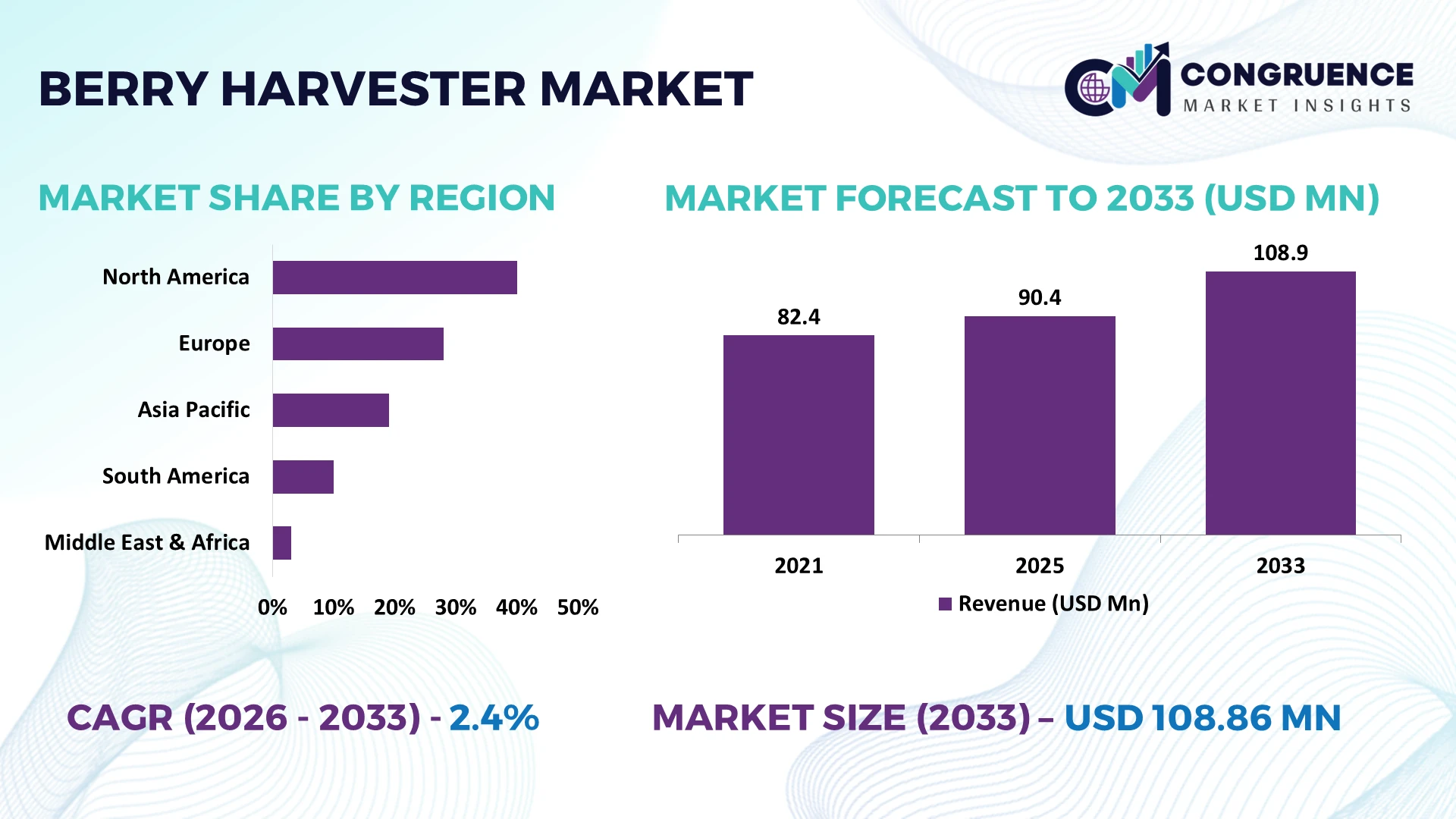
The Global Berry Harvester Market was valued at USD 90.4 Million in 2025 and is anticipated to reach a value of USD 108.9 Million by 2033 expanding at a CAGR of 2.35% between 2026 and 2033. Growth is driven by seasonal agricultural labor shortages, expanding commercial blueberry cultivation, and adoption of automated harvesting systems equipped with precision fruit-detachment and sorting technologies.
The United States dominates the global berry harvester market, supported by extensive blueberry cultivation in Washington, Oregon, Michigan, and Georgia. The country produced approximately 350,000 metric tons of cultivated blueberries in 2023, compared with Canada's approximately 80,000 metric tons. Washington's mechanized processing-berry operations benefit from established equipment infrastructure, while tightening agricultural labor availability accelerates investment in advanced harvesting machinery.
Manufacturers prioritizing selective harvesting, reduced fruit bruising, and compatibility with fresh-market blueberry production are positioned to capture higher-value equipment contracts.
Market Size & Growth: The market advances from USD 90.4 million in 2025 to USD 108.9 million by 2033, registering 2.35% CAGR, supported by mechanization of labor-intensive berry harvesting operations.
Top Growth Drivers: Three principal drivers are seasonal labor shortages, harvesting labor representing approximately 40–60% of production labor requirements in certain operations, and improved fruit recovery through precision harvesting.
Short-Term Forecast: By 2028, advanced mechanical harvesting systems target 10–15% improvements in operational efficiency through optimized shaking mechanisms and automated collection systems.
Emerging Technologies: AI-assisted fruit detection, machine vision, and sensor-controlled harvesting heads are advancing equipment precision, with pilot performance targets exceeding 90% fruit identification accuracy.
Regional Leaders: North America, Europe, and Asia Pacific represent principal equipment markets, with indicative 2033 values of USD 43.6 million, USD 30.5 million, and USD 23.9 million, respectively, supported by mechanization, precision farming, and plantation expansion.
Consumer/End-User Trends: Commercial blueberry growers increasingly evaluate mechanical harvesting for processing operations, where equipment can replace multiple manual picking crews during peak harvesting periods.
Pilot/Case Example: In 2025, commercial evaluations of soft-catch harvesting technologies targeted reductions in berry bruising and improvements in fresh-market packout compared with conventional mechanical systems.
Competitive Landscape: Oxbo, Littau Harvester, BEI Incorporated, Weremczuk, and JAGODA JPS compete through harvesting efficiency, equipment reliability, specialized attachments, and service availability.
Regulatory & ESG Impact: Agricultural mechanization supports labor productivity and resource optimization, while EU machinery safety requirements reinforce investments in protective systems and operator safety.
Investment & Funding: Equipment investment concentrates on precision harvesting attachments, improved collection conveyors, orchard-compatible platforms, and manufacturer–grower partnerships rather than broad venture-capital funding.
Innovation & Future Outlook: Next-generation berry harvesters integrate adjustable vibration frequencies, optical quality assessment, and digital fleet monitoring to strengthen harvesting consistency and reduce fruit damage.
The global berry harvester industry serves commercial blueberry farms, raspberry plantations, blackcurrant growers, and agricultural contractors seeking dependable harvesting capacity. Recent innovations emphasize soft-catch platforms, automated sorting, and adjustable harvesting mechanisms. Fresh-market quality requirements increasingly influence equipment design, particularly in the United States and Europe, where labor availability and fruit handling standards shape procurement decisions and long-term mechanization strategies.
Berry harvesting mechanization is becoming strategically important as commercial growers confront tighter seasonal labor availability, rising quality expectations, and increasingly concentrated harvesting windows. The transition from conventional shaking systems toward precision-controlled harvesting equipment is reshaping agricultural machinery procurement. Producers increasingly prioritize equipment capable of maintaining fruit quality while reducing dependence on large temporary workforces.
Modern self-propelled berry harvesters can collect several hectares daily under suitable field conditions, compared with substantially smaller areas covered by individual manual harvesting crews. Advanced soft-catch systems further improve fruit handling through controlled collection surfaces and adjustable vibration settings. The United States emphasizes high-capacity blueberry harvesting, while Poland and Serbia maintain strong demand for specialized currant and raspberry harvesting machinery. Equipment suitability varies considerably by cultivar, planting density, and intended fruit market.
During 2026–2028, manufacturers are expected to expand sensor integration, remote diagnostics, and modular harvesting attachments. Commercial blueberry operations in Washington provide practical deployment examples where mechanization supports concentrated harvesting schedules. Equipment suppliers are strengthening grower partnerships, field-testing programs, and aftermarket service capabilities. Long-term competitive advantage will depend on combining harvesting productivity with consistent fruit quality and reliable equipment utilization.
Seasonal workforce shortages are accelerating mechanical berry harvesting adoption across major producing countries. In the United States, harvesting labor can account for approximately 40–60% of direct production labor requirements in labor-intensive berry operations, creating substantial exposure to wage increases and worker availability. Mechanized harvesting enables growers to concentrate collection activities within shorter operating windows while improving scheduling predictability. Washington and Oregon blueberry producers increasingly prioritize self-propelled harvesting equipment for processing-oriented plantations. Manufacturers such as Oxbo and Littau Harvester are responding through improved collection mechanisms, adjustable shaking systems, and expanded technical support. The strategic advantage extends beyond labor substitution: reliable harvesting capacity reduces the risk of fruit remaining uncollected during peak ripening periods.
High initial investment requirements constrain berry harvester adoption among small and medium-sized agricultural enterprises. Commercial harvesting equipment involves substantial expenditure on machinery, maintenance, transportation, and plantation modifications. In Poland and Serbia, fragmented berry cultivation creates additional difficulties because smaller plots reduce annual equipment utilization. Mechanical harvesting also requires compatible row spacing, field access, and suitable cultivar characteristics. Fresh-market blueberry growers face additional economic constraints when conventional mechanical collection causes fruit bruising or reduces marketable quality. Manufacturers are addressing these limitations through compact machinery, modular attachments, financing arrangements, and contractor-oriented equipment configurations. Shared harvesting services offer an alternative ownership model, allowing growers to access mechanization without carrying the full capital burden of specialized machinery.
Fresh-market blueberry harvesting represents a significant opportunity for equipment manufacturers developing gentler fruit collection technologies. Conventional mechanical harvesting primarily serves processing applications, while premium fresh-fruit distribution requires tighter control over bruising, firmness, and postharvest quality. Sensor-controlled vibration, soft-catch collection surfaces, and optical inspection technologies are improving equipment suitability for quality-sensitive production. Chile and Peru present attractive deployment opportunities because export-oriented blueberry operations depend on consistent harvesting schedules and strict quality specifications. Manufacturers are investing in adjustable harvesting heads, automated grading interfaces, and data-enabled equipment monitoring. Partnerships with commercial plantations support cultivar-specific testing and faster product refinement. The strategic opportunity lies in expanding mechanical harvesting beyond processing-grade fruit into higher-value fresh-market supply chains.
Achieving consistent harvesting performance across different berry varieties remains a major technical challenge. Blueberries, raspberries, blackcurrants, and other berries differ in fruit attachment strength, ripening uniformity, canopy architecture, and susceptibility to mechanical damage. Equipment calibrated for one cultivar often requires substantial adjustments when deployed across mixed plantations. In Germany and Poland, variable planting configurations further complicate machinery integration and harvesting consistency. Manufacturers must balance vibration intensity, fruit recovery, and crop protection while maintaining acceptable harvesting speeds. Digital monitoring systems introduce additional requirements for operator training, sensor calibration, and maintenance expertise. Companies are responding through field-testing partnerships, adaptable harvesting mechanisms, and specialized technical support. Sustained competitiveness depends on delivering repeatable performance across diverse growing conditions without compromising fruit quality or plantation productivity.
Expansion of Modular Harvesting Platforms: Berry equipment manufacturers are shifting toward modular harvesting platforms that accommodate different row widths, canopy structures, and fruit collection requirements. Adjustable harvesting heads and interchangeable collection components support equipment utilization across multiple crop configurations. In Poland, specialized currant and berry machinery suppliers are emphasizing adaptable tractor-mounted systems alongside self-propelled equipment. Manufacturers are standardizing mechanical components, simplifying maintenance procedures, and strengthening distributor networks to improve equipment availability during concentrated harvesting seasons.
Integration of Digital Fleet Monitoring: Commercial harvesting operations are increasingly incorporating GPS tracking, machine diagnostics, and digital maintenance records into equipment management. These systems monitor operating hours, harvesting routes, and component performance, helping plantation managers coordinate machinery across geographically dispersed farms. In the United States, larger agricultural enterprises are integrating harvesting equipment information with broader farm-management platforms. Manufacturers are expanding telematics capabilities and remote technical support to improve equipment utilization, maintenance planning, and service responsiveness.
Greater Emphasis on Postharvest Quality: Equipment procurement is increasingly influenced by berry firmness, collection cleanliness, and compatibility with downstream sorting infrastructure. Growers are evaluating harvesting systems according to fruit condition rather than collection capacity alone. In Chile, export-oriented blueberry producers prioritize handling consistency and rapid transfer to cooling facilities. Manufacturers are refining conveyor geometry, collection surfaces, and discharge mechanisms while collaborating with packing facilities to improve harvesting-to-packhouse coordination.
Restructuring of Equipment Service Networks: Berry harvester suppliers are strengthening localized spare-parts inventories, technical training, and seasonal maintenance programs. Short harvesting windows make component availability particularly important for commercial operators. European machinery manufacturers are expanding dealer partnerships and emphasizing standardized replacement components to simplify field repairs. Equipment suppliers are also developing preventive maintenance packages and operator training programs, shifting competition toward lifecycle support, equipment uptime, and long-term customer retention.
Self-propelled berry harvesters represent the leading product category, with an estimated 48.5% market share in 2025, supported by high harvesting capacity, integrated collection systems, and suitability for large commercial plantations. These machines dominate mechanized blueberry production in the United States, where harvesting schedules demand reliable equipment performance. Tractor-mounted berry harvesters serve medium-sized farms requiring lower initial investment and compatibility with existing agricultural tractors. Manufacturers including Oxbo and Littau Harvester emphasize self-propelled equipment with adjustable shaking mechanisms, integrated conveyors, and improved operator controls.
Handheld berry harvesters represent a faster-growing adoption category in smaller and fragmented plantations, particularly where full-row machinery cannot operate efficiently. Compact equipment offers greater flexibility for selective harvesting and difficult terrain. Other specialized harvesting systems address crop-specific collection requirements. Manufacturers are expanding lightweight equipment portfolios and adaptable harvesting attachments to serve diversified farm structures. Investment priorities increasingly reflect plantation size, annual machine utilization, and crop handling requirements rather than harvesting capacity alone.
Blueberries represent the dominant application, accounting for an estimated 44.5% of the global berry harvester market in 2025. Extensive commercial plantations in the United States, Canada, Chile, and Peru support demand for mechanized collection equipment. Blueberry harvesting systems benefit from established over-the-row machinery designs and standardized processing workflows. Raspberry harvesting represents a comparatively fast-growing application as manufacturers develop specialized equipment for delicate fruit handling. Blackberries also require careful control of harvesting intensity to minimize damage during collection and transportation.
Strawberry harvesting remains an emerging mechanization application because fruit positioning, ripening variability, and susceptibility to bruising complicate automated collection. Other berry applications include currants, haskap, gooseberries, and aronia, particularly in European commercial farming. Equipment manufacturers are developing crop-specific harvesting attachments, adjustable picking mechanisms, and improved collection surfaces. Companies such as JAGODA JPS and Weremczuk emphasize versatile machinery suitable for multiple berry crops. Demand concentration increasingly favors equipment capable of balancing collection productivity with fruit quality and compatibility with plantation infrastructure.
Commercial farms account for an estimated 67.5% of global berry harvester market demand in 2025, reflecting extensive plantation infrastructure, concentrated harvesting schedules, and greater capacity to finance specialized agricultural machinery. Large blueberry operations in Washington, Oregon, and British Columbia prioritize self-propelled harvesters to support continuous field operations and coordinated fruit transportation. These enterprises favor equipment reliability, harvesting throughput, and established service networks. Manufacturers are responding through customized machinery configurations, technical support contracts, and integrated equipment monitoring capabilities.
Small and medium farms represent the fastest-growing end-user category as shared machinery services, compact harvesting systems, and flexible financing improve mechanization accessibility. Other end-users include agricultural contractors, research institutions, and specialized harvesting service providers. Contractors increasingly prioritize versatile equipment that operates across multiple plantations and crop varieties. Manufacturers are strengthening dealership partnerships and offering tractor-mounted or compact harvesting platforms suited to smaller operations. Competitive positioning increasingly depends on delivering appropriate equipment economics, dependable seasonal servicing, and adaptable harvesting performance across different farm sizes.
North America accounted for the largest market share at 40% in 2025 however, Asia Pacific is expected to register the fastest growth, expanding at a CAGR of 3.8% between 2026 and 2033.

North America dominated the global berry harvester market with approximately 40% share in 2025, supported by established blueberry production, extensive agricultural mechanization, and specialized equipment manufacturing. The United States and Canada maintain substantial commercial berry cultivation across Washington, Oregon, Michigan, British Columbia, and Quebec. Large blueberry plantations increasingly integrate self-propelled harvesters, adjustable shaking systems, and automated collection conveyors to optimize harvesting schedules. Equipment manufacturers such as Oxbo and Littau Harvester support commercial operations through machinery customization, technical servicing, and harvesting technology improvements. Washington's blueberry industry provides a strong deployment base for mechanized harvesting, particularly in processing-oriented production. Equipment procurement increasingly emphasizes harvesting capacity, fruit recovery, and maintenance accessibility. Regional manufacturers are strengthening precision harvesting capabilities and aftermarket service networks to improve machinery utilization and operational consistency across major producing states.
United States Market Outlook: The United States leads regional equipment demand through its extensive commercial blueberry industry and established agricultural machinery distribution infrastructure. Michigan, Georgia, and Oregon maintain specialized berry production systems requiring different harvesting configurations. American manufacturers benefit from proximity to commercial growers, agricultural engineering institutions, and equipment testing facilities. Adoption increasingly emphasizes adjustable fruit-detachment mechanisms, improved collection surfaces, and reliable harvesting performance across different blueberry cultivars.
Europe accounted for approximately 28% of the global berry harvester market in 2025, supported by commercial berry production, specialized agricultural machinery manufacturing, and increasing equipment modernization. Poland, Germany, Serbia, and the United Kingdom represent important markets for mechanized currant, raspberry, and blueberry harvesting. Polish equipment manufacturers, including Weremczuk and JAGODA JPS, specialize in harvesting systems designed for diverse plantation structures and berry varieties. European agricultural enterprises increasingly favor tractor-mounted and compact harvesting equipment compatible with smaller field configurations. Equipment development emphasizes adjustable collection systems, mechanical durability, and efficient field maneuverability. The European Union's agricultural modernization initiatives encourage investment in productive machinery and improved farm operating practices. Manufacturers are expanding dealership networks and developing adaptable harvesting attachments to address diverse crop requirements. Regional competitiveness increasingly depends on equipment versatility, maintenance efficiency, and compatibility with established agricultural infrastructure.
Poland Market Outlook: Poland maintains a strategic position in European berry harvesting equipment through its extensive blackcurrant, raspberry, and blueberry cultivation. Domestic machinery manufacturers have developed specialized harvesting systems suited to narrow planting configurations and commercial plantation requirements. Poland's established agricultural engineering capabilities support equipment production, customization, and exports. Manufacturers increasingly prioritize tractor-mounted harvesting systems, adjustable shaking assemblies, and practical maintenance solutions for commercial growers and agricultural contractors.
Asia Pacific represented approximately 19% of the global berry harvester market in 2025, supported by expanding commercial blueberry cultivation and increasing agricultural equipment modernization. China, Australia, New Zealand, and Japan represent important markets with differing production scales and mechanization requirements. China's expanding blueberry industry supports investment in plantation infrastructure, specialized harvesting equipment, and agricultural automation. Australia maintains established commercial blueberry operations where equipment productivity and harvesting consistency influence procurement decisions. Regional manufacturers are developing compact machinery, adjustable harvesting attachments, and equipment configurations suitable for diverse planting systems. Agricultural enterprises increasingly evaluate mechanization according to crop characteristics, field accessibility, and equipment utilization. Partnerships between machinery suppliers, commercial plantations, and agricultural technology developers are strengthening equipment deployment capabilities. Regional market development increasingly favors localized machinery solutions, practical technical support, and improved compatibility with commercial berry production systems.
China Market Outlook: China represents a strategically important emerging market for berry harvesting equipment, supported by commercial blueberry cultivation in Yunnan, Guizhou, Shandong, and Liaoning. Yunnan's favorable production conditions support intensive berry cultivation and export-oriented supply chains. Chinese agricultural equipment manufacturers are developing localized harvesting technologies and adapting machinery to different plantation layouts. Investments in agricultural modernization, equipment manufacturing, and commercial farm infrastructure strengthen China's position in advanced berry harvesting mechanization.
South America accounted for approximately 10% of the global berry harvester market in 2025, supported by commercial blueberry production and export-oriented agricultural operations. Chile, Peru, Argentina, and Brazil represent important markets with varying levels of harvesting mechanization. Chile's established blueberry export industry supports demand for reliable harvesting equipment and improved postharvest handling systems. Peru's expanding commercial blueberry plantations are increasing interest in harvesting technologies capable of supporting concentrated production schedules. Equipment adoption remains influenced by fruit quality requirements, labor availability, plantation configuration, and access to specialized technical services. Manufacturers are strengthening distributor relationships and evaluating machinery configurations suited to local growing conditions. Import dependence and limited specialized servicing infrastructure constrain equipment deployment in selected agricultural areas. Competitive positioning increasingly depends on reliable machinery performance, regional spare-parts availability, and integration with export-oriented packing operations.
Chile Market Outlook: Chile maintains an established commercial blueberry industry supported by export infrastructure, specialized agricultural services, and production concentration in central and southern growing areas. Commercial plantations increasingly evaluate harvesting equipment according to fruit quality, operating efficiency, and compatibility with postharvest handling systems. Chilean growers benefit from established agricultural equipment distribution channels and access to international machinery manufacturers. Equipment suppliers are prioritizing harvesting reliability, operator training, and technical support to serve export-oriented production.
The Middle East & Africa accounted for approximately 3% of the global berry harvester market in 2025, reflecting relatively limited commercial berry harvesting mechanization compared with established producing regions. South Africa and Morocco represent strategically important markets supported by expanding blueberry cultivation and export-oriented agricultural production. Morocco's berry industry benefits from proximity to European distribution markets, while South African producers maintain established agricultural export infrastructure. Equipment adoption remains concentrated among larger commercial plantations capable of supporting specialized machinery investments. Water management requirements, plantation configurations, and equipment servicing capabilities influence harvesting technology selection. Agricultural enterprises increasingly prioritize equipment compatibility with intensive production systems and reliable field operations. International manufacturers are strengthening regional distributor relationships and technical support capabilities. Future market positioning depends on localized equipment availability, practical operator training, and improved integration between harvesting machinery and agricultural infrastructure.
Morocco Market Outlook: Morocco represents an important market for commercial berry harvesting technologies, supported by expanding blueberry and raspberry cultivation around Larache, Kenitra, and Agadir. Export-oriented agricultural enterprises benefit from established logistics connections with European markets and specialized horticultural production infrastructure. Commercial growers increasingly evaluate machinery capable of supporting consistent harvesting schedules and efficient field operations. Equipment suppliers are targeting partnerships with agricultural distributors, plantation operators, and technical service providers to strengthen mechanization accessibility.
The global berry harvester market features competition between established equipment manufacturers Oxbo, Littau Harvester, BEI Incorporated, Weremczuk, and JAGODA JPS. These players collectively represent an estimated 55% of specialized equipment sales, reflecting moderate market concentration. American manufacturers compete through high capacity self propelled harvesters, while Polish suppliers emphasize affordable tractor mounted systems and crop specific customization. Premium equipment configurations command estimated price premiums of 15–25%, whereas modular machinery can reduce initial investment requirements by approximately 20% compared with larger platforms. Oxbo and Littau prioritize harvesting precision, operator controls, and dealer support. Weremczuk and JAGODA JPS strengthen competitiveness through product diversification and regional distribution partnerships. Competition increasingly shifts toward integrated fruit handling, equipment uptime, and adaptable harvesting mechanisms. Specialized engineering expertise, field validation, and seasonal service infrastructure create substantial entry barriers. Winning requires reliable fruit recovery, competitive ownership costs, and responsive technical support throughout harvesting operations worldwide.
Oxbo International Corporation
Littau Harvester
BEI Incorporated
Weremczuk Agro Machines
JAGODA JPS
Kokan 500
A&B Packing Equipment, Inc.
FineField
Agrobot
Dogtooth Technologies
Advanced.Farm
Harvest CROO Robotics
Current berry harvesting technology centers on self propelled platforms, adjustable shaking mechanisms, and integrated fruit collection conveyors. Modern machines use controlled vibration frequencies and improved catching surfaces to reduce fruit losses while maintaining harvesting capacity. Compared with conventional mechanical harvesters, optimized collection systems target 10–15% improvements in handling efficiency under suitable operating conditions. Commercial blueberry plantations remain the primary deployment base, with equipment manufacturers emphasizing durability, operator ergonomics, and compatibility with established field infrastructure.
Emerging technologies include machine vision, automated fruit grading, and sensor assisted harvesting controls. Optical detection systems support selective collection and fruit quality assessment, while digital monitoring improves equipment maintenance scheduling. Advanced robotic harvesting platforms integrate cameras, artificial intelligence, and precision manipulators to identify individual berries. These technologies particularly benefit fresh market producers requiring consistent fruit appearance. Manufacturers are developing modular automation systems and collaborating with commercial growers to validate harvesting performance across different cultivars.
Between 2026 and 2028, technology development will emphasize autonomous navigation, predictive maintenance, and harvesting data integration. Equipment suppliers combining precision controls with reliable mechanical platforms will strengthen competitive positioning. Smaller manufacturers will focus on specialized attachments and affordable automation upgrades. Successful deployment depends on consistent field performance, technical support availability, and measurable improvements in fruit recovery.
October 2024: Oxbo announced AutoFill automation for its 7440 and 7450 blueberry harvesters, targeting labor reductions of up to 75%. Limited availability began in 2025, with full production planned for 2026, strengthening automated collection and packhouse throughput. Source: oxbo.com
August 2025: Oxbo introduced its 2026 berry harvester model year while celebrating 40 years of manufacturing in Lynden, Washington. The company highlighted AutoFill, FleetCommand, and SoftSurface technologies, reinforcing integrated automation, machine monitoring, and fruit-quality improvements. Source: oxbo.com
September 2025: Dogtooth Technologies described its manufacturing scale-up for autonomous strawberry harvesting robots, reporting five generations developed and deployed across Europe and Australia. The initiative emphasized production planning, equipment testing, refurbishment, and fleet expansion to support commercialization. Source: dogtooth.tech
The Berry Harvester Market Report evaluates industry performance, equipment adoption, competitive positioning, and technological developments between 2026 and 2033. The study covers self-propelled, tractor-mounted, handheld, and specialized harvesting systems. Application analysis examines blueberries, raspberries, blackberries, strawberries, and other berry crops, while end-user coverage includes commercial farms, smaller agricultural enterprises, harvesting contractors, and research institutions. Regional assessments span North America, Europe, Asia Pacific, South America, and the Middle East & Africa.
The report examines precision shaking mechanisms, automated collection systems, machine vision, robotics, and digital fleet monitoring. Competitive analysis addresses manufacturer positioning, product differentiation, distribution strategies, and equipment servicing capabilities. Additional coverage evaluates fresh-market harvesting, compact machinery, and emerging agricultural automation opportunities. These insights support equipment investment decisions, geographic expansion, strategic partnerships, and long-term competitive planning.
| Report Attribute / Metric | Details |
|---|---|
| Market Revenue (2025) | USD 90.4 Million |
| Market Revenue (2033) | USD 108.9 Million |
| CAGR (2026–2033) | 2.35% |
| Base Year | 2025 |
| Forecast Period | 2026–2033 |
| Historic Period | 2021–2025 |
| Segments Covered |
By Type
By Application
By End-User
|
| Key Report Deliverables | Revenue Forecast; Market Trends; Growth Drivers & Restraints; Technology Insights; Segmentation Analysis; Regional Insights; Competitive Landscape; Regulatory & ESG Overview; Recent Developments |
| Regions Covered | North America; Europe; Asia-Pacific; South America; Middle East & Africa |
| Key Players Analyzed | Oxbo International Corporation; Littau Harvester; BEI Incorporated; Weremczuk Agro Machines; JAGODA JPS; Kokan 500; A&B Packing Equipment, Inc.; FineField; Agrobot; Dogtooth Technologies; Advanced.Farm; Harvest CROO Robotics |
| Customization & Pricing | Available on Request (10% Customization Free) |




