
Reports
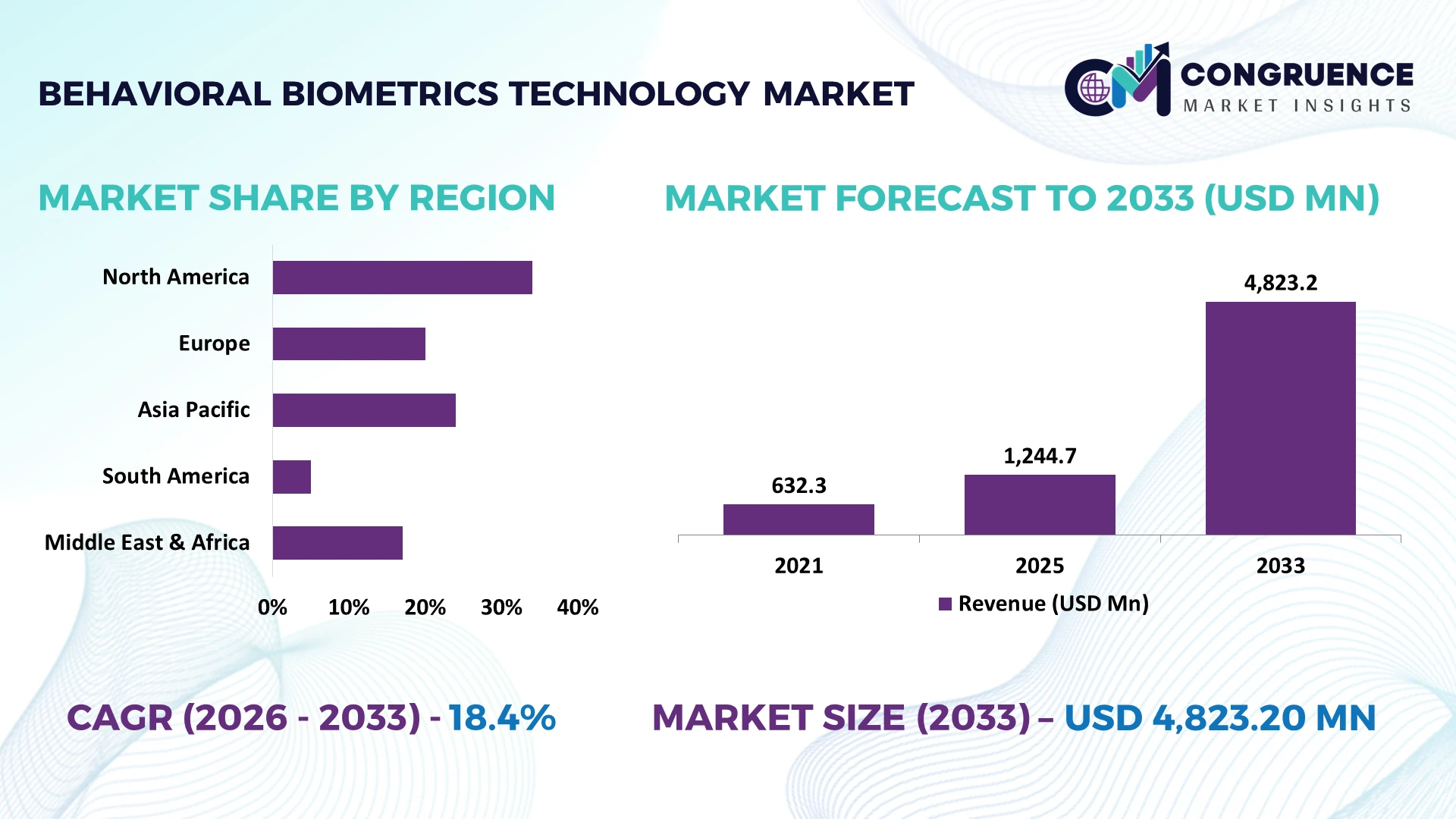
The Global Behavioral Biometrics Technology Market was valued at USD 1244.67 Million in 2025 and is anticipated to reach a value of USD 4823.2 Million by 2033 expanding at a CAGR of 18.45% between 2026 and 2033. Growth is driven by real-time payment fraud, AI-enabled account takeover, continuous authentication, money-mule detection, and banks replacing static credentials with passive behavioral risk intelligence.
The United States remains the dominant country, representing approximately 34% of global deployment value, supported by large digital-banking volumes, mature fraud analytics infrastructure, and behavioral monitoring across tier-one financial institutions. U.S. institutions increasingly analyze hundreds of behavioral signals per session, while India faces account takeover representing 55% of observed digital banking fraud cases. Cross-border mule networks and geopolitical cybercrime pressure are accelerating continuous-authentication investment.
Strategically, financial institutions combining behavioral intelligence with device, transaction, and identity signals gain the strongest advantage in reducing fraud without adding customer friction.
Market Size & Growth: USD 1,244.67 million in 2025 advances to USD 4,823.2 million by 2033 at 18.45% CAGR as continuous authentication replaces static fraud controls.
Top Growth Drivers: Account takeover represents 55% of observed Indian digital fraud; real-time payments, social engineering, and AI-generated identities are the three strongest adoption triggers.
Short-Term Forecast: By 2028, behavioral-risk orchestration is positioned to reduce manual fraud-review workloads by approximately 20–30% through automated session-level decisioning.
Emerging Technologies: AI behavioral modeling, device intelligence and agentic-AI detection increasingly combine 100+ interaction signals covering typing, swiping, navigation, hesitation and device behavior.
Regional Leaders: By 2033, indicative allocations place North America near USD 1.69 billion, Europe around USD 1.25 billion and Asia-Pacific approximately USD 1.45 billion, led by banking deployments.
Consumer/End-User Trends: Indian account-takeover fraud represents 55% of observed cases, reinforcing passive authentication as banks reduce dependence on OTP-centered verification.
Pilot/Case Example: In 2025, ORNL Federal Credit Union reported behavioral intelligence helped prevent more than USD 1 million in account-takeover fraud, demonstrating measurable operational value.
Competitive Landscape: BioCatch holds an estimated 20%+ competitive position, alongside Mastercard/NuData, LexisNexis Risk Solutions, TransUnion and BehavioSec-backed behavioral security capabilities.
Regulatory & ESG Impact: UK APP reimbursement rules returned 88% of eligible scam losses during their first ten months, increasing banks’ financial incentive to strengthen preventive behavioral controls.
Investment & Funding: BioCatch achieved a USD 1.3 billion valuation following a major 2024 investment transaction, signaling institutional confidence in behavioral intelligence and financial-crime technology.
Innovation & Future Outlook: FCA synthetic fraud infrastructure spans 15 million transactions and 58 million data points, accelerating privacy-preserving AI model development and next-generation behavioral risk detection.
Behavioral biometrics technology is becoming integral to digital banking, payments, e-commerce, insurance, fintech and identity security as enterprises shift from authentication events toward continuous risk assessment. Account takeover represents 55% of observed fraud cases in India, highlighting the operational need for passive behavioral intelligence. AI-driven session profiling, device intelligence and scam detection are now converging as regulators tighten real-time payment fraud controls, establishing the strategic context for deeper market analysis.
Behavioral biometrics is becoming strategically important because financial institutions must distinguish legitimate customers from AI-assisted fraud without adding authentication friction. Real-time payments, account takeover and authorized push-payment scams are shifting fraud controls from transaction screening toward continuous session intelligence. UK reimbursement rules have intensified this transition, with 88% of eligible APP scam losses reimbursed during the first ten months, directly increasing the economics of prevention.
Behavioral analytics evaluates typing, navigation, device handling and hesitation continuously, whereas legacy OTP authentication validates a single possession event. Deployments combining behavioral and device intelligence can reduce manual investigation workloads by 20–30%. The United States leads enterprise-scale financial deployments, Europe combines adoption with tighter privacy controls, while India’s rapid digital-payment ecosystem faces account takeover representing 55% of observed fraud cases. Through 2028, orchestration across behavioral, device and transaction signals will become increasingly standard.
A practical deployment at ORNL Federal Credit Union helped prevent more than USD 1 million in account-takeover losses through behavioral intelligence. Vendors are consequently expanding scam detection, mule-account analytics and platform integrations with payment and identity providers. Competitive leadership will depend on converting invisible behavioral signals into accurate, explainable decisions with minimal customer friction.
Instant payments and digital banking are forcing institutions to detect malicious intent during sessions rather than after transactions settle. Account takeover represents approximately 55% of observed Indian digital-banking fraud cases, while UK reimbursement arrangements returned 88% of eligible APP scam losses during their first ten months. Behavioral platforms can analyze 100+ interaction variables, including typing cadence, navigation, hesitation and device handling. Faster payments compress intervention windows, making conventional password and OTP checks insufficient for intent detection. Banks are responding by combining behavioral biometrics with device intelligence, transaction monitoring and fraud orchestration. The non-obvious advantage is customer experience: passive risk assessment concentrates additional verification on anomalous users instead of introducing friction across every legitimate session, improving fraud economics and digital-channel conversion simultaneously.
Behavioral models depend on persistent interaction telemetry, yet privacy requirements constrain how enterprises collect, retain and transfer those signals. Under GDPR, organizations face penalties reaching 4% of worldwide annual turnover for serious infringements, while California consumers can exercise deletion, correction and opt-out rights over qualifying personal information. Apple’s App Tracking Transparency framework has also reduced unrestricted cross-application identifiers, reinforcing data minimization across digital ecosystems. These constraints complicate centralized behavioral profiling, particularly for multinational banks operating different consent and retention architectures. Vendors are responding with pseudonymization, regional processing, configurable retention and privacy-by-design model development. Strategically, the limitation is not simply compliance cost: fragmented behavioral histories reduce model continuity when customers move across channels, devices or jurisdictions, making interoperable first-party intelligence increasingly valuable.
Behavioral biometrics is extending beyond login authentication into scam intervention, mule-account detection and continuous payment-risk assessment. UK payment rules reimburse qualifying APP fraud victims up to £85,000, while Faster Payments handles billions of transactions annually, creating a strong economic case for intervention before funds leave an account. India’s UPI processes more than 20 billion monthly transactions, providing another large environment for session-level behavioral risk controls. Emerging models increasingly combine behavioral signals with generative-AI detection, payment context and graph analytics to identify coercion or unusual beneficiary activity. Technology providers are expanding partnerships with banks, payment processors and identity platforms while investing in behavioral consortium intelligence. The overlooked opportunity is detecting legitimate customers being manipulated, a fraud scenario where conventional identity authentication succeeds but behavioral deviation still exposes risk.
Behavioral authentication faces an escalating execution challenge as criminals use automation, remote-access tools and generative AI to imitate legitimate digital activity. More than 60% of financial institutions globally report increased concern around AI-enabled fraud, while deepfake incidents have risen sharply across identity-verification workflows. At the same time, false-positive rates of even 1% become operationally significant when banks process millions of daily sessions. Models must distinguish genuine behavioral change caused by new devices, accessibility needs or travel from malicious manipulation without blocking legitimate customers. Providers are investing in continuous model retraining, explainable risk scoring, adversarial testing and multimodal signal fusion. The strategic challenge is model durability: institutions need behavioral systems that adapt faster than attacker techniques while maintaining stable decision quality across channels, geographies and changing customer behavior.
Passive Authentication Moves Into Workflows: Enterprises are embedding behavioral scoring behind login, payment, and account-change journeys instead of triggering separate verification events. Credential stuffing represents about 19% of median daily authentication attempts and reaches 25% at large enterprises. Banks are combining typing, touchscreen, device, and navigation telemetry with existing IAM platforms, reducing unnecessary step-up authentication while concentrating analyst attention on genuinely anomalous sessions.
Multimodal Risk Engines Gain Priority: Behavioral signals increasingly operate alongside device intelligence, transaction context, and identity analytics rather than as standalone classifiers. In 2025, 67% of security leaders were moving toward software-driven security platforms and 73% considered unified data methodologies important. Vendors are expanding APIs and orchestration layers so fraud teams can generate one continuously updated risk score across customer journeys.
Digital Identity Friction Gets Repriced: Authentication design is shifting toward invisible verification as enterprises recognize the commercial cost of password friction. A 2025 five-country survey found 48% of consumers had abandoned an online purchase after forgetting a password, while 36% reported an account compromised by weak or stolen credentials. Providers are integrating passive behavioral intelligence behind passwordless journeys to protect conversion while strengthening session assurance.
Adaptive Models Replace Static Rules: Fraud teams are shortening behavioral-model update cycles as attack patterns change faster. Suspected global account-takeover volume increased 21% from H1 2024 to H1 2025 and 141% versus H1 2021. Companies are automating feature engineering, model monitoring, and analyst feedback loops, turning behavioral platforms from fixed authentication controls into continuously recalibrated fraud-decision systems.
Keystroke Dynamics leads the Behavioral Biometrics Technology Market with an estimated 31% share, supported by low deployment friction, mature machine-learning models, and compatibility with existing web and desktop interfaces. Timing between keystrokes, dwell time, correction patterns, and typing rhythm can be collected without dedicated biometric hardware, keeping implementation costs below sensor-dependent approaches. Mouse Movement represents another mature desktop-oriented segment, particularly in enterprise authentication and account monitoring, while Gait Recognition remains specialized because reliable deployment requires motion-rich mobile or surveillance environments.
Touchscreen Behavior is the fastest-growing type as mobile banking, digital wallets, and app-based commerce move behavioral analysis toward swipe velocity, pressure, gesture geometry, and device handling. Mobile sessions now dominate many consumer banking journeys, shifting investment away from keyboard-only models toward multimodal touchscreen intelligence. Voice Biometrics retains strategic relevance in contact centers and remote verification but faces increasing deepfake pressure. Vendors are responding with behavioral fusion, SDK-based mobile integration, and continuous model retraining, favoring platforms that combine multiple behavioral modalities instead of selling isolated algorithms.
Fraud Detection accounts for an estimated 38% of market deployment, reflecting its direct connection to payment abuse, synthetic identity activity, credential compromise, and suspicious digital journeys. Account Takeover Prevention follows closely as enterprises monitor changes in typing, navigation, device orientation, and interaction speed after successful login. Global suspected digital account-takeover attempts increased 20% from 2023 to 2024, strengthening investment in session-level detection rather than relying solely on entry-point authentication.
Continuous Authentication is the fastest-growing application as banks and digital platforms move from one-time verification toward persistent behavioral risk scoring. Identity Verification remains important during onboarding, while Risk Assessment increasingly combines behavioral intelligence with device, transaction, and network signals to prioritize intervention. Companies are expanding real-time APIs, automated decision engines, and fraud-orchestration integrations rather than deploying behavioral models as separate controls. The business shift is significant: behavioral technology increasingly influences whether a transaction proceeds, receives step-up verification, or enters investigation, making model latency and explainability operationally critical.
Banking & Finance represents approximately 44% of Behavioral Biometrics Technology Market demand because institutions manage persistent authentication, account takeover, payment fraud, mule activity, and regulatory exposure across millions of digital sessions. Continuous monitoring is increasingly embedded into mobile and online banking rather than operated as an independent fraud tool. Telecommunications uses behavioral intelligence for account access and SIM-related fraud, while Government deployments concentrate on identity assurance and protected digital-service access.
E-Commerce is the fastest-growing end-user as merchants balance fraud prevention against checkout abandonment and account-login friction. Healthcare adoption is expanding more selectively around patient portals, workforce authentication, and protected data access. Vendors are targeting these sectors through cloud-native pricing, mobile SDKs, prebuilt fraud workflows, and integrations with identity and payment ecosystems. Banking remains the deepest deployment environment, but future demand is broadening toward businesses where a false rejection directly reduces conversion. Competitive positioning therefore increasingly depends on proving both fraud reduction and low-friction customer experience rather than authentication accuracy alone.
North America accounted for the largest market share at 36% in 2025 however, Asia-Pacific is expected to register the fastest growth, expanding at a CAGR of 21.3% between 2026 and 2033.
Continuous Authentication Moves Into Banking Infrastructure
North America represented approximately 36% of global behavioral biometrics technology adoption in 2025, anchored by U.S. banking, payments, insurance, e-commerce, and identity-security deployments. Financial institutions increasingly integrate keystroke, touchscreen, navigation, and device-behavior signals directly into fraud orchestration rather than operating behavioral analytics separately. Credential abuse remains a strong operational trigger: compromised credentials were involved in approximately 22% of breaches assessed in recent U.S.-focused security datasets. Banks are consequently extending passive monitoring beyond login into beneficiary creation, payment authorization, and account-profile changes. Cloud-native APIs and real-time scoring also enable behavioral models to process hundreds of session attributes without requiring dedicated biometric hardware. Vendors are strengthening integrations with identity platforms, payment processors, and fraud-management stacks, making orchestration depth and low-latency decisioning more important competitive factors than standalone authentication accuracy.
United States Market Outlook: The United States combines mature digital banking infrastructure with high fraud-management spending and extensive cloud adoption. Account-takeover attempts remain operationally significant, pushing major banks and credit unions toward continuous behavioral risk scoring. U.S. deployments increasingly connect behavioral analytics with device intelligence, transaction monitoring, and step-up authentication, creating a strong environment for multimodal fraud platforms.
Regulation Reprices Fraud Prevention Economics
Europe accounted for approximately 27% of global market activity in 2025, with the United Kingdom, Germany, France, and Nordic countries driving adoption across banking and digital payments. The structural catalyst is stronger liability for online fraud alongside GDPR requirements governing personal-data processing. UK payment-service providers now operate under mandatory APP scam reimbursement rules with a £85,000 maximum reimbursement level for qualifying claims, making pre-transaction behavioral detection financially consequential. European institutions are therefore applying passive session intelligence to identify hesitation, remote-access manipulation, unusual navigation, and beneficiary anomalies without continuously challenging legitimate users. Vendors are adapting through explainable scoring, regional data processing, configurable retention, and privacy-preserving analytics. Europe consequently favors behavioral platforms that combine fraud reduction with auditable model governance, giving privacy architecture a direct role in procurement rather than treating compliance as a post-deployment requirement.
United Kingdom Market Outlook: The United Kingdom is Europe’s most strategically important deployment environment because Faster Payments, open banking, and APP reimbursement rules combine high transaction velocity with direct fraud liability. During the first ten months of the reimbursement regime, approximately 88% of eligible scam losses were returned, strengthening the business case for behavioral intervention before payment execution.
Mobile Payment Scale Accelerates Deployment
Asia-Pacific represented approximately 24% of global behavioral biometrics technology activity in 2025, with India, China, Australia, Singapore, and Japan creating distinct deployment models. India provides exceptional transaction scale: UPI surpassed 20 billion monthly transactions in 2025, increasing the operational value of passive behavioral screening that does not interrupt payment speed. Banks and fintech platforms are analyzing touchscreen gestures, device handling, navigation sequences, and transaction context to distinguish legitimate customers from account takeover and social-engineering activity. Australia’s scam-prevention initiatives and Singapore’s digital-banking controls add regulatory momentum, while Japan emphasizes low-friction identity assurance. Technology providers are scaling mobile SDKs, localized risk models, and cloud-based decision engines. The region’s advantage is behavioral-data density: enormous mobile transaction volumes create stronger opportunities for continuously recalibrated models when privacy, consent, and false-positive controls are properly engineered.
India Market Outlook: India stands out through its mobile-first financial ecosystem and exceptionally high real-time payment intensity. UPI processes more than 20 billion transactions during peak monthly periods, creating a large behavioral signal environment across smartphones. Banks and fintech providers increasingly need passive risk scoring that detects abnormal touchscreen, navigation, device, and payment behavior without weakening transaction convenience.
Instant Payments Reshape Fraud Controls
South America represented approximately 6% of global behavioral biometrics technology activity in 2025, with Brazil providing the dominant deployment environment. The expansion of instant payments has compressed fraud-detection windows and increased the importance of session-level intelligence before transaction authorization. Brazil’s Pix infrastructure processes more than 200 million transactions on high-volume days, exposing banks and fintech companies to account takeover, social engineering, device compromise, and mule-account activity at substantial scale. Behavioral analytics is consequently being integrated with transaction monitoring, device intelligence, and identity verification rather than deployed as a separate authentication layer. Financial institutions are prioritizing mobile behavioral signals because smartphone banking dominates consumer interaction. Vendors are responding through Portuguese-language support, localized fraud models, cloud delivery, and partnerships with payment-security ecosystems. Integration capabilities remain critical because smaller institutions often operate fragmented legacy fraud stacks.
Brazil Market Outlook: Brazil leads South American adoption through Pix, digitally active banks, and a strong fintech ecosystem. Banco Central do Brasil has progressively tightened Pix security mechanisms, including transaction limits and fraud-management controls. This environment favors behavioral platforms capable of assessing customer intent during high-speed payment journeys while minimizing false declines for legitimate mobile users.
Digital Banking Modernization Expands Identity Security
Middle East & Africa represented approximately 7% of global behavioral biometrics technology activity in 2025, with the UAE, Saudi Arabia, South Africa, and major Gulf banking centers generating the strongest enterprise opportunities. Digital-government programs and mobile-first banking are increasing authentication volumes while financial institutions modernize fraud infrastructure. Saudi Arabia’s electronic payments already represent more than 79% of retail transactions, expanding the need for continuous digital-session assurance beyond passwords and OTPs. UAE banks similarly operate highly digitized customer journeys spanning onboarding, transfers, cards, and mobile services. Behavioral vendors are integrating touchscreen dynamics, device intelligence, and risk-based authentication into cloud banking platforms rather than requiring separate biometric hardware. Local data requirements and Arabic-language digital journeys encourage configurable deployments. Providers are responding through regional cloud infrastructure, banking partnerships, and localized risk engines designed for high-mobile-use environments.
Saudi Arabia Market Outlook: Saudi Arabia combines rapid cashless-payment adoption with national digital-transformation programs and increasingly sophisticated banking infrastructure. Electronic payments exceeding 79% of retail transactions create substantial volumes of digital behavioral data. Banks can use passive analytics to strengthen mobile authentication, payment-risk assessment, and account-takeover prevention while maintaining the low-friction experience expected from digital financial services.
BioCatch, LexisNexis Risk Solutions, Mastercard, TransUnion and Thales compete across behavioral intelligence, identity security and fraud orchestration, while specialized vendors challenge integrated platforms through faster model innovation. The top five players collectively control approximately 52% of market activity. Competition increasingly centers on detection accuracy, integration speed, behavioral-data depth and false-positive reduction. Advanced platforms target 20–30% lower manual review workloads, while passive authentication can remove additional verification from more than 90% of low-risk sessions. Vendors compete through bank partnerships, cloud integrations, AI model expansion and acquisitions that combine behavioral, device and transaction intelligence. The competitive shift favors unified fraud-decision platforms over standalone behavioral engines as enterprises consolidate security stacks. Long customer qualification cycles, proprietary behavioral datasets and regulatory requirements create substantial entry pressure. Regional specialists retain leverage through localized fraud patterns and deployment flexibility. Winning requires explainable real-time models, broad behavioral telemetry, low-friction integration and measurable fraud-loss reduction across complex digital journeys.
BioCatch
LexisNexis Risk Solutions
Mastercard
TransUnion
Thales
IBM
OneSpan
Featurespace
Callsign
Plurilock Security
NeuroID
TypingDNA
Zighra
UnifyID
Current behavioral biometrics platforms combine keystroke cadence, touchscreen gestures, mouse trajectories, device handling, and navigation behavior with machine-learning risk scoring. Leading deployments analyze 3,000 behavioral and device signals per session, enabling continuous authentication without repeated customer challenges. Compared with legacy password-and-OTP workflows, passive behavioral screening can reduce manual fraud-review workloads by 20–30%, improving investigation productivity while preserving low-friction digital banking journeys across mobile and web channels.
Emerging architectures integrate behavioral intelligence with device telemetry, transaction analytics, consortium data, and graph-based mule detection. Multimodal engines increasingly process billions of monthly sessions, while automated orchestration can remove step-up verification from more than 90% of low-risk interactions. Generative-AI detection and adaptive models also identify remote-access manipulation, scripted activity, and social-engineering patterns that static rules miss. Banks and payment platforms gain the strongest advantage because behavioral context improves intervention before irreversible real-time transfers occur.
Through 2026–2028, disruptive development will center on agentic-AI detection, privacy-preserving learning, cross-institution behavioral intelligence, and continuous risk models spanning complete customer lifecycles. Federated intelligence can improve detection coverage by 15–25% without centralizing raw customer data. Vendors integrating behavioral, transactional, network, and device signals now gain stronger competitive positioning as enterprises consolidate fragmented fraud stacks into unified real-time decision platforms.
August 2024 Experian acquired behavioral-analytics specialist NeuroID, integrating its digital interaction intelligence into CrossCore. Experian’s broader identity and fraud portfolio had helped clients avoid an estimated $15 billion in fraud losses, strengthening behavioral analytics across onboarding, login, and transactions. Source: experianplc.com
September 2025 Nasdaq Verafin partnered with BioCatch, integrating behavioral intelligence with consortium analytics covering 2,600+ financial institutions and 725 million counterparties. The combination enables banks to evaluate up to 3,000 behavioral-device signals and stop suspicious payments before funds leave accounts. Source: nasdaq.com
August 2025 Macquarie Bank joined BioCatch Trust Australia, expanding the inter-bank behavioral intelligence network to protect more than 85% of Australians. During its first 10 months, the network evaluated $500 billion in payments, strengthening receiving-account risk assessment before transfers. Source: biocatch.com
August 2026 Visa signed a definitive agreement to acquire BioCatch for $2.4 billion cash, adding behavioral and device intelligence analyzing thousands of application, network and interaction signals. The transaction strengthens Visa’s defenses against scams, account takeover, money mules and application fraud. Source: visa.com
The Behavioral Biometrics Technology Market report evaluates Keystroke Dynamics, Gait Recognition, Mouse Movement, Touchscreen Behavior and Voice Biometrics across Fraud Detection, Continuous Authentication, Account Takeover Prevention, Identity Verification and Risk Assessment. End-user coverage includes Banking & Finance, E-Commerce, Healthcare, Telecommunications and Government, with analysis across North America, Europe, Asia-Pacific, South America and Middle East & Africa.
The report examines AI-driven behavioral modeling, device intelligence, multimodal authentication, graph analytics, privacy-preserving learning and real-time fraud orchestration. Banking & Finance represents approximately 44% of current demand, while emerging deployment areas include scam intervention, mule detection and agentic-AI defense. Analysis through 2026–2033 identifies technology migration, regional deployment priorities, partnership models and competitive positioning, supporting investment planning, geographic expansion, product development and vendor-selection decisions as enterprises transition from isolated authentication controls toward continuous behavioral risk intelligence.
| Report Attribute/Metric | Report Details |
|---|---|
Market Revenue in 2025 | USD 1244.67 Million |
Market Revenue in 2033 | USD 4823.2 Million |
CAGR (2026 - 2033) | 18.45% |
Base Year | 2025 |
Forecast Period | 2026 - 2033 |
Historic Period | 2021 - 2025 |
Segments Covered | By Type
By Application
By End-User
|
Key Report Deliverable | Revenue Forecast, Growth Trends, Market Dynamics, Segmental Overview, Regional and Country-wise Analysis, Competition Landscape |
Region Covered | North America, Europe, Asia-Pacific, South America, Middle East, Africa |
Key Players Analyzed | BioCatch, LexisNexis Risk Solutions, Mastercard, TransUnion, Thales, IBM, OneSpan, Featurespace, Callsign, Plurilock Security, NeuroID, TypingDNA, Zighra, UnifyID |
Customization & Pricing | Available on Request (10% Customization is Free) |




