
Reports
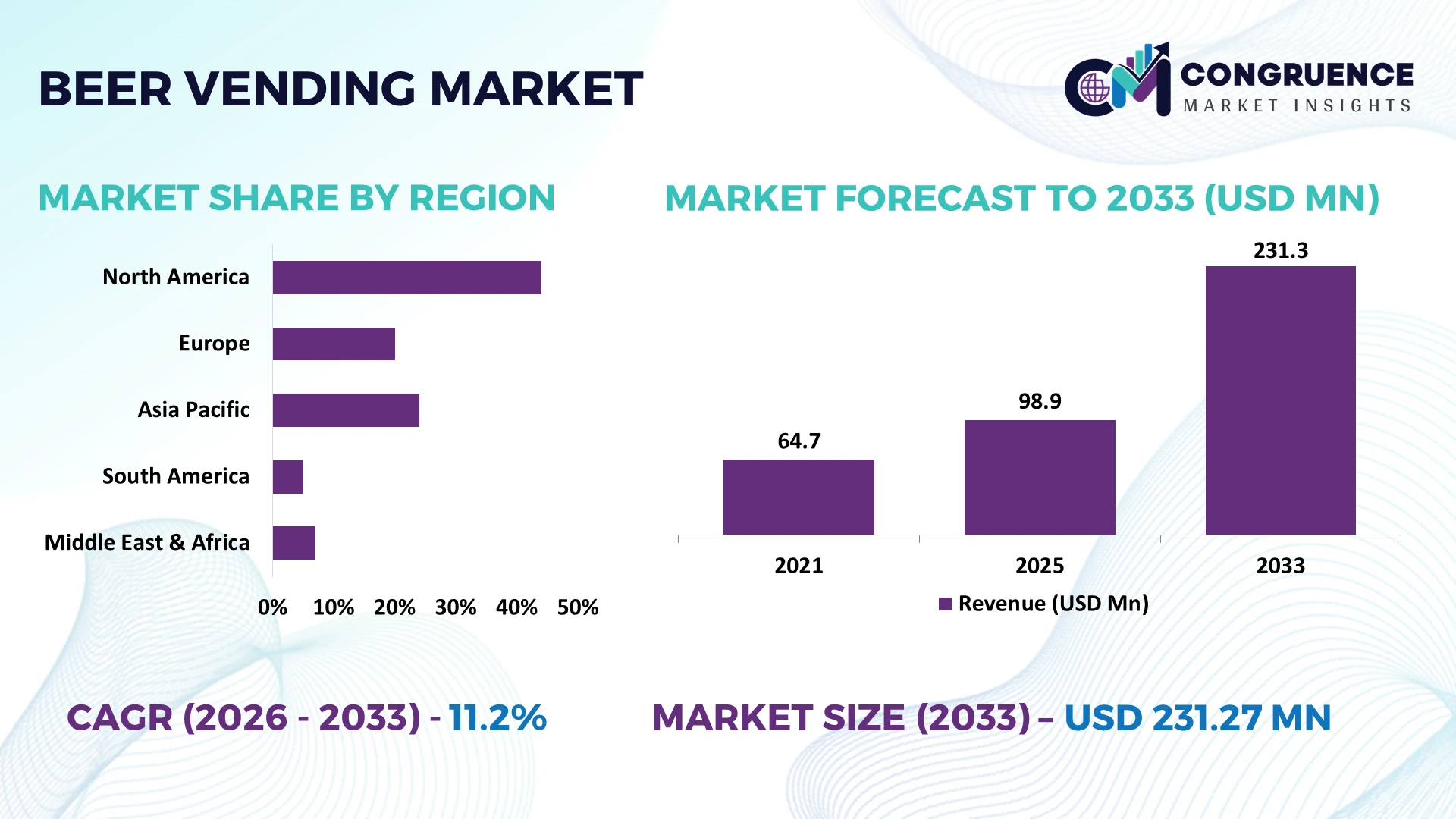
The Global Beer Vending Market was valued at USD 98.92 Million in 2025 and is anticipated to reach a value of USD 231.27 Million by 2033 expanding at a CAGR of 11.2% between 2026 and 2033. Growth is being driven by AI-enabled age verification, cashless payment, RFID-controlled dispensing, and hospitality labor automation that converts regulated alcohol sales into measurable unattended-retail workflows.
Japan remains the most structurally mature beer-vending environment, with 8,521 alcohol vending machines operating as of April 2025, despite an installed-base reduction exceeding 95% from 1996 levels as regulators eliminated conventional non-age-verifying machines. Digital modernization is now replacing legacy deployment: smartphone My Number age-verification trials began in 2025, while Kirin’s next-generation dispensing platform surpassed 30,000 restaurant installations. By comparison, U.S. self-pour systems operate under state-by-state alcohol rules; one major platform is permitted across most states and limits automated access to 32 ounces of beer before staff reauthorization.
Strategically, winning suppliers must combine regulatory-grade identity verification with automated dispensing, payment integration, inventory intelligence, and venue-specific deployment rather than compete as conventional vending-machine manufacturers.
Market Size & Growth: USD 98.92 million in 2025 reaches USD 231.27 million by 2033 at 11.2%, driven by automated age verification and cashless dispensing.
Top Growth Drivers: AI routing supports 10% fewer labor hours; optimized vending assortments target 5% higher sales; self-pour deployments demonstrate 50% labor-cost reductions.
Short-Term Forecast: By 2027, advanced operators will target approximately 10% lower servicing labor through AI-directed replenishment, route optimization, and remote machine analytics.
Emerging Technologies: Computer vision, biometric ID verification, RFID metering, and AI inventory engines are scaling; established self-pour networks already exceed 8,000 taps across 25 countries.
Regional Leaders: Using current deployment-based planning shares, 2033 demand equates to approximately North America USD 78.6 million, Asia-Pacific USD 76.3 million, and Europe USD 55.5 million as smart unattended retail expands.
Consumer/End-User Trends: Automated platforms meter individual pours and commonly cap access at 32 ounces before reauthorization, combining customer convenience with responsible-service controls.
Pilot/Case Example: A self-pour taproom deployment reported 50% lower labor costs and 20% lower cost of goods after reducing overpouring and theft.
Competitive Landscape: Technology leadership increasingly rests with PourMyBeer, Dispension, 365 Retail Markets, BeerBox, and specialized beverage-equipment providers; PourMyBeer reports deployment across 25 countries.
Regulatory & ESG Impact: Japan’s alcohol-vending fleet has contracted by more than 170,000 machines since 1996, pushing suppliers toward verified-age systems rather than unrestricted outdoor vending.
Investment & Funding: Kirin’s TAPPY platform exceeded 30,000 installed venues by April 2025, demonstrating how beverage companies are scaling automated dispensing infrastructure through restaurant partnerships.
Innovation & Future Outlook: Smart refrigeration and natural refrigerants are entering beverage dispensing; Asahi and Hoshizaki validated a new platform across 10 restaurants before wider deployment.
Beer vending demand is concentrating in stadiums, hospitality venues, entertainment complexes, hotels, breweries, and controlled retail environments where automation reduces queues and staffing intensity. AI identity verification, RFID pour control, computer vision, and cashless payment are replacing conventional machines. Self-pour deployments have demonstrated labor-cost reductions of 50%, while tightening alcohol-access rules make compliant automation the defining strategic transition.
Beer vending is becoming strategically important as hospitality operators replace labor-intensive alcohol service with digitally controlled, self-service dispensing. The critical shift is regulatory digitization: Japan is testing smartphone-based My Number age verification while U.S. operators increasingly use RFID credentials and transaction-level pour controls. Japan still operates 8,521 alcohol vending machines, demonstrating an established infrastructure base available for modernization.
Technology changes the operating model. Self-pour systems have demonstrated labor-cost reductions approaching 50% and cost-of-goods improvements near 20% by controlling overpouring, theft, and serving quantities. Unlike legacy vending machines, connected systems combine identity verification, cashless payments, inventory telemetry, and remote diagnostics. Japan leads conventional alcohol-vending scale, while the United States is advancing venue-based self-pour deployment under state-specific rules, including automated 32-ounce beer limits before reauthorization.
Through 2026–2028, deployment will concentrate in stadiums, taprooms, hotels, entertainment venues, and controlled retail locations. A 40-tap self-pour venue can redirect employees from repetitive pouring toward customer service while capturing real-time consumption data. Operators and technology suppliers are consequently expanding payment integrations, compliance partnerships, cloud monitoring, and dispensing networks. Competitive leadership will depend on converting regulated alcohol transactions into secure, measurable, low-labor digital workflows.
Labor optimization is accelerating automated beer dispensing in high-throughput hospitality environments. Self-pour deployments have demonstrated approximately 50% lower labor costs and 20% lower cost of goods, while automated systems meter each serving and can restrict customers to 32 ounces before staff reauthorization. In the United States, persistent restaurant labor pressure makes this combination of productivity and compliance particularly valuable for taprooms, stadium concessions, and entertainment venues. The operational impact extends beyond headcount: RFID-controlled pouring reduces overpouring and creates transaction-level consumption records. Operators are responding by installing multi-tap walls, integrating point-of-sale platforms, and redesigning staff roles around customer support rather than repetitive dispensing. The non-obvious advantage is throughput visibility—operators can identify fast-moving beers and adjust keg allocation before queues or stockouts reduce sales.
Alcohol vending cannot scale like conventional snack or beverage automation because licensing, age verification, serving limits, and machine-location rules vary sharply by jurisdiction. Japan’s installed alcohol-vending base has fallen more than 95% from approximately 186,000 machines in 1996 to 8,521 by April 2025 as traditional machines without effective age controls were progressively removed. Only about 11% of remaining machines were conventional units targeted for continued reduction. This regulatory structure raises compliance costs and prevents standardized global deployment. U.S. suppliers face another layer of complexity because alcohol rules differ among states and municipalities. Operators are mitigating exposure through RFID authorization, staff-controlled activation, digital identification, and transaction limits. Strategically, regulatory compatibility now matters more than machine density: hardware that cannot accommodate local verification workflows becomes commercially stranded regardless of dispensing performance.
Digital identity creates a pathway to move beer vending beyond supervised taprooms into increasingly automated retail environments. Japan began testing smartphone-based My Number age verification for alcohol vending in 2025, while its remaining 8,521-machine installed base provides immediate infrastructure for technology replacement. Connected self-pour platforms already operate across more than 25 countries, demonstrating that RFID-controlled dispensing can scale internationally when integrated with local compliance workflows. Through 2026–2028, computer vision, digital wallets, mobile identity credentials, and cloud-based consumption controls will increasingly converge inside vending platforms. Suppliers are positioning through payment partnerships, API development, remote monitoring, and modular verification technology. A less obvious opportunity lies in data monetization: machine-level pour information enables brewers and venue operators to measure SKU velocity, daypart consumption, and keg utilization, turning dispensing equipment into a demand-intelligence endpoint.
Scaling intelligent beer vending requires reliable integration among refrigeration, flow meters, RFID credentials, payment gateways, age verification, cloud software, and venue networks. Self-pour platforms can manage installations exceeding 40 taps, while established providers operate more than 8,000 taps across 25 countries; this scale increases software uptime, cybersecurity, calibration, and remote-support requirements. Even a 1–2% measurement variance across high-volume dispensing can distort inventory reconciliation and weaken the economics promised by automated portion control. Japan adds another execution pressure as digital age-verification systems must coexist with legacy vending infrastructure, while U.S. deployments must accommodate changing state-level rules. Companies therefore need encrypted payment architecture, remote diagnostics, standardized flow calibration, software updates, and trained service partners. The strategic challenge is no longer dispensing beer automatically; it is delivering identical compliance, measurement accuracy, and system availability across thousands of heterogeneous locations.
Smart Dispensing Replaces Fixed Pouring: Connected beer systems now combine flow meters, RFID access, digital payments, and remote diagnostics, with leading networks exceeding 8,000 taps across more than 25 countries. Operators are using real-time keg data to reduce stockouts, improve replenishment speed, and standardize serving volumes, while suppliers expand cloud-based monitoring and POS integrations.
Age Verification Moves Digital: Japan’s remaining 8,521 alcohol vending machines are becoming a testing ground for smartphone and digital-ID verification as conventional non-age-controlled units disappear. More than 95% of the country’s alcohol-vending base has been removed since 1996. Vendors are redesigning machines around verified transactions, creating a compliance-led replacement cycle rather than simple equipment expansion.
Compact Systems Gain Venue Share: Countertop and modular self-service dispensers are moving into hotels, restaurants, entertainment venues, and temporary events where large freestanding machines are impractical. Modern platforms can manage 10–40+ taps per installation, improving service density while reducing queue pressure. Equipment companies are responding with modular refrigeration, mobile payment interfaces, and scalable keg-management architectures.
Operational Analytics Shapes Beer Assortment: Automated dispensing increasingly measures SKU velocity, pour volume, daypart demand, and keg depletion rather than functioning only as a serving device. Controlled self-pour deployments have demonstrated labor-cost reductions near 50% and cost-of-goods improvements around 20%. Operators are restructuring beverage menus and inventory around consumption data, while technology suppliers add analytics dashboards and automated replenishment alerts.
Refrigerated Units represent the leading Beer Vending Market type, with an estimated 34–38% share in 2025, supported by their ability to combine cold-chain integrity, keg storage, dispensing control, and unattended operation within one platform. Their strongest use remains in hospitality, entertainment, and controlled retail environments where consistent beer temperature and service reliability outweigh higher equipment footprints. Freestanding Units account for approximately 24–28%, benefiting from flexible placement and strong visibility in high-footfall venues.
Self-Service Units are the fastest-growing type, with an estimated 20–24% share, as RFID authorization, digital payments, and automated pour measurement shift beer service toward customer-controlled workflows. Countertop Units hold roughly 14–18%, serving bars, hotels, and smaller-format venues requiring compact deployment. Suppliers are consequently shifting investment toward modular self-service architectures, integrated refrigeration, and software-driven dispensing rather than purely mechanical vending. The business implication is clear: equipment value is migrating from hardware capacity toward transaction control, compliance, and data connectivity.
Hospitality is the largest application, representing an estimated 35–39% of Beer Vending Market demand, driven by hotels, bars, restaurants, and food-service venues that require high throughput with tighter labor control. Automated beer dispensing reduces repetitive bartender workload while improving portion accuracy and inventory visibility. Entertainment Venues account for approximately 20–24%, where queue reduction and rapid transaction processing support high-volume concession operations.
Events & Festivals are the fastest-growing application, estimated at 17–21%, as modular, mobile, and cashless dispensing systems make temporary deployments easier to scale. Retail represents roughly 12–16%, constrained by stricter alcohol-access regulation, while Corporate Facilities remain a smaller 6–10% niche focused on controlled hospitality and employee events. Companies are adapting through portable systems, cloud-connected inventory management, temporary-event partnerships, and multi-location software platforms. Demand is strengthening where service speed and staffing flexibility directly influence throughput, making event deployment increasingly important to equipment utilization.
Restaurants & Bars remain the dominant end-user group, accounting for an estimated 38–42% of Beer Vending Market demand because they operate continuous beverage service, maintain dedicated keg infrastructure, and benefit directly from faster pouring and labor optimization. Hotels represent approximately 18–22%, using automated dispensers in lounges, buffets, executive floors, and high-traffic food-service areas where standardized service improves operating consistency.
Stadiums are the fastest-growing end-user segment, with an estimated 15–19% share as venues prioritize queue reduction, cashless transactions, and higher beverage throughput during short service windows. Event Venues account for roughly 12–16%, while Shopping Centers represent approximately 8–12%, constrained by licensing and supervised-consumption requirements. Suppliers are targeting stadiums and event operators with high-capacity, RFID-enabled systems and revenue-sharing partnerships, while restaurant customers receive compact configurations and POS integration. Future competitive positioning increasingly depends on adapting dispensing architecture to venue-specific throughput, compliance, and staffing requirements.
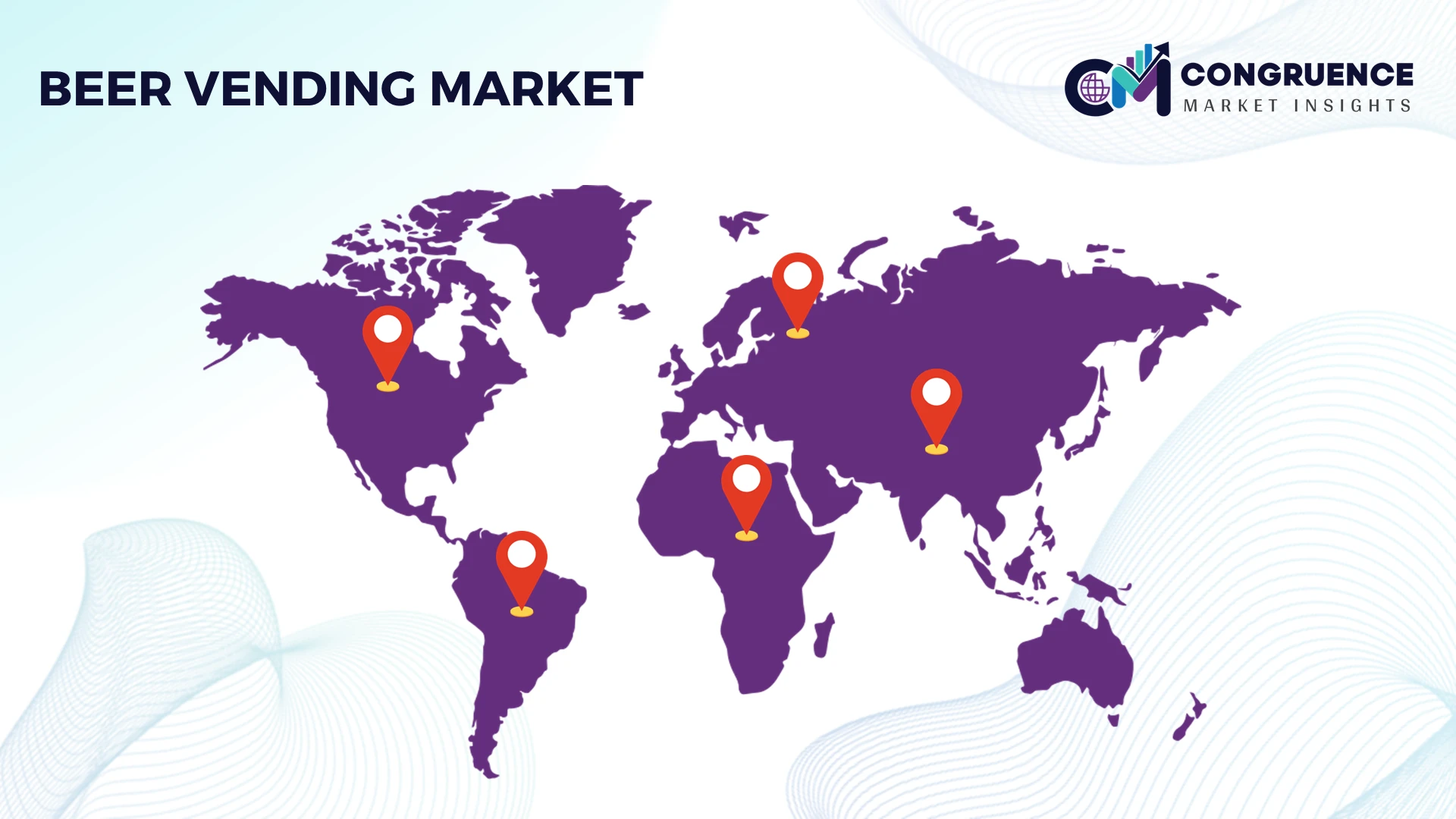
North America accounted for the largest market share at approximately 36% in 2025 however, Asia-Pacific is expected to register the fastest growth, expanding at a CAGR of approximately 13.4% between 2026 and 2033.
Self-Service Technology Reshapes Venue Economics
North America represents approximately 36% of global beer vending demand, supported by advanced hospitality technology, cashless payments, sports infrastructure, and established self-pour deployments. The United States concentrates activity across restaurants, taprooms, casinos, stadiums, food halls, and entertainment venues. Leading self-pour networks now exceed 12,000 taps across 500+ global locations, with major U.S. operators using RFID, QR, NFC, and POS-connected dispensing. Commercial adoption is increasingly tied to labor economics: automated beverage systems can reduce labor costs around 20% and maintain beverage waste below 3%. Canada contributes through stadium, hospitality, and entertainment installations, although provincial alcohol controls create more fragmented deployment conditions. Suppliers are responding with modular systems, age-verification integration, financing, and partnerships with draft-equipment installers and hospitality technology platforms.
United States Market Outlook: The United States provides the strongest commercial ecosystem for smart beer vending because technology providers already integrate with major POS platforms including Toast, Square, Clover, and Micros. Self-service installations can replace four traditional bar staff with one beverage-wall ambassador in comparable workflows. Stadium and entertainment operators increasingly prioritize transaction throughput, controlled dispensing, and real-time consumption analytics, strengthening demand for connected rather than standalone vending equipment.
Automated Dispensing Targets Venue Throughput
Europe represents approximately 27% of beer vending demand, supported by mature draft-beer culture, stadium modernization, festivals, hospitality automation, and dense entertainment infrastructure. Germany and the United Kingdom are important technology and deployment centers, while continental operators increasingly use automated dispensing to overcome queue congestion during short service windows. Advanced European systems demonstrate the operational potential: a dual-unit automated beer wall can dispense approximately 600 pints per hour from only 4×1 meters of floor area, while six dispensing units can reach 1,200 pints per hour under one trained supervisor. Cashless transactions and pressure-controlled pouring further improve throughput consistency. Suppliers are moving from temporary event equipment toward permanently installed beer walls, combining hardware ownership with maintenance, digital payments, and venue integration. Regulation remains country-specific, favoring supervised installations over unrestricted alcohol vending.
United Kingdom Market Outlook: The United Kingdom stands out for stadium-based deployment and automated beer-wall engineering. Systems installed at football venues demonstrate configurations ranging from one to 100 dispensing units, with project turnaround achievable within 2–3 weeks. This combination of modular capacity and rapid installation gives venue operators a practical route to monetize underused concourse space while reducing dependence on conventional staffed bars.
Japan Anchors Regulated Vending Modernization
Asia-Pacific accounts for approximately 25% of global beer vending demand, with Japan providing the world’s most established alcohol-vending infrastructure and China, Australia, and South Korea adding hospitality automation potential. Japan had 8,521 alcohol vending machines operating in April 2025, including 7,466 improved machines and only 1,055 conventional units. That 88% concentration in improved formats demonstrates how regulation is transforming installed equipment rather than simply expanding machine numbers. Osaka’s tax jurisdiction alone contained 3,407 units, approximately 40% of Japan’s total, highlighting unusually concentrated deployment infrastructure. Technology suppliers are increasingly combining age controls, mobile verification, refrigeration, cashless payment, and telemetry. Elsewhere, high-density hospitality and entertainment environments favor controlled self-service dispensing rather than traditional outdoor vending, pushing suppliers toward venue-specific partnerships and locally compliant software.
Japan Market Outlook: Japan combines vending-machine familiarity with unusually strict alcohol-sale modernization. Its alcohol vending fleet has contracted from 185,829 machines in 1996 to 8,521 in 2025, forcing technology replacement toward controlled formats. The remaining installed base therefore represents a compliance-led modernization opportunity centered on improved machines, digital identity, cashless transactions, and remote operating controls rather than a return to unrestricted vending.
Hospitality Digitization Creates Selective Demand
South America represents approximately 7% of global beer vending demand, with Brazil providing the strongest addressable hospitality, brewing, sports, and entertainment ecosystem. Adoption remains concentrated in controlled venues rather than outdoor vending because alcohol regulation, payment infrastructure, maintenance availability, and refrigeration requirements complicate unattended deployment. Brazil’s high digital-payment penetration strengthens the economics of cashless self-service systems, while large football venues, festivals, breweries, and urban restaurant clusters provide natural high-throughput applications. International self-pour technology entered South American markets early, demonstrating that the operating model can function where local installation and service partners are available. Suppliers are emphasizing compact tap walls, mobile event systems, QR-enabled transactions, and distributor-led technical support. The main constraint remains fragmented after-sales infrastructure outside major cities, making serviceability and spare-parts availability as important as dispensing technology.
Brazil Market Outlook: Brazil offers the clearest scale opportunity because São Paulo, Rio de Janeiro, and other major urban centers combine large hospitality networks with widespread instant digital payments. PIX processed more than 63 billion transactions during 2024, creating strong consumer familiarity with cashless purchasing. Beer-vending suppliers can exploit this infrastructure through QR-enabled payment, controlled event deployment, and partnerships with local beverage distributors and hospitality integrators.
Tourism Infrastructure Shapes Controlled Deployment
Middle East & Africa represents approximately 5% of global beer vending demand, with deployment concentrated in licensed hotels, resorts, entertainment districts, casinos, airports, and tourism facilities. The UAE and South Africa provide the most practical environments because alcohol service already operates through regulated hospitality channels and digital payment infrastructure. In the Gulf, premium tourism expansion favors controlled dispensing inside licensed premises rather than conventional public vending. Dubai recorded more than 18 million international overnight visitors in 2024, creating substantial beverage-service throughput across hotels and entertainment venues. South Africa adds established brewing and hospitality infrastructure but faces greater operating variability across locations. Vendors are responding with supervised self-pour stations, integrated payment controls, compact refrigeration, and hotel-system connectivity. Market access depends heavily on licensing compliance and partnerships with established hospitality operators rather than broad consumer-machine placement.
United Arab Emirates Market Outlook: The UAE is strategically significant because high hotel density, international tourism, cashless payment adoption, and tightly regulated alcohol licensing create a defined operating environment for premium automated dispensing. Dubai’s expanding hotel and entertainment infrastructure favors systems installed inside licensed venues, where digital authorization and transaction tracking can improve service speed without challenging existing alcohol-control frameworks.
PourMyBeer, iPourIt, Beerjet, EBar, Dispension, and Bottoms Up compete across self-pour walls, automated beer vending, and high-throughput dispensing, with technology specialists challenging conventional beverage-equipment suppliers. The top five are estimated to represent 45–50% of advanced deployments. Competition centers on throughput, integration, reliability, customization, and operating economics: leading self-pour platforms report 20% lower labor costs, waste below 3%, and sales improvements reaching 50%. Providers compete through POS partnerships, RFID and NFC integration, automated age verification, venue-specific hardware, and installer networks. The competitive shift is toward software-connected dispensing rather than standalone refrigeration, making transaction data and compliance functionality increasingly valuable. Stadium specialists differentiate through dispensing speed, while hospitality platforms emphasize analytics and flexible tap configurations. Regulatory certification, alcohol licensing compatibility, payment security, refrigeration reliability, and local servicing create substantial entry barriers. Winning requires proven dispensing accuracy, seamless compliance, rapid deployment, dependable technical support, and measurable operator-level productivity gains across diverse venues worldwide.
PourMyBeer
iPourIt
Beerjet GmbH
EBar Initiatives Ltd.
Dispension Industries Inc.
Bottoms Up Draft Beer Systems
Table Tap
PUBINNO
RevolMatic
Hoshizaki Corporation
BeerBox
PourMyBev
RFID-controlled self-pour taps, digital payments, flow metering, and cloud analytics define current beer-vending technology. Connected systems can cut labor costs about 20% and reduce beverage waste from roughly 23% at traditional bars to below 3%. Deployment is established: leading networks exceed 12,000 taps across 30 countries, giving operators faster service, tighter portion control, and real-time inventory visibility.
Emerging systems combine AI foam control, automated line cleaning, contactless payment, and digital quality monitoring. AI-controlled taps can improve keg yield by up to 20%, while smart cleaning technologies deliver substantially more consistent sanitation than manual workflows. Compared with legacy bartender-led dispensing, modern self-pour systems can reduce beverage waste by about 87%, shifting competitive advantage toward venues that integrate dispensing data with POS, staffing, and replenishment systems.
Disruptive development centers on biometric age verification, computer vision, natural-refrigerant cooling, and autonomous payment-to-pour workflows. New refrigeration platforms already cut electricity consumption around 20%, while facial verification removes another manual checkpoint. During 2026–2028, stadiums, hotels, restaurants, and controlled retail locations will increasingly connect identity, payments, refrigeration, dispensing, and analytics. Technology suppliers with compliance integrations and scalable service networks benefit most; early deployment builds operating data, regulatory experience, and venue partnerships before automated alcohol service becomes standardized.
October 2024 – Pubinno partnered with IDmission to combine Smart Tap with GameFace facial ID verification for automated sports-venue beer sales. The system integrates age checking, payment, and dispensing, reducing concession queues and labor dependence, strengthening unattended-service economics. Source: Pubinno.
May 2025 – Kirin Beer reported TAPPY deployment exceeding 30,000 Japanese restaurants by April 30. Its 3-liter PET format cuts annual handling and cleaning work by approximately 80 hours versus keg systems, strengthening compact dispensing economics for operators. Source: Kirin.
June 2025 – Beerjet featured in the DFL Stadium Innovations program with automated dispensers delivering approximately 2,000 servings hourly and filling six glasses simultaneously. Bundesliga deployment raises concession throughput without expanding available kiosk space or staffing during demand. Source: DFL.
September 2025 – Asahi Beer and Hoshizaki unveiled Japan’s first countertop draft dispenser using natural refrigerant after testing at 10 restaurants. The redesigned unit cuts electricity use approximately 20% and reduces refrigerant GWP from 1,430 to 3 nationwide. Source: Asahi.
The Beer Vending Market report covers Refrigerated Units, Countertop Units, Freestanding Units, and Self-Service Units across Events & Festivals, Hospitality, Retail, Entertainment Venues, and Corporate Facilities. End-user analysis encompasses Hotels, Restaurants & Bars, Stadiums, Shopping Centers, and Event Venues, with Restaurants & Bars representing an estimated 38–42% of current deployment concentration.
Regional assessment spans North America, Europe, Asia-Pacific, South America, and Middle East & Africa, including country-level regulatory and operating environments. Technology coverage examines RFID dispensing, biometric age verification, AI-controlled pouring, contactless payments, flow metering, natural-refrigerant cooling, POS integration, and cloud analytics. The report also evaluates niche stadium automation, mobile event dispensing, and controlled unattended retail. Competitive benchmarking, deployment economics, compliance requirements, partnership models, and technology adoption patterns support investment planning, geographic expansion, product positioning, and strategic decision-making throughout 2026–2033.
| Report Attribute/Metric | Report Details |
|---|---|
Market Revenue in 2025 | USD 98.92 Million |
Market Revenue in 2033 | USD 231.27 Million |
CAGR (2026 - 2033) | 11.2% |
Base Year | 2025 |
Forecast Period | 2026 - 2033 |
Historic Period | 2021 - 2025 |
Segments Covered | By Type
By Application
By End-User
|
Key Report Deliverable | Revenue Forecast, Growth Trends, Market Dynamics, Segmental Overview, Regional and Country-wise Analysis, Competition Landscape |
Region Covered | North America, Europe, Asia-Pacific, South America, Middle East, Africa |
Key Players Analyzed | PourMyBeer, iPourIt, Beerjet GmbH, EBar Initiatives Ltd., Dispension Industries Inc., Bottoms Up Draft Beer Systems, Table Tap, PUBINNO, RevolMatic, Hoshizaki Corporation, BeerBox, PourMyBev |
Customization & Pricing | Available on Request (10% Customization is Free) |




