
Reports
The Global Beauty Supplements Market was valued at USD 3,400.7 Million in 2025 and is anticipated to reach a value of USD 6,341.2 Million by 2033 expanding at a CAGR of 8.1% between 2026 and 2033. Growth is being driven by premium nutricosmetics, collagen supplementation, personalized nutrition, and the convergence of beauty, wellness, and preventive-health purchasing.
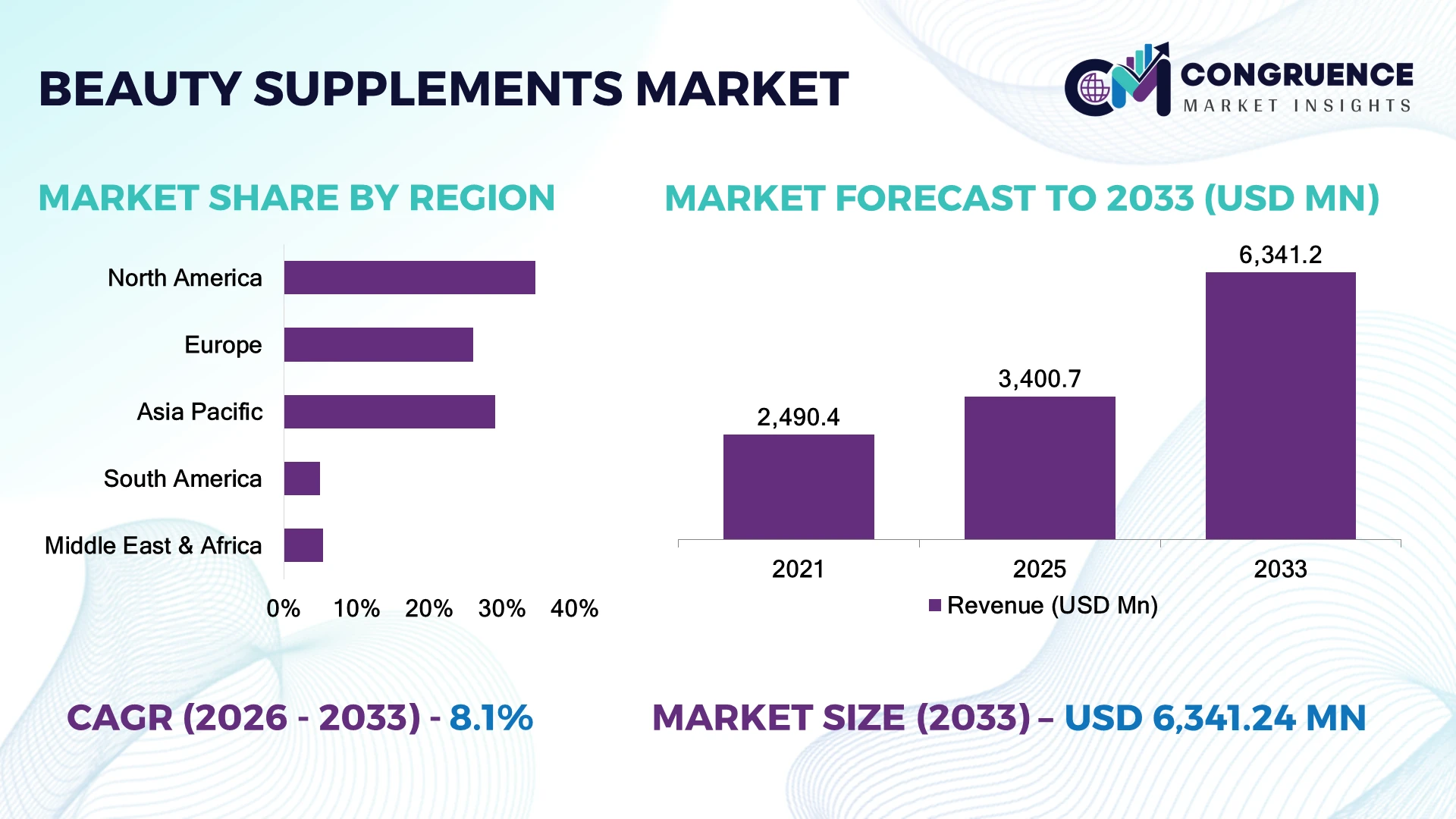
The United States held an estimated 31% share in 2025, supported by strong nutraceutical retail, dermatology, e-commerce, and premium wellness channels. Japan followed at approximately 12%, with functional-food infrastructure supporting ingestible beauty products. U.S. brands increasingly allocate 8–12% of product-development budgets to clinically positioned formulations, while Japan emphasizes functional claims and standardized ingredients. Geopolitical supply-chain restructuring is accelerating regional sourcing of collagen, vitamins, and botanical actives.
Strategically, companies should prioritize clinically differentiated formulations and resilient ingredient sourcing over undifferentiated supplement launches.
Market Size & Growth: USD 3,400.7 million in 2025 to USD 6,341.2 million by 2033 at 8.1% CAGR, supported by collagen, biotin, and nutricosmetic adoption.
Top Growth Drivers: Collagen 34%, personalized nutrition 27%, beauty-wellness convergence 23%.
Short-Term Forecast: By 2028, personalized formulation adoption is projected to rise 12%, improving targeting and repeat-purchase potential.
Emerging Technologies: AI formulation, biomarker-led personalization, and microencapsulation can improve active-delivery performance 15–25%.
Regional Leaders: North America could reach USD 2.0 billion, Europe USD 1.5 billion, and Asia-Pacific USD 1.9 billion, led by premium and functional-product adoption.
Consumer/End-User Trends: Approximately 28% of beauty-focused supplement users increasingly combine ingestible products with topical skincare.
Pilot/Case Example: 2025 collagen-formulation programs reported approximately 18% improvement in targeted skin-hydration measures, strengthening clinical-positioning strategies.
Competitive Landscape: Premium leaders such as Amway, Shiseido, Nestlé Health Science, HUM Nutrition, and Nature’s Bounty compete through formulation, branding, and omnichannel reach.
Regulatory & ESG Impact: Clean-label and traceability requirements are increasing documentation workloads by roughly 10–15%, accelerating standardized sourcing and formulation controls.
Investment & Funding: Strategic investment is increasingly directed toward clinical validation, personalized nutrition, and vertically integrated ingredient supply, with development budgets commonly allocating 8–12% toward differentiated formulations.
Innovation & Future Outlook: Next-generation beauty supplements will combine ingestible actives, microbiome support, AI personalization, and precision delivery, shifting competition toward measurable outcomes.
Beauty supplements are increasingly concentrated around collagen, skin-health vitamins, hair-growth formulations, probiotics, and antioxidant blends, with approximately 28% of users combining ingestible beauty products with topical routines. Microencapsulation and personalized dosage formats are improving active delivery, while tighter ingredient traceability is reshaping sourcing decisions. This transition is moving the category toward clinically substantiated, multifunctional products.
Beauty supplements are becoming strategically important because they convert cosmetic spending into recurring wellness consumption, giving manufacturers opportunities to build higher-frequency revenue streams and differentiated consumer ecosystems. The market is shifting from generic vitamins toward clinically positioned collagen, ceramides, probiotics, antioxidants, and personalized formulations. In 2026, ingredient traceability and substantiated claims are increasingly influencing retailer acceptance and brand positioning.
Technology is widening the performance gap. Conventional powdered formulations typically provide basic ingredient delivery, while microencapsulated systems can improve active stability and delivery efficiency by approximately 15–25%. AI-assisted formulation and consumer profiling can further reduce formulation-development cycles by around 10–20%. North America remains strongest in premium e-commerce and nutraceutical commercialization, while Japan and South Korea lead sophisticated functional-beauty integration.
Over the next 2–3 years, companies are expected to increase investment in clinical validation, personalized dosage systems, microbiome-focused formulations, and traceable ingredient networks. A practical deployment model is the integration of supplement subscriptions with dermatology, beauty-retail, and digital wellness platforms. Competitive advantage will increasingly depend on measurable efficacy, formulation transparency, supply resilience, and personalized consumer engagement.
Clinical validation is shifting beauty supplements from lifestyle products toward evidence-led nutricosmetics. Collagen, ceramides, probiotics, and antioxidant formulations collectively represent an estimated 45% of premium product launches, while clinically substantiated products command approximately 15–20% higher shelf positioning. In the United States, personalized nutrition platforms are accelerating formulation segmentation, while Japan continues integrating functional beauty with established nutraceutical channels. Supply-chain normalization after recent marine-collagen and botanical ingredient disruptions is enabling manufacturers to rebuild inventories and expand SKU ranges. Companies are responding through clinical trials, proprietary blends, contract-manufacturing partnerships, and vertically managed ingredient sourcing. The non-obvious advantage is formulation credibility: brands demonstrating measurable skin, hair, or nail outcomes can sustain premium pricing while reducing dependence on discount-led customer acquisition.
Beauty supplement manufacturers face simultaneous pressure from specialty-ingredient costs, regulatory claim requirements, and inconsistent botanical supply. Premium collagen peptides and standardized plant extracts can increase formulation costs by approximately 12–18%, while clinical substantiation can add 8–15% to development budgets. In Europe, stricter scrutiny of health and beauty claims increases documentation requirements and lengthens commercialization workflows. Weather variability affecting botanical harvests further exposes manufacturers to procurement volatility, particularly for plant-derived actives. These constraints compress margins for brands competing below premium price points. Companies are mitigating exposure through multi-country sourcing, longer supplier contracts, standardized extract specifications, and reformulation toward more readily available ingredients. Strategic procurement is becoming a competitive capability because reliable availability increasingly matters as much as formulation novelty.
Personalized beauty supplements create an opportunity to connect diagnostic data, dietary profiles, and targeted formulations. AI-assisted recommendation engines can reduce manual product-selection workflows by approximately 20–30%, while modular formulations enable brands to tailor nutrient combinations across skin, hair, nail, and healthy-aging needs. In India, expanding digital-health and e-commerce ecosystems provide a scalable route for personalized supplement subscriptions, while South Korea offers strong integration between beauty diagnostics and functional products. Companies are investing in direct-to-consumer platforms, at-home assessment tools, and partnerships with dermatology and wellness providers. A particularly attractive opportunity lies in subscription-based replenishment, where personalized packs can increase purchase frequency by an estimated 15–25% compared with conventional single-product purchasing. This shifts competition from shelf visibility toward data-enabled retention.
The major execution challenge is converting laboratory-level formulation claims into consistent consumer outcomes across diverse diets, lifestyles, and baseline nutritional profiles. Clinical programs can require 20–40% longer development cycles when endpoints involve visible skin or hair changes rather than simple nutritional biomarkers. Manufacturing complexity also rises as brands expand personalized SKUs, with operational variation potentially increasing production workload by 10–15%. In the United States and Europe, evolving scrutiny of substantiated claims intensifies the need for validated testing, batch traceability, and controlled formulation processes. Companies must therefore strengthen quality systems, analytical testing, and contract-manufacturing oversight while investing in scalable personalization architecture. The strategic pressure is clear: brands that cannot connect formulation composition with reproducible outcomes will face higher customer-acquisition costs and weaker retailer credibility.
Collagen Formulations Become Multifunctional Collagen products are shifting beyond basic beauty positioning toward combinations with hyaluronic acid, vitamin C, ceramides, and antioxidants. Combination formulas represent an estimated 30–35% of premium launches, while ready-to-drink formats are gaining approximately 10–15% faster shelf rotation than traditional powders. Manufacturers are expanding flavor systems, single-dose packaging, and clinically positioned formulations to improve convenience and repeat consumption.
Microencapsulation Improves Active Stability Microencapsulation is increasingly used for sensitive vitamins, botanical extracts, probiotics, and polyphenols, improving active stability by approximately 15–25% under controlled storage conditions. Adoption remains concentrated in premium products but is expanding as manufacturers seek longer shelf life and differentiated delivery. Ingredient suppliers and supplement brands are forming technology partnerships to integrate encapsulation without materially increasing manufacturing complexity.
Personalized Packs Reshape Replenishment Digital questionnaires, wellness assessments, and algorithmic recommendations are moving beauty supplements toward individualized packs. Personalized programs can reduce product-selection friction by roughly 20% and increase replenishment frequency by 15–25% in subscription-oriented models. U.S. and South Korean brands are integrating diagnostics, e-commerce, and recurring delivery, shifting competitive emphasis from individual SKUs toward consumer data, retention, and formulation agility.
Traceable Ingredients Gain Commercial Weight Ingredient traceability is becoming a purchasing requirement as retailers and consumers demand clearer provenance for collagen, botanicals, and marine-derived actives. Digital batch tracking can reduce manual documentation workloads by approximately 10–20%, while multi-source procurement is reducing exposure to localized supply disruptions. Companies are responding with supplier diversification, standardized specifications, and digitally documented sourcing, turning procurement transparency into a brand-level differentiator.
Collagen Products Lead While Peptide Formats Accelerate
Collagen-based supplements lead the Beauty Supplements Market, accounting for an estimated 38% share, supported by broad consumer recognition, flexible delivery formats, and established use across skin, hair, and nail positioning. Powders, gummies, capsules, and ready-to-drink products allow manufacturers to address different price points and consumption occasions. Vitamin and mineral formulations remain mature, representing approximately 27% of demand, while botanical and herbal products retain strategic relevance through antioxidant, adaptogenic, and holistic-wellness positioning. Probiotic beauty formulations are smaller but increasingly connected to gut-skin positioning.
Peptide-enhanced formulations represent the fastest-moving type, with adoption expanding as brands seek differentiated alternatives to conventional collagen. Recent market intelligence indicates collagen use is beginning to face substitution pressure from newer peptide concepts. Manufacturers are therefore shifting R&D toward peptide blends, enhanced absorption systems, and multifunctional formulations. Investment is moving from single-ingredient products toward clinically positioned combinations capable of supporting premium pricing and stronger consumer retention.
The Industry Transparency Center’s 2025 survey of more than 4,000 supplement users found collagen usage ranging from 65% in the United States to 34% in India, demonstrating substantial cross-market adoption differences.
Skin Health Dominates as Gut-Skin Expands
Skin health is the leading application, representing an estimated 46% market share, as hydration, elasticity, radiance, barrier support, and anti-aging remain the most commercially established beauty claims. Hair and nail health follows at approximately 31%, supported by collagen, biotin, zinc, and peptide combinations. Anti-aging and healthy-aging applications account for roughly 15%, while emerging gut-skin and holistic wellness applications are reshaping the remaining demand pool. Companies are increasingly bundling multiple benefits to increase perceived product value and reduce reliance on single-claim positioning.
Gut-skin formulations are the fastest-growing application, driven by probiotics, prebiotics, postbiotics, and microbiome-oriented ingredients. Their expansion is shifting product development toward interconnected beauty-and-wellness outcomes rather than purely cosmetic claims. Manufacturers are responding with clinical collaborations, microbiome testing, combination formulas, and personalized recommendations. The business implication is significant: brands that connect skin outcomes with digestive and metabolic wellness can access broader consumer occasions and defend premium positioning more effectively than narrowly focused products.
Euromonitor reported that 46% of global consumers in its 2025 Beauty Survey associated beauty with “appearing healthy,” reinforcing the commercial shift toward health-linked beauty positioning.
Women Lead While Younger Consumers Accelerate Adoption
Women represent the dominant end-user group, estimated at approximately 68% of Beauty Supplements Market consumption, reflecting stronger participation in collagen, skin-health, hair-care, and anti-aging supplementation. Men account for roughly 19%, while aging consumers and broader wellness-oriented users comprise the remaining demand. Established female-focused purchasing remains concentrated in collagen and beauty-specific vitamins, whereas younger consumers increasingly favor gummies, powders, subscription programs, and multifunctional products. Companies are adapting packaging, dosage formats, influencer strategies, and product claims around these differentiated consumption patterns.
Younger beauty-and-wellness consumers represent the fastest-growing end-user cohort, particularly across digitally native purchasing channels. In the United States, younger adults show higher engagement with collagen and other emerging supplements, while social platforms increasingly influence product discovery. Manufacturers are therefore expanding direct-to-consumer programs, personalized recommendations, and social-commerce partnerships. The strategic shift is toward retention rather than one-time acquisition: brands combining convenient formats, transparent ingredients, and measurable beauty outcomes are better positioned to convert younger consumers into recurring subscribers.
A 2025 YouGov survey found that 25% of U.S. women had bought or used collagen compared with 11% of men, while 18–34-year-olds showed 23% collagen usage, confirming a stronger female and younger-consumer concentration.
North America accounted for the largest market share at 34.6% in 2025 however, Asia-Pacific is expected to register the fastest growth, expanding at a CAGR of 10.2% between 2026 and 2033.
Premium Clinical Positioning Is Reshaping Supplement Portfolios
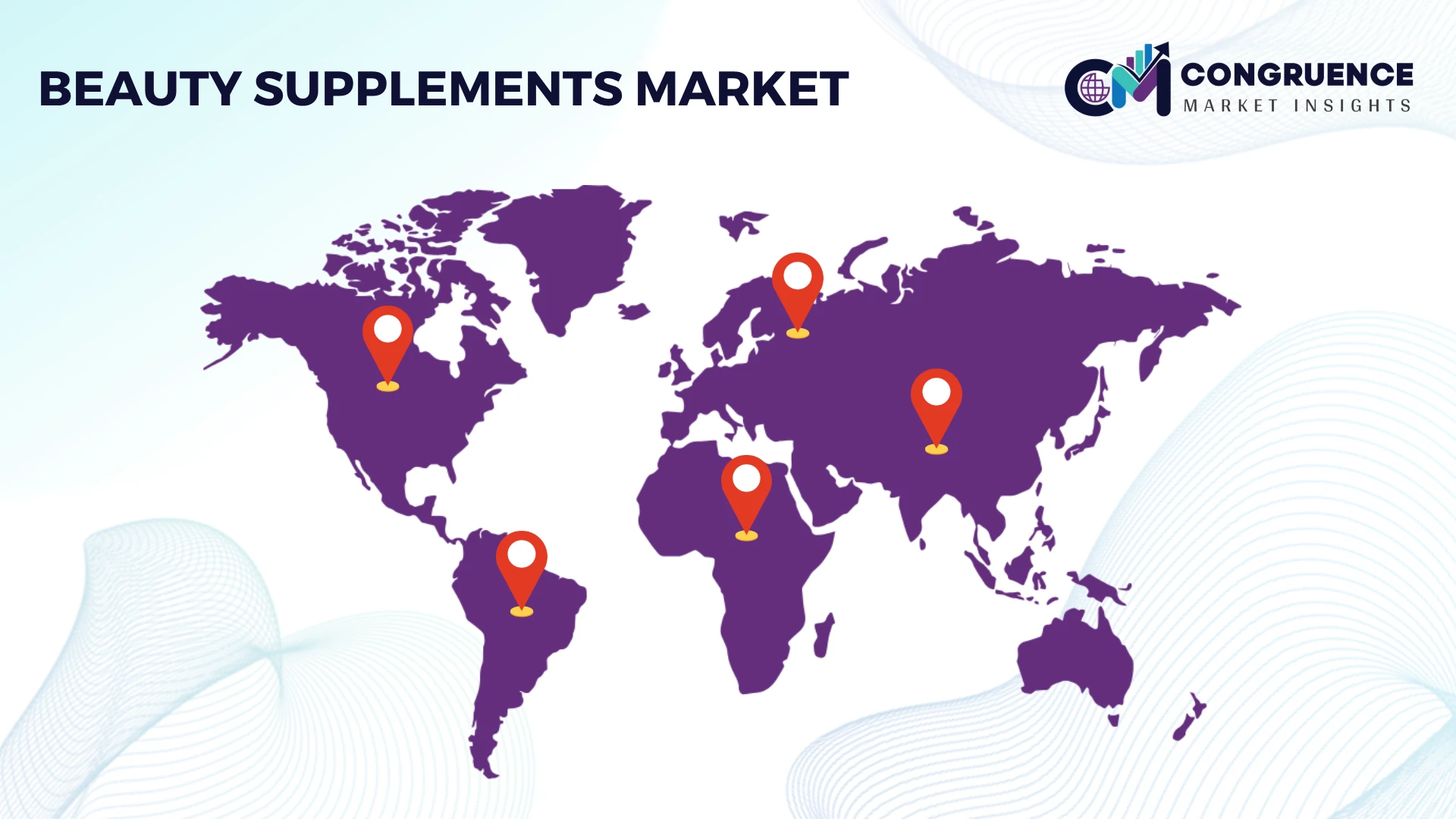
North America remains the leading Beauty Supplements Market, supported by sophisticated nutraceutical retail, strong e-commerce penetration, and high consumer familiarity with collagen, biotin, probiotics, and antioxidant formulations. The United States represents the dominant national market, with premium beauty supplements concentrated across pharmacy chains, specialty nutrition stores, dermatology-linked channels, and direct-to-consumer platforms. Approximately 38% of regional category value is concentrated in collagen-led products, while personalized and multifunctional formulations are gaining shelf space. Companies are responding to intense competition by investing in clinical substantiation, transparent ingredient sourcing, subscription models, and convenient gummies or ready-to-mix powders. The region's mature distribution infrastructure enables rapid national product launches, but premium brands increasingly compete on measurable efficacy rather than formulation novelty alone.
United States Market Outlook: The United States is the region's principal commercial and innovation hub, supported by extensive supplement retail infrastructure and advanced digital distribution. Collagen remains particularly influential, with powder formats historically representing more than 50% of consumption in surveyed U.S.-linked markets. Companies are prioritizing clinically positioned peptides, personalized recommendations, and recurring online purchasing to strengthen customer retention.
Regulatory Discipline Is Driving Evidence-Led Formulation
Europe is shifting toward clinically substantiated, clean-label, and traceable beauty supplements as consumers increasingly connect beauty with healthy aging and preventive nutrition. Germany, France, Italy, and the United Kingdom represent major commercial centers, while pharmacies and specialist health retailers remain important alongside digital channels. Approximately 30% of premium launches increasingly emphasize multifunctional benefits spanning skin, hair, nails, and healthy aging. European manufacturers are strengthening formulation documentation, ingredient provenance, and quality-control systems to manage regulatory scrutiny around health claims. This environment favors companies with established scientific capabilities and compliant pan-European distribution. Investment is moving toward standardized botanical extracts, collagen peptides, probiotics, and evidence-backed combinations rather than heavily promotional single-ingredient products.
Germany Market Outlook: Germany offers a strategically significant market because of its strong pharmacy network, sophisticated nutraceutical manufacturing base, and high consumer emphasis on product quality. Manufacturers are increasingly using pharmaceutical-grade quality systems and traceable sourcing to differentiate premium beauty supplements. Demand for collagen, micronutrients, and healthy-aging formulations is strengthening, while pharmacy-led professional recommendations provide brands with a credible route to higher-value consumers.
Beauty-from-Within Is Becoming a Regional Category Engine
Asia-Pacific is the fastest-transforming market, led by China and Japan's mature beauty-supplement cultures and rapidly expanding adoption across South Korea and Southeast Asia. Beauty is now the second most important positioning within the region's vitamins and dietary supplements market, while online penetration of VDS products increased from 32% in 2020 to 46% in 2025. China and Japan maintain strong collagen awareness, while South Korea and Australia are attracting new brand entrants. Companies are expanding jelly, liquid, gummy, and traditional-herb formats, using social commerce and localized formulations to reach younger consumers. The competitive advantage is shifting toward rapid product localization and digital distribution rather than relying solely on established retail networks.
Japan Market Outlook: Japan represents the region's most sophisticated beauty-supplement market, combining advanced functional-food expertise with strong consumer acceptance of collagen, hyaluronic acid, probiotics, and healthy-aging products. Jelly formats remain commercially important, while manufacturers are expanding into gut-health and family-wellness applications. Companies with strong clinical evidence, precise dosage formats, and established functional-food expertise are best positioned to defend premium pricing.
Collagen-Led Consumption Is Expanding Through Localized Channels
South America is developing around collagen, hair-and-nail supplements, vitamins, and beauty-oriented functional foods, with Brazil accounting for the largest commercial opportunity. A Brazilian consumer study found that 84% of surveyed collagen users were women and 73.3% were located in the Southeast, demonstrating strong concentration around major urban and higher-income consumer markets. Powder collagen represented 52.7% of consumption in that study, ahead of capsules and gummies. Manufacturers are responding with localized pricing, pharmacy distribution, social-commerce campaigns, and diversified formats. The principal operational constraint is uneven access beyond major cities, making distributor coverage and affordable single-dose formats strategically important for secondary-market expansion.
Brazil Market Outlook: Brazil is the region's leading market, supported by a large beauty and nutraceutical consumer base, extensive pharmacy infrastructure, and strong collagen awareness. Surveyed consumers reported that 41.9% of perceived collagen benefits related to skin, hair, and nails, reinforcing the category's beauty-led positioning. Companies are increasingly combining collagen with vitamins, antioxidants, and multifunctional ingredients to broaden usage occasions.
Premium Wellness Investment Is Expanding Beauty-from-Within Access
Middle East & Africa is evolving through premium wellness retail, private healthcare investment, e-commerce expansion, and increasing consumer interest in healthy-aging products. Saudi Arabia and the United Arab Emirates represent the strongest commercial hubs, supported by modern retail infrastructure and high penetration of premium beauty and wellness products. Beauty supplements are increasingly positioned alongside skincare, dermatology, fitness, and preventive-health portfolios rather than as isolated nutraceutical products. Approximately 20–25% of premium category launches in developed Gulf channels increasingly emphasize multifunctional wellness benefits. Companies are strengthening distributor partnerships, premium pharmacy placement, localized digital campaigns, and high-value formulations containing collagen, antioxidants, and micronutrients.
Saudi Arabia Market Outlook: Saudi Arabia provides the strongest strategic platform through healthcare modernization, expanding premium retail, and substantial investment in wellness-oriented consumer categories. Beauty supplements are increasingly integrated with pharmacy, dermatology, fitness, and e-commerce channels. Manufacturers are prioritizing premium packaging, transparent ingredient sourcing, and localized distribution partnerships, while convenient gummies, sachets, and ready-to-consume formats provide an effective route toward younger digitally engaged consumers.
Amway, Nestlé Health Science, Herbalife, Shiseido, and GNC compete as portfolio leaders, while specialist collagen, probiotic, and D2C brands challenge them through niche formulations and faster product cycles. The top five are estimated to control about 30% of global value, leaving meaningful fragmentation among regional brands. Competition centers on formulation efficacy, clinical substantiation, distribution, and price: premium clinically positioned products command roughly 15–25% higher pricing, while personalized formats can lift repeat purchasing 10–20%. Nestlé and Amway leverage scale and omnichannel reach; Shiseido integrates beauty science with ingestible wellness; GNC emphasizes premium collagen; specialist brands compete through customization and digital engagement. Competitive activity increasingly involves partnerships, localized launches, new delivery formats, and ingredient integration rather than simple SKU expansion. The market is shifting toward evidence-backed, multifunctional, convenient products, raising barriers around clinical validation, regulatory compliance, ingredient quality, and retail access. Winning requires differentiated efficacy, resilient sourcing, rapid innovation, and consumer retention.
Beauty supplement technology is moving from conventional powders and capsules toward microencapsulated actives, controlled-release delivery, precision dosing, and multifunctional formats. Microencapsulation can improve sensitive-ingredient stability by roughly 15–25%, while controlled-release systems can extend active availability by 10–20%. Adoption is strongest in premium collagen, probiotic, antioxidant, and botanical formulations, where delivery performance directly supports premium positioning.
AI-assisted formulation and personalization are emerging as competitive differentiators. Algorithmic product recommendations can reduce manual product-selection workflows by approximately 20%, while modular dosage systems can cut reformulation cycles by 10–15%. Digital skin assessments, microbiome testing, and subscription platforms are integrating with supplement commerce, allowing brands to connect formulation choices with consumer profiles. This favors D2C innovators and science-led manufacturers that can convert consumer data into differentiated products.
From 2026–2028, ready-to-drink formats, precision nutrition, and advanced delivery systems will reshape product development. Vital Proteins’ 2025 collagen-protein shake illustrates the shift toward convenience, while Rohto’s time-control drink-and-tablet format demonstrates differentiated release engineering. Compared with basic powder delivery, advanced formats can improve convenience-related adherence by approximately 15–20%. Companies combining clinical validation, delivery technology, and personalized recommendations will gain an advantage over cost-focused brands, making technology investment essential for premiumization, retention, and faster product localization across priority markets globally.
The Beauty Supplements Market Report covers collagen, vitamins and minerals, antioxidants, probiotics, hyaluronic acid, omega-3, botanical ingredients, and emerging bioactive formulations across powders, capsules, gummies, liquids, tablets, and ready-to-drink formats. Analysis spans skin health, hair and nail care, anti-aging, healthy aging, gut-skin applications, and multifunctional wellness, with assessment of women, men, younger consumers, and aging populations.
Regional coverage includes North America, Europe, Asia-Pacific, South America, and Middle East & Africa, with country-level analysis of adoption, distribution, formulation preferences, regulatory environments, and competitive intensity. The report evaluates clinical substantiation, microencapsulation, controlled release, personalization, AI-enabled recommendations, and digital commerce. Quantitative assessment covers segment shares, adoption patterns, product-format shifts, and company positioning, supporting investment planning, portfolio expansion, market entry, partnerships, competitive benchmarking, and strategic direction through 2026–2033.
| Report Attribute/Metric | Report Details |
|---|---|
|
Market Revenue in 2025 |
USD 3,400.7 Million |
|
Market Revenue in 2033 |
USD 6,341.2 Million |
|
CAGR (2026 - 2033) |
8.1% |
|
Base Year |
2025 |
|
Forecast Period |
2026 - 2033 |
|
Historic Period |
2021 - 2025 |
|
Segments Covered |
By Type
By Application
By End-User
|
|
Key Report Deliverable |
Revenue Forecast, Growth Trends, Market Dynamics, Segmental Overview, Regional and Country-wise Analysis, Competition Landscape |
|
Region Covered |
North America, Europe, Asia-Pacific, South America, Middle East, Africa |
|
Key Players Analyzed |
Amway, Nestlé Health Science, Herbalife, Shiseido, GNC Holdings, Nature’s Bounty, HUM Nutrition, OLLY Nutrition, Rohto Pharmaceutical, Meiji Holdings, Amorepacific, Suntory Holdings, Otsuka Pharmaceutical, DHC Corporation |
|
Customization & Pricing |
Available on Request (10% Customization is Free) |




