
Reports
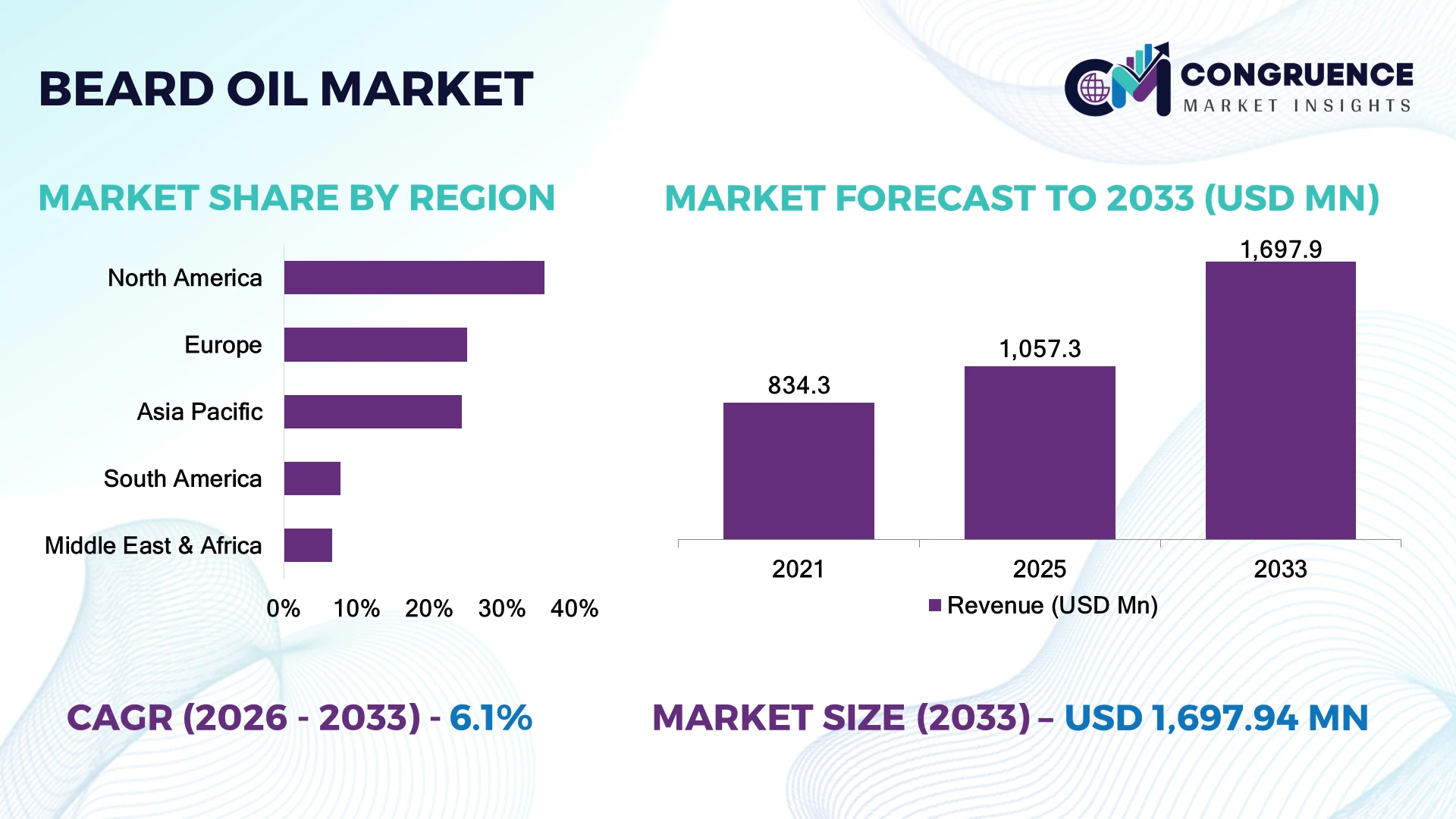
The Global Beard Oil Market was valued at USD 1,057.3 Million in 2025 and is anticipated to reach a value of USD 1,697.9 Million by 2033 expanding at a CAGR of 6.1% between 2026 and 2033. Growth is being driven by premium grooming routines, natural-oil formulations, male skincare convergence, and rapid expansion of direct-to-consumer and social-commerce channels.
The United States remains the dominant country market, supported by established men's grooming brands, specialty retail, e-commerce infrastructure, and premium personal-care spending. The country is estimated to represent about 31% of global beard-oil demand, while the United Kingdom accounts for roughly 9%, reflecting stronger beard-care specialization relative to population size. Natural and organic formulations represent approximately 38% of premium product launches, reinforcing demand for argan, jojoba, coconut, and essential-oil blends. Global logistics normalization following geopolitical disruptions is also improving availability of imported botanical ingredients.
Strategically, manufacturers that combine formulation differentiation with digitally efficient distribution and transparent ingredient positioning will capture the strongest premium-grooming opportunities.
Market Size & Growth: USD 1,057.3 million in 2025 to USD 1,697.9 million by 2033 at 6.1% CAGR, supported by premiumization and men's skincare convergence.
Top Growth Drivers: Premium grooming 18%, natural formulations 15%, e-commerce purchasing 13%.
Short-Term Forecast: By 2028, digitally influenced beard-care purchases are positioned to increase 12%–15%, strengthening direct-to-consumer distribution.
Emerging Technologies: AI-assisted formulation, personalized grooming recommendations, QR-based product authentication, and automated filling systems are improving product development and traceability.
Regional Leaders: North America is projected at approximately USD 610 million, Europe at USD 470 million, and Asia-Pacific at USD 390 million by 2033, with premium grooming penetration increasing across urban consumers.
Consumer/End-User Trends: Approximately 42% of premium beard-oil consumers increasingly prefer products combining conditioning, skin hydration, fragrance, and styling benefits.
Pilot/Case Example: A 2025 personalized-grooming program using digital recommendation tools reported approximately 16% higher repeat-purchase engagement versus conventional product merchandising.
Competitive Landscape: Leading brands include Beardbrand, Honest Amish, The Art of Shaving, Scotch Porter, and Mountaineer Brand, competing through formulation, branding, scent profiles, and digital distribution.
Regulatory & ESG Impact: Approximately 35% of premium launches increasingly emphasize natural, recyclable, or responsibly sourced positioning, raising packaging and ingredient-transparency expectations.
Investment & Funding: More than USD 100 million in cumulative brand and category investment is increasingly directed toward e-commerce expansion, influencer-led acquisition, formulation development, and premium retail placement.
Innovation & Future Outlook: 2026–2028 innovation will emphasize multifunctional oils, microbiome-conscious formulations, refillable packaging, personalized scent systems, and digitally enabled product discovery.
Beard oil is increasingly positioned as a multifunctional men's grooming product rather than a basic beard-conditioning treatment. Demand is strengthening around lightweight non-greasy textures, botanical ingredients, fragrance layering, and products that combine beard softness with underlying skin hydration. Approximately 38% of premium product launches emphasize natural or botanical positioning, while social-commerce and creator-led product discovery are reshaping brand visibility. Supply-chain normalization for specialty oils and fragrance ingredients is enabling manufacturers to broaden formulations and premium product ranges.
The beard oil market is becoming strategically important because men's grooming is converging with skincare, fragrance, and wellness, allowing brands to increase basket value through multifunctional formulations. Competitive differentiation is moving beyond beard conditioning toward ingredient provenance, sensory performance, personalization, and premium brand identity. This shift is particularly visible in the United States and United Kingdom, where specialist grooming brands have established strong digital communities.
Technology is reshaping product development and distribution. Automated filling and dosing systems can improve production consistency by approximately 10%–15% compared with manual small-batch processes, while AI-assisted consumer recommendation tools improve product matching and support more targeted digital merchandising. North American brands emphasize premiumization and direct-to-consumer engagement, whereas Asia-Pacific markets increasingly combine grooming products with broader male skincare routines.
Over the next 2–3 years, personalized formulations, refillable packaging, botanical ingredient traceability, and multifunctional beard-and-skin products will become more commercially important. Companies are expanding through specialty retailers, marketplaces, barbershop partnerships, subscription models, and creator-led commerce. Brands that integrate formulation science, transparent sourcing, efficient fulfillment, and personalized digital discovery will hold the strongest competitive position as beard care becomes an established component of modern men's personal-care portfolios.
Premium grooming and clean-label positioning are shifting beard oil purchasing from basic conditioning toward performance-led formulations. A 2025 consumer survey found 67% of male grooming buyers prioritized natural or clean ingredients, compared with 48% for brand recognition and 31% for price. Online retail already represented 45.72% of beard-oil sales in 2025, strengthening direct-to-consumer economics. In India, digitally native male-grooming brands are extending into tier-2 and tier-3 markets as e-commerce broadens assortment access. Regulatory tightening around cosmetic ingredient disclosure is simultaneously increasing formulation scrutiny. Companies are responding with botanical oils, transparent sourcing, subscription models, and digitally targeted product bundles. The strategic advantage is shifting toward brands that convert ingredient credibility into repeat purchasing rather than relying solely on fragrance or packaging differentiation.
Premium beard oil formulations remain exposed to volatility in carrier oils, essential oils, fragrances, and specialty botanical extracts. Natural and organic products are expanding rapidly, yet conventional formulations still accounted for approximately 56% of beard-care sales in 2025, creating a persistent price-performance divide. Premium carrier-oil procurement can experience double-digit cost swings when harvest conditions, freight disruptions, or geopolitical instability affect supply. Smaller brands face greater exposure because purchasing volumes limit contract leverage and inventory buffering. Companies are responding through multi-origin sourcing, longer-term supplier agreements, localized filling, and reformulation using functionally comparable oils. The non-obvious pressure point is margin dilution: premium positioning does not automatically offset higher ingredient costs when consumers remain highly price-sensitive. Scalable sourcing and disciplined SKU rationalization therefore directly determine profitability.
The strongest whitespace is emerging where beard oil intersects with facial skincare, personalization, and multifunctional grooming. Approximately 67% of surveyed male grooming consumers prioritize natural or clean ingredients, while online channels already capture more than 45% of beard-oil sales, creating a strong foundation for digitally personalized product discovery. AI-driven recommendation engines can match beard density, skin sensitivity, fragrance preference, and conditioning requirements, while lightweight formulations address humid climates such as India and Southeast Asia. Refillable packaging and concentrated oil formats also create opportunities to reduce packaging intensity and logistics volume by roughly 10%–15%. Companies are investing in skin-tested claims, tailored bundles, barbershop partnerships, and subscription programs. The strategic opportunity lies in converting beard oil from a single-purpose grooming SKU into a recurring, skin-compatible treatment platform.
Beard-oil brands face a difficult balance between customization and manufacturing efficiency. Personalized scent or ingredient combinations can increase SKU complexity by 20%–30%, raising forecasting, filling, labeling, and inventory requirements. Small-batch production also creates consistency challenges, particularly when botanical ingredients vary in viscosity, aroma, or active concentration. At the same time, digital acquisition increasingly requires rapid creative testing, localized messaging, and responsive inventory allocation. Companies expanding across the United States, India, and Europe must manage differing cosmetic labeling and ingredient requirements without fragmenting production. Contract manufacturers, automated dosing systems, standardized base formulations, and modular fragrance options are becoming practical solutions. The key long-term challenge is achieving personalization without sacrificing batch consistency, fulfillment speed, or cost discipline as product portfolios expand.
Clean Ingredients Enter Mainstream: Natural and clean-label positioning is moving beyond premium niches, with 67% of surveyed male grooming consumers prioritizing these attributes. Conventional formulas still retain roughly 56% share, forcing established brands to reformulate selectively rather than abandon cost-efficient bases. Companies are expanding botanical variants while preserving accessible price points, creating a sharper performance-versus-purity positioning battle.
Online Channels Gain Control: Online retail accounted for approximately 45.72% of beard-oil sales in 2025, accelerating subscription models, personalized recommendations, and creator-led discovery. Digital channels are reducing dependence on physical shelf placement while increasing pressure for rapid fulfillment and differentiated content. Brands are restructuring inventory around high-conversion SKUs and using customer data to refine scent, texture, and bundle selection.
Beard Care Meets Skincare: Products increasingly address the skin beneath facial hair, responding to concerns around dryness, irritation, and patchy growth. In India, skincare and beard care are among the faster-developing men's grooming categories, while ingredient-led routines are gaining traction among younger consumers. Companies are adding aloe, argan, tea-tree, and conditioning actives, turning beard oil into a broader facial-care proposition.
Sustainable Packaging Becomes Premium: Refillable bottles, recyclable glass, reduced secondary packaging, and concentrated formulations are moving into premium launches as sustainability becomes a purchasing signal. Packaging optimization can reduce material intensity by roughly 10%–15% in redesigned formats. Supply-chain pressure on imported botanical inputs is also encouraging regional sourcing, while brands increasingly combine sustainability claims with traceable ingredients and premium positioning.
Conventional Formulations Retain Scale While Natural Oils Accelerate Premiumization
Conventional beard oil remains the leading type, accounting for approximately 59.6% of market share in 2025, supported by lower formulation costs, broad retail availability, familiar performance, and stronger penetration among first-time users. Its cost advantage remains important in price-sensitive markets, while established brands benefit from mature procurement and manufacturing networks. Organic beard oil is the fastest-growing type, driven by clean-label preferences, plant-based ingredients, sustainability positioning, and greater scrutiny of synthetic additives. Natural formulations are gaining particular traction among younger consumers, although conventional products still retain the scale advantage.
The gap is increasingly strategic rather than purely functional: organic products command stronger premium positioning, while conventional formulations preserve volume through affordability. Approximately 60% of demand remains concentrated in conventional formulations, but natural variants are expanding product-launch activity and premium shelf presence. Companies are therefore allocating more R&D toward argan, jojoba, coconut, and essential-oil blends while maintaining conventional lines to protect mass-market penetration. This shift is pushing investment toward dual portfolios combining cost-efficient scale with differentiated natural formulations.
NielsenIQ's June 2025 India Gen Z and Male Grooming study found that more than 46% of Indian consumers prioritize domestic brands, while younger men increasingly favor ingredient-led and natural grooming products, reinforcing the commercial relevance of locally formulated beard oils.
Beard Maintenance Leads as Growth Treatments Gain Momentum
Beard maintenance is the leading application, representing approximately 62.5% of market demand, because conditioning, softening, itch reduction, moisture retention, and styling remain routine requirements for established beard users. The segment benefits from high purchase frequency and straightforward product positioning, while beard growth applications are emerging as the fastest-growing use case. Growth-oriented formulations are gaining traction as consumers increasingly seek fuller-looking facial hair and targeted solutions for patchiness. Companies are responding with multifunctional oils combining conditioning, skin nourishment, and growth-support positioning instead of maintaining narrowly defined product architectures.
Maintenance remains the mature application, but growth-focused products are increasing formulation sophistication through botanical extracts, vitamins, and scalp-care-inspired actives. Roughly 35% of new product positioning is increasingly centered on multifunctional or treatment-oriented benefits, creating stronger differentiation than fragrance-led products alone. Companies are expanding clinical-style claims, educational content, and personalized product recommendations to capture this shift. The strategic implication is clear: demand is moving from basic beard conditioning toward products positioned as daily treatment systems.
A 2025 India men's grooming assessment identified patchy beard growth as a specific concern among younger men and highlighted opportunities to adapt established hair-growth ingredients for beard-care applications, supporting stronger demand for targeted growth formulations.
Personal Consumers Anchor Scale While Professional Grooming Expands
Individual consumers dominate the beard oil market with approximately 74% share, reflecting the predominance of home-based grooming and recurring personal-use routines. Their purchasing decisions emphasize affordability, ingredient transparency, fragrance, texture, and convenience, making mass and mid-range formulations particularly important. Professional grooming salons and barbershops represent smaller but commercially influential segments because product use during services creates direct trial and recommendation opportunities. Professional grooming is the fastest-growing end-user channel as barbers increasingly add beard conditioning, styling, and treatment services to higher-value packages.
Personal buyers typically favor smaller bottles and online replenishment, whereas professional users prioritize larger formats, consistent formulation performance, and predictable application across multiple clients. Approximately 44% of consumers actively switching between grooming brands indicates significant competitive pressure on retention. Companies are responding with subscription programs, personalized bundles, barbershop partnerships, professional-size packaging, and trial formats. Future demand is therefore shifting toward a two-track model: high-frequency consumer replenishment provides volume, while professional grooming acts as a trust-based acquisition channel that can influence downstream retail purchases.
NielsenIQ reported in 2025 that more than 46% of Indian consumers prioritize domestic brands, while digitally native younger men increasingly seek performance-led and ingredient-focused grooming products, strengthening the role of local brands and professional recommendations in purchase decisions.
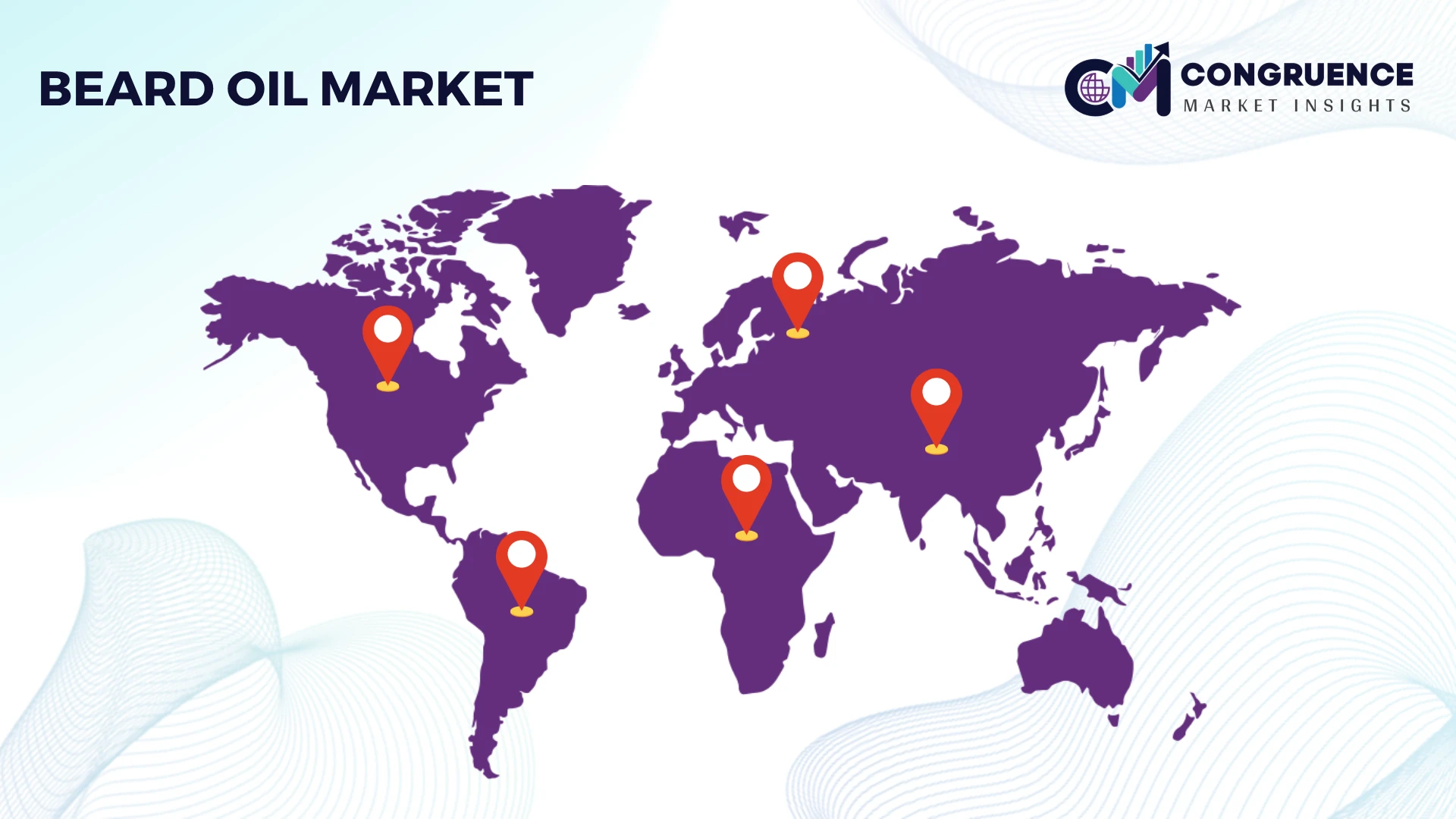
North America accounted for the largest market share at 35.78% in 2025 however, Asia-Pacific is expected to register the fastest growth, expanding at a CAGR of 9.78% between 2026 and 2033.
Premiumization and Digital Grooming Reshape Category Economics
North America remains the largest beard oil market, supported by high spending on premium men's grooming, established specialty retail, and sophisticated direct-to-consumer distribution. The United States represents approximately 87% of North American men's grooming demand, giving brands a concentrated launch platform for premium beard oils, multifunctional formulas, and subscription-based replenishment. Product differentiation is increasingly centered on natural oils, skin-conditioning benefits, fragrance sophistication, and lightweight formulations rather than basic beard softening. Online discovery and influencer-led grooming content are strengthening trial while established retailers retain substantial shelf visibility. In 2026, brands are increasingly combining beard oils with trimmers, balms, washes, and skincare to raise basket value. The commercial implication is clear: companies with strong digital acquisition capabilities and broad men's-grooming portfolios have greater leverage than standalone oil specialists.
United States Market Outlook: The United States is the region's strategic anchor, combining the deepest premium-grooming consumer base with extensive specialty retail, e-commerce infrastructure, and contract manufacturing capabilities. Its approximately 87% contribution to North American men's grooming value gives suppliers an efficient market for national product launches and rapid formulation testing. Premium natural beard oils increasingly command a 30%–45% price premium over conventional alternatives, encouraging brands to invest in botanical blends, skin-compatible formulations, and higher-margin multifunctional products.
Regulatory Rigor Accelerates Natural and Premium Formulations
Europe represents a mature beard oil environment where formulation compliance, natural ingredients, and premium positioning increasingly determine competitive differentiation. Germany, the United Kingdom, France, and Nordic markets form the principal demand centers, while Germany accounts for approximately 20.7% of European men's grooming expenditure. EU cosmetic requirements continue to push manufacturers toward tighter ingredient documentation, safety assessment, and formulation discipline. This environment favors companies capable of maintaining consistent botanical quality while meeting stringent labeling and product-safety requirements. Premium fragrance and skin-conditioning benefits are gaining importance alongside traditional beard maintenance, particularly in Germany and France. Companies are responding through certified natural formulations, localized product adaptation, and stronger pharmacy, specialty-retail, and digital distribution strategies.
Germany Market Outlook: Germany is Europe's most strategically significant country, supported by a large men's-grooming consumer base, strong drugstore distribution, and high acceptance of established and premium personal-care brands. Men's grooming sales reached approximately EUR 3.3 billion in 2025, rising 6% year over year. For beard-oil suppliers, Germany provides a strong platform for natural formulations, premium packaging, and fragrance-led innovation, while its sophisticated retail infrastructure supports rapid national distribution.
India-Led Grooming Expansion Creates New Volume Pools
Asia-Pacific is the fastest-expanding beard oil market, supported by rising male grooming participation, expanding digital commerce, local beauty entrepreneurship, and increasing acceptance of natural and herbal formulations. India is the principal strategic growth engine as younger consumers increasingly treat grooming as self-expression rather than a purely functional routine. The region also benefits from lower historical penetration, creating greater headroom than mature North American and European markets. Approximately 31.4% share was attributed to the broader beard-oil and hair-oil category in Asia-Pacific in 2025, highlighting the region's scale potential. Companies are responding through localized fragrances, ayurvedic and botanical positioning, smaller affordable packs, marketplace expansion, and partnerships with digital-first grooming brands.
India Market Outlook: India combines a large young male consumer base, rapidly expanding digital commerce, and strong domestic formulation capabilities. Investment interest in men's grooming has increased as major FMCG groups pursue acquisitions, partnerships, and portfolio extensions. Local brands are using botanical ingredients, culturally relevant fragrances, and accessible price points to penetrate beyond metropolitan markets. The country's strategic advantage is its ability to combine high-volume mass products with premium digital-native offerings, creating a broad addressable market for beard oil suppliers.
Brazil Drives Premium Grooming Through Localized Formulation
South America is anchored by Brazil, where a strong grooming culture, tropical climate, and developed beauty-product ecosystem support beard-care adoption. Local brands benefit from familiarity with regional hair and skin characteristics, while imported premium products compete through fragrance, packaging, and ingredient sophistication. Brazil's established cosmetics manufacturing base provides an important advantage for localized beard-oil production and rapid product adaptation. Demand is increasingly shifting toward lightweight, non-greasy oils suited to warmer climates, creating differentiation from heavier formulations traditionally designed for temperate markets. Companies are expanding through barbershop partnerships, specialty grooming stores, social-commerce channels, and locally sourced botanical ingredients. The principal execution constraint is uneven premium-product penetration outside major urban centers, making tiered packaging and price architecture important for broader market coverage.
Brazil Market Outlook: Brazil is the region's most strategically significant market because of its mature beauty and personal-care manufacturing ecosystem and extensive consumer acceptance of male grooming. Local producers can formulate oils around tropical-use requirements, emphasizing rapid absorption, lightweight textures, and botanical ingredients. The country's established cosmetics supply chain also supports shorter product-development cycles and localized packaging. Companies targeting Brazil are increasingly balancing premium beard oils with smaller pack sizes and digitally promoted entry products to extend penetration beyond major metropolitan consumers.
Premium Grooming and Barber Culture Expand Category Reach
Middle East & Africa demand is increasingly concentrated in affluent urban markets where premium men's grooming, fragrance culture, and professional barbering support higher-value beard-care purchases. Gulf markets, particularly Saudi Arabia and the United Arab Emirates, provide the strongest commercial platforms because of established luxury-grooming consumption and modern retail infrastructure. Beard oils with oud, sandalwood, amber, and other regionally resonant fragrance profiles offer greater differentiation than standardized Western formulations. Companies are combining premium packaging with botanical conditioning benefits and expanding through barbershops, specialty retailers, and e-commerce. The region remains operationally diverse, however, with purchasing power and modern retail penetration varying sharply between Gulf markets and African economies. This makes localized pricing, distributor partnerships, and climate-specific formulations critical to scaling beyond premium urban consumers.
Saudi Arabia Market Outlook: Saudi Arabia offers the strongest strategic platform in the region because of its large young population, established fragrance culture, expanding premium retail infrastructure, and rapidly modernizing men's grooming ecosystem. Beard-care products benefit from cultural familiarity with facial-hair grooming, while premium fragrances create opportunities for differentiated oil blends using oud, amber, sandalwood, and botanical notes. Companies can leverage Saudi Arabia as a Gulf launch market before expanding through regional distributors into neighboring high-income markets.
The competitive field pits global FMCG leaders such as Procter & Gamble, L’Oréal and Unilever against specialist DTC brands including Beardbrand, Honest Amish and Viking Revolution. Global players compete through distribution, portfolio breadth and scale, while specialists win through ingredient credibility, community marketing and rapid iteration. The top five players collectively account for approximately 21.4% of the beard-grooming market, leaving substantial share for regional brands. Competition is increasingly driven by formulation differentiation: clean or natural ingredients influence 67% of surveyed buyers, versus 48% for brand recognition and 31% for price. DTC specialists gain speed advantages, testing launches online before retail expansion. Large players counter through premium extensions, acquisitions, partnerships and bundles, while regional brands localize fragrances and botanical formulations. The competitive shift favors brands combining digital acquisition with scalable supply chains. Entry remains easy, but sustained differentiation, compliant formulation, repeat-purchase economics and channel reach determine winners in this fragmented category.
Procter & Gamble Co.
L’Oréal S.A.
Unilever PLC
Marico Limited (Beardo)
Honest Amish LLC
Beardbrand Inc.
Viking Revolution LLC
Scotch Porter LLC
Bossman Brands Inc.
Mountaineer Brand Products
Grave Before Shave
Seven Potions Ltd.
Reuzel USA, Inc.
Murdock London Ltd.
AI-assisted formulation is becoming relevant to beard oil development through ingredient screening, formulation optimization, consumer preference analysis, and rapid concept generation. GenAI-supported formulation workflows can reduce new-product research from weeks to days and lower raw-material costs by up to 5%. Digital recommendation engines are also improving product matching across beard density, skin type, fragrance preference, and climate, giving DTC brands a measurable personalization advantage.
Cold-process extraction, precision blending, and standardized botanical processing are strengthening natural-oil consistency while reducing batch variability. Compared with conventional manual formulation workflows, digitally supported process control can improve formulation iteration efficiency by approximately 20%–30%. Adoption remains concentrated among premium and digitally native brands, but contract manufacturers are increasingly incorporating automated dosing and quality-control systems. This benefits brands seeking scalable natural formulations without losing premium positioning.
From 2026–2028, AI-enabled demand forecasting, personalized product selection, traceability systems, and refill-oriented packaging will become more commercially relevant. Digital traceability can reduce inventory discrepancies by roughly 5%–10%, while modular formulation platforms allow brands to introduce localized fragrance or botanical variants without creating entirely separate production systems. Global FMCG companies benefit from scale and supply-chain integration; specialist brands benefit from faster experimentation. The competitive priority is therefore shifting toward technology-enabled customization that preserves manufacturing efficiency and regulatory consistency.
August 2024 Emami Limited acquired full ownership of The Man Company for $19.57 million, strengthening its premium men's grooming portfolio and expanding distribution capabilities across India. The transaction consolidated localized beard-care positioning within a larger FMCG platform, increasing cross-category commercialization potential. Source: economictimes.indiatimes.com
February 2025 Edgewell Personal Care reported 4.5% net-sales growth in Sun and Skin Care, with grooming led by Cremo and Billie. The company emphasized consumer-led, locally designed innovation, strengthening product-development speed and supporting broader grooming distribution across the United States and Europe. Source: ir.edgewell.com
May 2025 Procter & Gamble’s Old Spice became a sponsor of Spain’s national football team ahead of the 2026 World Cup. The partnership expanded brand visibility across a major sporting platform, connecting men’s grooming with international football audiences and strengthening premium fragrance-led brand engagement. Source: pg.com
August 2025 Edgewell reported that international markets represented 40% of global sales, while Bulldog expanded premium skincare across Europe and Cremo broadened its range in the United States and Europe. The strategy strengthened localized innovation and international grooming distribution. Source: Edgewell Personal Care. (Edgewell Investors)
The Beard Oil Market Report evaluates the industry across conventional and organic formulations, beard maintenance and growth applications, individual consumers, professional grooming establishments, salons, and barbershops. Coverage spans North America, Europe, Asia-Pacific, South America, and Middle East & Africa, with country-level assessment of major demand centers including the United States, Germany, India, Brazil, and Saudi Arabia. The report examines premiumization, clean-label positioning, multifunctional formulations, digital commerce, professional grooming channels, and emerging personalized beard-care products.
Quantitative analysis covers segment shares, channel penetration, adoption patterns, product-positioning shifts, competitive participation, and regional demand concentration. Strategic assessment evaluates formulation innovation, botanical sourcing, packaging optimization, DTC economics, retail expansion, partnerships, and brand differentiation. The report supports investment planning, market-entry decisions, product portfolio development, geographic expansion, competitive benchmarking, and positioning priorities through 2026–2033.
| Report Attribute/Metric | Report Details |
|---|---|
|
Market Revenue in 2025 |
USD 1,057.3 Million |
|
Market Revenue in 2033 |
USD 1,697.9 Million |
|
CAGR (2026 - 2033) |
6.1% |
|
Base Year |
2025 |
|
Forecast Period |
2026 - 2033 |
|
Historic Period |
2021 - 2025 |
|
Segments Covered |
By Type
By Application
By End-User
|
|
Key Report Deliverable |
Revenue Forecast, Growth Trends, Market Dynamics, Segmental Overview, Regional and Country-wise Analysis, Competition Landscape |
|
Region Covered |
North America, Europe, Asia-Pacific, South America, Middle East, Africa |
|
Key Players Analyzed |
Procter & Gamble Co., L’Oréal S.A., Unilever PLC, Marico Limited (Beardo), Honest Amish LLC, Beardbrand Inc., Viking Revolution LLC, Scotch Porter LLC, Bossman Brands Inc., Mountaineer Brand Products, Grave Before Shave, Seven Potions Ltd., Reuzel USA, Inc., Murdock London Ltd. |
|
Customization & Pricing |
Available on Request (10% Customization is Free) |




